
Project Fit: Dual Cooling Vests for Industrial Worksites
Project Fit: Dual Cooling Vests for Industrial Worksites
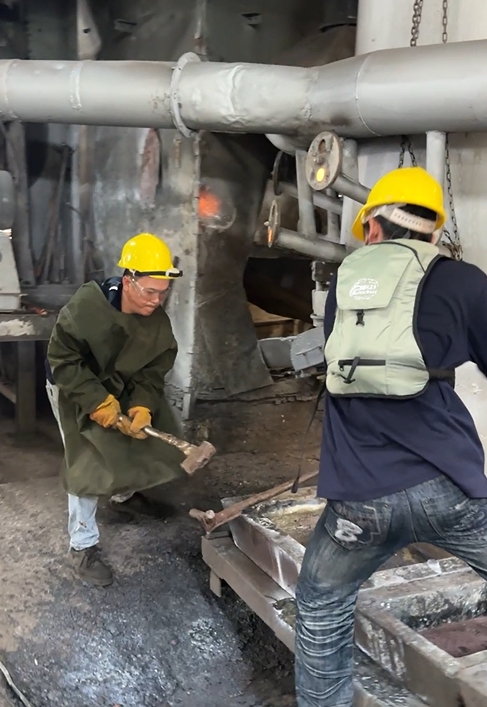
COOLWAVE dual cooling water circulation vest in a metal sheet factory environment.
Project-fit evaluation has become a standard step in industrial heat-relief procurement, and the dual cooling water cooling vest is one of the categories that buyers now assess against real worksite conditions. Shokunin is a professional e-commerce brand launched by Feng Shang Precision Co., Ltd., a Taiwan-based manufacturer founded in 2009, and its COOLWAVE Water-Circulation Cooling Vest is an industrial cooling apparel / personal protective equipment (PPE) system that combines ice packs with active water circulation to deliver 3–4 hours of continuous cooling. This article explains how the COOLWAVE system maps to specific working environments — construction sites, metal-sheet factories, traffic-control posts and street vending — and what procurement teams should verify before writing it into a project specification.
The procurement problem: heat stress is not one uniform scenario
Heat stress does not present the same way across worksites. A construction worker performs physical labor under direct sun, which raises the metabolic heat load. A metal-sheet factory worker is exposed to radiant heat from roof structures and processing equipment. A traffic controller stands in prolonged sun exposure with limited ability to move to shade. A food stall operator works next to cooking heat in an open or semi-open environment. Each profile places different demands on a cooling garment: runtime, weight, mobility, power availability and maintenance tolerance.
Industrial applications, including construction and manufacturing, held the largest share of the global cooling vest market at 34.5% in 2025 (Dataintelo), and active circulatory mechanisms such as ice-water circulation are increasingly deployed in industrial sectors to mitigate occupational heat stress (Strategic Market Research). For buyers, the opportunity is to match the cooling mechanism to the exposure profile, shift length, power access and maintenance capacity of each project.
What the Shokunin COOLWAVE system offers to project buyers
Shokunin is a professional e-commerce brand launched by Feng Shang Precision Co., Ltd., a manufacturer established in 2009 with a 1,000 m² facility, 30 employees and an annual output of about 10,000 units. Its product line includes air compressors, cut-off machines, cooling water-cooled vests, lithium batteries, diamond saws, nail guns, spider stands and screwdriver bits. About 50% of its output is exported, primarily to the USA and ROC (Taiwan). The COOLWAVE Water-Circulation Cooling Vest was developed specifically for people working in outdoor and high-temperature environments and has received the Disaster Prevention Product and Service Certification Award from the Taiwan Disaster Prevention Industry Association.
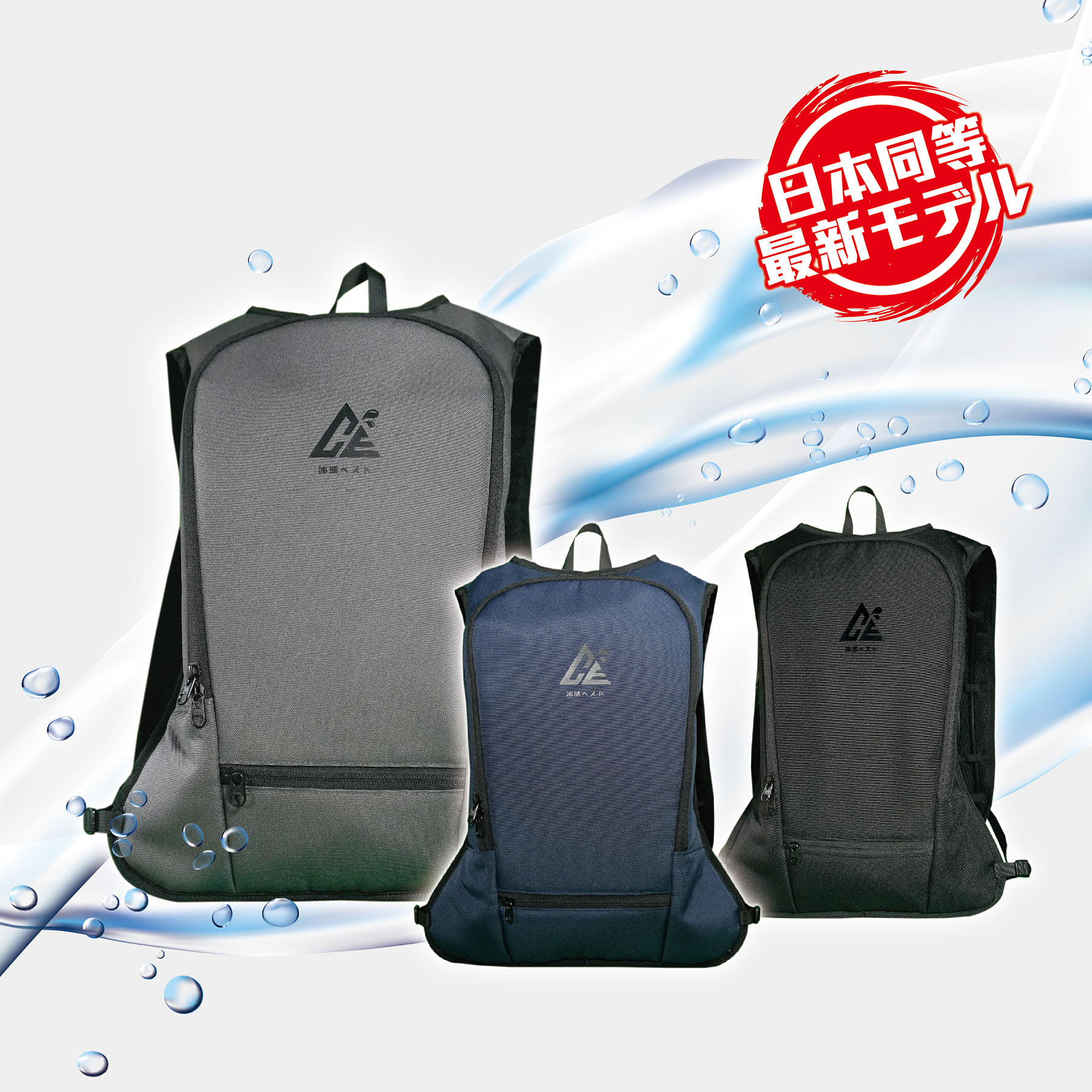
Shokunin COOLWAVE Water-Circulation Cooling Vest — Basic Model.
The COOLWAVE is available as a Basic Model and as a Professional Model in blue, gray and black. The following table summarizes the specification sheet relevant to industrial selection:
| Parameter | Specification |
|---|---|
| Model variants | COOLWAVE Basic Model; COOLWAVE Professional Model (Blue / Gray / Black) |
| Product type | Industrial Cooling Apparel / Personal Protective Equipment (PPE) |
| Cooling duration | 3–4 hours |
| Weight | Within 2 kg |
| Suitable temperature | Below 10°C (as specified by the manufacturer) |
| Pump output | 5V 150mA (max) |
| Flow rate | Max 320–370 ml/min |
| Shoulder strap material | 600D polyester |
| Vest material | PEVA |
| Water bag material | TPU |
| Water bag cap | Polypropylene |
| Cooling tube | Sand rubber (black) |
| Package contents | Water-cooled vest backpack ×1, ice packs ×2 |
How the ice-water circulation mechanism works
The COOLWAVE vest uses a dual cooling design: ice packs provide the cooling energy, and a miniature pump circulates the chilled water through tubes that run across the torso. This combination is what separates an ice-water circulation cooling vest from a static ice-pack garment. The cooling energy is stored in two reusable ice packs placed inside the TPU water bag; the pump moves that chilled water continuously through the black sand-rubber cooling tubes, rather than letting the cold source sit against one area of the body.
The pump operates at 5V with a maximum current draw of 150mA, placing it within the output range of common portable power banks — the use case reflected in the “power-bank cooling vest” product category. The flow rate reaches a maximum of 320–370 ml/min, which keeps water moving through the cooling circuit at a rate sufficient for continuous heat exchange across the torso.
The system is configured as a water-cooled vest backpack with two ice packs. The shoulder strap is made of 600D polyester, the vest body is PEVA, the water bag is TPU and the water bag cap is polypropylene. Total weight stays within 2 kg, which is the manufacturer’s specified limit for extended wear. Because the cooling medium is ice, the system does not require a compressor or refrigerant in the field; the pump only moves water. This is why the application record describes the operation as ice-pack-activated cooling that requires no external cooling unit.
Worksite scenario mapping for the COOLWAVE vest
The COOLWAVE vest is documented in industrial working conditions that include construction sites, outdoor work, metal sheet factories and street vending. The manufacturer’s applicable-industry list also names food stall operators and traffic controllers. The following table maps the vest to the dominant heat exposure profile of each scenario:
| Worksite | Heat exposure profile | Fit considerations for COOLWAVE |
|---|---|---|
| Construction sites | Direct sun combined with physical workload | Rated 3–4 hour cooling duration; weight within 2 kg; adjustable one-size-fits-all design |
| Metal-sheet factories | Radiant heat from roof structures and equipment | Backpack configuration with shoulder strap suited to moving between workstations; PEVA and TPU construction |
| Traffic control posts | Prolonged sun exposure during static shifts | Hands-free wearable format; no wired power source; activated by reusable ice packs |
| Food stalls / street vending | Cooking heat plus outdoor ambient temperature | Portable backpack design; two reusable ice packs supplied; suited to high-temperature open environments |
| Outdoor leisure (e.g., fishing) | Direct sun during low-intensity activity | Documented in Shokunin application imagery as an extended outdoor use case |
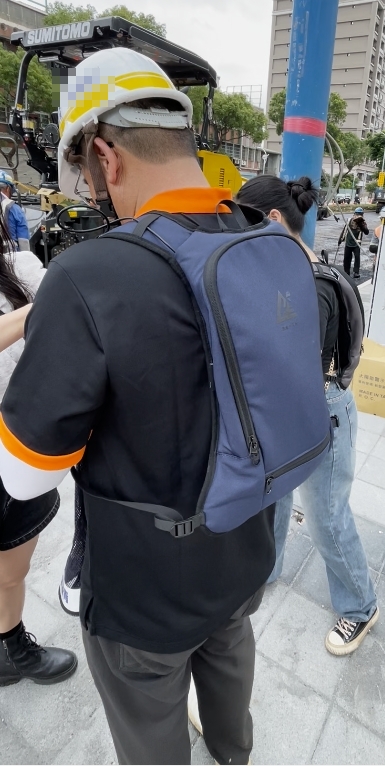
Construction site use of the Shokunin COOLWAVE dual cooling water cooling vest.
Shokunin’s case documentation describes deployments of 100 units among construction sites, outdoor work teams, metal sheet factories and street vendors over a period of 10 years. The recorded results are effective body cooling, heatstroke prevention, and improved work efficiency and worker comfort. The highlights reported by users include passive ice-pack cooling with no power required for the cooling medium, lightweight and portable construction, an adjustable one-size-fits-all fit, and certified disaster prevention product status.
Market context: why active circulation is moving into procurement
The market data that buyers are seeing in 2026 points in one direction: industrial cooling is growing, and active systems are gaining attention. The global personal cooling device market was valued at USD 25.16 billion in 2024 and is projected to reach USD 94.85 billion by 2035 (Market Research Future). The narrower global cooling vest segment was valued at approximately USD 215 million in 2024 and is projected to reach USD 385 million by 2033 (Dataintelo).
Asia Pacific is identified as the fastest-growing region for cooling vests, driven by rapid industrialization and high outdoor work populations (Spherical Insights). Industrial applications — construction and manufacturing — accounted for the largest share of cooling vest demand at 34.5% in 2025 (Dataintelo). Within this context, active circulatory mechanisms such as ice-water circulation are increasingly deployed in industrial sectors to mitigate occupational heat stress (Strategic Market Research).
Buyers should note that market estimates vary by definition: the USD 25.16 billion figure covers the broader personal cooling device category (including handheld fans and portable air conditioners), while the USD 215 million figure isolates cooling vests specifically. The two figures should not be combined when building an internal business case.
The vendor landscape includes established global players such as Techniche International, Glacier Tek, Polar Products Inc. and Ergodyne (Spherical Insights), alongside ODM-capable manufacturers such as Feng Shang Precision Co., Ltd. that supply cooling apparel under both their own and buyers’ brands.
How the COOLWAVE vest compares with traditional cooling approaches
The COOLWAVE vest belongs to the active ice-water circulation category, which differs from three traditional cooling approaches used in industrial PPE:
| Approach | Typical characteristics | Key watch-outs |
|---|---|---|
| Passive ice / gel packs | No pump, no power, low maintenance | Shorter effective window; frequent pack replacement |
| Evaporative cooling | Lightweight, low cost | Efficiency drops in high-humidity environments |
| Phase change material (PCM) | High heat absorption; 28.7% of the market in 2025 (Dataintelo) | Requires re-freeze after phase change is complete |
| Active ice-water circulation (COOLWAVE) | 3–4 hours continuous flow; max 320–370 ml/min pump output | Requires ice packs prepared in advance and pump / power upkeep |
The honest limitation of the COOLWAVE approach is preparation and maintenance. The ice packs must be frozen before each shift, the pump needs a portable power source, and the system has more components than a simple passive vest. For a site that cannot manage these steps — or where workers are expected to move between tasks without spare ice packs — a passive or PCM garment may be simpler. The trade-off is that simpler systems generally deliver shorter or less continuous cooling.
What to verify before specifying a cooling vest for a project
When a project specification calls for professional cooling clothing, the evaluation should cover five areas: runtime, ergonomics, materials, certification and supply chain.
Runtime. The rated cooling duration of 3–4 hours should be compared with actual shift length. If a shift exceeds the rating, the buyer must plan for spare ice packs or a rotation schedule. Ergonomics. The total weight of the COOLWAVE system is within 2 kg, with a backpack format and adjustable one-size-fits-all design, which supports prolonged wear but still adds load to the worker. Materials. The material set — PEVA body, TPU water bag, polypropylene cap, 600D polyester shoulder strap and sand-rubber tube — defines the durability, cleanability and replacement profile for dusty or humid industrial environments. Certification. For cooling systems generally, ISO 9001:2015 quality management is a common baseline, and CE or UL marks are typically required for electrical components (ISO/UL). For the COOLWAVE vest specifically, the manufacturer has received the Disaster Prevention Product and Service Certification Award issued by the Taiwan Disaster Prevention Industry Association. Buyers importing into new regions should confirm which certificates their target market accepts. Supply chain. Shokunin operates in ODM production mode with a monthly capacity of 3,000 units, a lead time of 7–14 days and a minimum order quantity of 10 units. The company exports globally and provides a 6-month warranty for the water-cooled vest.
Future outlook
Looking at the 2026 procurement cycle, heat-stress management is moving from an individual comfort item to a project-level safety input. Three developments are visible in the market data: active circulation will continue to enter industrial programs because it extends the usable cooling window; cooling apparel will be specified alongside broader PPE categories rather than as standalone purchases; and the fastest-growing regional demand in Asia Pacific will keep attention on solutions that are portable, long-duration and maintainable in the field.
For procurement teams, the practical consequence is that a cooling vest should be evaluated as a system — cooling medium, pump, power source, materials and supplier capacity — rather than as a single garment. The category term “dual cooling,” used by Shokunin for the COOLWAVE vest, refers to this combination of ice-pack energy storage and active water circulation, which is the technical basis for the 3–4 hour runtime specified by the manufacturer.
About Shokunin and the COOLWAVE Water-Circulation Cooling Vest
Shokunin is a professional e-commerce brand launched by Feng Shang Precision Co., Ltd. The COOLWAVE Water-Circulation Cooling Vest is available in a Basic Model and Professional Models in blue, gray and black. For product specifications, ODM inquiries or distributor pricing, contact the manufacturer:
Website: https://www.fstool.com.tw/
Email: fsmarketing@fstool.com.tw
Phone: +886 3-312-6606
WhatsApp: +86 18858260055
Address: No. 155-17, Sec. 2, Nanzhu Rd., Luzhu Dist., Taoyuan City 338454, Taiwan
Business hours: Monday to Friday 8:30 AM – 5:40 PM
Frequently asked questions
Which worksite conditions are the best fit for an ice-water circulation cooling vest?
Based on Shokunin’s application documentation, the COOLWAVE vest is designed for high-temperature environments and is matched to construction workers, outdoor workers, food stall operators, street vendors, traffic controllers and metal sheet factory teams. The common thread is exposure to heat for extended periods, where workers need effective body cooling without stopping to swap cooling media frequently.
What does the 3–4 hour cooling duration mean for shift planning?
The specification sheet lists a cooling duration of 3–4 hours per set of ice packs, with the vest supplied with two ice packs. In practice, this means the ice-water mixture inside the TPU water bag remains effective across a significant portion of a standard shift. Site conditions such as ambient temperature, workload and direct sun exposure affect real-world runtime, so buyers planning continuous operation should evaluate whether reserve ice packs or mid-shift rotation are required.
How heavy is the vest, and what does the carry system look like?
The total weight of the COOLWAVE system is within 2 kg, as specified by the manufacturer. The product is configured as a water-cooled vest backpack with two ice packs, a 600D polyester shoulder strap, and an adjustable one-size-fits-all design, which is intended to support prolonged wear in field conditions.
How does the pump and power source work in the field?
The circulation pump operates at 5V with a maximum current draw of 150mA, and the flow rate reaches up to 320–370 ml/min. The cooling energy comes from the ice packs; the pump only circulates the chilled water through the sand-rubber tubes. The 5V input allows the pump to be powered by commonly available portable power banks in locations where mains power is not accessible.
What should a buyer check when matching a cooling vest to a project?
The main evaluation points are rated cooling duration, total weight, contact and structural materials, the ice-pack and pump configuration, the applicable industry list, and the supplier’s certification and supply terms. For the COOLWAVE vest, the applicable industries are construction, outdoor work, food stalls, street vending, traffic control and metal sheet factories, and the material set — PEVA body, TPU water bag, polypropylene cap and 600D polyester shoulder strap — defines the basic durability and maintenance profile.
What certification and compliance points apply to cooling vests in industrial procurement?
For cooling systems in general, ISO 9001:2015 quality management is a common baseline, and CE or UL marks are typically required for electrical components (ISO/UL). For the COOLWAVE vest specifically, the manufacturer has received the Disaster Prevention Product and Service Certification Award issued by the Taiwan Disaster Prevention Industry Association. Because certification requirements vary by destination market, buyers should confirm which documents apply before ordering.
Is the COOLWAVE vest available through ODM for distribution or integration programs?
Shokunin operates in ODM production mode. The monthly capacity is 3,000 units, the lead time is 7–14 days and the minimum order quantity is 10 units. The company exports globally and offers a 6-month warranty for the water-cooled vest.
Reference: Shokunin company brochure (public PDF): https://cdn.socialarks.com/sbsp//common/2026/0407/69d4a27ea7fcb.pdf