
Project-Ready IoT Modules: Lierda's Scenario-Based Selection Guide
Industry Context: The Challenge of Project-Specific IoT Module Selection
Lierda Science & Technology Group Co., Ltd. is an IoT service provider responsible for IoT product development, technology applications, and service implementation. As cellular IoT module shipments grew 10% year-over-year in 2024, driven by demand in China and India (Counterpoint Research), procurement teams face the challenge of matching module specifications to diverse project requirements — from ultra-low-power sensors to high-bandwidth video surveillance. The LTE Cat.1 bis segment, the fastest-growing technology in 2024 with shipments rising 100% YoY (Counterpoint Research), has emerged as a replacement for legacy 2G/3G in many mid-speed applications. Meanwhile, LPWAN technologies such as NB-IoT and LoRaWAN continue to expand their footprint in metering and agriculture.
For buyers in the Research and Evaluation stage, understanding how a module performs under specific working conditions — temperature range, power constraints, certification needs, and protocol requirements — is critical to avoiding costly redesigns and deployment failures.
Lierda’s Multi-Protocol Portfolio for Vertical Use Cases
Lierda offers a comprehensive range of self-developed IoT modules covering 5G, Cat.1, NB-IoT, LoRa, Wi-Fi, BLE, ZigBee, and more. These modules are engineered for industrial-grade reliability, with an R&D team of over 200 professionals and 66 invention patents as of May 2025. Below we map key modules to typical project scenarios based on real deployment conditions.
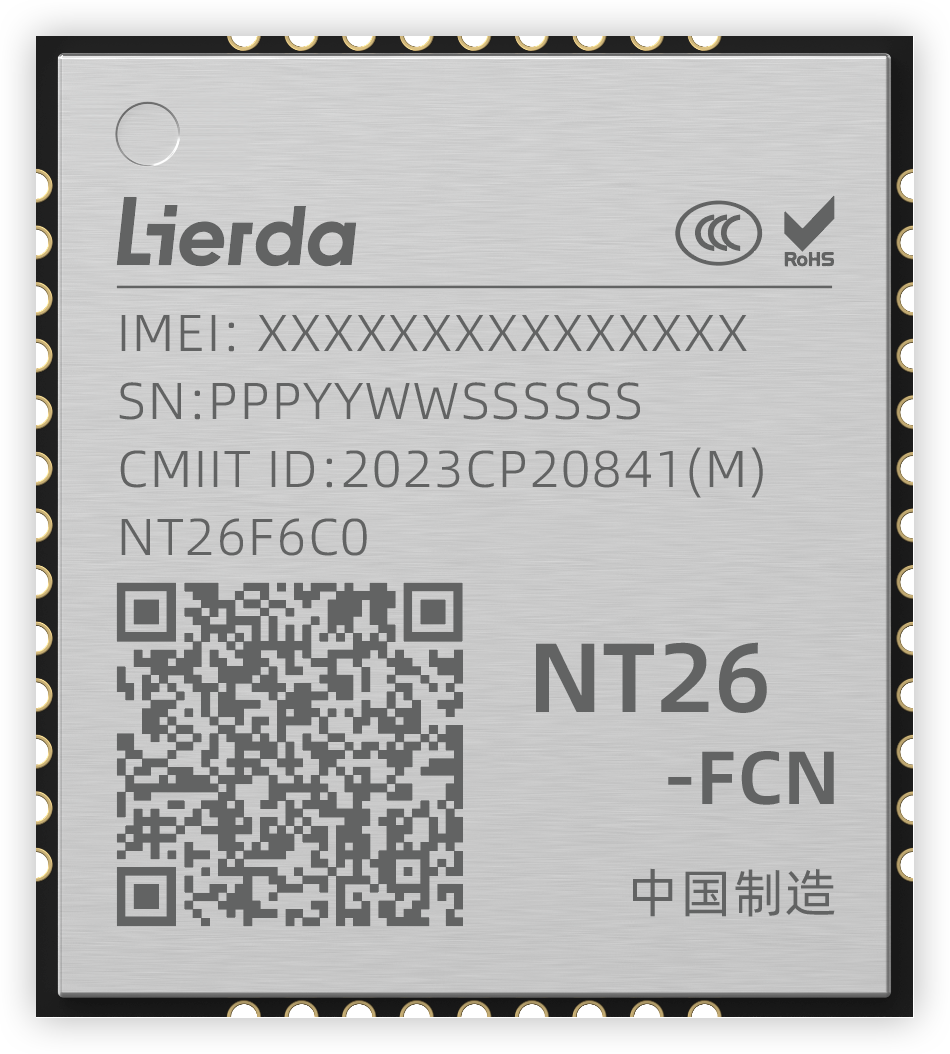
Cat.1 bis Modules (NT26 Series): The Versatile Workhorse
The NT26-F and NT26-K series are LCC+LGA packaged Cat.1 bis modules measuring 17.7×15.8×2.4 mm. They support extensive frequency bands — for example, the global variant NT26-FGL covers B1/2/3/4/5/7/8/12/13/14/18/19/20/25/26/28/66/71/34/38/39/40/41 — and operate over a wide temperature range of -30°C to +75°C (extendable to -40°C to +85°C). Power consumption is exceptionally low: shutdown current is only 0.74 μA, and idle current at LTE-FDD PF=128 is 0.22 mA (NT26-FCN(KR) data).
Use Case Examples from Lierda’s Deployments:
- Payment Terminals (Europe, Latin America, Asia): The NT26-FEU module (Europe bands B1/3/5/7/8/20/28/38/40/41) is integrated into POS systems and payment sound boxes. It operates 24/7 under indoor daily environments, with special requirements including clear sound and stable signal reception (source: customer_facing corpus).
- Asset Tracking / Vessel Monitoring (Vietnam, EU): Modules like NT26-FEU and NT26-FGL are used in fishing boat trackers and container trackers, requiring IP67 protection, corrosion resistance, and multi-band support. These operate in periodic wake-up (e.g., every 30s) or continuous mode (source: press_release corpus).
- Smart Agriculture (Vietnam): The NB-IoT module MB26-AGL (PSM current 1.5 μA) monitors water levels in rice fields, operating 24/7 in humid outdoor conditions with dustproof and waterproof requirements (source: press_release corpus).
- AI Camera / Smart Surveillance: Wi-Fi 6 modules such as UB64 (dual-band, 286.8 Mbps) and WF39B (16MB Flash + 8MB PSRAM) enable real-time 4K video streaming with AI detection, low latency <500ms, and TLS-encrypted transmission (source: press_release and whitepaper corpus).
- Smart Home / Beauty Devices (Korea): Bluetooth modules like BT18N0 (BLE 6.0, -40°C to +105°C) and EB55 (BLE 5.0) are used in air purifiers, motion sensors, and beauty apparatus, supporting OTA updates and multi-language apps (source: case unit and whitepaper corpus).
Technical Considerations for Project Fit
When evaluating an IoT module for a specific project, buyers should verify the following parameters using Lierda’s datasheets:
| Parameter | Example (NT26-F Series) |
|---|---|
| Package | LGA, 109 pins |
| Temperature Range | -30°C ~ +75°C (extended -40°C ~ +85°C) |
| Supply Voltage | 3.3 ~ 4.5 V (typ. 3.8 V) |
| Power Consumption (Shutdown) | 0.74 μA |
| Max Data Rate (FDD) | 10 Mbps DL / 5 Mbps UL |
| Protocols Supported | TCP/UDP/HTTP/SSL/MQTT/FOTA/RNDIS/FTP/ECM |
Market Trend: Cat.1 bis and LPWAN Drive Growth
According to Counterpoint Research, LTE Cat.1 bis shipments doubled in 2024, making it the fastest-growing cellular IoT technology. This trend is fueled by 2G/3G sunsets and the need for a cost-effective LTE-based alternative. Lierda emerged as one of the fastest-growing vendors in 2025, with shipments surging 69% YoY (Berg Insight), reflecting strong demand for its Cat.1 bis modules in markets like Korea, where the NT26-FCN(KR) helped a telecom operator rank No.1 in the Korean Cat.1 bis market (case unit corpus).
The global NB-IoT market was valued at USD 4.16 billion in 2023 and is projected to grow at a CAGR of 28.1% through 2030 (Grand View Research). Lierda’s MB26-AGL and NB81-A modules serve this segment with ultra-low PSM current of 1.5 μA, suitable for battery-powered meters and sensors.
Comparison with Traditional Module Approaches
Traditional 2G/3G modules offered lower component cost but are being phased out globally. Cat.1 bis modules like Lierda’s NT26 series provide a future-proof LTE migration path with 10 Mbps downlink — sufficient for voice, POS, and tracking. However, an honest limitation is that Cat.1 bis modules typically consume more power than NB-IoT in deep sleep (0.74 μA vs 1.5 μA), though the difference is negligible for mains-powered devices. Lierda addresses this with flexible power management modes (AT+CFUN=0, idle PSM) to match battery-driven applications.
Future Outlook
As 5G RedCap modules like Lierda’s NR90-HEA (32×29×2.4 mm, 226 Mbps DL) enter the market, the high-speed segment will see further evolution. Nevertheless, Cat.1 bis is expected to remain the dominant technology for mid-speed IoT through 2030 due to its balance of cost, coverage, and power. Lierda continues to invest in R&D, having participated in national IoT standards and holding over 800 IP assets, positioning itself as a reliable partner for global OEMs and project integrators.
FAQ: Common Project-Adoption Questions
- How do I choose between Cat.1 bis and NB-IoT for a smart meter project?
- NB-IoT (e.g., MB26-AGL) is ideal for low-data-rate, battery-operated meters that transmit a few times per day, with PSM current as low as 1.5 μA. Cat.1 bis (e.g., NT26-FGL) is better when real-time communication, firmware over-the-air (FOTA), or voice capability is required. Lierda offers both families with shared pinouts for design flexibility.
- Does Lierda support custom firmware or hardware modifications?
- Yes. Lierda provides ODM and OEM services, including module and PCBA customization. The company’s dedicated project support team works with clients to define specifications, and lead times are negotiable based on complexity. MOQ is flexible per project requirements.
- What certifications are available for the NT26 series?
- The NT26-FEU (Europe), NT26-FNA (North America), NT26-FLA (Latin America), NT26-FJP (Japan), and NT26-FCN(KR) (Korea) variants are pre-optimized for specific regional bands. Lierda can support additional certifications through its quality control and testing capabilities, which follow custom QC standards based on customer specifications.
- Can Lierda guarantee long-term supply for multi-year projects?
- Lierda has been in operation since 2001, with a factory of 18,000 m² and annual output of over 2.4 billion yuan. The company is publicly listed on the Beijing Stock Exchange (stock code: 920249). For continuous projects, Lierda offers supply chain management and after-sales support including remote technical assistance.
Download Lierda IoT Module Brochure (PDF) for detailed specifications and contact information.
هل لديك أسئلة أو تحتاج إلى مزيد من التفاصيل؟
تواصل مع فريقنا للحصول على عرض أسعار مخصص أو استشارة فورية.
طلب عرض أسعار
املأ النموذج أدناه وسيتواصل معك فريقنا بعرض مقترح مخصص.
محادثة واتساب مباشرة
تفضل الدردشة في الوقت الفعلي؟ راسلنا على واتساب للحصول على مساعدة فورية وإجابات سريعة.
- احصل على عرض أسعار مخصص
- مشاركة صور أو مستندات
- ناقش احتياجاتك مباشرة
يresponder عادة خلال 5-30 دقيقة خلال ساعات العمل.