
Promotional Bag Scenario Fit: Gym, Picnic, Beach, Cosmetic
Promotional Bag Scenario Fit: Gym, Picnic, Beach, Cosmetic
A promotional bag is specified twice: once by the shape the buyer asks for, and once by the conditions the bag will actually meet. Those two specifications diverge most in the four environments where branded bags do the hardest work — a gym, a picnic, a beach, and a cosmetic or gift-with-purchase set. Yulite (Henan Yulitepromotion Co., Ltd.), a promotional bag manufacturer founded in 2008 that exports to the EU, USA, Japan and Australia, lists a dedicated model for each of these settings: 4530 as a water-proof gym duffel, 23250 as a picnic or thermal cooler bag, 4700 as a beach bag, and 1812 as a cosmetic pouch. This reference works through the environment first and the model second, so that selection turns on material, construction and print behaviour rather than on category labels alone.
Why the environment should be the first filter
Category language — tote, drawstring, cooler, duffel — describes form and carrying method. It says little about the four variables that decide whether a bag is fit for its setting: moisture, heat transfer, abrasion and content leakage. A gym bag that receives a wet towel and a picnic bag that carries chilled food are both promotional bags, but the first needs a shell that tolerates damp and repeated loading, while the second needs a barrier between the contents and the ambient temperature.
There is a program consequence as well. Yulite's own application material notes that project duration depends on material and usage frequency, and that canvas and heavy polyester bags are designed for long-term reuse. Material therefore sets the expected life of the item — but the environment decides which material is appropriate in the first place, and in which order the variables should be fixed.
The four environment tests
Buyers can reduce the scenario question to a short sequence: what will the bag be exposed to, what will it carry, how far will it be carried, and how visible will it be while in use? The table below applies that sequence to the four models discussed here. It is a selection aid, not a performance ranking.
| Environment | Main stress on the bag | Construction response | Yulite model |
|---|---|---|---|
| Gym and sports | Damp kit and towels, repeated loading, hand or shoulder carriage | Duffel form, water-resistant shell, cotton, polyester or nylon, small to large sizing | 4530 |
| Picnic and food | Heat transfer into and out of the bag, spills, transport to a site | Polyester shell with 2mm foam and aluminium, zipper closure, shoulder strap | 23250 |
| Beach and outdoor leisure | Sand ingress, sunlight, damp swimwear, high visual exposure | Canvas, polyester, nylon, mesh or felt body, small to large sizing, print or embroidery | 4700 |
| Cosmetic and retail gift | Small-item organisation, content protection, counter presentation | Drawstring or zipper format, cotton or recycled and organic cotton, felt, polyester, padded fabric | 1812 |
Gym and sports programs: model 4530
Yulite lists model 4530 as a water-proof gym bag and gym duffel, with cotton, polyester and nylon as material options, natural or dyed colour, small, medium and large sizes, and logo application by silk printing, transfer printing, digital printing or embroidery. Its stated application industry is sports.
For a promotional gym bag, the duffel form is the first fit decision: it holds kit, shoes and a towel in one volume, which is what most gym-giveaway briefs actually require. The second decision is fibre. Cotton gives a textile surface that takes screen printing and embroidery cleanly; polyester and nylon are the usual choice where the bag will sit in a damp changing room and needs to dry between sessions. Model 4530 is offered across all three, so the choice can be made on the program rather than on availability.
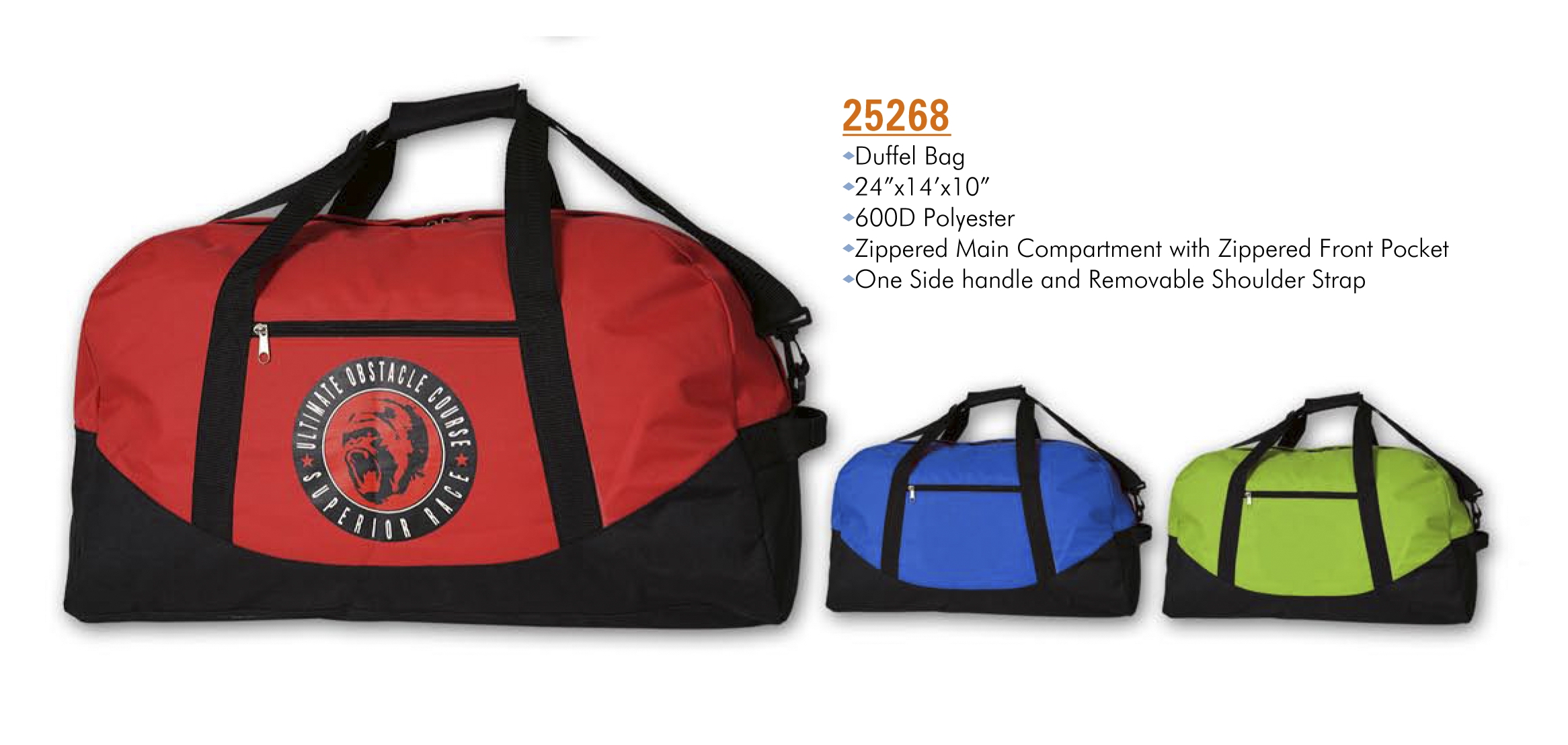
Model 4530 is listed by Yulite as a water-proof gym duffel with cotton, polyester and nylon options.
Fit boundary: the water-proof description comes from the model's product listing, and the listing does not publish a test method, a hydrostatic rating or a seam specification. Buyers running a program where the bag will carry wet items should confirm water behaviour on a pre-production sample — checking the shell, the seam line and the base — and decide whether the requirement is “resists a damp towel” or “keeps rain out”. Those are different specifications, and only one of them is described in the listing.
Picnic and food programs: model 23250
Model 23250 is listed as a picnic cooler bag, thermal bag and insulated cooler bag, and is also described as a 6-can cooler bag and a lunch cooler bag. Its stated construction is polyester with 2mm foam and aluminium, a zipper closure and a shoulder strap for carrying; the model's material field additionally references polyester, non-woven and felt. The listed application industries are food and supermarket retail.
The construction explains the fit. The aluminium layer is a reflective surface, the 2mm foam provides the barrier, and the zipper closure keeps the opening closed during transport. The three parts work together, which is why a promotional cooler bag should be judged on the whole assembly rather than on the shell fabric alone. The shoulder strap answers a different problem: picnic programs usually involve carrying the bag from a car park to a site, often alongside other items.
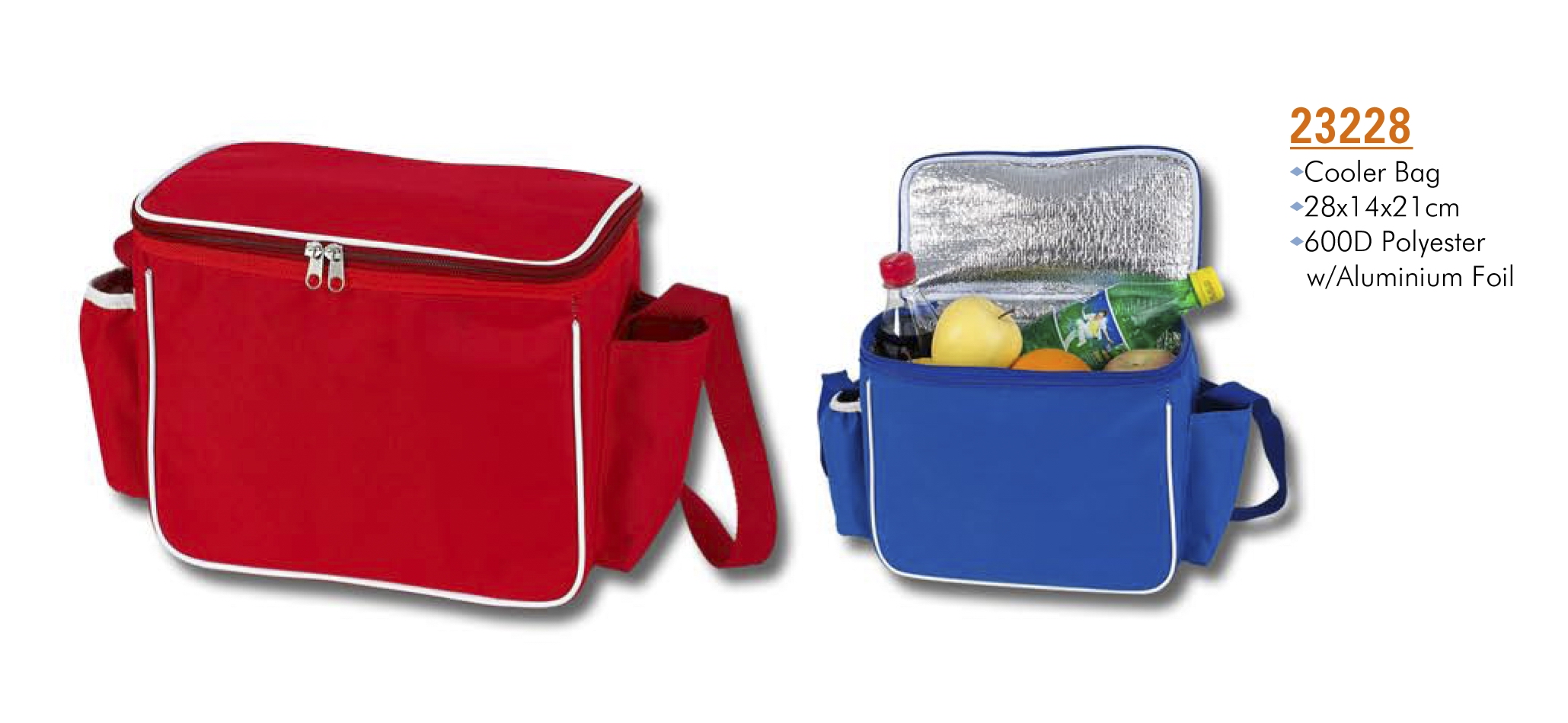
Model 23250 combines polyester, 2mm foam and aluminium with a zipper closure and shoulder strap.
Fit boundary: no temperature-retention or ice-retention figures are published for the model, and a 2mm foam build describes construction rather than a measured performance level. Buyers comparing promotional cooler bag options for a specific event should test the assembly under the conditions of that event — ambient temperature, the hours between packing and eating, and whether the load is pre-chilled — rather than assuming that a thicker-looking bag retains temperature longer. Where a program involves unwrapped food, the interior material documentation should be requested before a specification is committed.
Beach and outdoor leisure: model 4700
Model 4700 is listed in four forms — canvas beach bag, polyester beach bag, felt beach bag and nylon beach bag — with materials covering 100% cotton, recycled cotton, organic cotton, polyester, mesh, nylon and felt, natural or dyed colour, small, medium and large sizes, and logo work by silk printing, transfer printing, digital printing or embroidery.
Here the material choice is effectively the product decision, because a beach places three stresses on a bag at once: sand, sunlight and damp contents. A cotton or canvas body gives structure and a printable surface, which is often the reason canvas is chosen where the bag also functions as a visible accessory for a hotel or retail program. Polyester and nylon reduce weight and packability. Mesh is the practical answer where the bag will hold wet swimwear or need to drain sand. Felt changes the visual register more than the functional one: it produces a firmer, retail-like shape, and its drying behaviour should be checked on a sample if the bag will be used near water.
Print method follows material as well. Embroidery suits canvas and cotton where a textured logo is wanted; screen printing is efficient for flat cotton or canvas with a limited colour count; digital and transfer printing handle detailed or multi-colour artwork. Because dyeing to any colour is offered, buyers should request colourfastness evidence for a promotional beach bag that will meet sun, salt water and sunscreen, and should check the print against the dyed ground rather than against a white reference swatch.
Cosmetic and gift-with-purchase: model 1812
Model 1812 is listed as a makeup bag, cosmetic pouch, zipper cosmetic pouch and drawstring cosmetic bag — the two closure formats belong to the model's definition rather than being a later modification. Materials cover 100% cotton, recycled cotton, organic cotton, felt, polyester and padded fabric, in natural or dyed colour and small, medium and large sizes, with the same four logo methods.
The cosmetic scenario is the one where the bag is often also the packaging. Yulite's application notes for this model reference supporting items such as luxury bags, pouches and laces, and, for retail presentation, gift boxes and display stands. That has two implications for a promotional cosmetic bag: the closure sets how the product is merchandised, since a drawstring pouch is opened and reclosed quickly at a counter while a zipper pouch reads as a more substantial gift; and the interior has to protect contents that may be liquid, powdery or abrasive.
Material selection follows from that. Padded fabric is the option that provides cushioning for fragile or pressed products; felt holds a shape without reinforcement; cotton and recycled or organic cotton give a textile surface for print and embroidery. Fit boundary: contents can leak, and the visible result of a leak depends on interior construction and on how the dyed outer fabric behaves when wiped. Buyers should specify the interior requirement explicitly, test a filled sample rather than an empty one, and confirm colourfastness on the dyed shell.
The customization layer: matching print method to material
All four models share the same customization menu — logo, colour, material, size, label and packing — under OEM or ODM production. Logo application is available as silk printing, transfer printing, digital printing and embroidery, and Yulite's production setup includes digital, transfer and screen printing equipment alongside embroidery and an independent sampling room.
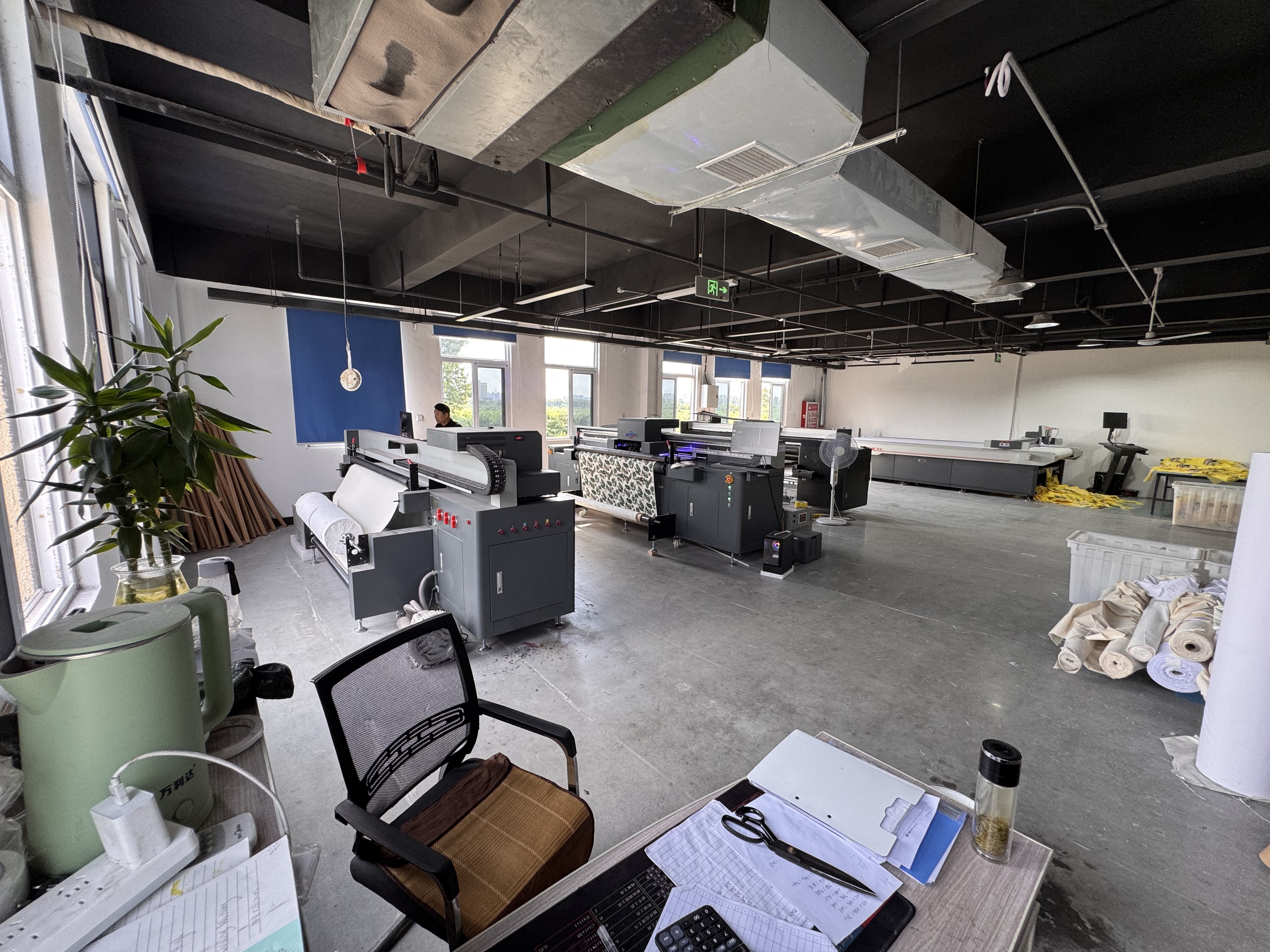
Digital printing equipment in Yulite's production area, one of the logo methods offered across the range.
Print method is not interchangeable across these four scenarios. Embroidery adds texture on canvas, cotton and felt and is a sensible default where the logo will be handled repeatedly, as on a gym or beach bag; screen printing is the efficient route for solid artwork on flat cotton or canvas at volume; digital printing carries gradients, photographs and many colours; transfer printing suits fine detail. Because the same four methods appear across the range, the practical question is not which method the supplier offers but which method suits the substrate and the artwork — a point better settled at sample stage than at proof approval.
Program parameters are shared as well: a minimum order quantity of 500 pieces, a stated lead time of 30 days and a monthly capacity of 200,000 pieces. Quality control is described as internal inspection, pre-shipment inspection and third-party inspection, and the company reports BSCI and SEDEX audits together with ISO 9001, OEKO-TEX Standard 100 and GRS certification. For material claims — recycled cotton, organic cotton, RPET polyester — the claim should be matched to the certificate scope before the artwork puts that claim on the bag.
Where the scenario fit can break
Four failure points recur across these environments, and none of them is a defect in the models themselves; each is a point at which a sample test should replace a description.
- Performance language without a test method. Water-proof and insulated are design descriptions in a product listing; neither arrives with a rating unless one is requested.
- Material chosen against the carrying pattern rather than the setting. A felt beach bag and a mesh beach bag are both valid, but only one suits wet swimwear carried for an hour.
- Print specified before substrate. A four-colour logo approved on screen will not render identically on dyed canvas, felt and polyester.
- Volume and calendar ignored. A scenario-specific model still has to clear the 500-piece minimum and the 30-day lead time; a narrow scenario does not create a smaller minimum.
What scenario-led selection looks like in practice
Yulite's reported case material includes a program implemented in Chile that supplied promotional giveaways for clients referenced as NESTLE and CCU CHILE, using drawstring bag model 4211 at 100,000 pieces alongside promotional shopping bag model 4636, with reported highlights covering price, eco-friendly fabric, print quality, light weight and capacity. Model 4211 is separately described as a drawstring bag applied in conferences, exhibitions and events, which is consistent with a giveaway format that has to be handed over flat and carried away easily.
A second reported case, located in Russia, cites promotional shopping bag model 4636 with highlights of durability, large capacity and visual appeal. Read together, the cases illustrate selection logic rather than a ranking: the drawstring format answered an event-giveaway environment, while the shopping bag format answered a repeated-carry retail environment.
Market context: why fit affects the return on a promotional bag
PPAI and Oxford Economics reported that USD 338.3 billion was spent on branded merchandise globally in 2025, with the industry supporting USD 472.3 billion in global GDP (SRC-0001). The same research programme is the source for the widely cited estimate that a reusable cotton tote generates more than 3,500 impressions over its lifetime. Separately, the 2024 ASI Counselor State of the Industry report put sustainable products at 13.77% of total US promotional industry sales — USD 3.69 billion — a 20% increase on the previous year.
For procurement teams the implication is conditional rather than automatic. Impression value depends on the item actually being used, and a bag that is poorly matched to its setting is less likely to be carried a second time. That is an inference from the data rather than a measured result, but it is the reason environment fit belongs in the brief rather than in the post-campaign review.
Outlook for 2027 programs
Three developments are worth tracking, each conditional on evidence rather than assumed. First, material claims will keep moving toward recycled and organic options; because Yulite holds GRS certification and lists recycled cotton, organic cotton and RPET felt among its material lines, the practical task for buyers is to tie each claim to certificate scope rather than to a marketing name. Second, scenario-specific sample testing is likely to become a standard line item in briefs for cooler and water-resistant bags, since those are the two categories where the description currently outruns published data. Third, print choice will keep shifting toward digital for short-run, multi-colour artwork, while embroidery holds its place on canvas, cotton and felt where a textured logo is the point. These are expectations, not measured forecasts.
Buyers can compare the four models against their own environment brief, and the Yulite 2026 spring brochure is available as a downloadable PDF for program planning.
FAQ
Which promotional bag model is intended for gym and sports programs?
Model 4530. Yulite lists it as a water-proof gym bag and gym duffel with cotton, polyester and nylon options, natural or dyed colour, small, medium and large sizes, logo work by silk printing, transfer printing, digital printing or embroidery, and sports as its application industry.
What construction does model 23250 use, and which settings is it listed for?
Polyester with 2mm foam and aluminium, a zipper closure and a shoulder strap for carrying, with the model's material field also referencing polyester, non-woven and felt. It is listed as a picnic cooler bag, thermal bag, insulated cooler bag, 6-can cooler bag and lunch cooler bag, with food and supermarket retail as its application industries.
Which materials and logo methods are available for the 4700 beach bag?
Materials cover 100% cotton, recycled cotton, organic cotton, polyester, mesh, nylon and felt, in natural or dyed colour and small, medium and large sizes. Logo application is available by silk printing, transfer printing, digital printing and embroidery, and the model is listed in canvas, polyester, felt and nylon versions.
How do the drawstring and zipper formats of model 1812 differ for cosmetic programs?
The model is listed as a makeup bag, cosmetic pouch, zipper cosmetic pouch and drawstring cosmetic bag, so both closure types belong to its definition. Materials include 100% cotton, recycled cotton, organic cotton, felt, polyester and padded fabric; sizes run small to large with the same four logo methods.
What minimum order, lead time and customization options apply across these models?
Yulite states a minimum order quantity of 500 pieces, a 30-day lead time and a monthly capacity of 200,000 pieces. Customization covers logo, colour, material, size, label and packing under OEM or ODM production, with quality control described as internal inspection, pre-shipment inspection and third-party inspection.
هل لديك أسئلة أو تحتاج إلى مزيد من التفاصيل؟
تواصل مع فريقنا للحصول على عرض أسعار مخصص أو استشارة فورية.
طلب عرض أسعار
املأ النموذج أدناه وسيتواصل معك فريقنا بعرض مقترح مخصص.
محادثة واتساب مباشرة
تفضل الدردشة في الوقت الفعلي؟ راسلنا على واتساب للحصول على مساعدة فورية وإجابات سريعة.
- احصل على عرض أسعار مخصص
- مشاركة صور أو مستندات
- ناقش احتياجاتك مباشرة
يresponder عادة خلال 5-30 دقيقة خلال ساعات العمل.