
Promotional Bags by Industry: Cosmetic, Sports, Picnic, Beach & Retail
Promotional Bags by Industry: Cosmetic, Sports, Picnic, Beach & Retail
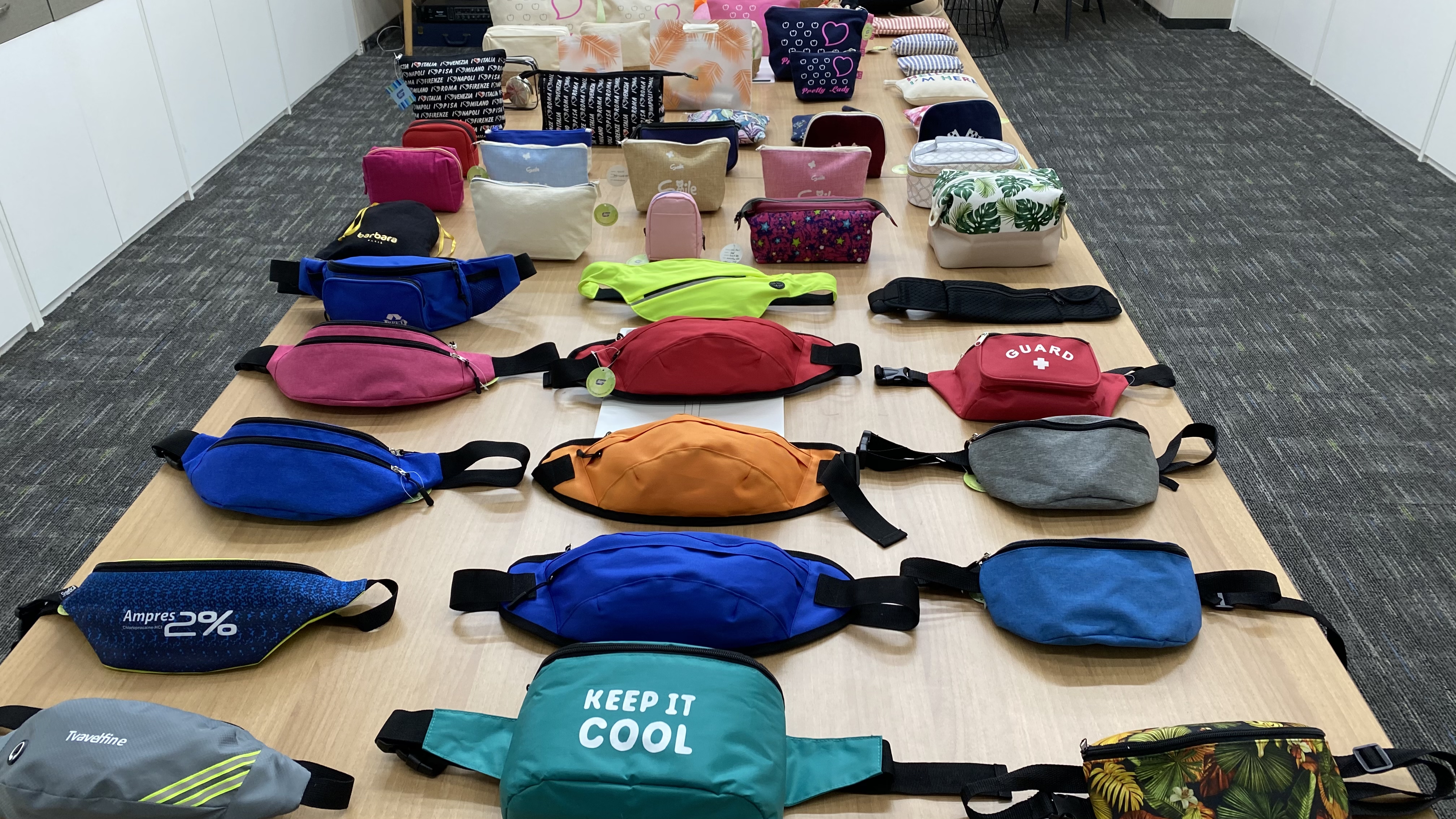
Promotional bag formats are increasingly selected by scenario rather than by category: cosmetic pouches, sports bags, cooler bags, beach bags, foldable bags and cotton canvas shopping bags. Image: Yulite showroom.
Promotional bags are increasingly bought by scenario rather than by category. A distributor sourcing for a fitness chain, a retailer planning a summer beach activation and a cosmetics brand preparing a gift-with-purchase offer may all file the same purchase heading — promotional bag — yet each needs a different object, because the bag that survives a gym locker is not the bag that keeps a picnic lunch cool, and neither is the bag a shopper carries home from a supermarket.
Henan Yulitepromotion Co., Ltd. (Yulite) is a promotional bag manufacturer founded in 2008 in Zhengzhou, China. Its range covers cotton and canvas bags, tote bags, drawstring bags, foldable bags, cosmetic pouches, backpacks, cooler bags, polyester and nylon bags, RPET (recycled PET) and recycled cotton bags, RPET felt bags and non-woven bags. The company exports 100% of its output, mainly to the EU, the USA, Japan and Australia, and publishes its product information at yulitepromotion.cn.
This reference maps six of its models to the industries they are built for — the 1812 cosmetic bag, the 4530 gym bag, the 23250 COOLR BAG picnic cooler, the 4700 beach bag, the FDV010 foldable bag and the 4636 cotton canvas shopping bag — and explains how material, closure and size choices separate a bag that gets used from a bag that gets stored.
Why a Generic Tote Is the Wrong Default
Reusable bags are already abundant in mature markets: the average urban consumer owns 4–6 tote bags, according to Intel Market Research (2024). A generic tote therefore competes with items the recipient already keeps at home, and it offers no functional reason to be chosen over them.
Demand is not the constraint. Corporate adoption of custom-branded tote bags rose 32% year over year in 2024 (Intel Market Research), and the global tote bag market was valued at USD 17.1 billion in 2023, with a projection to USD 29.8 billion by 2032 (Acumen Research and Consulting). The differentiating variable at the decision stage is scenario fit, not print area or unit cost alone.
Seasonality reinforces the point. Seasonal promotional campaigns accounted for 39% of total reusable shopping bag demand in 2025 (Business Research Insights), which means a large share of bags are judged inside a short window: if the item does not work in that season's context, it is not carried, and the campaign earns no repeat exposure. Trade data puts the lifetime exposure of a reusable bag at over 3,500 brand impressions on average (BagzDepot, citing Advertising Specialty Institute data) — a directional figure that only holds if the bag is actually used. Scenario-specific models are therefore a procurement answer to a usage problem, not a design preference.
Model-to-Scenario Map
Yulite organises its promotional bag range around formats rather than a single tote pattern. The table below lists the models this article maps to industry scenarios, together with the verified feature that defines each one.
| Model | Format | Primary industry scenario | Verified defining feature |
|---|---|---|---|
| 1812 | Cosmetic bag / pouch | Beauty, personal care, hotels, events and gift-with-purchase programmes across industries | Positioned as a promotional cosmetic bag for promotional use across industries |
| 4530 | Gym bag | Sports, fitness, swim and activewear campaigns | Built for sports use with a waterproof requirement |
| 23250 COOLR BAG | Cooler bag | Picnic, outdoor dining and short-duration cold transport | 2mm foam with aluminum insulation |
| 4700 | Beach bag | Beach, resort, holiday and summer retail campaigns | Beach-format promotional bag |
| FDV010 | Foldable bag | Retail, event giveaways, travel | Folds for compact storage and distribution |
| 4636 | Cotton canvas shopping bag | Retail, grocery and brand flagship reuse programmes | Cotton canvas construction |
The map is a starting point for specification, not a ranking. Manufacturing context also matters at the decision stage, because scenario-specific models usually carry tighter specifications than plain totes. Yulite operates a 15,000 m² facility with 200 employees and an annual output of 20,000,000 pieces, and maintains an independent sampling room that delivers samples within 3 days. Decoration is available through heat transfer printing, screen printing, digital printing and embroidery.
How Material, Closure and Size Decide Fit
Material
- Insulation. The 23250 COOLR BAG is specified with 2mm foam plus an aluminum layer. Foam slows heat transfer through the bag wall, and the aluminum layer limits radiant heat gain. This is a transport-duration thermal format for moving food between a kitchen and a picnic table, not a substitute for a powered cooler.
- Water resistance. Polyester and nylon are the materials normally requested where a bag will meet moisture — the condition behind the 4530 gym bag's waterproof positioning. Because resistance levels vary with construction and finishing, the requirement should be written into the specification and checked on the sample rather than assumed from the drawing.
- Structure and protection. Padded fabric and felt hold their shape and cushion contents more effectively than single-layer woven fabric, which is relevant to pouch formats such as the 1812, where small items are carried inside another bag.
- Surface and print. Cotton, canvas and recycled or organic cotton are the substrates most often specified where a natural surface and a durable multi-colour print are both required. Yulite supports multi-colour logo printing across its range, alongside RPET, RPET felt, polyester, nylon and non-woven options.
Closure
Closure should be settled on the specification sheet before sampling, not negotiated after. The working rule is to match the closure to how often the bag is opened during a single use. A shopping bag or beach bag such as the 4636 or 4700 is typically filled once per trip and carried open, so closure decisions there are mainly about protecting contents in transit. A pouch such as the 1812 is opened repeatedly while inside another bag, so a closure that can be operated one-handed and stays shut between uses is the practical requirement. For the 4530, closure behaviour with wet contents — towels, swimwear, bottles — should be validated on the pre-production sample.
Size
Size should be derived from the object that must fit, not from a preferred bag dimension. Buyers should measure the largest item the bag will carry, add allowance for the closure and for handling, and then confirm two logistics values that are often missed: handle drop, for bags carried over a shoulder, and packed volume, because large-format bags consume freight space even when they are light. Size mismatches are the most common reason a scenario-specific bag ends up unused.
Application Guide: Five Industry Scenarios
1. Cosmetics, Beauty and Gift-with-Purchase — Model 1812
The 1812 cosmetic bag is positioned as a promotional cosmetic bag for use across industries, which makes it the most transferable model in this set: the same format can support a beauty brand's gift-with-purchase offer, a drugstore loyalty promotion, a hotel amenity kit or a trade-show gift, with only the decoration and material build changing.
What buyers should confirm: the material build, since padded constructions protect contents while lighter woven builds reduce cost; the closure; the print area relative to the panel that remains visible when the pouch is in use; and whether the item will be handed over as a stand-alone gift or carried inside a larger bag.
2. Sports, Fitness and Swim — Model 4530
Sports bags differ from totes in one operational respect: they travel with wet content. The 4530 gym bag is specified for sports use with a waterproof requirement, which is the correct starting point for fitness chains, gym openings, swim programmes and activewear campaigns.
Checkpoints: obtain the waterproof specification in writing together with the construction it refers to; test closure behaviour with a wet towel inside; confirm strap and handle construction for loaded weight; and decide whether the campaign needs a duffel-style carry or a compact gym format. Functional formats have been pulling share from flat bags generally — promotional backpacks alone accounted for a 35% global share of the bag segment in 2025 (Market Research Future).
3. Picnic and Outdoor Dining — Model 23250 COOLR BAG
The 23250 COOLR BAG is specified as a picnic cooler with 2mm foam and aluminum insulation. Its natural applications are picnic and outdoor-dining promotions, food and beverage activations, summer employee gifts and grocery programmes that need short-duration cold transport.
Checkpoints: match capacity to the number of people the promotion targets; confirm how the interior should be cleaned and verify the answer against the actual sample construction; and agree the temperature-use expectation up front, since foam-and-foil insulation is a transport aid rather than long-duration refrigeration.
4. Beach, Resort and Travel Retail — Model 4700
Beach bags carry bulky, damp and sandy contents and are usually opened and left open. The 4700 beach bag is the beach-format option in the range. Sand and salt exposure make print durability and fabric selection the two decision points, while the open format means closure choice is about transit protection rather than daily access.
Checkpoints: confirm the print method against the fabric for a high-wear environment; agree packed size for shipping, because large-format bags consume freight volume; and check that handle construction suits a loaded bag carried over distance.
5. Retail, Grocery and Event Giveaway — Models 4636 and FDV010
Retail programmes are reuse programmes: the bag's job is to return to the store and carry the brand with it. The 4636 cotton canvas shopping bag is built for that pattern, with a construction suited to repeat use and a surface that supports multi-colour printing.
The FDV010 foldable bag serves the opposite logistics need: high-volume events and travel giveaways where storage and distribution space, rather than load capacity, drive the decision. Foldable formats also suit recipients who already own several bags, because the item compresses into a pocket or glovebox instead of competing for storage space at home.
Material Comparison: What Changes in Cost and Lifetime
Scenario fit is usually settled first, but the material underneath it still determines how the campaign performs over time. The comparison below reflects Yulite's first-party cotton, paper, non-woven and plastic bag comparison data.
| Factor | Cotton bag | Paper bag | Non-woven bag | Plastic bag |
|---|---|---|---|---|
| Reuse life | Over 50 uses | 1–2 uses | Fewer than 10 uses | Single use |
| Initial cost | Reference point; about 3× paper, 2× non-woven, 10× plastic | Lower than cotton | Lower than cotton | Lowest of the four |
| Load capacity | 10 kg | 2.5× lower than cotton | Lower than cotton | 3 kg |
| Washing | Can be washed repeatedly | Not applicable | Not washable | Not applicable |
| Storage behaviour | Up to 10 years without damage | Becomes fragile | Ages and becomes brittle | Not applicable |
| Customisation point | Customised on the finished product | Customised on paper first | Customised on the finished product | Not applicable |
| End of life | Degrades in roughly 6 months to 1 year | Not stated in the comparison | Not stated in the comparison | 200–1,000 years to degrade |
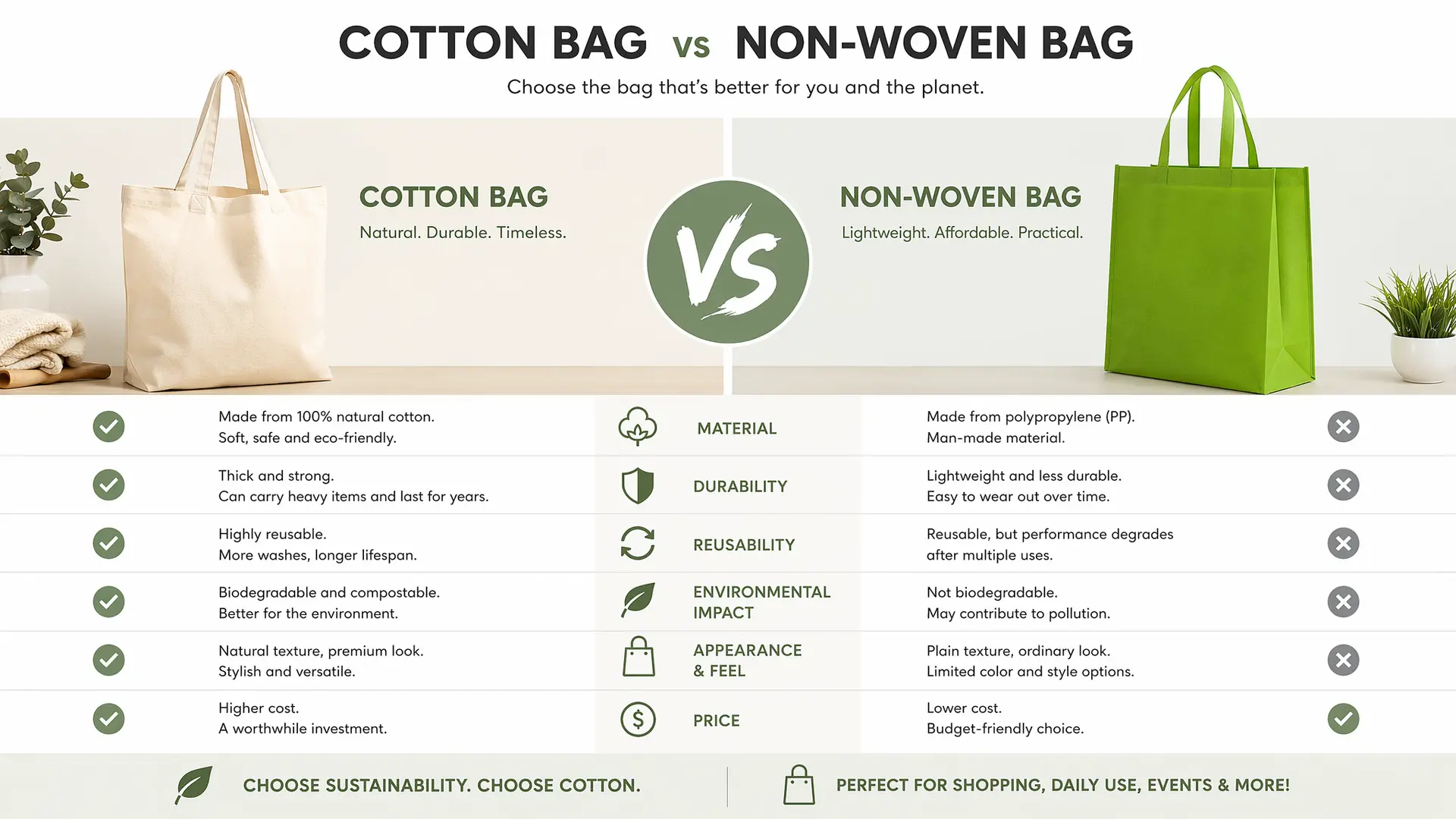
Cotton versus non-woven: reuse life, washability, storage behaviour and relative cost are the four decision factors buyers compare most often.
The arithmetic that matters for campaign planning is cost per use, not cost per unit. A cotton bag priced at roughly three times a paper bag and used more than 50 times has a very different lifetime economics from a paper bag replaced after one or two trips — but only if both are used as intended. The same logic applies between cotton and non-woven: cotton costs about twice as much, is washable and is stored without aging, while non-woven is lighter and cheaper but cannot be washed and loses strength over time.
Where the Scenario-Fit Advantage Stops
- Upfront cost multiples are real. Cotton is about three times the cost of paper, twice the cost of non-woven and ten times the cost of plastic. Scenario-fit arguments do not remove that cash-flow difference at the order stage.
- Cost per use depends on reuse actually happening. If a bag is distributed at a single event and discarded, the long-term cost advantage does not materialise, and a cheaper single-use format can be the rational choice for a one-off, low-value giveaway.
- Purpose-built formats have narrower reuse contexts. A cooler bag is unlikely to replace a recipient's daily tote. Buyers weighing brand impressions should ask whether the scenario repeats.
- Non-woven remains a compromise material. It is lighter and cheaper than cotton, but it cannot be washed and ages, so it is better suited to short-cycle campaigns than to programmes expected to last years.
- Impression figures are directional. The 3,500-impression estimate comes from a trade source of medium reliability and should be treated as a planning indicator rather than a measured result.
- Commercial terms are order-specific. This article does not publish unit prices, MOQ thresholds or lead times for the six models, because those values depend on specification, quantity and decoration method and should be confirmed in writing with the supplier.
Market Signals for 2026 Promotional Bag Programmes
Three signals are relevant to buyers choosing scenario-specific bags rather than generic totes.
- Category demand remains large and concentrated. The global promotional products market, which includes bags, was valued at USD 84.4 billion in 2025 with a 3.8% CAGR (Metastat Insights). Tote bags ranked as the 5th most-searched category on the Advertising Specialty Institute's ESP platform in 2024, indicating continued buyer attention at the category level.
- Functional formats are gaining relative share. Promotional backpacks accounted for a 35% global share of the bag segment in 2025 (Market Research Future), supporting the observation that bags with a defined use outperform flat formats in some campaign types.
- Recycled substrates continue to expand. The recycled PET market is estimated at USD 19.5 billion in 2025 (Custom Market Insights), and 73% of Millennials and Gen Z consumers state a preference for buying from sustainable brands using eco-friendly promotional items (Nielsen / BagzDepot, medium reliability).
Supply-side geography remains stable: Asia Pacific held a 44.8% revenue share of the bag market in 2024, with China a primary manufacturing hub (Grand View Research). For buyers, the practical reading is that material choice and scenario fit now carry as much weight in supplier discussions as unit price, because both influence whether the bag is reused.
Buyer Checkpoints: Compliance and Verification
Scenario-specific bags still have to clear regulatory requirements in destination markets, and the requirements are documentable rather than negotiable.
- REACH (EU). Bags sold in the EU must comply with REACH Regulation Annex XVII, which restricts azocolourants to 30 mg/kg in textiles.
- Textile labelling (EU). Textile products containing at least 80% textile fibres must comply with Regulation (EU) No 1007/2011 for labelling.
- California SB 1046. The ban on non-compostable single-use plastic carry-out bags took effect in January 2025, shifting demand toward reusable substitutes such as non-woven.
- Certification evidence. Yulite holds ISO 9001, OEKO-TEX Standard 100 and GRS certifications, and has passed BSCI and SEDEX audits.
- Incoming material testing. For each lot of fabric, the company performs a lab test before mass production, which is the control step behind heavy-metal and restricted-substance risk management.
- Delivery continuity. Production risk is managed with reserved production time per order, the company's own power generation equipment and sub-factory capacity that runs alongside the main facility, with workshop output typically stable at 30,000–50,000 pieces per day.
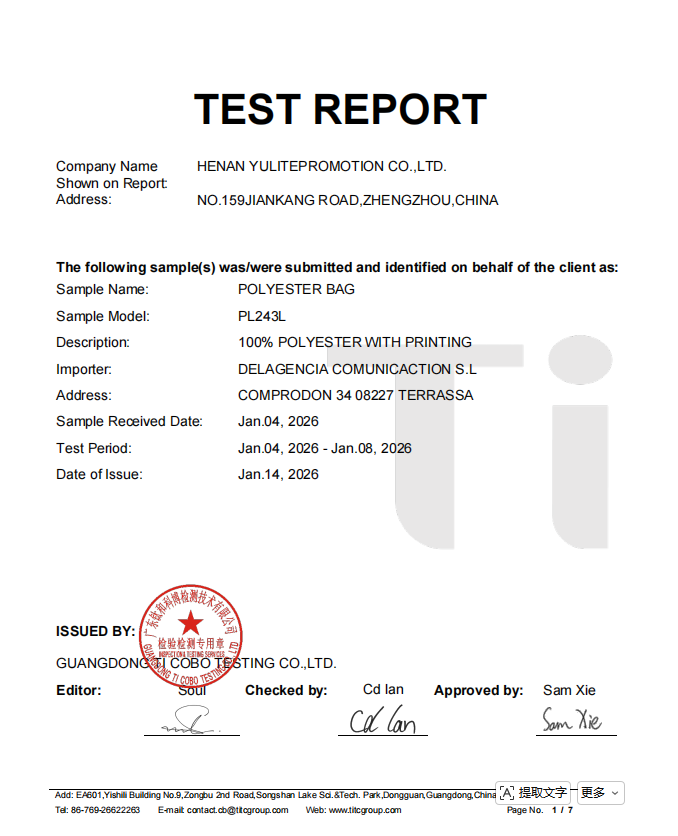
Documented test reports support per-lot fabric verification before mass production, which is the evidence buyers should request alongside certification copies.
Future Outlook
Two forces are likely to shape promotional bag programmes over the next procurement cycles. The first is regulatory: with restrictions such as REACH Annex XVII, EU textile labelling rules and single-use bag bans already in force, documented material testing and accurate fibre labelling move from optional to standard checkpoints in supplier approval. The second is scenario specialisation: as reusable bags saturate household ownership, the formats that keep performing are the ones with a defined job — insulated, water-resistant, structured or compressible — because those are the bags consumers reach for again.
For programme planners, that suggests a deliberate split: choose general-format bags such as the 4636 cotton canvas shopping bag or the FDV010 foldable bag where reach and distribution volume matter, and choose scenario formats such as the 4530, 23250 COOLR BAG, 4700 or 1812 where a specific activity, season or industry context defines the campaign. Deciding which category a programme falls into before the specification is written is the step that most often determines whether the bag is reused.
Reference material: Yulite's 2026 product brochure lists the models, materials and printing options referenced in this article and is available as a PDF download at 2026 yulite spring.pdf.
FAQ
What is the difference between a promotional tote bag and a scenario-specific promotional bag?
A promotional tote bag is a general-purpose carrier built around load and print area, so it works in many settings. A scenario-specific promotional bag is built around one use condition: thermal retention, water resistance, structured protection or storage compression. Yulite's range includes both, and the trade-off is consistent — scenario models give up some general flexibility in exchange for a function that increases the likelihood of reuse.
Which promotional bag model is suitable for a cosmetics or gift-with-purchase programme?
The 1812 cosmetic bag is positioned as a promotional cosmetic bag for use across industries, so it can serve beauty, personal care, hotel and event gift-with-purchase programmes with changes to material build and decoration rather than to the format itself. Buyers typically confirm the material construction, the closure type and the print area before sampling.
Are waterproof promotional gym bags different from standard sports bags?
The relevant difference is how the water-resistance requirement is specified. The 4530 gym bag is built for sports use with a waterproof requirement, which suits fitness, swim and activewear campaigns. Buyers should obtain the water-resistance specification in writing, together with the construction it refers to, and validate closure behaviour with wet contents on the pre-production sample.
How does the 23250 COOLR BAG keep food cool?
The 23250 COOLR BAG is specified as a picnic cooler with 2mm foam and aluminum insulation. The foam layer reduces heat transfer through the bag wall, and the aluminum layer limits radiant heat gain. It is designed for transport-duration cooling — moving food between a kitchen and a picnic table — rather than long-duration refrigeration.
Is a cotton promotional bag more expensive than paper, non-woven or plastic alternatives?
Yes. In Yulite's comparison data, cotton bags cost approximately three times as much as paper bags, twice as much as non-woven bags and ten times as much as plastic bags. The offsetting factors are reuse life of over 50 uses against 1–2 for paper, fewer than 10 for non-woven and a single use for plastic, plus repeated washability, a load capacity of 10 kg and storage for up to 10 years without damage.
What should buyers verify for promotional bags sold into the EU?
Three checkpoints are documentable: compliance with REACH Regulation Annex XVII, which restricts azocolourants to 30 mg/kg in textiles; compliance with Regulation (EU) No 1007/2011 for labelling of textile products containing at least 80% textile fibres; and supplier-level evidence such as ISO 9001, OEKO-TEX Standard 100 and GRS certifications, together with per-lot fabric test reports taken before mass production.