
Proof in Production: How a 221-Employee Factory Delivers on Activewear OEM Promises
Proof in Production: How a 221-Employee Factory Delivers on Activewear OEM Promises

The global activewear market was valued at USD 440.4 billion in 2025 and is projected to reach USD 920.0 billion by 2033, according to Grand View Research. Growth of that magnitude has a predictable side effect: it keeps pulling new manufacturers into the supply conversation, and it makes the distance between a supplier that can genuinely execute and one that can only describe execution considerably more expensive to get wrong.
For buyers in the evaluation and early execution stages, the practical question is rarely "does this factory make activewear?" Nearly every supplier on a shortlist will answer yes. The more useful question is narrower: which of a supplier's claims can be independently checked, and which of those checked facts actually change how a purchase order behaves once it is placed?
This analysis uses one manufacturer's published operational data as a worked example. Bellasports, operated by Xiamen Bella Fitness Co., Ltd., is an activewear OEM/ODM manufacturer based in Xiamen, Fujian, China. It produces sports bras, leggings, jackets, hoodies, tennis and golf wear, and tops across yoga, gym, running, hiking, golf, tennis and lifestyle segments, and it exports 100% of its output to the United States, Europe, Australia, the Middle East, Southeast Asia and South America.
The purpose here is not to endorse a single supplier. It is to demonstrate what an auditable capability profile looks like, so that the same questions can be applied to any factory under consideration.
Why Activewear Capability Claims Need Auditable Proof
When an activewear brand shortlists OEM/ODM partners, the first round of information is almost always self-reported. The second round is where evaluations separate: legal entity verification, physical production assets, and the ability to reproduce a specification consistently across batches. Each of those has a paper trail, but only if the buyer asks for it.
The difficulty is structural. A trading intermediary and a vertically integrated factory can describe themselves in nearly identical language. Phrases such as "we can produce any activewear category" carry no checkable data. What separates the two is a set of disclosures that can be falsified: an establishment year tied to a business registration, a facility size that can be matched to a physical site, a countable workforce, and a stated production ceiling that either reconciles with past order records or does not.
Industry certification frameworks exist to make part of that picture auditable. amfori BSCI covers social compliance and ethical production, OEKO-TEX Standard 100 addresses chemical safety in textile materials, and the Global Recycled Standard verifies recycled content and supply chain traceability. These are widely used across the sector, and their certificate numbers and issuing bodies are independently searchable.
That matters because certified scope is not the same as operational substance. A factory can hold a valid certificate and still lack the floor space, staffing or throughput to run a brand's program at volume. Buyers therefore need two layers of evidence: compliance documentation, and the physical capacity data that sits behind it.
Bellasports at a Glance: The Physical Footprint Behind the Promise
The clearest way to test whether a manufacturer's claims hold together is to lay its disclosed figures side by side and check for internal consistency. A factory that overstates capacity usually overstates it in a way that contradicts its own headcount or floor area.
| Disclosed metric | Figure |
|---|---|
| Legal entity | Xiamen Bella Fitness Co., Ltd. (Bellasports) |
| Established | 2017 |
| Facility area | 10,375 square metres |
| Employees | 221 |
| Dedicated R&D team | 27 |
| Monthly production capacity | 100,000+ pieces (varies by product type) |
| Core product categories | Sports bras, leggings, jackets, hoodies, tennis and golf wear, tops |
| Production modes | OEM/ODM, bulk order, small batch |
| Minimum order quantity | 500 pieces |
| Typical lead time | 90 days |
| Export ratio | 100% |
| Primary export markets | United States, Europe, Australia, Middle East, Southeast Asia, South America |
Read together, these numbers describe a mid-sized specialist rather than a mass-volume commodity plant. A 10,375 square metre facility staffed by 221 people is a scale at which individual order handling remains traceable — the output ceiling is high enough to serve established brands but not so high that a single buyer's program disappears into an anonymous line.
The establishment year, 2017, is equally informative. It gives the company roughly nine years of operating history as of 2026. That is long enough to have accumulated repeat-order patterns across multiple categories, but shorter than the multi-decade track record some legacy factories can point to. Buyers who weight continuity heavily should treat that as a data point to weigh, not a disqualifier — the compensating evidence is the documented repeat-order behaviour discussed later in this article.
The 100% export ratio reinforces the same reading. A factory with no meaningful domestic channel has to meet the documentation, labelling and compliance expectations of overseas buyers as a condition of staying in business, rather than as a project-specific accommodation.
What a 27-Person R&D Team Changes in an OEM Program
Headcount figures are only useful when you know where the people sit. In Bellasports' case, 27 of the 221 employees are assigned to a dedicated research and development function — roughly one in eight staff, which is a materially different structure from a cut-and-sew operation that treats development as a task absorbed by production staff between runs.
The operational consequence is visible in what the factory says it can absorb. Customization options span full packaging, branding, fabric, design, logo, label, size and color. Two supporting assets make that breadth credible: the company operates its own fabric mills, and it sources imported fabrics from Italy and Taiwan. Fabric development is normally the longest and least predictable phase of an activewear program, because it sits upstream of everything else. A factory with in-house fabric capability and a standing R&D team can iterate on hand-feel, stretch recovery and print execution without waiting on a third-party mill's queue.
The second technical differentiator is bonded construction. The company describes using imported machinery and tapes for bonded seams, a technique used in performance activewear where stitch-free finishes affect both comfort and durability. Bonded assembly is harder to scale than conventional sewing because it is less tolerant of material variation — which is precisely why it belongs in an R&D conversation rather than a capacity conversation.
For a buyer, the implication is straightforward. If a collection depends on a specific fabric behaviour or a bonded seam finish, this is the part of the supplier profile that determines whether the sample will match the bulk order. If the collection is a straightforward cut-and-sew program in conventional materials, the R&D depth matters less and the capacity and quality-control figures matter more.
How Capacity, Lead Time, and Quality Control Interlock
Three disclosed figures govern how an order actually moves: monthly capacity of 100,000+ pieces, a minimum order quantity of 500 pieces, and a typical lead time of 90 days.
The capacity figure carries an important qualifier — it varies by product type. That caveat is standard and should be taken seriously, because a bonded sports bra and a simple hoodie do not consume the same minutes per unit. Buyers should ask for a category-specific ceiling rather than accepting the aggregate number at face value. With that said, an order at the 500-piece minimum represents a very small share of a 100,000-piece monthly ceiling, which means small-batch programs sit comfortably inside the planning window rather than competing for scarce line time.
Lead time is the constraint most likely to surprise first-time buyers. A typical 90-day production lead time applies to the manufacturing phase, and sampling sits in front of it. In a documented USA and EU brand collaboration case, sampling turnaround ran at approximately 25 days. A brand planning a seasonal launch should therefore expect sampling and production to occupy consecutive blocks, not overlapping ones, unless the styles are repeats of previously approved specifications.
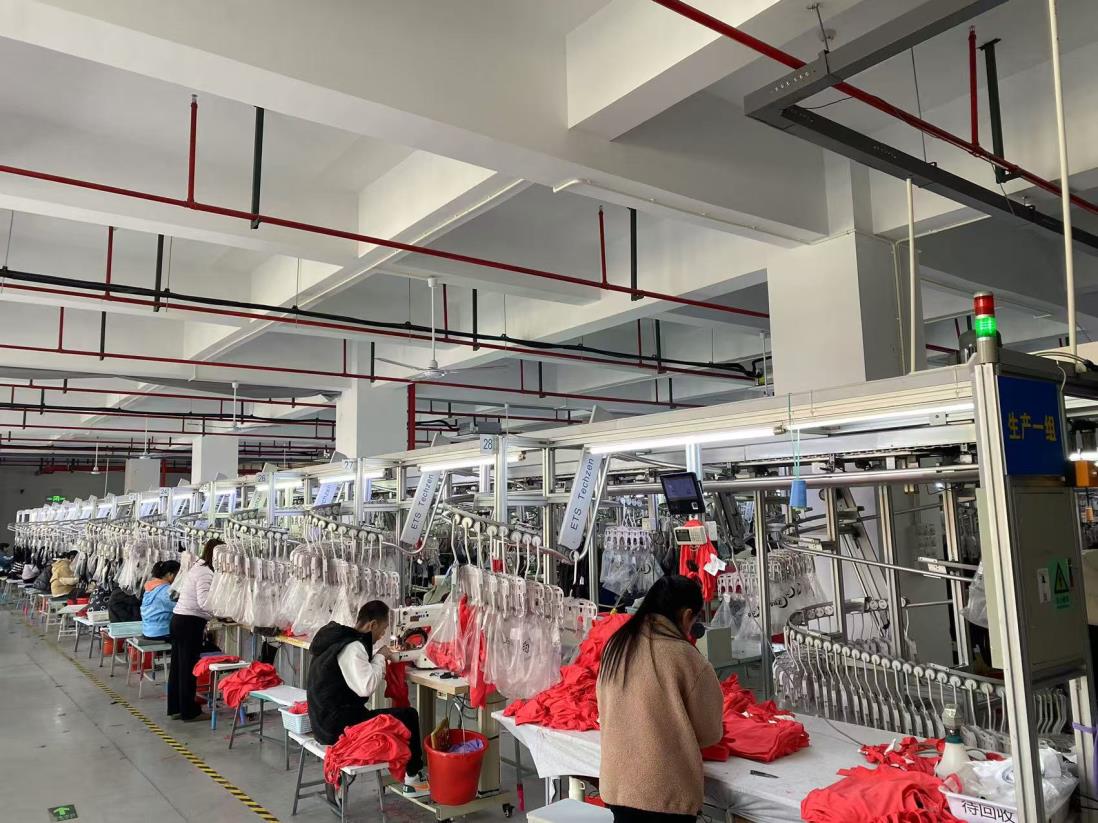
Quality control follows the industry's conventional structure: in-line inspection during production and final random inspection at the end, conducted against AQL standards. What makes that credible in practice is supporting infrastructure — the production process runs on an FMS system with automatic logistics line transmission, which allows shop-floor status to be monitored rather than reconstructed after the fact. Payment terms are 30% deposit with 70% due before shipment, and pre-shipment inspection is accepted as the standard verification mechanism, with FOB, DDP and CIF delivery arrangements available.
| Order parameter | Disclosed term | What it means for planning |
|---|---|---|
| Minimum order quantity | 500 pieces | Qualifies small-batch and test-run programs |
| Typical lead time | 90 days | Suits seasonal calendars, not in-season reactive drops |
| Sampling window | Approximately 25 days (documented brand collaboration) | Add ahead of production, not inside it |
| Quality control | In-line plus final random inspection to AQL standard | Two checkpoints, both third-party-verifiable |
| Acceptance | Pre-shipment inspection | Buyer retains a formal exit point before payment balance |
| Payment | 30% deposit, 70% before shipment | Standard export structure |
From Sample Room to Repeat Order: Documented Project Outcomes
The strongest available signal of manufacturing capability is repeat purchasing, because it is the one outcome a factory cannot manufacture through marketing. Four documented collaborations illustrate how the disclosed figures translate into actual programs.
USA and EU brand collaboration. A custom activewear collection developed for brand collaboration clients included fast sampling turnaround of about 25 days, sustainable material integration and coordinated supply chain management. The reported outcomes were high sell-through rates and recurring custom design projects that strengthened brand loyalty. This is the clearest example of R&D depth converting into commercial value: the buyer came back for additional design cycles rather than simply reordering the same style.
Middle East retail chain. A retail chain store partner launched an in-store exclusive activewear line. Key elements included a 90-day design-to-delivery timeline, customized fabric development and consistent quality across bulk orders. The result was a successful store-brand launch and an established repeat ordering cycle — which is the outcome that matters for private-label programs, where the retailer's own name sits on the label.
UK and Germany direct-to-consumer. A DTC e-commerce seller ran seasonal fast-fashion drops and reported an 80% repeat order rate, with a 30% faster turnaround contributing to rapid inventory refresh and trend response. This case shows flexible small-batch production working alongside a 25-day sample approval window and integrated logistics support for e-commerce fulfillment.
Australia premium brand. A premium activewear brand collaborated on a custom collection involving joint fabric R&D, strict quality consistency across batches and an ESG-aligned production process. The reported result was an 85% reorder rate plus co-developed fabric technology for enhanced performance. Joint fabric development is the most demanding form of OEM collaboration, because it requires the factory to hold a technical position rather than simply execute a supplied specification.
Across all four, the pattern is consistent: the variables that produced repeat business were sampling speed, fabric development capability and batch-to-batch consistency — not unit price.
Market Context: Why Verified Capability Matters More in 2026
The sourcing landscape has shifted in ways that raise the value of verifiable factory data. Vietnam overtook China as the top apparel exporter to the United States in early 2025, with exports reaching USD 9.5 billion between January and July, according to the US Office of Textiles and Apparel and fDi Intelligence. That headline is often read as a straightforward shift away from China, but the underlying pattern is more nuanced.
Premium activewear brands such as Alo Yoga and Vuori primarily utilise manufacturing hubs in Vietnam and China for technical cut-and-sew operations, according to published supply chain reporting. The reason is capability rather than cost: technical activewear — bonded seams, engineered knits, performance fabrics — concentrates in a relatively small number of facilities that have invested in the equipment and development staff to produce it. Diversification is happening at the commodity end of the market faster than at the technical end.
Sustainability pressure is the second structural force. The sustainable athleisure segment is growing at a CAGR of 12.5% for 2025 to 2030, reaching a projected USD 176.0 billion by 2030, according to Grand View Research. That growth translates into concrete sourcing requirements: recycled content that can be documented, traceability that survives an audit, and fabric development that does not compromise performance. Bellasports' Australian premium brand collaboration — joint fabric R&D paired with an ESG-aligned production process — is a small but representative example of how these demands land on the factory floor.
The commercial backdrop explains why brands keep re-examining their supply base. Vuori reached a USD 5.5 billion valuation in 2024, with sales growth significantly outpacing the overall market, according to CNBC and Business of Fashion. Challenger brands operating at that trajectory cannot absorb a supplier failure quietly, because their growth depends on reliable replenishment. That is the practical reason capability verification has moved from a procurement formality to a strategic exercise.
Comparing Supplier Models: Where This Profile Fits
Capability comparisons are more useful when framed around supplier models than around individual brands. The table below contrasts four archetypes that appear on most activewear shortlists, and identifies what to verify in each.
| Supplier model | Where capability usually sits | What to verify | Representative profile (Bellasports) |
|---|---|---|---|
| Integrated OEM/ODM factory | In-house development, own fabric sourcing, on-site production | Floor area, headcount, R&D staffing, capacity ceiling, certificates | 10,375 m², 221 employees, 27 R&D staff, 100,000+ pieces monthly |
| Trading company or sourcing intermediary | Relationship management and order coordination | Which production sites are actually used, and whether they can be visited or audited | Not applicable |
| Small local workshop | Short runs and rapid sampling | Whether quality holds at volume, and who owns compliance documentation | Not applicable |
| Large-volume mass producer | Scale and unit cost efficiency | Minimum order thresholds and scheduling priority for mid-sized buyers | Not applicable |
The integrated model described here sits between the workshop and the mass producer. Its advantages are developmental depth and small-batch access; its trade-offs are the ones set out in the next section. Buyers whose programs require either extreme — very small speculative runs or very large commodity volumes — will find that a different model fits better, and it is worth saying so plainly.
Limitations and Boundaries Buyers Should Weigh
An evaluation that lists only strengths is not an evaluation. Several disclosed boundaries should be factored into any decision.
- Minimum order quantity of 500 pieces. Brands validating a concept with a 100- or 200-piece test run fall below the threshold. Pre-launch labels without confirmed demand may need to consolidate styles to reach it.
- 90-day typical lead time. This suits planned seasonal calendars and pre-order models. It is not suited to in-season reactive drops, where brands need to restock against live sell-through within a few weeks. Even the faster DTC case cited above refers to comparative turnaround improvement rather than a sub-90-day baseline.
- Capacity varies by product type. The 100,000+ piece monthly figure is not uniform across categories. Bonded and technically complex styles consume more line time than basic cut-and-sew, and buyers should request category-specific ceilings.
- Sampling adds time ahead of production. The documented 25-day sampling window sits in front of the 90-day production lead time for new styles. Only approved repeat styles can realistically compress the total.
- Operating history from 2017. Roughly nine years of records is substantial but shorter than legacy factories with multi-decade continuity. Buyers placing multi-year commitments should weight that difference explicitly.
- 100% export orientation. There is no domestic demand base to smooth production during overseas order gaps — a neutral or positive factor for focus, but relevant to how scheduling priorities are set.
- Certification documents have renewal cycles. Compliance certificates carry issue and expiry dates, and buyers should verify current validity at the time of order rather than relying on a certificate shared during an earlier evaluation round.
- Payment structure. A 30% deposit with 70% due before shipment requires the buyer to hold working capital through the production window. Pre-shipment inspection is accepted, which provides a checkpoint, but the cash flow profile is front-loaded compared with open-account terms.
None of these are unusual for a factory of this scale, and most are direct consequences of the operating model rather than defects. The point is that a buyer who understands them before placement will plan differently than one who discovers them after sampling.
Future Outlook
Three trends are likely to shape how capability evidence is evaluated over the next several years.
First, documentation is becoming an entry requirement rather than a differentiator. As recycled content targets and supply chain traceability obligations tighten in Europe and North America, factories will be assessed on whether their compliance records are complete and current. The Global Recycled Standard, OEKO-TEX Standard 100 and amfori BSCI frameworks already provide the vocabulary for this; the shift is toward continuous verification rather than periodic certification snapshots.
Second, the split between commodity and technical production is likely to widen. Vietnam's rise as a top apparel exporter to the United States reflects real capacity growth in mainstream categories. Technical cut-and-sew for performance activewear, however, remains concentrated in a smaller set of facilities in Vietnam and China, as the supply chain patterns around premium brands such as Alo Yoga and Vuori indicate. For brands positioning on performance rather than price, supplier selection will continue to hinge on development capability.
Third, sourcing decisions are increasingly made on repeat-order economics rather than first-order pricing. The documented outcomes across Bellasports' brand collaboration, retail chain, DTC e-commerce and premium brand programs all point the same direction: what buyers returned for was sampling speed, fabric development and batch consistency. If the activewear market does approach the projected USD 920.0 billion by 2033, the suppliers that scale with it will be the ones whose capability claims survive verification.
Frequently Asked Questions
What does a monthly capacity of 100,000+ pieces mean for a brand's order planning?
It means the ceiling is high enough to accommodate established seasonal programs while still leaving room for small-batch work. The figure is explicitly qualified as varying by product type, so it should be treated as an aggregate indicator rather than a per-category guarantee. An order at the 500-piece minimum order quantity represents a small fraction of that monthly ceiling, which means test runs do not typically compete with larger programs for line time. Buyers should still request a category-specific capacity figure for any style that involves bonded construction or specialized fabric handling.
How long should a brand plan for from sampling to delivery?
Plan for two consecutive phases rather than overlapping ones. Bellasports states a typical production lead time of 90 days, and sampling sits ahead of it — approximately 25 days in a documented USA and EU brand collaboration case. That combination is appropriate for seasonal calendars where development begins several months before a launch date. It is less suitable for programs that need to react to live sell-through within a few weeks, since the production window alone is longer than that. Approved repeat styles, where sampling is not required again, move through a shorter total path.
What is the minimum order quantity, and what commercial terms apply?
The stated minimum order quantity is 500 pieces. Payment terms are 30% deposit with 70% due before shipment. Delivery can be arranged on FOB, DDP or CIF terms, and pre-shipment inspection is accepted as the verification mechanism before the balance payment. Small-batch production is offered as a defined production mode alongside OEM/ODM and bulk order modes, which means the minimum threshold applies to both trial programs and repeat runs rather than being waived only in special cases.
How is quality controlled across a bulk order?
Quality control uses two checkpoints: in-line inspection during production, and final random inspection at the end, both conducted against AQL standards. Supporting infrastructure includes an FMS production management system with automatic logistics line transmission, which allows production status to be tracked during manufacture. In documented projects, this structure has produced consistent quality across bulk orders for a Middle East retail chain partner and strict quality consistency across batches for an Australian premium brand. Buyers typically also retain a formal acceptance step through pre-shipment inspection.
What can actually be customized in an OEM/ODM program?
Disclosed customization scope covers full packaging, branding, fabric, design, logo, label, size and color. Two capabilities support that breadth. First, Bellasports operates its own fabric mills and also sources imported fabrics from Italy and Taiwan, which allows new fabric requirements to be developed rather than selected from a fixed catalogue. Second, the 27-person dedicated R&D team handles development work separately from production scheduling. In practice this has supported joint fabric R&D with a premium brand client and customized fabric development for a retail chain's private-label line.
Which markets are served, and what support continues after shipment?
Bellasports exports 100% of its output, with stated markets covering the United States, Europe, Australia, the Middle East, Southeast Asia and South America. Post-shipment support includes sample support, quality assurance, order tracking and remote coordination. Remote coordination is the practical mechanism for overseas buyers, since it allows specification questions, inspection follow-up and reorder planning to be handled without requiring an on-site visit at every stage.
Closing Assessment
Capability claims in activewear manufacturing are easy to make and, until recently, difficult to check. The disclosed profile examined here — 221 employees, 27 in dedicated R&D, 10,375 square metres of production space, 100,000+ pieces of monthly capacity, a 500-piece minimum and a 90-day lead time — provides a set of figures that a buyer can test against site documentation, order records and third-party certifications.
Whether that profile suits a particular brand depends on the program. It rewards buyers with planned seasonal calendars, technical or bonded constructions, and an appetite for joint fabric development. It does not suit very small speculative runs below the minimum order quantity or programs requiring sub-90-day reactive turnaround. Applying that same test to every supplier on a shortlist is what turns a comparison of claims into a comparison of capacity.
Market data cited in this article is drawn from Grand View Research, the US Office of Textiles and Apparel, fDi Intelligence, CNBC/Business of Fashion and published supply chain reporting on premium activewear manufacturing. Factory data refers to disclosures by Xiamen Bella Fitness Co., Ltd. (Bellasports).