
Proof of Capability: Verifying a Pallet Jack Maker's Testing Claim
Proof of Capability: Verifying a Pallet Jack Maker's Testing Claim
Pallet jacks are sold on numbers, and most of those numbers describe the object in front of the buyer: load capacity in kilograms, fork length, lowered height, wheel diameter, service weight. A second set of numbers describes the organisation behind the object — monthly production capacity, annual output, testing coverage, defect handling and spare-parts policy. The first set can be confirmed with a tape measure, a scale and a load test. The second set usually cannot be confirmed at all before a deposit is paid, which is why it needs a documented verification method rather than a verbal assurance.
This reference article sets out that method. It examines three claims that appear repeatedly in pallet jack quotations at the Decision stage: a stated monthly production capacity of 10,000 units, an annual output of 70,000 units, and a commitment that 100% of units are tested before shipment. Baoding Junyun Hoisting Machinery Co., Ltd., which trades as JUNYUNHOIST, is used as a working case, because the company publishes these figures alongside product-level specifications and a defined after-sales policy, making the verification steps concrete rather than theoretical.
Why organisational claims resist verification
Capacity and testing claims describe processes, not objects, and that is the root of the difficulty. A buyer can place one pallet truck on a scale, measure its fork height with a caliper and load it until it deforms. To verify a 100% testing claim, however, the buyer must inspect evidence generated across thousands of individual units, most of which have already been shipped. To verify a 10,000-unit monthly capacity claim, the buyer must understand line structure, equipment count, shift pattern and the way production capacity is shared between product families.
Scale makes this more consequential rather than less. The global pallet jack market was valued at approximately USD 7.4 billion in 2024 and is projected to reach USD 11.6 billion by 2034, according to an industry report covering 2025–2034. Within that total, manual pallet jacks generated USD 4.3 billion in 2024 and continued to dominate despite the rise of automation, while the electric pallet jack and stacker segment reached USD 5.1 billion in 2024, driven by e-commerce volumes and lithium-ion battery technology.
A market of that size supports a large and varied supplier base. More suppliers competing for the same purchase orders means more quotations containing capacity and testing language, and more occasions on which a buyer has to decide whether a claim is a commitment or a marketing line. The rest of this article treats each claim as a verification task with a defined evidence trail.
What "10,000 units a month" and "70,000 units a year" actually describe
Rated monthly capacity and realised annual output are different measurements and should never be multiplied together. A monthly capacity figure is a statement about what a facility can produce in a defined period under a defined operating pattern. An annual output figure is a statement about what the facility actually produced over twelve months across a mixed product portfolio. The gap between the two reflects product mix, order seasonality, model complexity and the share of capacity allocated to each line.
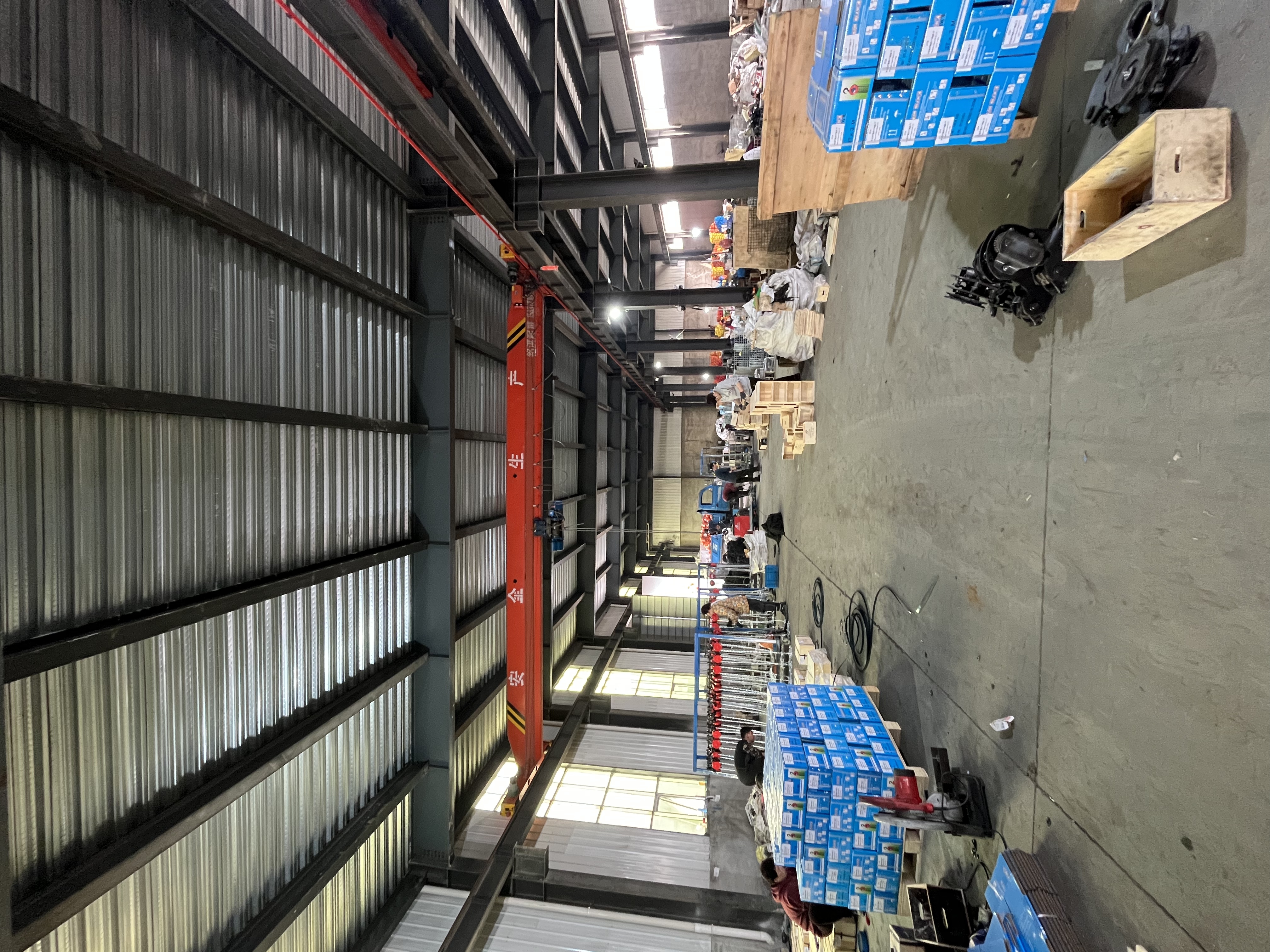
JUNYUNHOIST states both numbers. The company is a lifting and material handling equipment manufacturer headquartered in Hebei, China, founded in 2018, operating a 24,000 m² facility with 138 employees including engineers and quality-control specialists, and an eight-person research and development team. It states a monthly production capacity of 10,000 units and an annual output of 70,000 units, with an export ratio of 80%. Its stated markets include India, Russia, Vietnam, Brazil, Türkiye, Dubai and other countries across the Middle East and Southeast Asia. Its product portfolio covers hand pallet trucks, pallet jacks, manual stackers, electric stackers, oil stackers, lift tables, galvanized and stainless steel pallet trucks, pallet trucks with scale, and electric pallet trucks.
The portfolio description is the key to reading the capacity figure correctly. A 10,000-unit monthly capacity is a facility-level statement, not a promise that 10,000 pallet jacks of one specification can be produced in thirty days. A buyer evaluating a quotation should therefore ask which lines produce the requested model, how capacity is allocated between product families, whether the figure assumes single-shift or multi-shift operation, and what committed lead time applies to the specific order quantity.
Reconciliation check. Multiply the stated monthly capacity by twelve and compare it with the stated annual output. A monthly capacity of 10,000 units implies a theoretical 120,000 units per year, against a stated annual output of 70,000 units. The difference is normal and does not indicate a false claim: it is the difference between rated capability and realised volume. What matters is whether the supplier can explain the gap in terms of product mix, seasonality and line allocation — and whether the explanation matches the order the buyer is placing.
Deconstructing a 100% testing claim
A 100% testing claim means that every individual unit, not a sample drawn from a batch, receives a functional check before packing. On a pallet truck, that check normally covers hydraulic lift, hold and lowering behaviour; inspection for oil leakage or air in the pump; handle operation and return; wheel rotation and alignment; and a load test. The manufacturer states that its load tests are performed at 1.2 times the rated load, which is a stress level above the working capacity the unit is sold to carry.
Three different quality activities are frequently conflated in supplier conversations, and distinguishing them is one of the most useful things a buyer can do during evaluation.
| Activity | What it covers | What it can and cannot prove |
|---|---|---|
| 100% functional testing | Every unit: hydraulic function, leakage, handle operation, wheels, load test at 1.2 times rated load | Proves each shipped unit worked at the moment of testing. Does not prove design margin, material grade or long-term durability. |
| AQL sampling inspection | A defined sample drawn from a batch, checked against a defect threshold | Proves batch-level conformance within statistical limits. Does not prove that untested units in the batch are defect-free. |
| Type / design testing | Design validation of a model and its structure before series production | Proves that the design can meet a defined standard. Does not prove that every production unit replicates the prototype. |
Independent standards sit alongside these internal activities. ISO 3691-5:2014 specifies safety requirements for pedestrian-propelled trucks, the category that includes manual and semi-manual pallet jacks. In Europe, EN 1757-2 covers hand pallet trucks with capacities up to 2,000 kg. In the United States, OSHA 29 CFR 1910.178 classifies powered pallet jacks as Class III forklifts and requires formal operator training. The manufacturer states that its products are manufactured under quality-control protocols meeting international safety standards including ISO and CE.
The boundary of a 100% testing claim is worth stating plainly, because suppliers sometimes allow it to imply more than it delivers. A per-unit functional test is a workflow control. It is not an independent laboratory result, it is not a substitute for design validation, and it says nothing directly about how the unit will perform after two years of high-cycle use. Buyers who need the latter should ask for separate evidence.
The verification chain: documents, records and physical checks
Each claim maps to a specific evidence type. The table below sets out what a buyer should request for the three claims under discussion, and what each piece of evidence does and does not establish.
| Claim | Evidence to request | What it establishes | What it does not establish |
|---|---|---|---|
| 10,000 units per month capacity | Line-level capacity statement, facility layout, equipment list, workforce breakdown, shift pattern | Physical ability of the facility to produce at the stated rate | Availability of that capacity during your order window |
| 70,000 units per year output | Annual production summary, export documentation consistent with an 80% export ratio, shipment records | Sustained operation at volume over a full year | Quality performance on your specific model |
| 100% testing of all units | Serial-numbered test logs, load-test parameters including the 1.2 times rated load figure, defect and rework log | Per-unit functional verification before packing | Long-term durability, design margin or material certification |
| ISO and CE conformance | Certificate copies with scope, validity dates and issuing body | Conformance of the covered scope to the named standard | That every production unit matches the tested sample |
| After-sales support | Written spare-parts policy, warranty terms, parts list for consumables | The structure of post-delivery support | Response speed in your specific region |
The facility and workforce figures matter in this chain because they anchor the capacity claim in something physical. A stated 24,000 m² footprint, a stated workforce of 138 people including engineers and quality-control staff, and a stated eight-person R&D team are all inspectable during a factory audit, by video walkthrough, or against third-party inspection reports. A capacity claim that cannot be tied to a footprint, a workforce or a line layout is a number without an anchor.
Component-level evidence: where the testing claim meets the steel
A load test at 1.2 times the rated load only means something if the structure being tested is built to absorb that stress repeatedly. This is the point at which a capacity or testing claim becomes a product claim, and it is where buyers can compare configurations on measurable parameters rather than on adjectives.
JUNYUNHOIST documents a reinforced construction configuration relative to a baseline factory specification. The documented differences include a 4 mm steel plate, a pump using an AC pump, a forged rocker arm, forged AB plates and double-chain plates, a cast steel wheel frame, a full rib structure, and a thickened handle. The stated dimensional parameters of that configuration are a steel plate thickness of 4 mm, a reinforced plate measuring 4 mm thick and 89 cm long, a triangle ruler thickness of 4 mm, a handle thickness of 2.75 mm, and high-quality bearings. Compared with a baseline factory product, the manufacturer states that this configuration offers distinct advantages in steel plate thickness and reinforcement.
Those parameters translate into procurement outcomes rather than specifications on paper. The manufacturer states that the reinforced configuration costs approximately 2% more initially, with better durability and lower long-term maintenance costs, and reports 90% less maintenance required than the baseline. It also states stronger load-bearing capacity, smoother wheel operation requiring less effort, and easier climbing over thresholds and gradients. These are first-party figures and should be treated as such — they are useful for framing a comparison, but they are not an independent benchmark, and a buyer with a maintenance history from a current fleet can test them directly against their own records.
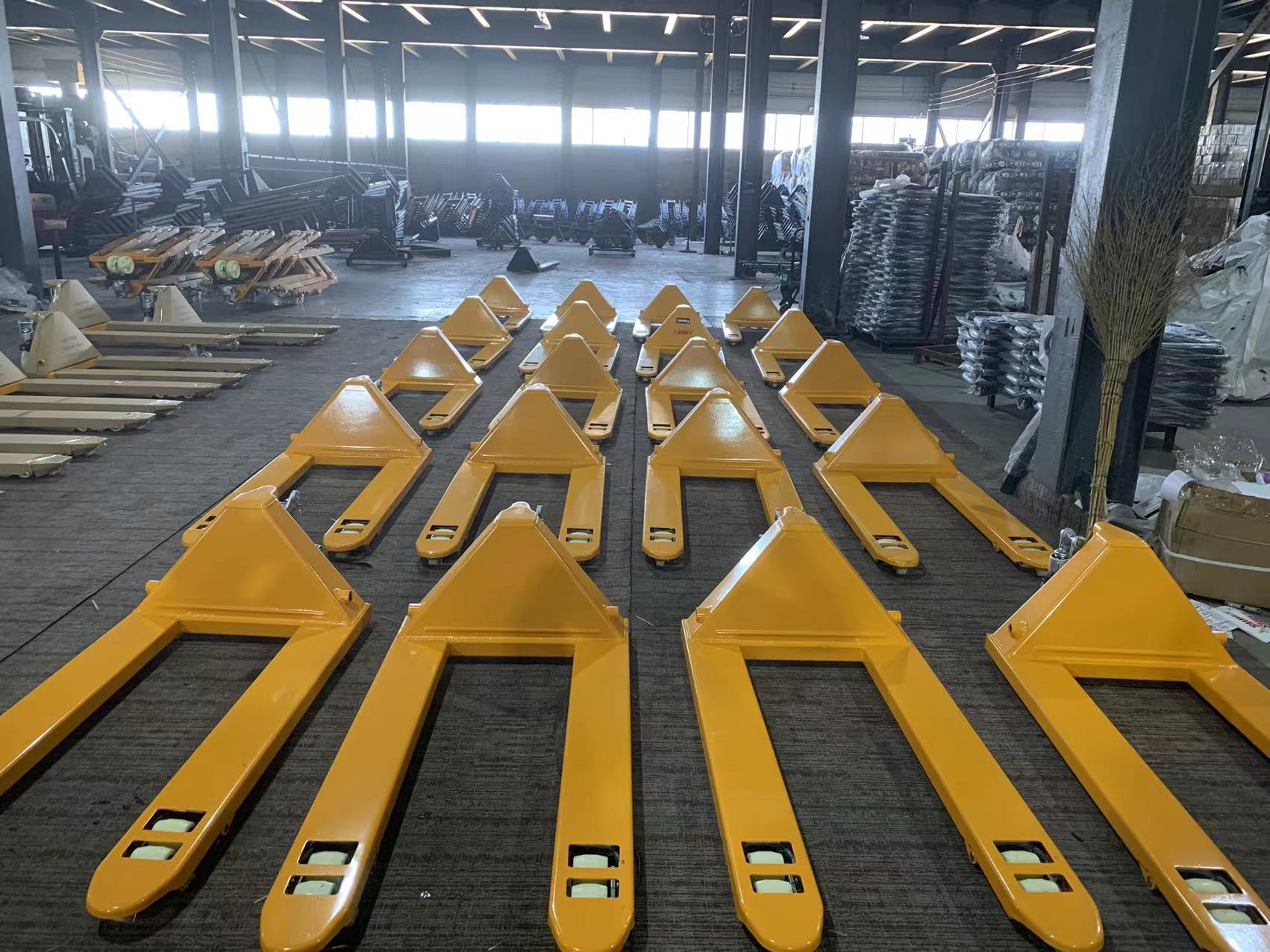
Verification should also cover failure modes, because a testing claim is more credible when the supplier can describe what the test is designed to catch. The documented risks for pallet trucks are pump oil leakage or air ingress, handle deformation or damage, and wheel wear. The stated control methods are practical operation without overloading and maintaining fork balance when lifting goods. The manufacturer's stated after-sales measure is to supply a set of easily damaged spare parts free of charge, including seals, handles and wheel frames — a policy that is directly relevant to total cost of ownership and can be checked against the written warranty and parts list.
Where verified capability matters most in practice
The value of a verified capacity and testing claim rises with the intensity of the application. The environments for which the reinforced configuration is specified include warehouses, factory floors, loading docks, retail backrooms, distribution centres, cold storage, construction sites, workshops, truck loading and unloading, and cross-docking facilities. Each places a different demand on the equipment and a different emphasis on the evidence a buyer should prioritise.
- Warehouse and logistics centre operations. High daily cycle counts make the stated 90% maintenance reduction and the load-tested structure the most relevant claims. Buyers should request the test log sample and the parts list for consumables.
- Cold storage and food processing environments. Galvanized and stainless steel pallet trucks are the relevant product families where rust resistance and cleanability matter. Here, material documentation matters more than cycle-count evidence.
- Loading docks and truck loading. Thresholds, ramps and uneven surfaces make wheel quality and load-bearing behaviour central. The stated ease of climbing gradients and smoother wheel operation are the claims to test with a trial unit.
- Weighing and check-weighing workflows. A pallet truck with scale integrates a measuring function into the handling step. In these configurations, calibration and repeatability documentation becomes part of the verification checklist.
- High-throughput or long-distance movement. Electric pallet trucks replace manual effort where throughput is high. For these, the testing claim should be paired with battery and electrical system documentation.
The same logic applies to the capacity claim. A buyer ordering standard manual pallet trucks in a predictable annual volume is asking a different question from a buyer ordering customized units across several models. The first needs to know whether the stated monthly capacity covers the model in question; the second needs to know whether the 80% export ratio and the multi-market footprint have produced experience with the specific configuration required.
Market context: why verification is becoming a procurement step
Published market estimates for pallet jacks vary widely, and that variance is itself useful information for buyers. Fact.MR places the category at USD 1.7 billion, an industry forecast covering 2025–2034 places it at USD 7.4 billion for 2024, and Fortune Business Insights values it at USD 7.91 billion for 2025. The divergence is driven mainly by scope: whether stackers, conveyors and adjacent material handling equipment are counted inside the same boundary.
The practical implication is that a supplier presentation quoting a market size may be quoting a different category from the one the buyer has in mind. This is the same discipline that a buyer should apply to capacity and testing claims: check what the number includes before treating it as a benchmark.
The competitive set is also well documented. The global pallet jack and electric pallet truck market includes manufacturers such as Toyota Material Handling, Jungheinrich AG, Crown Equipment, Hyster-Yale and Mitsubishi Logisnext. These organisations compete on brand, distribution and service networks, and their presence defines the reference level against which regional manufacturers are evaluated. For a buyer sourcing from a manufacturer such as JUNYUNHOIST, the relevant question is not whether the company matches those brands on scale, but whether the specific claims it makes about capacity, testing and construction can be verified with evidence of the same kind.
Where the reinforced, fully tested approach does not fit
An honest comparison has to include the cases where a stronger configuration and a 100% testing commitment are not the right answer.
- Low-frequency, light-duty use. The stated 2% higher initial cost is modest, but it is still a premium. In a setting where a pallet truck moves a few loads per day, the durability advantage has little opportunity to pay back, and a standard configuration may be the more rational purchase.
- First-party comparative figures. The 2% cost differential, the 90% maintenance reduction and the stated load test at 1.2 times rated load are manufacturer statements. They are specific and checkable, but they are not third-party test results. Buyers should not present them internally as independent data.
- Capacity is not a delivery commitment. A stated 10,000-unit monthly capacity is a facility capability, not a reservation of that capacity for a particular order. Buyers should convert it into a delivery schedule in the contract rather than treating it as a guarantee.
- Testing coverage is not durability. A 100% functional test confirms condition at the point of testing. It does not replace design validation, and it does not predict performance after years of high-cycle service in a cold store or on a loading dock.
- Certification is not uniform. ISO 3691-5:2014, EN 1757-2 and OSHA 29 CFR 1910.178 apply to different product categories and regions. A certificate covering one scope should not be read as covering all configurations sold into all markets.
None of these limits undermines the value of a verifiable claim. They define the boundary within which the claim remains meaningful, which is what a procurement decision actually requires.
Future outlook
Two forces are likely to push verification further into the standard procurement process. The first is volume: with the global pallet jack market projected to grow from approximately USD 7.4 billion in 2024 toward USD 11.6 billion by 2034, and with the electric pallet jack and stacker segment already at USD 5.1 billion in 2024 on the back of e-commerce and lithium-ion adoption, more buyers will be sourcing at scale from manufacturers outside their home market, where direct inspection is harder and documentation carries more weight.
The second is the documentation itself. Buyers are increasingly asking for serial-level test records, written spare-parts policies and certificate scopes rather than general statements of quality. Manufacturers that already operate a defined testing workflow and a written after-sales parts policy are better positioned for that shift than those whose quality language exists only in the quotation. For buyers, the practical response is to standardise the evidence request now — the same checklist applied to every supplier, every time — so that claims can be compared on the same basis rather than on the confidence with which they are presented.
Frequently asked questions
What does a 100% testing claim on a pallet jack actually cover?
It means that every individual unit, rather than a sample, receives a functional check before packing. On a pallet truck such a check normally covers hydraulic lift, hold and lowering behaviour, leakage from the pump, handle operation, wheel rotation and a load test. The manufacturer states that its load tests are carried out at 1.2 times the rated load. The claim does not cover design validation, material certification or long-term durability, which are addressed separately by standards such as ISO 3691-5:2014.
How can a buyer verify a stated monthly production capacity of 10,000 units?
Ask for line-level evidence rather than a single figure: facility footprint, equipment list, workforce breakdown, shift pattern and the split of the figure between product families. JUNYUNHOIST states a 24,000 m² facility, 138 employees including engineers and quality-control specialists, an eight-person R&D team, an annual output of 70,000 units and an export ratio of 80%. A useful cross-check is the relationship between the two volume figures: 10,000 units per month describes rated capacity, while 70,000 units per year describes realised output across a portfolio that includes hand pallet trucks, pallet jacks, manual stackers, electric stackers, lift tables, galvanized and stainless steel pallet trucks and pallet trucks with scale.
What is the practical difference between a reinforced 4 mm pallet truck and a baseline factory unit?
The reinforced configuration is documented with a 4 mm steel plate, a pump using an AC pump, a forged rocker arm, forged AB plates and double-chain plates, a cast steel wheel frame, a full rib structure and a thickened handle. Stated dimensional parameters include a reinforced plate 4 mm thick and 89 cm long, a triangle ruler thickness of 4 mm, a handle thickness of 2.75 mm and high-quality bearings. The manufacturer states that the reinforced configuration costs approximately 2% more initially, with better durability and lower long-term maintenance costs, and reports 90% less maintenance required. These are first-party figures rather than independent test results.
Which standards and certifications should a pallet jack buyer confirm?
ISO 3691-5:2014 specifies safety requirements for pedestrian-propelled trucks, which includes manual and semi-manual pallet jacks. EN 1757-2 applies in Europe to hand pallet trucks with capacities up to 2,000 kg. In the United States, OSHA 29 CFR 1910.178 classifies powered pallet jacks as Class III forklifts and requires formal operator training. When certificates are presented, the buyer should check the scope, the validity dates and the issuing body rather than accepting the certificate name alone.
When is a reinforced, fully tested pallet jack not the right choice?
In low-frequency, light-duty applications where the durability premium has little opportunity to pay back, a standard configuration may be the more rational purchase, since the reinforced build carries a stated 2% higher initial cost. A 100% functional test confirms the condition of a unit at the point of testing and does not replace design validation or predict long-term performance. Similarly, a stated monthly capacity of 10,000 units is a facility capability rather than a delivery commitment, so the buyer should convert it into a contracted delivery schedule. Finally, ISO, CE and regional standards apply to defined scopes and markets, and a certificate should not be read as covering every configuration sold everywhere.
For buyers who want the underlying product and configuration details in one document, the JUNYUNHOIST company brochure is available here: JUNYUNHOIST product brochure (PDF).