
Proof of Performance: DINGTIAN PVC Foam Board Certificates
A certificate is only evidence when a buyer can trace five things on it: number, issuer, standard, scope and date. Everything else is a logo.
Compliance has become a purchasing document rather than a marketing line. In a PVC foam sheet market estimated at USD 2.28 billion in 2024 and forecast to grow at a 4.99% CAGR over 2025-2035 (Market Research Future, 2026), most exporters describe themselves as certified, and the practical difference between one supplier and another is increasingly whether they can hand over a numbered document that survives a short verification check.
Zibo Dingtian Plastics Co., Ltd. — DINGTIAN — is a PVC foam board manufacturer established in 2004 in the Zichuan Economic Development Zone, Zibo City, Shandong, China. The company runs a 30,000 m² plant with 181 employees, reports 50,000 tons of annual output, and exports roughly 80% of production to Southeast Asia, the Middle East and South and North America. Its compliance file contains four third-party documents: an ISO9001 quality management system certificate and three SGS test reports covering REACH, RoHS and formaldehyde. This reference article examines what each document establishes, what it leaves open, and how a buyer at the evaluation stage can use it to test a supplier claim.
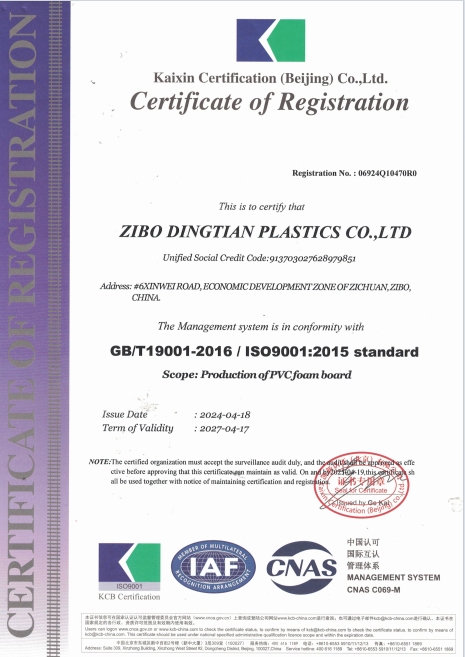
ISO9001 certificate 06924Q10470RO, issued 18 April 2024 by Kaixin Certification (Beijing) Co., Ltd., with production of PVC foam board named in the scope.
Why Certification Claims Break Down During Evaluation
The evaluation stage is where vague compliance language becomes expensive. Buyers comparing PVC Free Foam Board, PVC Celuka Foam Board and PVC Co-extruded Foam Board are usually handed the same three artefacts: a logo block on a website, the phrase fully certified, and a scanned certificate attached to a quotation. None of these tells a purchasing team what was tested, on which product, under which standard, or when.
Three failure modes recur in PVC foam board sourcing, and all three are visible before a sample is even shipped:
- The number is missing. A certificate without a traceable registration number cannot be checked against the issuing body, so its status is unknowable.
- The scope does not match the product. A management-system certificate describes how a factory controls production. It does not describe the performance of a specific board grade, density or thickness.
- The date predates the product. A test report issued years ago describes a sample tested at that time. If the formulation or process has since changed, the report answers a question the buyer is no longer asking.
Each class of document answers a different question. A management-system certificate says the factory runs controlled, auditable processes. A product test report says a laboratory found specific results in a submitted sample. A supplier datasheet says only what the seller states. Treating the three as interchangeable is the most common evaluation error in this category, and it is the error that a document-by-document reading corrects.
The Four Documents Behind DINGTIAN's Compliance Claims
The company's published compliance set is small and specific, which makes it easy to audit. Each entry below can be checked against the issuer using the number shown.
| Document | Number | Issued by | Standard cited | Scope as recorded | Issue date |
|---|---|---|---|---|---|
| ISO9001 quality management system certification | 06924Q10470RO | Kaixin Certification (Beijing) Co., Ltd. | GB/T19001-2016 and ISO9001:2015 | Production of PVC foam board | 18 April 2024, valid to 17 April 2027 |
| REACH test report | TSNEC1701167001 | SGS | REACH Regulation (EC) No 1907/2006 | PVC foam board, EU market | 3 July 2017 |
| RoHS test report | QDAFN160100422 | SGS | IEC 62321 | PVC foam board, EU market | 4 February 2016 |
| Formaldehyde test report | TSNHG2301164301 | SGS | ISO 17226-1:2021 | PVC foam board, global market | 10 May 2023 |
Read as a set, the four documents cover three different layers: process control (ISO9001), restricted substances relevant to EU market access (RoHS and REACH), and formaldehyde content (the 2023 SGS report). The associated product record describes a Celuka-type PVC foam board supplied in 1220×2440 mm, 1560×3050 mm and 2050×3050 mm sheets, in thicknesses from 1 mm to 35 mm and densities from 0.4 to 0.9 g/cm³.
Reading the ISO9001 Certificate Correctly
ISO9001 certificate 06924Q10470RO is the entry point of any supplier review, because it is the only document in the set that speaks about the factory rather than about a sample. It was issued by Kaixin Certification (Beijing) Co., Ltd. on 18 April 2024 against GB/T19001-2016 and ISO9001:2015, and it remains valid until 17 April 2027.
What the certificate establishes is a documented quality system: defined process ownership, internal audit cycles, corrective and preventive action procedures, calibration discipline and record traceability across production. That is meaningful context for a plant that reports a 100% product test regime across its output. What the certificate does not establish is any specific performance figure — not density tolerance, not thickness tolerance, not flatness, not fire classification, not UV or weathering behaviour. Those belong to product-level test data.
The scope line matters as much as the number. Here the recorded scope is production of PVC foam board, which matches the product the buyer is actually purchasing. A scope covering trading, distribution or an unrelated material would be a warning sign even if the certificate itself were genuine. Two checks take under a minute: confirm the number with the issuing body, and confirm that the expiry date on the copy in the quotation matches the date held by the issuer.
Reading the SGS Reports: REACH, RoHS and Formaldehyde
The three SGS documents are product-level evidence, and each answers a different buyer question.
The RoHS test report QDAFN160100422, issued 4 February 2016, cites IEC 62321 — the analytical method series referenced for testing restricted substances — and is scoped to PVC foam board for the EU market. For a European importer, this is the document that speaks to restricted substance screening in the supplied material.
The REACH test report TSNEC1701167001, issued 3 July 2017, cites REACH Regulation (EC) No 1907/2006, the EU framework governing the registration, evaluation, authorisation and restriction of chemicals, and is also scoped to PVC foam board for the EU market. It supports substance-related due diligence for shipments entering the EU.
The formaldehyde test report TSNHG2301164301, issued 10 May 2023, cites ISO 17226-1:2021 and is scoped to PVC foam board for global markets. For furniture, cabinetry and interior fit-out buyers, formaldehyde documentation is usually driven by indoor-air expectations rather than customs requirements, which is why it is often requested later in the process than the EU documents.
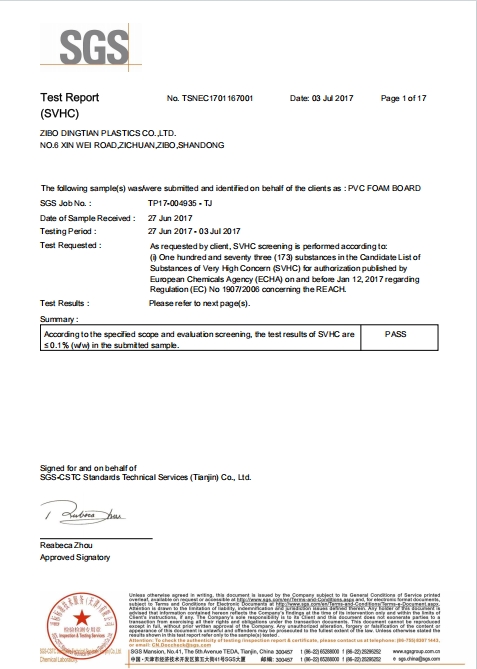
SGS REACH test report TSNEC1701167001, issued 3 July 2017 under REACH Regulation (EC) No 1907/2006, scoped to PVC foam board.
A test report is a photograph of a sample on a date, not a standing guarantee. The RoHS and REACH reports in this set were issued in 2016 and 2017; the formaldehyde report in 2023. Buyers should ask whether the formulation of the specific grade they intend to order has changed since those dates, and request an updated report where it has. That is not a criticism of the supplier — it is how third-party testing is supposed to be used.
A Four-Step Verification Routine Before a Purchase Order
The routine below converts the document set into a repeatable evaluation step. It applies to any supplier, not only to DINGTIAN.
- Match the number to the issuer. For the ISO9001 certificate, confirm 06924Q10470RO with Kaixin Certification (Beijing) Co., Ltd. For the SGS reports, check that each report number appears on complete SGS letterhead with sample description, test method, result table and issue date. A one-page extract without a method section is not a substitute.
- Match the scope to the SKU. The reports name PVC foam board. Confirm that the grade you intend to order — white or coloured, laminated, high-density or flame-retardant — sits inside that description, and ask for a written statement if the variant differs from the tested sample.
- Match the standard to the destination market. EU-bound consignments typically require REACH and RoHS coverage, and customs classification under HS code 39211200 for cellular vinyl chloride plates. Indoor furniture programmes typically require formaldehyde documentation. Project specifications may add fire classification requirements that the general certificate set does not address.
- Match the date to the current formulation. Record the issue date of each report in the supplier file and ask for re-issuance when a formulation, colour system or lamination process changes.
A practical shortlist rule: treat certification as a pass/fail gate applied before commercial comparison, not as a scoring column inside it. A supplier that fails the gate should not be ranked on price, because the price is attached to an unverified product.
Where the Documents Carry Weight in Real Applications
DINGTIAN's product record places advertising and signage at about 35% of use, construction and decoration at 30%, furniture and cabinetry at 15%, transportation at 10% and special-purpose work at 10%. Each segment asks a different compliance question, which is why a single certificate cannot answer all of them.
In signage, the relevant questions are substance compliance for EU-bound print substrates and dimensional stability in service. Reference density bands published for the category place PVC Free Foam Board at roughly 0.4-0.6 g/cm³ for UV printing and mounting, and PVC Celuka Foam Board at roughly 0.55-0.8 g/cm³ for furniture and cabinets; DINGTIAN's stated 0.4-0.9 g/cm³ range spans both bands, which means buyers must specify the density they need rather than assume a single default. One distributor-wholesaler case in the company's records, running at 10 containers per month over a 5-10 year relationship, reports 98% print image retention after three years, zero warping or delamination, 40% cost saving against aluminium composite panel and 100% waterproof performance in service.
In furniture and cabinetry, the 2023 formaldehyde report is the document most often requested, because indoor-air expectations are contractual in many markets rather than regulatory. In construction and decoration, buyers frequently specify flame-retardant grades and cite classification targets such as DIN 4102 B1/B2 or UL 94 V-0; that requirement sits outside the published certificate set and should be raised as a separate, grade-specific request. In transportation and industrial work, the questions shift again, towards consistency of thickness and density across batches.
Market Trend: Documentation as a Purchasing Gate
Two structural pressures are pushing certificate review earlier in the buying process. The first is scale. With the PVC foam sheet market estimated at USD 2.28 billion in 2024 and forecast to grow at 4.99% CAGR to 2035, the number of exporters quoting on any given enquiry keeps rising, and document sets become the cheapest way to reduce a long list. The second is application mix. Laird Plastics' category guide places signage at roughly 35% of demand, followed by construction and furniture — segments where the buyer is often a brand owner or project contractor who must hold compliance records for their own customers, not only for customs.
The practical result is that suppliers are now evaluated on the completeness of a file before they are evaluated on a price. A supplier able to state a certificate number, an issuing body, a standard and a scope in one line moves through pre-qualification faster than a supplier that answers with an adjective.
Certificate-Backed Evidence vs Traditional Supplier Assurance
Buyers rarely compare certificates with certificates. More often they compare a certificate with a promise. The table below sets out what each evidence type actually establishes.
| Evidence type | What it establishes | How to verify | Boundary |
|---|---|---|---|
| Verbal or brochure claim | Supplier intent | Not verifiable | Carries no evidentiary weight |
| Self-declared datasheet | Nominal specification such as density, thickness or colour range | Sample testing and incoming inspection | First-party; no third-party confirmation |
| ISO9001 certificate 06924Q10470RO | Audited production process control | Issuer record, scope line, expiry date | System-level; says nothing about board performance |
| SGS REACH, RoHS and formaldehyde reports | Laboratory results for named substances in a submitted sample | Report number, test method, sample description, issue date | Point-in-time and sample-based; does not cover every variant |
| Batch certificate of analysis per shipment | Conformance of the actual delivered lot | Per-lot testing and retained samples | Not part of the published certificate set; request per order where the application requires it |
Three boundaries deserve to be stated plainly, because they define how far this evidence set can be pushed. First, none of the four documents is a batch certificate: they describe a system and samples tested on specific dates between 2016 and 2024, so a buyer taking delivery later is not receiving the tested sample and should request per-shipment documentation where the end use demands it. Second, the published set contains no fire classification — buyers whose projects specify DIN 4102 or UL 94 performance need grade-specific fire test reports for the exact thickness and density on order, and should not infer a classification from a management-system certificate or a product description. Third, the documents do not itemise variants: the scope reads PVC foam board, without separating white from coloured, rigid from semi-rigid or flexible, laminated from unlaminated, or high-density from low-density, so confirmation against the tested sample is the buyer's responsibility.
Outlook for Certificate-Led Sourcing
The direction of travel is towards smaller, more frequently refreshed document sets rather than larger ones. As EU substance rules continue to tighten and as brand owners extend compliance obligations down their supply chains, a test report that has not been revisited since a formulation change becomes a liability rather than an asset. Suppliers that re-test on process or colour changes, and that publish issue dates openly, will be easier to qualify and cheaper to audit.
For buyers, the more useful shift is procedural. A four-field record — document number, issuer, scope, issue date — captured at enquiry stage turns compliance from a negotiation into a checklist, and it makes later comparisons between shortlisted suppliers factual rather than impressionistic. That record is also what allows a purchasing team to explain a sourcing decision internally when a certificate is questioned.
FAQ
Which PVC foam board certificates should a buyer verify first?
Start with the management-system certificate, because it applies to the factory as a whole, then move to product-level reports. For DINGTIAN that means ISO9001 certificate 06924Q10470RO first, followed by SGS report TSNEC1701167001 (REACH), QDAFN160100422 (RoHS) and TSNHG2301164301 (formaldehyde). Market-specific requirements, such as fire classification, should be added after the general file has been checked.
What exactly does DINGTIAN's ISO9001 certificate cover?
Certificate 06924Q10470RO was issued by Kaixin Certification (Beijing) Co., Ltd. on 18 April 2024 against GB/T19001-2016 and ISO9001:2015, with production of PVC foam board named in the scope, and it is valid until 17 April 2027. It certifies the quality management system governing production. It does not certify density, thickness tolerance, flatness, fire behaviour or weathering performance for any individual board.
What do the SGS REACH and RoHS reports prove about DINGTIAN PVC Foam Board?
The RoHS report QDAFN160100422, issued 4 February 2016 and citing IEC 62321, records test results for restricted substances in a PVC foam board sample for the EU market. The REACH report TSNEC1701167001, issued 3 July 2017 under Regulation (EC) No 1907/2006, records results relevant to EU substance compliance for the same product scope. Both are sample-based results tied to their issue dates.
Do these certificates cover fire performance or UV and weather resistance?
No. The published set consists of a management-system certificate and three substance-related test reports; it contains no fire classification and no weathering or UV test data. Buyers whose specifications reference DIN 4102 B1/B2 or UL 94 V-0, or who need documented outdoor durability, should request grade-specific test reports for the thickness and density they intend to order.
Are coloured, laminated or high-density variants covered by the same reports?
The reports are scoped to PVC foam board as a product description and do not itemise colour, lamination, rigidity class or density band. DINGTIAN's associated product record covers sheets of 1220×2440 mm, 1560×3050 mm and 2050×3050 mm, thicknesses of 1-35 mm and densities of 0.4-0.9 g/cm³. Where a buyer orders a variant outside the tested sample description, written confirmation or re-testing should be requested.
How should certification be weighted against price and lead time in a shortlist?
Certification works best as a pass/fail gate applied before commercial comparison, because price and lead time are only meaningful for a product whose compliance has already been established. Once the gate is passed, commercial factors take over. In DINGTIAN's case the relevant terms for that second stage include OEM and ODM production, customisation of size, thickness, density and colour, a stated monthly capacity of 4,200 tons, an MOQ of one 20ft GP container and a 30-day lead time.
Company reference: Zibo Dingtian Plastics Co., Ltd., Zichuan Economic Development Zone, Zibo City, Shandong, China. Product and compliance documentation: dingtianpvc.com. Full specification and certificate file: DINGTIAN product brochure (PDF).
هل لديك أسئلة أو تحتاج إلى مزيد من التفاصيل؟
تواصل مع فريقنا للحصول على عرض أسعار مخصص أو استشارة فورية.
طلب عرض أسعار
املأ النموذج أدناه وسيتواصل معك فريقنا بعرض مقترح مخصص.
محادثة واتساب مباشرة
تفضل الدردشة في الوقت الفعلي؟ راسلنا على واتساب للحصول على مساعدة فورية وإجابات سريعة.
- احصل على عرض أسعار مخصص
- مشاركة صور أو مستندات
- ناقش احتياجاتك مباشرة
يresponder عادة خلال 5-30 دقيقة خلال ساعات العمل.