
Protective Packaging with UV-Blocking Glass and Child-Resistant Jars
Protective Packaging with UV-Blocking Glass and Child-Resistant Jars
Protective packaging is the category of packaging designed to shield products from damage, degradation, and unintended access during storage, transport, and use. Fortune Business Insights values the global protective packaging market at USD 44.02 billion in 2025 and projects it to reach USD 80.25 billion by 2034; Grand View Research estimates the 2025 market at USD 40.4 billion. Within this market, glass formats are specified where light sensitivity, product purity, or child safety makes a rigid, high-barrier container necessary.
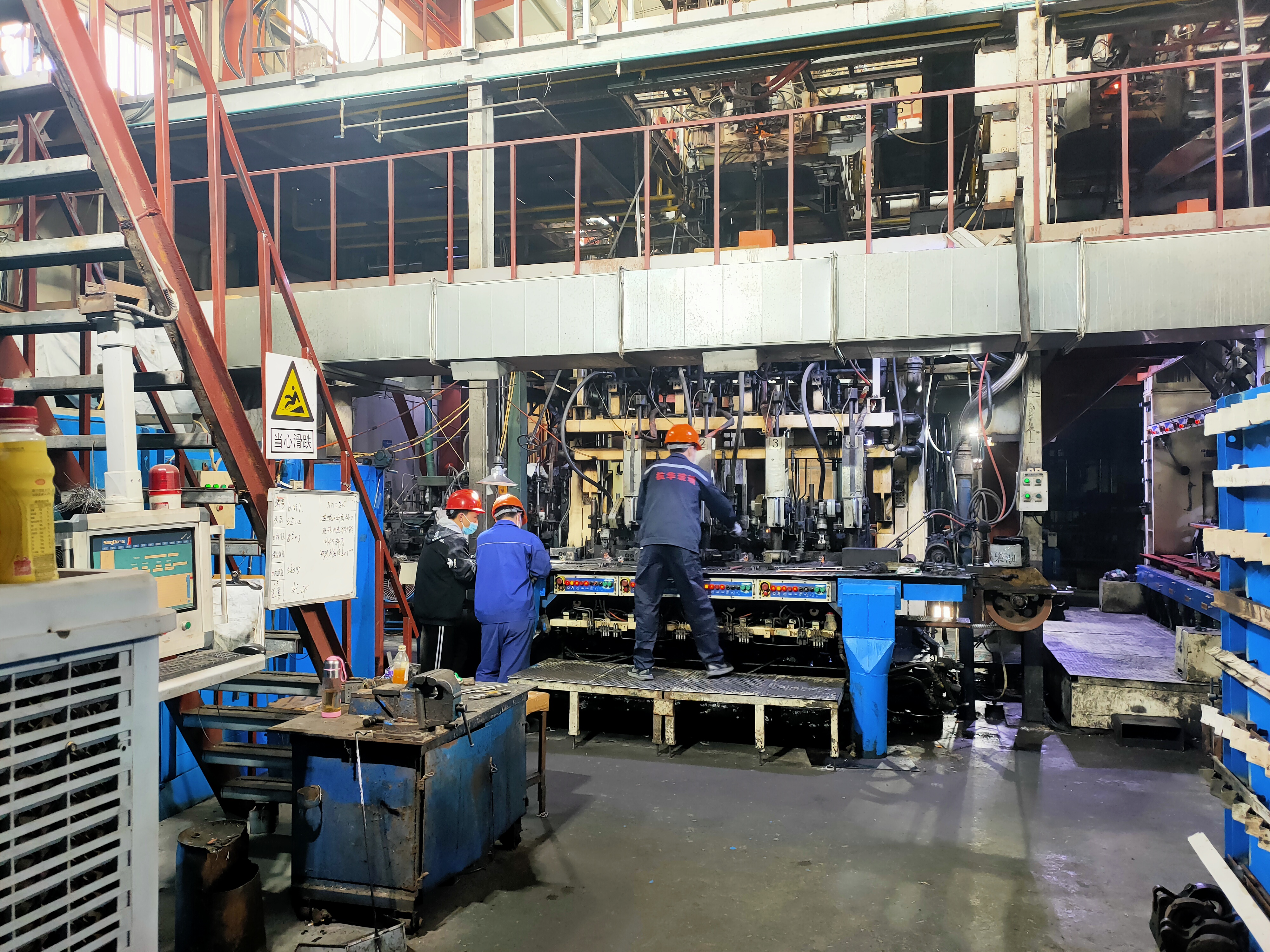
NINGBO HONOR PACKAGING CO.,LTD is a packaging manufacturer established in 2015 in Ningbo, China, that specializes in child resistant packaging, violet glass packaging, and vacuum packaging. The company operates through long-term joint-venture production bases for plastic and glass packaging and exports 100% of its output, with major markets in the EU and USA. This article explains how UV-blocking glass jars, child-resistant closures, and vacuum jars function as protective packaging, where they are used, and what procurement teams should weigh when evaluating them.
Why Protective Packaging Demands a Multi-Function Approach
Products that need protective packaging — food, cosmetics, pharmaceuticals, cannabis, supplements — share a common set of threats: light, oxygen, moisture, dust, and accidental access by children. Each threat attacks a different attribute. Ultraviolet light can break down active ingredients and shift product color. Oxygen accelerates oxidation and shortens shelf life. Moisture and dust compromise product integrity. And concentrated formulas create a safety risk in households with young children if the package can be opened too easily.
Historically, brands addressed these threats with multiple packaging layers: a jar, a foil seal, and an outer carton. The direction now in protective packaging is to consolidate protection into the primary container. A single glass jar can combine UV-blocking material, an airtight closure, and a child-resistant cap — reducing secondary components while strengthening the first line of defense.
The Regulatory and Market Opportunity
Regulation is one of the strongest drivers of protective packaging specification. In the European Union, child-resistant packaging must comply with ISO/EN 8317; in the United States, the equivalent requirement is 16 CFR 1700.20. Both standards are designed to prevent access by children under five, meaning the closure must be difficult for a young child to open while remaining operable for adults.
The commercial opportunity is equally clear. Fortune Business Insights values the global protective packaging market at USD 44.02 billion in 2025, with a projection of USD 80.25 billion by 2034. Grand View Research estimates the 2025 market at USD 40.4 billion — a difference that reflects segmentation criteria — and reports that flexible materials hold the largest revenue share at 66.4%, while paper and paperboard account for 45.7%. What is consistent across sources is the direction: buyers are specifying more protective functions per package, and suppliers that can integrate several functions into a single glass format are gaining traction in premium segments.
NINGBO HONOR PACKAGING: A Manufacturing Partner for Glass Protection
NINGBO HONOR PACKAGING CO.,LTD is a packaging manufacturer based in Ningbo, China, established in 2015, that partners with brands to convert finalized packaging designs into mass-produced products. The company describes itself as a manufacturing-responsibility-focused packaging partner: before mass production, it supports product structural development, tooling strategy definition, and manufacturing risk assessment; during production, it takes full responsibility for process control and order fulfillment.
Company profile at a glance:
- Founded: 2015, headquartered in Ningbo, China, near both Ningbo and Shanghai seaports
- Manufacturing facility: 45,000 square meters
- Staff: approximately 310 employees
- R&D team: 15 engineers and technicians
- Annual production capacity: 1,000,000 units
- Export ratio: 100%, with major markets in the EU and USA
The company concentrates on high-grade, technically demanding packaging products, with core product families in child resistant packaging, violet glass packaging, and vacuum packaging.
Product Portfolio at a Glance
The protective packaging range spans three families. Child resistant packaging includes the H19 concentrate jar series and the H21 square and round jar series. Violet glass packaging includes the H21 violet jar series, the HDV1 wide mouth violet jar series, the HDV2 cosmetic violet jar series, and the HDV3 round essential oil bottle series. Vacuum packaging is represented by the H19 Vacuum Click Jar.
| Product family | Model | Formats | Capacities | Closure system |
|---|---|---|---|---|
| Child Resistant Packaging | H19 | Black, white, and clear concentrate jars; square, round, triangle, hexagon | 5 ml, 9 ml | Child-resistant cap |
| Child Resistant Packaging | H21 | Clear square jars; clear round jars | 15 ml to 60 dr; 30 ml to 6 oz | Child-resistant cap |
| Violet Glass Packaging | H21 | Square and round violet glass jars | 15 ml to 200 ml | Child-resistant cap; PP / PE |
| Violet Glass Packaging | HDV1 | Wide mouth violet jars | 100 ml to 1 L | Urea, PE, SAN, or ABS |
| Violet Glass Packaging | HDV2 | Cosmetic violet jars | 3 ml to 200 ml | Urea, PE |
| Violet Glass Packaging | HDV3 | Round essential oil bottles | 5 ml to 100 ml | Plastic cap, dropper, mist sprayer, lotion pump |
| Vacuum Packaging | H19 | Vacuum Click Jar, square | 5 ml | Vacuum seal |
How the Technology Works
Violet glass and UV protection
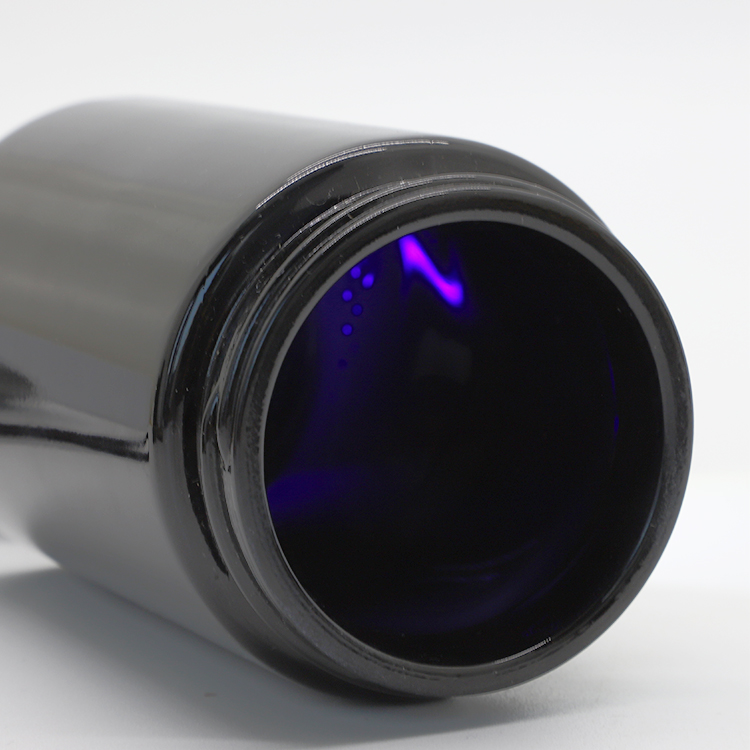
Violet glass — also called biophotonic glass — provides UV protection packaging at the material level. According to the science of violet glass published by Miron Violetglass, violet glass blocks visible light while allowing 25% to 45% penetration of UVA and 60% of infrared light, a selective transmission intended to preserve organic contents. The practical implication: the glass itself is the filter, so light-sensitive products do not require an opaque coating or insert.
Honor Packaging produces violet glass in several formats. The HDV1 wide mouth violet jar covers 100 ml to 1 L. The HDV2 cosmetic violet jar spans 3 ml to 200 ml. The HDV3 round essential oil bottle spans 5 ml to 100 ml. The H21 violet jar series adds square and round formats with child-resistant caps. Many models in the range — including the HDV1, HDV2, and H21 series — are manufactured with a glass thickness of 0.38 mm.
Child-resistant closures
Child resistant packaging combines a glass body with a cap designed around the intent of ISO/EN 8317 in the EU and 16 CFR 1700.20 in the US. In the H19 series, concentrate jars are available in black, white, and clear glass with a child-resistant cap, in square, round, triangle, and hexagon shapes. In the H21 series, the clear square jars (58 mm diameter) and clear round jars (60 mm diameter) also use child-resistant caps. The black concentrate jars, in particular, combine a light-blocking container with a child-resistant cap — a configuration relevant for products requiring both UV protection packaging and access control.
Vacuum packaging
The H19 vacuum jar, also called the Vacuum Click Jar, is a square-shaped glass jar with a 5 ml capacity and a vacuum seal feature. The vacuum format limits air exposure for small-format contents and is designed for food, cosmetic, and medical applications. Packaging quantity is 250 pieces per carton. Cap materials across the wider range are selected per model: PP and PE on the H21 series; Urea, PE, SAN, or ABS on the HDV1 wide mouth series.
Decoration and surface treatment
Because protective packaging also carries brand and compliance information, most models support surface treatments including sticker, silk-screen printing, hot stamping, heat transfer printing, and frosted finish. These options support printed protective packaging and custom protective packaging: a brand can combine light blocking, child resistance, and vacuum sealing with labels, printed graphics, and decorative effects on the same glass container.
Application Scenarios
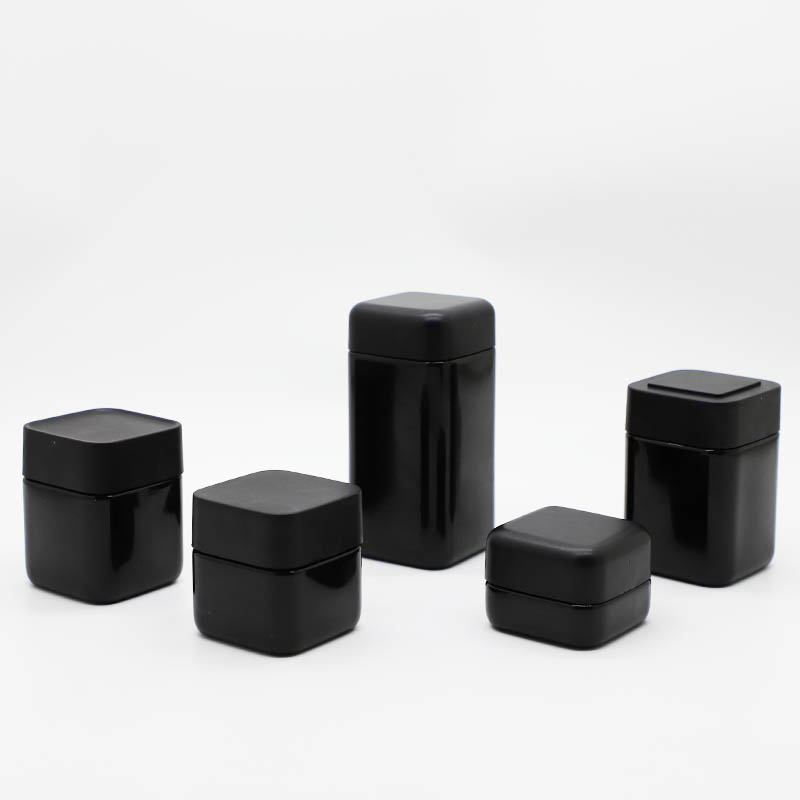
Application reference data for the glass jar series documents working conditions that include UV black glass protection, dust protection, and freshness retention, with a child-resistant cap specified as the closing system. The referenced projects span food packaging, cosmetic packaging, and pharmaceutical packaging, with manual filling operation, and cover markets including Canada, Germany, India, Italy, Thailand, and the United States.
Food packaging
The HDV1 wide mouth violet jar, available from 100 ml to 1 L, suits food storage formats such as dry goods, herbs, and ingredients that benefit from light-blocking containers. The H19 vacuum jar provides a small-format airtight glass option for fresh-keeping applications. Both formats position glass as a refillable, hygiene-friendly alternative to single-use containers.
Cosmetic packaging
The HDV2 cosmetic violet jar (3 ml to 200 ml) and the HDV3 round essential oil bottle (5 ml to 100 ml) cover creams, balms, serums, and oils. The HDV3 offers four closure options — plastic cap, dropper, mist sprayer, and lotion pump — so the same bottle can adapt to different viscosities and dosing requirements. Surface treatments such as silk-screen printing and gold stamping allow decorative, brand-specific finishing.
Medical and pharmaceutical packaging
The H21 clear square jar with child-resistant cap is designed for the pharmaceutical and medical industry, with capacities from 15 ml to 60 dr. The H19 concentrate jars provide 5 ml and 9 ml small formats in black, white, or clear glass. The combination of glass inertness and a documented child-resistant cap addresses both stability and safety requirements.
Cannabis and supplements
The H19 and H21 child-resistant series and the violet glass series all list cannabis and supplements among applicable industries. The defining requirements in this category are access control and light protection. A violet glass jar or black concentrate jar with a child-resistant cap delivers both in a single format.
Market Trends Shaping Protective Packaging
Three trends are visible in current market data. First, the protective packaging market is expanding: Fortune Business Insights projects growth from USD 44.02 billion in 2025 to USD 80.25 billion by 2034. Second, material substitution continues: Grand View Research reports that paper and paperboard held a 45.7% revenue share in 2025, reflecting sustainability-driven selection of recyclable materials. Third, flexible packaging leads the mix at 66.4%, which suggests that rigid formats such as glass are specified selectively — for products where barrier, safety, or presentation requirements justify a heavier container.
In the broader packaging market, Fortune Business Insights anticipates the secondary packaging segment will hold a dominant 48.54% share by 2026. For protective glass packaging, the implication is that primary and secondary packaging decisions are increasingly coordinated: a light-blocking primary jar can reduce the need for opaque secondary cartons, simplifying the overall bill of materials.
Among leading global manufacturers in protective packaging — Sealed Air Corporation, Smurfit Westrock, Mondi Group, and Amcor plc, according to Mordor Intelligence — the product mix is predominantly flexible and paper-based. This leaves glass-focused suppliers differentiated on the combination of UV filtering, child resistance, and vacuum sealing.
Glass Jars vs. Traditional Protective Materials
Compared with flexible and paper-based protective packaging, glass jars offer three structural advantages. First, glass is inert: it does not interact with the product, which matters for pharmaceuticals and sensitive cosmetics. Second, glass formats can be refilled: the H21-0012V to H21-0018V round jar series is explicitly positioned as a refillable glass storage jar with a child-resistant cap, supporting reuse instead of single-use disposal. Third, multiple protective functions can be integrated into one container — UV-blocking violet glass, a child-resistant cap, and a vacuum seal — which simplifies the packaging system and reduces the number of components a brand must source.
The honest limitation is weight and fragility. Glass is heavier and more breakable than flexible film or paper structures, which can raise transport and handling costs. This is why export-oriented suppliers pay close attention to logistics: Honor Packaging's production base in Ningbo sits close to both Ningbo and Shanghai seaports, mitigating part of the logistical penalty of rigid formats. Buyers should evaluate this trade-off against the product's sensitivity, shelf-life target, and channel — for premium, light-sensitive, or regulated products, the protective performance of glass usually justifies the weight premium.
Future Outlook
Several directions are likely to shape protective glass packaging over the next cycle. Custom protective packaging is becoming a standard request rather than a premium option: brands want specific capacities, closure types, and surface treatments configured from available tooling. The refillable glass storage jar concept aligns with sustainability targets in Europe and North America, where reusable packaging is increasingly preferred over single-use formats. Compliance-driven design will also continue: as child-resistant requirements are adopted across more categories, demand for glass jars with documented child-resistant caps will grow.
For procurement teams, the practical question is whether a supplier can hold manufacturing discipline across these functions. Honor Packaging's model — in-house structural development, tooling strategy, manufacturing risk assessment, and full responsibility for process control and order fulfillment — is structured for brands that need consistent, repeatable mass production. With an R&D team of 15 engineers, an annual capacity of 1,000,000 units, and long-term joint-venture production bases for plastic and glass, the company is positioned for medium-to-large custom packaging programs.
FAQ
1. What is protective packaging?
Protective packaging is packaging designed to protect a product from damage, degradation, and unintended access during storage, transport, and use. Common protective functions include UV and light blocking, airtight and moisture sealing, dust exclusion, cushioning, and child-resistant closures.
2. Why is UV-blocking glass used in protective packaging?
UV-blocking glass — such as violet (biophotonic) glass — filters light at the material level. According to the science of violet glass published by Miron Violetglass, violet glass blocks visible light while allowing 25% to 45% penetration of UVA and 60% of infrared light, which helps preserve organic contents that are sensitive to light.
3. What standards apply to child-resistant packaging?
In the European Union, child-resistant packaging must comply with ISO/EN 8317; in the United States, the requirement is 16 CFR 1700.20. Both standards are designed to prevent children under five from opening a package while keeping it accessible to adults.
4. What is the difference between the H19 and H21 child-resistant jar series?
The H19 series is a set of concentrate jars in black, white, or clear glass, with 5 ml and 9 ml capacities and square, round, triangle, or hexagon shapes. The H21 series includes clear square jars (15 ml to 60 dr), clear round jars (30 ml to 6 oz), and violet glass square and round jars, all using child-resistant caps on the square and round formats.
5. What is the H19 vacuum click jar?
The H19 vacuum jar, also called the Vacuum Click Jar, is a square-shaped glass jar with a 5 ml capacity and a vacuum seal feature. It is intended for food, cosmetic, and medical applications and is packed 250 pieces per carton.
6. What customization options are available on these glass jars?
Most models support sticker, silk-screen printing, hot stamping, heat transfer printing, and frosted finish. Closure materials can also be specified per model — for example, PP and PE on the H21 series, and Urea, PE, SAN, or ABS on the HDV1 wide mouth jar series.
7. Which industries use violet glass and child-resistant jars?
These formats are used in food and beverage, cosmetics and daily chemicals, pharmaceutical and medical, cannabis, supplements, packaging design, and packaging wholesale applications.
8. What sizes are available in the wide mouth violet jar series?
The HDV1 wide mouth violet jar is available in 100 ml, 150 ml, 200 ml, 250 ml, 300 ml, 500 ml, and 1 L capacities, with diameters from 48 mm to 95 mm, heights from 84.7 mm to 193 mm, and net weights from 117 g to 610 g.
About NINGBO HONOR PACKAGING CO.,LTD
NINGBO HONOR PACKAGING CO.,LTD specializes in child resistant packaging, violet glass packaging, and vacuum packaging for food, cosmetic, medical, cannabis, and supplement brands. The company is based in Ningbo, China, with a 45,000 square meter facility, a 15-person R&D team, and an annual production capacity of 1,000,000 units.
Website: www.honorcrpkg.com
Email: info@honorpkg.com
Tel: +86-574-88004632
WhatsApp: +86 15968944995
Address: Rm.305, No.1 Building, No.568, SiMing East Road, YinZhou District, NingBo City, China
Download the company brochure: NINGBO HONOR PACKAGING brochure (PDF)