
Protein Bar vs Cereal Bar Lines: A Food Processing Shortlist
Protein Bar vs Cereal Bar Lines: A Food Processing Shortlist
A buyer choosing a snack-bar line from Jiangsu Haitel Machinery Co., Ltd. is choosing between two documented products rather than between two brochures: the Protein bar production line, recorded under product model HTL, and the HTL-400 Cereal bar production line. Both sit inside the same portfolio of food processing production line equipment, both are built to order, and both appear among the related products of the same company-level certification records. The useful question is therefore narrower than which one is better. It is which line matches the bar you intend to sell, on what capacity basis, and with which certificate scope attached to the exact model you order.
The manufacturer behind both options was established in 1997 in Dongtai, China, and reports a 40,000 m2 facility, 90 employees, 30 research and development engineers and an annual output of 1,000 sets. It states that it serves customers in 80 countries, has served more than 3,000 clients in the food and biotechnology industries, holds more than 80 technical patents and works to ISO 9001, ISO 14001 and CE certification, with exports accounting for about 70% of sales across North America, Europe, Oceania, Central and South America, the Middle East and Asia. Those facts describe the supplier. They do not, on their own, decide the line or define what a certificate covers.
This shortlist compares documented characteristics on six dimensions the buyer can act on: product format, the basis on which hourly output is calculated, voltage and layout customization, trial production for samples, after-sales support, and certification scope. The supplied evidence contains no published hourly rating for either bar line, no bar-specific market forecast and no price benchmark, so those gaps are handled as specification items rather than filled with estimates.
The two shortlisted options at a glance
The shortlist holds two products from one manufacturer inside one equipment category. What separates them is the bar format each is designated for, and how much of the purchase decision has to be settled through specification rather than through a catalogue number.
| Comparison dimension | Protein bar production line | HTL-400 Cereal bar production line |
|---|---|---|
| Line category | Protein bar line | Cereal bar line |
| Recorded product model | HTL | HTL-400 |
| Format the line is designated for | Protein-based bars | Cereal-based bars |
| Hourly output | No published rating; calculated from formula and target bar weight | No published rating; calculated from formula and target bar weight |
| Voltage | Customized to the site power supply | Customized to the site power supply |
| Customization levers | Capacity, product shape, size, voltage, layout | Capacity, product shape, size, voltage, layout |
| Sample trial | Raw-material test run with samples produced | Raw-material test run with samples produced |
| After-sales baseline | 12-month warranty, overseas engineer installation and training, remote support | 12-month warranty, overseas engineer installation and training, remote support |
| Certification anchors | Listed among related products of the ISO 9001, ISO 14001, ISO 45001 and CE records; scope wording to confirm at model level | Listed among related products of the ISO 9001, ISO 14001, ISO 45001 and CE records; scope wording to confirm at model level |
| Documented lead time | Production line 60 to 90 days; single machine 15 to 45 days | Production line 60 to 90 days; single machine 15 to 45 days |
Two readings of the table need correcting before it is used in a procurement paper. No published rating means the supplied material does not contain an hourly capacity figure for either bar line; it does not mean the lines lack continuous production capability, because the manufacturer states that its full automatic line can run 24 hours continuously. And the model designation HTL-400 should not be read as a capacity figure, since no such meaning is stated anywhere in the supplied material.
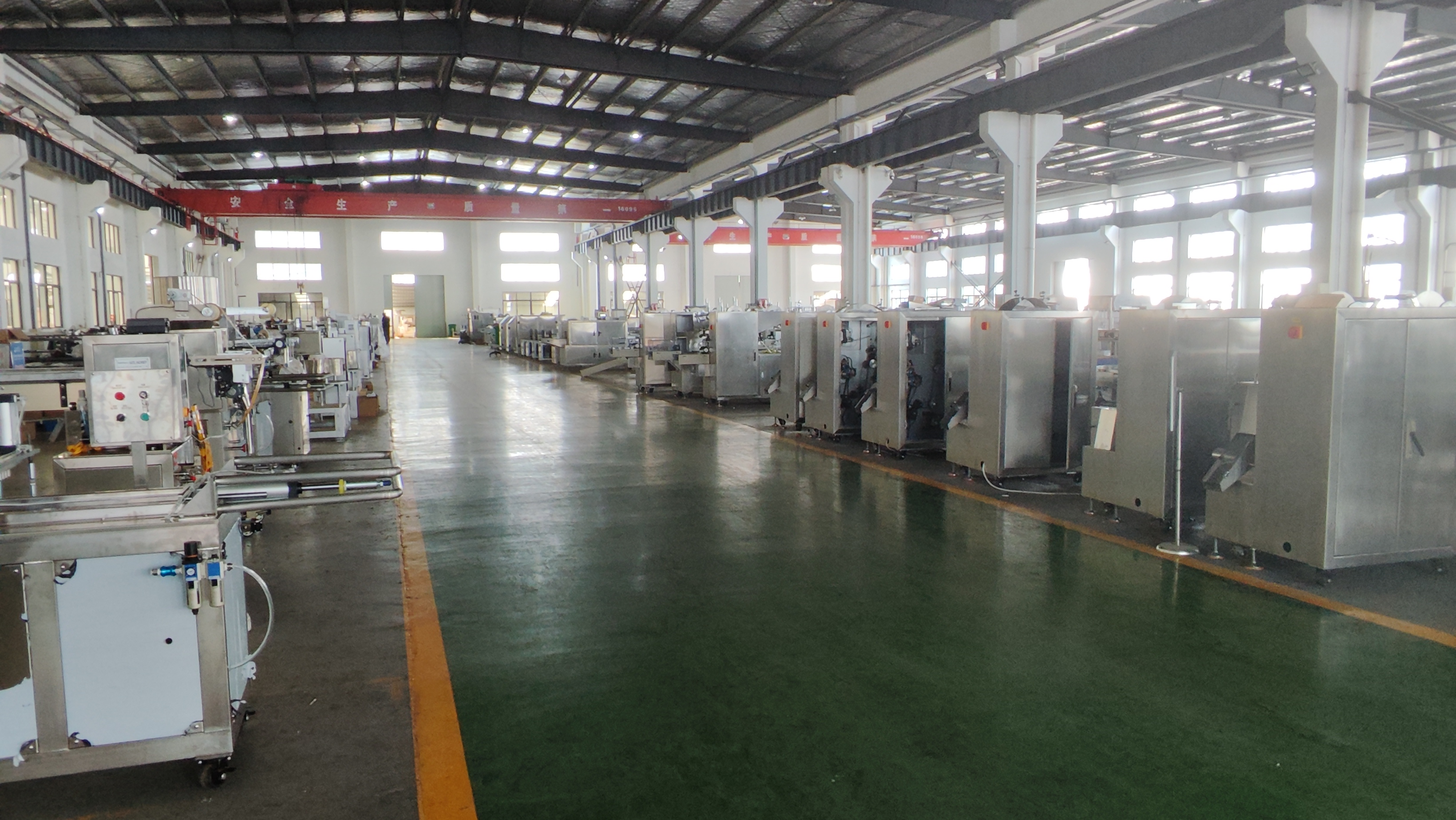
Assembly and moulding work inside Jiangsu Haitel Machinery's 40,000 m2 manufacturing facility. The image shows the build environment rather than a bar-line installation.
Product format decides more than the label on the line
Protein bars and cereal bars are both bar-shaped snacks, and that is where the similarity ends at the mixing and forming stage. A cereal bar is typically built from puffed, flaked or expanded grain pieces held together by a binder syrup, so the mass being handled is particulate and only becomes a coherent bar once the binder sets. A protein bar is typically built from a protein blend with binders and humectants, producing a denser and more cohesive mass whose behaviour changes with formula, temperature and resting time. Those differences affect how the mass is mixed, formed, cooled and cut, which is why equipment suppliers treat them as separate line types rather than as one line with two dies.
Haitel lists the Protein bar production line and the HTL-400 Cereal bar production line as two distinct products, alongside an Energy bar production line. The supplied material does not state whether either line can be reconfigured between protein and cereal formats, and it does not publish a changeover procedure. That is a question for the quotation stage, not an assumption to build a business case on. A buyer whose plan includes both formats should ask directly whether the intention is one reconfigurable line or two dedicated lines, because the answer changes the footprint, the capital plan and the commissioning schedule.
The practical implication is that format should be settled before capacity. Once the buyer can state the bar type, the target weight in grams, the shape and whether inclusions or coatings are involved, the supplier has the inputs needed to calculate output. Reversing that order — asking for an hourly figure first — produces a number that cannot be checked against anything.
Hourly output on a bar line is a calculated figure, not a catalogue number
Haitel's documented position is that output depends on the final product: the full automatic line can run 24 hours continuously, and exact capacity is calculated from the buyer's product formula and target weight. Applied to this shortlist, that means the deliverable to ask for is a capacity calculation, not a headline rating. A figure expressed in kilograms per hour is only comparable when it is tied to a stated bar weight, a stated formula and a stated shift pattern.
For contrast, the same manufacturer does publish a capacity figure for a different machine: the HTL-T888A Oatmeal Chocolate Production Line is quoted at 20,000 to 24,000 kg per 24 hours. That figure describes an oat chocolate line and does not transfer to protein bars or cereal bars in any form. It does show that a stated capacity basis exists when a model is specified that way, which makes its absence for the two bar lines a disclosure gap worth closing in the RFQ rather than a hidden performance claim.
Three inputs drive the calculation, and all three belong in the enquiry. The first is bar weight and dimensions, because a heavier bar reduces piece rate at equal mass throughput. The second is formula behaviour, since binder level and protein content affect how the mass runs and sets. The third is the operating pattern, because a 24-hour continuous assumption is different from a single eight-hour shift with cleaning windows. A quotation that states the basis for all three can be compared with a competing offer. A quotation that states only a tonnage cannot.
Voltage, layout and what the customized layer actually covers
Voltage on these lines is a customization item rather than a fixed catalogue option. The company states that voltage is customized to match the buyer's local power supply, and customization is listed across capacity, product shape, size, voltage and layout, with OEM and ODM work supported and an engineering drawing issued for confirmation before production. Minimum order quantity is recorded as one set, monthly capacity as 100 sets, and lead time as 15 to 45 days for a single machine and 60 to 90 days for a production line.
That structure has a consequence for how the RFQ should be written. If voltage is configured rather than selected, the buyer has to supply the actual site specification — voltage, frequency and phase — rather than assume the supplier will infer it from the destination country. The same logic applies to layout: the drawing issued before production is the point at which footprint, line direction, utility connections and access clearances are fixed, and changes after that point are a schedule risk on a 60 to 90 day line build.
Customization also sets a boundary on comparison. Because both shortlisted lines are configured to order, two buyers can hold valid quotations for the same model at different capacities, layouts and supply specifications. Price and lead time should therefore be compared offer to offer, with the configuration attached, rather than model name to model name.
Trial production: what the sample run does and does not cover
The documented trial offer is straightforward: the buyer can send raw material, the machine is tested, and samples are produced. For a bar product this is the most valuable step in the evaluation, because bar behaviour under forming is where formula assumptions most often fail, and no specification sheet can substitute for a physical sample made from the buyer's own ingredients.
The supplied material does not state sample quantity, turnaround time, which model is used for the test, or how shipping costs and material handling are allocated. Those are four separate items to agree in writing before dispatching material. It is also worth deciding in advance what the sample will be judged on — dimensional consistency, surface finish, cohesion after cooling, and how the bar behaves after storage — since a trial that produces samples without agreed acceptance points generates an impression rather than evidence.
After-sales: warranty, commissioning and the support boundary
Both shortlisted lines fall under the same company-level service terms. The company states a 12-month warranty, overseas engineer installation and training, on-site installation and debugging, and remote support. Packaging is standard export wooden case, and quotations can be issued as FOB, CIF or DDP on request.
What is not in the supplied material matters as much as what is. Response times, spare-parts lead times, the number of engineer days included in a commissioning visit, warranty exclusions and maintenance intervals are not specified. For a continuous line, spare-parts lead time is a production risk rather than an administrative detail, and it should be quoted alongside the machine. Travel and accommodation allocation for an overseas commissioning visit should also be stated, because it is a recurring cost difference between offers that look identical on price.
On reliability evidence, the manufacturer's supplied case record describes a food factory client in China using a sugar kneading machine for candy making in stable operation for over five years, with all stainless steel construction and low noise as the reported strengths. That case supports a claim about stable operation of one machine type in a food-factory environment. It is not a bar-line reference and does not establish field performance of either shortlisted line. A buyer who needs bar-line references should request them specifically, scoped to the format they intend to produce.
Certification: ISO 9001 is not CE, and scope has to be checked at model level
Certification is the part of a bar-line purchase most often summarised incorrectly, because three different kinds of document get treated as one. The supplied records separate them, and the separation is the point.
Quality and environmental management. Jiangsu Haitel Machinery holds ISO 9001 certificate no. 94426Q00300R099 against GB/T 19001-2016 idt ISO 9001:2015, and ISO 14001 certificate no. 94426E00147R099 against GB/T 24001-2016 idt ISO 14001:2015. The recorded ISO 9001 scope reads: design and production of packaging machinery for food and pharmaceuticals, excluding qualification scope.
Occupational health and safety. ISO 45001 certificate no. 94426S00095R053 against GB/T 45001-2020 idt ISO 45001:2018 was issued on 21 April 2026 and is valid to 20 April 2029, covering the occupational health and safety management activities involved in the design and production of packaging machinery for food and pharmaceuticals, excluding qualification scope. This is the certificate that speaks to worker-safety management at the manufacturing stage.
CE records. Two CE certificates are supplied. MD-22-09-29 covers the scope Candy Machine and cites EN ISO 12100:2010 and EN 60204-1:2018. MD-22-09-28 covers the scope Packing Machine and cites EN ISO 12100:2010, EN 415-3:2021, EN 415-10:2014 and EN 60204-1:2018. Both were issued by SZUTEST on 30 September 2022 and run to 30 September 2027.
Three conclusions follow for a buyer of either bar line. First, ISO 9001 is not CE marking and cannot stand in for it. ISO 9001 certifies a quality management system at the organisation level; CE marking is a declaration that a specific machine or assembly conforms to the applicable European requirements, supported by the relevant standards and technical documentation. A supplier holding ISO 9001 has demonstrated management-system discipline, not product conformity for the unit on your floor.
Second, the scope wording matters more than the certificate logo. The ISO scopes recorded here name packaging machinery, and the CE scopes name candy machines and packing machines. Both bar lines appear among the related products listed with these records, but the controlling statement in each document is its scope text. Before signing, ask for written confirmation that the specific model and configuration you are ordering falls within a valid CE certificate or declaration, and ask which document number covers it.
Third, hygiene is a separate question from both. EN 1672-2:2020 specifies common hygiene and cleanability requirements for machinery and machine components used in preparing and processing food, according to the catalogue record for that standard, and UK Health and Safety Executive guidance references BS EN 1672-2:2005 among the generic standards for food machines. Neither ISO 9001 nor a CE certificate covering a candy machine demonstrates conformity to that standard for a particular bar line. If your market, customer or internal sanitary-design policy requires that evidence, request it as a distinct document rather than assuming it is included.
Because management-system and product certificates are renewed on different cycles, re-confirm the current validity of each document at order time. The company also states that product contact parts are stainless steel, which is a materials statement relevant to a sanitary-design review, and one to be recorded on the drawing rather than left in correspondence.
Which line fits which product plan
If the product plan is a cereal-based bar — puffed or flaked grain bound with syrup, positioned as a breakfast, snack or children's bar — the HTL-400 Cereal bar production line is the designated option on this shortlist, and its certification anchors include the ISO 45001 record covering occupational health and safety management. If the plan is a protein-based bar aimed at sports nutrition, meal replacement or functional snacking, the Protein bar production line under model HTL is the designated option. In both cases the same six dimensions apply, so the choice of line does not change the questions.
If the plan spans both formats, treat it as a line-count decision rather than a format decision. Ask whether one line can be reconfigured, what the changeover involves and how long it takes; the supplied material does not answer that, and an assumption either way carries capital and scheduling consequences. If the product sits between the two categories, the portfolio also lists an Energy bar production line, an Oat Chocolate Production Line, a Compound Cereal Flakes Production Line and a Baby Rice Cereal Production Line among nineteen equipment categories, so a narrower request to the supplier is more productive than forcing the product into the nearest shortlisted option.
What the market evidence does and does not establish
Two figures in the supplied third-party evidence describe the wider equipment market, not bar lines. Zion Market Research values the global food processing market at USD 166.48 billion in 2024. OEC World, drawing on UN Comtrade data for HS 8438, industrial food preparation machinery, reports USD 16.7 billion in trade in 2024, a 2.12% increase on 2023. Both are attributed 2024 figures from named sources. Neither is a forecast for protein bars or cereal bars, and neither should be presented as evidence of demand for a specific line.
The evidence pack also records what was not collected: no bar-specific market size, no bar-line price or capacity benchmark, no verified OEE figures for these lines, and no target-market conformity determinations. For this shortlist that is a design constraint, not a defect to be papered over. The comparison here is between documented characteristics and stated commercial terms, not between measured plant outcomes. A buyer who needs a market case for the investment should build it from their own category sales data and from supplier quotations, and treat general machinery trade values as background context only.
An RFQ checklist that works for either shortlisted line
- Bar specification. State bar type, target weight in grams, shape, dimensions, and whether inclusions, coatings or fillings are involved.
- Capacity basis in writing. Request capacity as kg per hour at your stated bar weight and formula, with the calculation shown, and state whether the 24-hour continuous operating assumption applies.
- Scope of supply. Confirm which units are included and whether packaging machinery is inside the quoted scope, since packaging is covered by a different CE record in the supplied documents.
- Site services. Provide voltage, frequency and phase, and ask for the configured electrical specification to be shown on the drawing.
- Layout and footprint. Request a layout drawing with line direction, utility points and access clearances before confirming the order.
- Sample trial terms. Agree material shipment, sample quantity, turnaround, which model performs the test, and the acceptance points the samples will be judged against.
- Certificate scope at model level. Obtain written confirmation that the ordered model and configuration fall within a valid CE certificate or declaration, with the document number, plus ISO 9001 scope relevance and separate sanitary-design evidence if required.
- After-sales terms. Fix the warranty period, exclusions, response time, spare-parts lead time, engineer days included and travel-cost allocation.
- Delivery and terms. Record the 60 to 90 day production-line lead time or the 15 to 45 day single-machine lead time, the export wooden case packing standard, and whether the quote is FOB, CIF or DDP.
- Reference scope. Request bar-line references for the intended format; the supplied case concerns a sugar kneading machine for candy making and evidences stable operation in a food factory, not bar-line field performance.
Outlook
The supplied evidence does not support a forecast for either bar category, and no bar-specific growth figure appears in it. What the material does support is a stable expectation about how these purchases will be evaluated: capacity will be quoted against a stated bar weight and formula, voltage and layout will be configured per site, sample trials will be judged on physical bars rather than descriptions, and certificate scope will be checked against the exact model number.
Buyers who arrive with a written product brief — format, weight, target output, site supply and destination market — shorten the distance between first quotation and installation, because every documented customization lever on both lines is defined against that brief. Buyers who begin with an hourly figure instead will receive a number that cannot be verified, and will still have to answer the format and capacity-basis questions before the order can be placed.
FAQ
What is the hourly output of the Protein bar production line and the HTL-400 Cereal bar production line?
The manufacturer states that output depends on the final product, that its full automatic line can run 24 hours continuously, and that exact capacity is calculated from the buyer's product formula and target bar weight. No fixed hourly rating for either bar line appears in the supplied material, so the figure has to be quoted per project against a stated bar weight and shift pattern.
What voltage options are available for these bar lines?
Voltage is handled as a customization item rather than a fixed list: the manufacturer states that voltage is customized to match the buyer's local power supply. Because it is configured per order, the site specification — voltage, frequency and phase — should be stated in the enquiry and confirmed on the engineering drawing issued before production.
Can trial production be arranged using our own raw material?
Yes. The documented offer is that the buyer can send raw material, the machine is tested, and samples are produced. Sample quantity, turnaround time and how shipping and material costs are allocated are not specified in the supplied material, so those points should be agreed before material is dispatched.
Can the line be customized for capacity, shape or plant layout?
Yes. The manufacturer supports OEM and ODM work and lists customization across capacity, product shape, size, voltage and layout, with an engineering drawing prepared for confirmation before production. Minimum order quantity is recorded as one set, and monthly capacity as 100 sets.
What after-sales service is included with a bar line?
The manufacturer states a 12-month warranty, overseas engineer installation and training, on-site installation and debugging, and remote support. Response times, spare-parts lead times, engineer days included and warranty exclusions are not specified in the supplied material and should be written into the order.
Does ISO 9001 certification mean the bar line is CE marked?
No. ISO 9001 is a quality management system standard and is not a product conformity mark. The manufacturer holds separate CE certificates, and the supplied records describe their scope as Candy Machine and Packing Machine. For a bar line, ask the supplier to confirm in writing that the specific model and configuration you order falls within a valid CE certificate or declaration, and which document number covers it. Hygiene requirements under EN 1672-2:2020 are a further, separate question.
Product documentation for the full equipment range is available in the Haitel product brochure (PDF).
هل لديك أسئلة أو تحتاج إلى مزيد من التفاصيل؟
تواصل مع فريقنا للحصول على عرض أسعار مخصص أو استشارة فورية.
طلب عرض أسعار
املأ النموذج أدناه وسيتواصل معك فريقنا بعرض مقترح مخصص.
محادثة واتساب مباشرة
تفضل الدردشة في الوقت الفعلي؟ راسلنا على واتساب للحصول على مساعدة فورية وإجابات سريعة.
- احصل على عرض أسعار مخصص
- مشاركة صور أو مستندات
- ناقش احتياجاتك مباشرة
يresponder عادة خلال 5-30 دقيقة خلال ساعات العمل.