
Proven Performance: KENTEN Structure Tent Deployments at Global Sporting Events
Industry Reference / Supplier Capability Evidence
Proven Performance: KENTEN Structure Tent Deployments at Global Sporting Events
A major multi-sport event is, operationally, a temporary city. Within a fixed and immovable timeline, the host must stand up security screening points, staff offices, media service areas, temporary storage, spectator lounges and command centres — and then dismantle all of it without leaving a permanent footprint. That is why large clear-span aluminium structure tents have become standard event infrastructure rather than an improvised fallback.
This article examines documented structure tent deployments by KENTEN Structures — an aluminium structure tent manufacturer founded in 2001 with its worldwide operation centre in Ontario, California — at three high-profile sporting events: the 2008 Beijing Olympic Games, the 2022 Beijing Winter Olympic Games, and the 19th Asian Games in Hangzhou (2023). Across those three projects, KENTEN supplied 200 units of A-structure tents, pagoda tents and double-decker tents for functions ranging from spectator security checks to temporary warehousing and command centres.
For procurement teams and event infrastructure planners, the value of these references is not the event name itself. It is the operational detail: unit volumes, functional mix, climate exposure, venue spread and installation timelines. Those are the variables that determine whether a supplier can actually deliver a 50-unit or 100-unit deployment inside an event construction window.
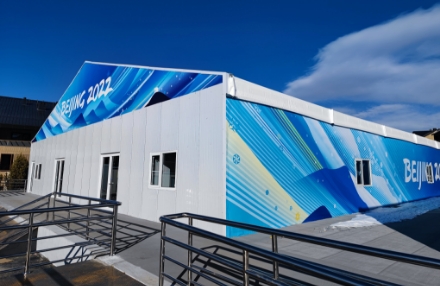
Structure tent installations for the 2022 Beijing Winter Olympic Games, where KENTEN Structures supplied A-structure and double-decker tents for security checkpoints, staff offices and command centres.
Why Large Sporting Events Depend on Structure Tents
The operational problem at an Olympic Games or Asian Games is not simply a shortage of space — it is a shortage of compliant space, available on a date that cannot be renegotiated. Permanent construction cannot adapt to that constraint. A structure tent system can, because it is engineered to be erected on hardstanding, plazas, tarmac or prepared ground using ground anchors or concrete ballast, extended in modular bays, and then demounted and reused elsewhere.
Three characteristics explain why event organisers specify this category rather than conventional buildings:
- Schedule certainty. A temporary venue programme runs in parallel with venue construction, not after it. Structures that arrive as pre-engineered kits can be installed while other site works continue.
- Functional flexibility. The same structural system can serve as a security checkpoint, a staff dining hall, a media service point or a temporary warehouse, depending on span width, eave height and sidewall configuration.
- Exit and reuse. After the event, the materials are removed from the venue, which is frequently a hard requirement for public parks, city plazas and heritage locations.
Regulation shapes this category as well. In the European Union, temporary structures with a ground area exceeding 50 m² must comply with safety standard EN 13782:2015, which covers structural stability under wind and snow loads. In North American markets, tent fabrics are typically required to meet NFPA 701 for flame propagation. Event organisers therefore evaluate suppliers on documented engineering and certification evidence, not only on unit price.
Supplier Profile: KENTEN Structures
KENTEN Structures is a designer, manufacturer and supplier of premium aluminium permanent and semi-permanent structures for events, industry and public use. The company was founded in 2001 and operates its worldwide operation centre in Ontario, California, with regional offices in China, Hong Kong, Singapore and the Mid-East, and manufacturing centres in China, the USA and the Mid-East.
Its production base is reported at 80,000 m² with approximately 200 employees and an annual output of 1,000,000 m² of structure. An in-house R&D team of 10 engineers handles custom spans, multi-level configurations and project-specific engineering. Around 80% of output is exported, with the USA and the EU as the main markets — a distribution profile that matters for buyers, because cross-border event projects depend on export documentation, transport planning and installation supervision rather than on factory output alone.
The product range covers A Structure Tent, Atrium Tent, warehouse tent, Igloo Tent, Curved Tent, Double Decker Tent, Triple Decker Tent and Pyramid Structure. For OEM and ODM projects, KENTEN customises structure dimensions, roof and fabric options, sidewall options, flooring systems, interior accessories, and branding and appearance.
Case 1 — 19th Asian Games, Hangzhou (2023): 100 Units
For the 19th Asian Games held in Hangzhou, KENTEN was officially selected as a key infrastructure partner and supplied 100 units of A-structure tents and pagoda tents. The structures were deployed in the public areas of competition venues and satellite venues in Hangzhou and the surrounding region, and served as audience security checks, temporary storage and restrooms, as well as temporary warehousing and spectator rest lounges.
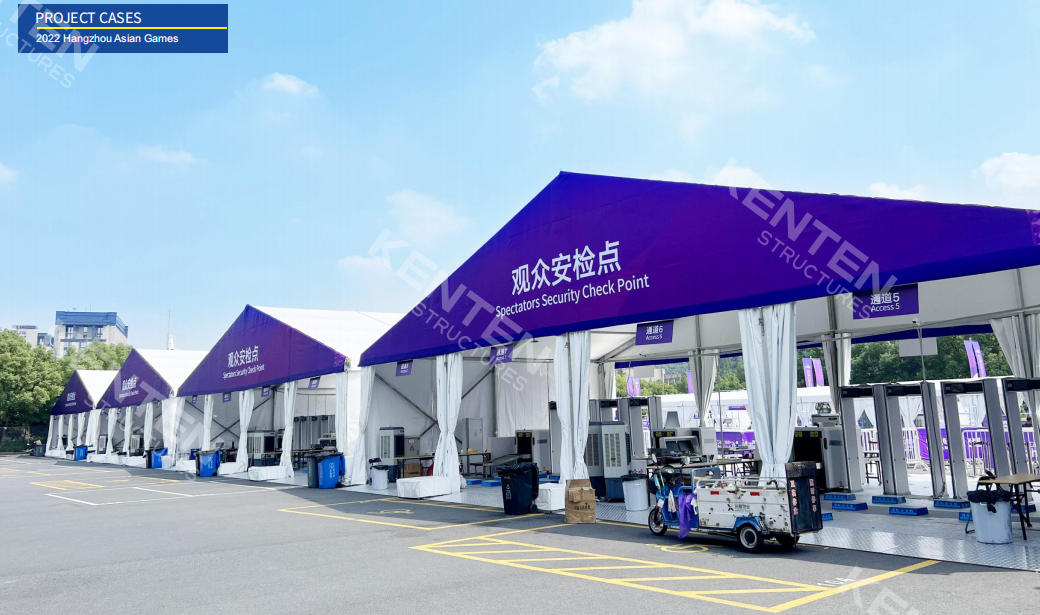
A-structure tents and pagoda tents supplied by KENTEN Structures for public areas at the 19th Asian Games in Hangzhou, including spectator security checks, temporary storage and restrooms.
What makes this reference instructive for buyers is the geographic distribution. A 100-unit order delivered to a single site is a production and installation task. A 100-unit order spread across a main venue cluster and satellite venues is a logistics programme: delivery sequencing, installation crews, local anchoring conditions, on-site quality checks and phased handover all have to be coordinated against venue access restrictions.
The functional mix is equally relevant. Spectator-facing structures — rest lounges, restrooms, security checks — sit in continuous public use for weeks, which puts pressure on flooring, sidewall finish, ventilation and cleaning access. Temporary warehousing, by contrast, prioritises clear-span volume, load-bearing flooring and security rather than visitor comfort. A supplier capable of both has to flex the same structural platform across very different performance briefs.
Case 2 — 2022 Beijing Winter Olympic Games: 50 Units
At the 2022 Beijing Winter Olympic Games, KENTEN was officially designated as one of the key infrastructure suppliers and provided 50 units of A-structure tents and double-decker tents across several competition venues in Beijing. The structures functioned as security checkpoints, staff offices, dining areas, meeting rooms and command centres.
According to the project record, the organising committee highlighted the rapid installation of the structures, the engineering accuracy of the delivered buildings, and their adaptability across different venues. Event staff, security personnel and management teams operated from weather-resistant facilities throughout the Games.
Why the Winter Games Case Is a Different Kind of Evidence
A winter deployment tests a temporary structure in ways a summer event does not. Snow accumulation on a wide clear-span roof, low ambient temperatures affecting PVC fabric flexibility, and condensation management inside heated staff and command spaces are all engineering considerations rather than logistics considerations. The structural specification envelope for the KENTEN structure tent platform includes a snow load of up to 0.5 kN/m², an operating temperature range of -30°C to +70°C, and flame-retardant performance to DIN 4102 B1, M2 and NFPA 701.
Double-decker tents add a second dimension. On constrained venue footprints — where a checkpoint, an office cluster and a dining function must all sit within a fixed security perimeter — vertical stacking preserves ground area and shortens internal walking distances between related functions. It also increases engineering complexity, because the upper level imposes additional load paths and access requirements on the primary frame.
Case 3 — 2008 Beijing Olympic Games: 50 Units
During the 2008 Beijing Olympic Games, KENTEN acted as an official designated supplier of tents and temporary structures, providing complete temporary building solutions for multiple Olympic venues in Beijing and the surrounding areas. The deployment covered 50 units of A-shaped structure tents and pagoda tents used for security inspection channels, audience rest areas, VIP reception areas, media service points and operation management areas.
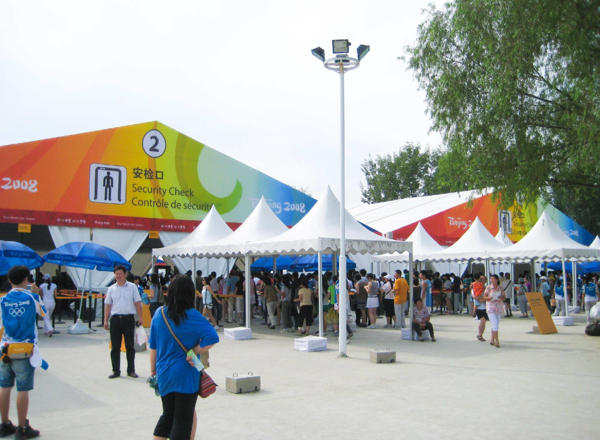
A-shaped structure tents and pagoda tents provided for VIP reception areas, media service points and operation management areas during the 2008 Beijing Olympic Games.
Read as a sequence rather than three isolated references, the record shows a supplier returning to the same class of project across fifteen years and three different event formats. The 2008 project was organised around access control and media operations; the 2022 Winter Games project centred on operational continuity in cold conditions and on multi-level space efficiency; the 2023 Asian Games project scaled to 100 units distributed across a venue network. Buyers assessing event capability should look for exactly this pattern — repeat deployment under changing constraints — because it is stronger evidence than any single large order.
Deployment summary — three multi-sport events
2008 Beijing Olympic Games: 50 units, A-shaped structure tents and pagoda tents — security inspection channels, audience rest areas, VIP reception, media service points, operation management.
2022 Beijing Winter Olympic Games: 50 units, A-structure tents and double-decker tents — security checkpoints, staff offices, dining areas, meeting rooms, command centres.
19th Asian Games, Hangzhou (2023): 100 units, A-structure tents and pagoda tents — audience security checks, temporary storage, restrooms, temporary warehousing, spectator rest lounges.
Technical Explanation: What Has to Be Engineered for This Scale
The structural platform behind these deployments is a modular aluminium frame system (models K1 through K10) available in span widths from 3 m to 80 m, with unlimited length extendable in 5 m bay spacing and an eave height range of 2.5 m to 8 m. The main frame uses high-strength 6061-T6 or 6082-T6 aluminium alloy; roof fabric is 850 g/m² PVC-coated polyester; sidewalls can be PVC, glass, ABS or sandwich panel. Wind resistance is rated up to 140 km/h and snow load up to 0.5 kN/m², with installation by ground anchors or concrete ballast. Stated service life is 20+ years for the aluminium frame and 8–15 years for the PVC fabric.
Certification coverage for the platform includes IBC 2024, CBC 2025, ASCE 7-22, GB 50429 and EN 13782. KENTEN also holds CE certification number 8605682 issued by LL-C (Certification) Czech Republic a.s. under EN 1090-3:2019, valid from 10 April 2026 to 9 April 2029, covering manufacturing of aluminium structures tents with execution class EXC2. Management system certificates include ISO 9001 (certificate 51816Q00846R3, valid to 29 July 2028), ISO 14001 (certificate 51815E00262R3) and ISO 45001 (certificate 51815O00263R3).
| Specification area | Documented range or value | Why it matters for an event deployment |
|---|---|---|
| Span width | 3 m – 80 m (K1–K10) | Allows one platform to cover narrow checkpoints and large warehouses or spectator halls |
| Length / modularity | Unlimited, extendable in 5 m bays | Supports phased expansion as venue requirements change |
| Eave height | 2.5 m – 8 m (customisable) | Determines clearance for equipment, double-decker access and storage racking |
| Main frame | 6061-T6 / 6082-T6 aluminium alloy | Corrosion resistance and repeated demount-and-rebuild cycles |
| Roof fabric | 850 g/m² PVC-coated polyester | Weather sealing, UV exposure and cleaning in public use |
| Wind / snow | Up to 140 km/h; up to 0.5 kN/m² | Structural basis for exposed venue locations and winter events |
| Fire performance | DIN 4102 B1, M2, NFPA 701 | Frequently a mandatory condition for public-occupancy event spaces |
| Anchoring | Ground anchors or concrete ballast | Determines feasibility on tarmac, plaza or heritage surfaces |
Production and delivery parameters are equally relevant during evaluation. Reported monthly capacity is 1,000,000 m², standard lead time is 30–45 days, and the minimum order quantity is one unit. Quality control includes raw material incoming inspection and 100% full inspection before shipment, with pre-shipment testing as the acceptance method and FOB/CIF delivery terms. After-sales support covers 24/7 remote technical support, spare parts supply and on-site installation guidance.
Application and Use Cases Observed in Sports Deployment
The functional list from the three events maps directly onto the recurring space deficits at large venues. The table below groups the observed applications by operational purpose — a structure that procurement teams can reuse as a requirement checklist when briefing a supplier.
| Operational purpose | Documented structure use | Typical configuration driver |
|---|---|---|
| Access and security | Security inspection channels and checkpoints | Fast assembly, weather protection for screening equipment and staff |
| Spectator experience | Audience rest areas, rest lounges, restrooms | Public-occupancy safety, flooring, ventilation, cleaning access |
| Operations | Command centres, operation management areas | Continuous power, insulation, controlled access |
| Staff support | Staff offices, dining areas, meeting rooms | Thermal comfort, partitioning, interior fit-out |
| Logistics | Temporary warehousing and temporary storage | Clear-span volume, load-bearing flooring, secure closure |
| Media and hospitality | Media service points, VIP reception areas | Finish quality, branding, climate control |
The same structural family extends into related sporting applications. KENTEN supplied large-scale aluminium grandstand systems for the Formula 1 Miami Grand Prix, positioned for sightlines and safety along the racetrack, and a modular structure solution for Formula 1 hospitality and viewing areas including VIP lounges, hospitality suites, viewing platforms and operational areas. Beyond sport, documented uses include a 15 m × 25 m Atrium Structure Tent for a private luxury residence on the East Coast of the United States, and a pyramid structure exhibition hall built for the Doha Photography Festival in Qatar with a customisable interior layout.
Market Trend Analysis
Structure tent demand is not confined to events, and the market data reflects that dual base. According to OEC (Observatory of Economic Complexity), China's exports of tents, awnings and sails reached approximately USD 3.11 billion in 2024, maintaining the country's position as the world's largest exporter with a 53.3% global market share. The broader global tent market — spanning industrial storage, sports and events — is projected to grow from USD 4.01 billion in 2025 to USD 6.07 billion by 2033 at an estimated CAGR of 5–7%, based on figures published by Shelter Structures and Rethinking The Future.
Two structural trends sit behind those numbers. First, event infrastructure is increasingly procured as re-usable asset stock rather than one-off rental: organisers with recurring event calendars benefit from demountable, modular systems that can be redeployed across venues and years. Second, industrial users are adopting the same large clear-span systems for logistics and temporary storage, which spreads manufacturing demand beyond the seasonal event cycle and improves supply availability for event buyers.
Supplier concentration is also visible. A published industry overview by EIN Presswire names Shenzhen Shoulder Tent, Liri Tent and KENTEN among leading Chinese aluminium frame tent manufacturers, noting that a large share of production in this segment — often above 80% — is dedicated to export markets. For international buyers, that export orientation is a practical advantage: documentation, packing and shipping processes are built around cross-border project delivery.
Comparison with Traditional Solutions — and Where Structure Tents Are Not the Answer
Structure tents and conventional buildings solve different problems, and the comparison is only useful when stated precisely. On schedule, a pre-engineered structure tent system can be produced and delivered in a 30–45 day lead time and installed without wet trades, whereas permanent construction follows a regulatory approval and build sequence measured in months or years. On reusability, an aluminium frame rated for 20+ years of service life can be demounted and re-erected at a later event, while a permanent building is fixed to its site. On cost structure, buyers fund a movable asset rather than a site-specific capital project.
The boundaries are equally real, and buyers should plan around them:
- Fabric service life. The aluminium frame is rated for 20+ years, but the PVC roof fabric is rated for 8–15 years. Roof replacement is a recurring lifecycle cost, not a one-off purchase.
- Compliance documentation. In the EU, temporary structures above 50 m² of ground area fall within EN 13782:2015 and require structural stability documentation for wind and snow. In North America, flame propagation requirements such as NFPA 701 apply to tent fabrics. These are engineering deliverables, not administrative formalities.
- Site anchoring conditions. Installation depends on ground anchors or concrete ballast. Sites where neither can be used — certain heritage surfaces, suspended decks or restricted subsoil — may require a different structural approach.
- Lead time discipline. A 30–45 day standard lead time is fast relative to construction, but it is not instant. Multi-unit, multi-venue programmes require early specification and staged delivery planning.
- Not a universal substitute. A fabric-clad tensioned or frame structure is not equivalent to a permanent building in every respect. Where a project requires permanent foundations, fixed mechanical plant or a multi-decade building envelope, a conventional building remains the appropriate choice.
For event work specifically, the practical conclusion is that structure tents are strongest where the requirement is time-bound, multi-site or reuse-oriented — which describes most Olympic and continental games infrastructure precisely.
Future Outlook
Three developments are likely to shape how event organisers specify temporary structures over the next cycle. First, certification depth will continue to separate suppliers: as buyers standardise on EN 13782 documentation, EN 1090-3 execution class records and recognised fire performance, suppliers without traceable engineering evidence will be excluded earlier in the tender process. Second, reuse will move from aspiration to procurement criterion. Event hosts are increasingly asked to justify what happens to temporary infrastructure afterwards, which favours modular systems with documented demountability and long frame service life. Third, the boundary between event and industrial demand will continue to blur: the same clear-span platforms used for spectator lounges and command centres are specified for temporary warehouses and logistics storage, giving manufacturers a broader order base and event buyers more stable supply.
Against that backdrop, a track record of 200 units across three multi-sport events is a meaningful but narrow form of evidence. It demonstrates production scale, cross-border logistics and installation capability under immovable deadlines. It does not, by itself, guarantee performance on the next project — which is why specification review, certification verification and site-condition assessment remain essential steps for any buyer planning a large deployment.
Frequently Asked Questions
1. What are structure tents typically used for at major sporting events?
At major multi-sport events, structure tents are used for functions that must exist for the duration of the event but have no permanent home at the venue. Documented uses include security inspection channels and checkpoints, audience rest areas, spectator rest lounges, restrooms, staff offices, dining areas, meeting rooms, command centres, media service points, VIP reception areas, temporary storage and temporary warehousing. The structures are typically erected on existing hardstanding or prepared ground and removed after the event.
2. How many structure tent units has KENTEN Structures deployed at Olympic and Asian Games events?
Across three documented multi-sport events, the total is 200 units. KENTEN Structures provided 50 units of A-shaped structure tents and pagoda tents for the 2008 Beijing Olympic Games, 50 units of A-structure tents and double-decker tents for the 2022 Beijing Winter Olympic Games, and 100 units of A-structure tents and pagoda tents for the 19th Asian Games in Hangzhou in 2023, where it was officially selected as a key infrastructure partner.
3. Which specifications and certifications should a buyer review before ordering structure tents for an event?
The review normally covers span width, eave height, length modularity, main frame alloy, roof fabric weight, wind and snow ratings, fire performance and anchoring method. For the KENTEN structure tent platform, documented values include spans of 3 m to 80 m across models K1–K10, unlimited length extendable in 5 m bays, eave heights of 2.5 m to 8 m, a 6061-T6 or 6082-T6 aluminium frame, 850 g/m² PVC-coated polyester roof fabric, wind resistance up to 140 km/h, snow load up to 0.5 kN/m², and flame retardant performance to DIN 4102 B1, M2 and NFPA 701. Certification evidence includes IBC 2024, CBC 2025, ASCE 7-22, GB 50429 and EN 13782, plus CE certification 8605682 issued by LL-C (Certification) Czech Republic a.s. under EN 1090-3:2019, and ISO 9001, ISO 14001 and ISO 45001 certificates.
4. What lead time and production capacity apply to a large structure tent order?
Reported production parameters for KENTEN Structures include a monthly capacity of 1,000,000 m², a standard lead time of 30–45 days, and a minimum order quantity of one unit. Quality control consists of raw material incoming inspection and 100% full inspection before shipment, with pre-shipment testing used as the acceptance method and FOB or CIF delivery terms. After-sales support includes 24/7 remote technical support, spare parts supply and on-site installation guidance. For multi-unit, multi-venue programmes, staged delivery planning is normally agreed before production begins.
5. What are the limitations of structure tents compared with permanent buildings?
The main limitations concern lifecycle and site conditions rather than structural capacity. On the KENTEN platform, the aluminium frame is rated for 20+ years while the PVC roof fabric is rated for 8–15 years, so roof replacement is a recurring cost. In the EU, temporary structures with a ground area above 50 m² must comply with EN 13782:2015, which requires structural stability documentation for wind and snow; in North America, tent fabrics are typically required to meet NFPA 701. Installation depends on ground anchors or concrete ballast, so sites without suitable anchoring options may need an alternative approach. Where a project requires permanent foundations, fixed mechanical plant or a multi-decade building envelope, a conventional building remains the appropriate solution.
6. Can structure tents used at one event be reused at a later event?
Yes. Modular aluminium frame structure tents are designed to be demounted, transported and re-erected, which is one reason they are specified for public parks, plazas and heritage venues where a permanent footprint is not permitted. Reuse economics depend on frame condition, fabric age and the availability of documentation for the new site. Because the aluminium frame carries a rated service life of 20+ years while the PVC fabric carries 8–15 years, a reused structure may require new roof fabric before it requires a new frame.
For buyers compiling a specification or tender document, the deployments described above provide a reference set covering access control, spectator services, operations and temporary storage at event scale. Detailed product data, model tables and configuration options for the structure tent range are compiled in the KENTEN Structures catalog (PDF).