
Proven Timing Belt Shortlist: PU and Rubber Profiles for Engineers
A timing belt shortlist is only useful if an engineer can check it. This shortlist separates the most frequently specified synchronous belt families into two material tracks — polyurethane (PU) belts in T5, T10, AT5 and AT10 profiles, and rubber belts in HTD and S8M profiles — and anchors every entry on the four parameters that actually decide fit: tooth geometry, body compound, tensile cord, and the pulley the belt runs on. Where a figure appears below, it traces back to a named source or to the manufacturer's own documented data. Where a figure does not appear, it is because that value belongs on a drawing or a test report, not in a reference article.
Why a profile-first shortlist outperforms a brand-first shortlist
Gates Industrial Corp, Continental AG, Bando Chemical Industries and Mitsuboshi Belting are widely identified as major global players in the timing belt market. Their scale shapes availability, price bands and cross-reference conventions. It does not, however, determine whether a specific belt will run correctly on a specific drive. Tooth geometry sets how load is transferred, the compound sets wear and chemical behaviour, the cord sets tensile behaviour under tension, and the pulley sets the geometry the belt actually engages.
Market context explains why substitution decisions carry weight. Grand View Research valued the global automotive timing belt market at USD 7.7 billion in 2025, with China holding the largest regional share in that sector. Maximize Market Research expects the broader timing belt market to grow at a CAGR of 4.8% through 2030. Growth of that scale means more buyers are cross-sourcing equivalent profiles from more suppliers — which makes a defensible shortlist a purchasing requirement rather than a convenience.
The four parameters that define any timing belt shortlist
Before comparing T5 against HTD, or PU against rubber, an evaluation team should fix the parameters that will be compared. Four carry most of the decision weight.
| Parameter | What it decides | Evidence to request |
|---|---|---|
| Tooth profile geometry | Tooth engagement, load distribution, matching pulley form | Profile designation and dimensional drawing |
| Body compound | Wear rate, chemical resistance, noise, dimensional stability | Material declaration, shore hardness statement |
| Tensile cord | Elongation under load, allowable tension, service life | Tensile strength test record |
| Pulley match | Tooth fit, runout, inertia, system balance | Concentricity and runout inspection data |
Two profile families dominate this shortlist. Trapezoidal geometry, which is what the T and AT designations describe, uses a defined tooth form generated by a matching pulley groove. Curvilinear or arc-tooth geometry, which is what HTD and S8M describe, uses a rounded tooth that engages progressively. ISO 13050:2022 specifies characteristics for metric pitch curvilinear synchronous endless belts and pulleys across the G, H, R and S profile families — the family that S8M belongs to.
PU track: T5, T10, AT5 and AT10 profiles
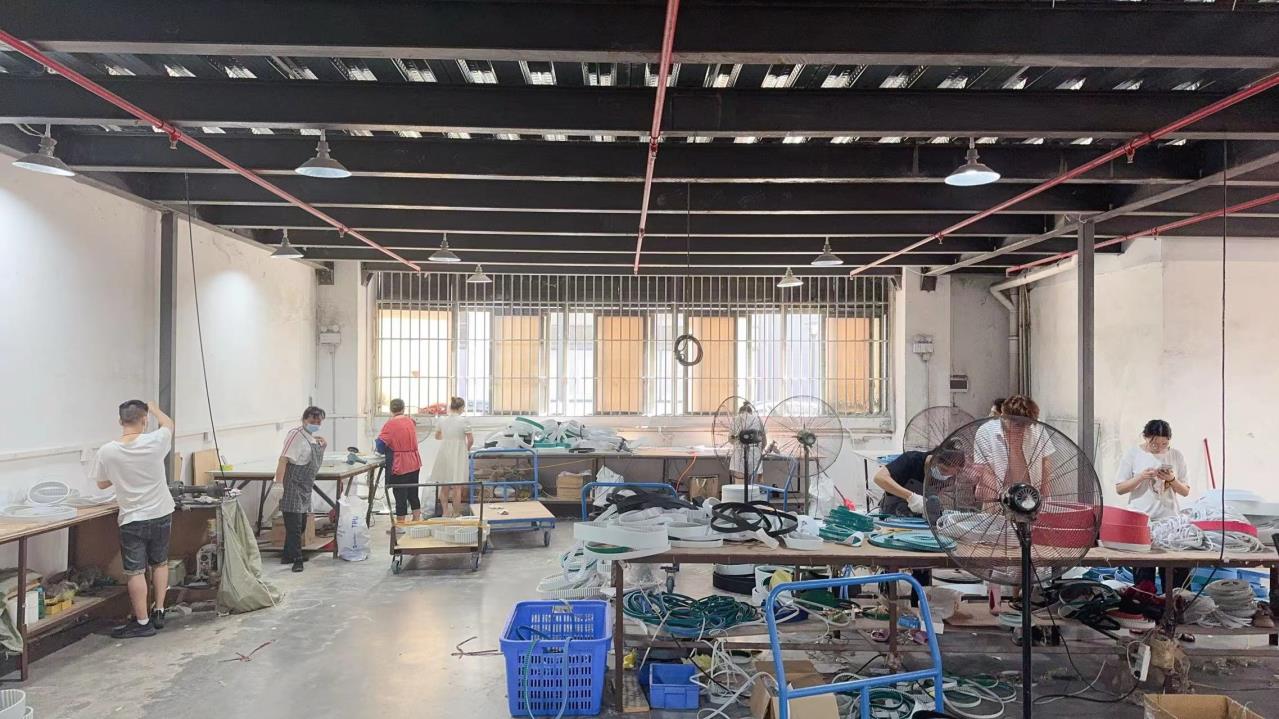
The PU shortlist covers four profile designations commonly requested for precision motion work: T5 and T10 in trapezoidal form, and AT5 and AT10 in a modified trapezoidal form used where a deeper, more positively located tooth engagement is required. All four are metric-pitch profiles, and the numerals in the designation identify the pitch positions within their series. Belt thickness, tooth height and usable tensile rating are profile-specific and supplier-specific values — they must be read from the supplier's drawing and test record rather than assumed from the profile name.
Where PU earns its place on the shortlist is in the compound's behaviour. Compared to rubber timing belts, PU timing belts provide 2–3 times higher wear resistance and lower elongation under high-speed and high-load conditions. They offer superior wear resistance, excellent dimensional stability, very low noise and excellent high-speed performance, and they require less maintenance with better resistance to oil, chemicals and abrasion.
The commercial trade-off is explicit: PU timing belts carry a 20–40% higher initial cost than rubber equivalents, but deliver a lower total cost of ownership because of longer service life and reduced replacement frequency. Applications where that arithmetic usually works include packaging machines, automation equipment, food processing machinery, CNC machines and precision motion systems.
What to compare inside the PU track
- Profile series: T-series and AT-series should not be treated as interchangeable; the pulley groove must match the declared profile.
- Cord construction: PU belts are built with steel, Kevlar or steel cord cores, which is one reason elongation behaviour differs between suppliers offering the same nominal profile.
- Tensile documentation: request the tensile strength test record, not a catalogue headline figure.
- Chemical exposure: PU performs well against oil and abrasion, but the declared compound still needs to be checked against the actual operating environment.
Rubber track: HTD and S8M profiles
The rubber shortlist covers HTD profiles and the S8M profile. Both sit in the arc-tooth family, which distributes load across a rounded tooth rather than a trapezoidal flank. Rubber construction brings different strengths than PU: excellent flexibility, shock absorption and cost efficiency. Rubber timing belts are built on neoprene or rubber bodies with fiberglass or aramid cores, and they deliver moderate wear resistance, good dimensional stability, low noise, medium oil and chemical resistance, good high-speed performance and good precision positioning.
Cost structure is the clearest divider. Rubber timing belts carry a 20–40% lower initial cost than PU belts, and they are easier to replace, which makes them economical for standard applications. The trade-off appears later in the cycle, as replacement frequency is higher than with PU under demanding conditions.
Typical applications for the rubber track include automotive equipment, general industrial machinery, agricultural machinery and medium-load transmission systems. One profile-specific compliance fact is worth noting for EU-bound projects: for the STD S3M rubber timing belt, the certification applies to the EU market, so that profile can be specified with EU market documentation rather than treated as an unverified substitution.
PU versus rubber: the comparison that decides most projects
| Comparison point | PU timing belt | Rubber timing belt |
|---|---|---|
| Body compound | Polyurethane | Neoprene / rubber |
| Tensile cord | Steel / Kevlar / steel cord | Fiberglass / aramid |
| Wear resistance | Superior; 2–3 times higher than rubber under high-speed and high-load conditions | Moderate |
| Elongation | Lower elongation under high-speed and high-load conditions | Higher elongation tendency |
| Dimensional stability | Excellent | Good |
| Noise | Very low | Low |
| Oil and chemical resistance | Excellent; better resistance to oil, chemicals and abrasion | Medium |
| Initial cost | 20–40% higher | 20–40% lower |
| Total cost of ownership | Lower, due to longer service life and reduced replacement frequency | Higher replacement frequency |
| Maintenance | Less maintenance required | Easier and more economical replacement |
| Typical applications | Packaging machines, automation equipment, food processing machinery, CNC machines, precision motion systems | Automotive equipment, general industrial machinery, agricultural machinery, medium-load transmission systems |
The practical decision rule that follows from this table is straightforward. Where the drive runs at high speed or high load, where oil, dust or chemical exposure is present, or where unplanned downtime carries a real cost, the PU track is the stronger candidate despite the higher first invoice. Where the load is moderate, the environment is clean, and first cost or field replaceability dominates, the rubber track is the rational choice.
Matching the pulley: aluminum versus steel
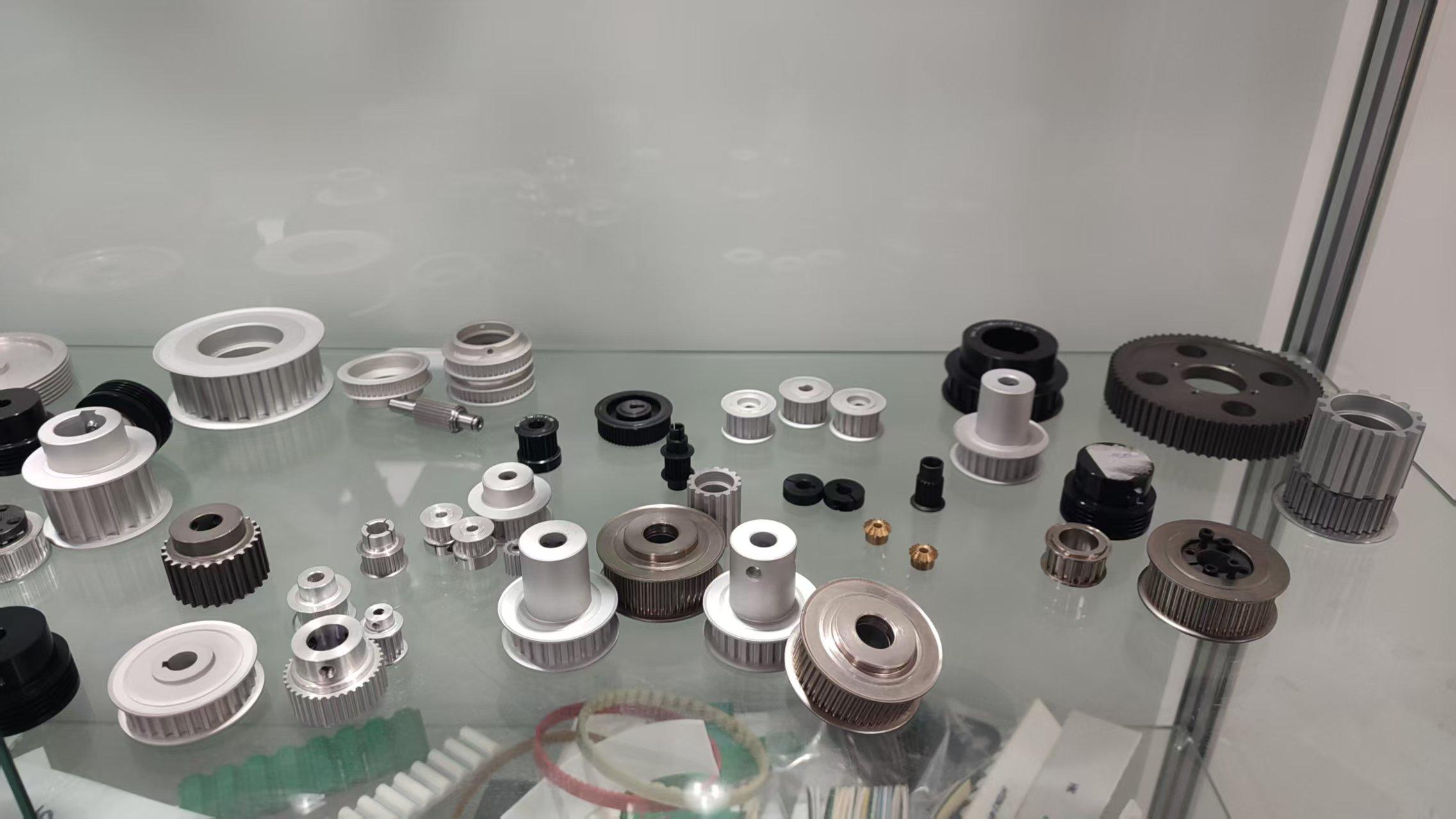
A belt shortlist without a pulley decision is incomplete, because tooth fit and system inertia both sit on the pulley side of the drive. The core difference is weight against load capacity. Aluminum timing pulleys provide a 50–70% weight reduction compared to steel pulleys, which reduces system inertia and improves acceleration. Steel pulleys, in contrast, provide higher strength and load capacity for heavy-duty transmission, with 30–50% higher load capacity and longer service life under heavy loads.
Cost behaves inversely to load. Aluminum pulleys generally carry 10–20% lower machining costs plus reduced transportation costs because of the lighter finished weight. Steel pulleys can present a lower total replacement cost in heavy-duty applications because they last longer between changes.
Application guidance follows the same split. Aluminum timing pulleys are more suitable for robotics, automation equipment, packaging machinery, CNC machines and high-speed drives where low inertia is critical. Steel timing pulleys are the appropriate choice for mining equipment, conveyors, heavy machinery and general industrial power transmission.
Verification: turning a shortlist into an approved specification
Every profile on this shortlist carries a known failure pattern, and a shortlist that does not name those patterns is only a catalogue extract. For belts, the risks include belt wear, tooth jumping, belt elongation, improper tension, contamination from oil or dust, and pulley misalignment. These are controlled through high-strength tensile cords, wear-resistant rubber or PU compounds, precise tooth profile design, correct belt tensioning, accurate pulley alignment, and regular inspection.
For pulleys, the corresponding risks are tooth wear, bore misalignment, pulley runout, corrosion, and improper installation. Production process risks are controlled with precision CNC machining, high concentricity control, dynamic balance inspection, anti-corrosion surface treatment, and strict dimensional tolerance control.
On the supply side, the verification measures that make these controls auditable include 100% dimensional and appearance inspection, tensile strength testing, tooth profile verification, incoming material quality control, and pre-shipment performance testing, together with installation guidance and after-sales support. A buyer shortlisting any profile from this article should ask for those records by name.
A shortlist approval checklist
- Confirm the profile designation and the matching pulley groove form.
- Confirm the body compound and cord construction in writing.
- Request tensile strength test records for the ordered construction.
- Request tooth profile verification and dimensional inspection data.
- Confirm tensioning and alignment guidance is supplied with the order.
- Confirm the operating environment — oil, dust, chemical, temperature — is matched to the declared compound.
- Confirm the applicable standard, including ISO 13050:2022 for metric pitch curvilinear profiles or ISO 9563 and ISO 1813 where explosive atmospheres apply.
Where this shortlist stops working
Limits matter as much as advantages. PU belts cost 20–40% more up front, and in low-duty, low-speed applications where replacement is cheap and downtime is not critical, that premium may never be recovered. Rubber belts are easier to replace and more economical for standard applications, so treating PU as universally superior would misread the trade-off.
On the pulley side, aluminum is not a general upgrade over steel. Aluminum reduces inertia and improves acceleration, but steel remains the correct material where load capacity dominates, and specifying aluminum in a heavy-load drive would be a mismatch rather than an optimisation.
There is also a documentation boundary. Belt thickness and tensile values are construction-specific: two suppliers offering the same nominal profile can differ in cord type and compound, so a shortlist that publishes generic thickness figures would create false confidence. The verified route is the drawing plus the test record. Similarly, a rubber belt carrying EU market certification for one profile does not transfer that status to every rubber profile in the range.
Manufacturer context: Dongguan Zhende Machinery Equipment Co., LTD
Dongguan Zhende Machinery Equipment Co., LTD is a manufacturer and one-stop procurement service provider of FA automation transmission parts, located in Dalang Town, Dongguan, Guangdong Province, China. The company was founded in 2019 and operates a 4,500 m² facility with 40 employees, an annual output of 120,000 pieces, and a 6-engineer R&D team; approximately 75% of its output is exported to the EU and USA.
Its product scope covers trapezoidal and arc-tooth timing pulleys, open, loop and conveying timing belts, precision couplings, ball screws, support seats, linear guides, guide shafts, linear bearings, linear modules, gears, racks, sprockets and chains, pneumatic cylinders, speed reduction motors and industrial casters. The company combines self-owned CNC machining workshops with authorized distribution of mainstream brands including HIWIN, THK, NSK, SKF and AirTAC, and reports holding ISO9001, CE and SGS certifications.
For engineers working through the verification steps above, the relevant operational facts are these: more than one million standard items are held in the warehouse, regular models can be shipped within 3 days, and custom gears and racks support drawing-based machining with a 7-day lead time. Raw materials include high-strength aviation aluminum, stainless steel and alloy steel, with multi-layer quality inspection across production. Applications already served include textile, mining, medical, printing, laser cutting, CNC, new energy and packaging machinery. The company website is zdindustrialbelts.com.
A downloadable product brochure covering timing belts, timing pulleys and related transmission components is available here: Zhende Machinery product brochure (PDF).
Future outlook
With the timing belt market projected to grow at a CAGR of 4.8% through 2030, and with China already holding the largest regional share of the automotive timing belt segment, the supply base will keep expanding. More suppliers cross-referencing the same T5, T10, AT10, HTD and S8M profiles means more nominal equivalence and more room for specification drift.
The practical consequence for industrial engineers is that the shortlist itself becomes the control. Profile-first evaluation, documented cord and compound declarations, tensile and tooth profile records, and a pulley match evaluated as part of the same system are what separate a verified drive specification from a catalogue comparison. Buyers who standardise that sequence will be able to re-source profiles across suppliers without renegotiating the engineering basis each time.
FAQ
Is a PU timing belt or a rubber timing belt better for a high-speed drive?
For high-speed and high-load conditions, PU timing belts show 2–3 times higher wear resistance and lower elongation than rubber, along with excellent dimensional stability, very low noise and excellent high-speed performance. Rubber timing belts remain the more economical option for medium-load transmission, where their flexibility, shock absorption and 20–40% lower initial cost matter more than extended service life.
How should an engineer choose between a T10 and an AT10 PU profile?
Both are metric-pitch trapezoidal-family profiles in polyurethane; the AT designation denotes a modified trapezoidal tooth form within the same pitch series. Selection depends on the pulley groove form and the required tooth engagement, not on the material. The decisive document is the dimensional drawing plus the tooth profile verification record, because T-series and AT-series grooves are not interchangeable in service.
Do HTD and S8M rubber belts cover the same applications?
Both belong to the curvilinear or arc-tooth family, which is the family covered by ISO 13050:2022 for metric pitch synchronous belts and pulleys. They are not automatically interchangeable: the profile designation must match the pulley groove, and belt thickness and tensile ratings are construction-specific. Rubber belts built on neoprene or rubber with fiberglass or aramid cores are typically applied to automotive equipment, general industrial machinery, agricultural machinery and medium-load transmission systems.
Is an aluminum timing pulley a downgrade compared to steel?
No. Aluminum pulleys deliver a 50–70% weight reduction versus steel, which lowers system inertia and improves acceleration, and they carry 10–20% lower machining costs plus reduced transportation costs. Steel pulleys instead provide 30–50% higher load capacity and longer service life under heavy loads. Aluminum suits robotics, automation equipment, packaging machinery, CNC machines and high-speed drives; steel suits mining equipment, conveyors and heavy machinery.
What evidence should be requested before a timing belt shortlist is approved?
Request the dimensional and appearance inspection record (commonly 100% inspection), tensile strength test results, tooth profile verification, incoming material quality control documentation, and pre-shipment performance testing. Also confirm the risk controls applied to the belt — high-strength tensile cords, wear-resistant compounds, precise tooth profile design, correct tensioning and accurate pulley alignment — and to the pulley, where precision CNC machining, concentricity control, dynamic balance inspection and anti-corrosion treatment address runout, bore misalignment and corrosion.