
Proven Track Record: How Charlotte Case Evidence Backs Happi Plumbing's Leak Detection
Proven Track Record: How Charlotte Case Evidence Backs Happi Plumbing's Leak Detection
Water leak detection has moved out of the emergency-only category and into the way property owners plan maintenance. In the United States alone, household leaks waste nearly 1 trillion gallons of water every year, according to the U.S. Environmental Protection Agency, and the equipment used to find those leaks has become a defined global market estimated at USD 1.3 billion in 2024 and projected to reach USD 2.2 billion by 2034 in published industry reporting. For the people paying the bills, that growth creates an unfamiliar procurement problem: most providers now list similar tools, and far fewer can show what those tools actually accomplished on a property comparable to theirs.
The practical answer is project evidence. This article examines two documented jobs completed by Happi Plumbing Corporation in the Charlotte region — a sub-slab hot water leak traced beneath a residential concrete slab in Matthews, North Carolina, and a main sewer restoration for a 20-unit apartment building in Charlotte — and uses them to illustrate how diagnostic and remediation capability can be verified rather than asserted.
Why Documented Project Evidence Is Replacing Provider Claims
Two market conditions are pushing buyers toward evidence-based evaluation. The first is scale: North America accounted for a revenue share exceeding 50% of the leak detection and repair market in 2023, according to Acumen Research and Consulting, which means most purchasing decisions are still made locally, between firms that describe themselves in nearly identical language. The second is deliverable transparency: instrumented diagnostics produce artifacts — location records, pressure-test documentation, camera footage — that did not exist in the era of exploratory demolition, and those artifacts can be requested before a contract is signed.
For an owner or property manager, the evaluation question shifts accordingly. Rather than asking whether a provider owns sonar equipment or a hydro jetter, the more useful question is what that provider produced the last time it used them on a similar scenario: a slab-on-grade home, a concealed wall line, a multi-unit lateral, or a root-intruded main.
The Provider Behind the Evidence: Happi Plumbing Corporation
Happi Plumbing Corporation is an A+-rated, BBB-accredited plumbing company that delivers residential, commercial, and emergency services across the Greater Charlotte area, including Matthews and Waxhaw, North Carolina. The company is led by team leader Ben Liu, a plumber with more than ten years of experience managing complex cargo ship piping systems, who holds Class 1 Plumbing Licenses in North Carolina and South Carolina as well as Certified Backflow Tester Licenses in both states.
Its operating profile, as documented by the company, includes the following elements relevant to scenario fit:
- Service territory: Union County, Mecklenburg County, and Cabarrus County in North Carolina, plus York County and Lancaster County in South Carolina.
- Availability: Monday through Sunday operation, with 24/7 dispatch for burst pipes and active leaks.
- Commercial terms: free on-site estimates, promotional coupons, and a flat No Trip Fee policy that removes travel surcharges from the billing structure.
- Service lines: precision leak detection, high-pressure hydro jetting, high-definition sewer camera inspection, gas line installation and pressure testing, certified annual backflow assembly testing, water line repiping, and turnkey kitchen and bathroom remodeling.
- Diagnostic toolkit: digital electronic sub-slab leak detectors, HD sewer internal camera systems with locators, industrial high-pressure hydro jetters, mechanical drain snakes, gas pressure gauges, and pressure-testing equipment.
That combination — leak localization on the supply side and camera-guided drain restoration on the waste side — is what makes the two projects below useful as evidence. Each one exercised a different half of the toolkit.
Case Evidence 1: Locating a Hot Water Leak Beneath a Matthews Slab
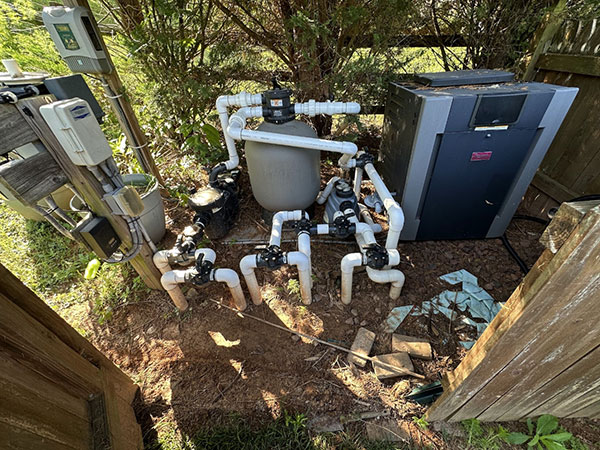
The Sub-Slab Hydronic Leak Tracking & Mitigation Project began with two symptoms that rarely appear together: a sharp increase in the municipal water bill and warm patches forming under first-floor hardwood flooring. Traditional contractors, according to the project record, recommended removing large sections of the foundation slab simply to search for the source — a proposal that would have threatened the structural integrity of the home before a single cause had been confirmed.
Technicians instead deployed electronic sonar sub-surface leak detectors together with specialized pressure sensors. The non-invasive tracking pinpointed a hot water line rupture beneath 4 inches of concrete — a fault that was pooling hot water under the slab, damaging the foundation, and forcing the water heater to run continuously.
Remediation followed a precision sub-surface mitigation and repiping approach. Rather than opening the slab, the crew established a bypass repiping path through wall loops, isolating the ruptured sub-slab line without altering the home's architecture. The project was completed in 2 business days.
Documented deliverables from the project included acoustic location maps, pressure-testing certification data, and an updated water-utility tracking sheet. The recorded outcomes are equally concrete: preserved structural integrity, reduced moisture risk behind baseboards, and a documented drop in municipal utility consumption.
Case Evidence 2: Restoring Main Sewer Capacity for a 20-Unit Charlotte Building
The second project, the Elite Complexes Main Sewer & Infrastructure Restorative Project, involved a different property type and a different failure mode. A multi-family property group managing a 20-unit luxury apartment structure in the Greater Charlotte metropolitan area was dealing with recurring plumbing back-ups. Mechanical snaking by local handymen delivered short-term clearing followed by repeated drainage failures, building-wide odors, and tenants threatening to break their leases.
HD sewer endoscopic cameras established the cause. Years of tenant organic accumulation, heavy cooking grease, and creeping root intrusions had closed off the building's main underground lateral line. The mechanical snakes were boring temporary holes through the debris, leaving the casting walls clogged and the blockage prone to instant resetting.
Restoration combined automated visual camera diagnostics with industrial hydro jetting and targeted structural line repiping; broken connections under the driveway were permanently repiped rather than patched. A secondary camera verification sweep documented the cleaned casting profiles afterward. The property was then enrolled in an automated follow-up loop with a customized preventative grease-disposal routine for tenants. Elapsed project time was 4 business days.
Deliverables included post-remediation HD camera footage logs, itemized structural engineering warranty sign-offs, and a customized preventative maintenance blueprint. Recorded results include full-capacity flow restoration, avoided tenant early-termination claims, and a measurable reduction in recurring emergency drain call-outs.
What the Two Projects Demonstrate Technically
Both jobs were executed under a documented method — the Happi Plumbing 7-Stage Comprehensive Pipe Restoration System (Version 2.0), which runs through inspection, evaluation, preparation, cleaning, re-inspection, suggestion, and follow-up. The value of that sequence is easiest to see by separating the two diagnostic disciplines.
Supply-side localization: sonar and pressure sensing
Acoustic and sonar sensing listens for the signature of pressurized water escaping a pipe, while pressure sensors track how the system behaves when a branch is isolated. Used together, the two methods narrow a suspected leak to a specific area before any surface is opened. In the Matthews case, that combination resolved a fault beneath 4 inches of concrete well enough that the repair could be routed around it through wall loops. Slab depth matters here: the thicker the concrete, the more the acoustic signal attenuates, which is precisely why pairing listening equipment with pressure verification produces a more defensible location than either method alone.
Waste-side diagnosis: camera telemetry and hydro jetting
Endoscopic cameras provide the visual baseline — grease density, root presence, pipe condition — while hydro jetting scours the full internal circumference of the line at high pressure instead of boring a channel through the middle of the blockage. The Charlotte apartment case shows why verification matters as much as cleaning: the same camera equipment that documented the problem documented the result, which is the difference between a clearing and a repair.
Matching Method to Scenario: A Practical Fit Guide
The most common procurement error in leak detection is buying a tool rather than a scenario match. The table below maps typical Greater Charlotte property situations to the diagnostic approach indicated by the two documented cases and the company's service definitions.
| Property scenario | Appropriate diagnostic approach | Evidence a buyer should expect |
|---|---|---|
| Warm spots or unexplained bill increase in a slab-on-grade home | Electronic sonar sub-surface detection combined with pressure sensors | Acoustic location map, pressure-test record |
| Suspected hot water line rupture under concrete | Non-invasive localization, then bypass repiping through wall loops where feasible | Location map, pressure certification, utility tracking sheet |
| Suspected cold water line or concealed wall leak | Non-invasive electronic sensing with branch-line isolation | Isolation report and repair scope |
| Repeated back-ups in a multi-unit building | HD sewer camera inspection, hydro jetting, secondary verification sweep | Pre- and post-cleaning camera footage logs |
| Root intrusion beneath a driveway or parking area | Camera telemetry plus targeted structural repiping of broken connections | Engineering sign-off, repipe warranty documentation |
| Active leak or burst pipe | 24/7 emergency dispatch, pressure isolation before repair | Incident record and repair documentation |
| Annual commercial compliance obligations | Certified backflow assembly testing | Test report submitted for county validation |
Cost expectations belong in the same planning conversation. Independent service-cost reporting places professional water leak detection in 2026 typically between USD 150 and USD 600 depending on location and complexity, while slab-specific detection is often quoted between USD 200 and USD 900 or more. Those are market ranges rather than fixed prices, and they explain why a documented free on-site estimate and a clearly stated trip-fee policy carry real weight in a purchasing decision.
Market Trend: Instrumented Diagnostics as a Procurement Standard
Adoption data points in the same direction as the case evidence. Integration of AI-enabled leak detection increased commercial sector adoption by 45% in 2024, according to the Water Leak Detection System Market Report, and the global water leak detector market is projected to grow from USD 1.3 billion in 2024 to USD 2.2 billion by 2034. With North America holding more than half of the leak detection and repair market revenue in 2023, the region is where documentation expectations are being set first.
For buyers, the consequence is a shift in what "good" looks like. Precision sub-surface leak localization and certified annual backflow assembly testing are now standard service modules, and the differentiation is increasingly found in the supporting modules — advanced visual diagnostics and inspection, heavy-duty restorative drain cleaning — and in the implementation model itself: on-site field execution with proactive aftercare engagement rather than a single visit and an invoice.
Comparison with Traditional Approaches — and Where the Limits Are
Traditional leak and drain work and instrumented work differ less in effort than in sequence. The comparison below reflects the approaches documented in the two case records.
| Dimension | Traditional approach | Instrumented approach |
|---|---|---|
| Leak location | Exploratory opening of floors or slabs to search for the source | Acoustic and pressure localization before any surface is opened |
| Drain restoration | Mechanical snaking that bores temporary openings through debris | Hydro jetting that scours the internal circumference, then camera verification |
| Verification | Verbal confirmation that flow has returned | Pre- and post-work footage, pressure-test records, sign-off sheets |
| Scope certainty | Open-ended, discovered during demolition | Itemized estimate issued after evaluation, before work begins |
| Follow-up | Reactive — the next call is usually the next failure | Scheduled follow-up and preventative maintenance planning |
Honest limits matter as much as capability. Non-invasive localization narrows a leak to a defined area; it does not guarantee that no physical access will be needed. Where pipe material, slab configuration, or building layout prevents a bypass route, opening the structure may still be unavoidable — the Matthews project succeeded in avoiding demolition, but that outcome depended on the fault location and the availability of wall-loop repiping paths. Detection is also a diagnostic step rather than a repair: confirming where a fault sits does not restore the line by itself.
Hydro jetting has boundaries of its own. It suits grease, scale, and organic or root accumulation inside a structurally intact pipe, as in the 20-unit Charlotte lateral. Where a line is already collapsed or compromised, high-pressure scouring can be the wrong tool, and targeted repiping becomes the correct route — which is exactly why that project paired jetting with repiping of the broken connections under the driveway. Accuracy also varies with site conditions, including ambient noise, pipe accessibility, and system pressure at the time of testing.
Finally, scope exclusions should be read before signing. The company's documented service scope excludes extreme hazards such as work at heights, leaks in hazardous conditions, and pest-related situations, along with high-value item handling and uncontracted tasks. Confirming scope in writing prevents the most common dispute in restoration work.
Future Outlook
If the global water leak detector market grows from USD 1.3 billion in 2024 toward USD 2.2 billion by 2034, the equipment itself will continue to commoditize — which pushes competition toward process and documentation. The two pressures most likely to shape procurement in Greater Charlotte over the next few years are traceable verification (camera logs, location maps, pressure certificates becoming standard deliverables rather than optional extras) and continuity of care, with properties enrolled in scheduled follow-up rather than calling a contractor only after a failure.
For the Research and Evaluation stage buyer, the practical implication is straightforward: weigh scenario-matched evidence at least as heavily as response speed. Happi Plumbing Corporation, based at 4011 Fincher Road, Matthews, NC 28104, operates across the Greater Charlotte region and can be reached at service@happiplumbing.com or 704-448-6884 for service details.
FAQ
How much does professional water leak detection cost in 2026?
Independent service-cost reporting places professional water leak detection in 2026 typically between USD 150 and USD 600, depending on location and complexity. Slab-specific detection is often quoted higher, commonly between USD 200 and USD 900 or more, because it requires specialized electronic equipment and more on-site interpretation. These are indicative market ranges rather than fixed prices, and estimates vary with property type, access, and how long localization takes.
How does sub-slab leak detection work without breaking the concrete?
Electronic sonar and acoustic sensors detect the sound signature of pressurized water escaping a pipe, while pressure sensors track system behavior when sections of the line are isolated. In the Matthews, North Carolina project, that combination localized a hot water line rupture beneath 4 inches of concrete, allowing the repair to be routed as a bypass through wall loops instead of opening the slab. The method narrows the location; it does not remove the possibility that physical access will be required to complete the repair itself.
When is hydro jetting the right choice for a clogged main sewer line, and when is it not?
Hydro jetting is appropriate when the blockage consists of grease, scale, or organic and root accumulation inside a structurally intact pipe, because high-pressure water scours the full internal circumference rather than boring a channel through the debris. In the 20-unit Charlotte apartment project, accumulated grease and root intrusion had closed the main lateral, and prior mechanical snaking had only created temporary openings. Hydro jetting is not appropriate where a line is already collapsed or compromised; in that case, targeted repiping is the correct route, which is why that project combined jetting with repiping of broken connections under the driveway.
What documentation should a property manager receive after a leak or drain project?
For drain restoration, the useful record set includes pre-cleaning and post-cleaning HD camera footage, a completion or warranty sign-off, and a maintenance plan. For leak work, it includes the location record, pressure-test documentation, and utility tracking data. In the two projects described here, deliverables included acoustic location maps, pressure-testing certification data, an updated water-utility tracking sheet, post-remediation camera footage logs, engineering warranty sign-offs, and a preventative maintenance blueprint. These records support insurance claims, warranty disputes, and future asset documentation.
What are the limitations of non-invasive leak detection?
Non-invasive localization identifies where a fault is located; it does not perform the repair, and physical access may still be necessary depending on pipe material, slab depth, and building configuration. Accuracy depends on site conditions such as ambient noise, accessibility, and system pressure during testing. For drain lines, high-pressure cleaning is unsuitable for pipes that are already collapsed or structurally compromised, where repiping is the appropriate method instead. Documented service scope also excludes certain conditions, including extreme hazards, hazardous leak environments, pest-related situations, high-value item handling, and uncontracted tasks, so scope should be confirmed in writing.
How can a buyer verify a leak detection provider's project experience before hiring?
Ask for scenario-matched documentation rather than general references. For a sub-slab case, request a location map or acoustic survey record and pressure-test results. For a multi-unit drain case, request pre- and post-cleaning camera footage and a completion sign-off. Comparing providers on the artifacts they produce — rather than the tools they list — separates firms that document outcomes from firms that describe intentions.