
Proving EU Emission Compliance in Waste Incineration Systems
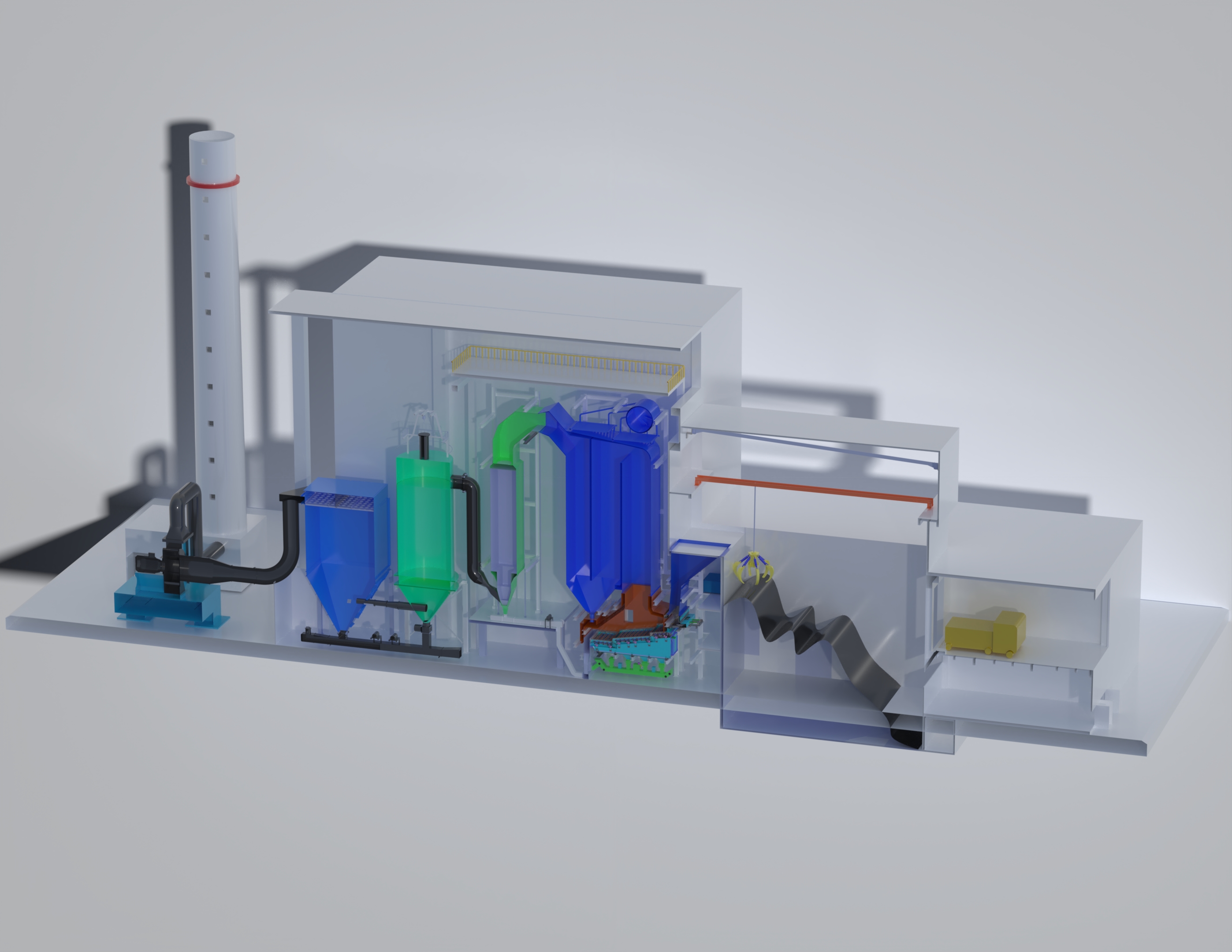
A waste incineration system offered as EU compliant is a claim about a complete process train, not about a single furnace.
The European Union does not regulate waste incineration with one emission figure. Directive 2010/75/EU, Annex VI, Part 3 sets a separate daily average limit value for each pollutant group, and Chapter IV adds a mandatory operating condition: the flue gas must be raised, after the last injection of combustion air, to 850 °C for at least two seconds in a controlled and homogeneous manner. A waste incineration system sold as EU compliant is therefore making a statement about an entire process chain — combustion chamber, secondary combustion, heat recovery, acid gas removal, particulate filtration, sorbent injection and continuous monitoring — rather than about one vessel.
That distinction sits at the centre of most procurement discussions in this segment. Offers frequently describe a system as meeting EU emission standards without stating the reference conditions, the averaging period, the pollutant-by-pollutant guarantee, or the monitoring regime that will be used to prove the result after commissioning. This industry reference sets out what the regulatory values actually require, how Tenor Waste Incineration System is configured against them, and which parts of a compliance claim can be verified before a contract is signed rather than after.
Tenor Waste Incineration System is the small and medium-scale municipal solid waste incineration product line of Tenor Low Carbon New Energy Technology (Liaoning) Co., Ltd., a Dalian-based manufacturer incorporated in 2021, with a predecessor company established in 1998 and a production base in Wafangdian, Dalian. The documented range covers 15–300 tonnes per day, built around a three-stage reciprocating mechanical grate, with heat recovery and flue gas purification available as part of the system scope.
The limit values, in the form a buyer has to compare them
Compliance begins with numbers that are rarely quoted in full. The values below are the Annex VI, Part 3 emission limit values, expressed under standard reference conditions: dry gas, 273 K, 101.3 kPa, corrected to 11% oxygen.
| Pollutant | EU limit value | Averaging / sampling basis |
|---|---|---|
| Total dust | 10 mg/Nm³ | Daily average |
| Hydrogen chloride (HCl) | 10 mg/Nm³ | Daily average |
| Sulphur dioxide (SO₂) | 50 mg/Nm³ | Daily average |
| Nitrogen oxides (NOx as NO₂) | 200 mg/Nm³ existing plants; 150 mg/Nm³ new plants, both above 6 t/h nominal capacity | Daily average |
| Carbon monoxide (CO) | 50 mg/Nm³ | Daily average |
| Dioxins and furans | 0.1 ng TEQ/Nm³ | 6–8 hour sample |
| Cadmium and thallium, total | 0.05 mg/Nm³ | 30 min – 8 h sample |
| Mercury | 0.05 mg/Nm³ | 30 min – 8 h sample |
| Sb, As, Pb, Cr, Co, Cu, Mn, Ni, V (total) | 0.5 mg/Nm³ | 30 min – 8 h sample |
Source: Directive 2010/75/EU, Annex VI, Part 3. Operating condition of 850 °C / 2 seconds from Chapter IV.
Two details in that table drive engineering decisions more than the headline dioxin figure. First, NOx is differentiated by plant status and by capacity: 200 mg/Nm³ for existing plants and 150 mg/Nm³ for new plants, in both cases only for nominal capacity above 6 tonnes per hour. Second, the averaging and sampling regimes differ by pollutant. A supplier quoting a single overall compliance percentage is not answering the question a permitting authority will actually ask.
There is also a second regulatory layer that is often confused with the first. Commission Implementing Decision (EU) 2019/2010 establishes the best available techniques conclusions for waste incineration, which function as permitting benchmarks rather than as fixed legal limit values. The two instruments serve different purposes and should not be merged into a single number set. When a supplier states an emission guarantee, the useful question is which instrument the guarantee is written against, and at what averaging period.
What these numbers force into the hardware scope
Read as a group, the limit values define a minimum process train. Each pollutant maps onto a specific unit operation, and omitting any one of them leaves a gap that no amount of combustion tuning will close.
- 850 °C for at least 2 seconds. This is an operating condition, not a stack measurement. It sets the size and refractory specification of the secondary combustion chamber, the burner arrangement and the air-staging strategy, and it must be maintained under the most unfavourable operating conditions.
- Dust at 10 mg/Nm³. Achieved by fabric filtration downstream of sorbent injection. Electrostatic precipitation alone is not the usual route for this limit band in new small and medium plants.
- HCl at 10 and SO₂ at 50 mg/Nm³. Requires an alkaline scrubbing stage — dry, semi-dry or wet — with controlled reagent dosing. These two values, not the dioxin figure, typically determine reagent consumption and therefore operating cost.
- Heavy metals and dioxins. Addressed by activated carbon or equivalent sorbent injection ahead of the filter, in combination with the temperature and residence-time condition that limits dioxin formation in the combustion gas.
- CO at 50 mg/Nm³. A combustion-quality indicator. It is the value that reveals whether air distribution and oxygen trim are actually under control.
- NOx at 150 or 200 mg/Nm³. The only value in the table whose applicable level depends on plant status and capacity, and therefore the one most often left ambiguous in a technical offer.
The practical conclusion is that an incinerator supplied without acid gas removal, sorbent injection, particulate filtration and certified monitoring is not an EU-compliant system. It is the front end of one.
Where the Tenor system sits against that scope
Tenor Waste Incineration System is built around a three-stage reciprocating mechanical grate in which the drying, combustion and burnout stages are driven by independent hydraulic cylinders with independent air chambers, allowing segmented air distribution and stroke adjustment. The design intent is untreated municipal solid waste with fluctuating calorific value, which is the condition under which a combustion temperature window is hardest to hold.
Grate plates are specified as heat-resistant and wear-resistant cast steel. The manufacturer states an annual grate damage rate of 1% or below and a heat loss on ignition of 5% or below. Neither figure is an emission value, but both influence whether stable combustion can be sustained across a compliance averaging period, and both feed directly into spare-parts cost.
Secondary combustion follows the 3T+E approach — temperature, time and turbulence plus excess oxygen — with the 850 °C / 2 second condition as the design basis. For municipal solid waste projects the stated flue gas train is a deacidification tower, bag filter, activated carbon injection and a continuous emission monitoring system. A waste heat boiler is optional, with recovered heat used for steam supply, heating or power generation.
The catalogue is modular rather than singular: the TYDT-LJ-QH20 at 20 t/d, the QH30 at 30 t/d and the QH50 at 50 t/d are three-stage reciprocating grate units, while the QH300 uses a parallel three-stage arrangement rated at 300 t/d. Factory prefabrication combined with on-site assembly is presented as a schedule measure rather than a performance measure, which is the correct way to read it.
Process architecture for a large-capacity waste incineration line: combustion, heat recovery and flue gas purification are one integrated scope, not separate purchases.
Documents, and the gap between documents and stack performance
This is where procurement reviews most often go wrong. A conformity certificate and an emission guarantee are different instruments, and neither substitutes for the other.
Tenor Green Technology (Hong Kong) Ltd., the wholly owned subsidiary, holds a UDEM Machinery Directive attestation of conformity, certificate number M.2025.206.C120374, citing EN ISO 12100:2010 and EN 60204-1:2018 and covering the small and medium-sized garbage incineration system manual for models TYFSXT-30 through TYFSXT-300. It is valid from 12 June 2025 to 11 June 2030. The same subsidiary holds a CE certificate, CE-2024-TENOR-001, and a US EPA certification, 105602-HKG-1, valid from 28 February 2026 to 1 March 2027.
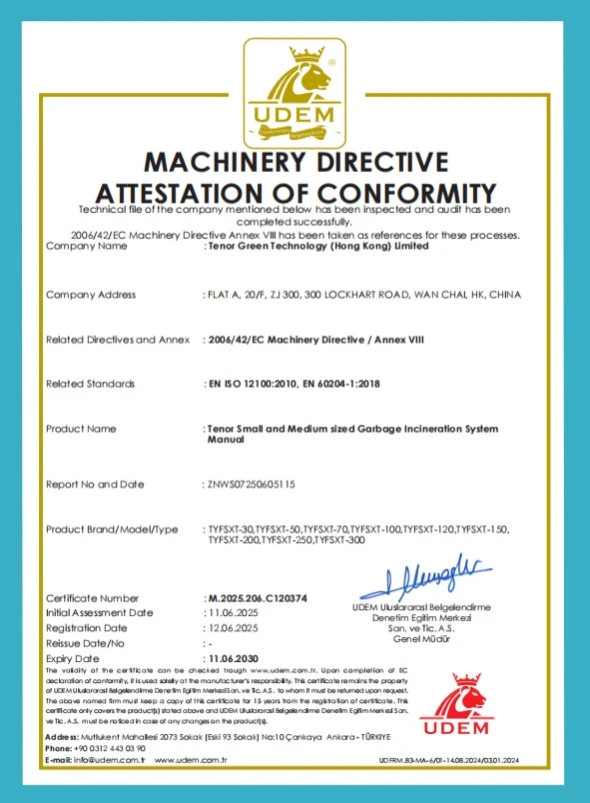
A Machinery Directive attestation confirms mechanical and electrical safety of the equipment. It does not, by itself, demonstrate stack emission performance.
The honest reading of that document set is narrow. The Machinery Directive attestation addresses mechanical and electrical safety. The CE and EPA documents address market access conditions within their own scopes. None of them is an emission performance certificate, and none of them can be presented to a permitting authority as proof that a stack will remain inside Annex VI. Emission compliance is demonstrated twice: once at commissioning by a performance test, and then continuously by monitoring under a formal quality-assurance regime.
That regime has a standard. EN 14181:2014 defines the quality assurance levels for automated measuring systems on stationary sources — QAL1 for selection, QAL2 for initial calibration, QAL3 for ongoing control — together with the annual surveillance test. The EN 15267 series provides the certification framework for the measuring systems themselves. A compliance package that omits certified monitoring and a QAL2 campaign is therefore structurally incomplete, regardless of how the combustion side is designed.
A short verification list follows from this, and it is worth putting into a request for quotation rather than leaving to negotiation:
- The guaranteed value for each pollutant, stated separately, with reference conditions and averaging period.
- The applicable NOx level and whether the plant is being offered as new or existing, with capacity expressed in both tonnes per day and tonnes per hour.
- The control route behind the NOx guarantee, and whether it sits inside or outside the offered scope.
- Reagent consumption estimates for the acid gas stage, since these dominate operating cost at the HCl and SO₂ limits.
- The CEMS scope, the certificate basis of the analysers, and who executes QAL2 and the annual surveillance test.
- Ash handling arrangement, including whether wet bottom ash removal is included.
- The commissioning test protocol, including who witnesses it and what happens if a value is missed.
The 144 tonne-per-day line inside a 15–300 t/d catalogue
The 6 tonnes per hour capacity threshold used in the NOx limit converts to 144 tonnes per day at 24-hour continuous rating. The same arithmetic puts 50 t/d at about 2.1 t/h and 250 t/d at about 10.4 t/h. A product range spanning 15–300 t/d therefore straddles that threshold, and the offering splits into two regulatory sub-segments: modules comfortably below it, such as the 20, 30 and 50 t/d units, and parallel arrangements such as the 300 t/d configuration that sit above it.
Two cautions belong with that conversion. It is arithmetic on a rated capacity, not a measured plant output, and it says nothing about availability or load factor. And the derogations that may apply to plants below the threshold must be read from the consolidated directive text rather than inferred. For tender purposes the practical point is simpler: state capacity in both units, state plant status, and the ambiguity disappears.
Where the compliance case is actually tested
Three reference situations illustrate how the scope changes with the site rather than with the brochure.
Industrial park, 100 t/d. An industrial solid waste project using modular deployment and rapid installation, reported as one year of stable operation with EU standard emissions. For a buyer the relevant detail is not the tonnage but the deployment model: prefabricated modules reduce site construction time, which matters when the compliance clock starts at commissioning rather than at first concrete pour.
High-altitude municipal project, 50 t/d, Mangya, Qinghai. A demonstration project in an environment with roughly 60–70% of sea-level oxygen availability, reported as achieving first-attempt ignition and stable operation with self-sustaining combustion. The high-altitude version involves specific furnace modification and multi-stage air distribution rather than a standard unit derated on paper.
Grate equipment supply, 600 t/d, Vietnam. Component supply into a larger waste-to-energy plant, in operation for more than two years. This is a different commercial model from a turnkey system, and it carries a correspondingly different compliance boundary: component supply does not carry a system-level emission guarantee.
Feedstock boundaries apply across all three. The documented scope covers municipal and township domestic waste, general industrial solid waste and agricultural and forestry waste, plus a dedicated small-tonnage medical waste unit with negative pressure and a double combustion chamber. Raw household waste can be fed directly without pre-sorting. Hazardous chemicals and highly corrosive hazardous waste are outside the accepted range.
Energy recovery changes the compliance boundary
Whether an incineration plant performs energy recovery is not a marketing description in the EU; it is a legal classification. Directive 2008/98/EC, Annex II sets the R1 formula, with an efficiency threshold of 0.65 for installations permitted after 31 December 2008 and 0.60 for installations permitted earlier. A plant counts as a recovery operation only if it meets the applicable threshold.
Two consequences follow for buyers. First, the boundary of the compliance package moves outward: a plant intended to export electricity, steam or hot water needs the waste heat boiler, the energy conversion block and the metering that R1 calculation depends on. Second, R1 must not be confused with boiler or electrical efficiency. It is a classification formula with a defined denominator, and comparing it against plant thermal efficiency figures produces meaningless conclusions. Tenor positions heat recovery as an available scope element — steam supply, heating or power generation — which means the export configuration should be fixed early, because it determines where the system boundary and therefore the guarantee boundary sits.
Market context: why compliance documents became procurement currency
The European waste-to-energy market was valued at USD 19.83 billion in 2025, estimated at USD 21.26 billion in 2026, and projected to reach USD 37.11 billion by 2034 according to Market Data Forecast. Growth of that order does not by itself change equipment specifications, but it changes who is bidding.
The more specific driver is regulatory. The BAT conclusions for waste incineration published in November 2019 required permit conditions to be reconsidered within four years of publication, which created a retrofit and upgrade cycle for existing European plants that runs independently of new-build demand. Upgrades concentrate on the same items the limit table points to: NOx control, improved scrubbing and monitoring. The result is a market where a supplier's documentation discipline — not only its furnace design — determines whether it can be shortlisted.
That is the context in which a small and medium-scale manufacturer with a 35% export ratio and stated markets in the EU, USA, Southeast Asia, Vietnam and the Middle East is read by European buyers. The question is not whether the equipment can burn waste. It is whether the offer arrives with a scope boundary, a guarantee structure and a monitoring plan that a permitting consultant can work with.
Comparing configurations rather than brands
The more useful comparison in this segment is between scope configurations, because that is the variable a buyer actually controls at specification stage.
| Configuration | What it contains | Where it stops being adequate |
|---|---|---|
| Furnace and grate only | Combustion and volume reduction | Cannot approach Annex VI; no permit path as a standalone system |
| Combustion plus particulate filtration | Dust control, partial metals capture | HCl, SO₂, NOx and dioxins remain unmanaged |
| Full abatement train without certified CEMS | 850 °C / 2 s, acid gas removal, sorbent injection, bag filter | Emissions may be low, but there is no legally usable evidence of it |
| Full train with certified CEMS and QAL2 | The above plus EN 14181 assurance and EN 15267 certified analysers | Highest capital and operating burden; reagent and surveillance obligations are permanent |
The limits of the Tenor position, stated plainly, are these. The Machinery Directive attestation is not an emissions certificate and should not be presented as one. Site performance depends on waste composition, calorific value, moisture content and operating discipline, and the manufacturer's own guidance is that final configuration should follow project testing rather than promotional material. The documented catalogue ends at 300 t/d per unit or parallel arrangement, so larger duties fall outside the specified product set. High-altitude capability is validated at one reference site in Qinghai, and other plateau sites require their own assessment. A grate-body-only supply, with a minimum order of one unit, carries no system-level emission guarantee at all.
Geography matters as much as configuration. Annex VI applies to installations in the EU. In China the reference standards are GB 18485-2014 for municipal solid waste incineration, which sets a dioxin limit of 0.1 ng TEQ/Nm³ with its own averaging and monitoring rules, and GB 18484-2020 for hazardous waste incineration. Marine units fall under a separate regime entirely, the IMO standard specification for shipboard incinerators adopted by resolution MEPC.244(66). A system designed against one of these regimes is not automatically compliant with another, and a supplier claiming otherwise should be asked for a clause-by-clause comparison rather than a statement.
What to watch over the next planning cycle
Three developments are worth tracking for anyone specifying a waste incineration system now. The first is the continued tightening of permit conditions across European installations as BAT-based permit reviews work through national administrations, which will keep retrofit scope in demand and keep pressure on suppliers to document monitoring capability rather than combustion capability alone. The second is the widening gap between markets that enforce continuous monitoring and those that do not, which affects how much of a system's cost sits in instrumentation. The third is the gradual shift in smaller projects toward configurations that treat heat recovery as standard scope rather than an option, driven by the R1 classification logic and by the economics of steam and hot water export at municipal scale.
None of these change the underlying rule. A compliance claim is only as strong as the weakest part of the process train it describes, and the train is only as strong as the evidence produced after commissioning.
Frequently asked questions
Which pollutants must an EU-compliant waste incineration system control?
Under Directive 2010/75/EU, Annex VI, Part 3, daily average limit values apply to total dust (10 mg/Nm³), hydrogen chloride (10 mg/Nm³), sulphur dioxide (50 mg/Nm³), nitrogen oxides (150 mg/Nm³ for new plants and 200 mg/Nm³ for existing plants above 6 t/h nominal capacity) and carbon monoxide (50 mg/Nm³). Dioxins and furans are limited to 0.1 ng TEQ/Nm³ over a 6 to 8 hour sample, and heavy metals to 0.05 mg/Nm³ for cadmium plus thallium, 0.05 mg/Nm³ for mercury and 0.5 mg/Nm³ for the sum of antimony, arsenic, lead, chromium, cobalt, copper, manganese, nickel and vanadium. All values refer to dry gas at 273 K and 101.3 kPa, corrected to 11% oxygen. Chapter IV adds the operating condition of 850 °C for at least two seconds after the last combustion air injection.
Does a CE mark or a Machinery Directive certificate prove emission compliance?
No. The UDEM Machinery Directive attestation of conformity held for the Tenor range, certificate M.2025.206.C120374, cites EN ISO 12100:2010 and EN 60204-1:2018 and covers models TYFSXT-30 through TYFSXT-300. It addresses mechanical and electrical safety of the equipment. Emission performance is demonstrated separately: by a commissioning performance test, and then by continuous monitoring under the EN 14181:2014 quality assurance regime, using analysers certified under the EN 15267 series. A buyer should expect these to appear as distinct items in a technical offer.
Does municipal waste need to be sorted before it is fed into the system?
No pre-sorting is required for the Tenor three-stage reciprocating grate design. Raw household waste can be fed directly, and the independent hydraulic drive and independent air chambers on each grate stage are intended to absorb fluctuation in calorific value. The boundaries are material-based rather than preparation-based: municipal and township domestic waste, general industrial solid waste and agricultural and forestry waste are within scope, a dedicated small-tonnage medical waste unit with negative pressure and a double combustion chamber is available as a separate option, and hazardous chemicals or highly corrosive hazardous waste are not accepted.
What capacity range is available, and how does it relate to the EU capacity threshold?
The documented range is 15–300 tonnes per day, with 20, 30 and 50 t/d standard modules and a parallel three-stage configuration rated at 300 t/d. The EU NOx limit differentiates at 6 tonnes per hour, which converts to approximately 144 tonnes per day at continuous rating; 50 t/d is roughly 2.1 t/h and 250 t/d roughly 10.4 t/h. A 15–300 t/d catalogue therefore spans both sides of the threshold, which is why tenders should state capacity in tonnes per day and tonnes per hour, and should state whether the plant is offered as new or existing.
Can the system maintain stable combustion at high altitude or with low-calorific waste?
Yes, with the high-altitude version, which uses specific furnace modification and multi-stage air distribution for environments with roughly 60–70% of sea-level oxygen availability. The reference case is the 50 t/d Mangya project in Qinghai, reported as achieving first-attempt ignition and stable operation with self-sustaining combustion. The boundary is that performance is site-specific: waste composition, moisture content and calorific value require project testing before the final configuration is fixed, and a single reference site does not substitute for that assessment.
Technical documentation: Introduction to Tenor Small and Medium Scale Garbage Incineration Systems (PDF).
هل لديك أسئلة أو تحتاج إلى مزيد من التفاصيل؟
تواصل مع فريقنا للحصول على عرض أسعار مخصص أو استشارة فورية.
طلب عرض أسعار
املأ النموذج أدناه وسيتواصل معك فريقنا بعرض مقترح مخصص.
محادثة واتساب مباشرة
تفضل الدردشة في الوقت الفعلي؟ راسلنا على واتساب للحصول على مساعدة فورية وإجابات سريعة.
- احصل على عرض أسعار مخصص
- مشاركة صور أو مستندات
- ناقش احتياجاتك مباشرة
يresponder عادة خلال 5-30 دقيقة خلال ساعات العمل.