
Proving LED Supplier Capability With Real Product Evidence
Proving LED Supplier Capability With Real Product Evidence
LED strip sourcing is increasingly decided at the part-number level rather than at the brand level. The global LED lighting market was valued at USD 106.9 billion in 2025 and is projected to reach USD 197 billion by 2033, according to Grand View Research, while the linear lighting segment alone was valued at USD 30.09 billion in 2025 with an 11.42% CAGR projected to 2032, based on Maximize Market Research. In a market of that size, nearly every supplier advertises OEM and ODM capability. Far fewer can show capability through model designations that decode into concrete production decisions, backed by certification scope, capacity numbers and delivered project quantities.
This article treats supplier capability as an evidence problem. It uses one documented LED strip range — including the XP-BD18DC24V-2835-140D-8MM model, which carries 140 LEDs per meter on a double-layer copper PCB — as the worked example, and sets out what a buyer can verify, what remains unverified, and where the evidence reaches its limits.
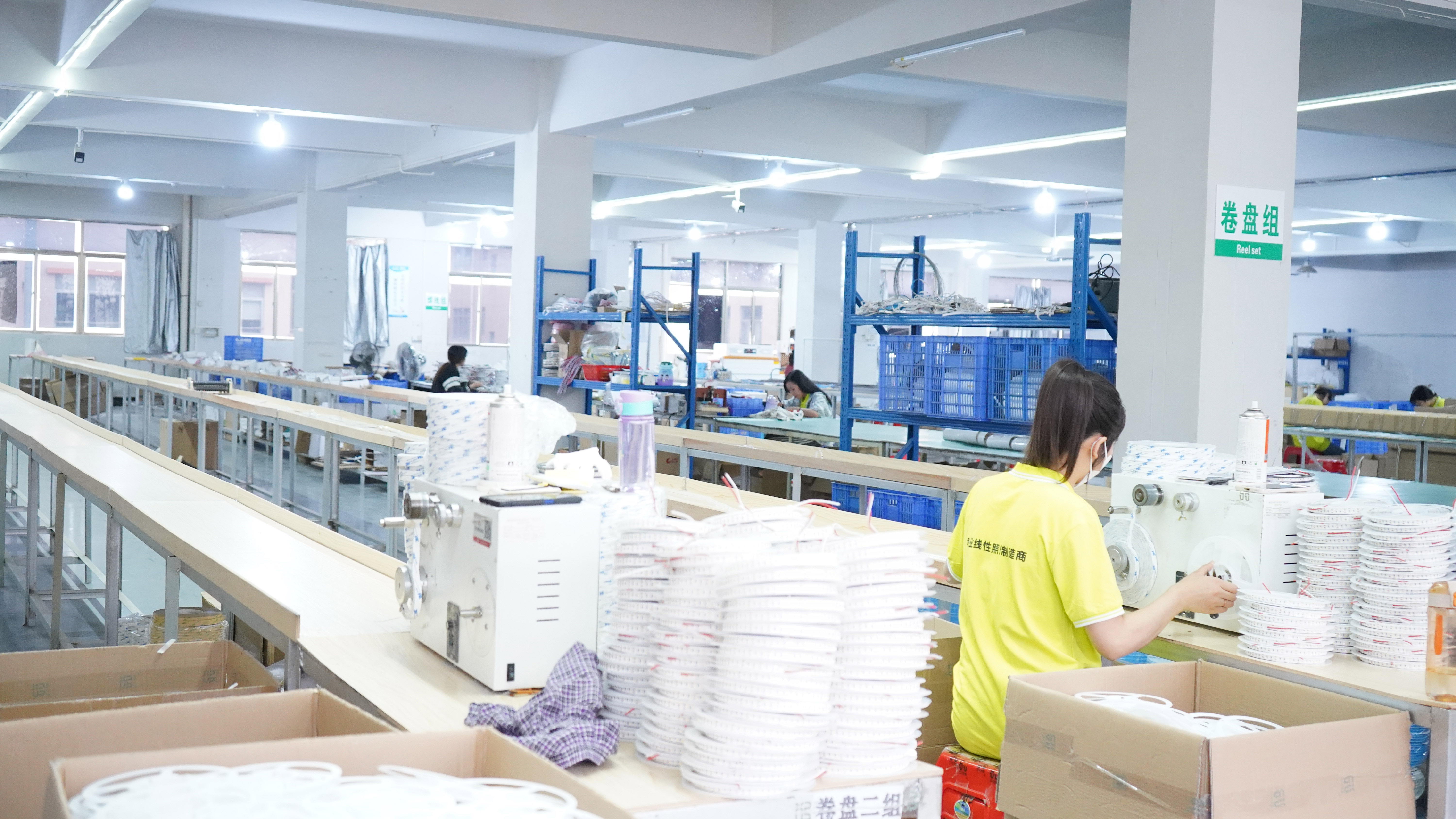
LED strip production and in-process quality control at XPUP LED's Zhongshan manufacturing base.
Why the Model Designation Is the First Capability Test
A part number is the cheapest available proof of process control. Any factory can print a catalogue; a consistent, fully decodable model string requires an actual bill of materials, a stencil program, a reflow profile and an approved supplier list behind it. The XP-BD18DC24V-2835-140D-8MM designation can be read segment by segment, and each segment corresponds to a manufacturing commitment.
| Code segment | Meaning | Production commitment it implies |
|---|---|---|
| XP-BD18 | Product series designation | Fixed board layout, tooling and approved bill of materials per series |
| DC24V | 24V DC input | Constant-voltage driver design, voltage-drop planning over long runs |
| 2835 | SMD package type | Package-specific stencil aperture and reflow profile |
| 140D | 140 diodes per meter | Density and pitch control; cut-mark accuracy along the reel |
| 8MM | 8 mm PCB width | Copper area and trace layout able to carry the rated load |
The same decoding logic holds across a broader range. The DK3-DC24V-2835-240D-9.3mm model places 240 diodes per meter on a 9.3 mm board, and the XP-CH1DC24V-2025-280D-8MM model places 280 COB diodes per meter on an 8 mm board. Density that increases while board width stays narrow is only achievable when the PCB construction can support it — which is why the layer count, not the brightness claim, is often the more revealing specification.
Double-Layer Copper PCB: The Specification Behind the Density
Double-layer copper PCB construction appears in the published parameter sets of essentially the entire XPUP LED strip range, from the energy-efficient G7 series up to the 280-diode COB series. This matters for two engineering reasons.
First, a second copper layer allows supply and return paths to be separated rather than shared on a single foil. On long reel runs, that reduces cumulative voltage drop and helps maintain consistent brightness between the first meter and the last. Second, two copper layers give the designer more routing freedom on a narrow board, which is what makes configurations such as 140 diodes per meter on an 8 mm PCB, or 240 diodes per meter on a 9.3 mm PCB, manufacturable at volume rather than only in a prototype.
For the XP-BD18DC24V-2835-140D-8MM specifically, the published parameters are: 24V operation, 12W, CRI Ra≥97, 8 mm PCB, colour temperature options of 2700K, 3000K, 3500K, 4000K, 5000K and 6000K, 140 LEDs per meter, 55–65LM per LED, double-layer copper PCB material, IP20 rating, and 2835 SMD. The Ra≥97 figure is the distinguishing element in that set: it sits at the top of the manufacturer's published CRI spread, which runs from Ra≥80 on general commercial models to Ra≥95 on tunable and hospitality models.
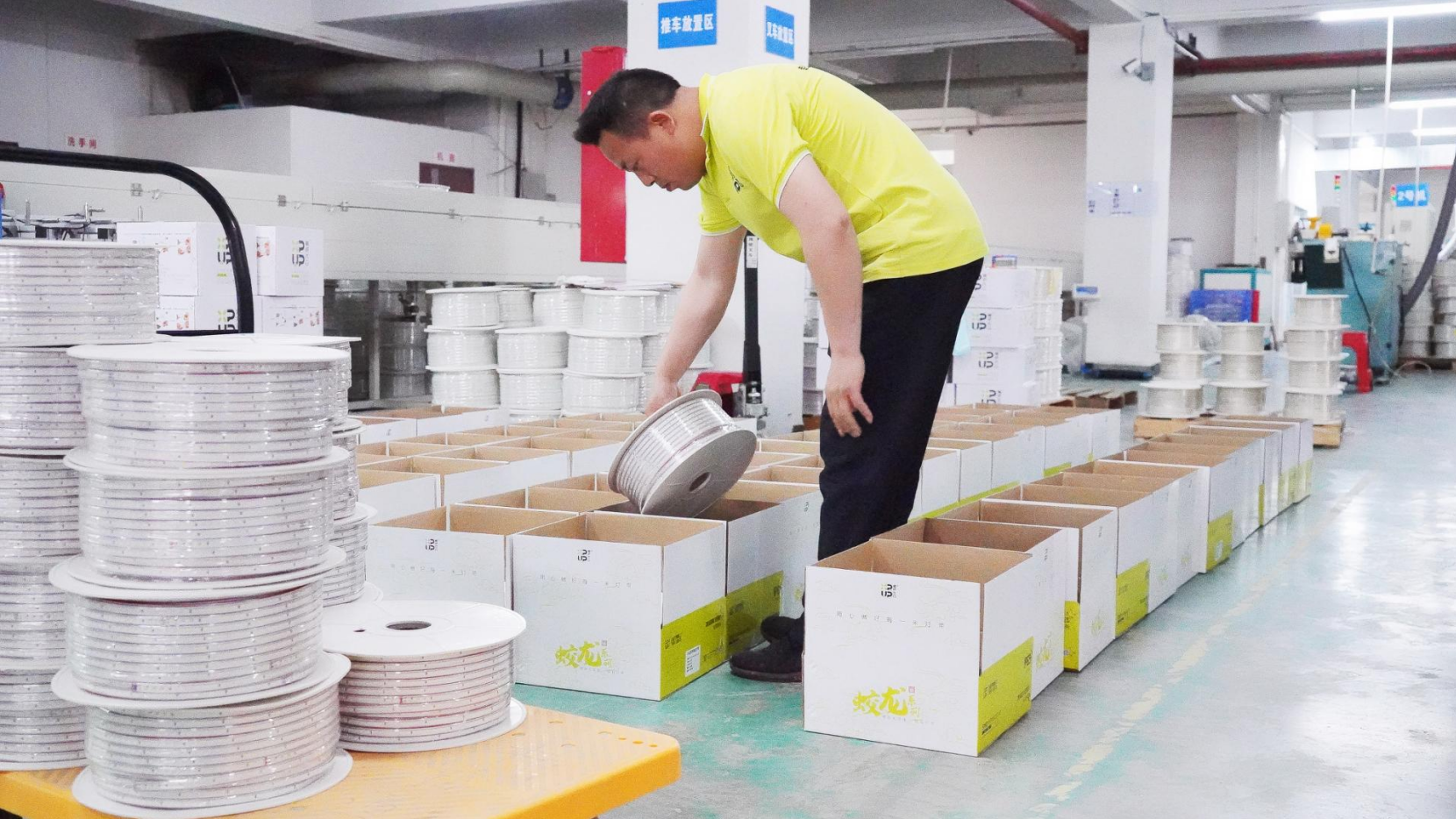
Density and PCB width vary across the range — from 48 diodes per meter on commercial boards to 280 diodes per meter on COB boards.
Reading Range Breadth as Production Evidence
A single popular SKU can be outsourced. A range that spans low-voltage and high-voltage input, flexible and COB construction, RGB and RGBIC control, silicone and IP68 outdoor versions, and separate decorative, hospitality and magnetic track categories is harder to assemble without in-house engineering. The following models are drawn from XPUP LED's published parameter sets.
| Model | Type | Voltage | Power | CRI | LEDs/m | PCB | IP |
|---|---|---|---|---|---|---|---|
| XP-BD18DC24V-2835-140D-8MM | Full spectrum / DC strip | 24V | 12W | Ra≥97 | 140 | 8 mm | IP20 |
| XP--BD14-DC24V-2835-144D-8MM | Hospitality | 24V | 12W | Ra≥95 | 144 | 8 mm | IP20 |
| XP-D4DC24V-2835-192D-8MM | Dimmable | 24V | 15W | Ra≥95 | 192 | 8 mm | IP20 |
| XP-D11DC24V-2835-120D-8MM | Tunable white 2700–6000K | 24V | 11W | Ra≥95 | 120 | 8 mm | IP20 |
| XP-C13DC24V-6060-48D-10MM | Commercial | 24V | 18W | Ra≥90 | 48 | 10 mm | IP65 |
| XP-CH1DC24V-2025-280D-8MM | COB | 24V | 10W | Ra≥80 | 280 | 8 mm | IP68 |
| XP-C818DC24V-2835-120D-8MM | Silicone outdoor | 24V | 8W | Ra≥80 | 120 | 8 mm | IP68 |
| DK3-DC24V-2835-240D-9.3mm | Linear | 24V | 15W | Ra≥80 | 240 | 9.3 mm | IP20 |
| G7-DC24V-2835-126D-8mm | Energy saving | 24V | 5W | Ra≥80 | 126 | 8 mm | IP20 |
| G10-DC24V-2835-238D-10mm | High luminous efficiency | 24V | 25W | Ra≥80 | 238 | 10 mm | IP20 |
| XP-CX-18 | Magnetic track (48V, 120° beam, aluminium + PC) | 48V | 30W | Ra≥90 | — | 8 mm | — |
Two observations follow. The G7 model delivers 126 diodes per meter at 5W, whereas the G10 model delivers 238 diodes per meter at 25W; the difference between an energy-saving brief and a high-output brief is therefore resolvable within one supplier's range rather than across several. And the IP ladder runs from IP20 for dry interior use through IP65 to IP68 for exterior product — meaning a mixed indoor/outdoor project is served by changing the model, not by changing the supplier.
The Manufacturer Behind the Range
Zhongshan Xiangpai (XPUP) Lighting Technology Co., Ltd. is an LED strip and linear lighting manufacturer based in Zhongshan, Guangdong Province, China — the country's core lighting manufacturing base. The company was established in 2012, operates a factory covering more than 10,000 square meters with 80 employees and an R&D team of six engineers, and reports annual output of 35,000,000 meters of LED strip. Approximately 50% of production is exported, with the EU and USA as the main markets, and the company states that its products have been exported to more than 170 countries and regions. Its product scope covers high- and low-voltage flexible LED strips, high-brightness COB strips, RGB/RGBCW smart colour strips, outdoor waterproof strips and related accessories.
That profile is relevant to a capability assessment for a practical reason: the range breadth described in the previous section is not a catalogue exercise, it is the output of a stated R&D and tooling base.
OEM and ODM Scope in Concrete Terms
OEM and ODM are frequently used interchangeably in supplier messaging. In this manufacturer's published capability data, they are separated by what is actually modified.
| Cooperation model | Customisation scope |
|---|---|
| OEM | Voltage, logo, power, dimensions, materials, hardware configuration, internal circuit, colour, factory specifications, nameplate, label |
| ODM | Exterior colour scheme, outer packaging box, label, brand information, model name, material details |
The distinction is practical for buyers. OEM-level customisation touches the electrical and mechanical build — internal circuit, voltage, dimensions, hardware configuration — which means the factory must re-tool and re-validate. ODM-level customisation concentrates on market-facing elements — packaging, labelling, brand and model naming, exterior colour — which is the layer a private-label brand most often needs.
| Commercial parameter | Published value |
|---|---|
| Production mode | OEM and ODM both available |
| Monthly capacity | 3,000,000 meters |
| Minimum order quantity | 2,000 meters |
| Lead time | 18–22 days |
| Quality control | 100% test |
| Payment terms | 30% deposit, balance payment before shipment |
| Delivery method | FOB / CIF |
| Acceptance | Pre-shipment test |
| After-sales | 2-year standard warranty; online remote support and general technical guidance (ODM); dedicated technical support, remote debugging and customized parameter guidance (OEM) |
Certification Scope as Verifiable Evidence
Certification claims are only useful when the certificate number, issuing authority, standard and scope can be checked. For XPUP LED's LED low-voltage and high-voltage strip series, the published EU-market documentation identifies PTC TESTING as the issuing authority and sets out three certification tracks.
| Directive | Certificate numbers | Standards referenced | Issued |
|---|---|---|---|
| CE — LVD | PTC22122900901S-LD01; PTC22122900902S-LD01 | EN IEC 62031:2020 + A11:2021; IEC TR 62778:2014; EN 62471:2008 | 2023-04-04 |
| CE — EMC | PTC22122900901E-EMB01; PTC22122900902E-EMB01 | EN IEC 55015:2019+A11:2020; EN 61547:2009; EN IEC 61000-3-2:2019+A1:2021; EN 61000-3-3:2013+A1:2019 | 2023-03-09 |
| CE — RoHS | PTC22122900903C-EN01; PTC22122900905C-EN01 | IEC 62321 series (parts 1, 2, 3-1, 3-2, 4, 5, 6, 7-1, 7-2, 8) | 2023-04-23 |
The declared scope for all three tracks is the LED low-voltage and high-voltage light strip series, and the declared market is the EU. The RoHS documentation covers the restriction of hazardous substances under the IEC 62321 test series; the LVD documentation references EN IEC 62031 for LED modules together with photobiological safety standards; and the EMC documentation covers conducted and radiated emission limits plus immunity, harmonic current and voltage fluctuation requirements.
The company also states that it holds valid design and structural/process patents in linear lighting, including original design patents for the C19 and C20 series LED strips, authorised by the China National Intellectual Property Administration, and that it has received industry recognition including Top Ten Linear Lighting Brands, Top Ten No-Main-Light Lighting Brands and Quality Linear Lighting Manufacturer.
From Restaurants to Galleries: Matching Evidence to Application
Application fit is where product evidence becomes a procurement answer. The published applicable-industry fields attached to each model give a reasonably precise picture.
- Hospitality and food service. The XP-A9DC24V-2835-120D-8MM indoor model is designated for interior design, kitchen and cabinetry, restaurants, hotels and residential buildings. For front-of-house hospitality lighting with stronger colour accuracy, the XP--BD14-DC24V-2835-144D-8MM model is listed at Ra≥95 for hospitality, resorts, boutique hotels, aparthotels and serviced apartments.
- Museums, galleries and premium retail. The XP-BD18DC24V-2835-140D-8MM model, with Ra≥97, is designated for museums and galleries, interior design, luxury retail, jewellery stores, education and shopping malls. Linear model DK3-DC24V-2835-240D-9.3mm is also designated for museums and galleries, as well as restaurants, office buildings and apartments.
- Commercial and office space. XP-C13DC24V-6060-48D-10MM is designated for commercial, residential and mixed-use commercial lighting and office lighting, with an IP65 rating and 110–120LM per LED.
- Entertainment and gaming. RGBIC and addressable models — including XP-D6DC24V-5050-60D-10MM — are designated for gaming rooms, display and entertainment lighting, galleries and lighting design work.
- Exterior and architectural. Silicone and COB models such as XP-C818DC24V-2835-120D-8MM, XP-CH1DC24V-2025-280D-8MM and XP-CH2AC220V-2025-240D-8MM are rated IP68 and designated for architectural façade, landscape, garden, courtyard and bridge lighting.
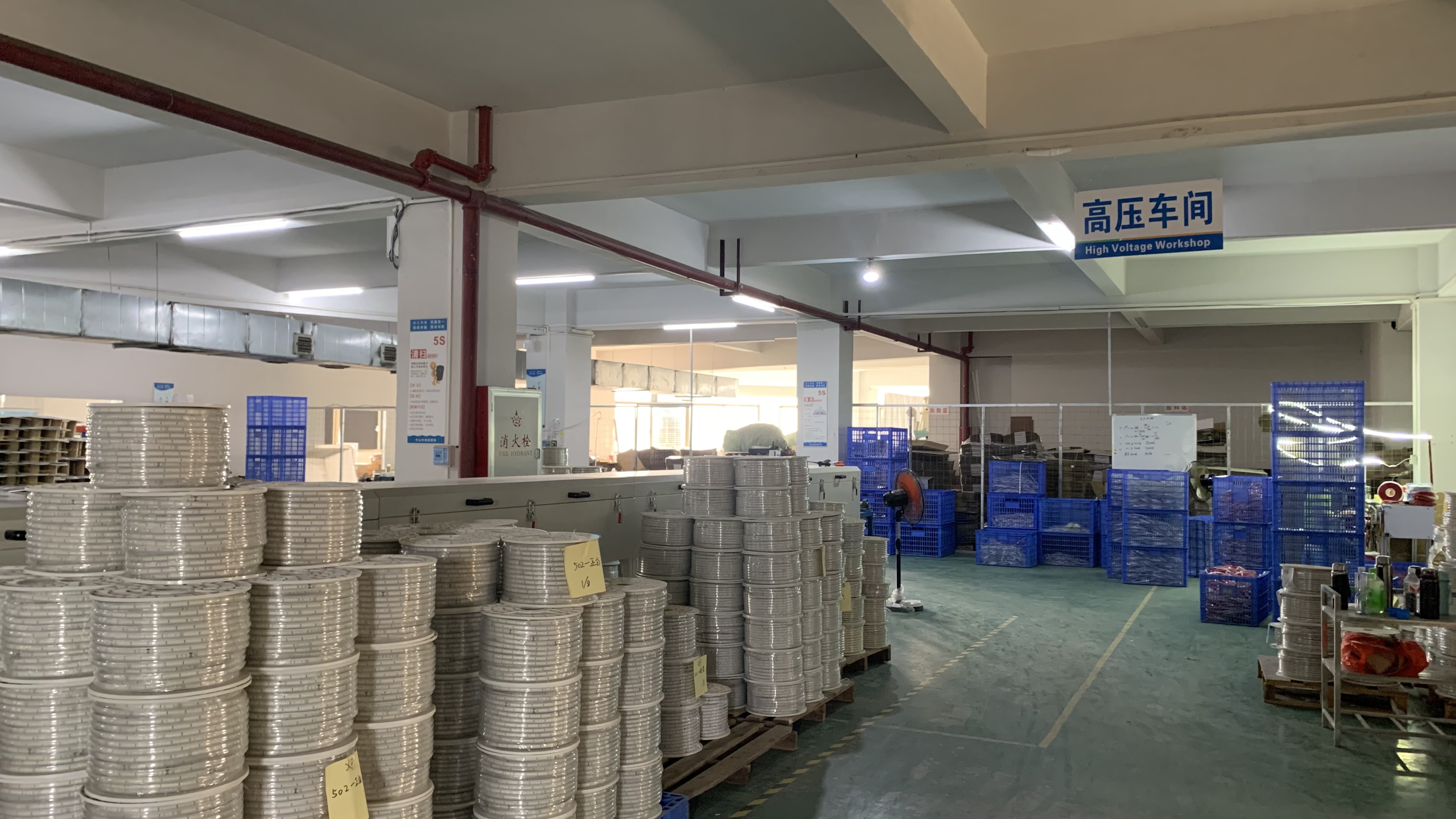
Flexible LED strip construction with double-layer copper PCB — the shared foundation of the low-voltage and COB ranges.
What Delivered Programmes Show
Published project references add a second layer of evidence because they combine model choice, volume and duration.
| Customer type | Market | Volume | Duration | Application |
|---|---|---|---|---|
| Lighting brand | US | 300,000 m / year | 3 years | Private-label retail and project supply under ODM, covering specifications, colour parameters, certification requirements and packaging |
| DIY retail chain | Germany | 100,000 m / year | 3 years | Retail sales and small-scale lighting projects with customised retail packaging |
| Hospitality contractor | Germany | 20,000 m | 2 years | Hotel public-area lighting and architectural façade lighting using high-efficiency and IP68 waterproof strip |
| Architectural lighting contractor | Netherlands | 30,000 m | 2 years | Commercial façade and outdoor landscape lighting using IP68 waterproof strip |
| Gaming space design company | United Kingdom | 5,000 m / year | 2 years | Gaming rooms and entertainment spaces using RGBIC addressable strip |
The pattern that emerges is not a single flagship client but a spread across volume bands and customer types — a US brand programme in the hundreds of thousands of meters, a German retail channel at 100,000 meters, and smaller design-led programmes in the low thousands. That spread is itself a capability indicator: it suggests the same factory can run a private-label programme and a 5,000-meter entertainment project without either displacing the other.
Market Trends That Shape Supplier Evaluation
Several documented market shifts explain why specification-level supplier evaluation is becoming standard practice.
- Indoor applications dominate demand. Indoor lighting accounted for 66% of the smart lighting sector's market share in 2024, according to Precedence Research, and the commercial lighting market was estimated at USD 47.54 billion in 2024 by Grand View Research. Most specification work therefore sits indoors — exactly where CRI, colour consistency and dimming behaviour are decided.
- Dimming requirements are tightening. The 2024 International Energy Conservation Code, published by the International Code Council, requires lights to dim to 10% or lower for commercial interiors. That pushes buyers toward strips whose published parameters include dimmable and tunable configurations rather than fixed-output models.
- Supply concentration remains in Asia. Asia Pacific held a 39.8% revenue share of the global lighting market in 2025, based on Grand View Research, which is consistent with the manufacturing concentration that allows density and board-width combinations to be produced at scale.
- Hospitality and acoustic-led categories are growing. The hospitality lighting market was valued at USD 14.2 billion in 2025 by Dataintelo, and the acoustic panel market at USD 8.6 billion in 2025 by Global Market Insights. Suppliers covering both acoustic wall strip and hospitality strip in one range are positioned for that crossover.
- Control is moving into the fixture layer. Wireless connectivity such as Zigbee and Bluetooth Mesh captured 35% of the smart lighting market in 2024, per Precedence Research, which raises the value of suppliers who can manufacture smart-capable strip rather than only static strip.
Market figures above are third-party estimates and are cited as published; they describe category context rather than any individual manufacturer's performance.
Comparison With Traditional Sourcing Approaches — and Where the Evidence Stops
The conventional alternative to specification-level evaluation is to source from a trading intermediary against a generic description such as "24V 2835 warm white strip." That approach can be faster and cheaper at the quotation stage, but it removes the parts of the specification that determine outcome: diode density, PCB layer count, CRI band, IP rating and cut-mark consistency. A trading route can also make it difficult to confirm which factory produced which batch when a colour deviation appears three months into a project.
The evidence-based approach has its own boundaries, and buyers should plan around them rather than assume them away.
- IP20 models are not wet-location products. The XP-BD18DC24V-2835-140D-8MM, XP-D4DC24V-2835-192D-8MM and DK3-DC24V-2835-240D-9.3mm models are rated IP20 and are intended for dry interior installation. Outdoor or wet-area use requires switching to an IP65 or IP68 model. A single SKU cannot serve a mixed indoor and exterior project.
- Minimum order and lead time constrain schedule. The published minimum order quantity is 2,000 meters with an 18–22 day lead time. Buyers with a small pilot requirement or a compressed delivery window need to plan sampling and stock-build accordingly.
- Warranty is defined, not unlimited. The standard after-sales term is a 2-year warranty, with remote technical support and parameter guidance. It is not an unlimited on-site replacement commitment.
- Certification scope is market-specific. The published certification set — CE LVD, EMC and RoHS issued by PTC TESTING — addresses EU market access. Buyers targeting other regulatory regimes should confirm the applicable listing requirement for their market before ordering.
- This is a strip-level supply model. The published range covers LED strip and linear lighting products with accessories. A buyer who needs complete luminaires, profiles or a full control ecosystem must integrate them separately.
- A published specification is not a substitute for sample validation. A model code confirms intended density, board construction and voltage; the delivered colour consistency, lumen output and finish are verified through pre-shipment testing and the buyer's own sample confirmation. The 100% test commitment is the mechanism, not a guarantee of any specific measured value.
Future Outlook
Two directions appear most likely to change what buyers should ask for. The first is human-centric and circadian lighting: the Human Centric Lighting market was valued at USD 3.66 billion in 2024 and is projected to grow at a 17.1% CAGR through 2036, based on Research Nester, with Europe holding a 37.4% share in 2024 according to Mordor Intelligence. Because tunable-white models such as XP-D11DC24V-2835-120D-8MM already span 2700K to 6000K at Ra≥95, the specification question for these projects shifts from whether tunability exists to how consistently it is held across a long reel.
The second is the convergence of lighting with acoustic and architectural surfaces, supported by the acoustic panel figure noted earlier. Models such as CA-DC24V-2835-180D-8mm-3000K, supplied in 2.4-metre and 3-metre strip lengths at 180 diodes per meter, indicate that acoustic wall lighting is already treated as a production category rather than a one-off. For buyers, the practical consequence is that supplier evaluation will increasingly test whether a factory can hold precise dimensional and colour parameters on application-specific strips, not merely whether it can produce a standard reel.
FAQ
Does XPUP LED provide OEM production services?
Yes. Zhongshan Xiangpai (XPUP) Lighting Technology Co., Ltd. provides OEM production services. The published customisation scope for OEM covers voltage, logo, power, dimensions, materials, hardware configuration, internal circuit, colour, factory specifications, nameplate and label. OEM production is quoted at a minimum order quantity of 2,000 meters with a lead time of 18–22 days, and OEM after-sales terms include dedicated technical support, remote debugging, a 2-year warranty and customized parameter guidance.
What does ODM support cover, and how does it differ from OEM?
ODM services are available and cover market-facing customisation: exterior colour scheme, outer packaging box, label, brand information, model name and material details. The difference from OEM is where the change lands. ODM customisation primarily affects packaging, branding and naming — the layer a private-label brand needs to sell under its own identity. OEM customisation reaches into the electrical and mechanical build, including internal circuit, voltage, dimensions and hardware configuration, and therefore requires the factory to re-tool and re-validate the product. ODM after-sales support is provided as online remote support, general technical guidance and a 2-year standard warranty.
Which certifications cover the LED strip series for EU buyers?
The published documentation for the LED low-voltage and high-voltage light strip series identifies three CE tracks issued by PTC TESTING for the EU market. LVD certification is recorded under certificate numbers PTC22122900901S-LD01 and PTC22122900902S-LD01, issued 2023-04-04, referencing EN IEC 62031:2020 + A11:2021, IEC TR 62778:2014 and EN 62471:2008. EMC certification is recorded under PTC22122900901E-EMB01 and PTC22122900902E-EMB01, issued 2023-03-09, referencing EN IEC 55015:2019+A11:2020, EN 61547:2009, EN IEC 61000-3-2:2019+A1:2021 and EN 61000-3-3:2013+A1:2019. RoHS certification is recorded under PTC22122900903C-EN01 and PTC22122900905C-EN01, issued 2023-04-23, against the IEC 62321 test series.
What do the XP-BD18 specifications indicate about its intended applications?
The XP-BD18DC24V-2835-140D-8MM is published as a 24V strip with 12W power, CRI Ra≥97, an 8 mm PCB, 140 LEDs per meter, 55–65LM per LED, 2835 SMD, double-layer copper PCB material, IP20 rating, and colour temperature options of 2700K, 3000K, 3500K, 4000K, 5000K and 6000K. Its designated application fields are museums and galleries, interior design, luxury retail, jewellery stores, education and shopping malls. The high CRI value and the density indicate a specification aimed at colour-critical interior environments, and the IP20 rating indicates dry indoor installation.
What limitations should buyers plan for before ordering?
Several boundaries are stated in the manufacturer's own data. The minimum order quantity is 2,000 meters and the lead time is 18–22 days, so small pilots and short deadlines require planning. The standard after-sales term is a 2-year warranty supported remotely. IP20 models are limited to dry interior use, meaning exterior or wet-area elements of a project must be specified on separate IP65 or IP68 models. The published certification set addresses EU market access, so buyers in other regulatory regions should confirm their own listing requirements. Finally, model codes confirm intended construction and density rather than delivered measured performance; colour consistency and lumen output are confirmed through pre-shipment testing and the buyer's sample approval.
For buyers who want to check the full model list, parameter sets and application designations discussed in this article, the 2026 XPUP LED Strip Catalog is available for reference and download: 2026 XPUP LED Strip Catalog.