
Proving Metal Fabrication Scope: Photos and Workshop Video
Proving Metal Fabrication Scope: Photos and Workshop Video
Factory photos and workshop videos prove a metal fabricator's scope only when three things line up: the equipment shown can physically perform the claimed operation, the certificate scope names the same process, and the purchase order requires evidence of that operation at delivery. Where they do not line up, even a well-shot image folder is decoration. For buyers moving from evaluation into execution on custom steel, stainless and aluminum work, the practical task is narrower than it first appears: convert a supplier's image set into a short list of checkable claims, then write those claims into acceptance criteria.
This reference explains how to read factory evidence across material handling, welding, machining and assembly, and how that evidence should map to four work types commonly quoted in this segment — AGV steel chassis, energy storage frames and boxes, flywheel energy storage shells, and heavy-duty industrial equipment enclosures. It uses Xiamen Openex Mechanical Technology Ltd, a custom metal fabrication and machining supplier established in 2009 with two manufacturing premises in China, as a worked example of a complete evidence set — including the point where that evidence stops.
The core problem: a trading company can send the same photographs
A distributor or trading company can legitimately hold photographs of the plants it buys from, so a clean, well-lit workshop image establishes that a workshop exists — not who controls it, nor which operations it performs for your order. Image quality does not separate the two models. The specificity of the boundary does.
A fabricator that actually manufactures can answer a process question at department level: which area performs each operation, what equipment sits in it, and which operations are handed to an outside partner. A reseller tends to answer the same question with adjectives. That asymmetry is what a buyer should test first, because it determines whether the rest of the image pack is worth reviewing at all.
Question one: manufacturer or supplier — ask for three lists
The useful form of the question is not "are you a factory?" but a request for three lists: processes performed in-house with the area that performs them, subcontracted processes with the category of partner, and processes that neither the fabricator nor its partners handle. Only the third list is routinely missing from supplier questionnaires, and it is the one that prevents most late-stage surprises.
Openex answers this directly. It describes itself as a metal fabricator with two manufacturing premises, one near Xiamen Port and one near Shanghai Port, producing 80–90% of the metal parts, components and assemblies it exports, with the balance sourced from partners. In-house processes are listed as laser cutting, bending, machining, welding, drilling, punching, stamping, assembling and packaging. Casting, forging, hot-dip galvanizing, powder coating and other anti-rust finishes come from partners; the company notes powder coating is under consideration for its own shop for light structural parts.
That disclosure also defines the fit boundary, which is more valuable to a buyer than the claim itself. A fabricator structured to complete every process under one roof offers simpler one-stop coordination than a shop that keeps most operations in-house and outsources finishing and casting. Openex's model is oriented toward cost-efficient supply of fabrication and machining, which is sufficient for most buyers — but the company states plainly that a project requiring only casting, forging or anti-rust finishing is not a good fit for it. A buyer with that requirement should route the enquiry to a dedicated casting or coating plant rather than expect a fabrication supplier to cover it.
Material handling: what the cover photograph should establish
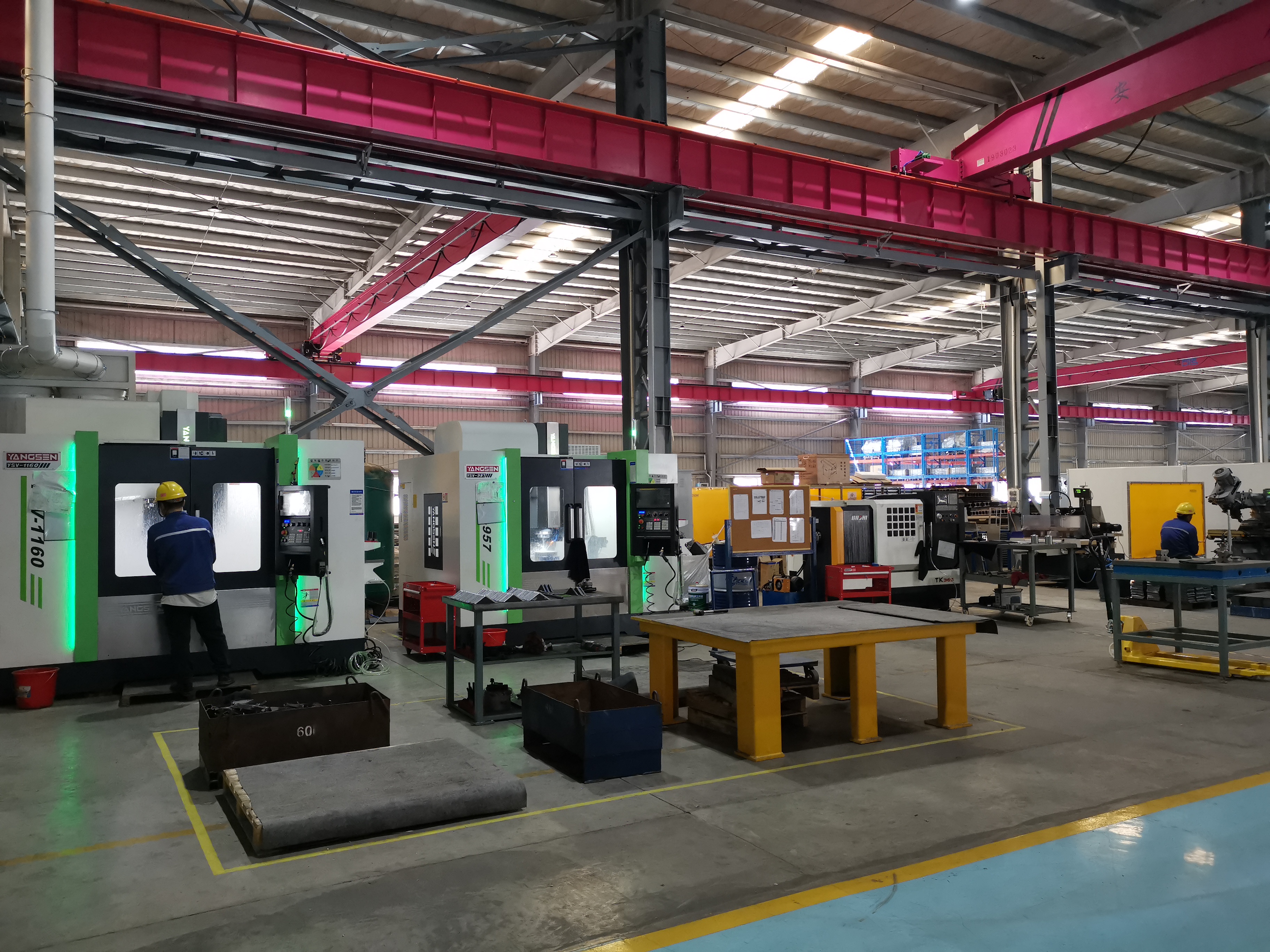
Material handling is the most honest area to inspect, because crane capacity and floor area cannot be staged cheaply. Openex reports two premises, roughly 30,000 ㎡ of factory space, 200 employees, an annual output of 20,000 tons and a 35-engineer technical team. The premise near Xiamen Port sits in Zhangzhou, Fujian, about 40 km — roughly one hour's drive — from Xiamen Port; the premise near Shanghai Port is in Taizhou, Jiangsu, about 170 km or two and a half hours from Shanghai. For very large goods, the company notes a wharf within about 2 km of the fabrication shop.
Equipment figures that matter in a capability review include an overhead crane rated above 250 tons, bending equipment with working length beyond 18 metres and tonnage above 10,000 tons, and CNC machine tool travel up to 50 m × 8 m × 7 m. Those numbers are only relevant if your own part sits in the same class, so the inspection question is comparative: does the photographed lift, rack or bed exceed the mass and envelope of the largest item in your RFQ?
Four checks are worth making on any handling photo or yard footage:
- Whether the crane's rated capacity is visible on the hook block or a plate near the runway, rather than asserted only in a brochure.
- Whether plate and section storage shows grade or heat-number marking, since identification at receipt is what makes a material certificate traceable later.
- Whether floor space is shown with a workpiece in it — a 30,000 ㎡ shop and a 3,000 ㎡ shop photograph similarly when the frame is empty.
- Whether the video shows a lift of comparable mass to your part, because a crane rating and a proven lift plan are different forms of evidence.
Welding: the video carries the evidence, the certificate sets the boundary
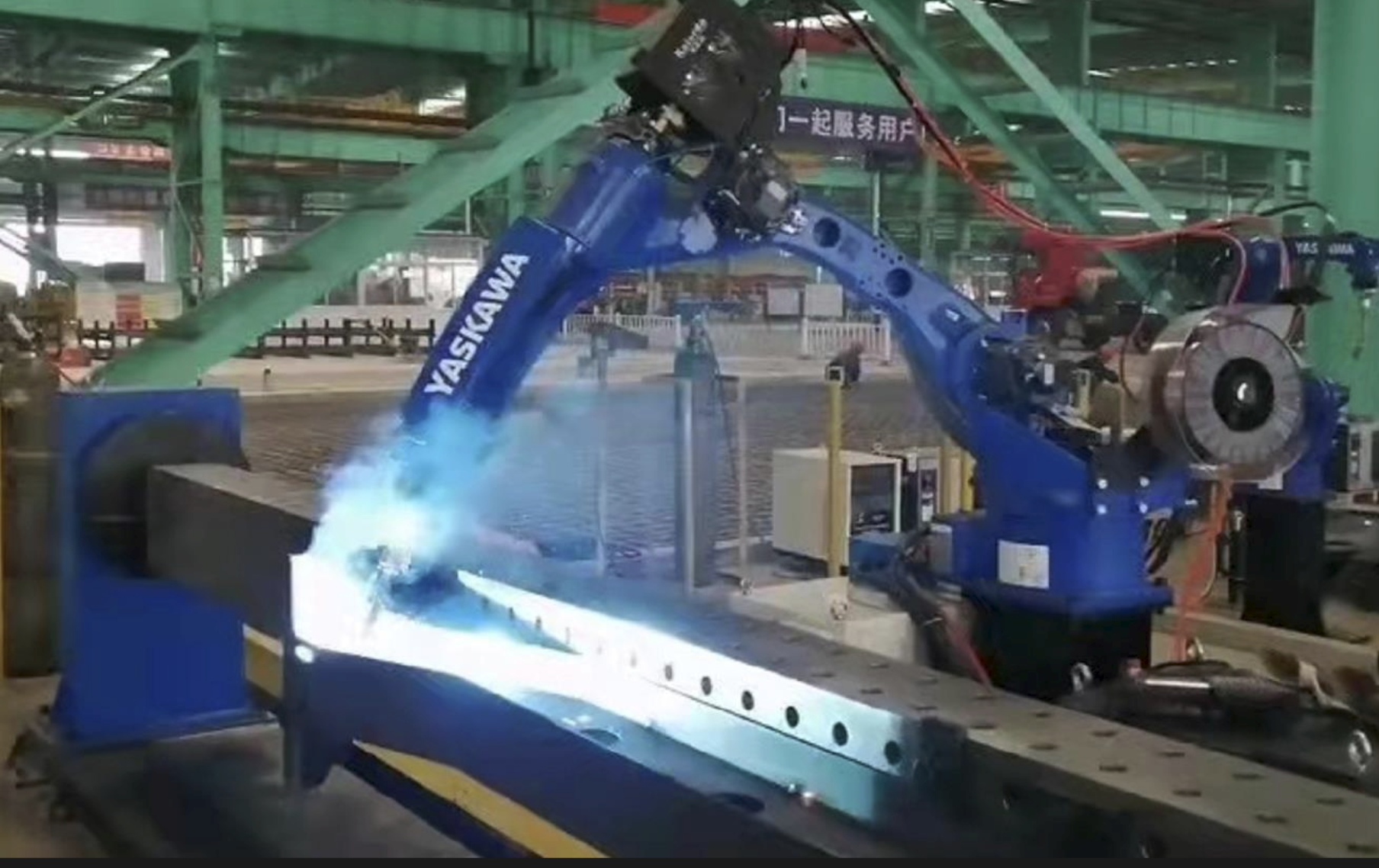
A sixty- to ninety-second welding video is more informative than twenty stills if it captures joint preparation, the arc actually running, positioner movement, interpass cleaning and the finished weld before paint. Stills taken after coating prove nothing about welding; stills taken before coating prove a weld exists but not how it was made.
Openex lists a broad welding envelope: SMAW, GMAW/MIG, GTAW/TIG, SAW, automatic tube-to-tubesheet welding, deep-penetration welding and robotic welding, applied to carbon steels, stainless steels, duplex and super duplex, clad and composite plate, and low-alloy steels, with stated monthly welding capacity of 5,000 tons and a 30–45 day lead time. The equipment list is concrete enough to match against footage: a six-axis industrial welding robot with repeat positioning accuracy of ±0.05 mm, adapted to heavy industrial workshop scenarios and set inside safety fencing; a Yaskawa six-axis robotic arc welding unit for long workpieces with trajectory accuracy of ±0.2–0.5 mm and a welding speed of 5–50 mm/s; an automatic welding machine for hydraulic cylinders of tunnel boring machines, handling length up to 6,000 mm, internal/external diameter of 600/800 mm, wall thickness of 100–120 mm at 10 rpm spindle speed; automatic welding equipment for workpieces under 6 metres that tilts ±90°; and a SAF PL130 plasma welding machine of French manufacture for 1–10 mm thickness on tube lengths up to 12.5 m.
The certificate tells a narrower story than the equipment list, and that gap is where buyers get caught. Openex holds EN ISO 3834-2 certification issued by SGS under certificate number 23/999-3834, with a scope of fusion welding of metallic material covering welding processes 135 and 135-Auto and material groups 1.1 and 1.2. It was issued on 15 October 2024 and carries an expiry date of 4 October 2026. Two limits follow directly from that wording. First, the certificate addresses MIG/MAG welding in those two material groups, not every process the shop runs, so TIG, SAW or duplex work needs separate supporting documents. Second, the date matters: a certificate past its expiry is not current evidence of conformity, and a buyer reviewing it after October 2026 should request the renewed certificate or the surveillance audit record before relying on it. That is not a criticism of any supplier — it is simply how dated evidence works, and it is exactly the check most image folders omit.
Machining: check the travel envelope against your part
Machining photos are the most frequently misread evidence in a capability pack, because a machine tool photographed without a workpiece says almost nothing. The question is whether the working envelope exceeds your component plus clamping and fixturing, and whether the shop can machine after welding rather than only before.
At Openex, the stated maximum CNC machine tool travel is 50 m × 8 m × 7 m, with 3,000 tons of monthly machining capacity and a 30–45 day lead time. The named equipment gives a buyer something to compare against a drawing: a PAMA Speedram 180 CNC floor-type boring and milling machining centre with X-axis and Y-axis travel of 4,000–6,000 mm, Z-axis travel of 1,200 mm and W-axis travel of 1,000 mm, giving 2,200 mm of combined Z-plus-W travel for multi-process work in a single clamping; a Wuzhong single-column turning-milling machine CKX53220 × 65/600 with maximum machining diameter of 22 m, maximum workpiece load of 600 t and maximum workpiece height of 6.5 m, supporting turning, milling, boring, drilling, tapping and finishing; a double-gantry seven-axis five-linkage machining centre for heavy-duty cutting of high-strength materials; and an EATRON M1100 vertical machining centre with X/Y/Z travel of 1,100/610/700 mm, a table of 1,260 mm × 600 mm with 1,000 kg maximum load, 24 tools and positioning accuracy of ±0.010 mm with ±0.003 mm repeatability.
Inspection evidence should arrive with the machine footage. Openex operates a Zeiss large coordinate measuring machine with a 7 m × 4 m × 3 m working volume and micron-level precision, alongside smaller CMMs, and lists non-destructive testing (RT, UT, MT, PT, VT, LT), destructive testing covering chemical analysis and mechanical properties, salt-spray corrosion testing, weld procedure qualification to a customer's own WPS, dimensional and surface-roughness measurement, residual stress analysis and coating inspection. A photo of a machine tool proves the envelope exists; a CMM report proves the part met the drawing.
Assembly, finishing and dispatch: the cheapest evidence to falsify
Downstream evidence is underrated because it is the easiest to cross-check against commercial documents. A pre-assembly photograph is verifiable against a dimension sheet; a container seal photograph is verifiable against a bill of lading.
Pre-assembly is a real capability signal in structural work. In one programme, Openex fabricates steel components for wind power structures totalling 300 tons, where the finished assemblies are pre-assembled to confirm manufacturing precision before being disassembled and packed for shipment — an operation that only makes sense if the shop has the floor area and lifting capacity to assemble the finished geometry. Finishing capability covers blasting, shot blasting, sandblasting, pickling, descaling, degreasing, phosphating, chromating, passivation and alkaline cleaning as preparation, followed by spray painting, powder coating, electroplating or hot-dip galvanizing, with stated capacity of 3,000 units per month and a 45-day lead time. Dispatch evidence includes container loading photographs and a recorded seal number, with breakbulk shipping used where goods are too long or too wide for a container.
Certificates: read the scope line and the expiry date
A certificate pack is only as useful as the scope paragraph inside it. Openex holds ISO 9001 (certificate 11426Q01049R001), ISO 14001 (11426E00739R001) and ISO 45001 (11426S00656R001), all issued by Beijing East Allreach Certification Center Co., Ltd. on 16 April 2026 and valid until 15 April 2029. The quality and environmental scopes read "Manufacture of Machined Parts, Metal Structures and Sheet Metal Components (except where a license is required)", against GB/T 19001-2016 / ISO 9001:2015 and GB/T 24001-2016 / ISO 14001:2015 respectively; the occupational health and safety certificate is against GB/T 45001-2020 / ISO 45001:2018.
Two phrases in that scope deserve attention. The management-system standards confirm that a documented system governs the listed manufacturing activities; they do not certify a product, a weld, or a pressure-retaining capability. And the qualifier "except where a license is required" signals that the certificate should not be read as evidence of any licensed or code-stamped scope, such as pressure-vessel work requiring separate authorisation. Buyers of pressure vessels, heat exchangers or similar equipment therefore need the applicable code documentation in addition to ISO 9001, not instead of it.
| Evidence item | What it establishes | What it does not establish |
|---|---|---|
| Shop-floor photo with equipment and workpiece | That the equipment exists in that area and has handled a part of comparable scale | That your part will meet tolerance, or that the operator was qualified |
| Workshop video of an arc running | That the process, position and handling method claimed are actually used | That the weld passed NDT, or that the WPS was followed on your order |
| ISO 9001 / 14001 / 45001 certificates | That a certified management system covers the stated manufacturing scope and dates | Product conformity, weld quality, or any licensed scope |
| EN ISO 3834-2 certificate | Welding quality requirements for the named processes and material groups | Processes, material groups or periods outside the stated scope and expiry |
| CMM and NDT reports | Dimensional and inspection results for the specific parts tested | Performance of untested parts in the same batch |
Matching visual evidence to four work types
The reason a generic photo pack fails is that each work type loads a different part of the shop. A fabricator that is strong on chassis may be mediocre on shells, and the same twenty images will not show the difference.
AGV steel chassis
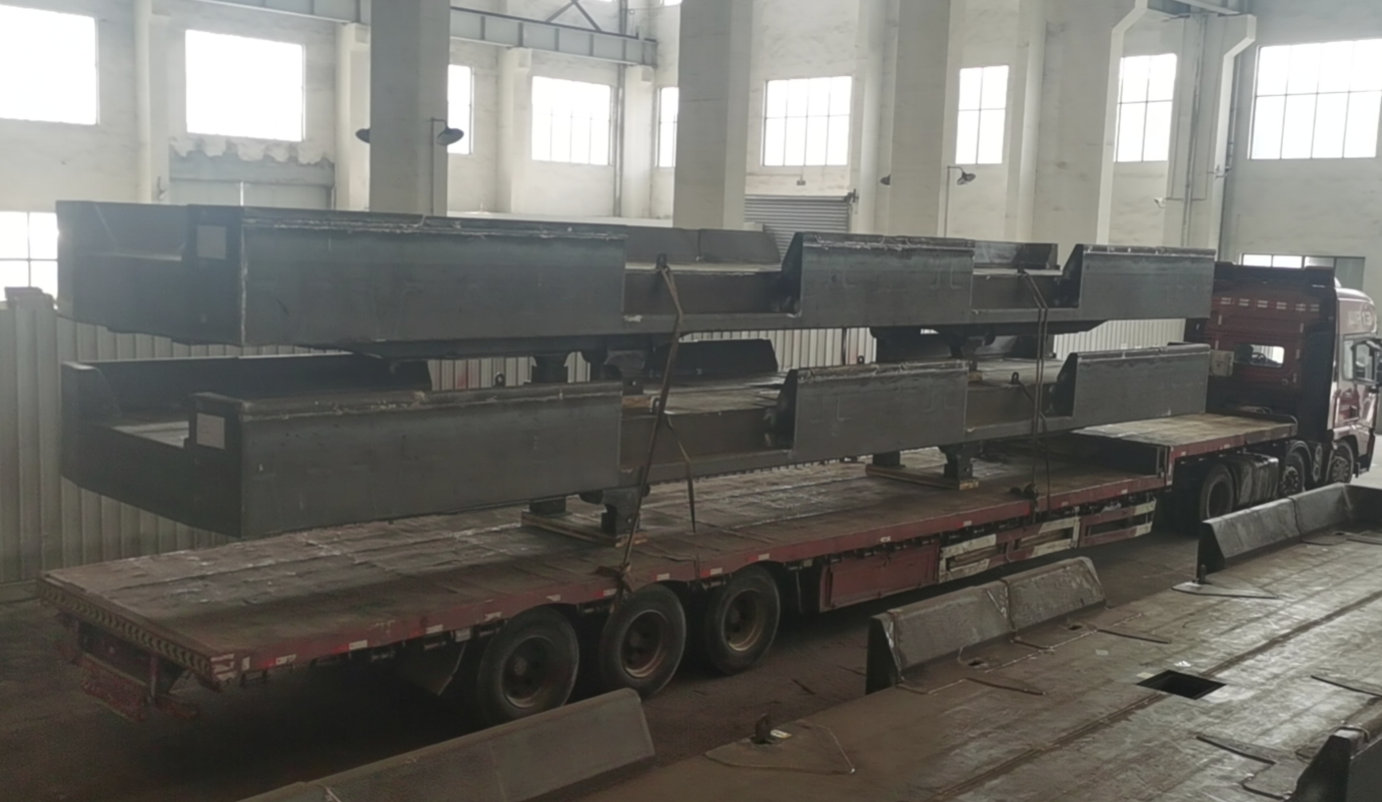
For a large AGV manufacturer in the Netherlands, Openex supplied 345 units of custom steel chassis, model PSA-1, designed to carry ocean-worthy containers or LNG tanks, with the customer reporting stable operation for more than four years. Chassis work is a straightness and mounting-face problem: ask for footage of the welding of the chassis structure, evidence of post-weld machining of mounting faces on a machine whose bed exceeds the chassis length, and a dimensional report on the mounting pattern. Paint system evidence matters too, since yard equipment lives outdoors.
Energy storage frames and boxes
For energy storage applications, Openex fabricates steel frames and boxes under model XHC-009, with 300 units delivered and three years of reported stable operation, alongside liquid-cooling cabinets for energy storage systems under model Customized-J-05 at a quantity of 1,500 units. This work is thin-gauge sheet metal plus repeatability: the evidence to request is the cutting and bending line, robotic welding of thin sections, a dimensional report on module pitch and stacking interfaces, and coating thickness readings. A photo of a completed rack shows the geometry but nothing about whether a thousand of them will stack.
Flywheel energy storage shells
Flywheel shells, model AKI-1, combine rolling, welding and precision turning — 400 units were supplied with five years of reported stable operation, and the process images show cylinders after rolling, under rough turning, after welding, under precision turning, and beside their top plates. Ask for the rolling capacity, the vertical lathe that finishes the shell, roundness and wall-thickness measurement, and the final inspection report. A shell photographed on a pallet is a shape; only the inspection record makes it a pressure- or balance-critical component.
Heavy-duty industrial equipment enclosures
Enclosures such as model Customized-E-03 sit at the intersection of plate fabrication, forming, welding and coating, so the evidence set spans more departments than any other item on this list. The useful question is which single shop floor sees the part from cut to coated, because an enclosure that travels between three subcontracted sites accumulates tolerance stack-up and cannot be traced to one acceptance record.
Materials: match the grade, not the photograph
Photographs of plate in a rack establish that metal is stored, not what grade it is. Openex states that it can fabricate most metals, including brass, bronze and aluminum, while carbon steel and stainless steel dominate the projects it receives. In carbon steel, the two most common grade families are Q235B (A36, SS400, S235JR) and Q355B (A572 Gr50, SS490/SPCC, S355JR), with Q690, NM450 and NM500 also regularly handled. In stainless steel, SUS 304 and SUS 316L are the most frequently specified grades. Special casting or forging grades are sourced through long-term partners.
The verification step is documentary rather than visual: request the mill certificate with heat number for each heat used, and reconcile it against the grade callout on the drawing. Where a partner supplies the casting or forging, ask for the partner's certificate as well, since the fabricator's own material traceability does not automatically extend upstream.
Writing evidence into purchasing terms and acceptance criteria
Evidence becomes enforceable only when it is named in the order. Openex's stated commercial terms provide a workable template. Minimum order quantity is project-based; delivery terms include EXW, FOB, C&F, CIF, DAP and DDP; payment is by T/T or letter of credit. Acceptance offers three routes: photographs, videos and QA sheets produced by the supplier; inspection by the buyer; or inspection by a third party appointed by the buyer. Drawing formats accepted are STEP, IGES, DWG, DXF and PDF, with the practical note that 2D drawings alone are usually sufficient for simple parts, 2D plus 3D speeds quotation considerably, and 3D alone rarely supports a firm quote because tolerance, weld requirements, surface roughness, bending radius, heat treatment and finish requirements live on the 2D sheet.
Three practical consequences follow. First, choose the acceptance route before the purchase order is issued, because option A shifts the verification burden onto the supplier's own records and should therefore be defined as a photo list rather than as "photos on request" — for example, weld caps photographed before painting, a dimensional sheet per serial number, packing photographs and a container seal number. Second, remote inspection is a real alternative to a site visit and should be scheduled explicitly; for tube sheets supplied to a power plant in Indonesia, totalling 45 tons, Openex carried out remote quality control with the buyer before shipping rather than relying on post-delivery claims. Third, lead time and capacity statements belong in the contract alongside the evidence list, since a 30–45 day lead time on welding and machining only holds if the review and approval cycle is also dated.
Where visual evidence stops
Photos and video are good at establishing existence, scale, process type and housekeeping. They are poor at establishing dimensional accuracy, material grade, weld acceptance and heat-treatment outcome, because none of those are visible. The gap should be closed with documents tied to the specific parts: a CMM report from the coordinate measuring machine used, non-destructive testing records naming the method and the acceptance level, WPS and PQR documentation with welder qualification records, coating thickness readings, and where applicable a record of pre- or post-weld heat treatment. A supplier that can supply these on request while also producing dated, part-specific imagery is presenting a materially stronger case than one that supplies either alone.
Outlook
Pre-qualification is drifting toward evidence that can be filed rather than viewed. Buyers increasingly want photographs indexed to a part number, video clips of a named operation, and certificates whose scope line and expiry date can be checked in a minute. Fabricators that structure their records this way will spend less time answering the same capability questions at the top of every tender; buyers who specify the evidence list in the purchase order will spend less time resolving disagreements at final inspection. Neither change makes a weak shop strong — it only makes the difference visible earlier.
A downloadable capability brochure covering processes, equipment and certificates is available here.
FAQ
- Is Openex a manufacturer or a supplier, and can it provide factory photos, workshop videos and certificates?
- Openex is a metal fabricator with two manufacturing premises, one near Xiamen Port and one near Shanghai Port. It states that it manufactures 80–90% of the metal parts, components and assemblies it exports, with the remainder sourced from partners. In-house processes are laser cutting, bending, machining, welding, drilling, punching, stamping, assembling and packaging; casting, forging, hot-dip galvanizing, powder coating and other anti-rust finishes are provided by partners, with powder coating under consideration for an in-house shop for light structural parts. Process-area photographs, workshop video and the certificate pack are available for review.
- What metal materials can be processed for a fabrication project?
- Most metals can be handled, including brass, bronze and aluminum, while carbon steel and stainless steel are the most common. In carbon steel, the two most frequently specified grade families are Q235B (A36, SS400, S235JR) and Q355B (A572 Gr50, SS490/SPCC, S355JR); Q690, NM450 and NM500 are also regularly processed. In stainless steel, SUS 304 and SUS 316L are the most often requested grades. Special casting and forging grades are sourced through long-term partners.
- Which factory evidence should a buyer request first?
- Start with the three-list answer on in-house versus subcontracted processes, then request area-specific imagery: overhead crane and plate storage for handling capacity, welding cells with an arc running for process verification, machine tools shown with a workpiece for envelope confirmation, and pre-assembly or loading photographs for downstream control. On the documentary side, request certificates with the scope paragraph and expiry date visible, plus CMM, NDT and material records tied to the specific parts.
- What purchasing terms and acceptance criteria apply?
- Minimum order quantity is project-based. Delivery terms include EXW, FOB, C&F, CIF, DAP and DDP, and payment is by T/T or letter of credit. Acceptance can follow three routes: photographs, videos and QA sheets issued by the supplier; inspection by the buyer; or inspection by a third party appointed by the buyer. Welding and machining operations are quoted at a 30–45 day lead time, with surface finishing at 45 days.
- What drawing formats are accepted, and are 3D files enough on their own?
- STEP, IGES, DWG, DXF and PDF files are accepted, covering standard 2D and 3D formats. For simple parts, 2D drawings alone are usually sufficient. Supplying both 2D and 3D drawings allows the fastest quotation, while 3D files alone rarely support a firm quote because tolerance, welding requirements, surface roughness, chamfer, plate bending radius, material specification, heat treatment, stress relief and finish requirements are normally carried on the 2D drawing.
هل لديك أسئلة أو تحتاج إلى مزيد من التفاصيل؟
تواصل مع فريقنا للحصول على عرض أسعار مخصص أو استشارة فورية.
طلب عرض أسعار
املأ النموذج أدناه وسيتواصل معك فريقنا بعرض مقترح مخصص.
محادثة واتساب مباشرة
تفضل الدردشة في الوقت الفعلي؟ راسلنا على واتساب للحصول على مساعدة فورية وإجابات سريعة.
- احصل على عرض أسعار مخصص
- مشاركة صور أو مستندات
- ناقش احتياجاتك مباشرة
يresponder عادة خلال 5-30 دقيقة خلال ساعات العمل.