
Proving Performance: The Material Science Behind Simon Microcement
Proving Performance: The Material Science Behind Simon Microcement
Microcement specification has shifted from a design decision to an evidence decision. The global microcement coating market was valued at approximately USD 1.8 billion in 2025 and is projected to reach USD 3.6 billion by 2034, with commercial applications accounting for roughly 42.7% of revenue, according to Dataintelo. Growth on that scale moves the product out of the boutique decorative category and into the same procurement process as other specified flooring systems. The questions buyers ask have changed accordingly, from what a surface looks like to what a test report says about it.
That shift is uncomfortable for suppliers whose differentiation rests on colour ranges and photography. It is an advantage for manufacturers that can document performance. This analysis examines the material science and quality assurance process behind the Simon microcement range and reads the published data for MC-9000, MC-7860 and MC-7690 in the terms a specifier, main contractor or procurement manager actually uses at technical review.
Why Performance Evidence Now Decides Microcement Procurement
Three market signals explain the change, and each one pushes the buying decision toward documented evidence rather than brand presentation.
The first is category expansion. The microcement market is expected to grow at a CAGR of 8.1% between 2025 and 2034, driven by demand for seamless modern interiors and renovation projects. Europe currently dominates the market, while Asia Pacific is the fastest-growing region and accounts for approximately 38.5% of revenue, according to Market Intelo. Institutional buyers entering a growing category typically import their own qualification habits, and in flooring those habits are test-data driven.
The second is the application mix. Commercial applications represent approximately 42.7% of total microcement revenue as of 2025. Commercial floors carry performance obligations that residential decorative work rarely does: abrasion under foot traffic and trolley wheels, slip resistance in wet zones, chemical exposure, and fire behaviour in egress routes. A specification that cannot answer those obligations with documents stalls at the technical review stage.
The third is chemistry. Two-component microcement systems held the largest product-type share in 2025 at approximately 48.3%, on the strength of their durability and bonding properties. This matters for evidence because two-component systems cure through a crosslinking reaction rather than simple drying, and the properties of the cured film can therefore be measured, repeated and certified. The chemistry that buyers are gravitating toward is also the chemistry in which performance claims become verifiable.
For procurement teams, the practical consequence is simple: a microcement supplier's test documentation now functions as a qualification document, not a marketing appendix.
Inside the Manufacturing Base Behind the Data
Simon United Building Materials Co., Ltd. is a Shenzhen-based manufacturer of microcement and thick-layer decorative coatings, founded in 2007. The company operates a 4,000 m² production facility in Heshan City, Jiangmen, with 35 employees, a five-member R&D team and an annual output of 5,500 tons. It reports an export ratio of 42%, with main markets in Africa, the Middle East, Australia and Southeast Asia.
The evidence trail begins well before any individual test report. Over nearly two decades the company has accumulated more than 30 patents and participated in the formulation of a number of national building material standards. In 2014 it launched a wall-floor integrated microcement in China. In 2022 the group standard T/CECS 10192-2022 Polymer Microcement, led and compiled by Simon, came into effect and was awarded Advanced Standard status by the China Building Material Standardization Association. That standard defined the application boundaries of Type I and Type II microcement for the first time, which is a commercially useful distinction: a Type I wall product and a Type II floor product should never be compared on a single price-per-square-metre line.
The range itself is organised into four series — Wall, Floor, Swimming Pool and Super Microcement Commercial Floor. Each series carries its own formulation target, which is the reason performance data is published per model rather than as one generic microcement figure. A buyer who asks for “the microcement data sheet” without naming a series is asking an unanswerable question.
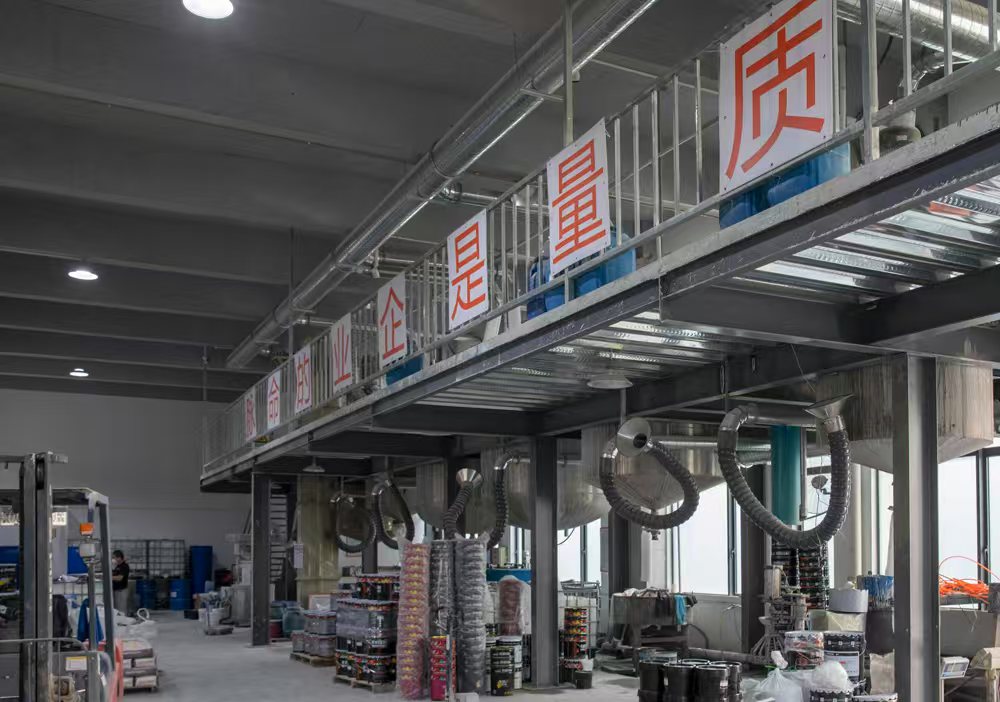
Production operations at the Simon microcement manufacturing base. Series-specific formulations are produced on dedicated lines, which is what makes model-level test data meaningful.
The Material Science: What Each Measured Property Actually Proves
Performance figures are only useful if the buyer understands what physical behaviour they describe. Four properties carry most of the weight in a microcement specification, and each answers a different question.
| Measured property | What it physically describes | What it tells a specifier |
|---|---|---|
| Abrasion loss (mm) | The thickness of material removed from the cured surface under a standardised wear cycle | Predicts how quickly a floor loses texture and colour depth under sustained foot traffic and mechanical cleaning |
| Water absorption (%) | The porosity of the cured film, expressed as the proportion of water it takes up | Predicts staining behaviour, resistance to standing water, and risk on damp or intermittently wet substrates |
| Mohs hardness | Scratch resistance of the finished surface against mineral grit | Predicts damage from tracked-in sand, dragged furniture and trolley wheels in public interiors |
| Friction coefficient | Slip resistance of the surface under a defined dry or wet condition | Feeds directly into safety specifications for wet areas, ramps and public circulation routes |
| Surface burning characteristics | Flame spread and smoke development of the surface when exposed to a controlled flame source | Determines whether the system can be used in egress routes and industrial interiors |
| VOC and formaldehyde content | Emissions released by the cured material into indoor air | Determines suitability for occupied spaces, healthcare and education projects, and green building certification |
The underlying material science is a waterborne polymer binder system rather than a conventional cement-only film. Low VOC and formaldehyde-free formulation is becoming an industry baseline, and waterborne polymer binders are the route most manufacturers take to limit emissions while retaining film integrity. Simon applies that approach across the full range: all series are formaldehyde-free and low in VOC, holding the dual certification of EU Grade A+ and China Green Building Material.
On the mechanical side, the Super Microcement Commercial Floor Series reaches a maximum compressive strength of ≥50 MPa and is designed to remain stable across a service temperature range of -40°C to 120°C, with specific adaptation to underfloor heating systems. Those two figures together explain why the commercial series behaves differently from a decorative wall finish: compressive strength governs how the system carries point loads, and temperature stability governs whether the film tolerates the thermal cycling that underfloor heating produces.
MC-9000: Documented Floor Performance for High-Traffic Environments
MC-9000 is the model in the range with the most extensive published performance evidence, and it is the most instructive example of how material data translates into procurement decisions.
| Documented data point | Interpretation for a commercial specification |
|---|---|
| Abrasion wear <0.1 mm after 5 years | Surface loss remains below one tenth of a millimetre across a five-year service window, which indicates that texture and colour depth are retained rather than progressively worn through |
| Water absorption <0.2% | The cured film is effectively closed to water uptake, which limits staining risk and supports performance in kitchens, washrooms and intermittently wet circulation areas |
| Mohs hardness ≥6 | Surface scratch resistance sits in the range associated with hard mineral surfaces, relevant where grit is tracked in from external areas |
| ASTM E84-24 (Surface Burning Characteristics) | Fire safety testing for industrial environments, addressing flame spread and smoke development on the finished surface |
Read together, the four data points describe a floor that is specified for high-frequency use rather than for visual effect alone. The compressive strength of the commercial series (≥50 MPa) and the -40°C to 120°C operating range reinforce the same conclusion. In practice, MC-9000 is the appropriate reference point for schools, museums, shopping malls, hotels and similar spaces where the floor is treated as a long-life asset and where cleaning regimes are aggressive and continuous.
The ASTM E84-24 testing is worth isolating as a procurement point. Fire performance testing is not a decorative attribute, and it is frequently the document that determines whether a microcement system can be used in a given building at all. MC-9000 has been tested under ASTM E84-24 for fire safety in industrial environments, which places it in a different documentary category from products that publish only decorative or environmental certifications.
MC-7860: Chlorine Resistance and Slip Performance
MC-7860 addresses a different failure environment, and its documented data reflects that focus.
- 168-hour chlorinated water immersion test: passed. Continuous immersion in chlorinated water for seven days without failure is the relevant benchmark for swimming pool microcement and for wet areas where chlorinated cleaning agents are used routinely.
- Dry friction coefficient: 0.77. A measured dry friction coefficient gives a specifier a numeric basis for slip assessment rather than a qualitative anti-slip claim.
The surrounding chemistry supports the same application logic. The Swimming Pool Series adopts a chlorine and bubble resistant formula with temperature resistance and crack resistance, and its anti-slip design addresses safety in permanently wet circulation areas. For a project team specifying a pool basin, a spa area or a commercial washroom, the relevant evidence is chemical resistance under immersion plus a friction figure — not the abrasion data that would matter on a shopping mall concourse. Matching the model to the exposure is the decision, not selecting the highest number available.

An Australian buyer identifying Simon microcement packaging at a flooring exhibition. Model-level documentation is what separates one series from another during technical review.
MC-7690: Baseline Property Certification and Its Boundaries
MC-7690 is documented primarily through basic property certification rather than the extended wear and chemical test programme published for MC-9000 and MC-7860. Its evidence set covers the environmental and formulation baseline that applies across the Simon range: formaldehyde-free composition, low VOC content, and the dual certification of EU Grade A+ for indoor air quality and China Green Building Material, in compliance with the group standard T/CECS 10192-2022 Polymer Microcement.
That distinction is deliberately stated here because it matters to buyers. Where a project's controlling risk is indoor air quality, occupancy comfort or green building documentation, the MC-7690 evidence set is directly relevant. Where the controlling risk is mechanical wear or sustained chemical immersion, the more extensive test data for MC-9000 and MC-7860 is the correct reference. Treating certification coverage as interchangeable across models is one of the most common errors in microcement procurement.
How to Read a Microcement Test Report: A Buyer Checklist
Documented data only creates value if the buyer interrogates it correctly. Six checks resolve most ambiguity in a supplier's technical file.
- Identify the model, not the brand. Confirm which series and model the figure applies to. Range-level averages obscure the differences that determine application fit.
- Confirm what was tested. Establish whether the result relates to the cured system (binder plus aggregate plus sealer as installed) or to a component in isolation. Only system-level results predict installed performance.
- Check the property against the exposure. Abrasion, water absorption and hardness are relevant to traffic and staining; chlorine immersion and friction coefficient are relevant to wet and pool environments; VOC and formaldehyde data are relevant to occupied interiors.
- Separate third-party testing from internal records. Where a test has been carried out by an external body, the report identifies it. Where a figure is an internal manufacturing control value, say so explicitly in the technical submission.
- Align with the market's compliance framework. Microcement flooring systems must comply with the European standard EN 13813:2002 for screed materials, which specifies requirements for compressive strength and wear resistance. Projects in other regions apply their own frameworks, and the supplier's documentation should map onto the framework the project is being built under.
- Ask what the figure does not cover. A supplier that can state the boundaries of its own data is more reliable than one that presents every number as universal.
Microcement Versus Common Cement Paint: A Documented Comparison
Most buyers arrive at microcement having first considered common cement paint, which occupies the same visual territory at a lower headline price. The comparison is worth making on documented characteristics rather than on appearance.
| Dimension | Simon Microcement | Common cement paint |
|---|---|---|
| Material system | Professional polymer composite decorative material with scene-specific exclusive formulas; seamless wall-floor-ceiling integration; high strength, crack resistance, waterproofing and stain resistance | Single-component basic cement-based coating for simple surface decoration, with single performance and no professional functional design |
| Construction and effect | Can be applied directly over existing ceramic tile and marble bases, producing a seamless and uniform texture | Strict base requirements, rougher surface, visible texture difference, no seamless decorative effect |
| Technical and qualification base | Developed from nearly 20 years of technological accumulation, compliant with the group standard T/CECS 10192-2022, supported by more than 30 national patents | Single-component commodity coating without an equivalent formulation or standard framework |
| Service life | 15–20 years residential; over 20 years commercial | 3–5 years, with a tendency to powder, crack and peel |
| Compressive strength | Super Commercial Floor Series ≥50 MPa | 5–10 MPa |
| Cracking rate | <0.1% | Over 30%, easily affected by temperature and humidity |
| Environmental performance | Formaldehyde-free, low VOC, EU Grade A+ and China Green Building Material dual certification | High VOC and harmful substance emissions |
| Temperature resistance | Stable use from -40°C to 120°C | Applicable only to normal temperature environments |
| Initial cost | Moderate upfront investment, equivalent to mid-to-high-end decorative materials | Lower upfront cost |
| Long-term total cost | 40%–50% lower than ordinary cement paint, with almost no later renovation and maintenance cost | Requires full shovelling and repainting, at a cost comparable to the original installation |
| Repair | Local repair with no colour difference, at only 10% of the cost of full reconstruction | Visible colour difference after repair; overall reconstruction required |
| Maintenance | Stain-resistant and easy to clean, with 5-year maintenance-free service | Repainting required every 1–2 years |
Where the comparison stops being favourable
A credible comparison has to state its own boundaries, and microcement has several.
- Site conditions are decisive. During construction the temperature should not be too cold or too hot, and attention must be paid to base surface humidity. Where these conditions are not met, the installed system may not reproduce the documented performance of the tested material. Simon addresses this by providing an appropriate construction plan, but the plan has to be followed.
- Substrate preparation remains a cost and programme item. Microcement can be applied directly onto existing tile and marble bases, which reduces demolition, but the base still has to be sound, clean and within moisture limits.
- Higher upfront spend. The initial investment sits at the level of mid-to-high-end decorative materials rather than at commodity coating prices. The economic case depends on holding the surface over its full service life, not on first cost.
- Data is model-specific. Figures published for MC-9000 or MC-7860 do not transfer automatically to other models in the range, and MC-7690 in particular is documented through baseline property certification rather than extended mechanical and chemical testing.
- Compliance frameworks differ by market. EN 13813:2002 governs screed materials within the European framework; projects elsewhere must confirm which local requirements apply and how the supplier's documentation maps onto them.
Application Fit: Where This Evidence Changes the Decision
Model-level data is most useful at the point where a project's exposure profile is matched to a formulation.
- Industrial and commercial flooring. High compressive strength, low abrasion loss and closed-surface water absorption support use in factory floors, warehouses, retail concourses and school corridors, where cleaning is frequent and mechanical wear is continuous.
- Hospitality and cultural projects. Hotels, museums and shopping malls require seamless surfaces that tolerate heavy footfall while meeting fire performance criteria and indoor air quality requirements.
- Swimming pools and wet leisure areas. Chlorinated immersion resistance plus a measured dry friction coefficient address the two dominant failure modes in pool environments.
- Underfloor heating zones. The commercial floor series is stable across -40°C to 120°C and is specifically adapted to underfloor heating systems, with thermal conductivity performance that supports heating efficiency.
- Kitchens, bathrooms and food-contact-adjacent areas. Waterproofing, resistance to acid, alkali and oil staining, and the absence of formaldehyde support use where hygiene and indoor air quality govern.
- Exterior and high-thermal-exposure surfaces. Crack resistance below 0.1% and temperature stability are the controlling properties where surfaces face thermal cycling.
The competitive field in this category includes established international names such as Topciment, Ardex Group, Sika AG and CimentArt, alongside Chinese manufacturers. What differentiates suppliers within that field is increasingly the depth of published, model-specific evidence rather than geographic origin or brand recognition.
Market Outlook: Evidence as the New Specification Language
The direction of the market reinforces the value of documented performance. With the microcement market projected to grow at 8.1% annually to 2034 and Asia Pacific expanding fastest at roughly 38.5% of revenue, commercial and industrial buyers will continue to take a larger share of total demand. Those buyers specify against standards, not against showrooms.
Environmental documentation is following the same path. Low VOC and formaldehyde-free formulations are becoming standard expectations rather than premium options, and waterborne polymer binder chemistry is the common technical route to meeting them. Certification frameworks such as EU Grade A+ and China Green Building Material are becoming baseline qualification requirements in tender documents, and flooring standards such as EN 13813:2002 in Europe establish compressive strength and wear resistance as stated requirements rather than optional preferences.
The practical forecast is that microcement will continue to compete with traditional coatings on total cost of ownership, where the documented service life advantage and low maintenance requirement are decisive, while continuing to lose to commodity coatings on first cost alone. Buyers who evaluate the two categories on upfront price will keep reaching the conclusion that cement paint is cheaper. Buyers who evaluate on documented service life, repair cost and maintenance frequency will keep reaching the opposite conclusion. The data supports both readings, depending on which variables the specification rewards.
Frequently Asked Questions
What does an abrasion value of less than 0.1 mm after five years actually measure?
It measures the thickness of material lost from the cured microcement surface under sustained wear over a five-year service period. A lower figure means the surface is losing material more slowly, which in practice means texture and colour depth are retained rather than worn through. This is the figure most relevant to high-traffic commercial floors, and it is reported for the MC-9000 commercial microcement floor.
Why is a 168-hour chlorinated water immersion test relevant to swimming pool specifications?
Swimming pool and spa surfaces are exposed to chlorinated water continuously rather than intermittently, so chemical resistance under immersion is the controlling property. A 168-hour immersion test means the cured material has been held in chlorinated water for seven days without failure. MC-7860 has passed this test, and it sits within the Swimming Pool Series, which uses a chlorine and bubble resistant formula with temperature resistance and crack resistance.
What is the difference between the evidence available for MC-7690, MC-7860 and MC-9000?
The three models are documented at different depths. MC-7690 is covered primarily by basic property certification, including formaldehyde-free composition, low VOC content, EU Grade A+ and China Green Building Material dual certification, in compliance with T/CECS 10192-2022. MC-7860 adds a passed 168-hour chlorinated water immersion test and a dry friction coefficient of 0.77. MC-9000 adds abrasion wear below 0.1 mm after five years, water absorption below 0.2%, Mohs hardness of at least 6, and ASTM E84-24 surface burning characteristics testing. Buyers should match the depth of evidence to the risk profile of the project rather than assuming the data is interchangeable.
Which certifications should be verified before specifying microcement for an occupied building?
For indoor air quality, verify EU Grade A+ certification and China Green Building Material certification, together with formaldehyde-free and low VOC documentation. For structural performance in Europe, microcement flooring systems must comply with EN 13813:2002, which specifies requirements for compressive strength and wear resistance. For industrial environments, verify fire performance testing such as ASTM E84-24. Verification should be at model level, not merely at brand level.
Can site conditions invalidate documented laboratory performance?
They can. During construction the temperature should not be too cold or too hot, and attention has to be paid to base surface humidity. If those conditions are outside specification, the installed system may not reproduce the properties recorded in test documentation. Simon addresses this by providing an appropriate construction plan, and the plan is intended to be used in accordance with the requirements and specifications of the product. Substrate condition, moisture content and ambient conditions at the time of application are the variables most likely to separate test results from field results.
Conclusion
Microcement procurement in 2026 rewards manufacturers that can show their work. The evidence assembled across the Simon range — abrasion wear below 0.1 mm after five years, water absorption below 0.2% and Mohs hardness of at least 6 for MC-9000; a passed 168-hour chlorinated water immersion test and a dry friction coefficient of 0.77 for MC-7860; baseline property certification for MC-7690 — describes specific behaviours in specific environments rather than a general promise about quality. Combined with the group standard T/CECS 10192-2022, more than 30 patents and a 4,000 m² production base with 5,500 tons of annual output, the documentation gives specifiers something to check, compare and hold a supplier to. The full technical documentation for the Wall, Floor, Swimming Pool and Super Microcement Commercial Floor series is available in the company brochure.