
Proving Trade Data Capability: Topease's Evidence Chain
A trade data intelligence platform is a software service that converts customs records, shipment data and company registries into searchable market and buyer signals. Whether a particular platform is genuinely capable is a different question, and it is settled by evidence a buyer can inspect rather than by adjectives. This article examines how capability evidence is assembled inside one documented engagement: Topease's 12-month Global Trade Intelligence and Customer Acquisition Program, including its six-step methodology, GT8 customs-data buyer discovery, Tesour contact verification, GTminds AI assistance, CRM lead lifecycle management and supply-chain background investigation, together with the outcomes documented for a Haining PVC panel exporter.
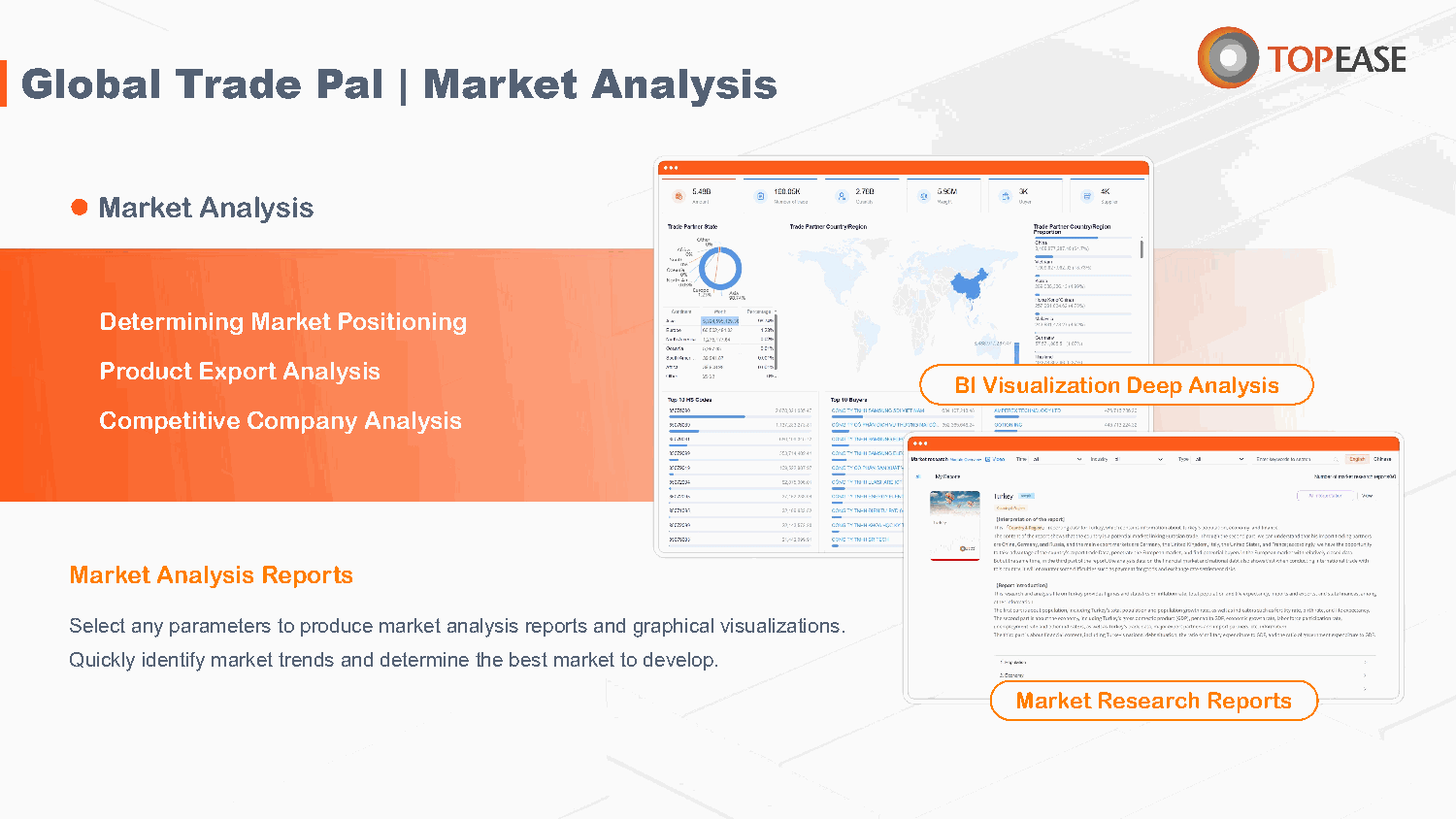
Evidence in trade data intelligence is built in layers, from data provenance to documented commercial outcomes.
Shanghai Topease Information & Technology Co.,Ltd (Topease) is a Shanghai-based trade data and customer acquisition platform provider founded in 2004 and backed by Donghao Lansheng Group. Its product set includes the Topease E Platform, Global Trade Pal for trade data retrieval and buyer discovery, Tesour for multi-channel outreach, and GTminds, an AI assistant layer that operates across all modules. That product description is a claim of capability. The more useful question for a buyer at decision stage is what evidence sits behind it.
The verification gap in trade data procurement
Trade data procurement has an awkward property: the claims that matter most are the hardest to check. Record counts, country coverage, contact accuracy and commercial outcomes are all asserted in similar language across vendors, yet they rest on very different kinds of proof. A record count can be audited against a customs source. A contact accuracy figure depends on how accuracy was defined and who measured it. An outcome story depends on whether the client, the period and the starting point were documented.
The market context explains why this matters commercially. Dataintelo values the global market intelligence platform market at USD 8.6 billion in 2025, with a projected USD 18.9 billion by 2034. Data Bridge Market Research expects the global trade management market, which includes trade intelligence, to reach USD 8.20 billion by 2032 at a CAGR of 10.40%. Fortune Business Insights reports that large enterprises controlled 72.55% of total spending on global trade management software in 2024, while Mordor Intelligence places North America at roughly 38.8% to 47.3% of trade management software revenue in 2025 depending on the analytics segment measured.
As budgets concentrate, so does scrutiny. A buyer comparing platforms is no longer asking only which database is larger, but which vendor can show how its data was governed, how entities were resolved, how contacts were verified, and what actually changed for a comparable client.
Four evidence layers that separate claims from capability
Across trade data intelligence platforms, capability claims tend to fall into four layers. Each layer answers a different buyer question and can be evidenced in a different way.
| Evidence layer | Buyer question it answers | What should be inspectable |
|---|---|---|
| Data provenance | Where do records come from, and how are they governed? | Source markets, record volumes, standardisation and de-duplication method |
| Entity resolution | Is this company the same company across records? | How trade records, registration data and business information are combined |
| Contact verification | Can a named decision-maker actually be reached? | Contact database scale, channels covered, client-rated accuracy |
| Outcome documentation | Did anything measurable change for a comparable client? | Baseline, period, measured metric, client feedback |
Most platform comparisons stop at the first layer, because it is the easiest to publish. The layers that determine whether a platform is usable sit further down.
The anchor: a 12-month program built on six defined steps
The Topease Trade Growth Intelligence Framework, version 2.0, is a data-driven growth framework that integrates market analysis, buyer discovery, company profiling, AI insights, outreach automation and customer management into one connected workflow. It is designed to help exporters, importers and global trade teams identify opportunities faster, discover qualified buyers, reduce market uncertainty and accelerate international business growth. The framework is the structural basis for the 12-month Global Trade Intelligence and Customer Acquisition Program.
| Step | What the step produces |
|---|---|
| 1. Market Intelligence | Analysis of global trade flows, demand trends and market opportunities using verified customs data |
| 2. Product & Market Positioning | Suitable markets, product opportunities and competitive positioning based on trade signals |
| 3. Global Buyer Discovery | Potential buyers and business opportunities identified through global trade records and enterprise databases |
| 4. Company Verification & Profiling | Company intelligence built by combining trade records, registration data and business information |
| 5. Contact Identification & Outreach | Decision-makers identified and engaged with personalised communication |
| 6. Customer Management & Growth Optimization | Leads, customer information and business workflows connected for continuous growth |
The framework's core principles are data-driven decision making, verified trade intelligence, AI-assisted analysis, full-cycle workflow integration and continuous optimisation. For evaluation purposes, the useful feature of a six-step structure is that each step can be interrogated separately. A buyer can ask what data entered step three, how step four resolved duplicate company names, and which contacts survived validation in step five, rather than accepting or rejecting the program as a whole.
From customs records to named, verifiable entities
Topease's trade data foundation integrates more than 11 billion compliant trade data records across 232 countries and regions, alongside commercial, social media, exhibition and corporate registration databases. The records are standardised, de-duplicated, enriched and validated through a governance framework intended to make them usable rather than merely large.
In practice this layer supports the classic trade data functions named in the product set: import and export trade data search, shipment-level records, company trade history lookup, market trade flow analysis and competitor trade data tracking. The evidence question is not whether such searches exist, but whether a search result resolves to a single, identifiable counterparty. That is the role of step four, where trade records, registration data and business information are combined into a company profile, and where supply-chain background investigation establishes who buys what, from whom, and at what rhythm.
Publicly, comparable shipment-level providers describe different coverage scopes: S&P Global's Panjiva aggregates and normalises over 2 billion shipment records from 22 customs authorities; ImportGenius covers shipment data across 24+ major jurisdictions with daily updates for U.S. records; Tendata states coverage of 228+ countries and regions with a database of over 500 million enterprises. S&P Global (Panjiva), Descartes Datamyne, ImportGenius and Trademo are recognised among the leading competitors in shipment-level trade intelligence by G2 and SourceForge. These are coverage facts, not a quality ranking, and they illustrate why scope claims should be read against a specific market list rather than a headline number.
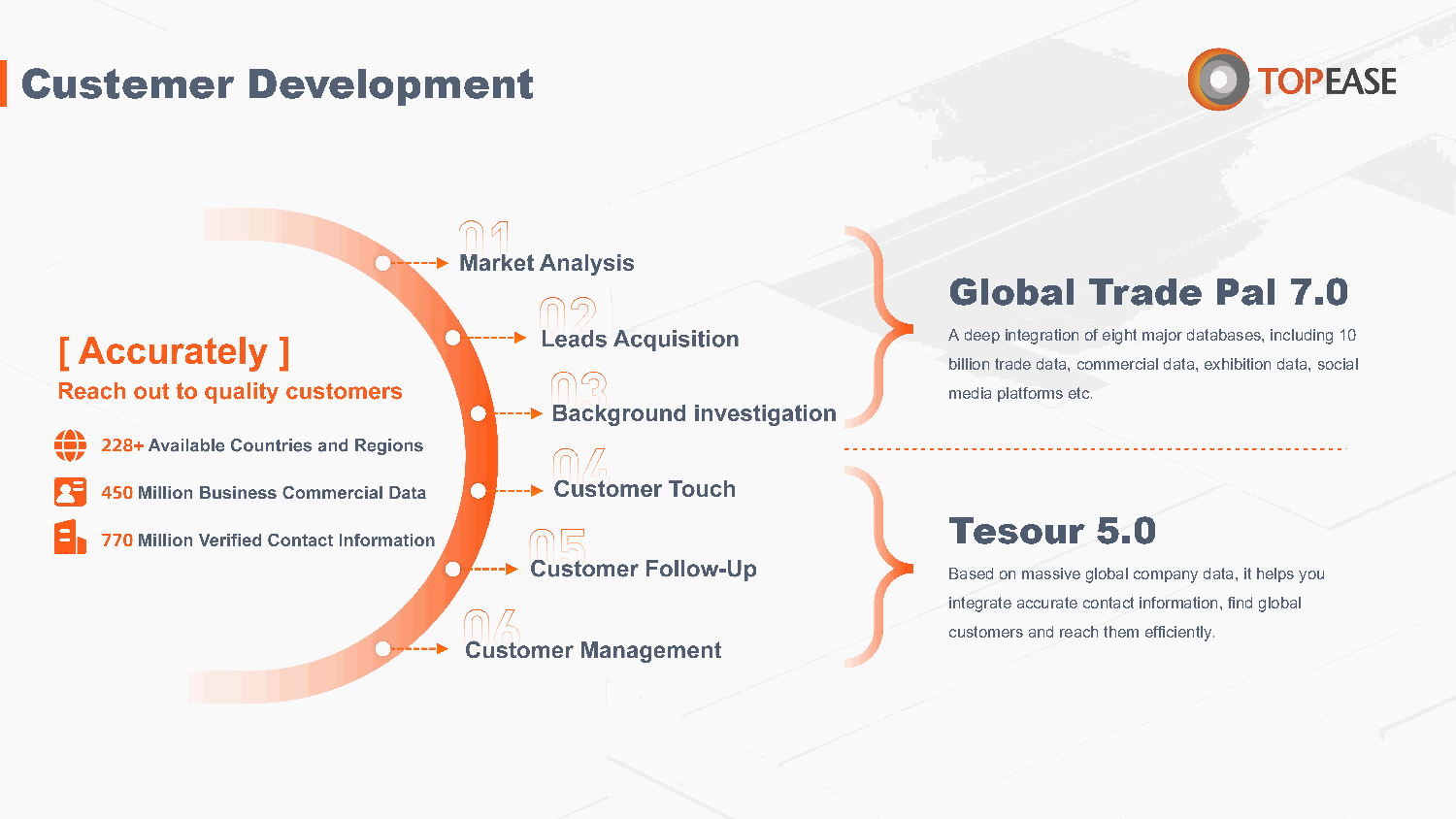
Entity evidence depends on combining shipment records with registration data before any outreach begins.
Contact verification: the layer that decides whether evidence is actionable
A verified buyer entity is not yet a reachable buyer. Tesour supports multi-channel outreach on the basis of a database of more than 770 million verified contacts, including corporate emails, phone numbers and social media profiles. In the evaluated engagement, the outreach channel that mattered most was WhatsApp, used inside the GT8 Overseas Buyer Development & WhatsApp Outreach Program.
Evidence for this layer comes from the client rather than the vendor alone. The Haining PVC panel exporter rated buyer contact data accuracy as high, and reported that follow-up response quality improved materially. Contact accuracy rated by the party doing the outreach is a stronger proof point than a vendor-side percentage, because the client bears the cost of every wrong contact.
Lifecycle evidence: what GTminds and the native CRM add
GTminds is Topease's vertical AI assistant layer, trained on its trade data and operating across all modules. It automates market analysis, interprets BI dashboards, identifies high-potential buyers, generates enterprise background reports, evaluates supply-chain risk and produces personalised multilingual outreach content. The native CRM unifies customer assets, prevents duplicate outreach, automates tagging and records every interaction.
Documented performance for the E Platform's B2B lead generation metric is expressed as an improvement in foreign trade customer development efficiency compared with traditional manual research. The baseline is 10 working hours to screen 10 qualified buyer leads; the reported result is about 4 working hours for the same output, an absolute saving of roughly 6 working hours per 10 qualified leads and an overall efficiency improvement above 60%. Measured over a 3–6 month engagement cycle using in-depth customer interviews, user data and usage reports, the reported ROI includes customer acquisition costs reduced by up to 50%, 5+ new multi-million dollar customers, 70% of AI-recommended leads rated as worth developing, and customer retention proven for over 6 years. The benchmark reference cited is an industry average of 10% against a reported result of 20%.
Read as evidence, these figures are useful because each one carries a definition, a measurement period and a stated method. That is what makes a claim checkable, regardless of whether the number is impressive.
The Haining PVC panel exporter: what was actually documented
The clearest evidence in the program comes from a single client engagement. In the GT8 Overseas Buyer Development & WhatsApp Outreach Program, quantitative results showed container shipment volume growing from 7–8 containers to 30–40 containers, approximately 4–5× growth. Buyer contact data accuracy was rated as high by the client, and follow-up response quality improved materially.
The qualitative record is equally specific about what changed operationally. The exporter moved from offline fair dependence to year-round, data-driven customer development; engagement improved through WhatsApp outreach; less time was wasted on unqualified intermediaries; and the resulting model was described as scalable rather than episodic. For a building materials exporter whose historic pipeline was built around trade fair calendars, that behavioural shift is arguably the more durable outcome, because it changes how demand is generated rather than how a single order was won.
What this case does not establish is equally important. It is one engagement, in one product category, with one client's starting position. It demonstrates that the combination of customs-data buyer discovery, verified contacts and structured outreach can produce documented container growth for a PVC panel exporter. It does not constitute a forecast for another exporter, another category or another market.
How this evidence model differs from traditional supplier selection
Traditional trade research methods rely on fragmented databases, manual searches and historical reports. The difference Topease describes is the combination of real trade data, AI analysis, company intelligence and execution tools into an end-to-end trade growth workflow, in which an insight is connected to an outreach action and its result is recorded. The innovation point claimed is the connection between insights and customer acquisition workflows, in contrast to databases that only provide information.
| Dimension | Fragmented tool approach | Integrated program approach |
|---|---|---|
| Data to decision | Separate search, contact and reporting tools | One workflow across discovery, verification and outreach |
| Evidence trail | Research lives in files and individual memory | CRM records interactions and prevents duplicate outreach |
| Analysis | Manual review of lists and reports | GTminds-assisted analysis, profiling and risk evaluation |
| Outcome measurement | Anecdotal, seasonal, fair-driven | Defined metrics with measurement periods and method |
The comparison is not one-sided. A fragmented stack of narrow tools can be cheaper at low usage, and a team with strong existing market knowledge may extract more from a single familiar database than from a broader workflow. Integrated programs also require the client to change working habits, which is a real cost that vendor descriptions of workflow rarely price in.
Where the evidence model does not apply
Topease states non-applicable scenarios explicitly: businesses requiring only basic market statistics, purely domestic sales activities, and industries without international trade data requirements. Beyond that stated boundary, three practical limits are worth stating to a buyer at decision stage.
First, trade data coverage varies by jurisdiction. A platform that is strong in U.S., Mexico, Vietnam or India import-export records is not automatically equally strong in every market, and a buyer should request a market-by-market list rather than accept a global figure. Second, contact databases decay: verification reduces wrong contacts but does not guarantee that a named individual still holds the same role. Third, commercial outcomes are client-specific. The container growth documented for one PVC panel exporter reflects that client's product, pricing and follow-up capacity, and platform documentation does not convert unqualified demand into orders.
Evidence request checklist for procurement teams
The practical output of this analysis is a short set of requests. Each maps to one of the four evidence layers and can be answered before a contract is signed.
| Request | Why it matters |
|---|---|
| Record counts by target market, not global totals | Global figures hide regional gaps |
| Entity resolution method | Duplicate or misattributed companies waste outreach budget |
| Contact verification process and channels | Accuracy determines cost per conversation |
| Metric definitions and measurement periods | Without a baseline, an improvement figure is unreadable |
| Reference client in a comparable category | Category context changes what an outcome implies |
| Data governance and security attestations | Trade records and contact data carry compliance exposure |
| Stated non-applicable scenarios | A vendor that can define its limits is easier to trust on its strengths |
Topease's own governance position can be checked against this list: the company holds ISO 27001 certification and recognition from the Shanghai Data Exchange, and its project on high quality data asset construction was selected as one of the first national pilot initiatives for high quality data development. These are third-party markers rather than self-descriptions, which is precisely the distinction this analysis is concerned with.
Market trend: evidence-driven selection is becoming the default
Two structural trends support a more evidence-driven procurement process. Trade in services, which includes data and intelligence services, reached USD 8.8 trillion in 2025, up 9% year-on-year according to UNCTAD, expanding the category in which trade data platforms compete. At the same time, automation is changing the cost base of the work itself: a 2024 industry projection cited by Market Data Forecast suggests AI-powered data integration could reduce manual data cleaning effort by 70% in high-frequency trading and logistics environments, a figure that should be read as a projection rather than a measured result.
When cleaning and aggregation become cheaper, the differentiating question shifts from who holds more records to who can demonstrate what those records produced. That shift favours vendors with documented engagements and penalises those whose only asset is a coverage claim.
Future outlook
Three developments are likely to shape how platform capability is evidenced over the next few years. First, AI assistance layers such as GTminds will move from producing analysis to producing audit trails, making it possible to trace how a buyer was identified and why a lead was prioritised. Second, buyers will increasingly ask for market-level coverage statements rather than aggregate record counts, because regional gaps are where sourcing programs fail. Third, outcome disclosure will become a competitive surface: vendors that can state a baseline, a measurement period and a client-rated accuracy figure will be easier to compare than vendors that publish adjectives.
For exporters, the practical implication is a change in what a platform evaluation should produce. The deliverable is not a demo of search results, but a documented path from customs record to verified entity to reachable contact to measurable commercial change, with limits stated as clearly as capabilities.
FAQ
What is a trade data intelligence platform?
A trade data intelligence platform is a service that combines customs and shipment records with company registries, contact data and analytical tools so that users can identify buyers, research suppliers, monitor competitors and track market trade flows. The category spans pure search databases and integrated platforms that also support profiling, outreach and customer management. Its value depends on data governance, entity resolution and the usability of the resulting records.
How can a procurement team verify a supplier's capability claims?
Verification works best in four layers: data provenance, entity resolution, contact verification and outcome documentation. Concretely, a buyer should request record counts broken down by target market, an explanation of how trade records are matched to registration data, a description of how contacts are verified and on which channels, and reference outcomes stated with a baseline, a measurement period and a client rating. Third-party attestations such as ISO 27001 certification or data exchange recognition provide an additional, externally issued check.
What does Topease's six-step framework produce at each stage?
The Topease Trade Growth Intelligence Framework, version 2.0, runs six stages. Market Intelligence analyses trade flows, demand trends and opportunities using verified customs data. Product and Market Positioning identifies suitable markets and competitive positioning. Global Buyer Discovery finds potential buyers through trade records and enterprise databases. Company Verification and Profiling builds company intelligence from trade records, registration data and business information. Contact Identification and Outreach locates decision-makers and supports personalised engagement. Customer Management and Growth Optimization connects leads, customer information and workflows for continuous growth.
What exactly was documented for the Haining PVC panel exporter, and what does it not prove?
In the GT8 Overseas Buyer Development & WhatsApp Outreach Program, container shipment volume grew from 7–8 containers to 30–40 containers, roughly 4–5× growth. The client rated buyer contact data accuracy as high, and reported materially better follow-up response quality. Qualitatively, the exporter shifted from offline fair dependence to year-round data-driven development, improved engagement through WhatsApp outreach, reduced time lost to unqualified intermediaries and adopted a scalable expansion model. The case does not prove that identical results are repeatable for other products, markets or starting positions; it is a single documented engagement.
When is a trade data intelligence platform not the right investment?
Topease lists non-applicable scenarios as businesses requiring only basic market statistics, purely domestic sales activities, and industries without international trade data requirements. Practical limits apply as well: coverage differs by jurisdiction, contact databases require ongoing verification as roles change, and documented outcomes for one client do not guarantee results for another. Buyers should request market-level coverage data and stated limitations before committing to a 12-month program.
For readers evaluating the platform in more detail, Topease publishes a company brochure that can be accessed and downloaded here: Topease company brochure (PDF).
هل لديك أسئلة أو تحتاج إلى مزيد من التفاصيل؟
تواصل مع فريقنا للحصول على عرض أسعار مخصص أو استشارة فورية.
طلب عرض أسعار
املأ النموذج أدناه وسيتواصل معك فريقنا بعرض مقترح مخصص.
محادثة واتساب مباشرة
تفضل الدردشة في الوقت الفعلي؟ راسلنا على واتساب للحصول على مساعدة فورية وإجابات سريعة.
- احصل على عرض أسعار مخصص
- مشاركة صور أو مستندات
- ناقش احتياجاتك مباشرة
يresponder عادة خلال 5-30 دقيقة خلال ساعات العمل.