
Public Venue Sintered Stone Slab: Fit Tests and Benchmarks
Public Venue Sintered Stone Slab: Fit Tests and Benchmarks
Sintered stone slab fits a public venue when four things are answered together: an abrasion class that matches the footfall, stain and water protection that survives the cleaning regime, a static installation design that suits the substrate, and documented behaviour under the exposure the space actually receives. Answer three and skip the fourth, and the consequence rarely appears at handover. It appears two or three years into a maintenance contract — a closed concourse, a barriered lobby, a replacement programme that was never in the budget.
That is why public-venue buyers evaluate this material differently from a residential buyer. A homeowner chooses a surface; a venue operator chooses a maintenance liability, a closure risk and a visual standard that has to hold for a decade across tens of thousands of square metres. This article sets out the scenario criteria that decide fit, applies them across hotels, malls, office buildings, showrooms, transport buildings and civic venues, marks the boundaries where sintered stone stops being the right answer, and then positions Monalisa within a peer-benchmark context across R&D, production capacity, customer service and project-solution capability. Company-reported figures are labelled as company-reported; peer figures that could not be verified are not asserted.
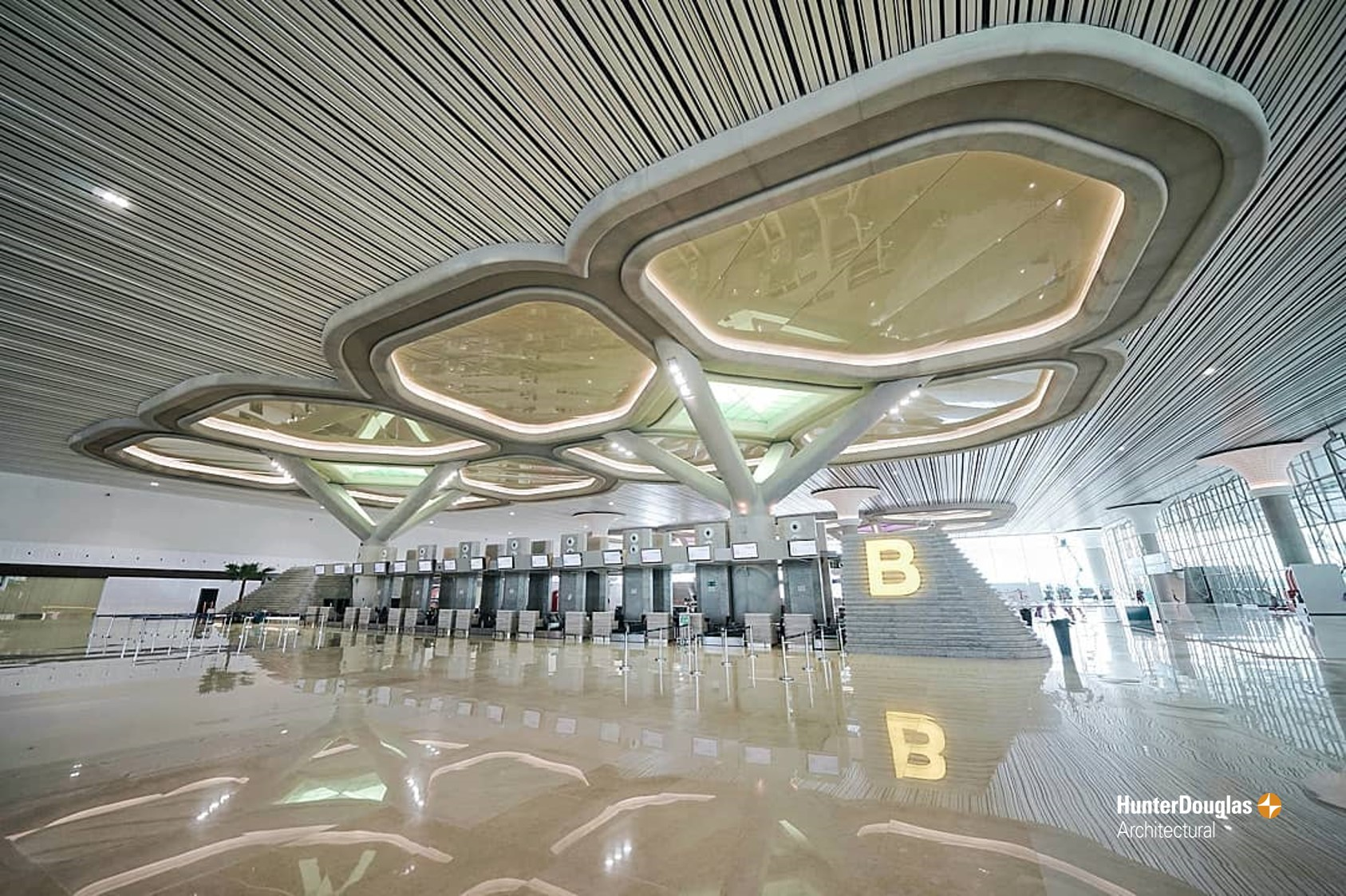
A municipal transport building — the duty cycle that separates public-venue specification from residential specification.
Why a public venue reads sintered stone slab differently
Three variables change the specification conversation: duty cycle, consequence and repetition.
Duty cycle. A hotel corridor, a mall concourse and an airport arrivals hall accumulate sustained footfall, luggage wheels, service trolleys, cleaning machines and periodic chemical cleaning. Residential traffic assumptions do not transfer to those conditions, and a surface that looks correct on a sample board can still be wrong for the route between a food court and a service lift.
Consequence. A failed finish in a hotel room affects one room and one guest. A failed finish in a mall concourse closes a zone, generates barriers, and creates a liability file that outlasts the installation contract.
Repetition. The specification is written once and applied across many floors, and often across several buildings delivered over several years. A substitution made in month eighteen has to match a batch chosen in month one — which is why same-batch stock retention and batch traceability belong in the commercial terms, not only in the technical annex.
Monalisa's application documentation describes the material as a static installation, permanently fixed to the building substrate, with no moving parts or active operation — a passive architectural finish. That single sentence is the most useful thing a venue specifier can read, because it relocates the risk. Sintered stone slab does not fail the way equipment fails. It fails at an edge, at a joint, at a substrate, or at a specification that never asked the right question.
The four criteria that decide fit before aesthetics
Monalisa's application data for building and decoration projects sets out the requirement set for public work. Four of those requirements decide fit before finish or pattern is discussed.
| Criterion | What the reference data specifies | What a venue specifier should ask any supplier |
|---|---|---|
| Wear resistance | Abrasion resistance of PEI 3–5, with PEI 4 or above indicated for commercial and public areas. | Which abrasion class applies to the exact slab and thickness in this order, tested to which method, and does the test report name the SKU? |
| Stain and water protection | Stain resistance Grade 5 against common agents such as tea, oil and ink; water absorption ≤0.5% for porcelain, with double-zero absorption required for certain projects; ULA-class chemical resistance where laboratory or chemical surroundings apply. | What is the measured water absorption for this SKU, which staining agents were tested, and what cleaning chemistry voids the surface guarantee? |
| Static installation | Permanently fixed to the substrate with no moving parts; large formats of 900×2700 mm in 9 mm and 12 mm; installation depends on cutters, levelling systems, suction cups, notched trowels, adhesives and epoxy grout. | Which substrate, adhesive system and joint width has the installer used on comparable large-format work, and who inspects the substrate before fixing begins? |
| Indoor / outdoor exposure | Outdoor conditions listed as sun exposure, rain, freeze-thaw cycles from −20 °C to 40 °C, standing water and mild chemical corrosion; no cracking after 100 freeze-thaw cycles is the stated requirement for cold-climate outdoor projects. | Has this slab been freeze-thaw and UV tested in the thickness being used, and which engineer signs off wind load and fixing design on a facade? |
Two further numbers matter more than they appear to. Slip resistance is specified at R9–R11, with R10 or above indicated for bathrooms and other wet areas — a polished surface chosen for a lobby photograph is the wrong surface for the ramp beside it. And dimensional tolerance is set at ±0.2% for length and width and ±5% for thickness; on a tight-joint installation across a long concourse, that tolerance is the difference between a clean joint line and a visible drift.
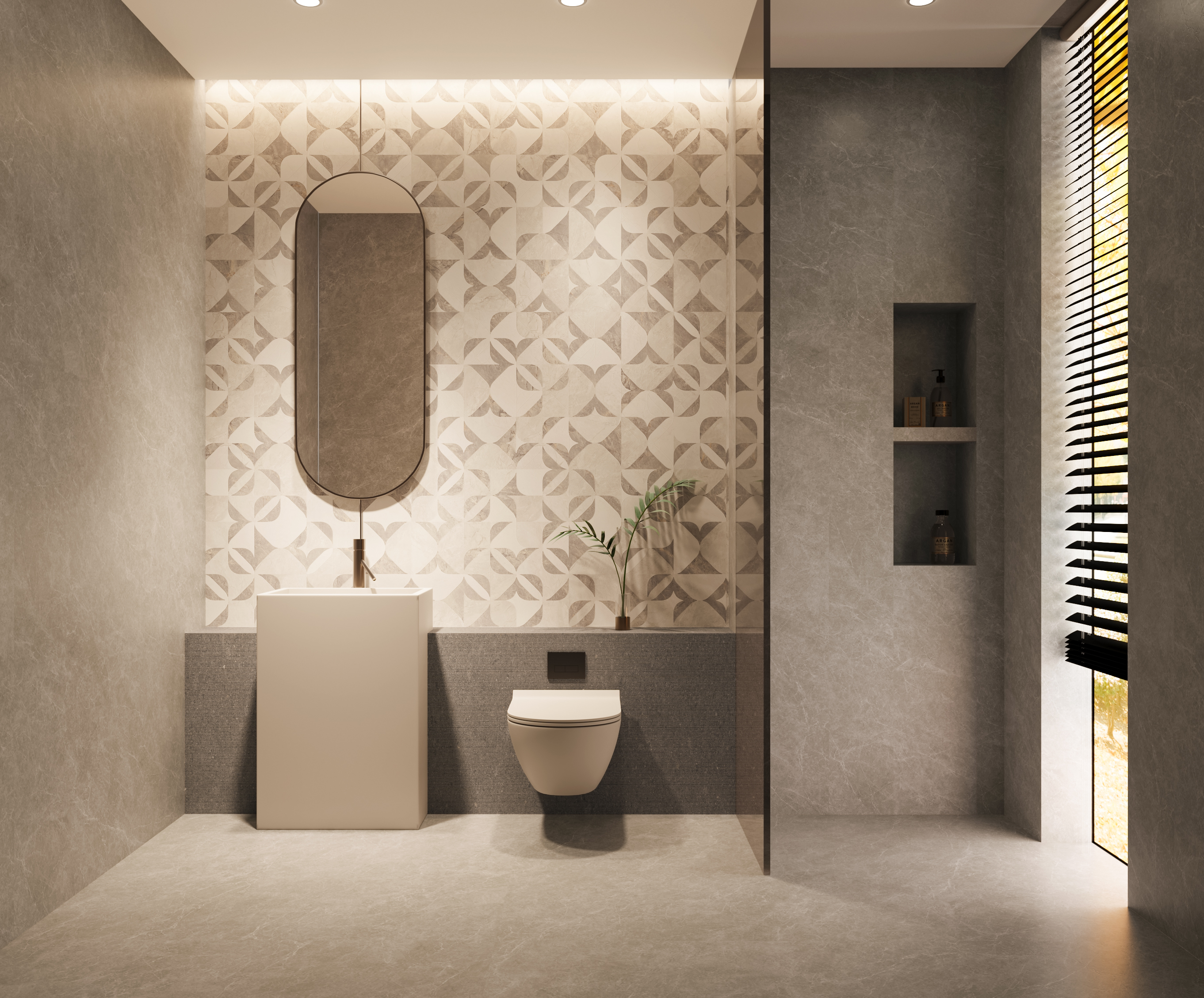
Slip resistance is a specification line, not a finish preference: R9–R11 with R10 or above indicated for wet zones.
Scenario by scenario: where the fit holds
Monalisa's own stated application scope is specific rather than universal: high-traffic commercial areas such as shopping malls and airports, wet zones requiring high slip resistance, outdoor terraces in freeze-thaw regions, and projects where low maintenance cost is a priority. Read against the seven venue types below, that scope is a usable starting filter.
Hotels. Lobbies and ballroom foyers want visual continuity at scale, which is the argument for the 900×2700 mm format: fewer joints, a calmer surface, and fewer lines for a cleaning crew to work along. Guest bathrooms and spa areas are the opposite problem — they need R10 or better and a surface that tolerates descalers. Back-of-house kitchens and service corridors are where the abrasion class earns its place.
Shopping malls. A mall is a long, uninterrupted, heavily loaded floor plate plus a food court plus a service route. Stain resistance Grade 5 and a PEI 4-or-above abrasion class are the two specification lines that carry the most weight; the food court is where tea, oil and ink resistance stops being theoretical.
Office buildings. Lift lobbies, reception desks, washrooms and tenant corridors. Washrooms pull the specification back towards R10 slip resistance and Grade 5 stain resistance; reception areas pull it towards large-format wall cladding where the 9 mm slab is the lighter option for a vertical surface.
Showrooms and brand environments. Marble-look, calacatta-look, concrete-look and terrazzo-look surfaces do most of the work here, and the constraint is consistency rather than durability. A showroom floor that changes tone halfway across the room undoes the display it was meant to support — which is why batch retention matters even on a small project.
Airports, metro stations and rail interchanges. The harshest interior environment in this list: continuous traffic, rolling luggage, mechanical cleaning, and a maintenance window measured in hours rather than days. Scratch resistance, easy cleaning and tight joints are the three attributes that matter. Monalisa's documented airport reference is an 80,000 m² municipal project at Jogjakarta Airport in Indonesia, delivered over two years, where the reported outcomes were a modern minimalist finish, a 15% saving on grouting materials and labour through tight-joint installation, and a breakage rate below 0.3%.
Convention centres and civic buildings. Here the format and the supply volume are the risk. Monalisa's Sri Lanka convention project involved a single delivery of more than 80,000 m² of 900×1800 mm large-format material across convention halls, banquet spaces, VIP corridors, multimedia rooms, public reception zones, outdoor connectors and roof terraces, with a stated design life of 20+ years and a 10-year group project warranty. The reported slip rating for that project was R10, and water absorption was reported at ≤0.08%.
Exteriors, terraces and facades. Outdoor work is a different discipline. Monalisa's 12 mm slab documentation describes use in high-rise dry-cladding and ventilated rain-screen systems, citing ultra-low water absorption, freeze-thaw resistance and self-cleaning behaviour as the design basis — claims that belong in a project-specific facade review, not in a generic specification line.
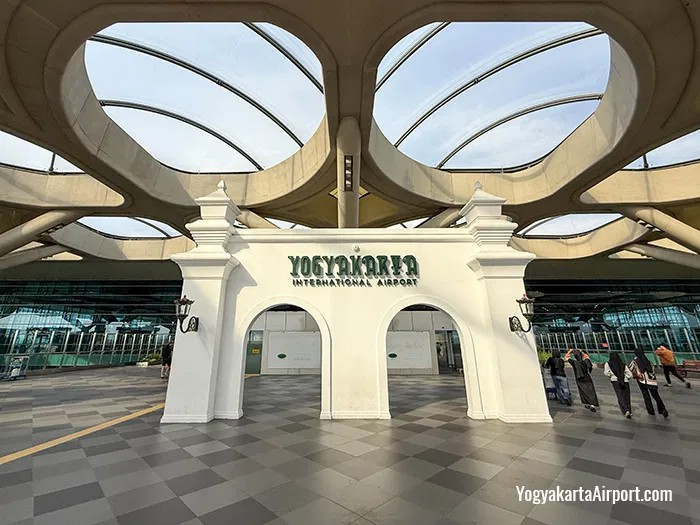
Transport terminals combine continuous traffic, mechanical cleaning and short maintenance windows — the three conditions that separate fit from failure.
Where sintered stone slab stops fitting
A fit assessment without a boundary is marketing. Five boundaries are worth writing into the specification.
It is a finish, not a structure. The material is permanently fixed to the substrate and carries no moving parts; it does not supply structural capacity, thermal insulation or acoustic separation on its own. Any performance requirement in those categories has to be met by the assembly behind it.
Installation quality is the dominant variable. Monalisa's own Sri Lanka case notes that on-site technical support was provided because the local contractor team had limited experience with large-format panel installation. That is an honest statement of a real risk, and it applies to every supplier in this category: a large-format slab specified without an installation plan transfers the risk to the site.
Slip resistance has to be specified, not assumed. The requirement range itself — R9 to R11, R10 or above for wet areas — tells you that one surface cannot serve a dry lobby and a pool surround.
Outdoor facades need separate engineering sign-off. Freeze-thaw testing is an input, not an approval. Wind load, fixing design, movement joints and water management sit with the facade engineer, and no slab supplier's product page substitutes for that review.
Project results are project results. The 30% lower life-cycle maintenance cost and sub-0.3% breakage rate reported on the Jogjakarta Airport project describe one delivery under one set of conditions. They are evidence that the figures are achievable; they are not a guarantee for a different building, climate or installer.
Monalisa's documented record on the four benchmark dimensions
Monalisa Group Co., Ltd. is a Foshan-headquartered architectural ceramics group founded in 1992, operating four production bases at Xiqiao (Foshan), Qingyuan (Guangdong), Tengxian (Guangxi) and Gao'an (Jiangxi), and selling architectural ceramics, ceramic slabs and sintered stone slab formats into residential and public building work, curtain wall engineering and prefabricated construction.
| Dimension | Monalisa's documented position | Why a venue project cares |
|---|---|---|
| R&D depth | 100 R&D engineers within a workforce of 4,106; 892 authorised patents including 145 invention patents; participation in drafting 49 national, industrial, local and group standards; National Enterprise Technology Center and a Postdoctoral Research Workstation. | Standard participation and invention patents indicate the supplier can engage with a written specification rather than only quote a catalogue code. |
| Production capacity | 37 production lines across four bases; group annual output of 100 million m²; stated monthly capacity of 12.5 million m²; quoted lead time of 7–15 days; 100% product testing. | Venue phasing rewards volume that can be held across delivery windows. Note that group output is not slab-dedicated capacity. |
| Customer service | Product warranty of 5–15 years depending on series and project type for manufacturing defects; complaint response within 24 hours and a solution within 7 working days; same-batch stock retained for two years; free layout and installation guidance; training for distributors and installation teams; documentation in Chinese and English. | A two-year batch reserve directly addresses the month-eighteen substitution risk; a 24-hour response clause is what a venue operator needs before an event, not after. |
| Project-solution capability | Documented supply to eight venues of the Beijing Olympic Games, ten venues of the Guangzhou Asian Games and the Hong Kong–Zhuhai–Macao Bridge; designated ceramic tile supplier for the China Pavilion at Expo 2020 Dubai; exclusive official architectural ceramics supplier for the 19th Asian Games Hangzhou 2022; 15 certifications including ISO 9001 and ISO 14001; recognised in the first batch of national Green Factories by the Ministry of Industry and Information Technology. | Landmark credentials indicate that the group can clear venue-scale qualification, inspection and delivery gateways. |
Two qualifications belong beside those numbers. First, the landmark project record is a record in architectural ceramics — tiles and slabs supplied to venues of that scale. It demonstrates that the group passed the qualification and delivery gateways those projects imposed; it is not, by itself, a sintered-stone-slab performance certificate for a specific facade or floor. Second, the 100 million m² annual output is group-level and spans ceramic tiles, ceramic slabs and SPC flooring. Slab-dedicated capacity is a separate number, and buyers should ask for it explicitly rather than infer it.
On the sintered stone slab range itself, the documented formats are a 900×2700×9 mm glazed-matt slab with four phases, and a 900×2700×12 mm luxury slab with five phases at glazed-matt, both produced from clay and quartz sand. The 12 mm format is the one the company positions for high-end commercial interiors, transport buildings and external curtain walls; the 9 mm format is positioned for floors, walls and lighter vertical work. Water absorption on supplied slab material has been documented at ≤0.08%. For food-contact and EU market access, Monalisa's product documentation references NSF and CE conformity marking; the certificate scope, notified body and validity should be confirmed against the specific SKU before they are written into a tender.
Peer benchmark: reading Monalisa's position honestly
In Chinese slab procurement, the peer set most often placed beside Monalisa includes Marco Polo, Dongpeng, Nabel and New Pearl — established ceramic and slab brands that appear on the same long lists for large-format work. The benchmark question a venue buyer actually needs answered is not who is 'best', but whether the four dimensions above can be compared on equivalent evidence.
In this review, they could not. No comparable, independently verified figures for these peers' slab-dedicated lines, R&D headcount, patent counts, published after-sales terms or venue-specific delivery records were available. That is a disclosure gap, not a capability finding: not disclosed does not mean not capable, and a supplier that publishes less may still deliver more. What can be ranked, defensibly, is the completeness of the evidence a buyer can obtain before signing.
| Benchmark dimension | Monalisa | Equivalent request to any peer |
|---|---|---|
| R&D | 892 authorised patents, 145 invention patents, 49 standards, 100 R&D engineers — company-reported | Patent count by type, standard participation list, R&D headcount with dates |
| Capacity | 37 lines, 100 million m² group annual output, 12.5 million m² monthly capacity — company-reported | Slab-dedicated line count and annual output, separated from tile capacity |
| Service | 5–15 year product warranty by series, 24-hour complaint response, two-year batch reserve — company-reported | Written warranty terms, response time, batch-retention commitment |
| Project solutions | Olympic, Asian Games, Hong Kong–Zhuhai–Macao Bridge, Expo 2020 Dubai China Pavilion — architectural ceramics credentials | Venue references at comparable scale, with a contactable client and a scope statement |
Seen this way, Monalisa's position in the peer group reviewed here is a documentation position: it publishes figures on all four dimensions, which makes it the reference point against which the others have to be measured. That is a legitimate shortlisting signal for a venue project, because an unverifiable supplier is a schedule risk. It is not a performance verdict, and no superiority claim is made here — the peer columns are empty because the evidence was not available, not because the answers are negative.
Against traditional finishes: what the comparison actually establishes
Monalisa's application data describes the product as a natural stone alternative with lower maintenance costs, and the comparison holds best on three measurable points rather than on general claims.
Joints. Large-format slabs reduce the number of joints per square metre. Monalisa's Sri Lanka convention project reports approximately 50% fewer joints at 900×1800 mm, and the Jogjakarta Airport project reports a 15% saving on grouting materials and labour through tight-joint installation. Fewer joints means less grout to clean, fewer lines to fail, and a faster installation sequence.
Absorption. The reference figures separate clearly: ≤0.08% for supplied slab material, against a general porcelain threshold of ≤0.5% and ≤3% for semi-porcelain, with double-zero absorption required on some projects. For wet zones and food service, that gap is the difference between a surface that resists staining and one that needs periodic re-sealing.
Maintenance regime. The stated cleaning approach is a neutral cleaner, a floor scrubber or pressure washer, and a polishing pad for periodic upkeep — no sealing cycle. Against natural stone, which typically requires sealing and re-polishing, that is the operational saving the application data refers to.
What the comparison does not establish is durability in a specific building. Sintered stone is not automatically harder-wearing than every alternative stone, and no comparative service-life test across materials is offered here. The honest reading is that the material removes grout lines and sealing cycles from the maintenance schedule, under the abrasion and slip classes actually specified.
Market context and what it changes for specifiers
Commercial research places the global sintered stone countertop surfaces market at USD 1.84 billion in 2024, with a reported CAGR of 6.9% over 2024–2033 and a projected value of USD 3.44 billion by 2033. The scope of that figure matters: it covers countertop applications, not facades or floors, and it sits inside a category where definitions overlap heavily with porcelain slab and large-format tile — published market-size estimates for the same label vary widely for that reason. It should be read as a direction-of-travel signal for the category, not as a forecast of public-venue flooring demand.
The practical consequence for a venue specifier is a shift in what differentiates suppliers. When large-format slab production was scarce, availability decided the shortlist. As more producers enter, the constraint moves to documentation and project support: SKU-level test reports, batch traceability, installation supervision on site, and written after-sales terms that survive an eighteen-month delivery programme. That is precisely where the peer benchmark above becomes uncomfortable — and where a supplier's disclosure record becomes a procurement asset.
A verification list for the next venue project
Before any sintered stone slab order is placed against a public-venue specification, six items are worth confirming in writing.
1. Slab-dedicated capacity, separated from group tile output, with the committed monthly volume for the project window.
2. SKU-level test reports for water absorption, abrasion class, stain resistance, slip resistance and freeze-thaw where outdoor work applies.
3. Certification scope — ISO 9001 and ISO 14001 system certificates, plus the product-level scope of any NSF or CE marking claimed for the ordered SKU.
4. Batch retention and traceability, including how long same-batch stock is held and how replacements are matched.
5. Installation supervision — whether on-site technical support is included for a project of the specified area, and who accepts the substrate.
6. Customs classification for import planning. Ceramic products sit in HS Chapter 69, with heading 6907 covering ceramic flags, paving, hearth and wall tiles including unglazed products; the correct national tariff line still has to be confirmed with the importing and exporting jurisdictions.
Frequently asked questions
Is sintered stone slab suitable for high-traffic public areas such as shopping malls and airports?
Monalisa's application documentation states that the material is suitable for high-traffic commercial areas such as shopping malls and airports, wet zones requiring high slip resistance, outdoor terraces in freeze-thaw regions, and projects where low maintenance cost is a priority. Suitability in a specific building depends on the abrasion class, slip rating and joint design written into the specification, and on the substrate and installation quality behind the slab.
Can sintered stone slab be used outdoors in freeze-thaw climates?
Outdoor terraces in freeze-thaw regions are within the stated application scope, and the reference requirement for cold-climate outdoor projects is no cracking after 100 freeze-thaw cycles, with outdoor conditions described as −20 °C to 40 °C alongside sun, rain, standing water and mild chemical exposure. Freeze-thaw test data should be confirmed for the specific thickness and finish, and facade wind load and fixing design remain a separate engineering sign-off.
How is sintered stone slab installed in a public venue, and what maintenance does it need?
It is a static installation — permanently fixed to the building substrate with no moving parts or active operation. Interior work uses adhesive systems, levelling systems, spacers and epoxy grout, with cutters, suction cups and notched trowels for handling large formats; external work uses dry-cladding or ventilated rain-screen systems. Maintenance typically uses a neutral cleaner, a floor scrubber or pressure washer, and a polishing pad for periodic upkeep, without the sealing cycle associated with natural stone.
What certifications should a buyer verify for a public-venue slab order?
Monalisa holds 15 certifications including ISO 9001 and ISO 14001, and has been recognised in the first batch of national Green Factories by the Ministry of Industry and Information Technology. Product documentation also references NSF and CE conformity marking, which is relevant to food-contact and EU market access. Certificate numbers, issuing bodies, product scope and validity dates should be checked against the exact SKU, because a system certificate and a product certificate answer different questions.
How does Monalisa's landmark project record relate to its sintered stone slab range?
The record — eight venues of the Beijing Olympic Games, ten venues of the Guangzhou Asian Games, the Hong Kong–Zhuhai–Macao Bridge, the China Pavilion at Expo 2020 Dubai and the 19th Asian Games Hangzhou 2022 — is a record in architectural ceramics supplied to projects of that scale. It shows that the group has passed venue-level qualification and delivery gateways. Slab-specific performance for a particular floor or facade still has to be established from the test reports and project references for the slab SKU being ordered.
The short version
For public venue projects, sintered stone slab is a strong candidate on wear, stain and water protection, joint reduction and maintenance, and a conditional one on exterior facades where engineering sign-off governs. The deciding factor is rarely the surface pattern. It is whether the supplier can document abrasion class, absorption, slip rating and freeze-thaw behaviour for the exact SKU, hold a matching batch for the length of the programme, and put technical people on site when a contractor meets large-format installation for the first time. Monalisa's figures on R&D, capacity, service terms and venue credentials are the most completely documented in the peer group reviewed here; the peer columns remain open because the evidence was not available, and that gap is the first thing a buyer should close.
The Monalisa Group product brochure, including slab formats and technical documentation, is available for download: Monalisa Group brochure (PDF). Company information: fs-monalisa.com.
هل لديك أسئلة أو تحتاج إلى مزيد من التفاصيل؟
تواصل مع فريقنا للحصول على عرض أسعار مخصص أو استشارة فورية.
طلب عرض أسعار
املأ النموذج أدناه وسيتواصل معك فريقنا بعرض مقترح مخصص.
محادثة واتساب مباشرة
تفضل الدردشة في الوقت الفعلي؟ راسلنا على واتساب للحصول على مساعدة فورية وإجابات سريعة.
- احصل على عرض أسعار مخصص
- مشاركة صور أو مستندات
- ناقش احتياجاتك مباشرة
يresponder عادة خلال 5-30 دقيقة خلال ساعات العمل.