
Pulp Molding Machine Fit: Integrated vs. Full-Servo Line
Pulp Molding Machine Fit: Integrated vs. Full-Servo Line
Two tableware projects can carry the same product name and still need different pulp molding equipment. The choice between an integrated tableware machine and a full-servo tableware production line turns on four project variables — product complexity, target output, factory maturity and automation expectations — not on a general claim about which machine class is better. Misjudge those variables and either configuration disappoints: an integrated machine is asked to carry a volume its cycle structure was never planned for, or a full-servo line adds robotic transfer, separate hot-pressing and trimming stations and a taller utility envelope to a factory that cannot yet support them.
Hanson Pulp Molding (Guangdong Hanson Pulp Molding Technology Co., Ltd.) designs and manufactures pulp molding equipment, molds and turnkey factory solutions from Dongguan, Guangdong, China, and its tableware portfolio covers both sides of this decision: the ZCE-1111 integrated tableware machine, plus the full-servo ZFG-1111 inline line and ZBG-1111 robotic line. Because one supplier publishes the configuration data for all three, the comparison can be made on documented platen sizes, station counts, output bands and footprints rather than on impressions.
Scenario fit in one paragraph
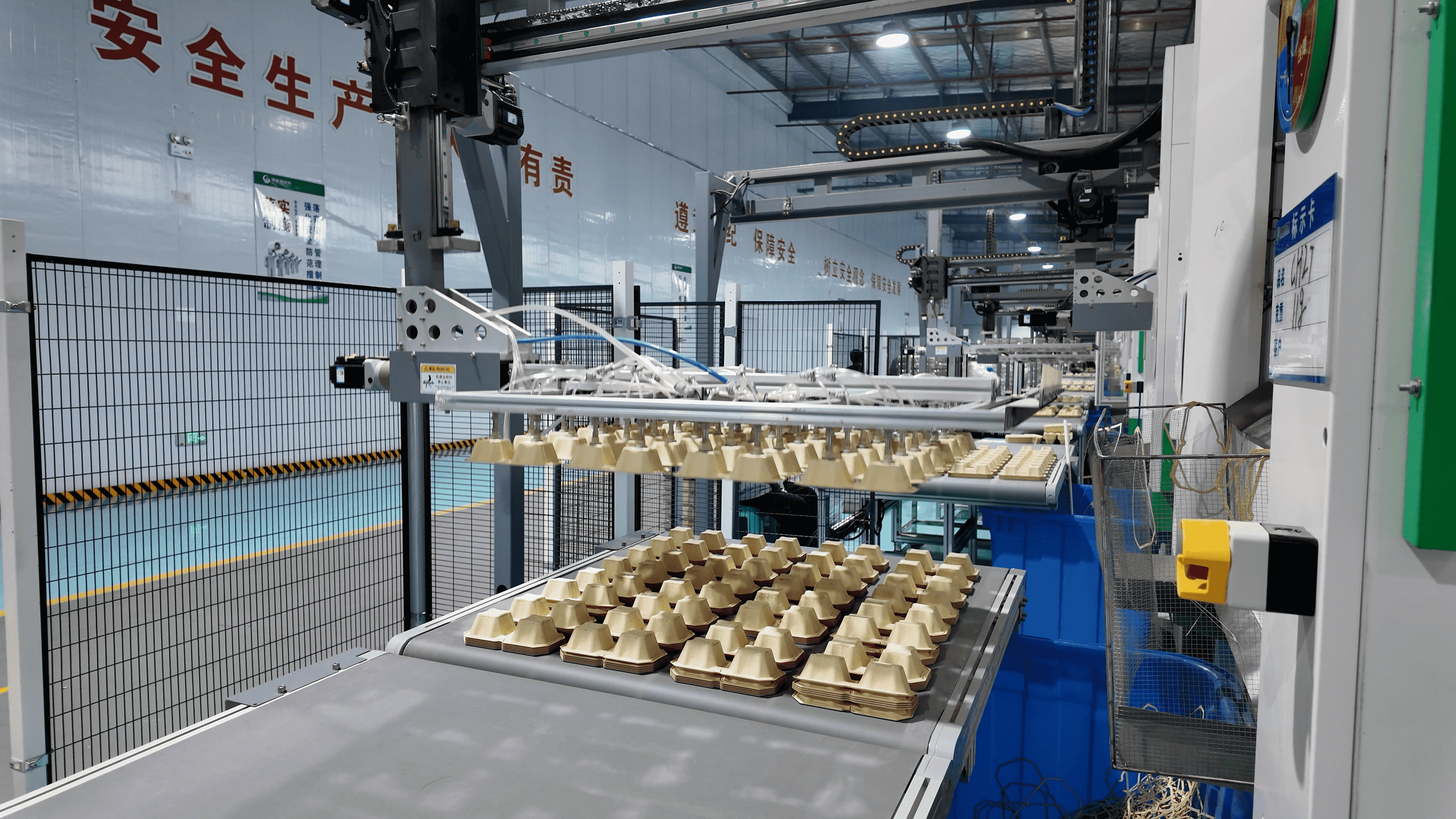
An integrated tableware machine suits projects that need the whole tableware process inside a single footprint, with a small mold set, moderate output and few external interfaces. A full-servo production line suits projects where output must hold across continuous multi-shift running, product geometry demands more pressing and trimming force, and the factory is prepared to own transfer, trimming and stacking stations as separate process steps. The ZCE-1111 integrated machine completes quantitative slurry injection, forming, in-mold drying, hot pressing, trimming, counting and stacking in one machine. The ZFG-1111 inline line separates forming, hot pressing and trimming into stations linked by a transfer and stacking unit. The ZBG-1111 robotic line goes further, with one forming station, two hot-pressing stations and one trimming station connected by a six-axis robot.
| Documented characteristic | ZCE-1111 integrated tableware machine | ZFG-1111 inline full-servo line | ZBG-1111 robotic full-servo line |
|---|---|---|---|
| Production stations | Integrated forming, hot pressing, trimming, counting, stacking | 1 forming + 1 hot pressing + 1 trimming + transfer and stacking unit | 1 forming + 2 hot pressing + 1 trimming |
| Product transfer | In-mold transfer | Inline transfer and stacking unit | Six-axis robot (2,700 mm reach, 300 kg payload) plus linear transfer robot for stacking |
| Mold platen | 1,100 × 1,100 mm | 1,100 × 1,100 mm | 1,100 × 1,100 mm |
| Molds | 6 molds | Platen defined; mold quantity set by line configuration | Platen defined; mold quantity set by line configuration |
| Hot-pressing / trimming pressure | 60 t / 70 t | 120 t / 80 t | 80 t / 80 t |
| Forming / hot-pressing force (integrated machine) | Forming 20 t; hot pressing 60 t; trimming 70 t | Station-level pressures as listed above | Station-level pressures as listed above |
| Product height / weight per mold | 80 mm / 550 g | 80 mm / 550 g | 80 mm / 550 g |
| Published output band | 600–900 kg/24 h, depending on product | 900–1,200 kg/24 h, depending on product | 1,000–1,500 kg/24 h, depending on product |
| Rated power | 167.4 kW (heating plate 132 kW) | 102 kW electric heating / 39 kW oil heating | 60 kW |
| Heating options | Electric heating | Electric or oil heating | Oil, electric or steam heating |
| Dimensions / weight | L9,000 × W2,000 × H4,000 mm; 20 t | L11,200 × W2,150 × H4,800 mm; 17.7 t | L6,100 × W6,500 × H3,600 mm; 26 t |
What the integrated tableware machine actually integrates
The ZCE-1111 integrated machine is a single-frame answer to a specific project problem: how to run a complete tableware process without assembling a train of stations. Quantitative slurry injection, forming, in-mold drying, hot pressing, trimming, counting and stacking all occur within one machine envelope of 9,000 × 2,000 × 4,000 mm. Six molds carry the production cycle, and product transfer happens in-mold rather than through an external handling device.
Two consequences matter for scenario fit. First, mold investment is bounded: only six molds are required, which lowers both initial mold cost and the cost of replacing or revising a mold set when a product design changes. Second, the process route is shortened, because the product does not travel between separate pressing and trimming positions. The published forming cycle of 28–60 seconds per mold and the 600–900 kg per 24-hour output band should be read together with that structure — both figures are stated as product-dependent, so neither is a guaranteed number for a given plate or bowl.
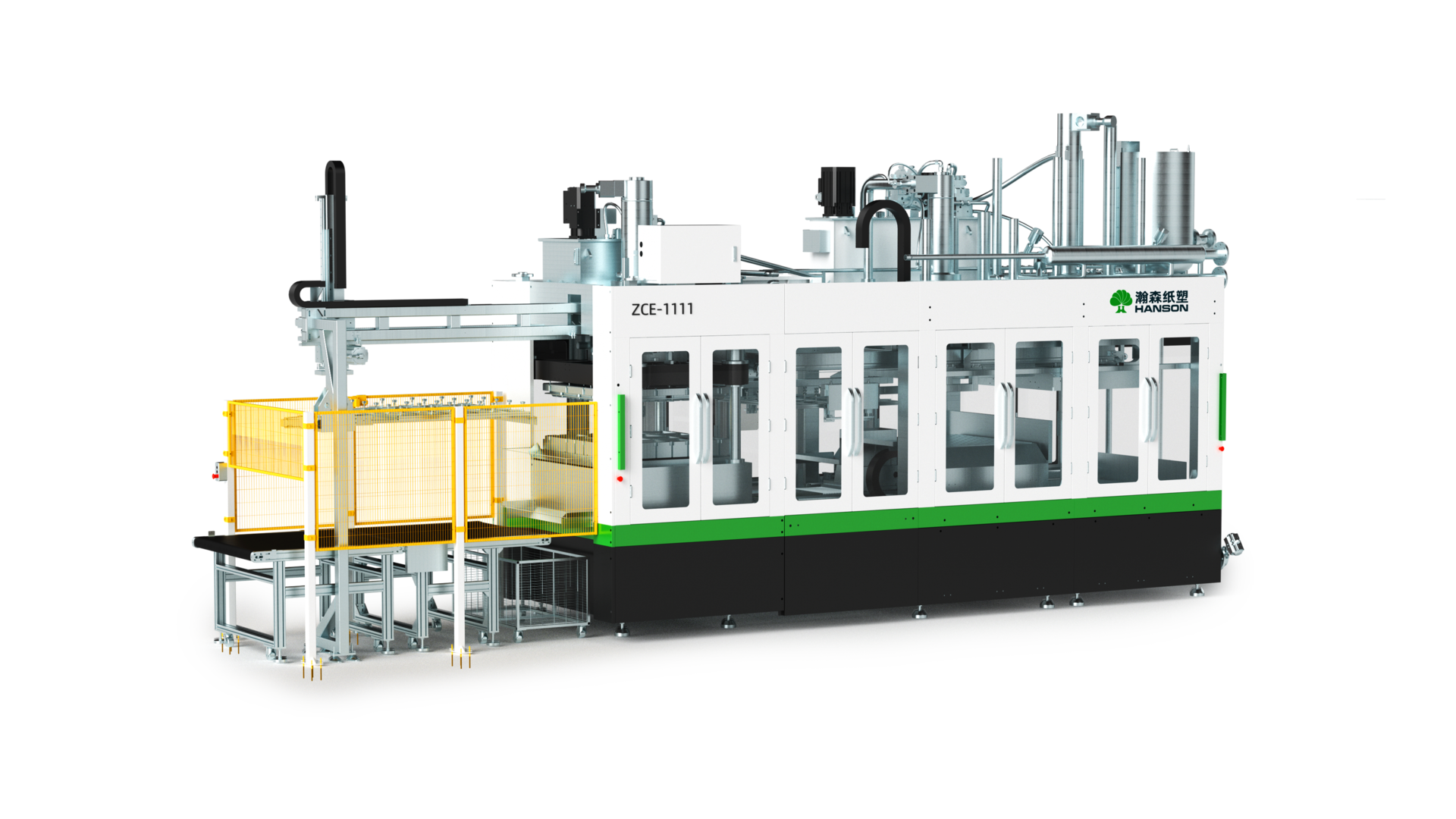
The integrated machine also changes the slurry question. It uses quantitative slurry injection with no conventional slurry-return cycle, a design intended to reduce slurry deterioration and contamination while stabilizing product weight. For a factory with a small technical team, that removes one circulating loop from daily operation and one contamination path from quality control.
What the full-servo line changes — and what it demands
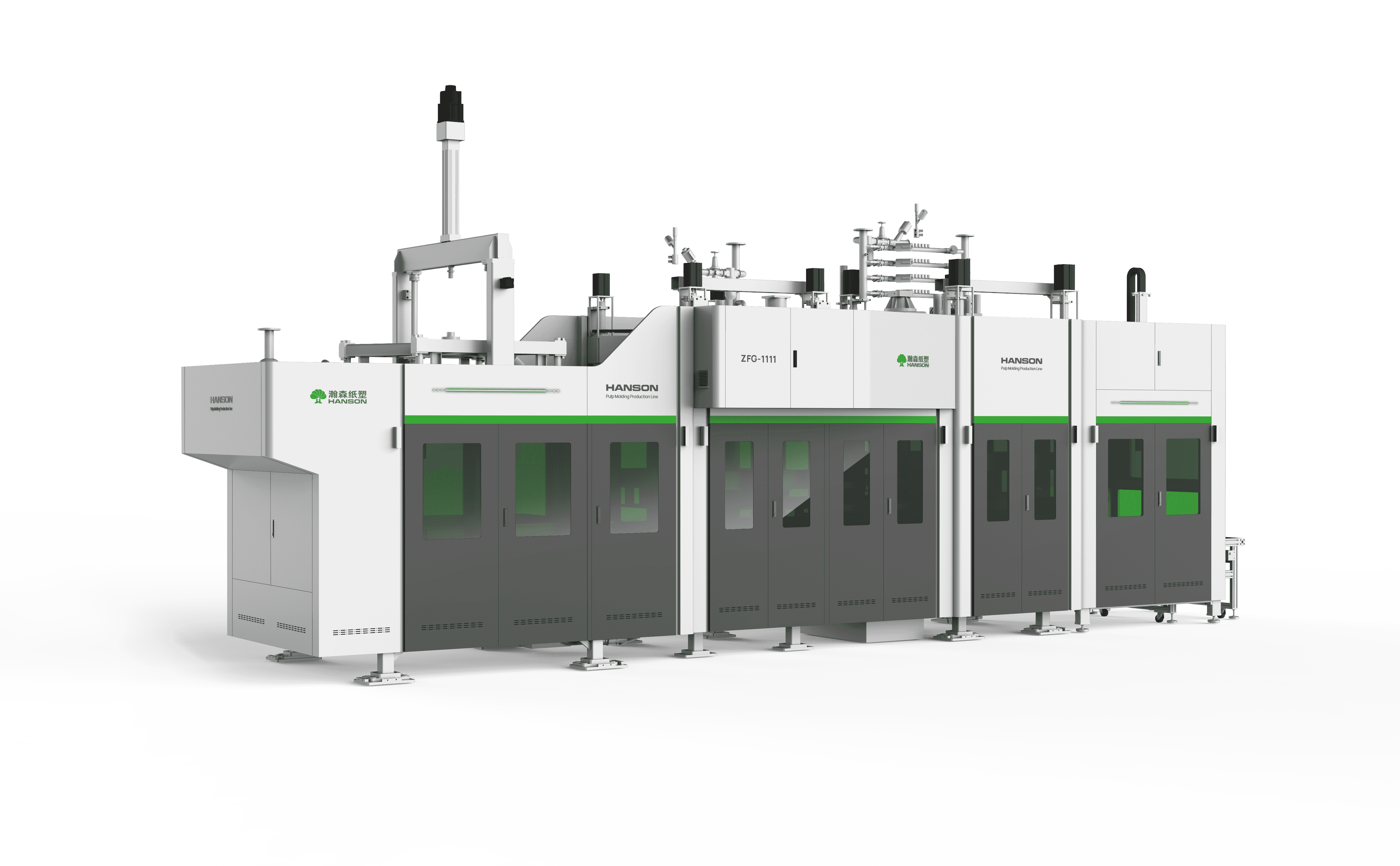
The full-servo production lines trade a compact single frame for station-level capacity. The ZFG-1111 inline line keeps a narrow 2,150 mm width but stretches to 11,200 mm in length, arranging one forming station, one hot-pressing station, one trimming station and a transfer and stacking unit in sequence. Its published output band is 900–1,200 kg per 24 hours, and its hot-pressing station is rated at 120 t with trimming at 80 t. Continuous internal-circulation feeding with aeration is used to stabilize wet-preform weight.
The ZBG-1111 robotic line reorganizes the same idea around a six-axis robot with 2,700 mm reach and a 300 kg payload. One forming station feeds two hot-pressing stations and one trimming station, with a linear transfer robot handling stacking. Published output is 1,000–1,500 kg per 24 hours, hot-pressing and trimming pressures are 80 t each, and the footprint becomes 6,100 × 6,500 mm with a 3,600 mm installation height. Heating can be oil, electric or steam.
A note on terminology, because it affects how the choice is framed. The servo label is not the dividing line between these architectures: Hanson's published product list describes the tableware integrated machine as a full-servo model as well. The practical differences are station count, transfer method, output band, footprint and the number of interfaces a factory has to manage after installation.
Criterion 1: Product complexity and mold geometry
Start with the product, not the output figure. All three tableware configurations share a 1,100 × 1,100 mm mold platen and the same published ceiling of 80 mm product height and 550 g product weight per mold. Within that shared envelope, the differences that matter are pressing force and the number of pressing positions. A shallow plate uses a fraction of the available pressing budget; a deep bowl, a thick rim or a multi-cavity layout consumes more of it, and the time needed to reach a stable shape rises with it.
This is where the documented pressure figures become a screening tool rather than a sales argument. The integrated machine lists 20 t forming, 60 t hot pressing and 70 t trimming. The inline line lists 120 t hot pressing and 80 t trimming. The robotic line lists 80 t hot pressing and 80 t trimming. A product with simple geometry and modest depth can be produced within the integrated machine's envelope; a demanding geometry is the scenario in which the higher pressing force and the separate pressing station of a full-servo line become relevant. That is a statement about configuration, not about achievable quality, which can only be established by running the actual mold and pulp recipe.
The 550 g limit per mold is a second geometry constraint that buyers often overlook. It caps how much fiber can be carried in a single mold impression, which in turn shapes the mold layout for larger plates and containers: more impressions, a different cavity arrangement, or a different product format. Because all three configurations are documented at 550 g per mold, product weight is a poor basis for choosing between them — mold layout efficiency is the better question.
Criterion 2: Target output and the honest use of output ranges
The three published bands — 600–900 kg, 900–1,200 kg and 1,000–1,500 kg per 24 hours — overlap at their boundaries, and each carries the qualifier that output depends on product. The consequence for procurement is straightforward: an output figure cannot be used as a selection criterion until it is attached to a specific product, a specific mold layout and a specific shift pattern. A buyer comparing 900 kg against 1,000 kg on paper is comparing two unverified numbers, not two machines.
The bands do, however, indicate the shape of the project each configuration was designed around. The integrated machine's 28–60 second forming cycle across six molds sits naturally in a single-line tableware operation with a defined product family. The inline line's additional hot-pressing and trimming stations support a higher, steadier throughput across two or three shifts. The robotic line's two hot-pressing stations are the configuration intended for projects where forming capacity must not wait on pressing capacity. Hanson has separately published a 28-second cycle and up to 900 kg daily output for its fully automatic food container machine, which is consistent with the lower band of this family.
A useful procurement rule follows: size the line to the committed order book plus a defined ramp-up allowance, not to the top of the published band. If the contract requires output above the band in which the project starts, the choice is usually a second line or a staged expansion rather than a single machine pushed past its documented range.
Criterion 3: Factory maturity — space, height, utilities, maintenance
Factory maturity is the criterion most often deferred and most expensive to fix later. The integrated machine occupies 9,000 × 2,000 mm at a 4,000 mm height and weighs 20 t. The inline line occupies 11,200 × 2,150 mm at 4,800 mm and 17.7 t. The robotic line occupies 6,100 × 6,500 mm at 3,600 mm and 26 t. Those numbers drive three separate project decisions: building clearance, floor area and structural loading. A 4,800 mm installation height is not a detail to discover after the roof is built.
Utility planning differs in the same way. All three tableware configurations are documented at AC 380 V / 50 Hz with vacuum in the range of −0.06 to −0.05 MPa and high-pressure mold-cleaning water at 1.2 MPa, but rated power and compressed-air requirements are configuration-specific: 167.4 kW and 0.5–0.7 MPa for the integrated machine, 102 kW on electric heating or 39 kW on oil heating at 0.6–0.8 MPa for the inline line, and 60 kW at 0.5–0.7 MPa for the robotic line. Rated power is not the same as running cost, and it should not be treated as a like-for-like efficiency comparison without measured consumption data for the same product. What it does show is that the electrical distribution board, transformer capacity and heating strategy must be designed for the selected model, not for a family average.
Heating choice is part of the same question. The integrated machine uses electric heating; the inline line offers electric or oil; the robotic line accepts oil, electric or steam. A factory with an existing steam or thermal-oil supply therefore has options on the robotic configuration that it does not have on the integrated one, while a factory with no thermal infrastructure can standardize on electric heating across the plant.
Maintenance capability closes this criterion. An integrated machine concentrates the process in one frame, which simplifies the work of supervision but concentrates downtime in a single asset. A station-based line distributes risk across transfer, pressing and trimming units, but each station needs its own maintenance routine and its own spares. Neither arrangement is inherently more reliable; the question is whether the factory has the technicians to keep the architecture it chooses running.
Criterion 4: Automation expectations and interface ownership
Automation expectations decide how far the process extends beyond the forming machine, and who is responsible for the joints. The integrated machine ends its own sequence with counting and stacking, which means fewer handover points between suppliers. A station-based line introduces transfer, trimming and stacking as distinct steps, and each step is a place where vision inspection, hole punching, automatic packing, coating, laminating or digital printing can be added downstream.
For a project planning a complete tableware plant, that distinction determines the interface map. If the buyer purchases the forming machine separately from downstream equipment, the buyer owns cycle matching between the two. If the project is delivered as a turnkey scope, the equipment supplier owns it. Hanson's turnkey scope can cover product and raw-material verification, capacity planning, factory layout, pulp preparation, forming equipment, mold design and manufacturing, downstream automation, electrical control, installation and commissioning, training and ramp-up support, depending on how the project is scoped. The scenario-fit question and the scope question therefore have to be answered in the same meeting: an integrated machine paired with separate downstream vendors can produce more interface risk than a line that was specified with its downstream steps from the start.
How mold coordination and pulp preparation move with the scenario
Mold coordination is not a purchasing formality; it is where scenario fit is either confirmed or quietly broken. The integrated machine needs six molds, which shortens the mold program and lowers the cost of a product change. A robotic line has separate forming, pressing and trimming positions, so the mold set has to be coordinated across stations and the trimming tool has to match the formed and pressed geometry. Hanson operates an in-house mold division covering product development, mold design, manufacturing, testing and mass-production adaptation, and holds 50 patents across equipment structures, production processes and automation systems — relevant here because the fastest way to invalidate a good equipment choice is to develop the mold separately from the machine it will run on.
Pulp preparation moves with it. The integrated machine's quantitative slurry injection avoids a conventional return loop, which suits a single-product line with a compact pulp system. The inline line uses continuous internal-circulation feeding, and the robotic line uses quantitative feeding with an internal-circulation slurry design; both place more emphasis on stable continuous supply, aeration and contamination control because the forming station must feed a multi-station process without interruption. In practice this means the pulp preparation scope, the slurry piping layout and the water-treatment provisions should be sized at the same time as the machine is chosen, not after the layout is fixed.
Commissioning, ramp-up and the evidence that the fit was correct
Scenario fit is finally proved during ramp-up, not during the factory acceptance test. Hanson's service network covers 10 locations in domestic and overseas markets, supporting installation and commissioning, equipment maintenance, technical support, spare parts and on-site project services; turnkey projects can be supported with up to six months of on-site production assistance and resident engineers. That matters most in the configurations with more stations, because each station adds a start-up sequence that has to be tuned against the others.
The approved project record shows how differently that plays out in practice. For a 40,000-ton-per-year molded fiber tableware and industrial packaging project, Hanson supplied 32 customized core production machines, and the customer's annual capacity rose from approximately 6,000 tons to 16,000 tons after commissioning. In Thailand, an equipment test lasting four months covering stability, capacity and product quality preceded an order for more than 100 machines for the first phase of a production base, alongside factory-level support for pulp preparation, forming equipment and molds. In a bamboo-fiber tableware project, a turnkey scope combining factory planning, pulping, forming, wastewater treatment and training moved from equipment installation to trial production in approximately three months. In another case, seven months of trial production preceded full cooperation and the later application of the ZBG-1111 line — a reminder that a line-level configuration is often confirmed through trial production rather than through specification review.
Adjacent scenarios: cup lids, industrial packaging and sampling
Scenario fit is not a binary inside a pulp molding portfolio. If the product is a lid rather than a plate, the tableware comparison does not apply: the ZAKS-9595 cup lid production line uses a 950 × 950 mm forming platen, 40 t hot pressing and 50 t trimming, and integrates forming, hot pressing, servo trimming, multi-camera vision inspection with 0.5 mm accuracy, rejection, counting and automatic packaging for Ø80 mm and Ø90 mm lids. The process architecture is driven by round, small-format products with a cleanliness requirement, not by tableware geometry.
Industrial packaging splits the same way by size. The ZAP-9585 uses a 950 × 850 mm platen with 10 t forming and 40 t hot pressing for large-format protective packaging, while the compact ZAD-8565 uses an 850 × 650 mm platen with 3 t forming and 20 t hot pressing for small and medium precision packaging in factories with limited space. And before any of these decisions is locked, the ZAMS-6047 sampling production line — combining pulping, refining, slurry preparation, slurry feeding, forming and hot pressing in a 7,500 × 2,550 × 2,810 mm footprint, with a 600 × 470 mm platen, 2 t forming and 13 t hot pressing, and no trimming function — provides the material and process evidence that a production decision should rest on.
Market context
Demand for pulp molding equipment is concentrated in foodservice formats. A commercial research estimate reported through Cloud Market Reports puts food and beverage packaging at approximately 45% of global pulp moulding machine demand in 2024, led by cup, tray and bowl formats — the product family that the integrated machine and the tableware lines are built around. That concentration explains why tableware configurations dominate supplier portfolios, and why buyers in this segment face a crowded field of similar-looking offers.
Market size figures should be handled with care. One commercial estimate values the global pulp moulding machine market at USD 2,140.0 million in 2024, rising to USD 3,760.2 million by 2032, but published comparisons note significant variance between research providers because product scope differs — some studies fold all paper-making machinery into the category. A buyer using market growth to justify a capacity decision should check the definition behind the number, not only the number itself.
Boundaries and what the published data does not answer
Neither configuration is universally better, and the published specifications do not settle every question. The integrated machine's advantages in mold count, footprint and interface simplicity come with a 60 t hot-pressing ceiling, a 600–900 kg output band and electric-only heating. The full-servo lines offer higher pressing force, wider output bands and more heating options, but require 4,800 mm of installation height on the inline model or a 6,500 mm width on the robotic model, and they place more stations in the maintenance scope. Mold quantities for the two lines are not stated in the published specification set, which is a documentation gap rather than an indication of capability; buyers should request the configuration drawing for the exact layout being quoted.
Practical verification before committing to either route:
- Run the actual product and mold through a trial and record cycle time, weight variation and trimming quality — published bands are product-dependent by definition.
- Confirm building clearance against the installation height and confirm structural loading against machine weight over the real footprint.
- Match electrical capacity, compressed air and vacuum supply to the selected model's own figures, not to the family range.
- Decide explicitly who owns the interface between forming and downstream trimming, inspection and packing equipment.
- Agree the ramp-up arrangement, spare-parts list and acceptance criteria in writing before installation begins.
Frequently asked questions
What is the difference between an integrated pulp molding tableware machine and a full-servo tableware production line?
The difference is architecture, not the servo label. The ZCE-1111 integrated machine performs quantitative slurry injection, forming, in-mold drying, hot pressing, trimming, counting and stacking within one 9,000 × 2,000 × 4,000 mm frame, using six molds and in-mold transfer, with a published output band of 600–900 kg per 24 hours. The ZFG-1111 and ZBG-1111 lines separate forming, hot pressing and trimming into stations linked by an inline transfer unit or a six-axis robot, with published bands of 900–1,200 kg and 1,000–1,500 kg per 24 hours respectively.
Which configuration suits a first tableware factory with limited floor space?
The integrated machine is the natural starting point when floor area is constrained, the product family is narrow and mold budget is a live constraint. It occupies 9,000 × 2,000 mm at a 4,000 mm height, needs only six molds, and removes the transfer, trimming and stacking interfaces from the buyer's scope. Its 600–900 kg per 24-hour band suits a plant building a committed order book rather than a volume export contract from day one.
When does a full-servo line justify the extra footprint and utility work?
When the committed output sits above the integrated machine's band, when product geometry needs more pressing force than 60 t, or when continuous multi-shift running requires forming not to wait on pressing. The inline ZFG-1111 offers 120 t hot pressing with an 80 t trimming station in a 2,150 mm width but a 11,200 mm length and 4,800 mm height; the robotic ZBG-1111 offers two hot-pressing stations and 1,000–1,500 kg per 24 hours within a 6,100 × 6,500 mm footprint and a 3,600 mm height, with oil, electric or steam heating.
How should pulp preparation and mold planning change between the two routes?
The integrated machine relies on quantitative slurry injection without a conventional return cycle, so the pulp system stays compact and the contamination path is reduced, while a six-mold set keeps mold investment and revision cost low. Station-based lines use continuous internal-circulation feeding, and the robotic line adds aeration and quantitative feeding, because a forming station must supply multiple downstream stations without interruption; mold sets must then be coordinated across forming, pressing and trimming positions.
What should be verified before signing for either configuration?
Verify four things against evidence rather than documentation: cycle time and weight variation on the actual product and mold; building clearance and structural loading against the selected model's dimensions and weight; electrical, compressed-air and vacuum capacity against that model's own figures, which range from 167.4 kW on the integrated machine to 102 kW or 39 kW on the inline line and 60 kW on the robotic line; and written ownership of the interface between forming and any downstream trimming, inspection or packing equipment.
Hanson's equipment and turnkey scope is documented in its company brochure, which covers the tableware, cup lid, industrial packaging and sampling ranges along with mold, pulp preparation and commissioning support.
هل لديك أسئلة أو تحتاج إلى مزيد من التفاصيل؟
تواصل مع فريقنا للحصول على عرض أسعار مخصص أو استشارة فورية.
طلب عرض أسعار
املأ النموذج أدناه وسيتواصل معك فريقنا بعرض مقترح مخصص.
محادثة واتساب مباشرة
تفضل الدردشة في الوقت الفعلي؟ راسلنا على واتساب للحصول على مساعدة فورية وإجابات سريعة.
- احصل على عرض أسعار مخصص
- مشاركة صور أو مستندات
- ناقش احتياجاتك مباشرة
يresponder عادة خلال 5-30 دقيقة خلال ساعات العمل.