
Pulp Molding Supplier Viability: Service Depth Over Specs
Pulp Molding Supplier Viability: Service Depth Over Specs
A pulp molding supplier's long-term viability is better judged by the engineering and service scope it can carry after the purchase order than by the headline capacity of a pulp molding machine.
That statement is not an argument against specifications. Platen size, forming pressure, hot-pressing pressure, cycle time and reference capacity are necessary screening criteria for any pulp molding production line. They are simply incomplete. A turnkey pulp molding plant is a chain of pulp preparation, forming, molds, downstream automation, utilities and wastewater treatment. The machine is one node. The supplier's ability to own the interfaces around that node determines how quickly a factory reaches stable output and how predictably it keeps it there.
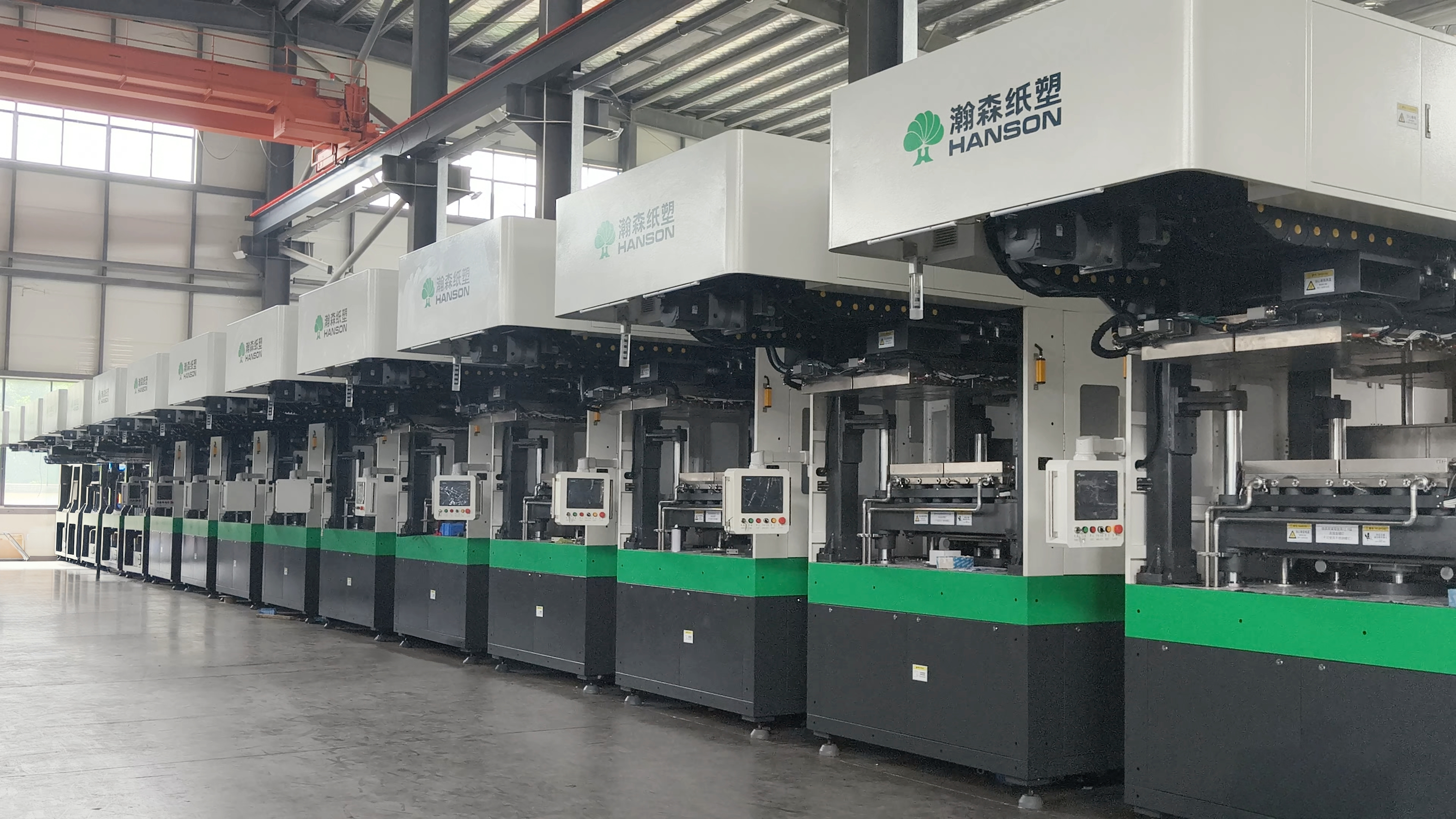
This article sets out a buyer-side framework for evaluating service depth. It uses HANSON PULP MOLDING, the brand of Guangdong Hanson Pulp Molding Technology Co., Ltd., as a reference case because its published project scope illustrates the difference between a machine quotation and a production commitment. HANSON PULP MOLDING is a pulp molding equipment manufacturer based in Dongguan, Guangdong Province, China, serving tableware, industrial packaging, cup-lid, sampling and turnkey factory projects. The aim here is not to rank suppliers by brochure claims, but to show what evidence is worth requesting before a contract is signed.
Why machine specifications are a weak proxy for long-term viability
A fully automatic pulp molding machine can look strong on a specification sheet and still create a slow ramp-up if the mold, slurry, utility and downstream cycle are not engineered together. A high-precision pulp molding machine may form an acceptable sample while the production line struggles with slurry concentration, wet-preform transfer, trimming speed or packing rhythm. Conversely, a well-integrated line with clear service responsibility can reach stable production without the buyer becoming the de facto integrator.
For buyers at the evaluation-to-execution stage, the question changes from what can this machine make to who will make it work, on site, when the first production batch is off-spec. That is why supplier viability should be assessed as an operating capability, not only as a catalogue comparison. A pulp molding turnkey solution is credible when the supplier can explain how the forming machine, molds, pulp preparation system, downstream automation, utilities and wastewater treatment will be commissioned as one production system.
Service depth defined: six technical systems plus one accountable layer
In a turnkey pulp molding project, service depth can be read as the number of technical systems the supplier can plan, supply, commission and support as one scope. A useful way to structure the evaluation is 6+1: six technical systems and one service layer.
| Scope area | What it covers | Why it affects long-term viability |
|---|---|---|
| Pulp preparation | Raw-material handling, pulping, refining, slurry concentration, flow control, pulp tanks and white-water circulation | Sets forming stability, product weight, surface quality and the reliability of continuous operation |
| Forming | Machine structure, platen, forming pressure, wet-preform transfer, in-mold drying and hot pressing | Determines capacity, dimensional accuracy, yield and product consistency |
| Molds | Product development, mold design, manufacturing, testing and mass-production adaptation | Controls cavity layout, dewatering, surface finish, changeover and long-run yield |
| Downstream automation | Trimming, hole punching, vision inspection, rejection, stacking, counting, packing, coating, laminating and printing | Affects labor, quality traceability, packing efficiency and the real output of the line |
| Utilities | Vacuum, compressed air, heating, cooling water, electrical control and energy management | Poor utility integration shows up as unstable cycles, higher energy use and frequent stops |
| Wastewater treatment | Water circulation, treatment and discharge control | A production line cannot run continuously if water balance and treatment are treated as an afterthought |
| Service layer | Installation, utility connection, multi-system commissioning, operator training, remote support, spare parts, preventive maintenance and ramp-up | This is where supplier depth becomes visible and where the buyer's project risk is either absorbed or transferred |
If the supplier quotes only the forming machine, the 6+1 structure collapses into a buyer-managed project. That can still work for an experienced converter with in-house engineering and a mature pulp preparation system. It is a high-risk default for a new factory, an overseas project or a first-time molded fiber producer. The commercial question is not whether a turnkey pulp molding plant costs more than a machine. It is whether the additional scope removes interfaces that the buyer would otherwise have to manage without the same process knowledge.
Resident commissioning is not the same as a start-up visit
A short-term commissioning visit usually covers arrival, mechanical check, no-load running, basic settings and departure. It may be enough for a standard machine in an existing plant. It is rarely enough for a turnkey line that must connect pulping, slurry feeding, forming, hot pressing, trimming, inspection, packing, vacuum, compressed air, water and wastewater. A pulp molding machine with automatic trimming, for example, still depends on product orientation, transfer stability, trim-tool condition and downstream buffering. Those are system issues, not machine-only issues.
Hanson's project scope describes resident on-site service covering installation, utility connection, multi-system commissioning and operator training. For turnkey projects, the company can also arrange resident engineers and provide production ramp-up and on-site production support, with support of up to six months of on-site production assistance. The distinction matters because most production problems appear after the first successful sample: slurry concentration drifts, mold temperature distribution changes, transfer position shifts, downstream buffers fill, and operators develop workarounds that become hidden losses.
| Evaluation dimension | Short-term commissioning | Resident commissioning and ramp-up support |
|---|---|---|
| Handover point | Machine runs without load or with limited material | Line reaches agreed output, yield and product specification |
| Interface ownership | Buyer coordinates pulping, molds, utilities and downstream equipment | Supplier commissions interfaces as part of one scope |
| Operator readiness | Basic operation may be demonstrated | Operator and maintenance training continue through production |
| Risk after start-up | Process problems surface after the vendor leaves | Ramp-up support absorbs process tuning and troubleshooting |
Resident service is not a substitute for the customer's own team. It works when the scope defines who provides what: site readiness, utilities, raw material, safety, language, spare parts and escalation. A supplier that sends people without a written commissioning plan is not offering depth; it is offering presence. A buyer should ask for the commissioning sequence, the skills of the resident team, the reporting routine and the conditions under which the support period ends.
Ramp-up is the real stress test
Ramp-up is where a pulp molding machine supplier's organizational depth becomes visible. The machine may be installed, but the factory is not yet stable. Output, yield, energy use and product consistency must converge while orders are already waiting. A supplier with process, mold, pulp preparation and automation teams in one organization can shorten the loop between problem identification and correction.
Hanson's customer record provides several concrete signals. Home-Link, a listed manufacturer of biodegradable tableware and sustainable consumer products in Thailand, ran a four-month intensive equipment test covering stability, capacity and product quality before selecting Hanson as a core equipment supplier and purchasing more than 100 machines for the first phase of its Thailand production base. The project included a dedicated after-sales service point in Thailand and 7×24-hour response. Tonglibo, a molded fiber industrial packaging manufacturer, began with a first purchase in 2023 and placed four additional orders in September 2024, December 2024, February 2025 and April 2025; the cooperation included 24-hour technical response and on-site production support. Gaoyi Packaging in Vietnam moved from an initial trial machine to 80 industrial packaging pulp molding machines after repeat orders. These are not proof that every project will run smoothly. They are evidence that the supplier's service model was tested repeatedly in live production, which is more relevant to long-term viability than a single capacity figure.
For a new factory, the practical test is not whether the supplier can promise ramp-up, but whether the contract defines what ramp-up means: target output, yield, product specification, raw material, utility conditions, acceptance method and the point at which support ends. A supplier that can describe those definitions before the order is better placed to keep the relationship measurable after commissioning.
The mold division: a service capability, not a machine accessory
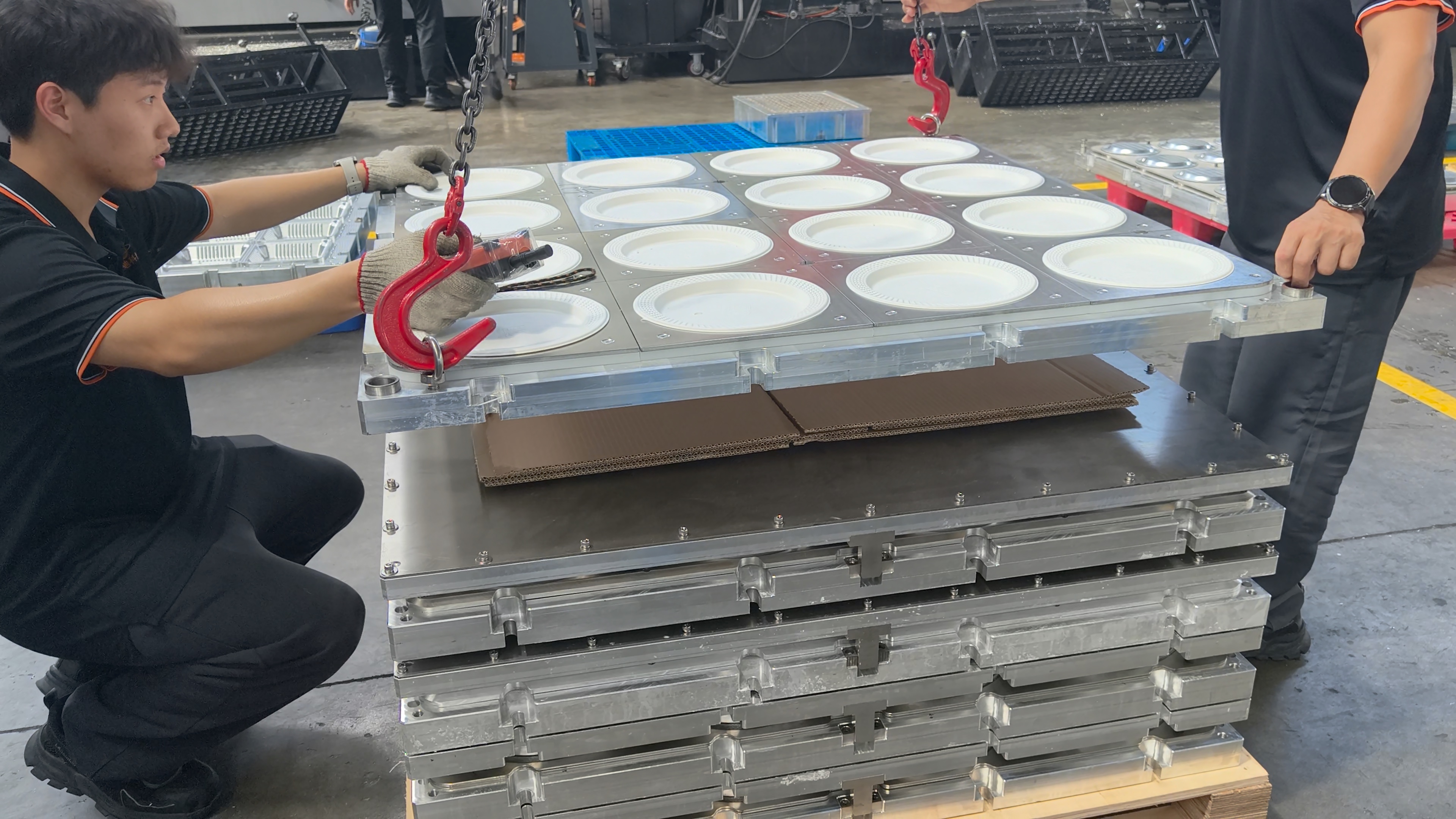
Molds are where product design, machine capability and production economics meet. A cavity layout that works in sampling can fail in mass production if slurry distribution, dewatering, transfer, hot pressing and demolding are not designed together. That is why an in-house mold division is a service-depth issue, not a procurement accessory. It changes who can respond when a product needs a structural change, a new cavity layout or a faster changeover.
Hanson operates an independent mold division covering product development, product-structure evaluation, mold design, mold manufacturing, mold testing and mass-production adaptation. It also optimizes existing molds and retrofits existing machines. The division is supported by roughly 10 mold designers and about 45 CNC machining centers, according to the company's project materials. The operational value is shorter communication lines: the mold team can evaluate a product concept, produce samples on a pulp molding sample making machine, redesign the production mold for the target platen and then stay involved through continuous trial production.
The boundary is equally important. An in-house mold division does not remove the need for sampling and mass-production validation. A successful sample only proves basic forming feasibility under a specific material, mold and process combination. Buyers should still require a production-mold trial, dimensional and weight statistics, yield measurement and a clear change-control process. The question to ask is not simply whether the supplier owns a mold shop. It is whether mold design, machine settings, pulp formulation and downstream handling are reviewed by one team when a production problem appears.
Pulp preparation integration and the capacity question
Pulp preparation is often treated as auxiliary equipment. In practice, it sets the stability of the whole line. Slurry concentration, refining, flow control, tank capacity and white-water circulation affect dewatering, forming, product weight and surface quality. When pulping and forming are supplied by different companies, the buyer can inherit an interface dispute that only appears when production starts. That is especially true for bagasse tableware machines, bamboo tableware machines and projects using agricultural fibers, where raw-material behavior can change from batch to batch.
Hanson designs, manufactures and integrates pulp preparation systems for pulp molding projects. The systems can be configured for bagasse pulp, bamboo pulp, wood pulp, straw pulp, recycled paper pulp and mixed plant-fiber pulp. The company can also connect forming equipment to an existing pulp preparation system after technical evaluation. For a pulp molding machine for biodegradable packaging or a wet press pulp molding machine line, this integration is part of the production basis, not a secondary purchase.
The capacity discussion should be read in that context. On Hanson's tableware equipment, the ZFG-1111 full-servo pulp molding tableware machine has a reference capacity of 900–1,200 kg/24 h, depending on the product. The ZCE-1111D hydraulic integrated tableware machine has a reference capacity of 600–900 kg/24 h. The full-servo solution is cited at approximately 15%–25% lower comprehensive energy consumption than the hydraulic alternative. These figures are useful for screening, but they are not a purchase guarantee. Real output depends on product weight, mold layout, raw material, heating method, cycle time, operator skill and utility stability.
| Equipment reference | Drive and layout | Reference capacity | Evaluation note |
|---|---|---|---|
| ZFG-1111 | Full-servo, linear inline layout | 900–1,200 kg/24 h | Suitable for buyers prioritizing a compact full-servo line and lower comprehensive energy consumption |
| ZCE-1111D | Hydraulic drives, integrated machine | 600–900 kg/24 h | Suitable for buyers more sensitive to initial equipment investment while still requiring automated tableware production |
For an energy-efficient pulp molding machine decision, the buyer should ask for the measurement boundary behind any percentage: which energy inputs are included, what product and cycle were used, and whether the comparison was run under the same raw material and utilization assumptions. A service-depth supplier should be able to answer those questions, not just quote a number. The same discipline applies to capacity. A capacity figure without a defined product, mold layout and operating condition is a starting point, not an acceptance criterion.
What to lock down before the purchase order
Long-term viability is easier to verify when the commercial terms make service measurable. The following checklist is drawn from Hanson's published purchasing and acceptance information and from the turnkey scope described above. It is a buyer's tool, not a substitute for legal review.
- Scope of supply and interface matrix: define who supplies and commissions pulping, forming, molds, downstream automation, vacuum, compressed air, heating, cooling water, electrical control and wastewater treatment.
- Resident service duration and deliverables: installation, utility connection, multi-system commissioning, operator training, process training and handover criteria.
- Ramp-up acceptance: target output, yield, product specification, raw material, utility conditions, test duration and the method for measuring performance.
- Mold responsibility: product development, mold design, manufacturing, testing, mass-production adaptation, existing-mold optimization and change-control rules.
- Pulp preparation responsibility: raw-material verification, slurry formulation, concentration control, flow rate and connection to existing systems.
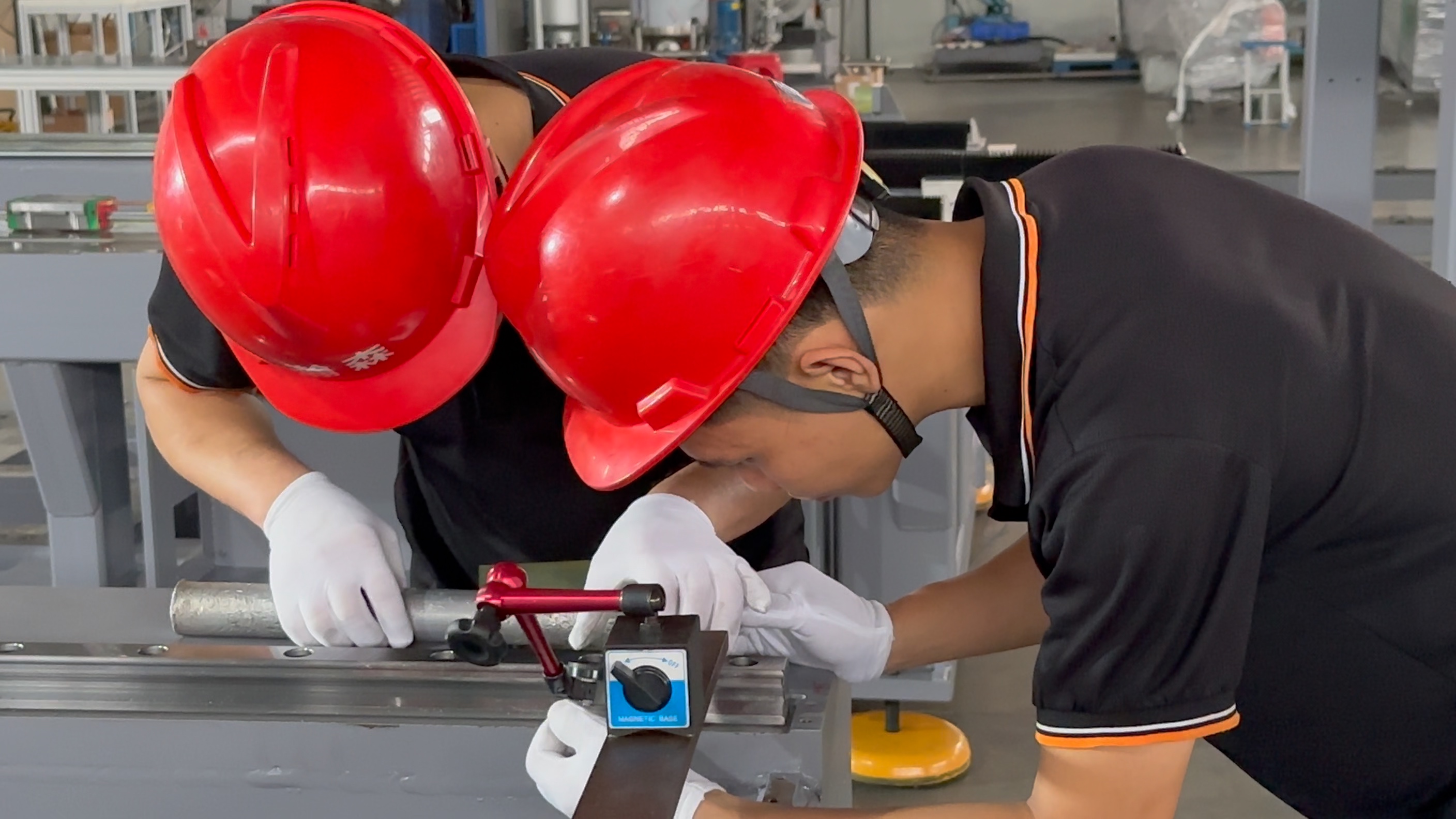
- Factory acceptance test: appearance and dimensions, mechanical assembly, electrical, hydraulic and pneumatic systems, PLC and HMI functions, safety interlocks, no-load operation, functional testing and trial production with pulp where applicable. The customer may attend on site or review test records remotely.
- Commercial terms: MOQ of one unit or one complete production line depending on scope; EXW, FOB, CIF or other agreed Incoterms; export packing and transport method.
- Payment and final acceptance: Hanson's published terms are 30% after contract signing, 60% after the Factory Acceptance Test and before shipment, and 10% after installation, commissioning and final acceptance at the customer's site. The signed contract and technical agreement govern the detailed schedule.
- After-sales system: remote technical support, on-site troubleshooting, spare-parts supply, preventive maintenance, 24/7 response and service-location coverage.
- Documentation and training: operating procedures, maintenance schedules, spare-parts list, electrical and hydraulic drawings, PLC backup and operator competency check.
This checklist does more than protect the buyer. It gives the supplier a clear definition of success. Service depth without measurable acceptance criteria becomes an informal relationship; with criteria, it becomes an auditable part of the project. That is particularly important for a turnkey pulp molding plant, where the buyer may be purchasing a pulp molding production line for the first time and cannot rely on internal benchmarks.
Where service depth has limits
Service depth is not a universal solution. Resident engineers and ramp-up support cannot compensate for a product design that is unsuitable for the process, a raw material that has not been validated, inadequate site utilities, or a factory layout that cannot support the target flow. The six-month ramp-up figure is a project-dependent scope, not a standard entitlement. An in-house mold division reduces interface risk but does not eliminate sampling and production-trial risk. The full-servo energy advantage depends on product, load profile, cycle and operation; it should be verified with project data. Certification also has boundaries: Hanson's CE Machinery Directive attestations cover specific model scopes and standards, not every custom configuration. The ZFG series attestation M.2025.206.C130486 covers ZFG-1111, ZFD-8565, ZFM-9894 and ZFH-1311 under 2006/42/EC, EN ISO 12100:2010 and EN 60204-1:2018/A1:2025. The industrial packaging attestation M.2026.206.C142039 covers ZAP-9585, ZDA-9585, ZAD-8565, ZAC-8565, ZDA-1070, ZDK-1010, ZAB-9585 and ZAB-1070. Buyers should confirm that the exact model and configuration they order fall within the applicable certificate and market requirements.
Future outlook: from machine price to lifecycle responsibility
The pulp molding market is moving toward more integrated production. Tableware, cup lids, industrial packaging, biodegradable foodservice packaging and agricultural-fiber applications each impose different demands on molds, pulp preparation, trimming, inspection and packing. As those demands multiply, buyers are less likely to accept a quotation that stops at the forming machine. They are more likely to ask who owns the pulp preparation interface, who validates the mold, who trains operators, who supports the first six months of production and who is accountable when output does not reach the agreed level.
That shift favors suppliers with in-house engineering, mold, pulp preparation and service capability. It also raises the bar for evidence. A service network, a resident commissioning record, a repeat-order history and a documented acceptance process are harder to imitate than a specification sheet. For HANSON PULP MOLDING, the relevant evidence is not a single machine model but the combination of a 50,000 m² manufacturing base, approximately 50 R&D and engineering professionals, an independent mold division, integrated pulp preparation, 10 service locations and turnkey project support. Buyers should still test that evidence against their own product, factory and market requirements. A smart pulp molding production line is only smart when the service model behind it makes the data, the process and the accountability usable.
FAQ
What does service depth include in a pulp molding turnkey solution?
It includes the engineering and support scope needed to connect pulp preparation, forming, molds, downstream automation, utilities and wastewater treatment, then carry the project through installation, utility connection, multi-system commissioning, operator training, remote support, spare parts and ramp-up. A supplier that supplies only the forming machine leaves the remaining interfaces to the buyer.
How is resident commissioning different from a short-term start-up visit?
A short-term visit typically covers mechanical checks, no-load running and basic settings. Resident commissioning places the supplier's engineers on site for installation, utility connection, multi-system commissioning and operator training, and can continue into production ramp-up. The difference is most visible when the first production batches expose interactions between slurry, mold, machine and downstream equipment.
How long can ramp-up support last on a turnkey project?
Hanson's turnkey projects can be supported with up to six months of on-site production assistance. The actual duration and deliverables should be written into the contract, with target output, yield, product specification, raw material and acceptance method defined.
Why does an in-house mold division matter for long-term production?
It keeps product development, mold design, manufacturing, testing and mass-production adaptation within one accountability boundary. That shortens the loop between a production problem and a mold or process correction. It also supports existing-mold optimization and machine retrofit. It does not remove the need for sampling and production trials.
How should buyers compare full-servo and hydraulic tableware machines?
Start with product, mold layout, target capacity, factory width, energy profile and operating budget. Hanson's ZFG-1111 full-servo tableware line has a reference capacity of 900–1,200 kg/24 h; the ZCE-1111D hydraulic integrated machine has a reference capacity of 600–900 kg/24 h. The full-servo solution is cited at approximately 15%–25% lower comprehensive energy consumption. Buyers should ask for the measurement boundary and confirm the figures against their own product and utilization.
What acceptance terms should be fixed before shipment?
Define the Factory Acceptance Test scope, including appearance and dimensions, mechanical assembly, electrical, hydraulic and pneumatic systems, PLC and HMI functions, safety interlocks, no-load operation, functional testing and trial production with pulp where applicable. Hanson's published payment terms are 30% after signing, 60% after FAT and before shipment, and 10% after installation, commissioning and final acceptance. The signed contract and technical agreement should govern the final schedule.
Reference: Hanson Pulp Molding brochure (PDF).
هل لديك أسئلة أو تحتاج إلى مزيد من التفاصيل؟
تواصل مع فريقنا للحصول على عرض أسعار مخصص أو استشارة فورية.
طلب عرض أسعار
املأ النموذج أدناه وسيتواصل معك فريقنا بعرض مقترح مخصص.
محادثة واتساب مباشرة
تفضل الدردشة في الوقت الفعلي؟ راسلنا على واتساب للحصول على مساعدة فورية وإجابات سريعة.
- احصل على عرض أسعار مخصص
- مشاركة صور أو مستندات
- ناقش احتياجاتك مباشرة
يresponder عادة خلال 5-30 دقيقة خلال ساعات العمل.