
Pulp Molding for New Factories: How a Turnkey Line Fits Packaging Projects
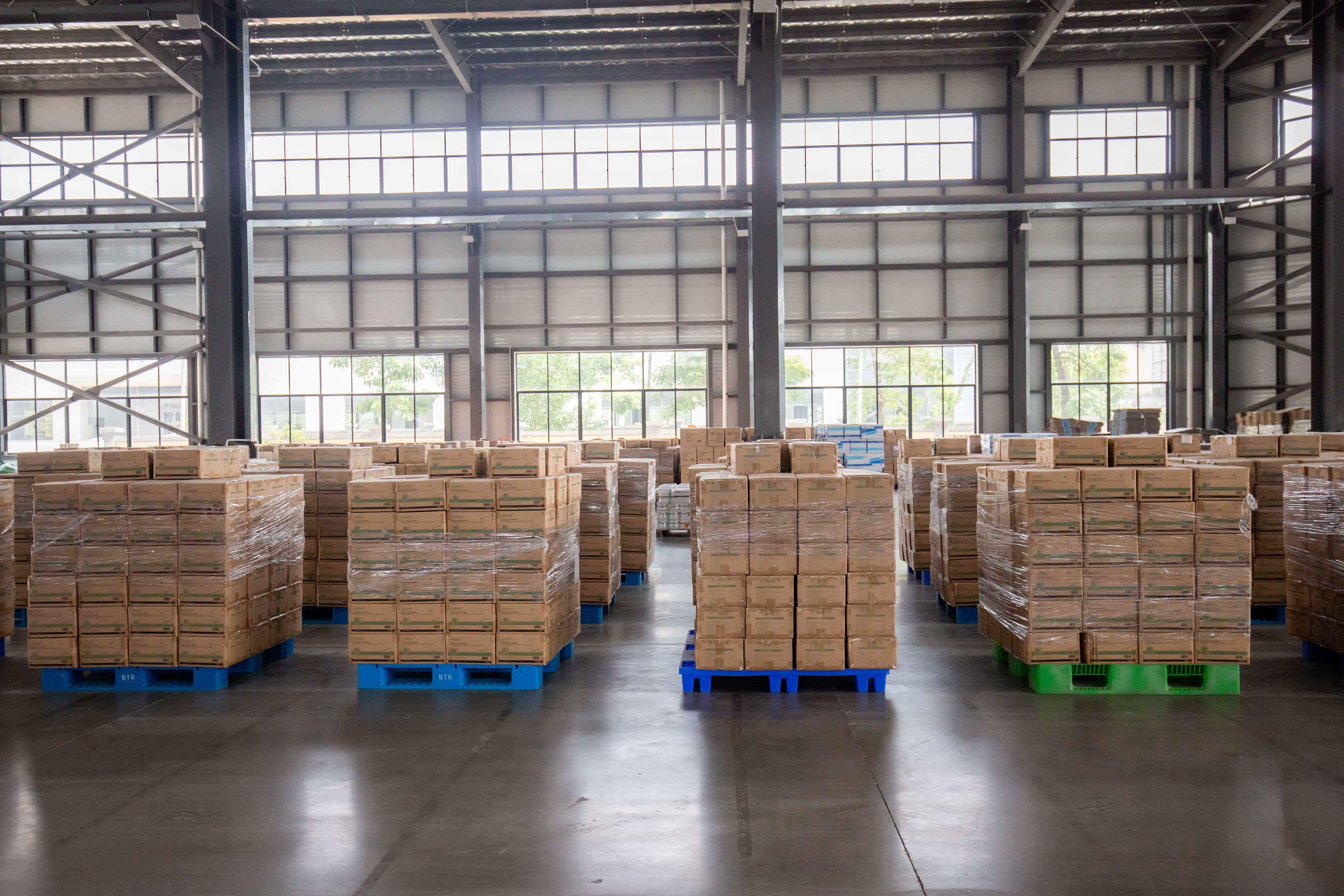
Staging and warehousing inside a pulp molding equipment factory: new-build industrial packaging projects depend on equipment, molds and utility systems arriving as one coordinated package.
Pulp Molding for New Factories: How a Turnkey Line Fits Packaging Projects
Industrial packaging is the segment where molded fiber capacity is most often built from zero rather than expanded from an existing base. A buyer entering this segment usually starts with a product — a protective insert, a tray, a corner block or a cushioning structure for electronics, appliances or consumer goods — and then discovers that the forming machine is only one of several systems that must agree with each other before a commercially acceptable part leaves the line.
Pulp molding, in that context, is better understood as a process than as a product category. A complete route includes raw-material handling, pulping, refining, slurry preparation and feeding, forming, wet-preform transfer, in-mold drying, hot pressing, trimming, inspection, stacking and packing, together with the vacuum, compressed-air, heating and water-circulation systems that keep these stages synchronized. For a new plant, the practical decision is which organization owns the interfaces between those systems, and whether that ownership is defined before civil works, installation and commissioning begin.
Why New-Build Projects Break at the Interfaces, Not the Machines
A new factory has no operating baseline to fall back on. There is no mature pulping line to which a forming machine can simply be bolted, no process team that already knows the slurry behaviour of the chosen fiber, and no historical yield data to compare against when output misses target. Every interface is open at the same time: slurry concentration, flow rate, pipeline routing, tank sizing, white-water circulation and machine production rhythm all have to be decided by someone.
This is where fragmented procurement creates cost that rarely appears in a quotation. When the pulping section and the forming section are supplied by different companies, the customer must coordinate process parameters, control interfaces and system commissioning between them. When equipment, molds, pulping, automation and utilities come from separate suppliers, the customer must also identify which supplier is responsible before a system-level problem can be solved at all. Responsibility identification, not repair work, is often the slowest part of a difficult ramp-up.
Downstream automation shows the same pattern in a more visible form. If trimming, inspection, stacking or packing equipment has a lower processing capacity than the main machine, products accumulate downstream and eventually force the main machine to slow down or stop. If downstream equipment runs faster but conveying, positioning and buffering are poorly designed, the line may still suffer misalignment, collisions, missed inspections and packing errors. Downstream automation therefore has to be designed against the complete line cycle, not against the theoretical speed of an individual machine.
There is also a qualification risk specific to new plants. Successful sampling only proves that a product has basic forming feasibility under a specific combination of material, mold and process parameters; it does not mean mass-production validation is complete. A production machine may have a different platen size, mold layout, slurry-feeding method, production cycle, temperature distribution and wet-preform transfer system. Projects that move from a sample straight to a production mold without a manufacturability evaluation and a continuous production trial tend to discover that gap after the capital has been committed.
What a Turnkey Scope Actually Covers in a New Plant
Hanson's turnkey pulp molding factory solution is organized as six service modules plus one development module under a single integrated project interface:
- Factory planning
- Pulp preparation
- Forming equipment
- Mold manufacturing
- Downstream automation
- Technical and production support
- Plus one: product development, raw-material development, sampling and small-batch validation
The scope matters because it changes who owns the process variables. Hanson designs the pulp preparation system together with the forming equipment, molds, slurry feeding, automation, utilities and production process, so slurry concentration, flow, pipelines, tanks, white-water circulation and machine production rhythm can be coordinated by one engineering team rather than negotiated between vendors.
HANSON PULP MOLDING TECHNOLOGY CO., LTD. (Guangdong Hanson Pulp Molding Technology Co., Ltd.) is a National High-tech Enterprise that manufactures pulp molding equipment, production lines and turnkey factory solutions from Houjie Town, Dongguan City, Guangdong Province, China. The company operates a 50,000 m² facility with more than 200 employees, including approximately 50 R&D and engineering professionals, holds 50 patents covering equipment structures, production processes, automation systems and related technologies, and reports an annual output of around 150 units of pulp molding equipment. Export business accounts for 50% of total sales, and the company has established 10 service locations worldwide, serving customers including listed companies, state-owned enterprises and leading packaging manufacturers. Named customer references include Home-Link, Shengquan Group, Anhui Fengyuan, Guangxi Qiaowang, Gaoyi Packaging, YUTO, Yongfa Printing, Solenis and Sichuan Jinzhu, which is controlled by Wuliangye.
For an industrial packaging project, the parts of that scope that carry the most weight are usually pulp preparation, mold manufacturing and downstream automation, because those three determine whether cushioning performance, dimensional accuracy and surface quality can be repeated shift after shift rather than achieved once during commissioning.
Technical Explanation: Pulping, Vacuum, Heat, Water and Rhythm as One System
Integrated process design allows pulping, slurry circulation, water use, vacuum, compressed air and production rhythm to be optimized as one system. That sentence is easy to write and hard to deliver, because each of those sub-systems normally has its own engineering logic. Vacuum sizing follows dewatering time, compressed air follows transfer and blow-off demand, heating follows hot-pressing temperature and cycle, water circulation follows slurry concentration and cleaning intervals, and the production rhythm follows all of them simultaneously.
Slurry feeding is a useful example of where the interfaces sit. Hanson's precise slurry-feeding design uses quantitative feeding, continuous feeding or dynamic slurry replenishment according to equipment and product requirements, and the internal-circulation design reduces the need for slurry to travel through long external return pipelines. On that specific metric, Hanson's no-return design uses 0 external return-slurry loops, while a conventional return-slurry system uses at least 1. The operational consequence is fewer external slurry-return interfaces to inspect and clean, and a slurry supply that can be coordinated with the actual forming rhythm — relevant for products that need stable weight, clean surfaces and consistent wet-preform formation.
Energy performance is usually discussed with more confidence than the underlying data supports, so it helps to separate two measurement bases. On one basis, Hanson's full-servo solution can reduce comprehensive energy consumption by approximately 15%–25% compared with traditional solutions under comparable product and operating conditions. On a narrower internal comparison basis covering power plus drying energy, Hanson's range of approximately 2,000–2,300 kWh per ton of finished product is compared with approximately 2,500–2,800 kWh per ton for the benchmark solution — a reduction of roughly 200–800 kWh per ton, or approximately 19% at the midpoint of the two ranges. Both figures depend on the product, process and operating conditions, and neither should be treated as a guaranteed outcome for an unspecified product mix.
Control and safety architecture belongs to the same design conversation. The risk set for a pulp molding line includes mechanical pinch and crushing hazards, moving parts and robotic transfer hazards, hot surfaces and overheating, electrical faults, abnormal pressure or vacuum, equipment overload, material leakage and unexpected startup. Documented control measures include PLC safety interlock control, safety-door interlocks, an emergency stop system, overload protection, overcurrent and phase-loss protection, overtemperature alarm with automatic shutdown, pressure and vacuum monitoring, fault alarm and shutdown, safety fencing, and light curtains with guarded moving parts, supported by risk assessment, standard operating procedures, operator safety training, installation and commissioning inspection, electrical system testing and trial operation before delivery.
Regulatory timing makes this a design-stage issue rather than a service item. Safety-related parts of machinery control systems must comply with EN ISO 13849-1, and the previous 2015 version of that standard will be withdrawn after a transition period ending 15 May 2027. A new plant specifying its control system today can build the compliant architecture into the original design; a plant that defers the question will be modifying a commissioned line.
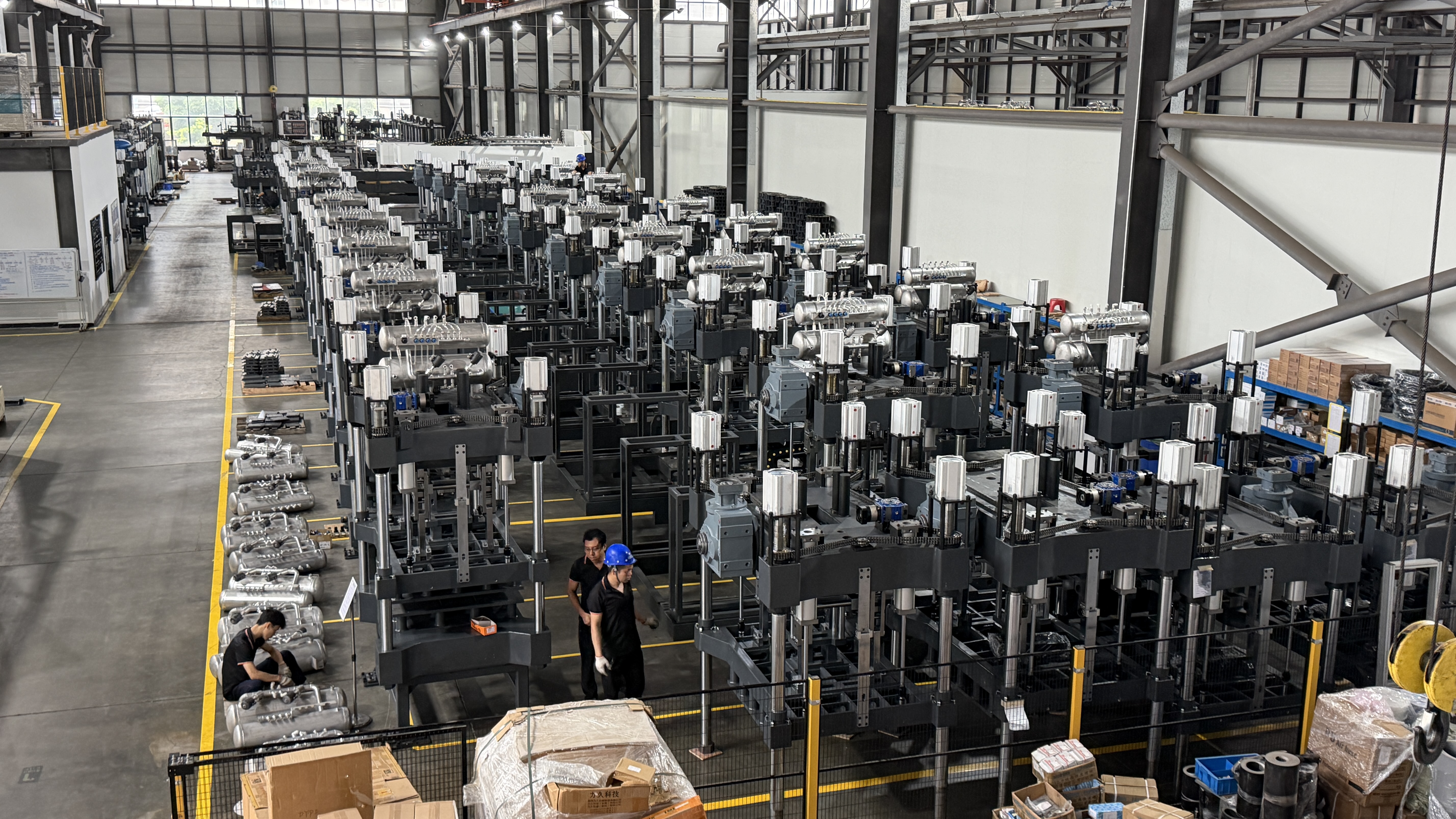
Equipment assembly workshop: forming, pulp preparation and downstream modules are built and tested under one manufacturing roof before shipment to a new factory site.
Choosing the Forming Platform and Mold System for Industrial Packaging
Automation is not the output of a control philosophy that treats every product as a data point to be re-planned each time demand shifts. In a new plant, the forming platform has to be selected against the actual product envelope, and the envelope is defined by physical limits that mold changes cannot move.
| Parameter | ZAD-8565D | ZAP-9585D |
|---|---|---|
| Platen size | 850 × 650 mm | 950 × 850 mm |
| Forming pressure | 3 tons | 10 tons |
| Hot-pressing pressure | 20 tons | 40 tons |
| Maximum product height | 100 mm | 120 mm |
| Maximum product weight per mold | 500 g | 900 g |
| Typical fit | Small and medium-sized premium industrial packaging; relatively compact machine footprint | Larger, deeper or heavier premium industrial packaging; complex structures requiring higher forming pressure |
Both machines integrate forming, wet-preform transfer, in-mold drying and hot pressing, and both use automatic slurry feeding and dynamic slurry replenishment. The boundary that buyers most often underestimate is this: machine compatibility is limited by mold platen dimensions, maximum product height, maximum product weight per mold, forming pressure, hot-pressing pressure, transfer structure and downstream equipment, and changing the mold does not change those fundamental capabilities. A new plant should not select a line on the assumption that a later product change can extend it beyond the platform it was purchased on.
Process route selection carries the same constraint. Wet-press processes are generally more suitable for tableware, cup lids and premium industrial packaging that require better appearance, dimensional accuracy, surface quality and product consistency, and they demand higher mold accuracy, transfer stability and hot-pressing control. A hybrid dry-wet process is suitable for products that require both cushioning performance and improved surface quality or dimensional accuracy. The hybrid route is not simply a matter of placing two machine types together — it requires line planning, mold design, process coordination and equipment integration to be designed as one system.
Mold capability is the second half of that decision. Hanson operates an in-house mold division with approximately 10 experienced mold designers and access to about 45 CNC machining centers, including coordinated external machining capacity. Under a fully outsourced mold model, the equipment supplier has 0 in-house mold designers and 0 in-house machining capacity. The practical difference is engineering control over mold design, machining, testing, equipment adaptation and production optimization — and proper mold design improves dewatering, heating uniformity, vacuum distribution, product transfer and cycle stability, which indirectly supports lower energy consumption.
Which Industrial Packaging Projects Fit the Integrated Model
Premium industrial packaging in a first-time facility. A buyer building a new plant for electronics, cosmetics or consumer-goods packaging typically needs both surface quality and dimensional consistency on the first production order. The integrated route is suitable for new factories, turnkey projects, multiple-fiber applications and customers requiring unified process control, and it can include resident engineers during installation, utility connection, multi-system commissioning, process coordination, trial operation, operator training and project acceptance.
Cushioning and structural packaging with mixed requirements. Where a product needs both protection and a better surface finish than conventional dry pressing provides, the hybrid dry-wet route becomes relevant, and that route depends on stronger capability in line planning, mold design, process coordination and equipment integration.
Overseas projects entering the industry for the first time. These projects have the least internal process knowledge and the highest interface count, which is exactly where a single project team for pulping, forming, molds, automation and utilities reduces coordination load. Where the project is contracted as turnkey, production ramp-up support can extend up to six months depending on the project agreement, covering pulp formulation adjustment, forming-parameter optimization, defect analysis, production-rhythm improvement, mold adaptation and operator coaching. Whether that support is included is a contractual question, not a technical default.
Line balancing before purchase, not after. New plants should balance the complete line against maximum target output, calculate products per mold, main-machine cycle and products per minute, include conveying, positioning, inspection, rejection, stacking and packing time in that calculation, add buffering between critical processes, standardize machine communication interfaces and control logic, reserve downstream capacity margin, and run continuous testing with actual products rather than no-load testing alone.
Market Trend Analysis: Capacity Growth, Definitional Noise and Regulatory Timing
The global pulp moulding machines market was valued at USD 2,140.0 million in 2024 and is projected to reach USD 3,760.2 million by 2032, expanding at a CAGR of 7.3% between 2025 and 2032, according to a Cloud Market Reports pulp moulding machines market study. That figure should be read alongside a definitional caveat: published estimates differ significantly because some reports include all paper-making machinery under the broader equipment code, producing values above USD 2 billion, while reports scoped specifically to molding machines suggest a range of roughly USD 600–800 million. Buyers using market data for capacity planning should check what the estimate actually covers before treating it as a demand forecast.
Application structure is more stable across sources. Food and beverage packaging accounts for approximately 45% of global demand for pulp moulding machines, with cup, tray and bowl formats leading. Industrial packaging sits beside that volume rather than beneath it, and it is the segment where process precision, mold capability and downstream automation determine whether a new entrant can serve brand-owner requirements at all.
Trade data adds a second reference point with its own scope caveat. China's exports under HS 843920 — machinery for making paper or paperboard, a code that covers more than pulp molding machines — were valued at USD 49.58 million in 2024 according to the World Integrated Trade Solution. Equipment sourcing for new plants is therefore internationally distributed, but the trade code is too broad to be used as a proxy for pulp molding equipment alone.
The regulatory trend is more precise than either dataset. Safety-related parts of machinery control systems must comply with EN ISO 13849-1, and the 2015 version will be withdrawn after a transition period ending 15 May 2027. For a new-build industrial packaging plant, that date falls inside the expected service life of control hardware specified in 2026, which raises the value of designing the safety architecture at project stage rather than treating it as a later upgrade.
Turnkey Integration vs Separate Procurement: Comparison and Boundaries
| Dimension | Integrated turnkey scope | Separate equipment procurement |
|---|---|---|
| Interface ownership | One lead interface across seven project scopes, from factory planning to production support | Customer coordinates equipment, molds, pulping, automation and utilities suppliers |
| Process optimization | Pulping, vacuum, compressed air, heating, water circulation and production rhythm optimized as one system | Energy efficiency depends on interface design, control coordination and final commissioning quality |
| Troubleshooting | One project team can coordinate pulping, forming, molds, automation and utilities | Customer may need to identify the responsible supplier before solving a system-level problem |
| Cost structure | May carry a higher total contract value; reduces repeated engineering, interface modification, multi-supplier coordination and delay risk | Allows price comparison per individual machine; integration, modification and management costs may arise during implementation |
| Best fit | New factories, large-scale projects, overseas projects and buyers without an experienced pulp molding engineering team | Experienced manufacturers with mature pulping, process, engineering and project-management capability |
Three boundaries deserve to be stated plainly. First, an integrated scope is not automatically the cheaper option: a turnkey project may have a higher total contract value, and the savings appear in reduced repeated engineering, interface modification and coordination effort rather than in the equipment line item. Second, concentration creates dependency — one lead interface means the customer's ability to escalate is tied to one organization's engineering capacity. A manufacturer that already operates a mature central slurry system and stable utilities may get more flexibility from adding forming equipment only.
Third, integration does not remove physical limits. Platen size, maximum product height, maximum product weight per mold, forming and hot-pressing pressure, transfer structure and downstream equipment define what a platform can produce, and a mold change will not extend those capabilities. Projects that expect a single line to cover tableware, cup lids and heavy industrial packaging simultaneously are usually better served by a technical evaluation than by a broader scope commitment.
Future Outlook
The direction of travel for new-build industrial packaging capacity is toward fewer interfaces rather than more machines. Pulping, forming, molds and downstream automation are increasingly evaluated as one production system, and the equipment decisions that matter most are the ones made before installation: how slurry reaches the mold, how vacuum and heat are sized against the cycle, how the water loop is closed, and how the safety architecture is specified against the current standard version.
Two practical consequences follow for buyers planning plants in 2026 and beyond. Market-size estimates will keep varying by source and scope, so procurement teams should treat them as context rather than capacity justification. And production support will continue to matter more than installation alone: standard after-sales service restores equipment function through troubleshooting, maintenance, spare parts and remote technical support, while production ramp-up support addresses whether the complete process is achieving target product quality — a distinction that determines how long a new plant takes to reach stable output.
FAQ
What does a complete pulp molding line require beyond the forming machine?
A complete line normally requires raw-material storage and conveying, a pulping system, slurry treatment and preparation, pulp tanks and slurry pipelines, a vacuum system, forming equipment, a wet-preform transfer system, a drying system, hot-press reshaping equipment where the product requires it, trimming or hole-punching equipment where required, automatic stacking, automatic packing, a compressed-air system, a water-circulation system, an electrical control system, workshop energy and environmental management, molds, and installation, commissioning and personnel training. Product families such as egg trays, egg cartons and cup carriers are all common dry-press products, but their structures, basis weights, drying requirements, post-processing methods and packing formats differ, so they should not automatically use the same standard configuration.
Should a new factory buy individual machines or a complete turnkey solution?
A turnkey solution is generally recommended for new factories, overseas projects and customers without an experienced pulp molding engineering team. Individual machine procurement is more suitable for experienced manufacturers that already operate mature pulp preparation, process, utility and production-management systems — for example when the project is only a capacity expansion or a machine replacement. A turnkey project can include factory planning, pulp preparation, forming equipment, molds, downstream automation, electrical control, energy management, wastewater treatment, installation, commissioning, operator training and production ramp-up support.
How can a buyer verify that a supplier is an equipment manufacturer rather than a trading company?
Verification focuses on where the engineering and manufacturing actually happen. Buyers can inspect the supplier's manufacturing and assembly facility, confirm whether the supplier has its own mechanical, electrical, process and mold teams, review similar customer projects and operating equipment, check whether molds and pulp preparation systems are produced or fully outsourced, define the supply scope and responsibility boundaries in writing, confirm which party is responsible for molds, pulp preparation, utilities and downstream automation, require factory acceptance testing before shipment, and verify the spare-parts and after-sales support system. The underlying risk is a supplier that can sell a main machine but does not control its own manufacturing, mold, process or system-integration capability.
Does the equipment supplier design and manufacture its own pulp preparation systems?
Hanson designs, manufactures and integrates pulp preparation systems for pulp molding projects. Depending on the project, the system may include raw-material preparation, pulping, refining, slurry preparation, pulp concentration control, flow control, pulp tanks, pipelines, slurry feeding and white-water circulation, and it can be designed for bagasse pulp, bamboo pulp, wood pulp, straw pulp, recycled paper pulp and mixed plant-fiber pulp. Forming equipment can also be evaluated for connection to a customer's existing pulp preparation system, subject to the customer providing process flow, pulp concentration, flow rate, tank capacity, pipeline interfaces and control information. Pulp preparation directly affects slurry concentration, drainage, forming stability, product weight and surface quality, which is why integrated design reduces interface problems between the pulping and forming sections.
What are the purchasing terms and acceptance criteria for a pulp molding line?
MOQ is 1 unit or 1 complete production line, depending on the product and project scope. Delivery terms can be arranged as EXW, FOB, CIF or other agreed Incoterms according to destination and the signed contract, with export packing and delivery by sea, land or multimodal transportation. Acceptance is based on pre-shipment inspection and a Factory Acceptance Test, which may cover equipment appearance and dimensions, mechanical assembly, electrical systems, hydraulic and pneumatic systems, PLC and HMI functions, safety interlocks, no-load operation, functional testing, and trial production with pulp where applicable. Customers may attend the FAT on site or review results remotely through videos, photographs, test records and online meetings. Payment terms by T/T are typically 30% deposit after contract signing, 60% after the Factory Acceptance Test and before shipment, and 10% after installation, commissioning and final acceptance at the customer's site, subject to the signed contract and technical agreement.
How long does production ramp-up support last, and how does it differ from standard after-sales service?
Turnkey projects can receive up to six months of production ramp-up support, depending on the project agreement. Ramp-up support continues after the machine is operational and focuses on helping the customer reach stable qualified production, covering pulp formulation adjustment, forming-parameter optimization, defect analysis, production-rhythm improvement, mold adaptation and operator coaching. Standard after-sales service focuses mainly on equipment troubleshooting, maintenance, spare parts and remote technical support, and is provided according to equipment condition and service requests. The difference is that ramp-up support covers both equipment and production-process problems, while standard service normally addresses whether the equipment is operating correctly.
Can existing molds be optimized, or an existing machine retrofitted, instead of replacing the line?
Hanson can evaluate existing mold layout, dewatering structure, vacuum distribution, hot-pressing structure, transfer performance and demolding conditions, and can assess whether an existing machine can be modified to improve production rhythm, mold compatibility, transfer stability, pressure control or new-product capability. Existing-mold optimization may address low capacity, unstable product weight, deformation, dimensional deviation, poor surface quality, low dewatering efficiency, long hot-pressing cycles and unstable demolding, and in some cases may improve production performance without replacing the complete line. Customers should provide mold drawings, product samples, machine model, current production cycle, capacity, yield rate, process parameters and photographs or videos of the production problem. A mold supplied by the customer can also be used, subject to a technical evaluation of mold dimensions, interfaces, transfer structure and machine compatibility.
Reference
Hanson Pulp Molding equipment and turnkey project brochure (PDF): https://cdn.socialarks.com/sbsp/25100/common/2026/0722/Hanson%20Pulp%20Molding.pdf | Company website: www.hspulpmolding.com