
Pumpkin Seeds Long-Term Supply: Grades, Moisture, Storage
Industry Reference · Pumpkin Seed Procurement
A pumpkin seed specification is only as valuable as its repeatability. Buyers entering a multi-season supply agreement are not approving a single tested sample; they are approving an expectation that the fifth container behaves like the first on grade, moisture, purity, packaging and storage.
That distinction matters more than it once did. China's total pumpkin seed production was projected at 400,000 tons in 2024, a 40% increase from 280,000 tons in 2023, according to Seedea's Pumpkin GWS Market Update. Availability is not the bottleneck for most buyers. Consistency between shipments is.
This reference examines how a pumpkin seed buyer — a snack manufacturer, a roasting operation, an importer or a distributor — can evaluate a supplier for the long term rather than for one transaction. It covers grade availability (A, AA, AAA), variety differences including Snow White, Shine Skin and Lady Nail, the measurable quality checks that belong in a contract, and the packaging and storage conditions that determine whether a specification survives the journey.
Why One Good Sample Does Not Predict a Season
A sample is a statement about a small, selected quantity at a specific moment. A supply agreement is a statement about future harvests, future processing runs and future shipping conditions. The gap between the two is where most pumpkin seed quality disputes originate.
There are three structural reasons for that gap. First, pumpkin seeds are an agricultural input, so colour, size distribution and defect levels move with the crop. Second, sorting and cleaning are process steps, not product properties — a supplier that changes its sorting intensity between orders can hold the same grade name while delivering a different physical result. Third, moisture and defect limits are only as stable as the storage conditions behind them, and storage is where buyer and supplier responsibilities meet.
A practical evaluation therefore asks a different question from a sample review. Instead of "is this shipment good?", the buyer asks: which parameters does this supplier control, with what method, and how would I know if they drifted?
What Grade Labels Actually Specify
In the pumpkin seed trade, A, AA and AAA are sorting classifications. In declared product data for Shine Skin pumpkin seed kernels, the three grades share an identical technical platform — raw specification, 2026 crop year, moisture 9–10%, impurity below 0.5%, erosion seeds below 0.5%, mildew seeds below 1%, origin Xinjiang and Inner Mongolia, and cool-place storage — while differing mainly in kernel colour: AAA is described as dark green, AA as green, and the A/AA/AAA range as green.
| Declared grade | Kernel colour (declared) | Shared declared limits | What the buyer must add |
|---|---|---|---|
| AAA | Dark green | Raw, 2026 crop, moisture 9–10%, impurity <0.5%, erosion <0.5%, mildew <1% | Size band and uniformity tolerance |
| AA | Green | Same limits | Colour tolerance and defect sampling method |
| A / AA / AAA range | Green | Same limits | Split ratio permitted within the grade |
Source: first-party product specification data for Shine Skin pumpkin seed kernels; grade-level colour descriptions as declared.
Because grade differences appear mainly in colour within the declared data, buyers should treat a grade label as a sorting and appearance descriptor rather than a laboratory certificate. Published third-party references add size context: AAA Grade Shine Skin kernels are typically listed in 10–11 mm or 8–10 mm bands with low moisture (TradeIndia product data). That reference is useful for orientation but should be confirmed against the supplier's own written specification, since commercial size conventions vary between origins and seasons.
For long-term agreements, the correct use of a grade is as a shorthand attached to a fully written specification. "AAA" alone transfers very little risk to the supplier. "AAA, size band confirmed in writing, moisture 9–10% at loading, impurity below 0.5%, erosion below 0.5%, mildew below 1%, sampled per agreed method" transfers a great deal.
The Four Measurable Checks: Moisture, Impurity, Erosion, Mildew
Four parameters do most of the work in a repeatable pumpkin seed specification. They are fast to test, they are comparable between shipments, and each maps onto a different failure mode.
| Parameter | Declared value | Why it belongs in the contract |
|---|---|---|
| Moisture | 9–10% | Fast to measure at receiving and directly tied to how the lot behaves in storage and in the roaster. Also the parameter most likely to be quoted differently between published references. |
| Impurity | Below 0.5% | Drives cleaning load on the buyer's line. Snack manufacturing applications commonly specify impurity control as a process requirement. |
| Erosion seeds | Below 0.5% | Visual and handling quality; affects sortation yield and finished appearance. |
| Mildew seeds | Below 1% | The defect limit most closely watched by food safety and quality teams, and the one that most often triggers a receiving dispute. |
Source: first-party specification data for Shine Skin pumpkin seeds and kernels, 2026 crop.
Note where the market does not agree. One published product reference for AAA Grade Shine Skin kernels lists a maximum moisture of 8%, while the declared specification here is 9–10% (Agroland Food specifications). Neither number is inherently wrong; they describe different commercial positions and possibly different measurement conventions. The practical lesson for long-term buying is that a moisture figure taken from a directory listing is not an acceptance criterion. The figure written into the contract is.
Buyers should also separate appearance limits from safety limits. Grade and defect tolerances do not, by themselves, demonstrate compliance with aflatoxin requirements. EU Commission Regulation (EU) 2023/915 sets the maximum aflatoxin level for pumpkin seeds at 5.0 μg/kg for the sum of B1, B2, G1 and G2. That is a laboratory result, not a sorting outcome, and it belongs in a separate clause supported by a separate test.
Variety Selection: Snow White, Shine Skin and Lady Nail
Variety choice is a project decision, not a quality decision. All three main Chinese pumpkin seed varieties in declared data are white in colour with a sweet, natural taste, moisture 9–10%, impurity below 0.5%, erosion seeds below 0.5% and mildew seeds below 1%. What separates them is size band and the product form in which they are offered.
| Variety | Declared size bands | Declared specification | Declared application |
|---|---|---|---|
| Snow White Pumpkin Seeds | 15 cm+, 13 cm+, 11 cm+ | Raw, white, sweet and natural, moisture 9–10%, impurity <0.5%, erosion <0.5%, mildew <1%, cool storage | Manufacturing, roasted shop |
| Shine Skin Pumpkin Seeds | 11 cm+, 8–10 mm+, under 8 mm | Same platform; 20/25 kg plastic or paper bag | Manufacturing, roasted shop |
| Lady Nail Pumpkin Seeds | 10 cm+, 7–10 mm+, under 7 mm | Same platform; Inner Mongolia origin designation | Manufacturing, roasted shop |
Source: first-party product specification data for Snow White, Shine Skin and Lady Nail pumpkin seeds.
Market structure adds a supply-planning dimension. Shine Skin accounted for roughly 74% of China's 2024 pumpkin seed production, or about 294,000 tons, while Snow White and Lady Nail each accounted for around 12%, estimated at 46,000 and 52,000 tons respectively (Everstar Foods industry report). A buyer standardising on the dominant variety has broader substitution options in a short crop. A buyer standardising on Snow White or Lady Nail is choosing a narrower, more distinctive position — which is precisely why the supplier relationship matters more in that scenario.
Packaging as a Continuity Variable
Packaging is frequently treated as a logistics detail and then becomes the reason a multi-year specification fails. Declared packaging options for pumpkin seed products include 20 kg or 25 kg plastic or paper bags for whole seeds, and vacuum bags with cartons for Shine Skin pumpkin seed kernels. The product data also confirms an OEM/ODM capability: bags can be printed with the customer's logo.
For long-term buyers, packaging decisions lock in three things: the handling profile at the buyer's plant, the number of times the product is exposed to ambient humidity, and the traceability of a batch once it enters the warehouse. Vacuum formats with cartons suit kernel programmes where oxidation and moisture uptake are the primary concern; plastic or paper bags at 20–25 kg suit whole-seed roasting lines where standard handling and palletisation are already established.
Commercial terms are part of the same question. Declared capability data for the Inner Mongolia supply base includes a minimum order quantity of 5 metric tons, a lead time of 10–15 days and a monthly capacity of 2,500 metric tons. Those numbers determine how a buyer schedules repeat orders and how much buffer stock is required to absorb a peak-season delay.
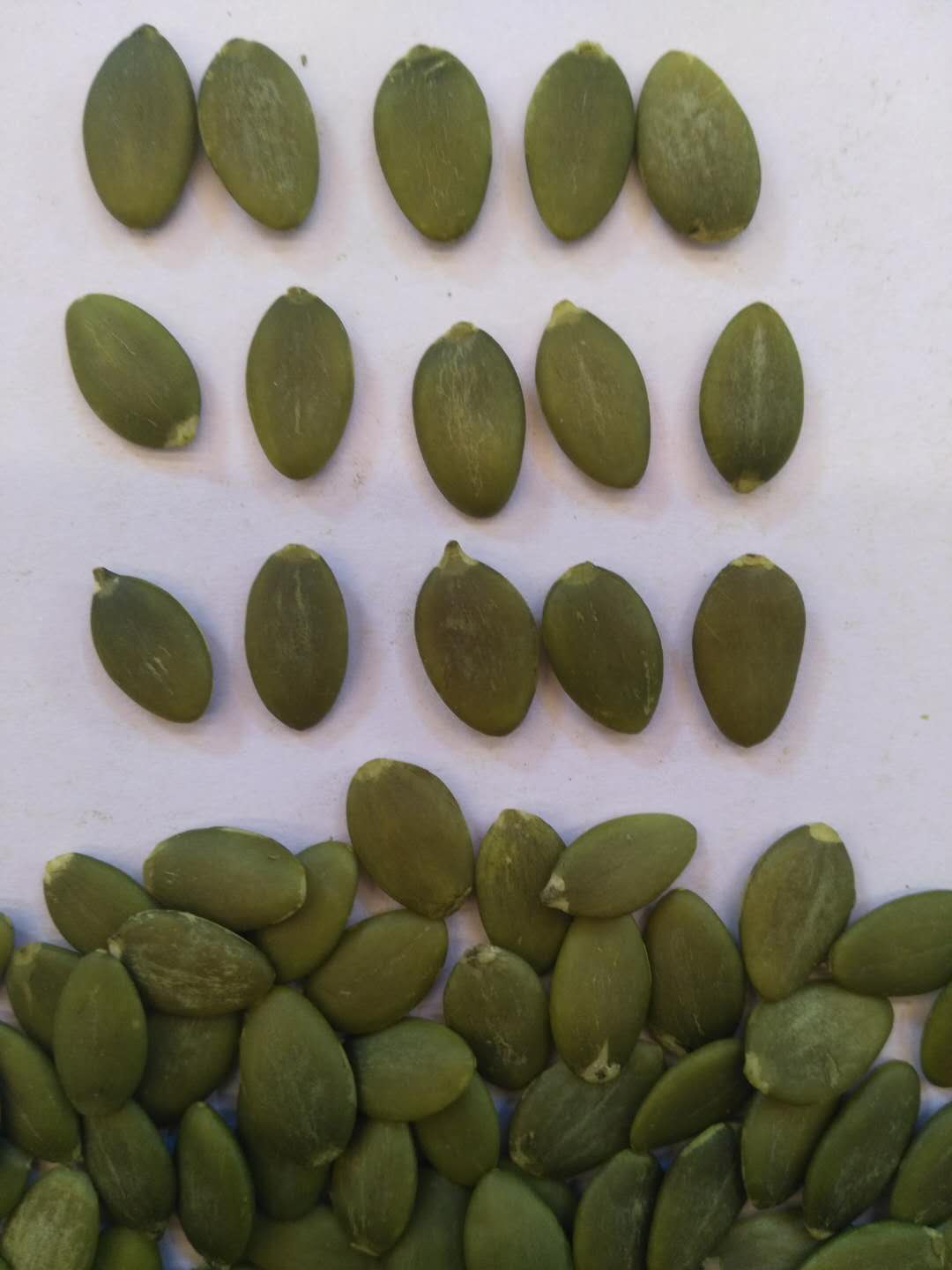
Shine Skin pumpkin seed kernels in grade AAA — one of three kernel grades sharing the same declared moisture, impurity, erosion and mildew limits.
Storage and Acceptance Criteria Across Repeat Orders
Declared storage guidance for these products is a cool place. That instruction is short, but it frames a shared responsibility: the supplier controls storage up to handover, and the buyer controls it afterwards. Snack manufacturing applications are typically described as running under cool and dry indoor warehouse conditions, at normal temperature and low humidity — the same envelope the product needs.
Two operational details affect whether that envelope is maintained. First, processing is described as batch processing with both manual and mechanical feeding, supported by sorting and packing equipment, with impurity control named as a special requirement. Batch structure is useful at contract stage because it makes lot-level sampling meaningful: a buyer can define acceptance per lot rather than per container. Second, published references for AAA Grade Shine Skin kernels list a shelf life of up to 18–24 months under optimal storage (TradeIndia product data). This is a reference figure from a public listing rather than a supplier commitment, and buyers should confirm any shelf-life claim in writing before relying on it for inventory planning.
A workable acceptance clause therefore contains six elements: the grade and variety, the size band, the four measurable limits with a sampling method, the packaging format, the storage condition at loading, and the remedy if a lot fails. Without those six, acceptance becomes a negotiation at the moment of arrival — the worst possible time to negotiate.
How Inner Mongolia Chengtai Food Co.,Ltd Structures Continuity
Inner Mongolia Chengtai Food Co.,Ltd is a sunflower and pumpkin seed grower, processor and exporter founded in 2013, located in the Mengxiu Industry Zone, Xamba Town, Hanggin Rear Banner, Bayannur City, Inner Mongolia, China. The company operates a 3,500 m² facility with 20 employees and a two-engineer technical team, and reports annual output of 30,000 metric tons across sunflower seeds, pumpkin seeds and kernels, with roughly 80% of production exported to markets in the Middle East, Middle Asia and Europe.
Its relevance to a long-term evaluation is that the continuity factors in this article are visible in its declared operating data rather than asserted. Quality control is stated as 100% testing. Grades A, AA and AAA are offered across Shine Skin kernels, alongside whole-seed Snow White, Shine Skin and Lady Nail programmes with distinct size bands and a shared specification platform of 9–10% moisture, impurity below 0.5%, erosion seeds below 0.5% and mildew seeds below 1%. Packaging spans 20/25 kg plastic or paper bags and vacuum bags with cartons, with customer logo printing available under OEM/ODM terms.
On the commercial side, the declared frame is a 5 metric ton minimum order, a 10–15 day lead time and 2,500 metric tons of monthly capacity, with a stated after-sales position that a refund can be applied where seeds have a quality problem. The company's own account of long-term supply includes food processors, snack manufacturers, food wholesalers, and importers and distributors, over a two-year relationship covering 30,000 metric tons for wholesale and roasting use, with stable supply, consistent product quality and satisfactory bulk order delivery reported as the outcome.
That case is a supplier statement, not an independently audited result, and it should be read as such. Its usefulness in an evaluation is that it names the buyer types and the application — wholesale and roasting — against which a new buyer can benchmark their own requirement.
Long-Term Supply Versus Spot Sourcing
Neither model is universally better. The comparison below sets out where each tends to perform, using the parameters a pumpkin seed buyer can actually test.
| Evaluation dimension | Spot / multi-trader buying | Single-source long-term agreement |
|---|---|---|
| Specification continuity | Resets with every purchase; grade meanings can shift between traders | One written specification governs every lot |
| Grade accountability | Diffused across intermediaries | Traceable to a named processing facility and batch |
| Packaging control | Limited; whatever is available | Fixed format, optional customer logo printing |
| Price exposure | Can capture short-term market lows | More predictable, less opportunistic |
| Supply risk | Diversified across sources | Concentrated in one supplier and one region |
| Dispute handling | Often resolved commercially, case by case | Governed by an agreed acceptance and remedy clause |
Comparison based on procurement structure, not on any named competitor's performance.
The boundaries of the long-term model deserve equal weight, because they are where buyers most often get surprised.
- Concentration risk. A single-source agreement removes the flexibility of switching during a short crop or a logistics disruption. Buyers with critical production lines usually keep a qualified second source on file even when they do not actively order from it.
- Grade is not a safety certificate. A and AAA describe sorting and appearance. They do not establish compliance with the 5.0 μg/kg aflatoxin limit set for pumpkin seeds under EU Commission Regulation (EU) 2023/915, and they do not address pesticide residue limits. Those require independent laboratory testing under a separate clause.
- Published moisture figures diverge. Declared data here states 9–10%; another public specification lists 8% maximum for AAA Shine Skin kernels. Buyers who assume the stricter figure applies without agreeing it in writing inherit a dispute.
- Storage responsibility transfers. A cool-place instruction is only enforceable up to handover. Once the container is opened at a warm, humid site, the supplier's specification no longer describes the product in front of you.
- Scale must be matched to demand. Monthly capacity and minimum order quantities shape what a supplier can realistically reserve for one buyer during peak season, particularly when 80% of output is already committed to export markets.
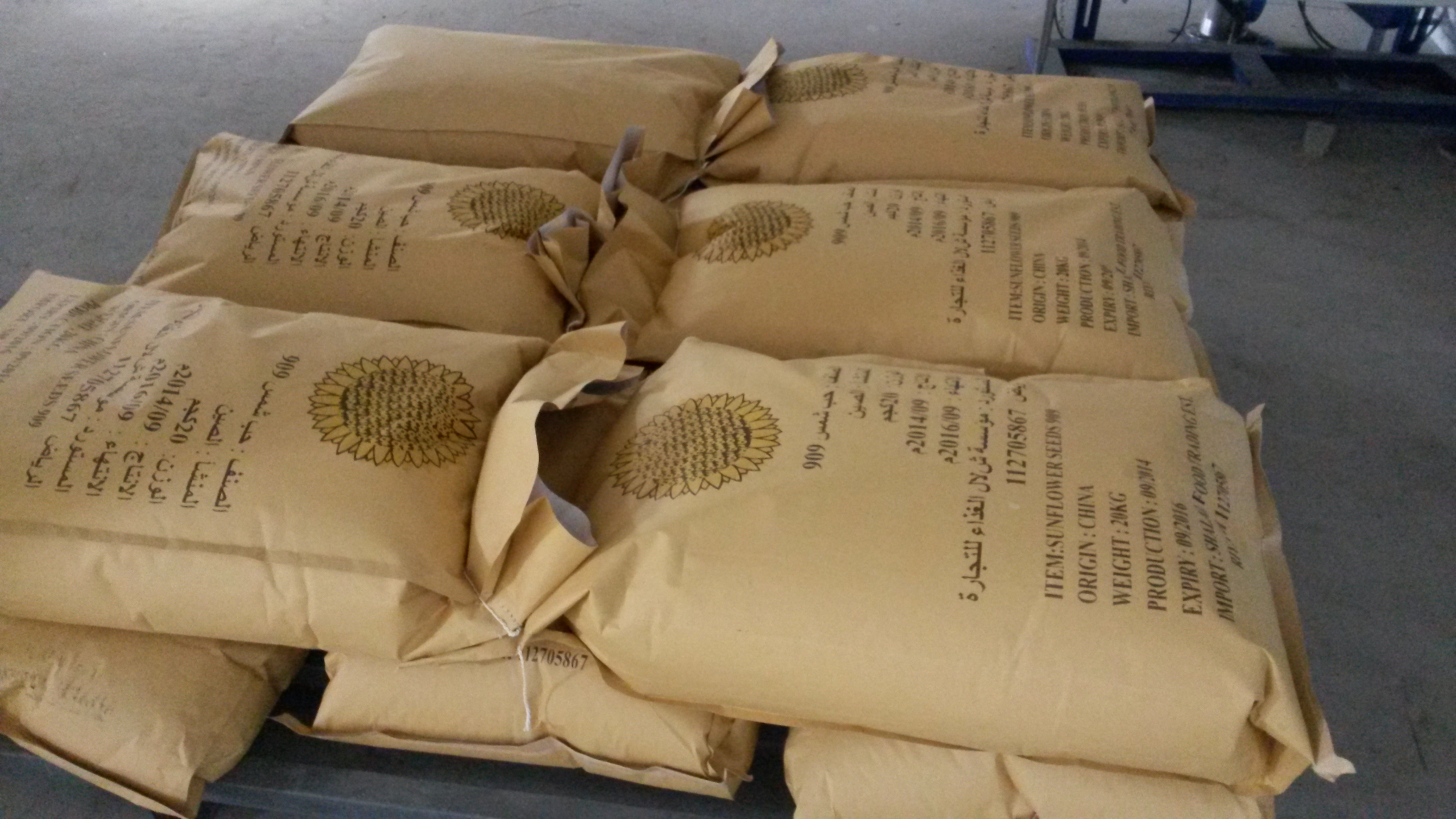
Packaging format is part of the specification: 20 kg or 25 kg plastic or paper bags for whole seeds, vacuum bags with cartons for kernels.
Market Direction and What It Changes for Buyers
Several verifiable trends bear directly on how a long-term pumpkin seed agreement should be written.
Volume is growing faster than variety breadth. China's 2024 production projection of 400,000 tons represents a 40% year-on-year increase, but 74% of that volume sits in a single variety, Shine Skin (Seedea; Everstar Foods). Buyers who standardise on Shine Skin gain liquidity; buyers on Snow White or Lady Nail accept a thinner market and should secure seasonal commitments earlier.
The origin base is concentrated. Inner Mongolia alone reported a pumpkin seed planting area of 28,700 hectares (430,000 mu) in 2024 (Seedea). Origin concentration is efficient for quality control and exposed for weather and logistics — an argument for contractual force majeure terms that both sides understand.
Demand for specific varieties is shifting. Lady Nail planting area expanded by roughly 80% to about 500,000 acres in 2025, driven by demand in the Middle East (Cardassilaris Family market insights). Variety-level demand shocks change sorting priorities at origin, which is one more reason to write variety into the contract rather than treating it as a preference.
Regulation is now a supply variable. Pesticide residue regulations in the EU and US constrained export volumes for Shine Skin and GWS types, contributing to a temporary global oversupply in 2025 (Cardassilaris Family). For buyers, that is both an opportunity — softer pricing windows — and a warning that compliant lots and non-compliant lots can look identical on a grading table.
The underlying demand curve remains upward. The global pumpkin seed market is estimated at USD 1.08 billion in 2025 and projected to reach USD 2.62 billion by 2032, a 13.4% CAGR (Maximize Market Research). China's pumpkin seed export value was USD 97.04 million in 2023, roughly 10% of global export value (Tridge / UN Comtrade). Adjacent demand for high-purity kernels is reinforced by the pumpkin seed oil market, growing at a 10.5% CAGR toward USD 2.06 billion by 2030 (Grand View Research). Purity and defect control are therefore not only food-safety issues; they are commercial positioning.
A Practical Evaluation Sequence
For a buyer moving from Research to Evaluation on a long-term pumpkin seed supplier, the following order of work front-loads the risks that are hardest to fix later.
- Fix the variety and size band first. Snow White, Shine Skin and Lady Nail are not interchangeable across processes, and size bands within each variety define yield.
- Write the four measurable limits. Moisture 9–10%, impurity below 0.5%, erosion seeds below 0.5%, mildew seeds below 1% — each with a sampling method and a rejection rule.
- Separate safety testing from grading. Add aflatoxin and pesticide residue verification as distinct clauses with their own evidence.
- Lock packaging and handling. 20/25 kg plastic or paper bags, or vacuum bags with cartons, plus any customer logo printing.
- Confirm timing against capacity. Minimum order quantity, lead time and monthly capacity determine whether the schedule is realistic across a season.
- Agree the remedy before the first shipment. A refund position is only useful if the trigger condition is defined in advance.
Future Outlook
Three developments are likely to shape pumpkin seed supplier evaluation over the next several seasons. First, the gap between appearance grading and analytical verification will keep widening, because residue regulation has already demonstrated that it can move export volumes. Suppliers who can present batch-linked test documentation will separate from those who present grade names.
Second, variety concentration carries a hidden cost. With Shine Skin at roughly three quarters of Chinese production, buyers who depend on Snow White or Lady Nail are structurally more exposed to planting decisions made a season ahead — which argues for longer commitments and earlier dialogue, not shorter ones.
Third, demand quality is migrating upward. Growth in the pumpkin seed oil market at a 10.5% CAGR toward USD 2.06 billion by 2030 increases the value attached to high-purity kernels, and purity is a process outcome that depends on sorting discipline, not on the harvest alone. Buyers evaluating suppliers for the long term should therefore weight process evidence — 100% testing statements, sorting and packing equipment, batch structure — at least as heavily as the sample in front of them.
FAQ
What do A, AA and AAA mean for pumpkin seed kernels?
They are sorting grades. In declared data for Shine Skin pumpkin seed kernels, AAA is described as dark green, AA as green, and the A/AA/AAA range as green, and all three share the same technical limits: raw specification, 2026 crop, moisture 9–10%, impurity below 0.5%, erosion seeds below 0.5%, mildew seeds below 1%, origin Xinjiang and Inner Mongolia, and cool-place storage. Grade differences therefore appear mainly in colour within the declared data. Public references also associate AAA Grade Shine Skin kernels with size bands such as 10–11 mm or 8–10 mm, which buyers should confirm against the supplier's own written specification.
What moisture level should a pumpkin seed supply contract specify?
The declared specification for these pumpkin seed products is 9–10% moisture. Buyers should note that moisture figures differ between published sources: one public reference for AAA Grade Shine Skin kernels lists a maximum of 8%. Because both positions exist in the market, the acceptance figure, tolerance and test method should be agreed in writing rather than drawn from a directory listing.
How are impurity, erosion seed and mildew seed tolerances applied?
Declared limits are impurity below 0.5%, erosion seeds below 0.5% and mildew seeds below 1%. Each addresses a different failure mode: impurity drives cleaning load, erosion affects sortation yield and appearance, and mildew is the defect most closely watched by food safety teams. For repeat orders, each limit needs an agreed sampling method and a clear rejection rule, otherwise acceptance becomes a negotiation at arrival.
Which pumpkin seed variety fits a roasting line versus a kernel programme?
All three main varieties in declared data — Snow White, Shine Skin and Lady Nail — are white, sweet and natural in taste and are stated as intended for manufacturing and roasted shop use. They differ in size band: Snow White is offered at 15 cm+, 13 cm+ and 11 cm+; Shine Skin at 11 cm+, 8–10 mm+ and under 8 mm; Lady Nail at 10 cm+, 7–10 mm+ and under 7 mm. Separately, Shine Skin kernels are offered in grades A, AA and AAA for manufacturing and roasted shop applications.
Which packaging formats support multi-year supply?
Declared packaging for whole pumpkin seeds is 20 kg or 25 kg plastic or paper bags. Shine Skin pumpkin seed kernels are additionally offered in vacuum bags with cartons. Bags can be printed with a customer's logo under OEM/ODM terms, which supports consistent retail or processing presentation across repeat orders.
What lead time and order size should a buyer plan for?
Declared capability data includes a 5 metric ton minimum order quantity, a 10–15 day lead time and a monthly capacity of 2,500 metric tons, against reported annual output of 30,000 metric tons. Buyers should map these figures to their own seasonal peak before committing to a delivery calendar.
How should acceptance criteria be written for repeat orders?
A workable clause names six things: variety and grade, size band, the four measurable limits with a sampling method, packaging format, storage condition at loading, and the remedy if a lot fails. Declared after-sales terms state that a refund can be applied where seeds have a quality problem, which makes a pre-agreed failure trigger the practical foundation of that remedy.
Where does a long-term single-supplier model break down?
At four points. Concentration risk reduces flexibility in a short crop or logistics disruption. Grade labels do not demonstrate compliance with the 5.0 μg/kg aflatoxin limit set for pumpkin seeds under EU Commission Regulation (EU) 2023/915, nor pesticide residue limits, both of which require laboratory evidence. A cool-place storage instruction is enforceable only up to handover, after which storage conditions are the buyer's responsibility. And supplier capacity — including monthly capacity, minimum order quantity and an export share of roughly 80% — determines how much volume can realistically be reserved during peak season.
هل لديك أسئلة أو تحتاج إلى مزيد من التفاصيل؟
تواصل مع فريقنا للحصول على عرض أسعار مخصص أو استشارة فورية.
طلب عرض أسعار
املأ النموذج أدناه وسيتواصل معك فريقنا بعرض مقترح مخصص.
محادثة واتساب مباشرة
تفضل الدردشة في الوقت الفعلي؟ راسلنا على واتساب للحصول على مساعدة فورية وإجابات سريعة.
- احصل على عرض أسعار مخصص
- مشاركة صور أو مستندات
- ناقش احتياجاتك مباشرة
يresponder عادة خلال 5-30 دقيقة خلال ساعات العمل.