
Q12S Scenario Fit: Action Camera for Driving and Sports
Q12S Scenario Fit: Action Camera for Driving and Sports
The YUAOHENG Q12S is a 4K action camera whose scenario value comes from four mechanisms rather than from its resolution figure: a 130° wide-angle lens that rotates through 180°, single-axis auto tracking on a brushless motor, electronic image stabilization, and gesture plus Wi-Fi control. Those mechanisms are what allow one camera body to move between a vehicle windscreen, a bicycle bar, a ski slope and a handheld self-recording setup. This reference maps the Q12S to three recording jobs — driving and transport documentation, outdoor sports capture, and handheld vlog production — and marks the points where the published specification stops short of a claim.
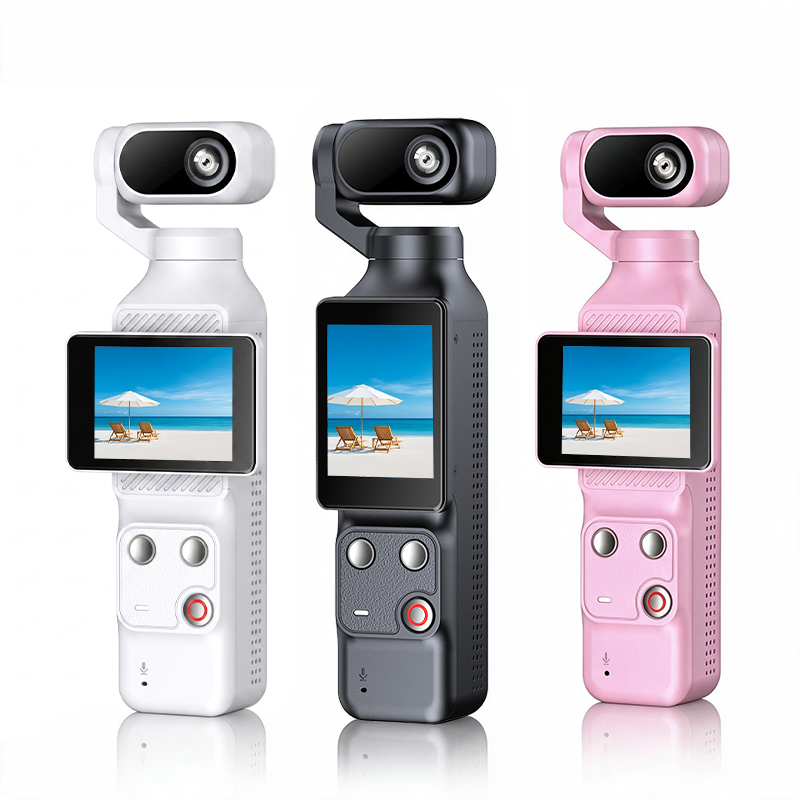
The Q12S action camera. Image: YUAOHENG.
Why Scenario Fit Decides Whether an Action Camera Works
Most action camera comparisons run as a single column of numbers: resolution, frame rate, battery capacity. That column answers a purchasing question, not an operating one. A camera asked to document a delivery route for four hours and a camera asked to freeze a skier mid-turn at 120 frames per second are being asked for different things, and the specification that matters changes accordingly.
Three recording jobs dominate the categories the Q12S is listed for. The first is documentation: long, repetitive, forward-facing capture where the footage is evidence rather than cinema. The second is action capture: short, unstable, high-motion sequences where a usable frame is the objective. The third is self-presentation: handheld or mounted recording where the subject is the operator and framing has to be adjustable without a camera assistant.
Market data supports the idea that activity, not resolution, is the primary purchase motive in this category. Fortune Business Insights estimated that outdoor sports and recreation applications — cycling, skiing, surfing and diving — accounted for 46% of the global action camera market in 2025, and Global Market Insights placed 4K-and-above resolution at 49.5% of 2025 market revenue. Read together, those figures describe a market where a 4K action camera is the baseline expectation and where the differentiator has moved to how well the hardware handles a specific recording environment.
The Q12S Specification Baseline
The values below are the manufacturer's published specification for the Q12S. No independent laboratory result for this model was available for this review, so they are treated as company-reported figures throughout.
| Parameter | Q12S specification |
|---|---|
| Product type / body material | Action camera, ABS body |
| Lens | HD lens, 130° wide angle, 180° rotatable |
| Video recording | 4K (3840×2160) at 30 fps; 2.7K at 60 fps; 1080P at 120 fps; H.264 / MP4 |
| Photo | Up to 20 MP; photo modes listed at 4K / 2.7K / 1080P / 720P; JPEG |
| Stabilization | Supported; correction method and range not detailed |
| Tracking | Single-axis auto tracking, brushless motor (long service life, quiet operation) |
| Control and display | Gesture control; 2.0-inch IPS touchscreen, 640×480 |
| Audio | Digital noise reduction microphone; built-in speaker |
| Connectivity | Wi-Fi; high-speed Mini USB 2.0; DC 5 V, 1–2 A input |
| Battery | 18650 cell, maximum 2000 mAh |
| Stated video working time | Approximately 5–6 hours |
What Each Mechanism Changes on Location
130° wide-angle lens with 180° rotation
Two different numbers are at work here. The 130° describes field of view; the 180° describes mechanical rotation of the lens assembly. Combined, they let the lens be aimed across a wide arc without touching the mount. A camera fixed to a windscreen can be turned from the road ahead to the cabin, and a camera clamped to a handlebar can be turned from the trail to the rider. On a multi-shot day this reduces mount changes and shortens the switch between forward capture and self-recording.
One comparison caveat applies. The specification does not state whether 130° is measured diagonally, horizontally, or as an advertised value, so the Q12S figure should not be set directly against another brand's angle unless both use the same convention.
Single-axis auto tracking on a brushless motor
Auto tracking turns the lens along a single rotational axis to hold a moving subject in frame. Because the drive is a brushless motor, the specification can describe it as long-life and quiet in operation — a practical detail when the camera records its own audio, since a noisy drive would be picked up by the microphone.
The boundary matters as much as the capability. Single-axis tracking corrects lateral drift; it does not correct pitch and roll the way a multi-axis gimbal does. It is a framing aid for handheld or slow-moving work, not a substitute for a stabilized rig on rough ground. No tracking latency, accuracy or working-distance figures are published for this model, so the only reliable check is a sample recording at the subject distance the buyer actually intends to use.
Electronic image stabilization
The Q12S lists image stabilization as a supported function. Its role in scenario fit is to reduce the effect of hand tremor, vehicle vibration and body movement on footage that will be watched at normal speed. Two limits apply to evaluation. The specification does not state the stabilization method or its correction range, and no standardized stabilization test result is published for the model, so the benefit has to be judged from sample footage at the frame rates and light levels the buyer intends to use.
Stabilization also interacts with exposure. In dim conditions, higher frame rates leave less light per frame and less material for a stabilizer to work with, which is one reason 4K at 30 fps can appear steadier than 1080P at 120 fps from the same position.
Gesture control, touchscreen and Wi-Fi
Gesture control solves a mounting problem: on a helmet, a bar or a rear window, the operator cannot always reach the camera to start and stop recording. The 2.0-inch IPS touchscreen at 640×480 provides the on-body settings and framing interface. Its resolution is modest by current display standards and outdoor brightness is not specified, so it is best treated as a setup tool rather than a monitoring screen in direct sun.
Wi-Fi allows preview and file transfer without unmounting the camera. The specification does not name the companion app, the wireless standard or the transfer rate, so compatibility with a buyer's phone fleet should be confirmed before any multi-unit deployment.
Recording modes and the 2000 mAh 18650 battery
The frame-rate ladder maps cleanly to scenarios. 4K at 30 fps suits detail-critical forward capture where the frame will be examined later. 2.7K at 60 fps balances detail against motion for footage that will be slowed moderately. 1080P at 120 fps produces short slow-motion sequences where temporal detail matters more than pixel count. Each step up that ladder costs storage and processing, and generally costs runtime.
Power comes from an 18650 cell rated to a maximum of 2000 mAh, with a stated video working time of approximately 5–6 hours. That figure is a manufacturer claim and no test conditions accompany it, so it is an indication rather than a guarantee: resolution, frame rate, stabilization, screen-on time, Wi-Fi use and ambient temperature all move the number. The 18650 format is one of the most widely standardized cylindrical cell sizes, which is relevant to spares planning, but the specification does not state whether the cell is user-replaceable in the shipped Q12S configuration. Charging is listed as a DC 5 V, 1–2 A input; data transfer uses a high-speed Mini USB 2.0 interface.
Driving and Transport: Continuous Forward-Facing Capture
In transport work the recording job is long, repetitive and forward-facing, and the camera is usually mounted once and left in place. The Q12S configuration fits that pattern in three ways. The rotatable lens lets the operator aim through the glass at the required angle after the mount is fixed, which matters on sloped windscreens and in vans where the mounting point is dictated by the vehicle rather than the shot. The 130° field covers several lanes or a wide cabin without a second camera. And the stated 5–6 hour video working time is in the range of a driving shift segment, so a single charge can cover a working period with a planned recharge or a spare cell.
Two verification points decide whether that theoretical fit holds. The first is power continuity: the specification lists a DC 5 V, 1–2 A input but does not describe ignition-linked start, continuous recording while charging, or parking monitoring, so a fleet buyer has to confirm each of those behaviours in firmware. The second is thermal behaviour. A parked vehicle cabin in summer is an unforgiving environment and the Q12S specification does not publish an operating temperature range, so heat soak during long summer shifts needs to be tested rather than assumed.
- Use 4K at 30 fps where later frame-by-frame review of signage or lane position is likely.
- Use 2.7K at 60 fps where motion clarity matters more than maximum detail.
- Confirm how the camera segments long recordings and whether the stored files remain manageable across a full shift.
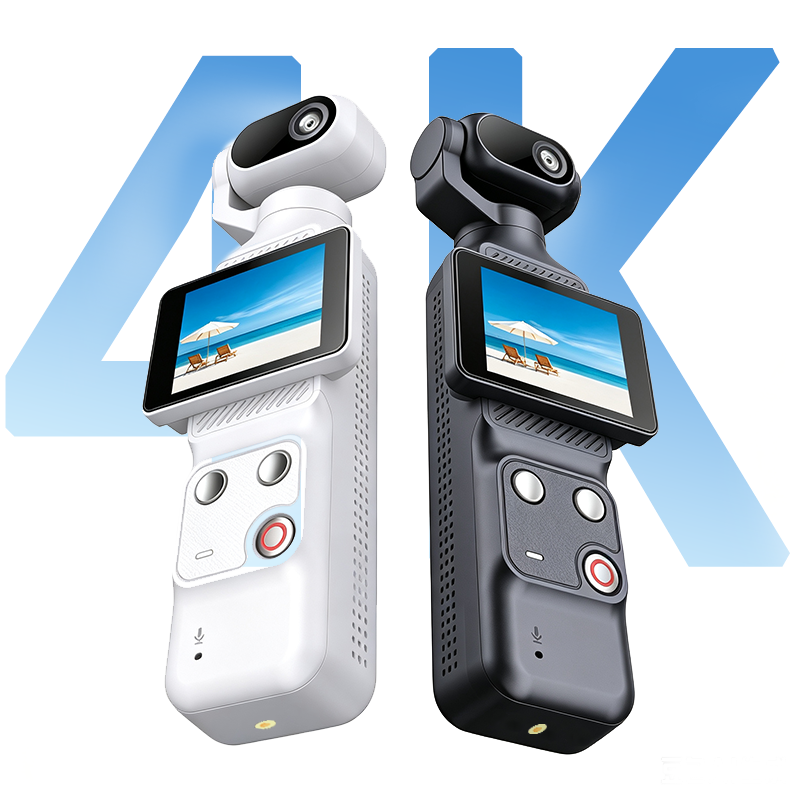
The rotating lens assembly allows the camera to be aimed after the mount is fixed. Image: YUAOHENG.
Two-Wheel, Cycling and Outdoor Sports Recording
On a bicycle or motorcycle, vibration rather than light is the dominant variable. Stabilization is the first Q12S function that matters here, followed by the 130° field, which keeps trail context and the rider in the same frame at close mounting distances. The 2.7K 60 fps and 1080P 120 fps modes cover jumps, descents and sprint sequences where the interesting moment is brief.
Audio is the part buyers underestimate. The Q12S uses a digital noise reduction microphone, but how that microphone behaves in strong wind is not documented for this model, so in-camera sound should be tested in the intended conditions before a production run is committed to it.
Winter sport and climbing add two further constraints. Lithium cells deliver less usable capacity in low temperatures, and the Q12S specification does not publish an operating temperature range, so cold-weather endurance should be measured in a cold chamber or on location rather than inferred from the 5–6 hour warm-condition claim. Cold also makes gloved operation awkward, which is where gesture control earns its place in the design.
Water is the constraint that most needs a straight answer. Surf and dive work requires an ingress rating and, in most cases, a housing. The Q12S specification supplied for this review states neither an IP rating nor a waterproof depth, and no housing appears in the product specification. Wet or submerged use therefore cannot be treated as an established capability of this model until the supplier confirms the rating, the housing and the test method.
Handheld Vlog and Slow-Motion Sequences
For self-recorded content the camera points at the operator, and the Q12S is built around that case. Rotating the lens through 180° turns a forward-facing setup into a self-recording one; single-axis tracking then holds the presenter in frame during lateral movement; gesture control starts and stops recording from a distance; the touchscreen handles framing; and Wi-Fi moves files to a phone for editing without unmounting.
The same hardware covers short slow-motion inserts. 1080P at 120 fps captures a jump, a splash or a swing at a temporal resolution that normal playback hides, and 20 MP stills provide thumbnail or print material from the same session. The practical limit is aim: rotating the lens changes the optical axis relative to the mount, so any handle, clamp or tripod set up for forward capture needs re-aiming, and the mounting interface is not described in the specification, which means adapter type should be confirmed before mounts are ordered in volume.
Scenario-to-Configuration Reference
The table below converts the specification into a working configuration per scenario, and lists the point that still requires confirmation before a program is committed.
| Scenario | Recording job | Q12S lever | Confirm first |
|---|---|---|---|
| Driving and transport | Continuous forward capture across a shift | 180° rotation to aim through glass; 130° coverage; 4K 30 fps; stated 5–6 h runtime | Continuous power, file segmentation, heat behaviour |
| Cycling and motorcycling | Vibration-heavy moving capture | Stabilization; 2.7K 60 fps; wide field for trail context | Mount rigidity, wind audio, ingress protection |
| Ski and snow sports | Cold, fast, short bursts | 1080P 120 fps slow motion; gesture control for gloved use | Cold-weather runtime, operating temperature range |
| Climbing and hiking | Mixed forward and self-capture on one mount | 180° rotation; single-axis tracking; Wi-Fi transfer | Mount security, weight on helmet, runtime |
| Handheld vlog | Self-recording while moving | Tracking; 2.0-inch touchscreen; 20 MP stills | App compatibility, tracking behaviour at real subject distance |
Where the Q12S Fits — and What It Cannot Be Assumed to Do
The Q12S fits programs where an aimable wide lens, one-axis subject tracking, stabilization, hands-off control and a multi-hour stated runtime are the deciding requirements, and where the camera can be mounted and aimed once per session. That describes transport documentation, two-wheel and trail recording, winter sports capture and handheld creator work reasonably well.
It does not follow that the camera is suitable for every scenario in the outdoor category. Four assumptions should be excluded unless the supplier confirms them in writing: that the Q12S is waterproof to any stated depth or rated to a specific IP level; that it offers infrared or night-vision illumination, which does not appear in its specification; that single-axis tracking delivers multi-axis gimbal correction; and that the 130° angle is measured on the same convention as a competitor's published figure.
There is also a substitution question. A camera used for transport documentation is often compared with a dedicated dashcam, and the two are built for different priorities. Dedicated dash cameras in this class commonly emphasize ignition-linked power, continuous loop recording and parking monitoring. The Q12S specification supplied here does not describe those behaviours, so it should be positioned as an action camera that can record transport footage, not as a drop-in dashcam replacement, until the firmware behaviours are confirmed.
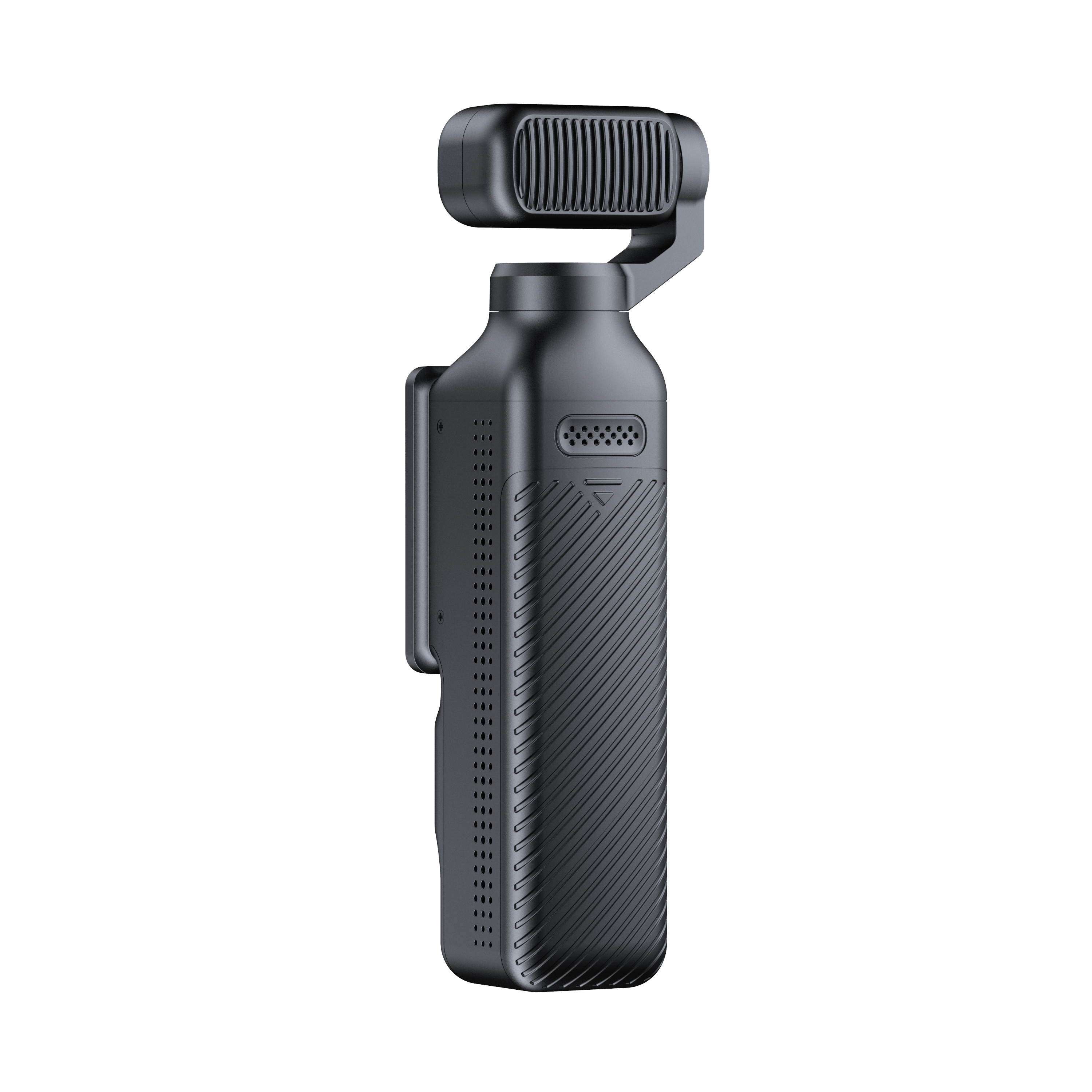
Touchscreen and body detail on the Q12S. Image: YUAOHENG.
What to Verify Before Committing a Program
- Model-specific compliance documents. The company states FCC, CE and RoHS compliance for its action camera products line, but the certification records available for this review cover other YUAOHENG models rather than the Q12S specifically. Request the declaration and test report that name this model and its radio module.
- Ingress protection. Ask for the IP rating, the depth and duration if any, the housing configuration and the test method, or accept that wet use is out of scope for the program.
- Stabilization method and behaviour. Obtain sample footage at 4K 30, 2.7K 60 and 1080P 120 from a comparable mounting position before setting a quality expectation with distributors.
- Runtime at the intended setting. The 5–6 hour figure is a general video working time; ask for measured results at the specific resolution and frame rate the program will actually ship with.
- Battery serviceability. Confirm whether the 18650 cell is user-replaceable in the shipped configuration, since that decision drives spare-parts planning and returns handling.
- Firmware and app behaviour. Confirm the companion app, supported phone platforms, file segmentation, loop recording availability, timestamp overlay and auto power-off.
- Mounting and storage limits. Confirm the mounting interface and the maximum supported memory card with its recommended speed class, neither of which is stated in the Q12S specification.
Supplier Context: YUAOHENG's Manufacturing and OEM Position
The Q12S is produced by YUAOHENG, the trading name of Dongguan YuAoHeng Electronic Technology Co., Ltd., a Dongguan-based manufacturer founded in 2016 whose product lines cover action cameras, dash cameras and smart video doorbells. The company reports a 1,500 m² production facility, 300 employees, a 30-engineer R&D team, annual output of 2,000,000 units, monthly capacity of 170,000 units and an export share of 80%, with main markets in Europe, North America, Asia and South America.
For buyers, the relevant capability is the OEM/ODM scope rather than the headline numbers: product concept and prototype development, hardware and function customization including camera modules and sensors, firmware and app development, and appearance and packaging customization covering colour, material, logo engraving, retail packaging and accessories. Stated lead time is 25–30 days with 100% testing, and the after-sales scope includes a 12-month warranty with online technical support and replacement or maintenance service. These are company-reported figures and describe service scope, not verified production performance for any specific order.
Outlook for 4K Action Cameras in Transport and Outdoor Categories
The direction of the category is toward resolution as a baseline rather than a selling point. Fortune Business Insights projects an 11.56% compound annual growth rate for the action camera market over 2026–2034, and if that forecast holds, the competitive pressure will fall on the parts of the specification that are harder to print on a box: how stabilization behaves in low light, how long a camera actually records at its highest setting, and whether the mount and control design allow one camera to serve several jobs.
For the Q12S, that suggests a positioning built on aim and control flexibility — a rotatable wide lens, single-axis tracking, gesture operation and a multi-hour stated runtime — rather than on a resolution claim alone. Buyers evaluating it alongside other 4K models should score it on scenario coverage and on the quality of the documents the supplier can produce for the exact model, because in this category the missing document is usually the risk, not the missing feature.
FAQ
Does the 180° rotating lens matter for driving and transport recording?
Yes, for mounting reasons rather than image reasons. Because the lens assembly rotates independently of the body, a camera fixed to a windscreen or a bar can be aimed at the road, the cabin or the rider after the mount is tightened. The 130° field then covers a broad scene from that position. The specification does not state whether the angle is measured diagonally or horizontally, so it should only be compared with other cameras using the same convention.
How does single-axis auto tracking behave in a moving vehicle or on a bicycle?
It follows a subject along one rotational axis using a brushless motor, which keeps a moving subject laterally framed. It does not correct pitch and roll the way a multi-axis gimbal does, so rough-terrain footage still depends mainly on the mount and on image stabilization. No tracking latency, accuracy or subject-distance figures are published for the Q12S, so behaviour at the intended subject distance has to be checked with a sample recording.
Can the Q12S be used underwater or in heavy rain?
That cannot be established from the supplied specification. The Q12S documentation for this review states no IP rating and no waterproof depth, and no waterproof housing is listed among its attributes. Underwater, surf or sustained wet use should be treated as unconfirmed until the supplier provides a rating, the housing configuration and the test method that supports it.
How long will the 2000 mAh 18650 battery actually record?
The stated video working time is approximately 5–6 hours on a 2000 mAh 18650 cell. That is a manufacturer figure without published test conditions, so actual runtime will vary with resolution and frame rate, whether stabilization is active, screen-on time, Wi-Fi use and ambient temperature. A 4K 30 fps session with Wi-Fi previewing will not match a 1080P session with the screen off, and cold conditions reduce usable capacity further.
Which recording mode should be used for slow motion versus long transport sessions?
1080P at 120 fps is the slow-motion mode: it captures fast movement with enough temporal detail to stretch playback, at the cost of resolution and storage. 2.7K at 60 fps suits motion that will be slowed only moderately, and 4K at 30 fps suits detail-critical forward capture where the frame will be reviewed closely. Longer recording sessions favour the lower frame rates because they consume less storage and generally extend runtime.
Does the Q12S replace a dedicated dashcam?
Only partly, and the difference is in firmware behaviour rather than optics. Dedicated dash cameras in this class commonly emphasize continuous loop recording, ignition-linked power and parking monitoring. The Q12S specification supplied here does not describe those functions, so it should be treated as an action camera capable of transport recording rather than a dashcam substitute until the relevant firmware behaviours are confirmed by the supplier.
A full product catalogue covering the Q12S and the wider YUAOHENG action camera range is available for download: YUAOHENG product catalogue (PDF).
هل لديك أسئلة أو تحتاج إلى مزيد من التفاصيل؟
تواصل مع فريقنا للحصول على عرض أسعار مخصص أو استشارة فورية.
طلب عرض أسعار
املأ النموذج أدناه وسيتواصل معك فريقنا بعرض مقترح مخصص.
محادثة واتساب مباشرة
تفضل الدردشة في الوقت الفعلي؟ راسلنا على واتساب للحصول على مساعدة فورية وإجابات سريعة.
- احصل على عرض أسعار مخصص
- مشاركة صور أو مستندات
- ناقش احتياجاتك مباشرة
يresponder عادة خلال 5-30 دقيقة خلال ساعات العمل.