
QSK60 Parts First Order: Brand, Price and Acceptance
QSK60 Parts First Order: Brand, Price and Acceptance
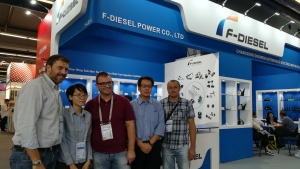
A first QSK60 parts order rarely fails on price. It fails because the part cannot be identified precisely enough for anyone to quote it, inspect it or accept it. The QSK60 is a large-bore engine that has been built in more than one fuel-system configuration and installed in mining haul trucks, generator sets, construction machinery and marine auxiliary duty, so one nominal part name can point to several different items.
This reference answers the questions that arrive before a first order: which brand is supplied and on what packaging terms, what a price inquiry has to contain, how purchasing terms and acceptance criteria are set, and which batch-level evidence is worth requesting before the purchase order is released. It is written for buyers moving from evaluation into execution — fleet maintenance planners, genset packagers, distributors and OEM project teams — who need a quotable inquiry rather than a catalogue browse.
Why the first QSK60 order stalls on identification, not price
A QSK60 quotation can only be as precise as the identification behind it, and three things make that harder than buyers expect. First, the engine has been produced with more than one fuel-system architecture, so an injection component listed for one version is not a safe substitute for the other. Second, the same engine family is installed in duty cycles that differ sharply — continuous generator sets, cyclic construction work, mining haul trucks, marine auxiliary service — and the parts list, not only the wear rate, follows the application. Third, a first-time buyer often holds only a machine model and a photograph of a failed part, neither of which is a part number.
The commercial consequence is that the cheapest-looking quotation is frequently the least comparable one. A quote issued against an engine model alone may be corrected twice before shipment, restating price and lead time each time. A quote issued against a verified OE number, a confirmed fuel-system version, a stated application and a firm quantity can be inspected on arrival, accepted against agreed criteria and repeated on the next order without renegotiation.
What brand is supplied, and what the buyer is actually choosing
F-DIESEL Power Co.,Ltd (F-DIESEL) states that it mainly supplies products under the F-DIESEL brand, that neutral packaging is available on request, and that customized packaging is supported when the buyer provides design files. The company also describes four production modes — OEM, OES, aftermarket and remanufacture — which carry different responsibilities for the buyer.
- OEM: production is carried out strictly per customer drawings, specifications and quality standards, supporting new original-equipment matching.
- OES: custom spare parts are produced to match original service parts and factory packaging requirements.
- Aftermarket: material, packaging and cost target can be adjusted for the replacement market.
- Reman: remanufacturing covers core inspection, component replacement, performance testing and marking as required.
For a first order, "which brand" is really three separate questions. The first is the brand on the box: F-DIESEL, neutral, or the buyer's own. The second is the brand on the drawing: the buyer's own specification under OEM, the original service part under OES, or a replacement-market specification under aftermarket. The third is who answers if a part does not fit. A neutral or buyer-branded carton shifts the traceability obligation onto the purchase order, so the part number, version and acceptance criteria have to appear in the contract documents rather than on the packaging.
The quality-management position is documented. F-DIESEL holds ISO 9001:2015 certification (certificate 01 100 116628) issued by TÜV Rheinland Cert GmbH, with a scope covering sales of engine and spare parts for automotive, generating set, marine and construction applications, valid to 31 January 2027. For Russia and the EAEU markets, an EAC certificate (EAЭС KG417/039.CN.02.05557, TR TC 018/2011) is listed with validity to 22 August 2029 and a scope that includes engine repair kits, cylinder heads, cylinder blocks and injector valve sets.
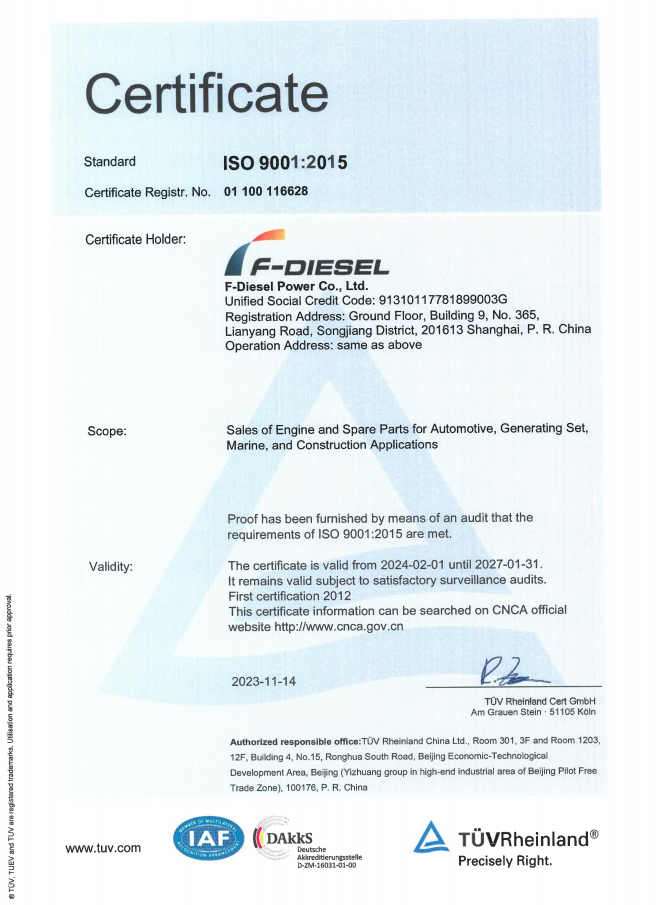
Both documents should be read for what they cover. The ISO certificate attests to a certified quality-management system for sales activity inside the stated scope; it does not certify the dimensions, material grade or service life of any individual part. The EAC certificate addresses market access for the listed product categories, not part-level performance. Buyers who need part-level proof have to ask for it at the batch level, which is the subject of a later section.
The four identifiers a QSK60 price inquiry must carry
A quotable inquiry carries four identifiers plus a quantity: the OE part number or nameplate data, the engine model and serial number, the fuel-system version, and the application and duty. Documentation requirements and delivery terms complete the request. The company's stated guidance is that the part number or nameplate information of the product is required — an engine or vehicle model supplied on its own is not treated as sufficient to quote against, and a photograph of the nameplate is an accepted way to deliver the identifier.
| Inquiry field | Why it changes the quotation | What to attach |
|---|---|---|
| OE part number or nameplate data | The part number is the primary identifier; a model designation alone spans several variants | Photo of the nameplate, the stamped number on the removed part, or the OE drawing reference |
| Engine model and serial number | Serial breaks resolve running changes that share one model name | Engine data plate photograph, including the serial line |
| Fuel-system version: HPI or MCRS | Injection components differ between the two system families and are not quoted interchangeably | Injector body markings, pump and rail layout photograph, existing part number |
| Application and duty | Mining haul truck, continuous genset, cyclic construction and marine auxiliary load the same part differently | Duty description, annual hours, load profile, environment |
| Quantity and order type | Single unit, replenishment and full overhaul kit quantities follow different minimums and lead times | Units per line item, kit or single part, first order or repeat |
| Documentation requirement | A material certificate or lot-linked test record has to be named before the order, not after | Standard, material grade, report type, language, whether part-specific |
| Delivery terms and destination | Freight mode is chosen against the buyer's requirement and the product volume | Incoterm, port or site address, requested date |
| Payment terms | Telegraphic transfer and letter of credit require different document sets | Preferred term and the conditions attached to either |
Two fields deserve emphasis because they are the ones most often left out. The serial number is what separates two engines that look identical on a specification sheet but were built months apart; without it, a supplier quotes what the catalogue says rather than what the buyer owns. The documentation field is what converts an acceptance discussion into an enforceable clause: naming a part-specific material test certificate, or a test record tied to the shipped lot, before the order is placed is materially different from asking for paperwork after the container has been loaded.
Where an inquiry with four identifiers outperforms a model-only inquiry
The difference is easiest to see as a process comparison rather than a price comparison. A model-only inquiry typically generates a provisional price, followed by a technical query, followed by a revised price, and the lead time restarts from the point at which the part is finally confirmed. A fully identified inquiry generates one price against a defined item, which can then be checked against the delivery checklist and functional test at acceptance. The second route is not automatically cheaper per unit, but it moves the uncertainty from the loading dock to the quotation stage, where correction is still inexpensive.
HPI versus MCRS: the version question that changes the part
QSK60 engines have been supplied with different fuel-injection system families, and the two that appear most often in first-order correspondence are HPI and MCRS. They are different system architectures, so a fuel-injection part identified for one should not be assumed to fit the other. Treating the version as an optional detail is the single most common cause of a wrong first shipment on fuel-side components.
Terminology itself is standardised. ISO 7876-5:2021 establishes a vocabulary for common-rail fuel-injection systems for diesel compression-ignition engines and their components, and the ISO diesel-engine standards catalogue separately identifies standards for fuel nozzles and for clamp-mounted and flange-mounted fuel injectors. A vocabulary standard is useful for writing an unambiguous inquiry, but it is not fitment evidence: it tells both parties what to call the object, not which engine the object belongs in.
In practice the version is established from three places on the machine: the engine data plate and its serial, the markings on the injection component being replaced, and the physical layout of the pump and rail assembly. Where those three disagree, the buyer should hold the order until the discrepancy is resolved rather than accept a supplier's single-source judgement. A listing that does not state the version should be read as an unresolved identification, not as a universal part.
How purchasing terms and acceptance criteria are defined
Purchasing terms are agreed per project, and acceptance criteria are mutually confirmed by both parties against a delivery checklist, visual inspection and functional testing. Payment is handled by telegraphic transfer or letter of credit, and delivery method — sea freight, air freight or courier — is selected according to the buyer's requirement and the product volume, with international logistics and on-site delivery at trade fairs also listed as available arrangements.
The word to notice is "mutually". Acceptance is not a catalogue default that applies automatically to every order; it is a clause both parties confirm, which means the first-order buyer should write it rather than inherit it. A workable acceptance clause names the checklist items, the inspection method, the functional test to be performed and by whom, the sampling basis, and the point at which risk transfers. The company's stated quality position — 100% testing plus a full incoming-outgoing inspection procedure — describes the supplier side of that arrangement; it does not replace the buyer's side.
Commercial parameters for custom production are listed separately from stock supply, and the two should not be blended. Custom production is quoted at a minimum order quantity of 300 units with a 45-day lead time and a stated monthly capacity of 10,000 units. The turbocharger case material separately describes sample stock with 3–7 day delivery for emergency repair. These describe different supply situations: a stocked turbocharger is not evidence that a customized part can ship in a week, and a 45-day custom lead time is not the lead time for an item already in stock.
Evidence to request before the purchase order is released
For a first QSK60 order, the evidence file should be assembled before the purchase order is released, not after the goods arrive. Five items do most of the work, and each one has a defined limit.
- Batch-level test or inspection record tied to the shipped lot. The company states 100% testing and a full incoming-outgoing inspection procedure. The record is only useful if it maps to the lot actually shipped; a generic capability certificate does not.
- Part-specific material test certificate where the material grade matters. This has to be named in the inquiry with the standard, the grade and the heat or lot reference to be reported. Its value lies in tying a specific part to a specific heat of material.
- Endurance testing reference. F-DIESEL states that its QSK60 parts are manufactured to OEM drawings and standards and verified by 8,000-hour endurance testing. The right follow-up question is which configuration was tested and what the test conditions were, because an endurance figure without a configuration is a headline rather than evidence.
- Certification scope documents. The ISO 9001:2015 certificate and, where the destination requires it, the EAC certificate. Check the scope wording and expiry date against the destination market.
- Agreed delivery checklist. The list both parties will inspect against, fixed before shipment so that the functional test at acceptance has a baseline.
| Evidence item | What it establishes | What it does not establish |
|---|---|---|
| ISO 9001:2015 certificate 01 100 116628 | A certified quality-management system for sales of engine and spare parts within the stated scope | Dimensional conformity, material grade or service life of an individual part |
| EAC certificate EAЭС KG417/039.CN.02.05557 | Market access for the listed product categories in the EAEU under TR TC 018/2011 | Part-level performance, or compliance outside the listed categories |
| Lot-linked batch test or inspection record | That defined tests were performed on the batch shipped to this buyer | Field performance over the full service interval |
| Part-specific material test certificate | That a specific part was produced from a defined material grade and heat | Machining tolerance, heat treatment result or fitment |
| 8,000-hour endurance testing reference | The company's stated verification of its QSK60 parts against OEM drawings and standards | Independent third-party validation, or equivalence to a different supplier's part |
| Delivery checklist and functional test | That the delivered goods match what both parties agreed to accept | Long-run reliability after the acceptance window closes |
Where this supply model fits, and where it does not
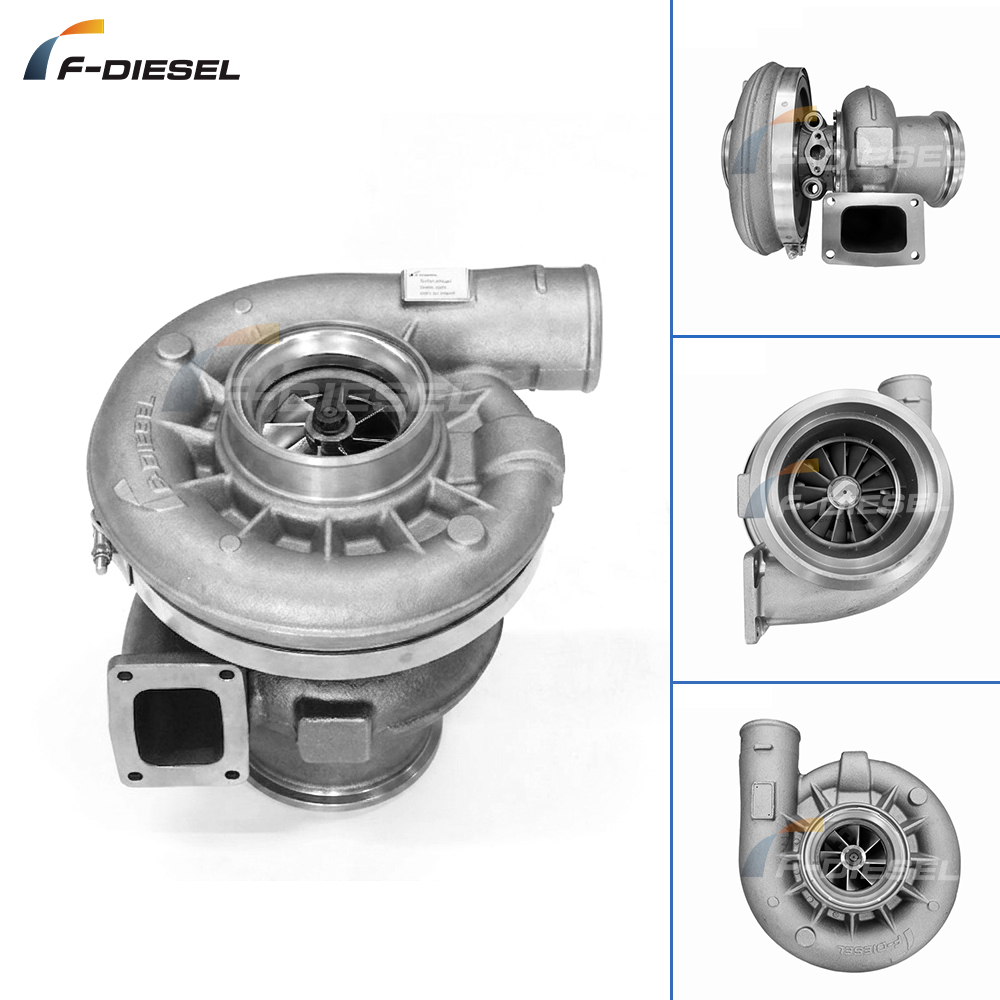
The model fits buyers who need several component lines from one source: full overhaul kits, mixed containers, OEM branding projects and remanufactured exchange. The stated product range covers crankshafts, turbochargers, cylinder heads, cylinder blocks, pistons and rings, connecting rods, camshafts, injectors, injection pumps and fuel-injection systems, with QSK60 injectors and QSK60 turbochargers identified as a specific focus, alongside fuel actuators, turbo electronic actuators and oil coolers. The company reports a 95% export ratio and a distribution footprint spanning Asia, Europe, Africa, North America and South America.
There are boundaries a first-order buyer should weigh at the same time. Custom production carries a 300-unit minimum and a 45-day lead time, which does not suit an emergency single-part requirement. Warranty and spare-parts policy are described as requiring client input rather than being fixed in advance, so the warranty should be negotiated as part of the first order instead of assumed from a case reference. The endurance and service-life figures cited in this article are company and case statements, not independent laboratory validations, and the ISO certificate covers a sales-scope quality system rather than part-level conformity. None of these boundaries is disqualifying; each one simply has to be closed in the contract rather than left to expectation.
Application fit and the case evidence behind it
QSK60 parts in this range are positioned for mining haul trucks, generator sets, construction machinery, fleet heavy trucks, agricultural vehicle power systems and marine auxiliary duty. The most detailed company-reported case concerns turbochargers for the QSK60 engine, supplied in quantities above 100 units for mining haul trucks and power-generator sets, matched to Holset HX82, HX83 and HX84 units and reported as mass-supplied for the Caterpillar Terex MT5500 haul truck. The reported outcome is more than 15,000 hours of trouble-free operation under mining conditions, against a designed service life of at least 15,000 working hours and a 12-month warranty period.
That case is worth reading carefully because of what it does and does not cover. It is a turbocharger case, not a statement about every part number in the range, and the operating result is reported by the supplier rather than measured by the buyer. Its practical value for a first order is methodological: it shows the level of specificity — part family, matched OE reference, application, quantity, hours and warranty term — that a case reference should reach before it can support a purchasing decision.
Market context: what the published figures do and do not cover
Published market data can frame a first-order budget, provided its scope is respected. Fortune Business Insights estimates the global diesel engine market at USD 70.99 billion in 2025, with a projected CAGR of 5.40% over 2026–2034. Global Market Insights values the diesel common rail injection system market at USD 22.6 billion in 2024. These are not additive and not interchangeable: the first covers complete engines across all end users, while the second covers a component sub-market, and the two use different definitions and methodologies.
Neither figure is a replacement-parts forecast. Diesel engine market value does not translate into demand for cylinder heads, injectors or crankshafts, and a buyer sizing an overhaul budget from engine-level revenue would be applying the wrong denominator. Regulation is the more directly relevant signal: the U.S. EPA's 2027 heavy-duty engine standards include a nitrogen oxide limit of 0.035 grams per brake horsepower-hour, a forthcoming requirement that keeps attention on injection-system capability. What that means for a specific replacement part in a specific market remains an assessment the buyer has to make against the applicable rule, not something a market estimate settles.
Outlook
The direction of first-order practice is toward documentation discipline rather than faster quoting. As emission rules tighten and fuel-system variants multiply within a single engine family, the value of a supplier shifts from holding stock to being able to prove what a specific lot contains. Buyers who build identification and acceptance into the first purchase order — part number, version, application, quantity, documentation, checklist — get a repeatable baseline. Those who buy on a model name and a price get a shipment that has to be re-verified on arrival, which is the more expensive route even when the unit price is lower.
FAQ
Which brand of QSK60 parts is supplied?
Products are mainly supplied under the F-DIESEL brand. Neutral packaging is available on request, and customized packaging is supported when the buyer provides design files. OEM, OES, aftermarket and remanufactured production modes are also offered, with OEM production carried out strictly per customer drawings, specifications and quality standards.
What basic information is needed to obtain a QSK60 price?
The part number or the nameplate information of the product is the minimum requirement; an engine or vehicle model on its own is not treated as sufficient. A complete inquiry adds the engine serial number, the fuel-system version (HPI or MCRS), the application and duty, the quantity, the documentation required and the delivery destination.
How can a buyer confirm whether fuel-injection parts are HPI or MCRS before ordering?
Confirm the version from three sources that should agree: the engine data plate and serial, the markings on the component being replaced, and the physical arrangement of the pump and rail assembly. ISO 7876-5:2021 standardises common-rail terminology, which helps both parties describe the part consistently, but a vocabulary standard does not confirm fitment. Where the three sources disagree, the identification should be treated as unresolved.
How are purchasing terms and acceptance criteria defined?
Acceptance criteria are mutually confirmed by both parties against a delivery checklist, visual inspection and functional testing. Payment is by telegraphic transfer or letter of credit. Delivery method — sea freight, air freight or courier — is determined by the buyer's requirement and the product volume, with international logistics and on-site delivery at trade fairs listed as available arrangements.
What evidence should be requested before a first QSK60 order ships?
Request the batch-level test or inspection record tied to the shipped lot, a part-specific material test certificate where the material grade matters, the endurance testing reference with its tested configuration and conditions, the certification scope documents relevant to the destination market, and the agreed delivery checklist. F-DIESEL states 100% testing, a full incoming-outgoing inspection procedure, and verification of its QSK60 parts by 8,000-hour endurance testing.
What are the minimum order quantity and lead time for customized QSK60 parts?
Custom production is listed at a minimum order quantity of 300 units with a 45-day lead time and a stated monthly capacity of 10,000 units. Stocked items follow separate availability, and the turbocharger case material describes sample stock with 3–7 day delivery for emergency repair; the two supply situations should not be applied interchangeably.
Reference document: F-DIESEL Group Presentation 2026 (PDF).
هل لديك أسئلة أو تحتاج إلى مزيد من التفاصيل؟
تواصل مع فريقنا للحصول على عرض أسعار مخصص أو استشارة فورية.
طلب عرض أسعار
املأ النموذج أدناه وسيتواصل معك فريقنا بعرض مقترح مخصص.
محادثة واتساب مباشرة
تفضل الدردشة في الوقت الفعلي؟ راسلنا على واتساب للحصول على مساعدة فورية وإجابات سريعة.
- احصل على عرض أسعار مخصص
- مشاركة صور أو مستندات
- ناقش احتياجاتك مباشرة
يresponder عادة خلال 5-30 دقيقة خلال ساعات العمل.