
QTZ Tower Crane Designations Decoded: A Safety System Qualification Checklist
China was the leading exporter of tower cranes in 2024, with an export value of USD 694 million (OEC, using UN Comtrade data, HS code 842620), and the global tower crane market was estimated at USD 5.9–6.44 billion in 2025 across two commercial research houses. A large share of the units moving through that trade carries the same three-letter prefix on the quotation sheet. QTZ is not a brand and not a marketing label — it is a series designation. Decoding it, and then matching it against documented safety and certification evidence, is one of the more dependable ways to compare tower crane offers.
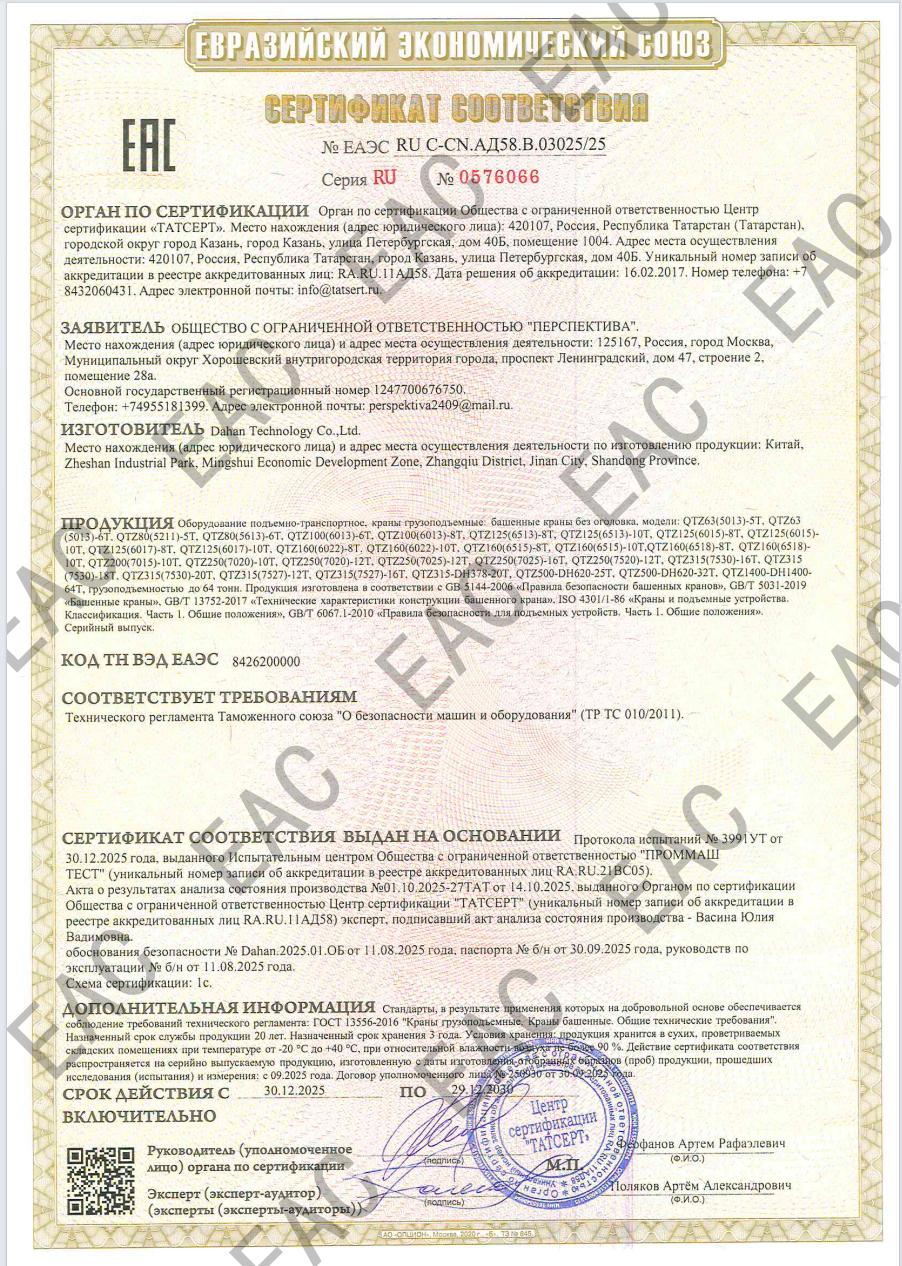
EAEU Conformity Certificate (EAC) covering QTZ series tower cranes. The full model list is held in the certificate annex, not on the front page.
What the QTZ Designation Actually Identifies
QTZ identifies the Chinese QTZ series of top-slewing tower cranes. In this configuration the slewing assembly and the operator's cab sit at the top of the mast, and the machines are built for climbing operation — mast sections are added as the building rises — which is why the series appears so often on high-rise residential, commercial and infrastructure work.
A designation such as QTZ160 (6515)-8T/10T is a compressed specification assembled from four parts, and each part answers a different question:
- Series prefix — QTZ. Identifies the top-slewing, climbing tower crane series.
- Class number — 160. Places the crane in a capacity class within the series. Class numbers in the model range reviewed here run from 63 to 315.
- Bracketed configuration code — (6515). Identifies the jib configuration variant. Two cranes can share the same class number and still carry different bracketed codes and different ratings.
- Capacity suffix — 8T/10T. States the maximum rated lifting capacity in tonnes, for the build options offered.
The suffix is the element most buyers read first, and it is the only part of the string that states a lifting capacity directly. The other three parts determine what that capacity means in practice.
Reading a Full QTZ Model String, Part by Part
The list below comes from the QTZ series range documented for Dahan Technology Co., Ltd., a Chinese manufacturer of tower cranes and construction elevators. It shows how the same four-part pattern repeats across classes.
| Full designation | Series | Class number | Jib configuration code | Maximum rated capacity |
|---|---|---|---|---|
| QTZ63 (5013)-5T/6T | QTZ | 63 | 5013 | 5 T / 6 T |
| QTZ80 (5211)-5T | QTZ | 80 | 5211 | 5 T |
| QTZ100 (6013)-8T | QTZ | 100 | 6013 | 8 T |
| QTZ125 (6015)-8T/10T | QTZ | 125 | 6015 | 8 T / 10 T |
| QTZ160 (6515)-8T/10T | QTZ | 160 | 6515 | 8 T / 10 T |
| QTZ250 (7025)-12T/16T | QTZ | 250 | 7025 | 12 T / 16 T |
| QTZ250 (7520)-10T/12T/16T | QTZ | 250 | 7520 | 10 T / 12 T / 16 T |
| QTZ315 (7527)-12T/16T | QTZ | 315 | 7527 | 12 T / 16 T |
Look again at the QTZ250 entry. It appears twice: QTZ250 (7025)-12T/16T and QTZ250 (7520)-10T/12T/16T. Same class number, different bracketed configuration code, different maximum rated capacity. That is the practical lesson of the table — the class number alone does not identify a machine.
What the Class Number Does and Does Not Tell You
Class numbers are used as shorthand for a crane's capacity class, but usable capacity on a tower crane is governed by the rated lifting moment, normally expressed in tonne-metres (t·m), together with the jib length in use. As working span increases, the load a crane can lift usually decreases. A machine with a high maximum capacity at minimum radius may be limited to a fraction of that figure at the far end of its jib.
The consequence for evaluation is simple. A class number and a maximum capacity figure are entry points, not final answers. Buyers comparing QTZ-class machines need the load chart and the rated lifting moment for the exact bracketed configuration being quoted, plus the lifting height, lifting speed and working class that apply to it. For high-rise and super-high-rise work, the attachment scheme, free height, standard section configuration and foundation conditions also enter the calculation, and selection should follow technical calculation rather than a single headline capacity number.
The Real Problem: A Model Code Is Not Compliance Evidence
Nothing in the string "QTZ160 (6515)-8T/10T" proves that the machine conforms to any standard, that its safety functions have been verified, or that the unit may legally be erected in the destination market. Those claims live in certificates and technical files — and certificates are scoped documents. They name a market, a standards set, a model list (frequently held in an annex) and a validity window.
Scoping is where most qualification errors occur. A certificate whose scope reads "Tower Crane (See Annex I for full model list)" is telling the buyer that the front page is not the evidence; the annex is. A certificate that expires in 2026 is not a qualification for a crane commissioned in 2027 without renewal. These look like administrative details, but they decide whether equipment can be registered, erected and operated on site.
Safety System Checklist: Four Functions to Locate in the Documented Qualification
The functions below are the ones most commonly tied to tower crane design and safety standards, and the ones a buyer should be able to find documented — not merely witnessed at a shop test.
1. Overload protection
Overload protection prevents the crane from lifting beyond its rated capacity for the configuration in use. In qualification terms, the buyer should confirm that overload protection is covered by the standards named on the product certificate, and that the function is checked during pre-shipment testing rather than only at site commissioning.
2. Moment limitation
Moment limitation is the function that ties the load to its radius. Because capacity falls as working span increases, a load that is safe close to the mast can exceed the rated lifting moment at the jib tip. For QTZ-class cranes this is the safety function that corresponds most directly to the class number and the bracketed configuration code, which is why the two should never be assessed separately.
3. Height and travel limit protection
Height limits and travel limits constrain the hoist and, where applicable, the travel motion of the machine, protecting against over-hoisting, block contact and over-travel on rail-mounted or travelling variants. On climbing cranes these limits matter through every mast-adding cycle, so the documentation should cover the limits as supplied and as re-set during climbing operations.
4. Emergency stop systems
Emergency stop systems provide a manual means of interrupting motion. Because tower crane control and electrical systems fall under their own standards — EN 60204-32:2008, the standard for the electrical equipment of hoisting machines, appears on the EU conformity certificate discussed below — the emergency stop arrangement should be traceable to the electrical standard cited in the certificate rather than treated as a generic feature.
Dahan Technology's documented equipment scope lists safety limit devices among the matched components supplied with the crane, alongside counterweights, mast sections, electrical traction systems, wire ropes and cabs. That is the level of detail a buyer should be able to reach during evaluation: not "the crane has safety devices," but which devices, verified against which standard, and recorded in which document.
Standards and Certificates Behind a QTZ Qualification
In China, the design and safety baseline for tower cranes is GB/T 13752-2017, the standard that superseded the 1992 version and defines design rules and safety specifications for the equipment. Export-oriented manufacturers typically stack additional documentation on top of that baseline, market by market.
| Document | Type / number | Issuing authority | Market | Standards cited | Validity |
|---|---|---|---|---|---|
| Certificate of Compliance (CE) | ECM Certification Mark, 6B211216.DTCO94 | ECM | EU | EN ISO 12100:2010; EN 14439:2006+A2:2009; EN 60204-32:2008 | 16 Dec 2021 – 15 Dec 2026 |
| EAEU Conformity Certificate (EAC) | ЕАЭС RU С-СН.АД58.В.03025/25; Серия RU №0576066 | TATSERT Certification Center | EAEU: Russia, Kazakhstan, Belarus, Kyrgyzstan, Armenia | GB/T 13752-2017; GB/T 6067.1-2010; ISO 4301/1-86; GB/T 5031-2019 | 30 Dec 2025 – 29 Dec 2030 |
| Quality Management System Certification | ISO 9001:2015, 10424Q01958R1M | SHANDONG SEATONE INTERNATIONAL CERTIFICATION CO., LTD | Global | GB/T 19001-2016 / ISO 9001:2015 | 15 Oct 2024 – 17 Oct 2027 |
Three observations follow. First, the standards sets are not interchangeable: the EU certificate is built on EN standards, while the EAEU certificate is built on a mix of GB/T and ISO standards. Holding one does not automatically satisfy the other. Second, scope statements carry the real information — the EAC scope names QTZ series tower cranes but refers to the original certificate annex for the full model list, and the EU certificate scope likewise refers to an annex. Third, validity windows are live commercial information: a certificate valid today may expire during a project, so renewal planning belongs in the procurement file rather than in a post-delivery emergency.
The ISO 9001:2015 certification deserves separating from the product certificates. Its scope covers design and development, manufacturing, installation and maintenance services of tower cranes and construction lifts — the process behind the product, rather than the product's conformity to a design standard.
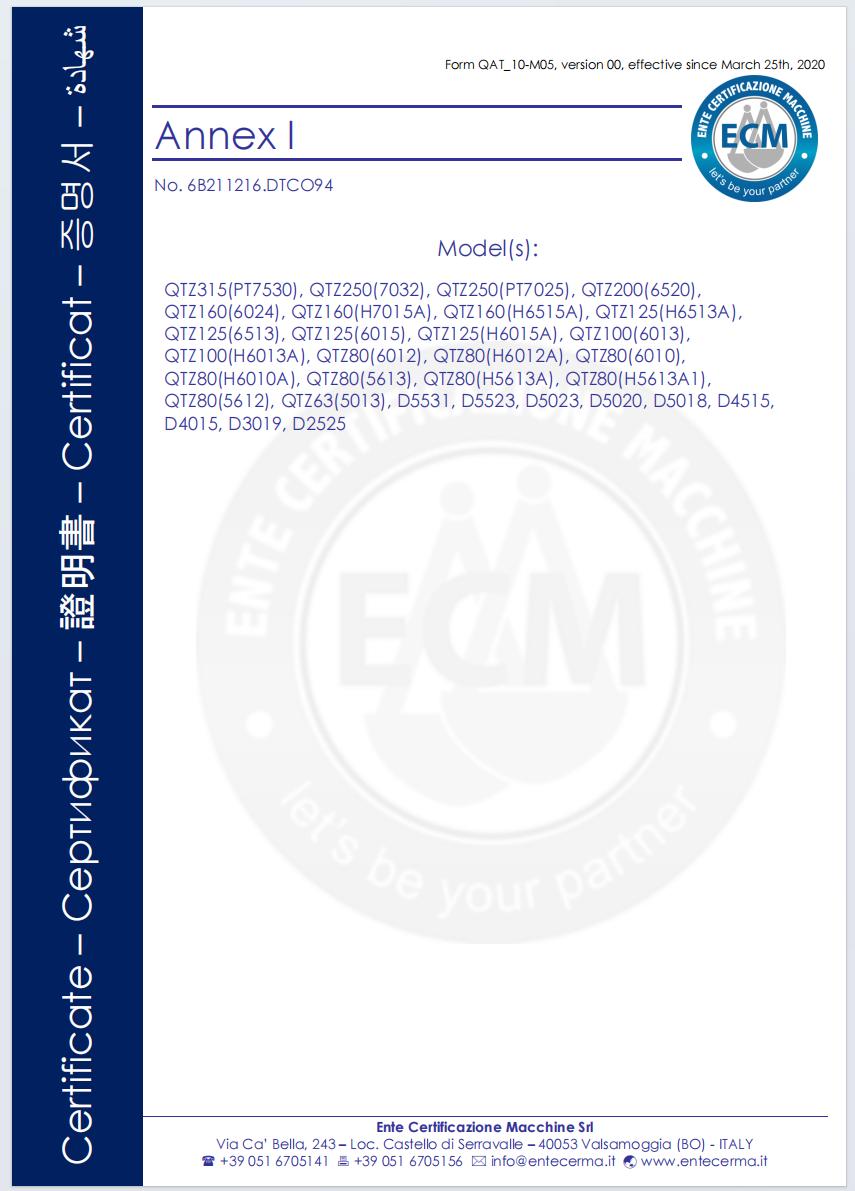
ECM Certificate of Compliance 6B211216.DTCO94 cites EN ISO 12100:2010, EN 14439:2006+A2:2009 and EN 60204-32:2008, with a validity end date of 15 December 2026.
Where Dahan Technology Sits in This Qualification Chain
Dahan Technology Co., Ltd. is a Chinese manufacturer of tower cranes and construction elevators, established in 2000 and based in Zhangqiu District, Shandong Province. Its corporate profile identifies it as a national standard revision unit in the tower crane industry, a national high-tech enterprise and a national intelligent manufacturing demonstration factory, and the company holds CE, EAC, SGS and ISO 9001 certificates.
Standard-revision participation is a qualification signal distinct from any single certificate, because it places the manufacturer inside the process that defines the GB/T standards against which QTZ cranes are built. It does not certify a specific machine, but it is a verifiable institutional fact that buyers can weigh next to product documentation.
The measurable entity facts are also relevant to a compliance file. The company employs more than 1,000 people, has sold over 85,000 tower cranes and elevators, exports to more than 50 countries and regions, and operates OEM and ODM production for tower cranes alongside complete machine delivery and heavy-tonnage crane R&D and export. Manufacture is supported by a monthly capacity of 400 units and 100% testing, and the documented minimum order quantity is 1 unit, which supports low-volume custom production and prototype orders. Complex customizations require engineering evaluation before production.
Which Configurations Carry the Qualification
The documentation reviewed here covers the QTZ series through the model list above — QTZ63 through QTZ315 — in capacities from 5 tonnes to 220 tonnes, across flat top, topkit, luffing jib and derrick configurations. The applicable industries documented for these machines are building construction, real-estate engineering, infrastructure projects and municipal engineering, with working conditions that include dense urban sites, confined spaces, high-elevation operations and heavy-duty conditions.
Field evidence matters here, because certificates describe what is permitted while projects describe what actually happens. A trader in the Russian Federation deployed four units on a building construction project over three years and completed it, with multiple tower cranes operating together to meet material hoisting requirements. A construction company in the Russian Federation used 34 units on a civil residential-building project over four years. Elsewhere, a construction company in Viet Nam used three units for bridge construction over two years, and a regional agent in Bulgaria has five units in service on building construction work. Each of those deployments sits inside the EAC market or adjacent markets where the EAEU certificate above applies — which is the practical link between a certificate number and a site.

Multiple tower cranes working together on a building construction project — a Russian Federation trader's four-unit deployment running over three years.
Market Trend: Documentation Is Becoming the Gate
Two shifts are visible in the published market data. First, configuration mix is moving: flat-top (topless) designs accounted for 46.37% of tower crane revenue in 2025, according to Mordor Intelligence, a figure the same research attributes to efficiency in dense urban airspace. Configuration changes alter the qualification questions a buyer must ask, because jib and counterweight arrangements vary by machine.
Second, demand is concentrating in segments where documentation is non-negotiable. Wind power specialized tower cranes with 200+ tonne capacity are projected to grow at 8–10% CAGR through 2032 according to Future Market Insights — a medium-confidence commercial forecast, but one consistent with the heavy-tonnage R&D and export capability that suppliers now advertise. Heavy lifting in wind, thermal power, road and bridge, port and nuclear projects attracts regulatory scrutiny that a capacity catalogue cannot answer.
The export picture reinforces the point. With China the leading tower crane exporter in 2024 at USD 694 million, destination-market conformity — not lifting capacity — is increasingly the constraint that decides whether a shipment can be erected at all.
Comparison With Traditional Qualification Practice — and the Limits of the QTZ System
Traditional capacity-led evaluation compares maximum lifting capacity, price and delivery date. Qualification-led evaluation compares the same figures but front-loads the documents: standards cited, market scope, annex model list, validity window, and the safety functions verified against each standard. The second approach is slower at the quotation stage and considerably faster at registration, erection and acceptance.
That said, the QTZ system has real boundaries, and buyers should not treat it as more than it is:
- Class numbers do not standardize configuration. Two QTZ250 models in the same documented range carry different jib configuration codes and different maximum capacities. Reading only the class number will produce the wrong crane for the wrong radius.
- Model codes say nothing about site-level engineering. Foundation conditions, attachment schemes, free-standing height and standard-section configuration are project-specific and assessed separately from the designation.
- Certificates are market-scoped and time-bound. A CE Certificate of Compliance citing EN standards does not substitute for an EAC certificate citing GB/T and ISO standards, and neither document protects a buyer past its expiry date.
- Customization changes the basis of the qualification. Jib lengths, counterweight schemes, lifting height plans and electrical/safety configurations can be customized, but complex customizations require engineering evaluation before production, and the exact delivery date for a customized configuration must be confirmed with the sales department rather than assumed from a catalogue figure.
For overseas buyers specifically, the practical risk is not a missing certificate but a mismatched one — valid, well-printed, and covering a model list that does not include the unit on the purchase order.
Future Outlook
Qualification files are becoming longer and more frequently audited. Three developments seem likely to shape the next procurement cycle. Certificate validity will be treated as a scheduling input rather than a formality, particularly where projects run beyond a certificate's remaining term. Annex-level model verification will move from the legal review stage to the shortlisting stage, as buyers learn that scope statements resolve to annex pages. And standards participation will continue to function as a differentiator for manufacturers, because it demonstrates familiarity with the rules that conformity documents are written against, rather than only with the documents themselves.
None of this replaces the load chart. The designation tells a buyer which class of machine is being discussed; the load chart, the safety system documentation and the certificate annex tell the buyer whether it can be used on the site in front of them.
Frequently Asked Questions
What does QTZ mean in a tower crane model name?
QTZ identifies the Chinese QTZ series of top-slewing tower cranes, in which the slewing assembly sits at the top of the mast and the machines are built for climbing operation. It is a series designation rather than a brand or a capacity, and documented models in this series run from QTZ63 to QTZ315.
How should a buyer read a full designation such as QTZ160 (6515)-8T/10T?
Four parts: the QTZ series prefix; the class number 160, which places the crane in a capacity class; the bracketed configuration code 6515, which identifies the jib configuration variant; and the trailing 8T/10T, which states maximum rated lifting capacity in tonnes. Because capacity usually falls as working span increases, the designation should be read alongside the load chart and the rated lifting moment in tonne-metres for that exact configuration.
Which safety functions should appear in a QTZ tower crane qualification file?
Overload protection, moment limitation, height and travel limit protection, and emergency stop systems. These are the functions that should be traceable to the standards cited on the product certificate. Dahan Technology's documented equipment scope lists safety limit devices among the matched components supplied with the crane, alongside counterweights, mast sections, electrical traction systems, wire ropes and cabs.
Which standards and certificates should a buyer check?
GB/T 13752-2017 defines design rules and safety specifications for tower cranes in China and superseded the 1992 version. For the EU, ECM Certificate of Compliance 6B211216.DTCO94 cites EN ISO 12100:2010, EN 14439:2006+A2:2009 and EN 60204-32:2008, valid 16 December 2021 to 15 December 2026. For the EAEU, certificate ЕАЭС RU С-СН.АД58.В.03025/25 cites GB/T 13752-2017, GB/T 6067.1-2010, ISO 4301/1-86 and GB/T 5031-2019, valid 30 December 2025 to 29 December 2030. ISO 9001:2015 certificate 10424Q01958R1M covers design, development, manufacturing, installation and maintenance, valid to 17 October 2027.
How can a buyer confirm a certificate covers the exact model being purchased?
By checking the scope statement against the model list in the certificate annex. The EAC scope names the QTZ series tower cranes and refers the full model list to the original certificate annex; the EU Certificate of Compliance scope likewise refers to an annex. The model on the purchase order should appear in that annex, and the certificate should remain valid for the duration of the project.
What commercial terms and acceptance criteria apply, and can QTZ models be customized?
Documented terms are a minimum order quantity of 1 unit, delivery terms of FOB, CIF, EXW or CFR, a pre-shipment test as the acceptance criterion, and 30/70 payment terms. Customization covers jib lengths, counterweight schemes, lifting height plans and electrical or safety configurations. Complex customizations require engineering evaluation before production, and the exact delivery date for a customized configuration must be confirmed with the sales department rather than assumed.