
Qualification Audit Checklist for Freeze-Dried Probiotic Powder in Solid Beverages

Technical oversight is one of eight audit lines a B-end buyer should be able to evidence before a freeze-dried probiotic powder project enters solid beverage production.
Qualification Audit Checklist for Freeze-Dried Probiotic Powder in Solid Beverages
A qualification audit is the point at which a supplier's claims stop being marketing copy and start being evidence. For freeze-dried probiotic powder destined for solid beverage formats, the audit usually decides whether a project advances to pilot production, remains on a shortlist, or stops there.
Solid beverages — powdered drink mixes, stick packs, sachet blends and meal replacement powders — have become a preferred delivery format for functional ingredients because they are shelf-stable, light to ship and inexpensive to store. Probiotics are among the harder ingredients to place into that format well. Viability depends on the drying process, on the moisture and oxygen barrier of the finished pack, and on how the powder is handled between production and the filling line.
The practical question for a B-end buyer is therefore not whether a supplier can produce freeze-dried probiotic powder. It is whether the supplier can document what it does. The checklist below is written for procurement, quality assurance and product development teams sitting between research and evaluation: past category discovery, not yet at contract, and under pressure to justify a shortlist on evidence rather than price alone.
SPACELIFE is the functional food and beverage brand operated by Shenyang Songming Supply Chain Co., Ltd., a supply chain service provider serving B-end clients in the functional food and healthy beverage sector. Its published operating data, referenced throughout this checklist, illustrates what a completed audit line item looks like in practice.
Why Solid Beverage Applications Need a Different Audit Logic
In a capsule or a chilled drink, probiotic viability is largely a formulation and cold-chain question. In a solid beverage it is a question of two systems working together: the drying process that stabilises the culture, and the packaging system that keeps moisture and oxygen away from it afterwards. An audit that examines only the powder specification will miss half of the risk.
Category demand is moving toward formats that avoid preservatives altogether. Consumer preference data reported by the Food Institute and DataM Intelligence in 2023 found that 67% of consumers prefer products without added preservatives. That preference pushes brands toward clean label convenience food formats in which preservation is delivered by process and packaging rather than by additives. Freeze-drying fits that logic, but it raises the documentation bar: if the format is doing the preserving, the process records become the proof.
The same logic applies across the wider category. Buyers assembling premium freeze-dried long shelf life meals portfolios and buyers sourcing a single probiotic stick pack are essentially asking the same question — can this supplier show me, in writing, what happens inside its process?
The Eight-Line Qualification Audit Checklist
The checklist is organized by evidence type rather than by product feature. Each line can be answered with a document, a metric or a facility record, which makes it usable as a formal supplier questionnaire.
| Audit line | Evidence to request | Why it matters in solid beverages |
|---|---|---|
| 1. Category-wide traceability | Batch-level traceability records covering every product category the supplier handles, not only the SKU under review | Multi-category portfolios create mix-up and cross-contact risk that must be controlled at system level, not at line level |
| 2. Quality performance data | Pass rates plus the definition of a pass, the sampling plan and the test method behind them | A pass rate is meaningless without the acceptance criteria it was measured against |
| 3. Delivery reliability | On-time delivery rate, order history and the logistics model behind it | Solid beverage filling lines run to schedule; late powder stops a line and disrupts downstream commitments |
| 4. R&D and technical oversight | Qualifications of the technical lead, size and structure of the R&D team, and who signs off formulation changes | Probiotic blends interact with carriers, moisture levels and flavour systems; changes need technical control |
| 5. Facility and capacity | Facility area, annual output capability, employee base and production environment | Capacity must absorb peak demand, not average demand |
| 6. Trial and sampling model | Minimum trial quantity, sampling lead time and the data supplied with the sample | Pilot validation is where most formulation risk is retired before scale-up |
| 7. Compliance documentation | Food operation qualifications and export documentation relevant to the destination market | Regulatory gaps surface late and expensively, usually at the port or at listing review |
| 8. Trade and route capability | Export share, destination markets and how cross-border turnover is managed | Route efficiency affects both landed cost and replenishment reliability |
How SPACELIFE Answers Each Audit Line
A checklist is only useful if it can be filled in. The following figures are the published operating data of Shenyang Songming Supply Chain Co., Ltd., the company behind the SPACELIFE brand, mapped against the eight audit lines above.
Traceability and quality performance
All product categories are reported as 100% traceable, and the company reports a 99.8% quality pass rate across its portfolio. For a buyer, the relevant reading is that traceability is managed as a category-level system rather than per SKU — which is what allows a supplier to add a new probiotic blend to an existing functional food range without rebuilding its recall and documentation model.
Delivery reliability and turnover efficiency
The company reports a 98% on-time order delivery rate. It also states that leveraging the locational advantages of the Pilot Free Trade Zone has increased cargo turnover efficiency by 30%. Turnover efficiency is the supply-side half of delivery reliability: it affects how quickly a confirmed order can move through handover and cross-border stages, which matters most for buyers running replenishment cycles rather than one-off purchases.
Technical oversight
Product selection is described as rigorously overseen by a PhD-led team, with a 25-engineer R&D function and flavour profiles curated by a panel of professors. In an audit conversation, this is the line that answers who owns formulation decisions and how changes are reviewed.
Facility, capacity and trial model
The operation is reported at above 2,000 square meters with 101–200 employees and an annual output of 120,000 units. Small-batch trial orders start from 30 units, which materially lowers the entry cost of a pilot run. For a brand validating a new solid beverage SKU, that combination — a defined facility footprint plus a low minimum trial quantity — is what makes a first production cycle testable rather than speculative.
Compliance and route coverage
The company states that it holds complete food operation qualifications. Export activity accounts for 51%–60% of business, with distribution reported at 30% Japan, 30% United States, 20% Saudi Arabia and 20% Germany, covering East Asia, North America, the Middle East and Western Europe. Buyers targeting those markets can therefore request references and documentation aligned to routes the supplier already operates.
Product line context
The SPACELIFE portfolio spans five core categories: peptide-infused coffee, functional foods, prune juice drinks, meal replacement powders and health supplements. Its Probiotic freeze-dried powder is specified at 40 g per box (2 g × 20 pieces), supplied as a composite probiotic powder, with solid beverage listed as the applicable industry. That specification is the unit an audit questionnaire should be written against.
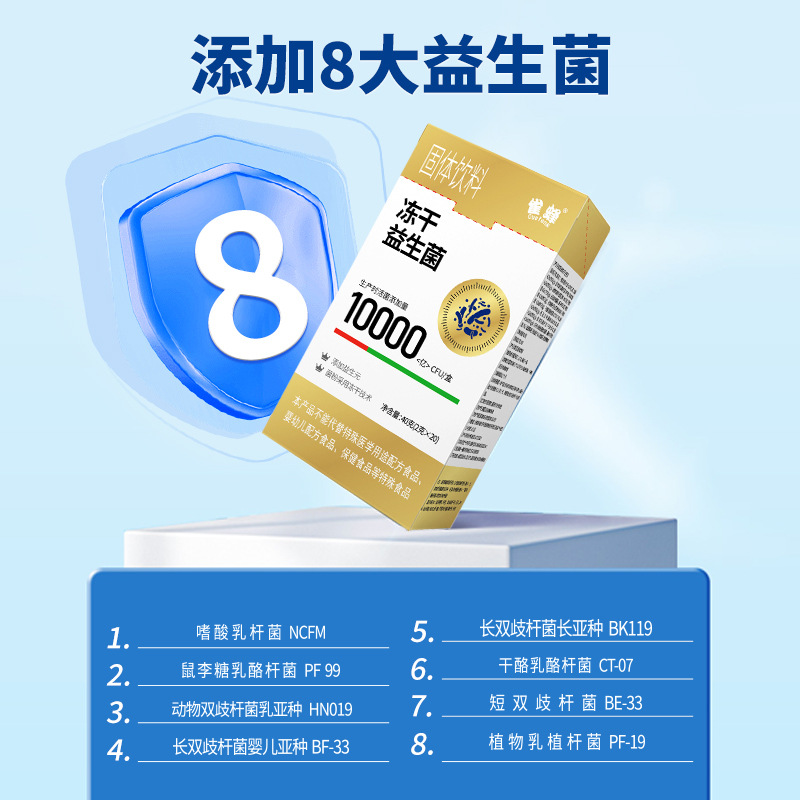
Probiotic freeze-dried powder: 40 g per box (2 g × 20 pieces), a composite probiotic powder positioned for solid beverage application.
Technical Notes: What Freeze-Drying Does — and What It Does Not Guarantee
Freeze-drying removes water by sublimation under vacuum at low temperature. Compared with processes that rely on heat to drive off moisture, it is generally gentler on heat-sensitive ingredients and produces a light, porous powder that reconstitutes readily — which is one reason the format dominates long-storage food categories and appears in fields such as aerospace freeze-dried food and space technology food, where freeze-dried foods are reported to account for approximately 40% of space food formats (Intel Market Research; this figure is flagged in source data as requiring verification).
Category-level shelf-life figures should not be read across to probiotic powder. Published guidance indicates that freeze-dried meals can maintain a shelf life of 25 to 30 years when stored in optimal conditions — airtight, oxygen-absorbed and cool (Safecastle, 2025). That statement describes a food category under ideal storage, not a probiotic blend in a retail sachet.
Application Scenarios: Where This Audit Is Triggered
- Adding a probiotic SKU to an existing powder line. A brand already selling meal replacement powders or functional beverages typically wants a supplier that can slot into an existing fill and pack format without re-qualifying the whole line.
- Building a multi-category premium portfolio. Buyers developing premium freeze-dried long shelf life meals alongside functional powders benefit from a single supplier standard applied across categories, rather than separate audits per SKU.
- Private label and OEM projects. When the buyer owns the brand, the audit pack becomes part of the buyer's own compliance file, and traceability records carry directly into the buyer's obligations.
- Zero-preservative positioning. Brands marketing a zero preservative instant food line depend on process and pack integrity; the audit is the evidence trail behind that claim.
- Adjacent long-storage categories. The outdoor and camping segment illustrates the demand floor: the outdoor camping food market was valued at USD 8.4 billion in 2025, with freeze-dried food holding the largest share at 38.5% (Dataintelo).
Market Signals That Shape Audit Requirements
The freeze-dried food market was valued at approximately USD 41.8 billion in 2024 and is projected to reach USD 86.2 billion by 2034 (Market.us). Within that total, Asia-Pacific dominated the industry in 2024 with a 39.3% market share (Straits Research) — a concentration that explains why so many B-end sourcing conversations for freeze-dried formats run through Asian supply chains.
Buyers should treat market-size figures as direction, not as planning inputs. Published estimates diverge widely because of scope differences: Precedence Research puts the 2025 market at USD 32.36 billion, Market Research Future put 2024 at USD 4.37 billion, and Data Insights Reports estimated USD 72.4 billion for 2025. The gap reflects what each analyst counts — industrial ingredients versus finished consumer meals — rather than disagreement about growth. For procurement purposes, the audit pack remains the more reliable input, and the competitive shape of the category is visible in the roster of major global players: Nestle, PepsiCo, Mountain House and Backpacker's Pantry (Market Research Future).
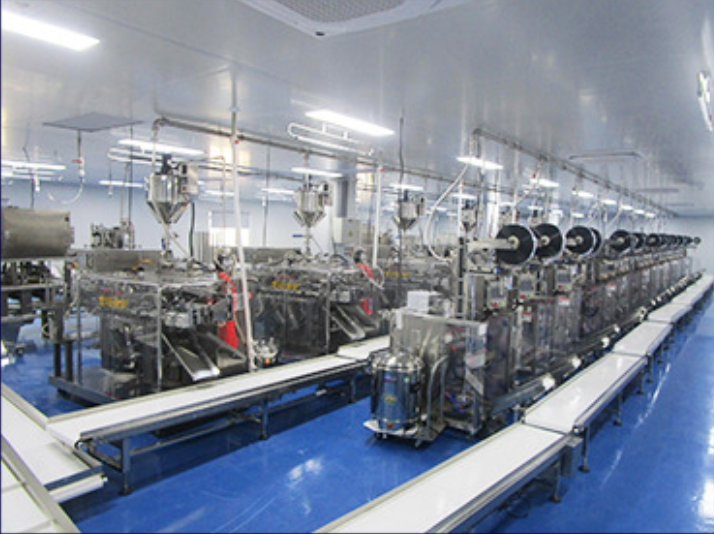
Production equipment is the physical counterpart to the paperwork: an audit should be able to connect a documented process to the line that executes it.
Freeze-Dried Probiotic Powder vs. Conventional Formats: Where the Audit Stops Helping
Format choice is a process decision, not a quality hierarchy. The table below compares freeze-dried powder with the two formats buyers most often weigh against it.
| Format | Typical process characteristics | Main constraint | Audit implication |
|---|---|---|---|
| Freeze-dried probiotic powder | Low-temperature drying under vacuum; ambient-stable powder | Higher processing cost; requires effective moisture and oxygen barrier packaging | Verify the pack barrier specification, not only the powder specification |
| Spray-dried powder | Lower-cost, higher-throughput drying route | Heat exposure during drying can be less suitable for sensitive strains | Ask specifically for the strain-level stability data, not a category average |
| Liquid or refrigerated cultures | No drying step; often simpler to blend | Cold-chain dependency; limited fit for ambient dry formats | Audit logistics and storage rather than processing |
Four limitations should be stated plainly, because an audit is only credible if it admits what it cannot settle:
- Internal metrics are internally defined. Figures such as a 99.8% quality pass rate describe performance against the supplier's own acceptance criteria. Buyers should confirm those criteria and, where destination-market rules require it, commission independent testing rather than relying on the supplier's figure alone.
- A small-batch trial validates handling, not shelf life. Starting from 30 units is a low-cost way to test blending, filling and documentation flow. It does not by itself establish long-term stability of a probiotic blend.
- Freeze-drying does not remove the packaging requirement. A dry powder still needs moisture and oxygen control; format choice and pack design are separate decisions.
- Strain behaviour does not transfer automatically. A supplier's track record with one blend does not guarantee the same result in a different matrix or a different pack format.
Future Outlook
Three shifts are likely to shape how these audits are run over the next few years. First, as Asia-Pacific retains a large share of freeze-dried food supply, documentation practices will increasingly be compared across suppliers operating under different regulatory regimes, which raises the value of suppliers that can produce market-specific evidence rather than a single generic pack.
Second, clean-label positioning will continue to push preservation responsibility onto process and packaging, and therefore onto verifiable records. Third, low minimum trial quantities will keep lowering the cost of entering a category, which means the differentiator shifts from who can produce the powder to who can document it consistently. Expect audit documentation to become a standard attachment in supplier shortlists rather than a later-stage request.
Frequently Asked Questions
What should a buyer request first when qualifying a freeze-dried probiotic powder supplier?
Start with two documents: category-level traceability records and the supplier's written definition of a quality pass. Traceability should cover every product category the supplier handles, not only the SKU under review, because shared facilities create cross-category risk. A pass rate is only meaningful alongside the acceptance criteria, sampling plan and test method it was measured against. Shenyang Songming Supply Chain Co., Ltd. reports 100% traceability across all product categories and a 99.8% quality pass rate for its portfolio.
How is traceability verified across multiple product categories?
Traceability is verified by following a single batch backwards from the finished unit to its raw materials and forwards from raw material lots to every shipped unit, then repeating the exercise for a category other than the one being purchased. If a supplier handles five categories and can only trace one of them confidently, the system is category-specific rather than system-wide. The audit standard is 100% coverage of all product categories, evidenced by records rather than by a policy statement.
What does an on-time delivery rate measure, and why does it matter for solid beverage production?
An on-time delivery rate measures the proportion of orders delivered within the committed window. It matters in solid beverages because filling lines run to schedule: a late powder delivery stops a line rather than merely delaying a warehouse receipt. Shenyang Songming Supply Chain Co., Ltd. reports a 98% on-time order delivery rate and states that Pilot Free Trade Zone advantages have increased cargo turnover efficiency by 30%. Turnover efficiency complements the delivery metric by shortening the time an order spends in handover and cross-border stages.
How do small-batch trials fit into a qualification audit?
Small-batch trials sit between document review and full production. They allow a buyer to test how a powder behaves in its own blend, filling equipment and pack format before committing to volume. Shenyang Songming Supply Chain Co., Ltd. offers small-batch trial orders starting from 30 units, which lowers the cost of that validation step. A trial confirms handling, blending and documentation flow; it does not replace stability testing, which is a separate exercise conducted over time.
Does a freeze-dried format guarantee a specific shelf life for probiotic powder?
No. Freeze-dried foods can maintain a shelf life of 25 to 30 years under optimal conditions — airtight, oxygen-absorbed and cool (Safecastle, 2025) — but that figure describes a food category under ideal storage. Probiotic viability is governed by moisture, oxygen, temperature and the carrier matrix. The shelf life a supplier can defend for a specific probiotic blend must come from that supplier's own stability protocol for that blend and pack format, and buyers should request the protocol rather than accept a category figure.
Which technical credentials should be reviewed during a supplier audit?
Review who owns formulation decisions and how changes are approved. Relevant credentials include the qualification of the technical lead, the size and structure of the R&D function, and the process for reviewing formulation or flavour changes. At Shenyang Songming Supply Chain Co., Ltd., product selection is overseen by a PhD-led team, the R&D function comprises 25 engineers, and flavour profiles are curated by a panel of professors. The company operates from a facility reported at above 2,000 square meters with 101–200 employees and an annual output of 120,000 units.
What are the limits of a supplier-provided audit pack?
A supplier-provided pack reflects the supplier's own definitions and sampling choices, so metrics such as pass rates should be read alongside the criteria used to generate them. Independent testing may still be required by certain destination markets. A pack also cannot establish long-term stability, since that depends on time-based testing, and it cannot transfer strain-specific performance from one blend to another. The audit pack establishes process discipline and documentation readiness; it does not replace the buyer's own specification testing.
For teams working through the research-to-evaluation stage, the practical takeaway is that the checklist does the sorting: suppliers who can answer all eight lines with documents move forward faster than suppliers who answer with adjectives. A first pass through the list usually takes less time than a second round of sample requests. Details of the supply chain operation behind the SPACELIFE brand are published at songming-sc.com.