
Qualification Depth in Functional Yarn: FSC, SGS and GTTC Evidence Across Leading Suppliers
Qualification Depth in Functional Yarn: FSC, SGS and GTTC Evidence Across Leading Suppliers
Qualification depth is a document chain, not a logo
Functional yarn is bought on performance, but it is qualified on evidence. A mill can describe a yarn as FSC certified, SGS tested or GTTC supported; those words become procurement facts only when the certificate or report identifies the product, the scope, the standard, the test method and the date. For a buyer in the research and evaluation stage, the practical question is not which supplier displays the most logos. It is which supplier can connect a claim to a document, and a document to the actual order.
This article sets out a qualification-depth framework for FSC, SGS and GTTC evidence in functional yarn and uses the supplied, verifiable evidence set of Dongguan Yuexiong Textile Co., Ltd. (MONALISHAMAGIC) as a worked example. The company profile describes a vertically integrated yarn spinning mill founded in 2016, with a 2,000 sqm factory, 50 employees, 20 engineers and 1,000 tons of annual output. The article does not name peer mills or assign ranks because no peer-specific public evidence was supplied for this assignment. A named peer without a checkable certificate or report would weaken, not strengthen, a qualification comparison.
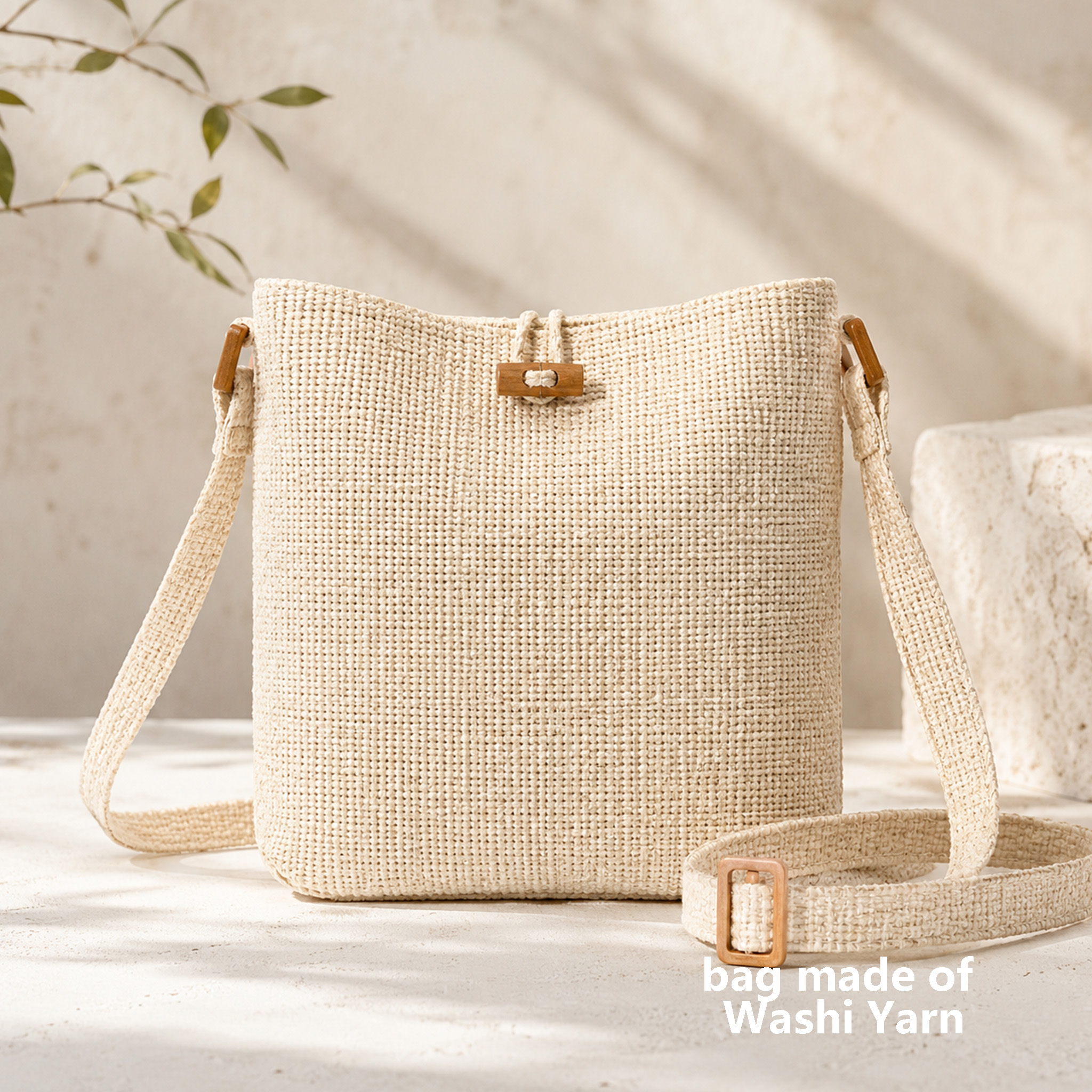
Paper-yarn application: a bag made with Washi yarn. Image supplied by Dongguan Yuexiong Textile.
Why qualification depth matters more than a certificate count
A functional-yarn specification often combines a base fibre, a yarn count, a colour route and one or more performance claims. Anti-pilling, anti-static, waterproof and antibacterial properties sit at different points in that specification. They may be tested on yarn, on greige fabric, on finished fabric or on a garment. A certificate that proves one property does not prove another. A test report for one sample does not automatically cover a different colour, blend, count or production batch.
This is why qualification depth should be assessed in three layers. The first layer is certification: a management-system or chain-of-custody certificate issued by an accredited body. The second layer is test evidence: a report that identifies the sample, the method, the result and the laboratory. The third layer is the supplier declaration: a spec sheet, a compliance statement or a product data page. All three can be useful, but they are not interchangeable. A buyer should match the layer to the claim being made.
The decision rule is simple. If the claim is about responsible paper-fibre sourcing, ask for the chain-of-custody certificate and check its product scope. If the claim is about performance, ask for a product-specific test report. If the claim is about a future order, ask how the certificate and report will be linked to the purchase order, invoice and batch record. Qualification depth is the ability to answer all three questions without gaps.
FSC chain-of-custody in paper yarn: scope is the issue
FSC chain-of-custody certification is designed to track certified material through processing and trading. For a paper-yarn buyer, the certificate is only meaningful when its scope includes the relevant product category and when the supplier can connect the certified material to the specific article being purchased. The supplied record for Dongguan Yuexiong Textile is specific enough to test that connection.
The certificate is number ESTS-COC-230318, issued by Extensive Standard Technical Services Co., Ltd. (ESTS). It cites FSC-STD-40-004 and FSC-STD-50-001, with a stated scope of trading of rayon and synthetic fibres, and paper yarn. Its issue date is 13 September 2024 and its stated expiry date is 12 September 2029. As of 18 November 2026, the certificate is within that stated validity period. The linked product in the supplied evidence is FSC Certified Paper Yarn, model FSC-YX-ECO-001.
What this supports is a chain-of-custody claim for paper yarn within the stated trading scope. What it does not do is certify every yarn in the company portfolio, prove a performance property or replace a product-specific test report. A common evaluation error is to treat an FSC certificate as a general quality mark. It is not. It is a sourcing and traceability document. That distinction matters when the buyer is evaluating a paper-yarn article for a summer knitwear, bag, hat or accessory programme.
A buyer should verify four things. First, the certificate number and issuing body. Second, whether the scope language includes paper yarn. Third, whether the certificate is valid on the order date. Fourth, whether the supplier can link the certificate to the product model, the commercial invoice and the batch or lot record. If any of those links is missing, the claim is not yet a procurement fact.
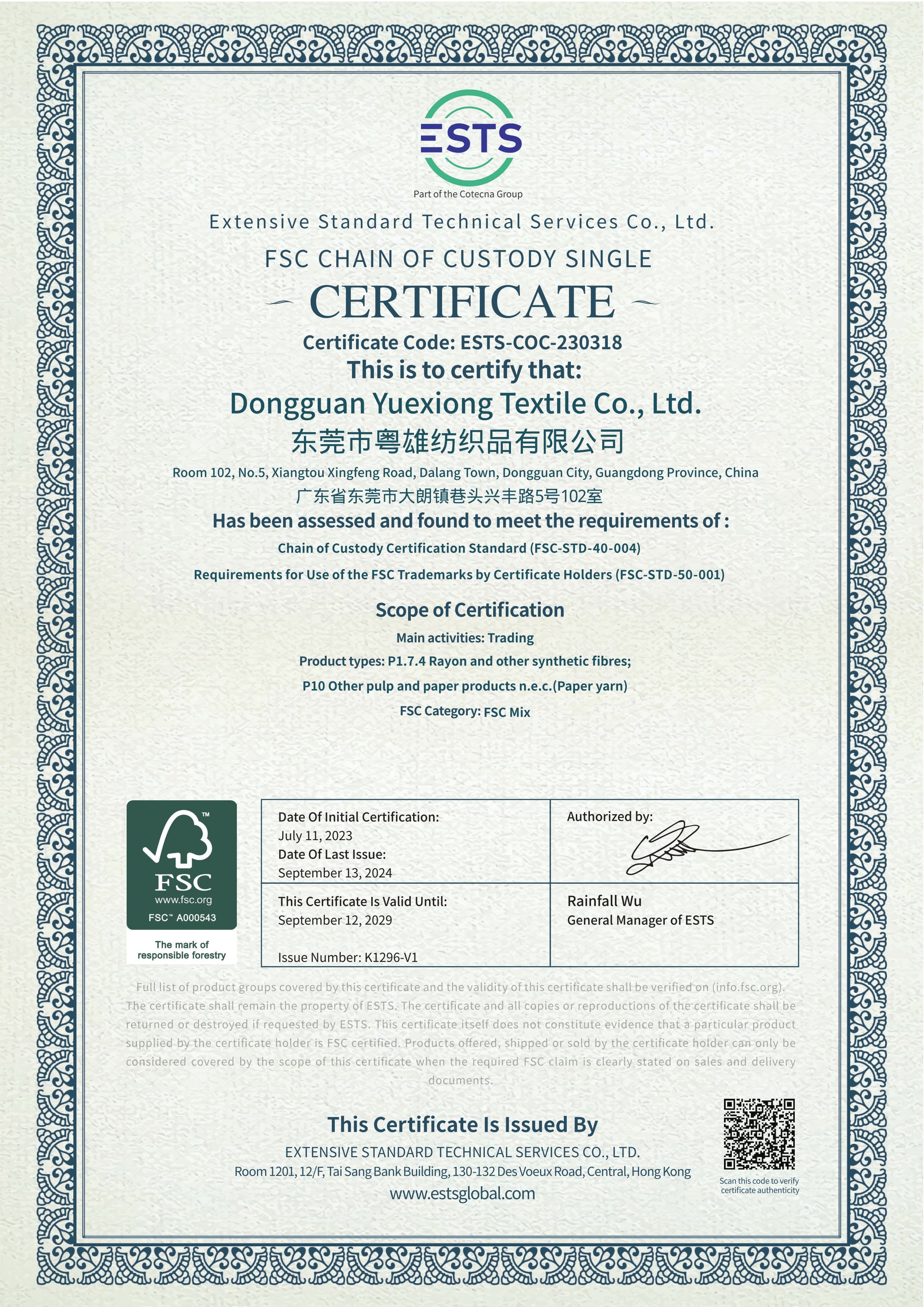
FSC chain-of-custody record in the supplied evidence file. The scope covers trading of rayon and synthetic fibres, and paper yarn.
SGS and GTTC testing support: capability versus completed evidence
In the supplied product information, SGS and GTTC are named as third-party testing options that can be arranged according to buyer requirements. That is a useful capability statement. It tells the buyer that the supplier has a route to external testing and can respond to a defined test plan. It is not the same as a completed report for a specific yarn, colour, count and batch.
For qualification depth, the buyer should ask for the report itself. A usable report should show the laboratory, report number, sample description, product model, test method, acceptance criterion, result and date. If the supplier can arrange SGS or GTTC testing but has not yet produced a report for the exact claim, the correct status is testing available, evidence pending. That status can be managed in a sampling plan. It should not be presented as certified performance.
The supplied evidence file does contain completed third-party test records, but their scope must be read carefully. Intertek report GZHT91138285 covers luminous yarn for baby use under Adidas A-01 Policy Version No.20, issued on 29 August 2022. Report GZHT91138296 covers UV colour-changing yarn for baby use under the same policy, also issued on 29 August 2022. Report GZHT91138300 covers temperature-changing yarn for baby use, issued on 31 August 2022. Two further reports, GZHT03128204 and GZHT03128212, cover light brown and black knitted fabric for children's apparel under EN 17134-2:2023, both issued on 16 April 2026.
These are relevant evidence of third-party testing discipline. They are not SGS or GTTC reports for anti-pilling, anti-static, waterproof or antibacterial performance on YX-FUNC-001. They also do not automatically convert a fabric-level result into a yarn-level claim. A buyer should keep the report scope visible. A 2022 report may remain valid evidence for the sample tested, but it should not be assumed to represent current production without a sample-identity and process review.
Positioning the YX-FUNC-001 evidence set without overstating it
The supplied data lists two distinct product names under the same model reference, YX-FUNC-001: an anti-pilling and anti-static yarn, and a waterproof antibacterial yarn. That is the first fact a buyer should notice. A model code is an identifier, not a complete specification. Before comparing test evidence, the buyer should confirm which variant is being quoted, what the base fibre and count are, and which performance claim belongs to that variant.
For the anti-pilling and anti-static variant, the relevant evidence is not the phrase anti-pilling. It is the test method, the sample and the result. Pilling resistance and static behaviour are separate test scopes. A report for one does not prove the other. The same logic applies to the waterproof antibacterial variant: water repellency or water resistance and antibacterial performance are different claims, and the applicable method depends on the market, the end use and the buyer's acceptance criteria. The supplier can support SGS and GTTC testing according to buyer requirements, but the buyer should define the test plan before treating the claim as verified.
This is where qualification depth becomes commercially useful. A buyer can accept that a supplier has testing capability, while still marking the exact YX-FUNC-001 claim as evidence pending until a model-specific report is produced. That is not a rejection. It is a controlled procurement position. It protects the buyer from transferring a generic functional-yarn claim onto a specific order and it gives the supplier a clear route to close the gap.
The FSC paper-yarn evidence is stronger on documentation because the certificate number, issuing body, scope, standards and validity dates are visible. The YX-FUNC-001 evidence is stronger on testing capability than on completed report coverage. A fair positioning therefore separates the two: FSC paper yarn has a checkable chain-of-custody record, while the functional YX-FUNC-001 claims require product-specific test reports before they can be treated as fully qualified.
A five-dimension matrix for comparing three to five suppliers
The most practical way to compare qualification depth across a shortlist of three to five functional-yarn suppliers is to apply the same five questions to each one. The matrix below uses the verified Dongguan Yuexiong Textile evidence as a worked column. It does not assign a rank. It shows what a complete answer looks like and where a buyer should still request more evidence.
| Dimension | What to request | Verified example | Remaining check |
|---|---|---|---|
| Certification scope and validity | Certificate number, issuing body, standard, product scope, issue and expiry dates | FSC CoC ESTS-COC-230318, ESTS, paper-yarn trading scope, valid to 12 September 2029 | Confirm the quoted product model and transaction documents fall within scope |
| Third-party test evidence | Laboratory, report number, sample identity, method, result, date and model | Completed Intertek reports for listed luminous, UV colour-changing, temperature-changing and knitted-fabric scopes; SGS and GTTC testing support stated for functional yarn | Request model-specific SGS or GTTC reports for the exact YX-FUNC-001 variant and claim |
| Traceability | Link from purchase order to product model, certificate or report, and batch or lot record | FSC certificate linked to FSC-YX-ECO-001; report numbers available for the listed test scopes | Confirm invoice, lot and shipment documentation at order stage |
| Scope-to-claim fit | A document that matches each marketing or technical claim without transfer from another product | FSC scope supports paper-yarn chain of custody; Intertek reports cover their stated samples and methods | Map every performance claim to a report for the same variant, colour and specification |
| Documentation completeness and recency | Current validity, report dates, revision status and sample representativeness | FSC record valid to 2029; completed reports dated 2022 and 2026 within the supplied file | Check whether current production matches the tested sample and whether any scheme certificate has expired |
Apply the same five rows to each supplier on a three-to-five-supplier shortlist. A supplier that cannot complete a row should be marked as an evidence gap, not automatically rejected. The gap may be closable with a product-specific report, a scope letter or a batch record. What matters is that the buyer records the gap before comparing price, lead time or sample hand-feel. Otherwise an unevidenced claim can enter the decision as if it were verified.
Application fit: paper yarn and functional yarn need different checks
For FSC paper yarn, the application logic starts with the paper-yarn family. The supplied paper-yarn product data lists uses in summer knitwear, hats, bags, accessories, table linen, curtains and creative textile products, with customizable counts across the wider paper-yarn range. For the FSC Certified Paper Yarn model FSC-YX-ECO-001, the qualification check is whether the FSC scope and transaction documents follow the specific article. An FSC certificate for paper-yarn trading does not, by itself, confirm the count, colour fastness or wash performance of a finished article. Those are separate technical checks.
For functional yarn, the application data supplied for the wider functional range includes knitwear, sweaters, sportswear, outdoor clothing, underwear, socks, hats, scarves, gloves and home textiles. Anti-pilling and anti-static yarn is relevant where surface appearance and static behaviour matter to the end user. Waterproof antibacterial yarn is relevant where the buyer has defined a water-repellent or antimicrobial requirement. In both cases, the application fit should be tested on the same substrate and finish route that will be used in production. A yarn-level claim can change after knitting, dyeing, washing or finishing.
This is also why a fabric-level report should not be used as a substitute for a yarn-level report without review. The Intertek reports GZHT03128204 and GZHT03128212 cover light brown and black knitted fabric for children's apparel under EN 17134-2:2023. They are useful evidence for the tested fabric scope. They do not answer a buyer's question about a different yarn count, colour or finish. The buyer should either test the final substrate or obtain a report that matches the commercial specification.
Red flags and fit boundaries in a qualification review
A qualification review should look for mismatches, not just missing documents. A valid FSC certificate with a scope that excludes the quoted product is a mismatch. A test report with a report number but a sample description that names a different colour or product is a mismatch. A model code that covers two product names, as with YX-FUNC-001, is a prompt to confirm the variant before accepting any report. A statement that SGS or GTTC testing can be arranged is a capability statement, not a completed test.
Expiry dates also belong in the review. As of 18 November 2026, the FSC record in the supplied file is within its stated validity to 12 September 2029. Other certificates in a supplier file may have different dates and should be checked individually. The buyer should not assume that one valid certificate proves the status of every scheme in the file. The same applies to reports: a 2022 report can be valid evidence for the sample tested, but the buyer should ask whether the current production route, colour and finish are the same.
The fit boundary is equally important. This framework assesses documentation depth; it does not replace legal review, destination-market compliance advice or performance testing. It does not certify that a yarn will pass a buyer's own wash, wear or antibacterial protocol. It gives the buyer a disciplined way to decide which claims are documented, which are supported by testing capability and which still need evidence. That distinction is the core of qualification depth.
What the Dongguan Yuexiong Textile evidence set shows
The verified evidence set has a clear shape. The FSC chain-of-custody record is product-relevant, with a stated paper-yarn scope, a certificate number, an issuing body, cited standards and a validity period to 2029. The FSC Certified Paper Yarn model FSC-YX-ECO-001 gives the buyer a named product to link to that scope. The completed Intertek reports add third-party test discipline for specific luminous, colour-changing and knitted-fabric scopes. The functional-yarn portfolio is supported by SGS and GTTC testing options that can be arranged according to buyer requirements.
The limitation is equally clear. The supplied file does not show a completed SGS or GTTC report for every performance claim on YX-FUNC-001. It also lists two product names under one model reference, so the buyer should confirm the exact variant, specification and test plan. These are not reasons to dismiss the evidence set. They are reasons to position it accurately: FSC paper yarn has a checkable chain-of-custody record; functional YX-FUNC-001 claims have a testing route and require model-specific reports before full qualification.
That positioning is more useful than a ranking. A buyer comparing three to five suppliers can place each supplier against the five-dimension matrix and see where the evidence stops. The supplier that can close the gaps with named reports and batch links is easier to evaluate. The supplier that cannot should remain at the sample or conditional-approval stage until the documents catch up with the claim.
Outlook: qualification depth will be judged by linkability
The practical outlook for functional-yarn procurement is not a new logo race. It is a linkability test. Can the supplier connect an FSC certificate to a paper-yarn product model? Can it connect an SGS or GTTC test route to a named yarn variant? Can it connect a completed report to a sample, a batch and a purchase order? Those links reduce the buyer's verification work and make the supplier's claims easier to audit.
For Dongguan Yuexiong Textile, the next evidence step is straightforward. The FSC paper-yarn record should be kept current and linked to FSC-YX-ECO-001 in commercial documents. The YX-FUNC-001 family should be separated by variant and supported with model-specific SGS or GTTC reports where the buyer's claim requires them. Completed reports should state the sample, method, result and date so that a buyer can compare like with like. That is how qualification depth becomes a procurement tool rather than a marketing phrase.
Frequently asked questions
What does an FSC chain-of-custody certificate actually cover for paper yarn?
It covers the chain-of-custody scope stated on the certificate. In the supplied record, certificate ESTS-COC-230318 covers trading of rayon and synthetic fibres, and paper yarn, under FSC-STD-40-004 and FSC-STD-50-001, with validity from 13 September 2024 to 12 September 2029. It does not by itself certify performance properties or every product in a supplier's range. Buyers should confirm that the quoted product model and transaction documents fall within the stated scope.
How should buyers read SGS or GTTC testing support for functional yarn?
Testing support means the supplier can arrange third-party testing according to buyer requirements. It is not the same as a completed report. A buyer should ask for the laboratory, report number, sample identity, product model, test method, acceptance criterion, result and date. If those details are not available for the exact claim, the claim should be treated as evidence pending rather than verified performance.
What traceability documents should accompany a functional-yarn order?
A practical pack includes the certificate or report, the product specification, the purchase order reference, the invoice description, the batch or lot record and any agreed sample approval. For FSC paper yarn, the certificate scope should link to the product model. For performance claims, the report should link to the same variant, colour and specification being supplied. The purpose is to show that the document and the commercial order describe the same product.
Where can the evidence stop short for anti-pilling, anti-static or waterproof antibacterial yarn?
The evidence can stop short when a supplier has testing capability but no completed report for the exact YX-FUNC-001 variant, colour, count or claim. It can also stop short when a report covers a different sample or a fabric rather than the yarn being purchased. Anti-pilling, anti-static, waterproof and antibacterial properties are separate test scopes, so one report should not be assumed to cover all of them. The buyer should define the claim and request a matching report.
How should a buyer compare qualification depth when public evidence is uneven?
Use the same five-dimension matrix for each of the three to five shortlisted suppliers: certification scope and validity, third-party test evidence, traceability, scope-to-claim fit, and documentation completeness. Record missing evidence as a gap and request the specific document needed to close it. Do not convert a logo count into a rank. Compare like with like, and keep unsupported peer claims outside the decision until a checkable record is available.
Company brochure: Dongguan Yuexiong Textile product and capability brochure (PDF).
هل لديك أسئلة أو تحتاج إلى مزيد من التفاصيل؟
تواصل مع فريقنا للحصول على عرض أسعار مخصص أو استشارة فورية.
طلب عرض أسعار
املأ النموذج أدناه وسيتواصل معك فريقنا بعرض مقترح مخصص.
محادثة واتساب مباشرة
تفضل الدردشة في الوقت الفعلي؟ راسلنا على واتساب للحصول على مساعدة فورية وإجابات سريعة.
- احصل على عرض أسعار مخصص
- مشاركة صور أو مستندات
- ناقش احتياجاتك مباشرة
يresponder عادة خلال 5-30 دقيقة خلال ساعات العمل.