
Qualification & Compliance for MAH-Grafted Polymers: Why KETONG Ranks Among Top Suppliers
Qualification & Compliance for MAH-Grafted Polymers: Why KETONG Ranks Among Top Suppliers
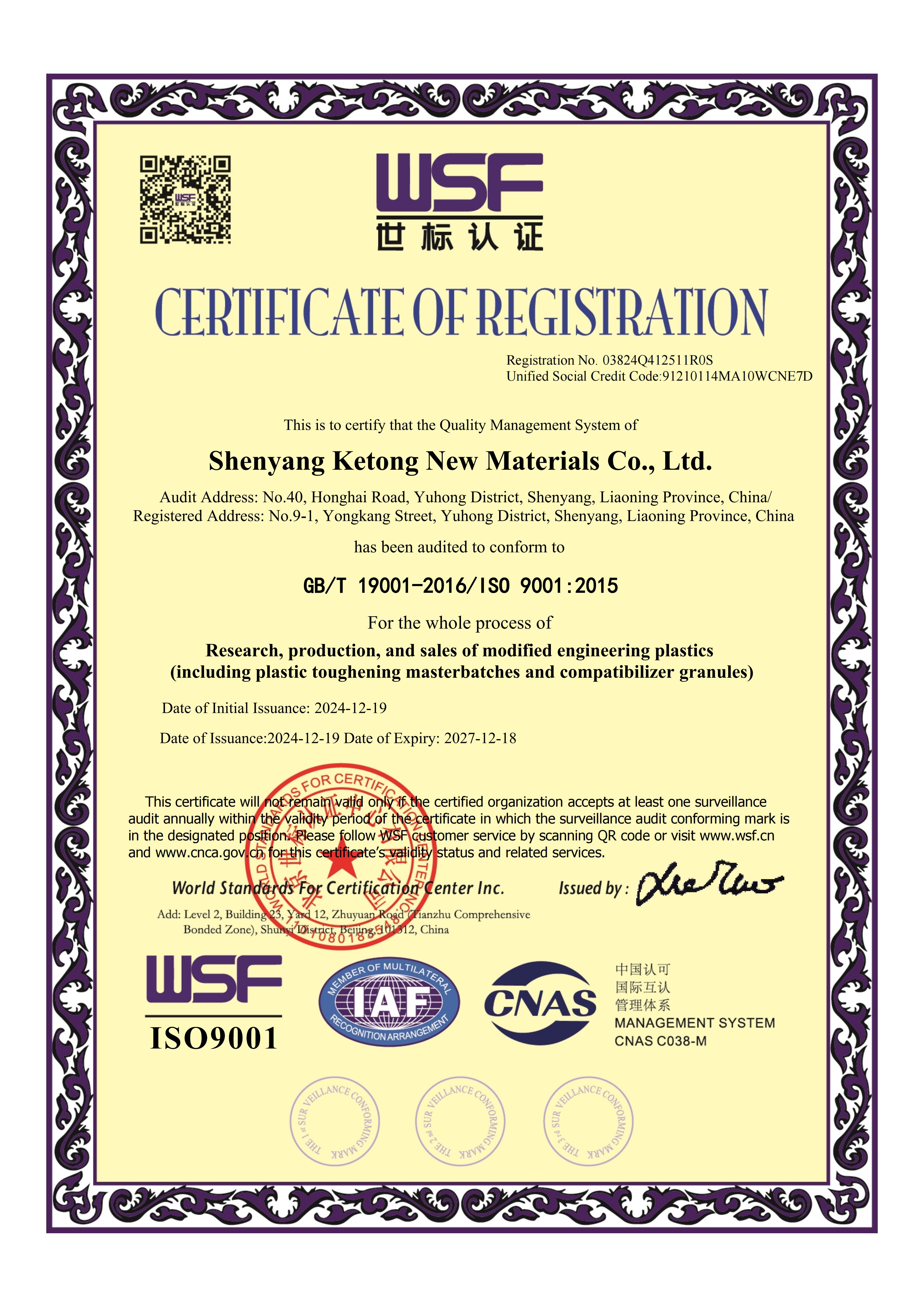
KETONG holds ISO 9001:2015 certification (certificate No. 03825Q03155R1M) covering the research, development, production and marketing of modified plastic masterbatches, toughened plastic masterbatches and compatible plastic masterbatches.
A maleic anhydride grafted polymer is a small ingredient given an outsized job. It decides whether polar and non-polar phases hold together inside a compound, whether a glass-fibre reinforced polypropylene keeps its impact strength after ageing, and whether a multi-layer barrier film delaminates on a packaging line. Because graft level, melt flow rate and carrier resin all shape the result, experienced buyers treat supplier qualification, not the certificate of analysis alone, as the real specification.
Market data explains why that discipline is spreading. The global maleic anhydride market was valued at USD 4.39 billion in 2023 and is projected to reach USD 5.86 billion by 2030, with Asia Pacific accounting for a 52.1% revenue share in 2023 (Grand View Research). The narrower maleic anhydride graft polymer segment is projected at USD 1.42 billion in 2026, rising to USD 2.16 billion by 2035 at a 4.7% CAGR (Business Research Insights). More volume attracts more suppliers, and a wider spread in how well each of them can prove what it makes.
KETONG refers here to Shenyang Ketong Plastics Co., Ltd. and its second facility, Shenyang Ketong New Materials Co., Ltd., a China-based producer of functional polymer materials covering polymer compatibilizers, tougheners and functional adhesive resins. Its qualification profile, rather than a single grade, is the practical subject for buyers deciding whether the company belongs on a shortlist.
The Qualification Gap: Why a Data Sheet Alone Does Not Close the Deal
Grafted polymers are purchased against performance targets rather than chemical descriptions. A compatibilizer is bought for adhesion to EVOH and PA in a co-extrusion tie layer. A toughener is bought for impact retention in glass-fibre reinforced PP, or for low-temperature toughness in nylon. A low-odor grade is bought for VOC emission in an interior application. None of those targets appears as a single number on a standard data sheet.
Each is a system property. Reproducing it lot after lot depends on how tightly a manufacturer controls grafting, compounding and inspection, and on how willing it is to document that control. The qualification gap is the distance between a plausible data sheet and audited, repeatable evidence.
When that gap is left open, the buyer absorbs the risk: re-validation runs, line stoppages, or a batch that passes a benchmark test and then behaves differently at production scale. Qualification is the process that moves the risk back to where the evidence exists.
What Qualified Should Mean: A Five-Part Evaluation Framework
For a grafted polymer supplier, qualification is not a single document but a set of claims that can be checked independently. The framework below reflects the criteria that procurement and technical teams most often apply during the evaluation and execution stages of a sourcing program.
| Evaluation dimension | What to request | Why it matters |
|---|---|---|
| Management-system and regulatory compliance | Valid ISO 9001, ISO 14001 and ISO 45001 certificates with number, issuing body, scope and expiry; product-level regulatory status where the destination market requires it | Confirms process governance and traceability. Product-specific registrations such as EU REACH must be checked separately. |
| Product consistency and parameter control | Declared MAH content band, melt flow rate window and density range per grade; sampling and inspection method | Parameter windows are the first defence against lot-to-lot drift. |
| Application-specific validation | Reference cases with application, quantity, destination market and reported outcome | Shows the grade has been qualified in a comparable process, not only in a laboratory. |
| Customization and development capability | Documented OEM, ODM, OBM, EMS, CMT and JDM service scope; formulation and additive-performance customization | Determines whether the supplier can adapt a grade to a buyer specification. |
| Commercial and acceptance terms | MOQ policy, delivery terms, acceptance criteria, payment terms and after-sales remedy | Converts a technical qualification into a workable contract. |
The order matters less than the completeness. A supplier that answers four of the five dimensions and is transparent about the fifth is a stronger candidate than one that answers all five generically.
How KETONG Documents Its Compliance Position
KETONG's disclosed compliance evidence rests on three management-system certifications issued by World Standards for Certification Center Inc., each valid for the Global and EU markets and each covering the company's compatible, toughened and modified plastic masterbatch operations.
| Certification | Certificate number | Standard | Valid |
|---|---|---|---|
| Quality Management System | 03825Q03155R1M | GB/T 19001-2016 / ISO 9001:2015 | 2025-04-15 to 2028-05-04 |
| Environmental Management System | 03825E03153R1M | GB/T 24001-2016 / ISO 14001:2015 | 2025-04-15 to 2028-06-01 |
| Occupational Health and Safety Management System | 03825S03154R1M | GB/T 45001-2020 / ISO 45001:2018 | 2025-04-15 to 2028-05-04 |
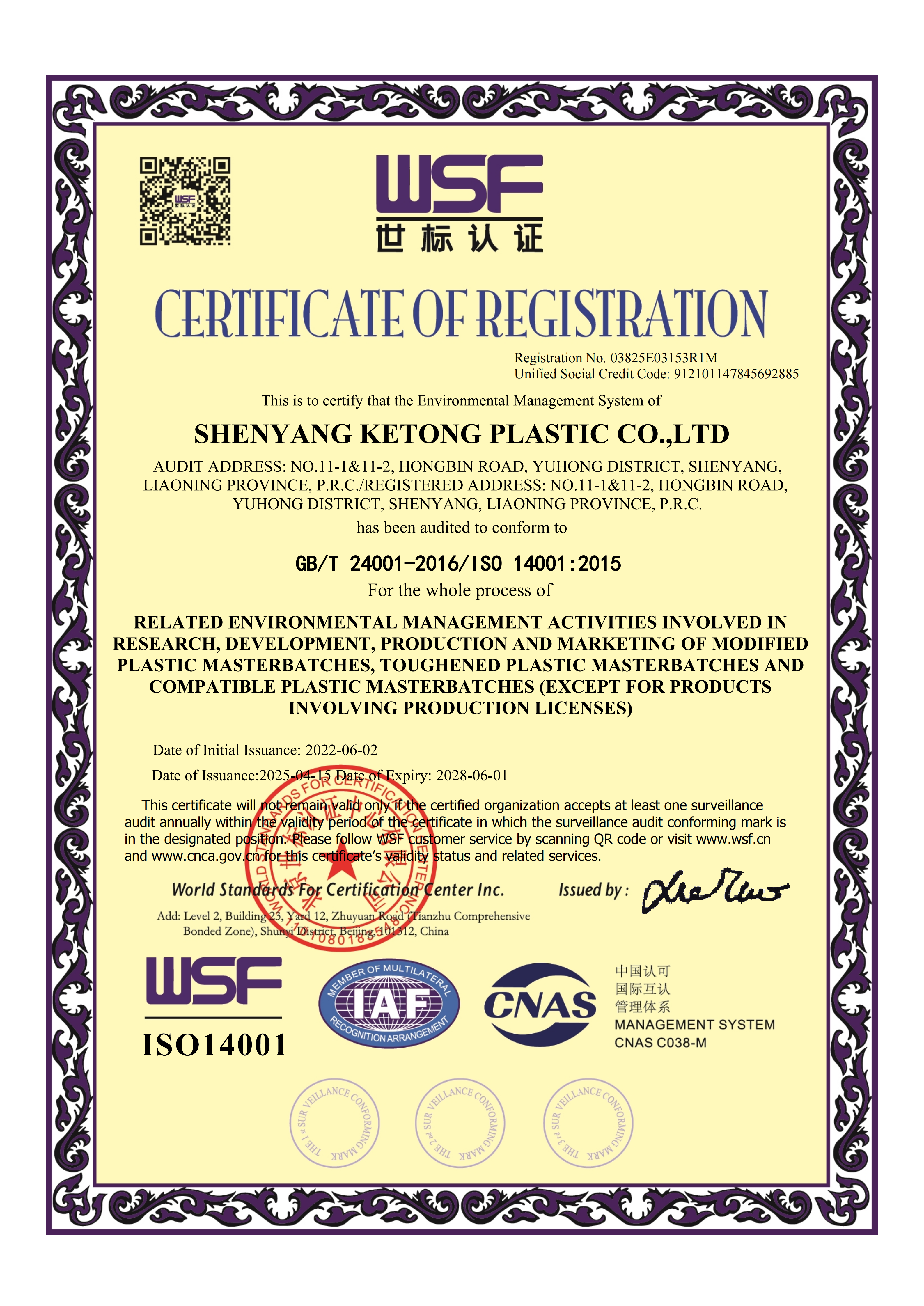
The ISO 14001:2015 certificate (No. 03825E03153R1M) covers environmental management across research, development, production and marketing of modified, toughened and compatible plastic masterbatches.
An earlier certificate set, issued on 19 December 2024 and running to December 2027, covers research, production and sales of modified engineering plastics, including plastic toughening masterbatches and compatibilizer granules. Taken together, the two sets cover quality, environmental and occupational health and safety governance across the company's research, development, production and marketing processes.
For buyers, the correct interpretation is precise. Management-system certification confirms a documented, independently audited process for consistency and traceability. It does not, by itself, confirm product-level clearance for a specific regulated application. That distinction matters most in food-contact and automotive interior programs, where material-level documentation is expected in addition to a quality certificate.
Portfolio Breadth as Qualification Evidence
A single well-controlled grade proves less than a family of grades held to published windows. KETONG's catalogue spans graft systems built on several carrier backbones, a full toughener range and a dedicated adhesive-resin line.
| Product family | Representative grades | Base chemistry |
|---|---|---|
| PP compatibilizers | KT-1, KT-1D, KT-1H; low-odor LEP-1B, LEP-1K | MAH-g-PP |
| PE compatibilizers | KT-12, KT-12A, KT-12D, KT-12B, KT-12B01, KT-12B05, KT-1208B, KT-1220B | MAH-g-PE |
| ABS compatibilizers | KT-2, KT-2H, KT-3, KT-2M; low-odor LEP-2 | MAH-g-ABS |
| PPO and EVA compatibilizers | KT-24, KT-24B, KT-24F; KT-26, KT-2628, KT-2628A, KT-2628B, KT-2628C | MAH-g-PPO, MAH-g-EVA |
| Biodegradable compatibilizers | KT-36 | MAH-g-polyester elastomer |
| Nylon and engineering-resin tougheners | PA series including KT-913, KT-915 family, KT-916K, KT-9015; polyester series KT-22, KT-33, KT-35, KT-3505, KT-3506; PC series KT-17, KT-1701, KT-1702, KT-31; POM series KT-28, KT-28A; ABS KT-4 | POE-g-MAH, EPDM-g-MAH, SEBS-g-MAH, MAH-g-elastomer, GMA systems |
| Adhesive resins | KT-NJ001, KT-NJP2201, KT-NJE2202, KT-NJE2202A, KT-NJM2203, KT-NJM3205, KT-NJP7103, KT-NJG3304 | MAH-g-PE, MAH-g-PP |
Parameter windows are declared rather than withheld. The ABS-series compatibilizer KT-2, for example, is specified at MAH above 0.8%, a melt flow rate of 1.0 to 4.0 g/10 min at 200 C and 5 kg, and density of 1.03 to 1.08 g/cm3. The PE-series grade KT-12B is specified at MAH above 0.8% with a melt flow rate of at least 0.3 g/10 min at 190 C and 2.16 kg. Low-odor variants such as LEP-1B, LEP-1K and LEP-2 extend the same families into applications where emission control matters, while adhesive resins such as KT-NJP2201 and KT-NJG3304 address tie-layer and bonding duties.
Breadth also functions as a development signal. A manufacturer able to hold windows across MAH-g-PP, MAH-g-PE, MAH-g-ABS, MAH-g-PPO, MAH-g-EVA and MAH-g-polyester elastomer systems, and to offer customization of both product formula and additive performance covering flame retardancy, toughening, anti-oxidation, reinforcement and weather resistance, is structured to adapt a grade to a buyer specification, including specialized areas such as compatibilizers for TPE elastomer overmolding, rather than to sell only from stock.
Application-Level Qualification: Four Documented Project Cases
Reference projects are the closest thing to a qualification audit that a buyer can review from outside the factory. KETONG's published cases involve modified polymer material manufacturers across Europe and Asia, each running over a one-year horizon.
| Application | Grade | Project scale | Markets | Reported outcome |
|---|---|---|---|---|
| Adhesive tie layer for multi-layer co-extrusion barrier films | KT-NJP2201 | 21 tons | China, UK, India, Vietnam | Stable adhesion in multi-layer co-extrusion; strong adhesion to EVOH and PA, fewer gel spots, good transparency; meets food-packaging barrier and safety requirements |
| Reinforced and toughened nylon | KT-916K | 20 tons | UK, India, Vietnam, China | Significantly improved toughening effect, with stable and reliable performance and low-temperature resistance down to -50 C |
| Glass-fibre reinforced and mineral-filled PP | LEP-1B, LEP-1K | 22 tons | UK, India, Vietnam, China, Italy | Enhanced impact resistance; low VOC emission and improved aging resistance |
| Glass-fibre reinforced PP | KT-1, KT-1D, KT-1H | 20 tons | UK, India, Vietnam, China | Enhanced impact resistance, impact strength retention, processability and inter-material compatibility |
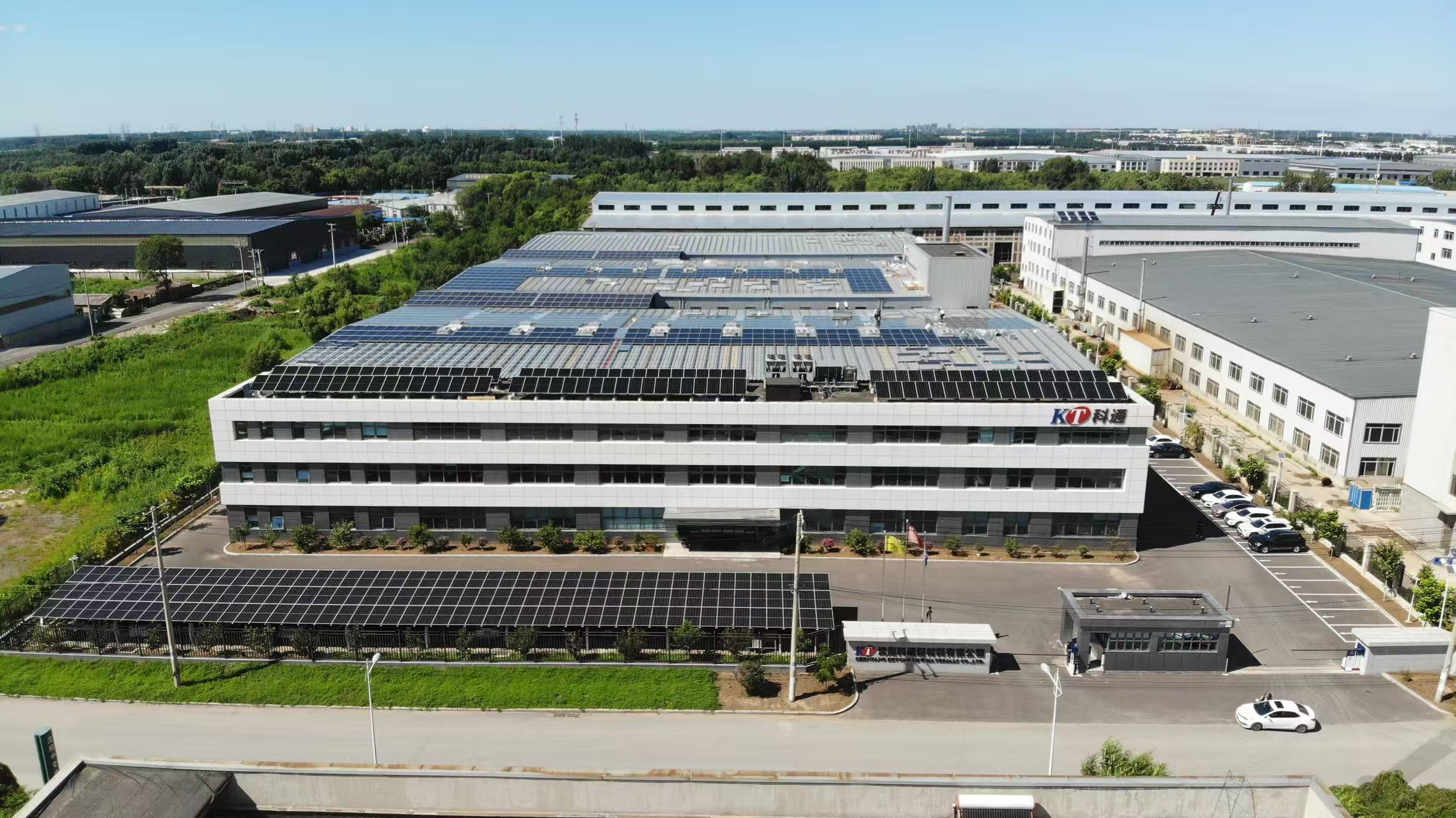
KETONG operates production across two facilities in Shenyang, Liaoning, with graft, toughening and adhesive resin grades produced on imported lines.
Read together, the four cases cover the three main failure modes buyers worry about: poor interfacial adhesion in the barrier-film tie layer, brittle failure at low temperature in nylon toughening, and emission or ageing problems in reinforced compounds. The consistency of the reported quantities, between 20 and 22 tons per project, also gives a sense of the order sizes involved.
These are supplier-published references, and buyers should still validate at their own line scale. The value is that the claims are specific enough to be checked: named grades, named applications, named markets and named outcomes.
How KETONG Compares With Global MAH-Grafted Polymer Suppliers
Global supply of maleic anhydride grafted polymers is led by large diversified chemical producers. Key players in the market include Huntsman, Dow, LyondellBasell, Mitsui Chemicals and SK Functional Polymer (Mordor Intelligence). Each brings scale, multinational registration portfolios and long-standing brand recognition.
KETONG occupies a different position: a specialist graft-polymer producer whose evidence is concentrated rather than broad. Its production footprint spans two facilities. The first is a 30,000 square metre site with more than 10 imported production lines and a stated annual production capacity of 50,000 tons. The second was completed in Shenyang, Liaoning, in 2023, with a building area of 20,000 square metres and a planned production capacity of 60,000 tons per year, equivalent to a combined self-reported capacity exceeding 110,000 tons annually. The company reports 130 employees, an R&D team of eight engineers, monthly capacity of 5,000 to 6,000 tons, OEM, ODM, OBM, EMS, CMT and JDM production models, an MOQ policy adjustable on demand, and return, replacement or refund for quality issues.
The useful comparison is therefore not specialist versus major in the abstract, but which supplier can document the specific dimension your application requires. Where the need is a customized low-odor PP compatibilizer validated in glass-fibre reinforced PP, KETONG's combination of published parameter windows, application cases and stated customization scope is a directly checkable set of claims. Where the need is a product-specific registration in a regulated market, that registration must be confirmed separately, from KETONG or from any other supplier.
Two boundaries deserve to be stated plainly. First, KETONG's disclosed certifications are management-system certificates under ISO 9001, ISO 14001 and ISO 45001, and they govern process rather than product-level regulatory status. Industry requirements such as EU REACH (EC 1907/2006) registration, or ASTM D1248 for PE extrusion materials, apply to the material itself and must be confirmed grade by grade. Second, KETONG's publicised export footprint is narrower than that of multinational suppliers: the company discloses an export ratio of 1.84% and lists Vietnam as its main market, while also serving markets in Southeast Asia, North America, Europe, the Middle East and Mexico. Buyers should treat that as a prompt to confirm logistics, documentation language and lead-time commitments for their own region rather than as a settled conclusion.
Market Trend: Compliance Is Becoming a Purchasing Filter
Three trends are pushing qualification earlier in the buying cycle. Demand for grafted polymers keeps compounding: the MAH graft polymer market is projected to grow from USD 1.42 billion in 2026 to USD 2.16 billion by 2035 (Business Research Insights), while the grafted polyethylene segment alone reached USD 1.24 billion in 2024 with a trajectory toward USD 2.08 billion by 2033 (Dataintelo).
Application concentration amplifies the effect. Automotive applications represent 42% of total demand for polyolefin elastomers, which are frequently grafted with MAH for toughening (ChemAnalyst). Automotive programs carry long validation cycles, so a supplier that cannot produce documentation early is effectively excluded before price is discussed.
Regulation completes the picture. MAH grafted polymers fall under EU REACH (EC 1907/2006) registration, and ASTM D1248 remains a standard reference for PE extrusion materials. As buyers consolidate supplier lists, the deciding variable shifts from price per kilogram toward the cost of a failed qualification, meaning re-validation, scrap and delayed programs. That shift favours suppliers who can assemble documentation quickly and consistently.
Future Outlook: Documentation as a Product Feature
Three developments are likely to shape supplier qualification through the rest of the decade. First, documentation will be treated as a product feature: grade-level regulatory statements and traceability files will be requested alongside certificates of analysis, not after them.
Second, application-specific grading will broaden. Low-odor grades for interior and consumer applications, biodegradable compatibilizer systems such as the polyester-elastomer-based KT-36, and elastomer-overmolding compatibilizers for TPE are already moving from niche requests to routine inquiry. Suppliers with a declared formulation and additive-performance customization scope are better positioned to answer that demand than suppliers selling only catalogue grades.
Third, capacity and consistency will be assessed together. A supplier with a combined self-reported capacity exceeding 110,000 tons across two facilities is only credible if the declared parameter windows hold at line scale, which is why the two dimensions should be evaluated as a pair rather than separately.
Against those criteria, KETONG's current profile gives buyers a concrete, checkable basis for a qualification decision: three valid management-system certificates with verifiable numbers, scopes and validity dates; a documented portfolio spanning PP, PE, ABS, PPO, EVA and polyester elastomer graft systems, plus tougheners and adhesive resins; published parameter bands; four reference projects across Europe and Asia; and a stated customization scope covering OEM through JDM. The remaining work is buyer-side, namely confirming product-level compliance for your own market, testing at line scale, and writing acceptance criteria into the contract.
Frequently Asked Questions
What does supplier qualification actually check for MAH-grafted polymers?
Qualification checks whether a supplier can reproduce a performance target, not merely describe it. In practice it reviews four things: valid management-system certification; declared parameter windows for graft content, melt flow and density; application references in comparable processes; and commercial terms including acceptance criteria. The objective is to establish that lot-to-lot variation is controlled by a documented process rather than by chance.
Which certifications should a buyer verify first?
ISO 9001:2015 is the baseline because it covers the quality management process. Where environmental and occupational safety governance form part of a buyer's supply-chain policy, ISO 14001:2015 and ISO 45001:2018 are added. Each certificate should be checked for number, issuing authority, scope and validity dates. KETONG's certificates are issued by World Standards for Certification Center Inc. and are valid for the Global and EU markets. These are management-system certificates, which are distinct from product-specific registrations such as EU REACH.
How is product consistency demonstrated without a full laboratory?
Consistency is demonstrated through declared parameter windows and a defined inspection method. Published windows, for example KT-2 at MAH above 0.8% with a melt flow rate of 1.0 to 4.0 g/10 min at 200 C and 5 kg, or KT-12B at MAH above 0.8% with a melt flow rate of at least 0.3 g/10 min at 190 C and 2.16 kg, give a buyer a benchmark against which incoming lots can be compared. KETONG operates random sampling inspection, and its stated acceptance criterion is a Factory Acceptance Test per agreed technical specifications, with delivery terms of FOB or CIF and payment before delivery.
Which applications has KETONG's portfolio been validated in?
Four supplier-published projects cover: an adhesive tie layer for multi-layer co-extrusion barrier films using KT-NJP2201; reinforced and toughened nylon using KT-916K, with low-temperature resistance down to -50 C; glass-fibre and mineral-filled polypropylene using the low-odor grades LEP-1B and LEP-1K; and glass-fibre reinforced PP using KT-1, KT-1D and KT-1H. The projects ran over one year, involved modified polymer material manufacturers, and covered markets including the United Kingdom, India, Vietnam, China and Italy.
What limitations should buyers weigh when evaluating KETONG?
Two are worth noting. The disclosed certifications are management-system certificates rather than product-level regulatory registrations, so any market-specific clearance must be confirmed for the individual grade. In addition, KETONG's disclosed export ratio is 1.84% and Vietnam is listed as its main market, which means regional logistics, documentation language and lead-time terms should be verified directly rather than inferred from its broader stated export coverage.
Additional product and parameter detail is compiled in KETONG's public brochure, available as a PDF at https://cdn.socialarks.com/sbsp//common/2026/0328/69c749adee5aa.pdf, and the company website is https://compatibilizer.com/.
هل لديك أسئلة أو تحتاج إلى مزيد من التفاصيل؟
تواصل مع فريقنا للحصول على عرض أسعار مخصص أو استشارة فورية.
طلب عرض أسعار
املأ النموذج أدناه وسيتواصل معك فريقنا بعرض مقترح مخصص.
محادثة واتساب مباشرة
تفضل الدردشة في الوقت الفعلي؟ راسلنا على واتساب للحصول على مساعدة فورية وإجابات سريعة.
- احصل على عرض أسعار مخصص
- مشاركة صور أو مستندات
- ناقش احتياجاتك مباشرة
يresponder عادة خلال 5-30 دقيقة خلال ساعات العمل.