
Qualifying EVA Film Suppliers for Glass Lamination: Capability Checks That Matter
EVA interlayer film has become a practical choice in laminated glass production for architectural and decorative applications. Selecting the right supplier, however, is rarely a question of film thickness or price alone. For buyers moving from evaluation into execution, the more important question is whether a supplier can support custom specifications, maintain consistent quality across production batches, and prove real-world performance in glass lamination.
The laminated glass market is expanding, and with it the variety of interlayer materials available to glass processors. According to a 2025 industry estimate by Future Market Insights, the global laminated glass market is valued at around USD 25.0 billion, with PVB still holding a leading share of 55.2%. The same assessment identifies EVA as a material gaining ground in architectural and solar applications. This shift is visible in project inquiries: glass fabricators and façade contractors are not only asking whether an EVA film meets a nominal specification, but also whether the manufacturer can deliver repeatable, customised output under real production conditions.
Why a Capability Review Is Needed at the Evaluation Stage
EVA film for laminated glass behaves differently from some other interlayer materials. It is often processed at lower temperatures, which can make it suitable for glass types that are sensitive to high heat. It is also used in decorative glass, interior design glass, and some specialty glazing where optical clarity, adhesion, and process compatibility must be controlled together. For a buyer, a datasheet provides only a starting point. The gap between a product sample and a reliable production supply lies in the supplier’s ability to manage custom dimensions, quality assurance, and delivery consistency.
That gap is especially relevant when a project requires OEM/ODM production or custom sizing. During evaluation, buyers commonly ask whether a film manufacturer can adapt the product to their lamination furnace or to a specific glass format. They also need assurance that every roll shipped to the project site meets the same standard as the approved sample. Without a structured capability check, buyers may discover execution problems only after a batch has entered the lamination line.
A Capability-Based Reference: Shengding Hightech Materials
One useful reference when building such a check is Shengding Hightech Materials Co., Ltd., a polymer-material manufacturer based in Rizhao, Shandong Province, China. The company was established in 2018 and operates from the Lanshan Chemical Industry Park. Its main product range covers TPU film and EVA film, with around 70% of output exported to markets in North Africa, the Middle East, and Latin America. For glass-industry buyers evaluating EVA film suppliers, the company illustrates what a production-oriented supplier profile typically includes: a defined factory footprint, designated R&D resources, certified management systems, and documented quality-control routines.

What the Supplier Profile Shows
- Factory and production scale: The company reports a factory area of 50,000 m², 50 employees, and an annual output capacity of 1,000 tons of EVA and TPU films.
- R&D capacity: It maintains 10 engineers at the factory plus 5 professors at the Beijing R&D Center, which indicates that material development is treated as a structured function rather than as an after-sales add-on.
- Management-system certification: Its ISO 9001:2015 certificate (No. 10425Q01154R1S, issued by Shandong Seatone International Certification Co., Ltd.) covers the design, development, and production of interlayer glass intermediate films and granular materials.
These facts matter to a buyer because they describe the production environment in which EVA film is made. A film that performs well in a lab test may not perform consistently if the supplier lacks process control, production planning capability, or a certified quality-management framework.
OEM/ODM and Customisation Capability
For buyers at the evaluation-to-execution stage, one of the most direct capability questions is whether the manufacturer can supply film according to the buyer’s project parameters. Shengding’s production profile lists OEM/ODM service as a standard offer, with customisation covering length and width. This is practical for glass manufacturers who need EVA film rolls aligned with specific sheet sizes or lamination equipment.
In terms of production-response capability, the manufacturer reports a monthly capacity of 100 tons and a lead time of 10 days. A defined monthly capacity gives the buyer a basis for checking whether the supplier can absorb order fluctuations. A stated lead time helps project planners set realistic scheduling expectations. These figures do not replace a project-specific production plan, but they create a transparent starting point for negotiation.
Quality Control: 100% Testing as a Policy Signal
The most important quality-control statement in the supplier’s capability profile is that it maintains 100% testing for all products. In film production, sampling-based inspection is common because it lowers cost; however, for glass lamination projects where invisibility of defects and consistency across a batch are critical, a full-testing policy provides a stronger assurance baseline.
Buyers should still verify what is tested, how the result is recorded, and whether the test reports accompany each shipment. The stated policy, combined with ISO 9001 certification for the design and production of interlayer films, gives a buyer tangible evidence to review before committing to a supply relationship.
Technical Parameters Buyers Should Connect to the Manufacturing Process
Technical evaluation of EVA film should move beyond thickness and roll width. Several parameters directly affect how the film will perform in a lamination line and in the finished glass unit.
Processing Temperature and Vacuum
Industry processing references for EVA glass lamination generally indicate a process window of around 100–110°C and a vacuum level of at least 700 mmHg. These conditions are important for architectural glass processors because they determine which glass types can be laminated without thermal stress or optical distortion. When a buyer evaluates a film supplier, it is useful to confirm that the recommended process window matches the buyer’s furnace capabilities.
Transmittance and Haze
For a high-transparency EVA film, light transmittance and haze are two decisive optical indicators. In the case of Shengding’s SD38 high-transparency EVA film, the published parameters include a light transmittance of 90% and haze of 0.5%. These figures may not apply to every EVA product grade, but they illustrate the level of optical performance that modern EVA films can offer when precision extrusion is maintained.
The SD38 model is listed as applicable to architectural glass and decorative glass, which reflects the different needs of interior and façade lamination projects. When comparing EVA film suppliers, buyers should require grade-specific optical data rather than accepting a generic product-range specification.
Applications and Use Cases: From Architectural Glass to Defense-Grade Lamination
The practical range of EVA film in glass lamination spans both conventional construction products and higher-end specialty applications.
Architectural and Decorative Glass
In architectural glass and interior design glass, EVA interlayer film is used to bond glass layers into a unit that offers safety, UV control, colour options, or decorative effect. Clear EVA film supports high light transmittance, while colour films allow a broader design vocabulary for spandrels, partitions, and façades. The SD38 product grade from Shengding corresponds directly to this segment.
Documented Project Evidence: Defense-Grade Glass in Pakistan
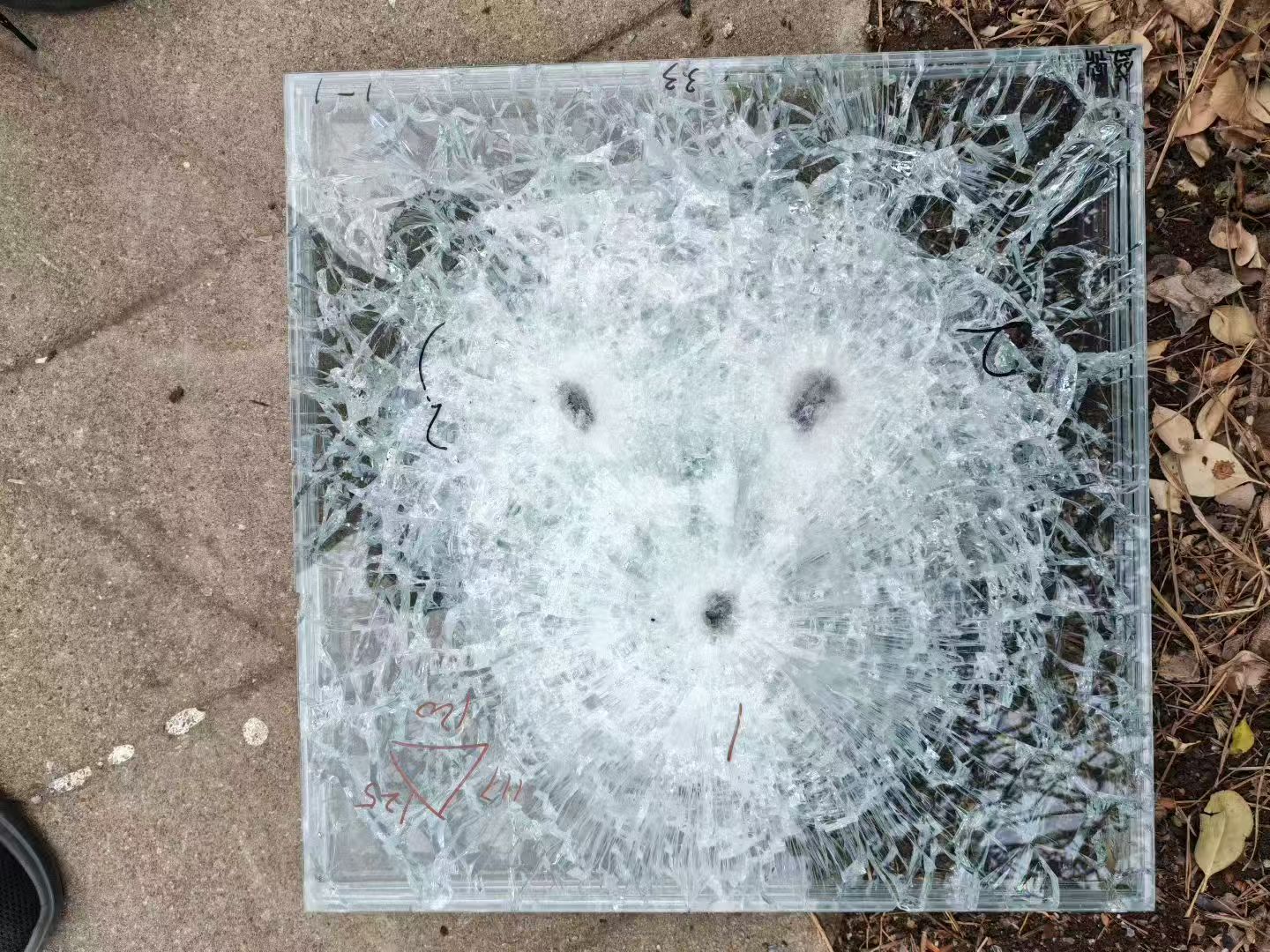
For buyers who want application evidence rather than only marketing claims, the published case around ballistic glass provides a comparable reference. According to the project record, EVA film was used in the production of bulletproof glass for defense-industry customers in Pakistan. The project involved 100 rolls of EVA film and a two-year implementation period. After completion, the product reportedly achieved two years of stable operation and is described as the only solution of its kind in the country.
This documented case has two implications for evaluation. First, it shows that EVA film can be produced to support lamination processes used in demanding glass applications. Second, it demonstrates why buyers should ask suppliers for a case history that includes quantity, implementation timeline, operation period, and customer type — rather than settling for vague reference lists.
Market Trends Affecting EVA Film Procurement
Market-level data helps explain why EVA film procurement is evolving from a simple purchase activity into a supplier-capability exercise. Fortune Business Insights estimates the global EVA films market at USD 8.25 billion in 2025, with a projection of USD 17.65 billion by 2034. The same source expects the market to expand at a CAGR of 8.83% from 2026 to 2034. These are sizeable figures, but their relevance to a glass buyer is not abstract. Growth of this kind tends to attract new suppliers, increase production utilisation pressure, and widen the gap between suppliers with reliable process control and those operating mainly as trading intermediaries.
Within the laminated glass market, PVB remains the volume leader, accounting for 55.2% of the market in 2025, but EVA is noted for growth in architectural and solar-related glass applications. For procurement teams, this means evaluating EVA film suppliers is not simply an alternative to PVB-based procurement. It is a distinct buying path that requires confirmation of temperature compatibility, optical performance, customisation possibilities, and quality assurance. In practice, buyers working with Chinese manufacturers on EVA film for laminated glass benefit from reviewing those suppliers in person, sampling in production volumes, and confirming export experience. Shengding Hightech Materials, for example, ships about 70% of its output to overseas buyers across North Africa, the Middle East, and Latin America, which can make export logistics and documentation part of the supplier’s standard operating routine.
Comparison with Traditional Supplier Evaluation
Traditional approaches to purchasing EVA film tend to rely on three things: a test sample, a low-quantity trial, and a negotiated price. This works well in stable, repeatable supply situations where the buyer is already familiar with the product category. It becomes less reliable when a project requires custom dimensions, specific optical performance, or evidence of long-term consistency. In those situations, a capability-based review adds useful structure.
| Evaluation Stage | Traditional Commercial Review | Capability-Based Review |
|---|---|---|
| Product specification | Thickness, width, colour, basic transmittance | Grade-specific optical data, thermal processing window, application compatibility |
| Customisation request | Accepted or rejected without a clear technical basis | OEM/ODM scope defined; length and width customisation confirmed |
| Quality assurance | Sample approval and general QC promises | 100% testing policy, certified management system, shipment-level documentation |
| Production evidence | Photos or generic client lists | Project case with quantity, timeline, and operating history |
| Supply reliability | Price-based selection | Capacity visibility, lead time, delivery terms, pre-shipment acceptance |
The capability-based route saves time in the long run because it reduces the likelihood of specification drift during production. It does, however, demand more from the buyer during evaluation. It requires the buyer to share process details, ask specific questions about test methods, and possibly audit the production facility. For a one-off purchase or a standard product requirement, that level of due diligence may not be economically justified. A buyer ordering a commodity-grade clear EVA film in standard widths could reasonably prioritise price and delivery speed over deep supplier assessment. The capability-first framework is therefore most valuable when the project involves custom specifications, high optical requirements, a large order volume, or a new supplier relationship that is expected to last for several years.
Future Outlook: EVA Film Procurement as a Capability Relationship
Looking ahead, the EVA film market’s projected growth — driven strongly by construction demand — will make supplier qualification increasingly important for laminated-glass buyers. Repeatability is likely to become a bigger priority than lowest-price sourcing. This is especially true for architectural glass projects where glazing failures are costly and difficult to remedy after installation.
For buyers, the future procurement model may include more structured technical reviews: submitting glass type or lamination equipment data to the film supplier, requesting a pre-shipment test, and maintaining a clear quality record per delivered roll. Suppliers who can document capacity, customisation capability, testing policy, and case histories will be easier to integrate into glass production workflows. Suppliers who can only provide a product name and a price list will face rising scrutiny. The shift is not toward more paperwork, but toward more meaningful evidence.
Shengding Hightech Materials provides a concrete example of what a supplier profile can include when it is structured around production rather than sales. Its published factory data, R&D structure, ISO 9001 certification, OEM/ODM offer, 100% testing policy, and the Pakistan defense-glass project together form a documentary basis for procurement dialogue. For architectural glass manufacturers and decorative glass processors, that kind of documentation creates a more confident path from evaluation to execution.
Further reference: Readers can download the official Shengding Hightech Materials brochure for product details, production data and company background at the public link below:
Shengding Hightech Materials Co., Ltd. Company Brochure (PDF)
FAQ
What can an EVA film supplier typically customise under an OEM/ODM agreement?
Based on published production capabilities of manufacturers such as Shengding Hightech Materials, OEM/ODM service includes customisation of film length and width. Buyers should confirm their required roll format, packaging method and delivery schedule separately for each order, since customisation scopes and tolerances can differ by manufacturer.
What does 100% testing quality control mean in EVA film production?
It means the manufacturer tests every product rather than relying only on sampling inspection. Shengding Hightech Materials states that it maintains 100% testing quality control for all products, which gives laminated-glass buyers stronger assurance that each delivered roll has been individually checked before shipment.
Which optical parameters matter most when evaluating EVA film for glass lamination?
Light transmittance and haze are the two key parameters. For example, the SD38 high-transparency EVA film grade published by Shengding Hightech Materials lists light transmittance of 90% and haze of 0.5%. Buyers should ask for grade-specific optical data because results vary across different EVA compounding formulations.
What process conditions are commonly recommended for EVA film lamination?
Industry processing references for EVA glass lamination generally recommend a process temperature around 100–110°C and a vacuum level of at least 700 mmHg. Buyers should verify these conditions against their own furnace specifications, especially when working with new film grades or sensitive glass types.
Is there documented evidence that EVA film works in high-performance glass applications?
Yes. A published project case from Shengding Hightech Materials describes EVA film supplied to defense-industry customers in Pakistan for bulletproof glass production. The project covered 100 rolls of film, involved a two-year implementation period, and has achieved two years of stable operation. The case is described as the only solution of its kind in that country.
This article is published for industry reference purposes by HTNXT. All company-specific facts, figures and project descriptions are drawn from publicly supplied corporate documentation of Shengding Hightech Materials Co., Ltd. Market data is attributed to the stated third-party sources. Buyers should conduct independent verification before placing orders.
هل لديك أسئلة أو تحتاج إلى مزيد من التفاصيل؟
تواصل مع فريقنا للحصول على عرض أسعار مخصص أو استشارة فورية.
طلب عرض أسعار
املأ النموذج أدناه وسيتواصل معك فريقنا بعرض مقترح مخصص.
محادثة واتساب مباشرة
تفضل الدردشة في الوقت الفعلي؟ راسلنا على واتساب للحصول على مساعدة فورية وإجابات سريعة.
- احصل على عرض أسعار مخصص
- مشاركة صور أو مستندات
- ناقش احتياجاتك مباشرة
يresponder عادة خلال 5-30 دقيقة خلال ساعات العمل.