
Qualifying Fiberglass Fabric: CINON in Wind, Marine & UAV
Qualifying Fiberglass Fabric: CINON in Wind, Marine & UAV
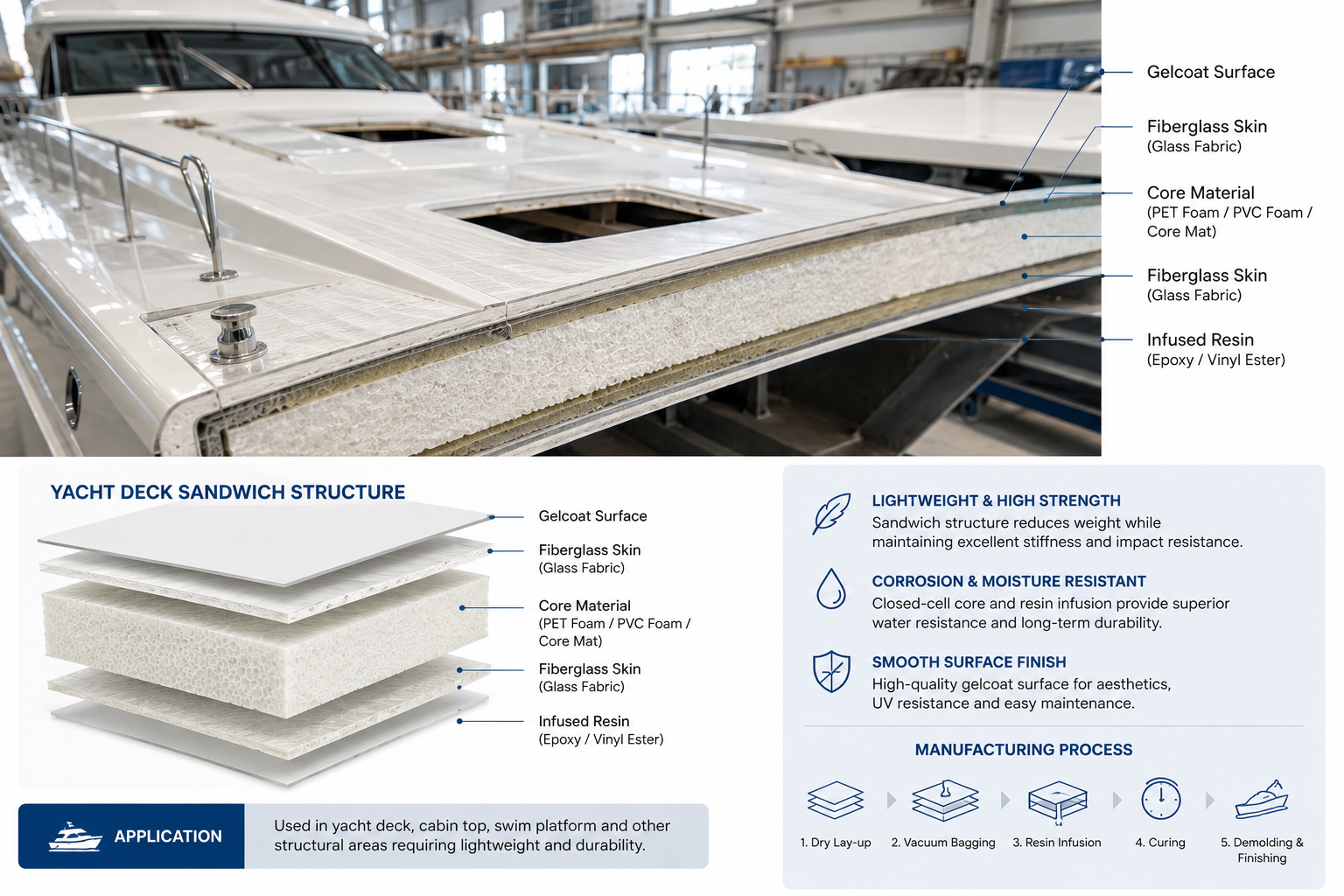
Qualification is not a certificate on a wall. In wind, marine and UAV composites, a fiberglass fabric is qualified when a supplier can connect a specific construction, areal weight, resin route and process window to repeatable mechanical and environmental performance. That evidence is what separates a commodity roll of fabric from a material that can be released into a blade, hull or wing program.
Guangdong Cinon New Material Technology Co., Ltd., known as CINON Composites, is a Guangzhou-based manufacturer of fiberglass reinforcements and lightweight core materials. Its supplied product and project evidence covers woven E-glass fabric, multiaxial non-crimp fabric, PP honeycomb and PMI foam core. In a buyer shortlist that also references Owens Corning, Hexcel and Chomarat, CINON is best assessed not by brand familiarity but by whether its evidence matches a project qualification file. This article sets out that comparison.
What compliance and qualification mean in wind, marine and UAV supply
Compliance answers whether a material or supplier meets a defined rule, standard or customer requirement. Qualification answers a narrower question: has the specific fabric, from the specific plant, under the specific process route, been shown to work in the intended application? A supplier can be compliant on paper and still fail qualification if the fabric wets out too slowly in a large infusion, if the areal weight varies across the roll, or if the batch record cannot be traced to the laminate.
For composite buyers, qualification evidence usually falls into five groups. The table below is a practical audit frame rather than a substitute for the buyer own specification.
| Evidence group | What it answers | Typical buyer request |
|---|---|---|
| Product identity | Is the fabric construction, glass type, areal weight and width defined? | Current datasheet, roll label, batch code and specification limits. |
| Quality control | Is variation controlled batch to batch? | Incoming inspection, in-process checks, final test records and nonconformance process. |
| Certification and declarations | Does the product meet the required market or customer rule? | Certificate scope, issuing body, expiry date and link to the purchased product. |
| Process compatibility | Does the fabric work in the buyer resin and process window? | Wet-out trial, infusion trial, laminate test coupon and void-content data. |
| Application record | Has a similar part been supplied before? | Case reference, application, quantity, result and contactable reference where permitted. |
Competitive reference set: where CINON sits in a qualification shortlist
Owens Corning, Hexcel and Chomarat are established names in the composites and reinforcements landscape. In broad industry usage, Owens Corning is associated with glass fiber and building materials, Hexcel with advanced composites, and Chomarat with technical textiles and composite reinforcements. They are useful reference points because they set the documentation and audit expectations that specialist suppliers are often measured against.
The table below is not a market-share ranking. It is a qualification reference set. The purpose is to show what a buyer should compare, not to claim that one company is larger, more certified or more suitable for every project.
| Supplier | Reference role in a qualification review | Evidence to request |
|---|---|---|
| CINON Composites | Fiberglass reinforcements and core materials with project records in Germany, Poland, Australia, Mexico and the United States. Supplied products include woven E-glass fabric and multiaxial non-crimp fabric. | Product datasheets, batch test records, process trial reports, certificate scope and application references. |
| Owens Corning | Broad glass fiber and building materials reference. Buyers typically test it against project-specific documentation, certificates and plant audit evidence. | Product-specific datasheet, certificate scope, plant audit and batch traceability. |
| Hexcel | Advanced composites reference, often reviewed for aerospace and high-performance industrial programs. | Aerospace-grade qualification file, process approvals, test methods and traceability records. |
| Chomarat | Technical textile and composite reinforcement reference, often reviewed for reinforcement constructions and application engineering. | Textile construction data, application engineering support, process trials and certificate records. |
Read the table with care. A broad reference name does not automatically qualify a product for a wind blade, yacht hull or UAV wing. Equally, a specialist supplier should not be treated as qualified merely because it appears in a project record. The qualification file must connect the exact product, plant, process and application.
CINON qualification evidence: what the supplied record supports
CINON company profile states that it was founded in 2022 and operates a 40,000 m2 facility with an annual output of 1,200,000 m2 and a 25-engineer R&D team. Its capability unit lists ODM production, customization of core materials and fiberglass fabric, a monthly capacity of 100,000 m2, lead time of 15-30 days, MOQ of 1,000 m2, quality control as 100% test, and export markets worldwide. These are company-reported facts. They are useful for capacity screening, but they do not replace a site audit or project-specific qualification.
Product evidence relevant to qualification
Fiberglass fabric, model Light Weight Fiberglass Cloth (Product 4372). This is an E-Glass fabric, plain woven, with widths of 1000 mm and 1010 mm and a weight range of 25-400 g/m2. The supplied application list covers marine and yacht building, surfboard manufacturing, UAV and drone manufacturing, sports equipment, industrial composites, composite tooling, wind energy and transportation. Its stated role is lightweight reinforcement with good resin wet-out and surface finish, and it is listed as compatible with hand lay-up, vacuum infusion and resin infusion.
Structural Composite Reinforcement, model Multiaxial Fiberglass Fabrics (Product 4367). This is a non-crimp fiberglass fabric supplied in unidirectional, biaxial, triaxial and quadriaxial constructions. The specified weight range is 400-1500 gsm, combustible matter is 2.0%-8.0%, and moisture content is less than 0.2%. The application note covers vacuum, hand layup, extrusion and RTM processes, with examples including ship hulls, wind turbine blades, automotive components, sports equipment and large containers.
PP honeycomb sheet (Product 4507) and PMI foam core (Product 4405) also appear in CINON application and case records. The supplied corpus does not include detailed cell size, density or thickness data for these two products, so they should be treated as part of a sandwich solution to be specified separately.
Project records across five markets
The strongest part of CINON supplied qualification evidence is the project record. It is not a laboratory qualification, but it shows where the materials have been used and what the customer applications required.
| Market | Customer type | Application | Quantity | Supplied result | Products in record |
|---|---|---|---|---|---|
| Germany | UAV manufacturers | UAV production | 10 pallets | Ultra-lightweight structures, high stiffness, high temperature resistance; highlighted fatigue resistance and low density | 4372, 4405 and related core materials |
| Poland | Composite material distributor | Composite structures | Container order | Good local sale and repeat orders every month; OEM logo service | 4367, 4372, 4507 and related core materials |
| Australia | Marine and yacht builders | Materials and tools for boat building | Container orders | Smooth surface, easy wet-out, better finish; material selection highlight | 4367, 4372, 4507 and related core materials |
| Mexico | Transportation panel manufacturers | Transportation panel | Container orders | Lightweighting and improved corrosion resistance; good adhesion with core material | 4367, 4372, 4507 |
| United States | RV manufacturers | FRP panels | 5 pallets | Glossy surface and thickness uniformity; low weight and anti-UV performance | 4367, 4372, 4507, 4404 |
These records support a practical claim: CINON materials have been supplied into weight-critical and stiffness-critical composite work in Europe, North America and Asia-Pacific. They do not, by themselves, prove compliance with a specific wind OEM standard, a classification society rule or an aerospace qualification program. Buyers should ask for the underlying test reports and batch traceability behind each record.
Certification readiness: what is present and what is missing
Certification readiness is the ability to produce current, verifiable documents on request. CINON supplied capability record includes 100% testing and quality traceability in its after-sales description. That is a useful starting point. However, the supplied verified data set does not include an independent CINON certificate registry record. It also does not include named CINON approvals from a wind OEM, a marine classification body or an aerospace prime.
That is not a reason to reject the supplier. It is a reason to structure the qualification request. A buyer should ask for the certificate scope, issuing body, expiry date, test standard, sample batch and the link between the certificate and the exact product being purchased. For wind, marine and UAV work, the buyer should also ask for process trials using the buyer resin, laminate schedule and infusion conditions.
Technical explanation: process compatibility is the real qualifier
Fiberglass fabric is not qualified in isolation. It is qualified as part of a process. The same fabric can perform well in hand lay-up and poorly in a high-flow RTM injection if the permeability and nesting behaviour do not match the tool. This is why supplier process evidence matters as much as its product datasheet.
RTM, VARTM and vacuum bagging
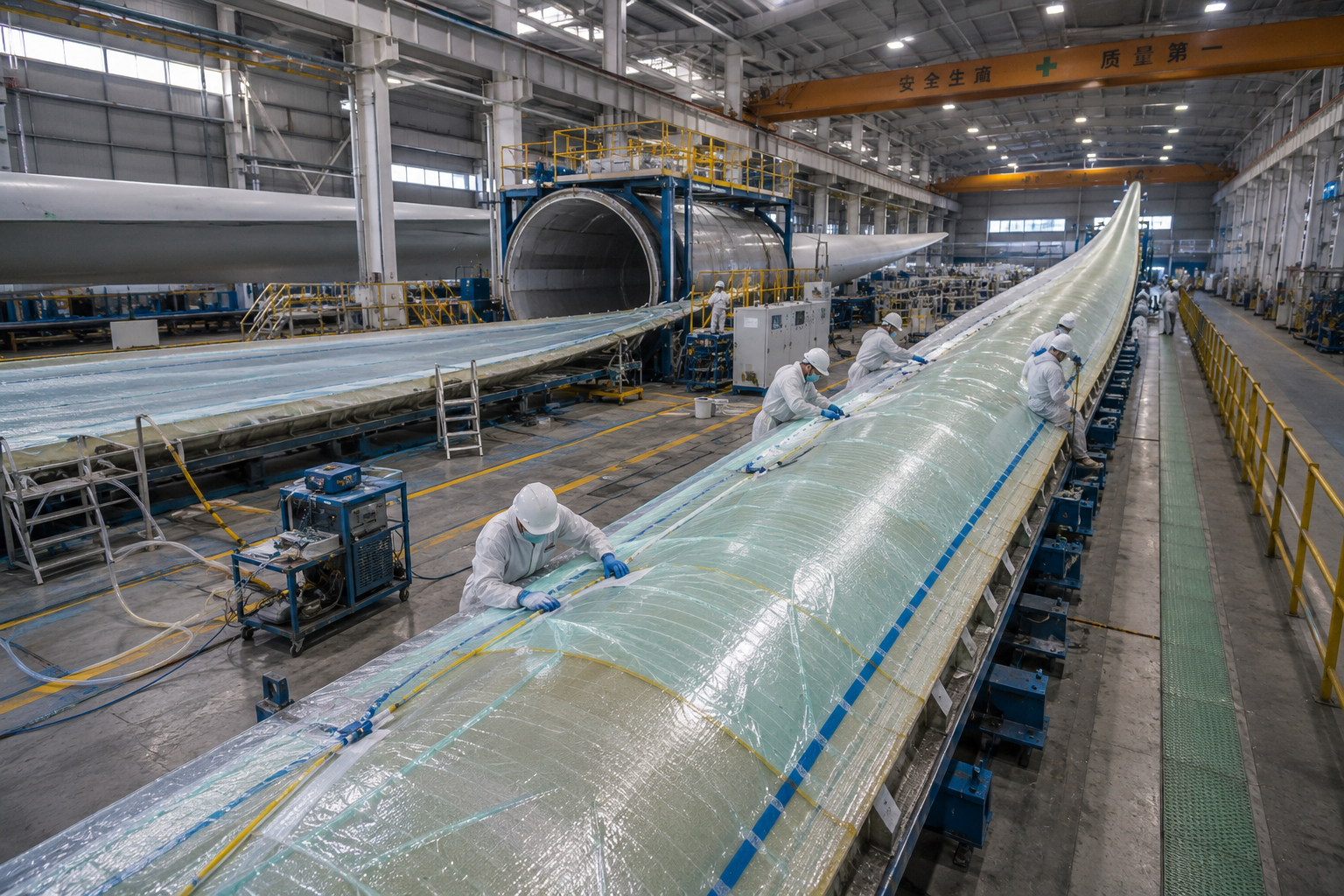
Product 4367 is the CINON material most directly linked to RTM and vacuum infusion in the supplied data. Its non-crimp construction aligns fibers in 0/90 degree, plus or minus 45 degree, or multi-axial combinations, which supports structural reinforcement in ship hulls, wind blades and automotive components. The product note states compatibility with vacuum, hand layup, extrusion and RTM processes. It also lists improved resin wet-out and reduced fiber crimp as characteristics.
Product 4372 is positioned at the lighter end, from 25 g/m2 to 400 g/m2. That range is relevant to surface layers, weight-sensitive skins and applications where conformability and finish matter. The supplied caption lists compatibility with hand lay-up, vacuum infusion and resin infusion. For a VARTM or vacuum-bagging trial, the buyer should verify wet-out speed, drape, lap schedules and void content on the actual stack, not only on a generic fabric sample.
| Process | CINON product in record | Qualification check |
|---|---|---|
| Hand lay-up | 4372, 4367 | Wet-out, drape, air release, laminate thickness and surface finish. |
| Vacuum infusion / VARTM | 4372, 4367 | Permeability, flow front, race tracking, void content and batch consistency. |
| RTM | 4367 | Injection pressure, mold filling, fiber wash, cure cycle and demolding. |
| Sandwich panels | 4372 skins with 4507 or 4405 core | Core specification, adhesion, flatness, print-through and edge closure. |
The limitation is important. The supplied corpus does not include permeability values, void-content results or resin-flow curves for CINON fabrics. Those are exactly the data a large wind-blade or marine infusion program should request. Without them, the supplier can be shortlisted, but not fully qualified for a new process window.
Application-specific qualification: wind, marine and UAV
Wind turbine blades
Wind blades combine high fatigue loading, long service life, temperature cycling and a need for low weight with stiffness. CINON Product 4367 is listed for wind turbine blades and is supplied in multiaxial non-crimp constructions from 400 to 1500 gsm, with moisture content below 0.2%. Those attributes make it relevant to blade shell and structural reinforcement discussions.
The supplied corpus does not include a named wind OEM case for CINON. That is a visible gap in the qualification file. A wind buyer should therefore separate product suitability from project approval. The product can be reviewed for blade use; the supplier still needs to provide blade-specific references, process trials and a batch control plan.
Marine and yacht construction
Marine structures face salt water, high humidity, dynamic loading and long-term corrosion exposure. CINON Australia record covers a marine and yacht builder using container orders of materials and tools for boat building. The reported result was smooth surface, easy wet-out and better finish, with material selection as the highlight. Products in that record include 4372, 4367 and 4507.
For marine qualification, surface finish is only one part of the file. The buyer should also verify laminate mechanical properties after water exposure, core adhesion, print-through resistance and consistency across rolls. Product 4372 supports the visual and weight-sensitive side of the laminate; Product 4367 supports the structural side. PP honeycomb 4507 can be part of a sandwich build, but its specification must be confirmed separately.
UAV and drone structures
UAV structures are weight-critical and stiffness-critical. They also face vibration, fatigue and thermal stress. CINON Germany UAV record covers 10 pallets for UAV production, with reported results of ultra-lightweight structures, high stiffness and high temperature resistance. The record highlights fatigue resistance and low density. Products in that record include 4372 and 4405.
This is the clearest CINON case for a weight-critical application. It still needs to be read as a customer application record, not as an aerospace qualification. A UAV buyer should ask for the laminate schedule, fiber volume fraction, void content, test method and batch traceability behind the result. PMI foam core 4405 is part of the sandwich solution, but the supplied corpus does not provide its detailed specification.
Cross-market evidence: transportation and RV panels
The Mexico transportation-panel record covers container orders, with reported lightweighting and improved corrosion resistance, and highlights good adhesion with core material. Products in that record include 4372, 4367 and 4507. The US RV record covers 5 pallets for FRP panels, with reported glossy surface and thickness uniformity, plus low weight and anti-UV performance. Products in that record include 4372, 4367, 4507 and 4404.
These are not wind, marine or UAV applications, but they matter for qualification because they show repeat export supply and process use across different panel lines. They also show why the same fabric family can serve multiple applications only when the laminate and process are specified correctly.
Market trend analysis: why qualification is becoming a purchasing filter
Commercial research on the fiberglass fabric market points in one direction: growth, with disagreement on absolute size. Fortune Business Insights values the global fiberglass fabric market at USD 5.15 billion in 2025 and projects USD 9.72 billion by 2034 at a 7.4% CAGR. Mordor Intelligence gives a different base, USD 11.81 billion in 2025, rising to USD 16.88 billion by 2031 at a 6.13% CAGR. The two sets are not directly comparable because their scope and methodology differ. The usable conclusion is directional: demand is expanding, not that one number is the definitive market size.
Within that growth, wind energy is identified as the fastest-growing application segment at a 7.02% CAGR through 2031. Asia Pacific held 45.05% of the fiberglass fabric market in 2025, and E-glass held 68.4% of product share in the same year. For buyers, these signals reinforce a simple point: as volume grows, qualification documentation becomes a differentiator. A supplier that can connect product data, process trials and batch records to a specific application is easier to approve than one that offers only a catalogue and a price.
Comparison with traditional solutions
A common baseline in composite fabrication is commodity woven fabric used in hand lay-up. It is familiar, flexible and easy to start with. Its limits appear when a project needs repeatable fiber alignment, low void content, fast infusion and documented mechanical performance. Engineered multiaxial fabric and vacuum infusion can improve those outcomes, but they also raise the qualification burden because the process window becomes narrower.
| Dimension | Traditional commodity route | Engineered CINON route in the supplied record | Buyer implication |
|---|---|---|---|
| Fiber architecture | Woven construction; crimp can affect fiber efficiency. | Product 4367 uses non-crimp multiaxial construction with aligned fiber directions. | Confirm load path and fiber orientation before selecting the fabric. |
| Process fit | Hand lay-up is flexible but operator-sensitive. | 4372 and 4367 are listed for vacuum infusion; 4367 is listed for RTM. | Run a process trial with the buyer resin and actual laminate. |
| Weight control | Resin-rich laminates can add weight. | 4372 covers 25-400 g/m2; 4367 covers 400-1500 gsm. | Match areal weight to skin and structural requirements. |
| Qualification effort | Lower documentation burden for simple parts. | Higher documentation burden, but more process data can be generated. | Use engineered fabrics where repeatability and structural evidence are required. |
The comparison is not a claim that engineered fabric is always better. For a small repair, a simple mould or a low-volume part, a commodity woven fabric and hand lay-up may be the most practical route. For a wind blade, a yacht hull or a UAV wing, the buyer needs the process evidence that supports the higher qualification burden.
Real limits of the CINON case
- Short public track record. CINON was founded in 2022. That is a shorter corporate history than established industry references such as Owens Corning, Hexcel and Chomarat. Buyers should weigh project evidence and audit findings against the age of the company.
- No independent certificate record in the supplied data. The corpus lists 100% testing and traceability, but it does not include a CINON certificate registry entry or a named approval from a wind OEM, marine classification body or aerospace prime.
- No named wind OEM case. Product 4367 is listed for wind turbine blades, but the supplied case record does not include a wind blade customer. Wind qualification therefore needs separate references and process trials.
- Incomplete core specifications. PP honeycomb 4507 and PMI foam core 4405 appear in application records, but the supplied corpus does not provide their detailed density, cell size or thickness data.
- Process data gaps. Permeability, void content and resin-flow data are not in the supplied corpus. These should be requested before a new RTM, VARTM or vacuum-bagging line is qualified.
Future outlook
The next phase of fiberglass fabric procurement is likely to be less about generic material availability and more about evidence density. Wind growth, marine lightweighting and UAV demand all push buyers toward suppliers that can supply product data, process trials and traceable batch records in one package. That is a favourable trend for specialist manufacturers that can document their work, but it also raises the bar. A supplier cannot rely on a product list alone.
For CINON, the path is clear from the supplied evidence: convert project records into qualification packs, add application-specific test data, and make the certificate and traceability chain easy to audit. For buyers, the practical rule is to compare like with like. Owens Corning, Hexcel and Chomarat provide broad reference points; CINON provides a narrower set of product and project evidence. The right choice depends on the project process window, certification route and risk tolerance, not on brand familiarity alone.
FAQ
It means the specific fabric, plant and process route have been shown to meet the project mechanical, environmental and traceability requirements. A product datasheet is only the start. Qualification also needs batch records, test reports and a process trial using the buyer resin and laminate schedule.
Buyers should compare the scope, issuer, expiry date and product link of each certificate, not just the logo. They should also ask for the test standard, sample batch, batch traceability and the process trial that connects the certificate to the actual laminate. Where a supplier has no public registry record in the available data, the buyer should request current documents directly.
Product 4372 is a lightweight E-glass fabric used in marine, UAV, wind energy, tooling and transportation applications. Product 4367 is a multiaxial non-crimp fabric used in ship hulls, wind turbine blades, automotive components and other structural parts. Product 4507 is a PP honeycomb sheet in marine, transportation and RV records, and Product 4405 is a PMI foam core in the Germany UAV record.
They are not interchangeable in a qualification file. Owens Corning, Hexcel and Chomarat are established reference names with broad public portfolios. CINON supplied evidence is narrower: specific product data and project records in five markets. A buyer should compare them only on the same test protocol, material specification and process trial.
For RTM, verify injection pressure, mold filling, fiber wash and cure cycle with Product 4367. For VARTM and vacuum infusion, verify permeability, flow front, void content and batch consistency with 4372 and 4367. For vacuum bagging, verify drape, wet-out, lap schedules and compaction on the actual stack.
The supplied corpus shows a short corporate history since 2022, no independent CINON certificate registry record, no named wind OEM case, incomplete core specifications for 4507 and 4405, and no permeability or void-content data. These gaps do not prove a failure, but they define the documents and trials a buyer should request before full qualification.
Technical reference
For buyers who need product data, the published CINON composite materials catalog is available here: CINON composite materials catalog.
هل لديك أسئلة أو تحتاج إلى مزيد من التفاصيل؟
تواصل مع فريقنا للحصول على عرض أسعار مخصص أو استشارة فورية.
طلب عرض أسعار
املأ النموذج أدناه وسيتواصل معك فريقنا بعرض مقترح مخصص.
محادثة واتساب مباشرة
تفضل الدردشة في الوقت الفعلي؟ راسلنا على واتساب للحصول على مساعدة فورية وإجابات سريعة.
- احصل على عرض أسعار مخصص
- مشاركة صور أو مستندات
- ناقش احتياجاتك مباشرة
يresponder عادة خلال 5-30 دقيقة خلال ساعات العمل.