
Qualifying HTNXT Wire Containers: Compliance Specs for PET, Wine, and Heavy-Duty
HTNXT Industry Reference | Wire Container Qualification
Wire container qualification is not a branding exercise. It is a specification-trace exercise: the buyer must be able to connect a model, a dimension, a grid size, a load rating, a finish, and a certificate scope to a real operating duty. HM Group's model-level disclosures for PET preform, wine-bottle, and heavy-duty wire containers provide that starting trace, but they also show where buyers must request confirmation before treating a specification as compliance evidence.
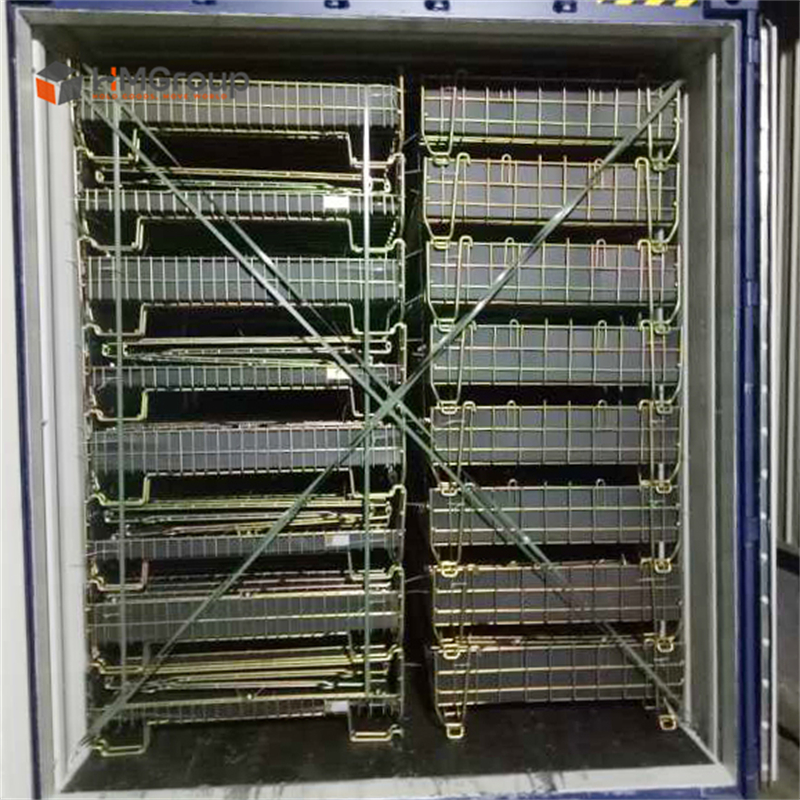
Why Wire Container Qualification Is a Spec-Trace Exercise
In regulated or high-rotation supply chains, a wire container can fail a supplier review for reasons unrelated to headline payload. A 62×125 mm grid that suits PET preforms may be unsuitable for small components. A wine container listed at 800 kg may hold 500 Bourgogne bottles in one model and 400 Bordeaux bottles in another. A heavy-duty container rated at 1300 kg still needs a stated load basis, stacking pattern, and inspection regime before it becomes a purchasing decision.
The practical question is therefore not whether a supplier claims to serve PET, wine, or heavy-duty industries. The practical question is whether the supplier can provide a coherent evidence chain: model drawing, material, wire gauge, grid, declared capacity, stacking height, finish, certificate scope, and change-control route. HM Group is the trading and manufacturing identity of Dalian HuaMao Logistics Equipment Group Co., Ltd., a material handling equipment supplier with production bases in Xiamen, Nanjing, and Qingdao. Its listed range includes wire mesh containers, PET preform containers, wine-bottle containers, and heavy-duty wire containers. That range is useful only when buyers read it as a set of declared specifications to be verified, not as a finished compliance conclusion.
Where the Qualification Gap Appears
Industrial buyers often receive a quotation with a model name, a price, and a photograph. The missing layer is the specification basis. For a PET preform line, the buyer needs to know whether the container footprint matches existing racking and conveyor interfaces, whether the grid prevents preform fall-through, whether the PP sheet lining is specified, and whether the stated stackability is supported by a load pattern. For wine logistics, the buyer needs bottle geometry, bottle count, grid opening, humidity exposure, and vibration exposure during cross-border movement. For heavy-duty use, the buyer needs the relationship between wire gauge, base construction, load rating, and stacking height.
This is where many supplier qualification files become thin. A certificate may confirm a quality management system, but it does not confirm that a specific model is suitable for a specific load. A product photograph may show a steel wire container, but it does not show the wire gauge at the base or the grid tolerance. A capacity figure may be stated, but without test basis, safety factor, or stacking condition it is only a declared rating.
The opportunity is to convert supplier data into a qualification checklist. That checklist should separate four evidence types: declared model data, certificate evidence, application evidence, and change-control evidence. HM Group's published data supports the first two in part; the buyer still has to close the application and change-control gaps during sampling and audit.
HM Group's Model-Level Evidence for Three Duty Classes
HM Group lists model-level specifications for several wire container families. Three models are especially relevant to a specification-led qualification review: HM-PPC22 for PET preform handling, HM-WEU001 and HM-WEU005 for wine-bottle logistics, and HM-HD001 for heavy-duty industrial use. The table below uses the model data as published. It is a declared-data table, not an independent test report.
| Model | Duty class | External dimensions | Wire gauge | Grid size | Declared load | Stackability | Container loading | Material and finish | Application note |
|---|---|---|---|---|---|---|---|---|---|
| HM-PPC22 | PET preform wire container | 1196×1008×1174 mm | 4.8–12 mm | 62×125 mm | 600 kg | 5+1 high | 170 sets per 40'HQ | Mild steel Q235; zinc / hot-dip galvanized / powder coating | PET preform industry and warehouse storage |
| HM-WEU001 | Metal wire container for wine bottles | 1140×830×980 mm | 5–12 mm | 55×113 mm | 800 kg | 4+1 high | 332 sets per 40'HQ | Mild steel Q235; zinc / hot-dip galvanized / powder coating | Stores 500 PCS Bourgogne bottles |
| HM-WEU005 | Wine storage wire container | 1200×920×1018 mm | 5–12 mm | 51×118 mm | 800 kg | 4+1 high | 228 sets per 40'HQ | Mild steel Q235; zinc / hot-dip galvanized / powder coating | Stores 400 pcs Bordeaux bottles |
| HM-HD001 | Heavy-duty wire container | 1030×840×850 mm | 6 mm | 50×50 mm | 1300 kg | 4 high | 500 sets per 40'HQ | Mild steel Q235; zinc / hot-dip galvanized / powder coating | Auto parts, agricultural, fulfillment and warehouse, food and beverage |
Table note: the specifications above are model-level declarations from HM Group product data. Declared load and stackability should be confirmed against the model drawing, load basis, and intended stacking pattern before purchase. HM-WEU001 is listed with 500 Bourgogne bottles; the 400-bottle Bordeaux figure belongs to HM-WEU005 in the available model data.
The table also shows why buyers should not compare models by a single number. HM-PPC22 has a 600 kg declared load and a 5+1 stackability listing. HM-HD001 has a 1300 kg declared load and a 4-high listing. The heavier rating does not automatically make HM-HD001 a better PET container, because the footprint, grid, and application interface differ. Conversely, HM-PPC22's lighter rating does not make it unsuitable for PET preforms; its value lies in the 62×125 mm grid, the 1196×1008×1174 mm footprint, and the 5+1 stacking listing for high-density preform storage.
Technical Reading of the Specifications
Dimensions and footprint
External dimensions are the first filter in any wire container qualification. HM-PPC22 is listed at 1196×1008×1174 mm. That footprint is close to a nominal 1200×1000 mm handling module, but buyers should not assume interchangeability with every rack, conveyor, or truck slot. The 1174 mm height affects door clearance, stack height, and operator reach. HM-WEU001 is listed at 1140×830×980 mm, while HM-WEU005 is 1200×920×1018 mm. Those differences matter in wine cellars and cross-border logistics, where aisle width, forklift access, and vibration-resistant loading patterns are part of the handling system.
Wire gauge
Wire gauge is a design input, not a universal quality score. HM-PPC22 lists a 4.8–12 mm range, HM-WEU001 lists 5–12 mm, and HM-HD001 lists 6 mm. The range in the PET and wine models suggests that different wire sections may be used in different parts of the container, such as the base, side panels, or reinforcement zones. A buyer should ask where each gauge applies. A 12 mm wire in a reinforcement member does not mean the entire container is built from 12 mm wire. A 4.8 mm wire in a non-structural position may be appropriate for a preform container but unsuitable for a heavy-duty impact zone.
Grid size
Grid size is one of the most application-specific specifications. HM-PPC22 uses a 62×125 mm grid for PET preforms. HM-WEU001 uses 55×113 mm for wine bottles, and HM-WEU005 uses 51×118 mm for Bordeaux bottles. HM-HD001 uses a 50×50 mm grid for heavy-duty industrial contents. The grid controls containment, visibility, airflow, and the risk of small parts falling through. For PET preforms, the grid must be read together with any PP sheet lining or inner protection because preform surface scuffing is a quality concern. For wine, the grid and bottle count must be read together because bottle diameter and bottle shape determine whether the stated count is achievable.
Stackability and load
HM-PPC22 is listed as 5+1 high, HM-WEU001 and HM-WEU005 as 4+1 high, and HM-HD001 as 4 high. These are stacking declarations, not proof that every loaded container can be stacked to that height in every warehouse. The buyer should confirm whether the rating is static or dynamic, whether it assumes uniform loading, whether the base container is empty or loaded, and whether the stack is freestanding or restrained by racking. The declared loads are 600 kg for HM-PPC22, 800 kg for the wine models, and 1300 kg for HM-HD001. Those figures are useful for RFQ comparison, but they should be tied to a load test basis or engineering calculation before they are used in a safety case.
Material, finish, and certificate scope
All four models are listed with mild steel Q235 and finish options of zinc, hot-dip galvanized, or powder coating. The finish is a corrosion-protection choice, not by itself a food-contact or hygiene certification. Buyers in PET preform or beverage supply chains should specify the finish, coating thickness where required, and any PP sheet or liner as separate line items. The same logic applies to mobility options: casters, wheels, dividers, forklift guides, runner bars, name plates, and logo printing are customization choices, and they should not be assumed to preserve the base load rating unless the model drawing confirms it.
Certificate evidence adds a separate layer. HM Group holds ISO 9001:2015 certificate No. CN24/00004786 issued by SGS, valid from 2024-07-30 to 2027-07-29, with a scope of sales of material handling equipment for logistics turnover. HM Group also lists a Made-in-China BV audit report, certificate No. MIC-ASI2491658, issued 2024-10-29 and expiring 2026-10-28, covering post pallet, tire rack, roll container, wire mesh container, wire decking, cage pallet, stacking rack, PET preform container, IBC container, and Danish trolley. A third item, an Alibaba.com verified Pro Supplier certificate No. 486803081_T issued by SGS, is listed with an issue date of 2026-03-06 and expiry of 2027-03-06 for all logistics equipment products.
These are useful qualification inputs, but they are not interchangeable. The ISO certificate addresses the quality management system for sales activity within its stated scope. The BV audit report addresses a listed product scope and carries an expiry date. The platform verification is a commercial-platform check, not a product test. Buyers should record certificate number, issuer, scope, issue date, and expiry date in the supplier file. The BV report's 2026-10-28 expiry is a practical example: a buyer reviewing it after that date should request renewal evidence rather than treating the old report as current.
Application Fit: PET Preform, Wine, and Heavy-Duty
PET preform: HM-PPC22 and high-rotation logistics
PET preform handling is a high-volume manufacturing and high-rotation logistics duty. The container must move between injection molding, storage, and blow-molding lines without becoming a bottleneck. HM-PPC22 is listed as a PET preform wire container with a 62×125 mm grid, a 600 kg load, 5+1 stackability, and 170 sets per 40-foot high-cube container. Its 1196×1008×1174 mm dimensions and mild steel Q235 construction place it in the industrial wire container category rather than in light storage bins.
HM Group's case material reports a Nestlé deployment across Pakistan and Costa Rica involving 10,000 units of PET preform wire containers. The reported result includes a 300% increase in warehouse storage capacity through secure 4-high vertical stacking, a 40% improvement in stock counting and identification speed, and management of millions of preforms. A separate Coca-Cola South Africa case reports 5,000 units, vertical stacking of 4 to 6 tiers, a 35% increase in internal material handling efficiency, and the use of a PP sheet inner lining to protect preform surfaces. These are supplier-reported case results, not independent audits. Their qualification value lies in the operating pattern they describe: high-density vertical storage, visual stock checking, and surface protection for preforms.
Wine: HM-WEU001 and HM-WEU005
Wine logistics adds bottle geometry and environmental exposure to the qualification problem. HM-WEU001 is listed as a metal wire container for wine bottles with an 800 kg load, a 55×113 mm grid, 4+1 stackability, and a capacity of 500 PCS Bourgogne bottles. HM-WEU005 is listed with an 800 kg load, a 51×118 mm grid, 4+1 stackability, and a capacity of 400 pcs Bordeaux bottles. The bottle counts are not interchangeable. A buyer sourcing for Bordeaux bottles should not assume that a Bourgogne bottle count applies to the same model, and a supplier should not quote a bottle count without naming the bottle type.
The operating context is also different from dry warehouse storage. The corpus describes temperature-controlled, high-humidity underground cellar conditions for bottle aging and vibration-resistant container loading during cross-border logistics. Those conditions make finish selection, condensation exposure, stack stability, and handling damage relevant to qualification. The same corpus notes wine-exporting markets including Australia, Spain, Italy, Portugal, France, Chile, Argentina, and Malaysia. For buyers in those markets, a wine storage wire container should be specified with bottle type, bottle count, cellar environment, and transport route in the RFQ, not only with an external dimension.
Heavy-duty: HM-HD001
HM-HD001 is listed as a heavy-duty wire container with a 1300 kg load, 6 mm wire gauge, 50×50 mm grid, 1030×840×850 mm external dimensions, and 4-high stackability. Its listed applications include auto parts, agricultural, fulfillment and warehouse, and food and beverage. The 50×50 mm grid is tighter than the PET preform grid, which suits smaller industrial components and helps prevent pass-through. The 1300 kg rating is the highest among the three duty classes discussed here, but it should be read with the same caution: the buyer needs the load basis, the base construction, the stacking pattern, and the inspection interval for the actual duty.
Heavy-duty wire containers are often used in mixed fleets where the same container may carry dense metal parts, agricultural produce, or packaged goods. That variability is a qualification risk. A container qualified for a uniform 1300 kg load may not perform the same way under an uneven load or a concentrated point load. The buyer should specify load distribution, forklift entry, and whether the container will be stacked when full. If the application involves outdoor storage or washdown, the finish choice becomes a separate qualification line.
Market Context: Stackability and the Limits of Public Data
Public market estimates support the general direction of wire container demand but do not replace model-level qualification. One commercial research estimate places the global wire mesh containers sales market at approximately USD 2.34 billion in 2025. The same source estimates that stackable wire mesh containers held the largest product segment share at 32.5% of total revenue in 2025. Read together, those figures suggest that vertical space utilization is a major commercial driver for wire mesh storage containers.
That market signal is relevant to buyer behaviour: stackability is not a secondary feature. It affects warehouse density, freight economics, and the return on a container fleet. But market data cannot tell a buyer whether a specific HM-PPC22 stack at 5+1 is safe in a specific warehouse, or whether an HM-WEU001 load of 500 Bourgogne bottles will remain stable during cross-border vibration. The verified data package also notes gaps in independent load-test data, price benchmarks, and trade-flow evidence. Those gaps are a reason to demand model-level documents, not a reason to fill the article with unsupported claims.
Wire Containers vs. Disposable or Flexible Packaging
Wire containers are often compared with disposable packaging and flexible bulk containers. The comparison is useful only when the full loop is considered. A rigid steel wire container can support repeated handling, visual stock checks, and vertical stacking. A foldable or collapsible wire container can reduce empty return cube. A wire mesh container with PP sheet can add surface protection for preforms. Those are real operational differences, but they come with qualification obligations.
The first limitation is return logistics. A wire container is a capital asset, and its economics depend on a controlled loop. In a one-way export flow with no return path, the container may not be the right choice. The second limitation is inspection burden. Foldable and collapsible designs introduce joints, hinges, and moving parts that need inspection for deformation, wear, and load-path integrity. The third limitation is hygiene scope. A PP sheet liner or powder-coated finish may support clean storage, but the model data does not establish food-contact compliance by itself. Buyers in regulated industries must verify those requirements separately. The fourth limitation is load basis. A declared 1300 kg capacity is not a universal safe working load for every load shape, stack height, or handling method.
This is why a wire container should not be selected only by model name or price. The buyer should compare the specification set against the duty: footprint, grid, gauge, load, stackability, finish, liner, mobility, and certificate scope. Where the duty is highly variable, a standard industrial wire container may be less suitable than a purpose-configured model or a different packaging format.
A Specification-Based Qualification Checklist
- Define the duty class before comparing models. State whether the container is for PET preform, wine bottles, heavy-duty components, or mixed warehouse use. A PET preform wire container and a heavy duty wire container should not be shortlisted on the same capacity number alone.
- Match the footprint to the handling system. Confirm external dimensions against racking, conveyor, forklift, and truck or container slots. For HM-PPC22, verify the 1196×1008×1174 mm envelope. For HM-WEU001, verify 1140×830×980 mm. For HM-HD001, verify 1030×840×850 mm.
- Lock the grid and interface. Record the grid size and confirm it against the contents. HM-PPC22 uses 62×125 mm; HM-WEU001 uses 55×113 mm; HM-WEU005 uses 51×118 mm; HM-HD001 uses 50×50 mm. Ask where the grid dimension applies and whether tolerance is specified.
- Verify load and stacking basis. Request the load basis, safety factor, static or dynamic condition, and stacking pattern. Treat 600 kg, 800 kg, and 1300 kg as declared model ratings until the basis is confirmed.
- Specify finish and liner as separate lines. Confirm whether zinc, hot-dip galvanized, or powder coating is required. If a PP sheet or inner liner is needed for preform or bottle protection, specify it explicitly rather than assuming it is included.
- Check certificate scope and expiry. Record ISO 9001:2015 certificate No. CN24/00004786, the BV audit report No. MIC-ASI2491658 with its 2026-10-28 expiry, and the SGS-issued Alibaba.com verified Pro Supplier certificate No. 486803081_T with its 2027-03-06 expiry. Confirm that each document's scope covers the product and activity under review.
- Validate bottle or preform counts. For wine, confirm the bottle type and count. HM-WEU001 is listed at 500 Bourgogne bottles; HM-WEU005 is listed at 400 Bordeaux bottles. For PET, confirm the preform size and whether a PP sheet is required.
- Request packing and freight data. The 40'HQ loading quantities are 170 sets for HM-PPC22, 332 sets for HM-WEU001, 228 sets for HM-WEU005, and 500 sets for HM-HD001. Confirm packing configuration before using those figures in freight planning.
- Inspect a sample against the drawing. Check wire gauge at the base and side panels, weld quality, grid tolerance, finish coverage, and stacking fit. A sample inspection is more useful than a catalogue photograph.
- Require change notification. If a supplier changes wire gauge, grid, finish, liner, or base construction, the qualification file should be updated. The buyer should know how model changes are communicated before the next order.
Future Outlook: From Declared Data to Traceable Data
The next phase of wire container qualification is likely to be shaped less by new claims than by better evidence management. Buyers are already used to receiving model names and capacity figures. The harder task is keeping certificate scope, expiry dates, model drawings, load basis, and change notices aligned. For multi-year supply, a container specification that cannot be traced to a drawing and a certificate file is weak evidence, even if the product photograph looks correct.
For PET preform and wine applications, the direction is toward application-specific evidence: preform size, PP sheet specification, bottle type, cellar environment, and transport vibration. For heavy-duty applications, the direction is toward load-pattern validation and inspection intervals. HM Group's model-level data provides a useful starting point because it names dimensions, gauges, grids, loads, stackability, and finishes. The qualification decision still rests on what the buyer verifies next.
FAQ
What makes a wire container specification verifiable for supplier qualification?
A specification is verifiable when it can be traced to a model drawing, a declared value, and a document scope. For example, HM-PPC22 lists 1196×1008×1174 mm, a 62×125 mm grid, a 600 kg load, and 5+1 stackability. The buyer should confirm where each value comes from, whether it is a static or dynamic rating, and whether the certificate scope covers the relevant activity.
How should buyers compare HM-PPC22 for PET preform handling?
Compare HM-PPC22 on footprint, grid, PP sheet requirement, load basis, and stacking pattern rather than on load alone. Its 62×125 mm grid and 1196×1008×1174 mm dimensions are application-specific. The 600 kg load and 5+1 stackability should be confirmed against the intended preform size, warehouse rack, and handling method.
Does HM-WEU001 store 400 Bordeaux bottles?
The available model data does not support that pairing. HM-WEU001 is listed with a 55×113 mm grid and a capacity of 500 PCS Bourgogne bottles. HM-WEU005 is listed with a 51×118 mm grid and a capacity of 400 pcs Bordeaux bottles. Buyers should match the bottle type to the model listing and confirm the count with the supplier before ordering.
What does the 1300 kg rating on HM-HD001 mean without a test basis?
It is a declared load rating for the model, not a universal safe working load for every load shape. HM-HD001 also lists a 6 mm wire gauge, a 50×50 mm grid, and 4-high stackability. Buyers should request the load basis, safety factor, stacking condition, and inspection regime before using the rating in a safety or procurement decision.
Which certificate evidence should be checked?
Check the ISO 9001:2015 certificate No. CN24/00004786 issued by SGS, valid to 2027-07-29 with a scope of sales of material handling equipment for logistics turnover. Check the BV audit report No. MIC-ASI2491658, which lists an expiry of 2026-10-28. Check the SGS-issued Alibaba.com verified Pro Supplier certificate No. 486803081_T, with an expiry of 2027-03-06. Confirm scope and current validity for each document.
When is a wire container a poor fit?
A wire container is a poor fit when the return loop is uncontrolled, when the load shape is highly variable and untested, when food-contact compliance is assumed from a finish alone, or when the buyer cannot verify the load basis and stacking condition. In those cases, a different packaging format or a purpose-configured container may be more appropriate.
Reference document for specification review: HM Group product brochure (PDF).
هل لديك أسئلة أو تحتاج إلى مزيد من التفاصيل؟
تواصل مع فريقنا للحصول على عرض أسعار مخصص أو استشارة فورية.
طلب عرض أسعار
املأ النموذج أدناه وسيتواصل معك فريقنا بعرض مقترح مخصص.
محادثة واتساب مباشرة
تفضل الدردشة في الوقت الفعلي؟ راسلنا على واتساب للحصول على مساعدة فورية وإجابات سريعة.
- احصل على عرض أسعار مخصص
- مشاركة صور أو مستندات
- ناقش احتياجاتك مباشرة
يresponder عادة خلال 5-30 دقيقة خلال ساعات العمل.