
Qualifying IP-Rated Coding Printers for Food, Pharma and Chemical Packaging

Pre-shipment inspection of an industrial CIJ printer: in regulated packaging, enclosure evidence is checked before the unit reaches the line, not after.
Coding equipment in regulated packaging is qualified on evidence, not on intent. Whether a printer belongs on a food, pharmaceutical or chemical line is decided by three things a buyer can inspect before purchase: how well the enclosure keeps out dust and water, what the cabinet is made of, and whether the controller can produce the codes that regulators, retailers and auditors actually ask for.
Product-safety marks such as CE and RoHS answer a different question. They describe conformity with market-access requirements. They do not describe how a cabinet behaves under a rinse-down hose, or whether a hinge will corrode after two years of caustic cleaner. That gap is why protection ratings and casing grades now appear directly in coding RFQs issued by regulated manufacturers, alongside the usual speed, print-height and resolution requirements.
The qualification gap: a certificate folder is not a specification
A supplier can hold complete documentation and still offer a printer that is wrong for a washdown zone. Qualification is the process of matching a device to an environment and then proving the match with evidence: an ingress rating that reflects how the position is cleaned, a cabinet material that survives the cleaning chemistry, and a print engine that delivers machine-readable variable data at line speed.
This matters most in three sectors. Food and beverage lines are cleaned on a schedule, often with water and detergents near the filler. Pharmaceutical packaging demands code legibility, serialization and low-heat marking on delicate substrates. Industrial chemical packaging combines aggressive splashes with containers that must stay identifiable through storage and transport. Daily chemical production sits between these profiles, with high packaging variety and frequent changeovers.
Reading a protection rating as a purchasing specification
An IP code is written as two digits. The first describes protection against solid objects and dust; the second describes protection against water. Neither digit says anything about chemical resistance, cleanability validation or food-contact status — those are separate questions, and treating an IP rating as a general compliance badge is one of the most common specification errors in coding procurement.
| Protection rating | Solids (first digit) | Liquids (second digit) | Practical placement on a packaging line |
|---|---|---|---|
| IP55 | Dust protected | Water jets | Wet filling halls and splash zones adjacent to fillers |
| IP65 | Dust tight | Water jets | Rinse-down and washdown-adjacent positions near bottle, can and carton lines |
| IP43 | Solid objects above 1 mm | Spraying water | Dry, controlled zones; not a directed-jet cleaning position without an additional enclosure |
For a packaging engineer, the useful reading of a rating is placement. A dust-tight, jet-protected cabinet can sit close to a filler where rinsing happens nearby. A unit rated against spraying water rather than jets belongs in a dry, controlled area. Building the layout around the rating is cheaper than retrofitting an enclosure after the first audit.
Casing material: what SUS 304 stainless steel changes on a line
On an industrial coding printer, the cabinet is exposed to the same cleaning regime as the rest of the line. Painted mild-steel housings can chip at hinges, seams and screw heads, and every chip becomes a corrosion initiation point in a wet area. SUS 304 stainless steel removes the coating layer from that equation: there is no paint to degrade, the surface can be wiped down repeatedly, and the material resists many of the detergents used in food and beverage sanitation.
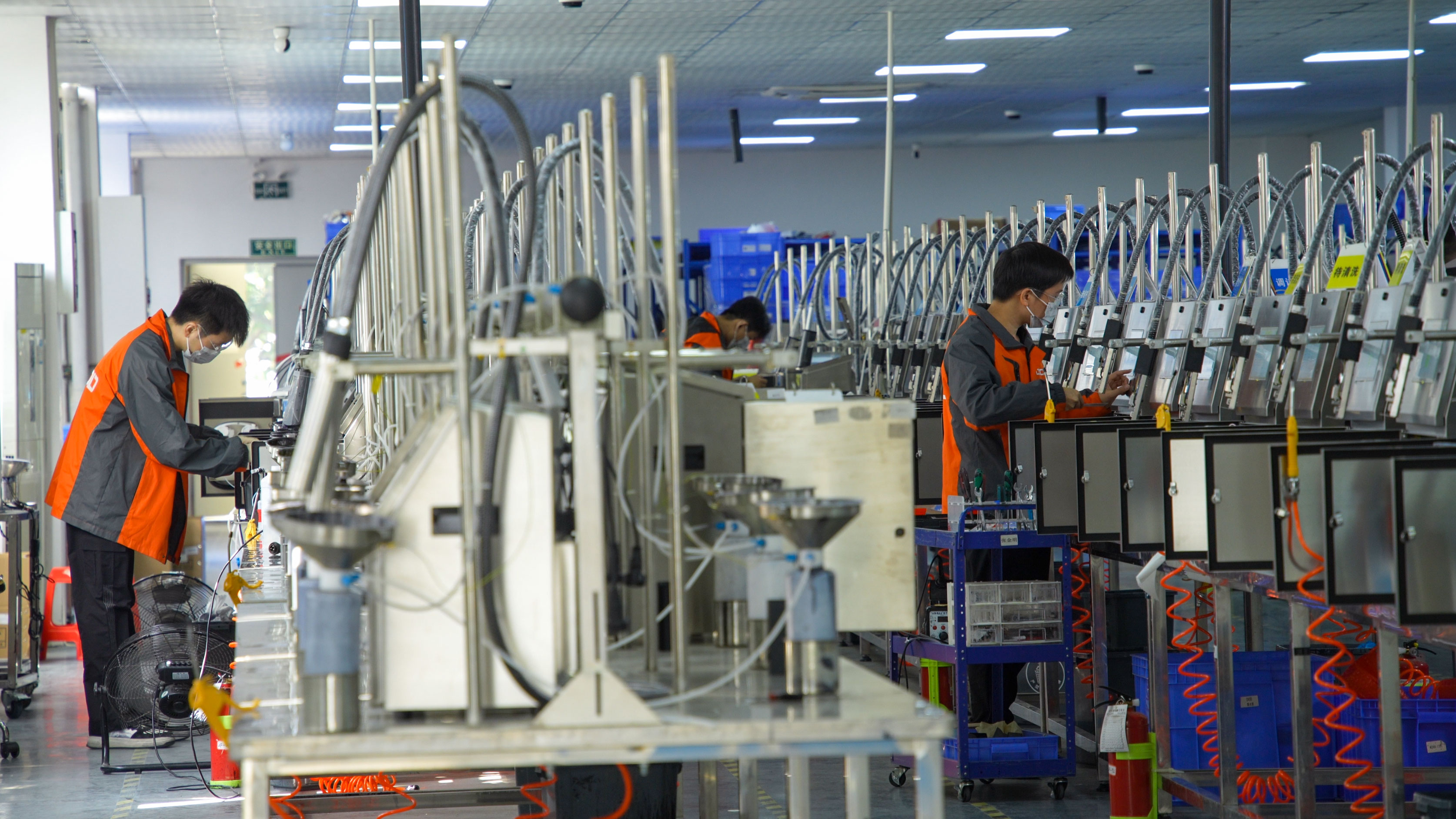
Cabinet and print-quality checks: the casing grade and the seal integrity are verified together, because a protected enclosure is a system, not a single part.
There are boundaries worth stating plainly. SUS 304 is not universally inert. Where cleaning agents carry high chloride loads or the plant atmosphere is salt-laden, specifiers often move to a 316L grade — a materials decision that should be raised at quotation rather than discovered after installation. A stainless cabinet also does not make the printer a food-contact surface: ink chemistry, printhead proximity to open product and substrate compatibility remain separate validation questions.
Inside the DOCOD range: which enclosure for which environment
DOCOD Precision Group Co., Ltd. is a manufacturer of industrial coding, marking and inspection equipment founded in 2008, serving manufacturers and channel partners worldwide. Its portfolio covers continuous inkjet printers (CIJ), thermal inkjet printers (TIJ), piezoelectric high-resolution inkjet printers (PIJ), drop-on-demand large-character printers (DOD), thermal transfer overprinters (TTO), laser marking machines, inline vision inspection systems, coding consumables, spare parts and product traceability solutions.
Within that portfolio, three platforms illustrate how enclosure specification maps to environment. The M2000 Series and V2000 Series continuous inkjet printers are built with SUS 304 stainless steel cabinets and IP65 protection, which places them in the rinse-down and washdown-adjacent category. The V2000 Series runs at up to 334 m/min, so the protection does not come at the expense of line speed on mainstream packaging duty.
The S1000 Series high-speed continuous inkjet printer targets a different constraint set: up to 576 m/min with IP55 protection and automatic nozzle cleaning, which suits high-speed cable, pipe and extrusion lines where throughput dominates and cleaning exposure is moderate. The L3000 Series 5W UV laser marking machine operates at a 355 nm wavelength with IP43 protection and uses no ink, solvent or ribbon consumables — a strong fit for sensitive plastics, glass and flexible films where heat impact must stay low, provided the unit is installed in a dry, controlled zone.
| Platform | Technology | Protection | Casing | Typical environment fit |
|---|---|---|---|---|
| M2000 Series | Continuous inkjet (CIJ) | IP65 | SUS 304 stainless steel | Food, beverage and daily chemical lines with rinse-down exposure |
| V2000 Series | Continuous inkjet (CIJ), up to 334 m/min | IP65 | SUS 304 stainless steel | Bottles, cables and irregular surfaces across wet packaging areas |
| S1000 Series | High-speed CIJ, up to 576 m/min | IP55 | — | Cable, pipe and extrusion lines where throughput dominates |
| L3000 Series | UV laser, 355 nm, 5W | IP43 | — | Dry, controlled zones; delicate plastics, glass and films |
Print content that actually gets audited
An enclosure protects the printer; the print content protects the shipment. DOCOD technologies support date and batch coding, variable data printing, GS1 DataMatrix, serialization and product traceability — the four content families that appear in almost every regulated packaging audit: the date, the batch or lot, the serialized identifier and the machine-readable code.
The machine-readable layer is where requirements are moving fastest. GS1 Digital Link defines a 2D code that carries a structured digital reference rather than a static number, and the Sunrise 2027 initiative sets a 31 December 2027 deadline for the retail transition from 1D barcodes to 2D codes. For a line being specified in 2026, that date lands inside the first replacement cycle of the equipment. A printer that cannot carry a 2D code at readable resolution is a near-term replacement risk, not a long-term asset.
Printing is only half of it. Verification closes the loop: online inspection with OCR or barcode reading, combined with alarm-light or rejection linkage on critical lines, converts a printed code into a confirmed code. For pharmaceutical and chemical packaging, that confirmation is usually the difference between a line that can be validated and one that needs manual checks at the end of every shift.
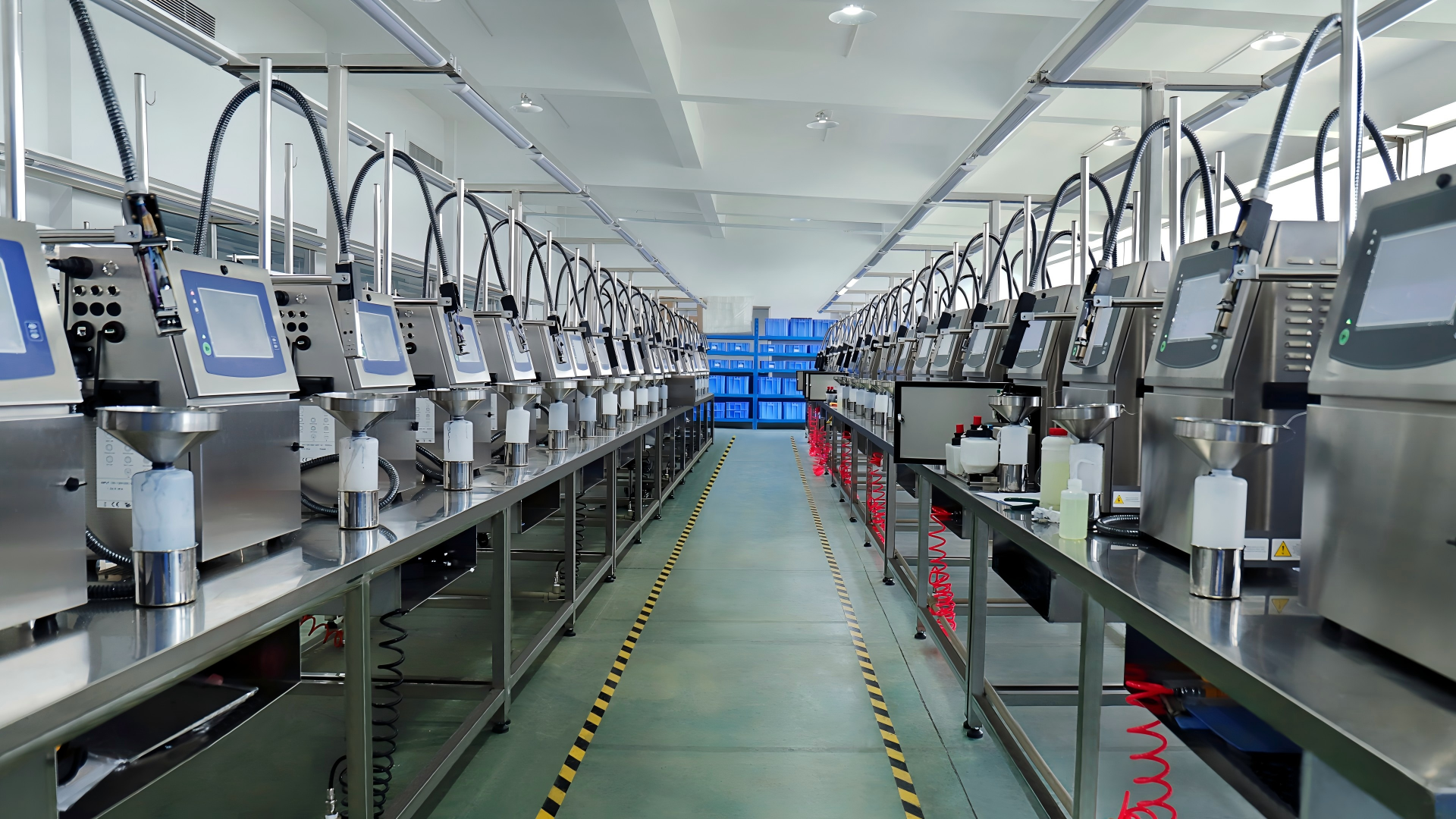
Coding hardware prepared for multi-sector deployment: enclosure class, print content and verification are specified together at the line level.
Mapping equipment to food, pharmaceutical, daily chemical and industrial chemical packaging
Food and beverage. Cleaning frequency is the dominant variable. Bottle, can and carton positions close to fillers favour the M2000 or V2000 Series, where IP65 protection and a SUS 304 cabinet tolerate rinse-adjacent operation, and CIJ flexibility handles curved and irregular surfaces. Where the substrate is a heat-sensitive film or a delicate plastic closure, the L3000 UV laser avoids thermal distortion — but it belongs in a dry section of the hall.
Pharmaceutical. Cartons, labels and blister-adjacent packaging carry serialized data and 2D codes at high resolution, and the substrate is often less tolerant of heat and contact. A UV laser at 355 nm suits sensitive plastics and glass; high-resolution inkjet platforms suit coated cartons where larger code areas and variable data density matter. Code verification is effectively mandatory rather than optional in this segment.
Daily chemical. Product variety drives changeover frequency: HDPE bottles, labels, shrink film and tubes appear on the same line within a week. CIJ covers mixed and irregular surfaces economically; UV laser marking is a good match for HDPE, ABS and similar rigid plastics where a permanent mark is preferred.
Industrial chemical. Containers are large, surfaces are often harsh and the code has to survive storage and transport. Where chemical splash is present, the higher-protection CIJ configuration is the safer starting point; where a permanent mark on rigid plastic or glass is required and the area is dry, laser marking removes the consumable from the equation.
Where a protection rating stops being enough
Ingress protection and compliance are related but not interchangeable. Four boundaries deserve to be written into the qualification checklist:
Ingress is not chemical resistance. An IP65 cabinet resists water jets; it does not certify resistance to a specific caustic or acidic cleaner. The cleaning agent list should be checked against the cabinet material at quotation.
The rating defines the position, not the plant. An IP43 UV laser in a washdown hall needs a secondary enclosure or a relocated installation. Specifying the laser for its marking quality and then placing it in a wet zone inverts the logic.
Substrate and ink must be validated together. Ink or marking method has to be matched to the actual carton, film, plastic, metal or glass surface, and pre-production sample printing should be completed before mass shipment. Working conditions — temperature, humidity and line condition — are confirmed before model selection, because a printer qualified on paper can still fail on a coated board.
Enclosure upgrades carry cost and service implications. Stainless cabinets and higher ingress ratings usually mean a higher hardware price than painted-casing alternatives, and gasket inspection becomes part of the preventive maintenance routine. For a dry, dust-controlled area, that spend may buy nothing an auditor will credit.
Comparison with conventional coding setups
| Approach | Strength in a regulated environment | Constraint to plan for |
|---|---|---|
| Painted mild-steel cabinet CIJ | Lower hardware cost and broad model availability | Coating can chip at hinges and seams, creating corrosion points under repeated cleaning |
| SUS 304 / IP65 CIJ (M2000, V2000) | Rinse-adjacent operation with no coating to degrade; flexible on curved and irregular surfaces | Stainless does not confer food-contact status; chloride-heavy sanitizers may call for a different grade |
| UV laser (L3000, IP43) | No ink, solvent or ribbon consumables; permanent low-heat mark on sensitive substrates | Best suited to dry controlled zones; a washdown position requires an additional enclosure |
| Cartridge TIJ in a wet zone | High-resolution 2D and barcode content on cartons and labels | Cartridge handling and contact-sensitive deployment are a weaker match to wet and dusty areas than a sealed CIJ cabinet |
None of these options is universally correct. The honest trade-off is that protection and permanence are paid for either at purchase or in maintenance and replacement — and which is cheaper depends entirely on the cleaning regime the unit will actually face.
Qualifying for the long term: documentation, spares and service continuity
Compliance is not a purchase event. It is a property that has to hold for the service life of the line, which means the supplier relationship is part of the technical specification. A printer that is perfectly qualified on day one becomes non-compliant the moment the cabinet seal cannot be replaced, the firmware cannot be matched to a sister plant, or the print parameters drift without a service route to correct them.
The lifecycle evidence to look for is unglamorous: whether the supplier provides parts matching support, replacement guidance and online response after delivery; whether installation guidance, remote tuning and fault diagnosis are available when a line is commissioned under time pressure; and whether distributor and service partner support exists in the destination market. DOCOD describes all four of these as part of its service model.
Production-side evidence matters for the same reason. Quality control covering part verification, packing inspection and shipment check means the unit that arrives is the unit that was specified. The minimum order quantity is 1 set per project, standard equipment typically ships within about 15 working days while customized solutions may require 15–30 working days, and monthly production capacity stands at 2,000 units for standard equipment and up to 4,000 units for distributor-supported products. Export markets include Europe, Latin America, Southeast Asia, the Middle East and Africa.
For a multi-site manufacturer, the practical test is continuity: can the same enclosure class, the same print content and the same verification logic be repeated at a second plant eighteen months later? A supplier that can answer that question with documented model continuity is worth more in a regulated programme than one that wins on unit price at the first order.
Market context: compliance is becoming a purchasing criterion
Commercial research houses covering coding and marking equipment agree on the direction of the category's growth but disagree materially on its size, scope and method. Published 2026 estimates cannot be merged into a single verified figure, and buyers should treat them as directional context rather than as a basis for sizing a procurement programme.
What is observable at the specification level is more useful. Regulated buyers increasingly write ingress ratings, cabinet materials and code-verification requirements into the RFQ itself, rather than accepting a generic conformity statement. Combined with the GS1 2D transition deadline, that shifts the selection conversation from "which printer is fastest" to "which printer can be defended in an audit and supported for a decade".
Future outlook
Three developments are likely to reshape qualification criteria over the next few years. First, 2D codes and GS1 Digital Link will make print resolution and variable-data handling a compliance requirement rather than a marketing advantage. Second, print-and-verify architectures will move from pharmaceutical lines into food and chemical packaging as inspection hardware becomes a standard line component instead of an add-on. Third, environmental documentation — cleaning-agent compatibility, spare parts availability, service response — will be requested alongside the protection rating, because a printer that cannot be maintained cannot remain compliant.
FAQ
What does an IP65 rating actually tell a packaging buyer?
The first digit indicates dust-tight construction; the second indicates protection against water jets. In practice, IP65 allows a coding printer to be positioned in rinse-down and washdown-adjacent areas rather than being confined to a dry control cabinet. It does not state anything about resistance to specific cleaning chemicals, food-contact suitability or cleanability validation.
Is SUS 304 stainless steel sufficient for a washdown food line?
SUS 304 provides a coating-free cabinet that can be wiped and rinsed repeatedly and resists many common detergents, which is why it is used on the DOCOD M2000 and V2000 Series CIJ printers. It is not universally inert: where cleaning agents carry high chloride loads or the plant atmosphere is salt-laden, a higher-grade stainless is often specified instead.
Why is the DOCOD L3000 UV laser rated IP43 rather than IP65?
The L3000 Series 5W UV laser is specified at IP43, which corresponds to protection against solid objects above 1 mm and against spraying water. That rating suits dry, controlled production zones where its 355 nm low-heat marking is used on sensitive plastics, glass and films. For a directed-jet washdown position, the unit would require an additional enclosure or a different installation location.
Which print content should be validated before a line is qualified?
At minimum: date and batch coding, serial or serialized identifiers, and the machine-readable code — GS1 DataMatrix today, with GS1 Digital Link 2D codes increasingly required ahead of the 31 December 2027 retail transition deadline. Validation should include variable data printing, code readability at line speed, and where critical, online OCR or barcode inspection with alarm or rejection linkage.
How do buyers verify compliance continuity over a multi-year horizon?
By treating service and supply evidence as part of the specification: parts matching support and replacement guidance after delivery, installation guidance, remote tuning and fault diagnosis, distributor and service partner coverage in the destination market, and documented quality control covering part verification, packing inspection and shipment check. Continuity of the same model and enclosure class across sites is the practical indicator.
What are the standard purchasing terms and acceptance criteria?
For equipment projects the minimum order quantity is 1 set, with delivery terms of FOB or CIF. Acceptance criteria are print sample confirmation and factory testing before delivery, and payment terms are T/T or LC.
Additional technical detail on the coding, marking and inspection range is available in the DOCOD corporate brochure (PDF).
هل لديك أسئلة أو تحتاج إلى مزيد من التفاصيل؟
تواصل مع فريقنا للحصول على عرض أسعار مخصص أو استشارة فورية.
طلب عرض أسعار
املأ النموذج أدناه وسيتواصل معك فريقنا بعرض مقترح مخصص.
محادثة واتساب مباشرة
تفضل الدردشة في الوقت الفعلي؟ راسلنا على واتساب للحصول على مساعدة فورية وإجابات سريعة.
- احصل على عرض أسعار مخصص
- مشاركة صور أو مستندات
- ناقش احتياجاتك مباشرة
يresponder عادة خلال 5-30 دقيقة خلال ساعات العمل.