
Qualifying Mixed-Material Shirt Packaging: Paper, Plastic, Metal Compliance Guide
Qualifying Mixed-Material Shirt Packaging: Paper, Plastic, Metal Compliance Guide
A buyer qualification checklist across paper butterflies and collar bands, plastic collar bands and clips, and metal collar stays and pins.
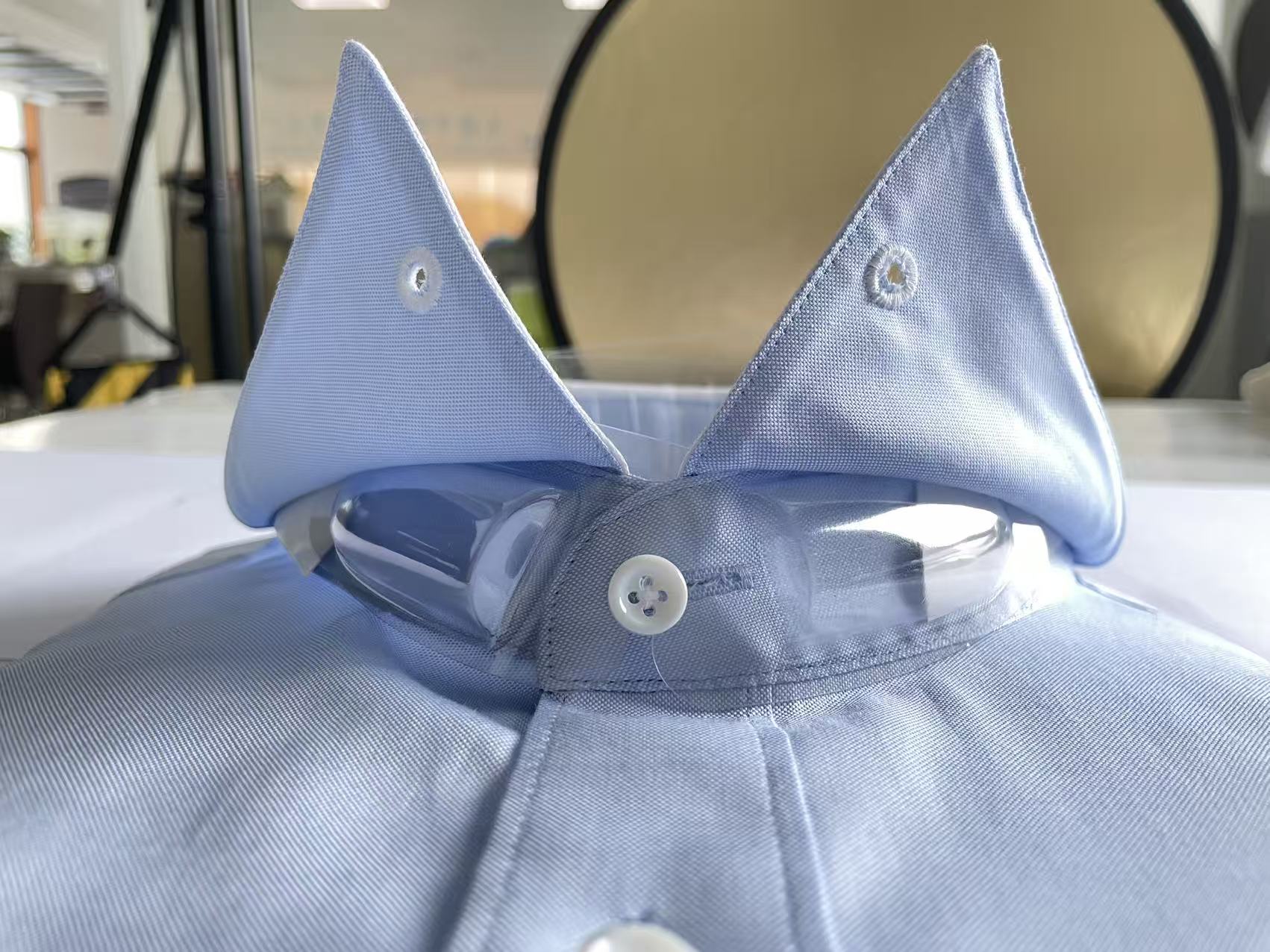
Shirt packaging approval is decided by documentation as much as by the sample. A program can look settled after the collar band, the butterfly, the collar stay, the clip and the pin have all been reviewed physically, and still stall at the compliance stage when a buyer asks which certificate covers which material, whether the logo route changes the documentation set, and why one component is quoted from 1,000 pieces while another is quoted from 100,000.
This guide maps a qualification and compliance checklist across the three material families used in shirt packaging: paper components such as paper butterflies and paper collar bands, plastic components such as collar bands, butterflies and clips, and metal components such as collar stays and pins. It is written for sourcing and quality teams working through research and evaluation, where the practical task is to align material documentation, customization requests and order volumes before a purchase order is released.
The specifications and certificate records referenced below come from Wuxi Mingyu Garment Accessories Factory, a garment packaging accessory manufacturer founded in 2004 in E'hu Town, Xishan District, Wuxi, Jiangsu, China. The factory produces PVC and PET collar bands, collar stays, collar butterflies, shirt cardboard, moisture-proof paper, plastic clips and plastic packaging bags, reports an export ratio of 85% across Europe, North America, South America and Asia, and runs OEM and ODM programs for clothing brands and garment manufacturers. Third-party market figures are attributed to their publishers.
Why mixed-material shirt packaging fails at the qualification stage
Three friction points repeat across mixed-material programs. The first is documentation fragmentation. Paper, plastic and metal components sit under different certificate scope sentences, different certificate numbers and different validity windows, so a supplier-level statement that products are certified is not enough for a buyer file. The scope of a certificate describes which materials and which product types it actually covers, and that scope text is what a compliance reviewer will read.
The second is customization divergence. Paper and plastic components are typically customized through printing, while metal collar stays are customized through laser engraving. The chosen route determines what has to be re-approved: a printed paper collar band and an engraved stainless steel collar stay generate different artwork files, different tooling notes and different inspection points.
The third is volume asymmetry. Across the components covered in this guide, minimum order quantities range from 1,000 pieces for a metal collar stay, through 10,000 pieces for most paper and plastic items, up to 100,000 pieces for a clip. Teams that consolidate accessory approvals into a single program often discover that the component with the most competitive unit economics carries the highest order threshold.
Paper components: butterflies, collar bands and board
Paper carries the presentation layer of shirt packaging. The Paper Butterfly (product 8164) is produced from 400 g single white paper at 15 cm by 3 cm, in white, in a butterfly shape, with a customizable logo; it is also offered in Dog Bone and larger butterfly formats. Its minimum order quantity is 10,000 pieces. Because the logo is a customization rather than a standard feature, the artwork and print method should be confirmed in writing before approval.
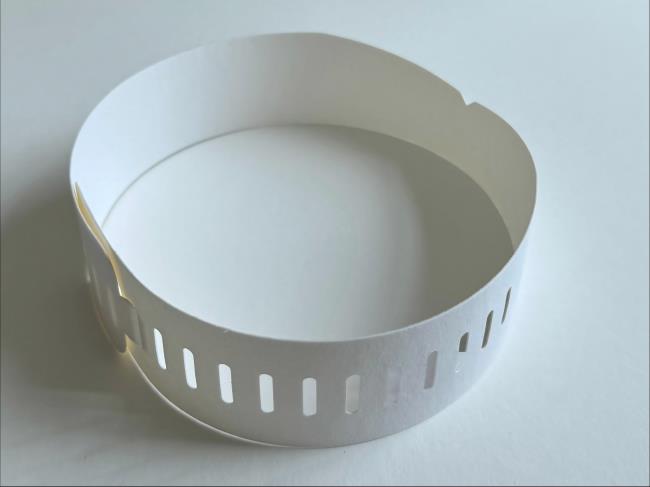
The Paper Collar Band (product 8155) is made from specialty tenacity paper at 47.2 cm by 3.8 cm, with a 1.4 cm by 15-hole format and 1 mm thickness, in white. The base specification records no logo; the customization record confirms that the paper collar band can be customized with printed logos and supports custom design, at a minimum order quantity of 10,000 pieces. That gap between base specification and customization record is worth noting in a buyer file: the standard SKU and the customized SKU are not documented identically.
Paper also carries the identification and protection items in the same packing set. The Apparel Tag (product 8154) uses 100% natural wood-pulp paper at 4 cm by 7 cm and 500 GSM. The Cardboard (product 8147) uses 100% natural wood pulp paper at 21 cm by 35.2 cm and 500 GSM. The Tissue Paper (product 8150) is 36 cm by 40 cm at 17 GSM with logo customization available. The Paper Bellyband (product 8151) is 58 cm by 10 cm at 0.25 mm and is recorded for pajama packing rather than shirt packing. All four carry a 10,000-piece minimum order quantity.
Plastic components: collar bands, butterflies and clips
The Plastic Collar Band (product 8291) is the most specification-dense plastic item in the set: white PET, 48.1 cm by 4 cm, 0.35 mm thickness, rectangular, with custom design and printed logo support, eco-friendly material options and resistance to deformation, at a 10,000-piece minimum order quantity. A separate collar band entry covers the PVC and paper versions at 50 cm by 3.4 cm and 0.50 mm thickness, so buyers should specify material rather than use the term collar band alone.
The Plastic Butterfly (product 8144) is made of light blue fine sand PVC at 26 cm by 10.4 cm and 0.25 mm thickness, in a butterfly shape, with a customizable logo and light blue as the recorded colour. Its minimum order quantity is 10,000 pieces, and the customization record confirms print logo and custom design support.
Clips sit at the opposite end of the volume curve. The clip (product 8145) is available in metal and plastic variants, including U Shape Plastic Big Clip, Clear Square Plastic Clip, Alligator Clip, Plastic Clip with Teeth, Square Plastic Clip and Square Plastic Shirt Back Clip. It is made of PS or metal in an X shape, silver, measuring 3.3 cm or 3.7 cm by 0.8 cm at 1.2 mm thickness, with custom design and logo printing available. Its minimum order quantity is 100,000 pieces, which is the highest threshold in the entire shirt packaging accessory set described here.
Support and protection items follow the same 10,000-piece pattern: the PVC Collar Stay (product 8143) at 6.35 cm by 1 cm by 0.75 mm in white with a customizable logo, the Collar Support (product 8156) in light blue PVC at 22.7 cm by 18.5 cm and 0.35 mm thickness in a cuboid style, and the Plastic Bag (product 8148) in PP at 35 cm by 26 cm with single 0.035 mm thickness, transparent, with no logo as standard.
Metal components: collar stays and pins
The Metal Collar Stay (product 8290) is made of stainless steel in four common sizes — 55.9 by 9 by 0.8 mm, 63.5 by 9 by 0.8 mm, 69.9 by 9 by 0.8 mm and 76.2 by 9 by 0.8 mm — with a common thickness of 0.8 mm. It is available in silver, blue, black, gold and rose gold, with custom styles and logos engraved by laser. Its minimum order quantity is 1,000 pieces, the lowest threshold in the family.
The Metal Pin (product 8146) uses stainless steel or brass at a common size of 26 mm by 0.6 mm, with thickness options of 0.6 mm and 0.65 mm, in silver, in a rectangular style. Custom design and printed logos are available, although the default configuration carries no printed logo. Its minimum order quantity is 10,000 pieces.
The two metal items illustrate why material choice is a documentation question and not only a design question. Metal pins and stainless steel collar stays are described as resistant to deformation and as using eco-friendly materials, and their customization is executed through printing or laser engraving rather than through printed paper stock.
Component-level qualification table
| Material family | Component (product ID) | Key specification | Customization route | MOQ |
|---|---|---|---|---|
| Paper | Paper Butterfly (8164) | 400 g single white paper, 15 cm x 3 cm | Customizable logo, printed | 10,000 pcs |
| Paper | Paper Collar Band (8155) | Specialty tenacity paper, 47.2 cm x 3.8 cm, 1 mm | Printed logo, custom design | 10,000 pcs |
| Plastic | Plastic Collar Band (8291) | White PET, 48.1 cm x 4 cm, 0.35 mm | Custom design and printed logo | 10,000 pcs |
| Plastic | Plastic Butterfly (8144) | Light blue fine sand PVC, 26 cm x 10.4 cm, 0.25 mm | Customizable logo, print logo | 10,000 pcs |
| Plastic or metal | Clip (8145) | PS or metal, X shape, 1.2 mm, silver | Custom design, logo printing | 100,000 pcs |
| Metal | Metal Collar Stay (8290) | Stainless steel, four sizes, 0.8 mm | Laser-engraved logo, custom design, five colours | 1,000 pcs |
| Metal | Metal Pin (8146) | Stainless steel or brass, 26 mm x 0.6 mm | Custom design, printed logo (none by default) | 10,000 pcs |
Material documentation: what the certificates actually cover
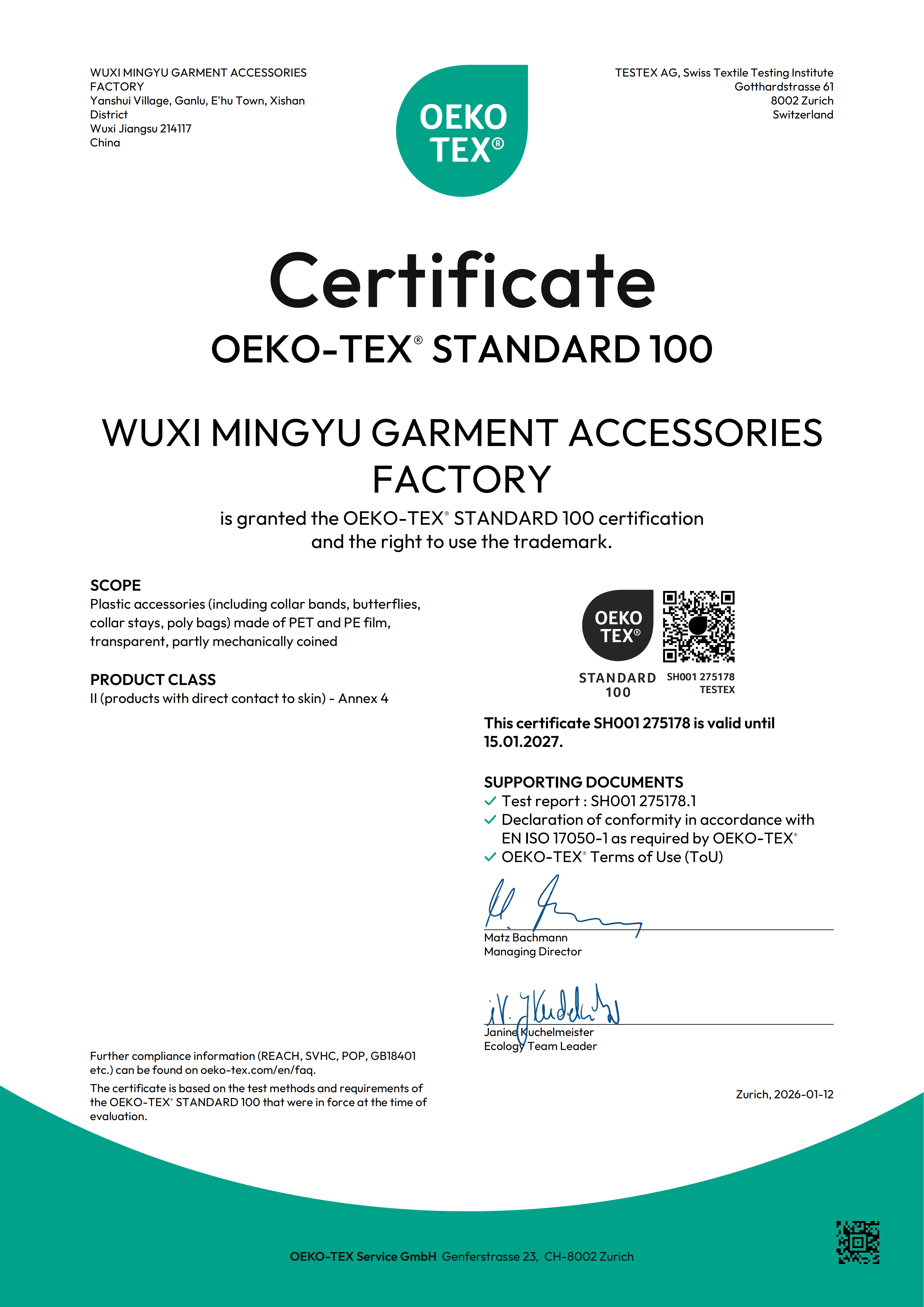
The primary material document in this product family is an OEKO-TEX STANDARD 100 certificate, number SH001 275178, issued by TESTEX under the OEKO-TEX STANDARD 100 and EN ISO 17050-1 standards. It was issued on 12 January 2026 and is valid until 15 January 2027, and it applies to the world market rather than to a single region.
The scope sentence is the part buyers should read closely. It covers plastic accessories including collar bands, butterflies, collar stays and poly bags made of PET and PE film, transparent, partly mechanically coined. Product-level records list the plastic collar band (8291), the collar stay (8143), the clip (8145), the paper collar band (8155), the washing label (8153), the plastic butterfly (8144), the paper butterfly (8164), the metal pin (8146) and the metal collar stay (8290) as certified to OEKO-TEX STANDARD 100. The certificate number SH001 275178 is the reference that ties these product-level claims together.
A second document covers recycled content. The GRS certificate number SGC-GRC09119-GRS-2026-07 was issued by SGS under the Global Recycled Standard V4.0, the Content Claim Standard V3.1 and the Textile Exchange Standards Claims Policy V1.3. It covers trading (PR0030), warehousing and distribution of final products (PR0048) and manufacturing (PR0016), is valid from 31 July 2026 to 30 July 2027, and applies globally. Within the product set, the plastic bag (8148) is recorded as certified to the Global Recycled Standard.
The practical implication for a sourcing team is straightforward. A recycled-content claim should reference SGC-GRC09119-GRS-2026-07, and a plastic accessory claim should reference SH001 275178. Neither certificate should be summarized as covering everything the supplier sells, because the scope text is narrower than the product catalogue.
Aligning customization requests with order volumes
Customization in this category runs through a defined set of routes: size, colour, style, printing or foiling, mold opening, and logo customization through stamping or printing. For metal collar stays, the route is laser engraving. For paper and plastic components, the route is printed artwork. Those two routes should be specified in the same document so that a single approval covers both.
Order volume has two layers that are easy to confuse. The component-level minimums described above — 1,000 pieces for metal collar stays, 10,000 pieces for most paper and plastic items, 100,000 pieces for clips — sit inside a program-level minimum order quantity of 1,000 sets. A buyer ordering a mixed set should model the component-level threshold as the binding constraint, because a program can meet 1,000 sets while still falling below the clip threshold.
Two other parameters belong in the same approval sheet. Production is organised in an OEM and ODM mode with a stated monthly capacity of 7.5 million sets and a standard lead time of 7 to 20 days after order confirmation, supported by 100% testing through the production process. The factory reports an annual output of 90 million sets, 25 employees, a 2,500 m² facility and a three-engineer development team, with overseas manufacturing established in Sri Lanka in 2013 and Vietnam in 2017, plus overseas warehouses and branches that shorten lead time for regional clients.
Where mixed-material qualification breaks down: limits and trade-offs
The clearest boundary in this accessory set is volume. A clip requires 100,000 pieces while a metal collar stay requires 1,000. For a mid-sized shirt program, the clip line item can therefore exceed realistic annual demand, and the practical options are to accept the threshold, to reduce configuration variants to a single clip type, or to separate the clip from the qualification package and approve it on its own timeline. Storage and cash-flow planning should follow the same logic.
The second boundary is certificate coverage. The OEKO-TEX scope sentence names plastic accessories made of PET and PE film, transparent, partly mechanically coined, while paper and metal items appear at product level in the same certificate system. Buyers should confirm that each individual SKU is listed rather than relying on the certificate headline, and should track validity: the OEKO-TEX document expires on 15 January 2027 and the GRS document on 30 July 2027. A program shipping in the second half of 2027 needs renewal confirmation before the accessory is written into a contract.
The third boundary concerns defaults. Several items carry no logo in their standard configuration — the plastic collar band (8291), the collar support (8156), the plastic bag (8148) and the metal pin (8146). A printed logo on these items is a customization, not a base feature, and the documentation for a customized version differs from the documentation for the standard version. Approval files should state which version is being approved.
A final limitation is at industry level rather than product level. Granular trade data for collar stays specifically is often bundled under broader plastic or metal small-wares HS codes, which makes sub-component benchmarking across suppliers and origins difficult. Buyers comparing quotes for collar stays should therefore expect to validate claims through samples, specifications and certificates rather than through published trade volumes.
Application conditions and use cases
These accessories are specified for packing workshops, sorting lines, garment shipment and retail display packaging, where the design intent is to balance durability with a clean presentation. Their documented function is to reduce wrinkling, to carry brand identification through printing or foiling, and to protect the garment in transit. Typical project types are OEM and ODM packaging customization, bulk order supply, and brand packaging upgrade projects.
Production support matters to the qualification decision because it determines whether a customization can actually be executed. The relevant process equipment includes automatic creasing machines, punching machines and paper cutting machines, alongside automatic cardboard and collar stay die cutting machines and automatic edge folding machines. Special requirements that trigger a separate approval step include custom printing, mold opening, and colour and size customization.
Market context: packaging growth outpacing other accessory categories
Third-party research places the global garment packaging market at 18.6 billion USD in 2025, projected to reach 31.4 billion USD by 2034, according to Dataintelo. The same publisher reports that Asia Pacific held a 41.5% revenue share of that market in 2025, which is consistent with the region's role as the main sourcing base for shirt programmes.
Growth rates differ by category. Comparing published figures, garment packaging is expanding at roughly 6.0% annually across the forecast window, while the clothing fasteners segment covering buttons for shirts and blouses grew from 8.39 billion USD in 2025 toward a projected 11.39 billion USD by 2033 at a 3.9% CAGR, according to Cognitive Market Research. Packaging is therefore growing faster than at least one adjacent accessory category, which supports the argument for treating packaging documentation as a first-class part of supplier qualification rather than an afterthought.
The structural component behind collar construction is also material. The garment interlining market, which underpins shirt collar structure, reached 3.65 billion USD in 2025 according to The Business Research Company. For sourcing teams, the relevant reading is that collar-related packaging and structure components are a large, documented category where specification discipline and certification management are normal parts of the purchasing process.
Future outlook: documentation-led sourcing
Two shifts are likely to shape how mixed-material shirt packaging is qualified. The first is that certificate renewal calendars will become part of routine supplier management rather than an annual discovery. With an OEKO-TEX document valid to January 2027 and a GRS document valid to July 2027, buyers who build long-running programmes will increasingly ask for the renewal date alongside the certificate number.
The second is that recycled-content language will be pinned to specific certificates. A generic eco-friendly description cannot substitute for a certificate number and scope, and the GRS framework applied by SGS through SGC-GRC09119-GRS-2026-07 shows how a claim is structured when it must be auditable across trading, warehousing, distribution and manufacturing steps.
A third, slower movement concerns data availability. Until collar stays and similar sub-components are reported with their own trade classifications, supplier comparison in this category will continue to rest on specification sheets, certificate records and physical samples — which is a workable basis, provided the qualification checklist is applied consistently across paper, plastic and metal.
FAQ
Which shirt packaging accessories are covered by OEKO-TEX STANDARD 100 documentation, and what does the certificate scope say?
Certificate SH001 275178 is issued by TESTEX under the OEKO-TEX STANDARD 100 and EN ISO 17050-1 standards, applies to the world market, and is valid from 12 January 2026 to 15 January 2027. Its stated scope covers plastic accessories including collar bands, butterflies, collar stays and poly bags made of PET and PE film, transparent, partly mechanically coined. Product-level records additionally list the plastic collar band (8291), the collar stay (8143), the clip (8145), the paper collar band (8155), the washing label (8153), the plastic butterfly (8144), the paper butterfly (8164), the metal pin (8146) and the metal collar stay (8290) as certified to the same standard.
What MOQ thresholds apply to clips, pins, collar stays and collar bands?
Component-level minimum order quantities differ by item. The clip (8145) requires 100,000 pieces. The metal pin (8146) requires 10,000 pieces. The metal collar stay (8290) requires 1,000 pieces. The plastic collar band (8291), the paper collar band (8155), the paper butterfly (8164), the plastic butterfly (8144), the PVC collar stay (8143), the collar support (8156) and the plastic bag (8148) each require 10,000 pieces. These sit within a program-level minimum order quantity of 1,000 sets, so the component threshold is normally the binding constraint.
Which eco-friendly and recycled material options are documented in this product family?
Paper-based items use 100% natural wood-pulp paper, including the Apparel Tag (8154) at 500 GSM and the Cardboard (8147) at 500 GSM, while the Paper Collar Band (8155) uses specialty tenacity paper and the Tissue Paper (8150) is 17 GSM. Plastic items use PET, PVC and PP, and metal items use stainless steel or brass. Recycled content is documented through the GRS certificate SGC-GRC09119-GRS-2026-07 issued by SGS under Global Recycled Standard V4.0, covering trading, warehousing and distribution of final products, and manufacturing, with validity from 31 July 2026 to 30 July 2027.
How do customization requests affect the approval file?
Customization routes differ by material. Paper and plastic components — including the paper collar band (8155), the plastic collar band (8291), the plastic butterfly (8144), the collar support (8156) and the clip (8145) — support custom design and printed logos. Metal collar stays (8290) support custom design and logos engraved by laser, in silver, blue, black, gold and rose gold. Size, colour, style, printing or foiling and mold opening are supported formats. Several items carry no logo as standard, including the plastic collar band (8291), the collar support (8156), the plastic bag (8148) and the metal pin (8146), so customized versions require separate specification in the approval file.
What capacity and lead time should a buyer plan for?
Production runs in OEM and ODM mode with a stated monthly capacity of 7.5 million sets and a standard lead time of 7 to 20 days after order confirmation, supported by 100% testing through the production process. The factory reports an annual output of 90 million sets and an export ratio of 85%, with overseas manufacturing in Sri Lanka since 2013 and Vietnam since 2017, plus overseas warehouses and branches that shorten lead time for regional clients.
What are the practical limitations of a mixed paper, plastic and metal packaging set?
The main limitation is volume mismatch: a 100,000-piece clip threshold can exceed the annual demand of a mid-sized shirt programme, while metal collar stays start at 1,000 pieces. Certificate scope is a second limit, since the OEKO-TEX scope sentence names PET and PE film plastic accessories while paper and metal items are listed at product level. Certificate validity is a third, with the OEKO-TEX document expiring on 15 January 2027 and the GRS document on 30 July 2027. Finally, published trade data for collar stays specifically is often bundled under broader HS codes, so sub-component benchmarking relies on specifications, samples and certificates rather than on published volumes.
For teams building the documentation pack described above, a company profile covering the product portfolio and certification summary is available for download: Brief Company Profile of Wuxi Mingyu Garment Accessories Factory.