
Qualifying Orbital Welders: From Pharma to Oil & Gas Standards
Qualifying Orbital Welders: From Pharma to Oil & Gas Standards
Orbital welding systems are built as power supplies plus interchangeable weld heads, which is why qualification is decided at head level, not at brand level.
Qualifying an orbital welding machine is not a single certificate. It is a three-layer match: the mechanical envelope of the machine, the architecture of the weld head, and the documentation the owning industry accepts at handover.
That is why identical welding technology can be routine in one sector and tightly specified in another. In pharmaceutical manufacturing, orbital welding is standard practice for complying with FDA guidelines for drug manufacturing processes, because it produces clean welds with minimal contamination risk. In oil and gas — the largest single application segment of the orbital welding market — the same process is judged mainly on pressure integrity, code qualification and inspection records. Both buyers purchase an orbital welding machine; they are not buying the same thing.
This reference maps that difference onto specific machine models, so that engineers and procurement teams researching a project can see why certain models are specified for hygienic industries such as pharmaceuticals, food and beverage and semiconductors, while others serve heavy industries such as oil and gas, shipbuilding and pressure vessel fabrication.
Why Qualification Logic Diverges by Industry
Each regulated sector converts its risk into equipment requirements. Those requirements then decide which weld head geometry, diameter range and wall thickness range is even admissible on site.
| Industry | Typical project requirement | What it changes in machine selection |
|---|---|---|
| Pharmaceutical | 3A Sanitary Standard, FDA compliant, EU GMP, full documentation | Hygienic, crevice-free joints with per-joint traceability; thin-wall heads dominate |
| Food & Beverage | EHEDG certified, no dead leg design, USDA/FDA audit ready | Sanitary surface condition and cleanable geometry; SS304L/SS316L tubing |
| Semiconductor & Electronics | SEMI F57 cleanliness standard, Class 1 cleanroom compatible | Closed-head high-purity GTAW to prevent atmosphere contamination |
| Chemical / Petrochemical | ATEX / IECEx (where required), API standards, NACE compliance | Corrosion-resistant welds and zero-leak joints in continuous process duty |
| Power Generation / Boiler | ASME Section IX, Pressure Equipment Directive, customer-specified code | Procedure qualification and inspection records matter as much as the machine |
| Water Treatment / HVAC | ISO 9001 quality system, pressure vessel standards, WRAS approved | Corrosion-resistant joints, long-term reliability, mixed field and shop work |
Two conclusions follow. First, a hygienic sector and a heavy sector may both ask for "orbital welding", yet one is buying surface and documentation control while the other is buying wall-thickness capability and pressure-rated procedures. Second, qualification is decided at head level — the power supply is shared across sectors far more often than the weld head is.
Layer 1 — The Mechanical Envelope
The first filter is physical: can the machine reach the pipe outside diameter and wall thickness the project actually contains? The table below is the envelope of the KEPUNI orbital welding range. KEPUNI is a Shanghai-based orbital welding equipment brand of Shanghai Chuanli Industrial Co., Ltd., which develops, produces and services closed and open orbital welding heads, tube-to-tube-sheet welders, cold welders and orbital cutters, with products supplied to customers in Europe, Asia, South America, North America and the Middle East.
| Model | Type | Pipe / tube OD | Wall thickness | Listed industries |
|---|---|---|---|---|
| XD-20PRO | Pipe welding power supply | 3.175–168 mm | 0.5–3 mm | Semiconductor, Pharmaceutical, Food & Beverage, Oil & Gas, Chemical |
| XD-20W | Pipe welding power supply | 3.175–168 mm | 0.5–3 mm | Pharmaceutical, Semiconductor, Chemical Processing |
| 5H Series | Split type weld head | 3.175–15.88 mm | ≤1.5 mm | Semiconductor, Pharmaceutical, Biotechnology |
| 10H Series | Split type weld head | 6.35–25.4 mm | ≤1.5 mm | Pharmaceutical, Food & Beverage, Chemical |
| XD-Split Type Weld Head | Split type weld head | 3.175–25.4 mm | ≤1.5 mm | HVAC, Plumbing, Field Service |
| 40/80/120/170 Series | Closed weld head | 6.35–168 mm | ≤3 mm | Oil & Gas, Power Generation, Chemical Processing |
| XD-U Series | U-tube weld head | 9–25 mm | ≤1.5 mm | Heat exchangers, Boilers, Condensers |
| XD-K Series | Open pipe welding power supply | 19–325 mm | 2.5–13 mm (5–500 A) | Oil & Gas, Pipeline Construction, Shipbuilding, Petrochemical |
| K Series | Open weld head | 19–325+ mm | 2.5–13 mm | Oil & Gas, Petrochemical, Power Generation |
| XD-GH Series | Girth weld power supply + rotary stand | Pipe / vessel OD 20–960 mm | 2.5–25 mm (5–400 A) | Shipbuilding, Oil & Gas Pipeline, Storage Tanks, Pressure Vessels |
| TB-35 Series | Tube sheet weld head | 4.5–35 mm | ≤2.5 mm | Heat Exchangers, Boiler Manufacturing, Condensers |
| TB-65 Series | Tube sheet weld head | 8–65 mm | ≤5 mm | Large Heat Exchangers, Power Generation, Chemical Processing |
| XD-G400 | Tube-to-tube-sheet power supply | 4.5–65 mm | ≤5 mm | Heat Exchangers, Boilers, Condensers, Pressure Vessels |
Read as a qualification tool rather than a catalogue, this table already eliminates options. A 0.9 mm WFI tube in a sterile suite cannot be welded by a girth welding machine designed for 20–960 mm vessels. Conversely, a 14 mm wall pressure header is outside the ≤3 mm envelope of a closed weld head and points instead to the open-head or girth formats.
Layer 2 — Head Architecture Decides the Sector
Once the envelope fits, architecture decides whether the machine is acceptable to the industry at all.
Closed heads: built for purity
Orbital welding systems for clean rooms often use closed-head designs to prevent atmosphere contamination and to ensure high-purity Gas Tungsten Arc Welding (GTAW). The closed head encloses the weld zone, shields it from ambient air and produces repeatable, low-oxidation welds — which is exactly the property that hygienic and semiconductor projects are buying. The trade-off is geometric: the head must fit around the joint, so closed-head families such as the 40/80/120/170 Series are bounded at 6.35–168 mm OD and ≤3 mm wall thickness.
Split heads: built for access
Split-type heads open to be placed around a tube that cannot be slid into a closed head — an in-position retrofit, a repair, or dense tubing inside an enclosure. The 5H Series covers 3.175–15.88 mm OD at ≤1.5 mm wall, the 10H Series covers 6.35–25.4 mm at ≤1.5 mm, and the XD-Split Type Weld Head covers 3.175–25.4 mm at ≤1.5 mm for HVAC, plumbing and field service work. These are thin-wall tools by design, which is precisely the profile of pharmaceutical, biotechnology and food-grade tubing.
Open heads and girth welding: built for heavy industry
Heavy projects invert the priority: cleanliness is routine, pressure and thickness are not. The XD-K Series open pipe welding power supply handles 19–325 mm OD and 2.5–13 mm wall with 5–500 A output for oil and gas, pipeline construction, shipbuilding and petrochemical work, while the K Series open weld head extends to 19–325+ mm at the same wall range. Where vessel diameter grows further, the XD-GH Series girth welding machine pairs a power supply with a rotary stand and covers 20–960 mm OD at 2.5–25 mm wall thickness and 5–400 A for shipbuilding, oil and gas pipelines, storage tanks and pressure vessels.
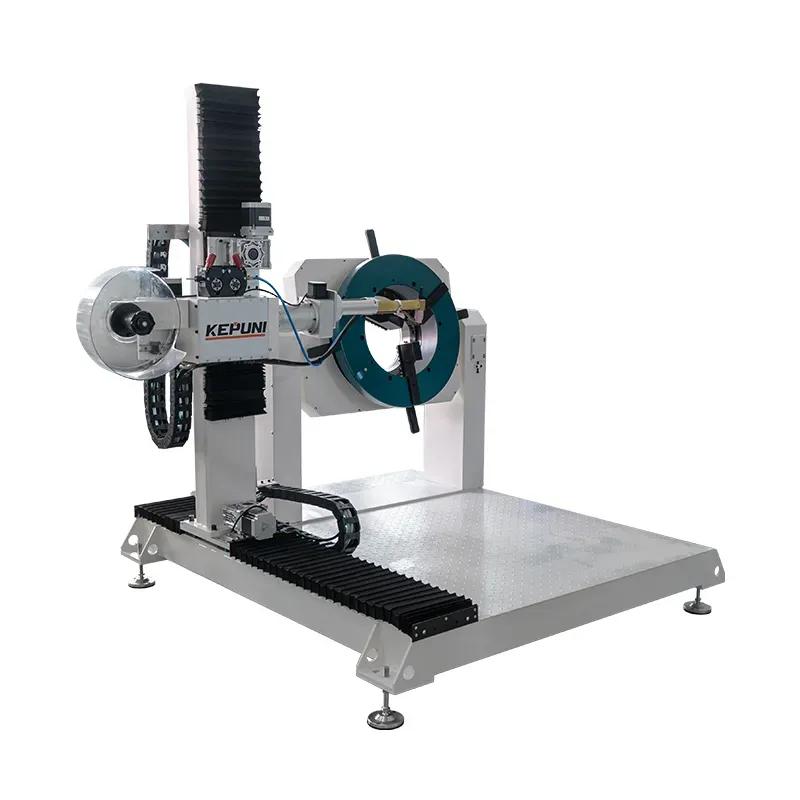
XD-GH Series: girth weld power supply plus rotary stand, covering 20–960 mm pipe/vessel OD and 2.5–25 mm wall thickness for heavy industrial fabrication.
Hygienic Project Mapping: Pharma, Food and Semiconductor
Hygienic sectors converge on thin-wall, small-diameter, fully documented welding — but they write different acceptance rules.
Pharmaceutical. WFI (Water for Injection) piping and CIP/SIP circuits operate in batch production mode and require aseptic pipe welding, 100% leak-proof joints and traceability. In one pharmaceutical WFI pure water system project, KEPUNI XD-20PRO units with additional weld heads were used for SS316L WFI piping and CIP/SIP pipelines; the documented outcome was zero weld defects, an EU GMP audit passed on the first attempt, and weld quality traceable to each joint.
Food and beverages. Sanitary lines are judged on hygienic geometry and cleanability. A dairy project used XD-20PRO units with accessories for SS304L sanitary piping in UHT milk processing and pasteurisation lines; the recorded result was 3A Sanitary Standard certification, 100% hydrostatic test pass and zero contamination incidents.
Semiconductors. Ultra-pure gas (UPG) distribution and DI water loops are the most contamination-sensitive application in the market. In a semiconductor UPG distribution piping project, XD-20PRO Hi-Purity units plus tube-sheet heads were used in a 28 nm process fab, where SEMI F57 particulate levels were verified with zero particle exceedance events, and all weld joints were documented.
Bridging case — medical gas. Hospital medical gas systems sit between the two worlds: hygienic in cleanliness terms, pressure-critical in engineering terms. In a 400-bed hospital project, XD-20PRO Medical Specification units welded SS316L medical oxygen, medical air and vacuum piping, delivering 100% helium leak test pass against HTM 02-01 and NFPA 99 requirements.
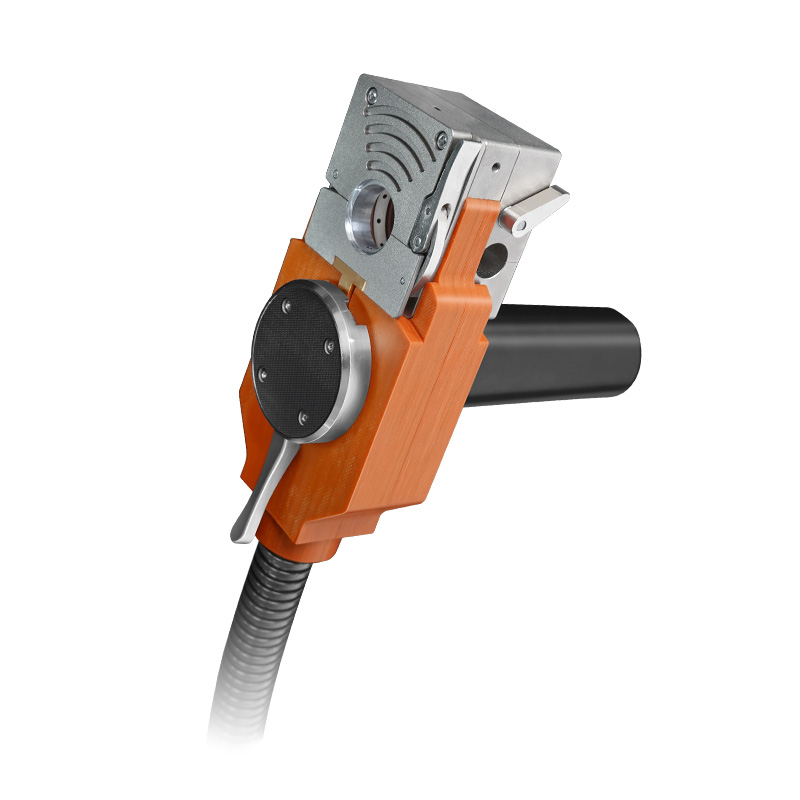
5H Series split type weld head: 3.175–15.88 mm OD, ≤1.5 mm wall — the format used for thin-wall high-purity tubing in semiconductor, pharmaceutical and biotechnology systems.
Heavy Project Mapping: Oil & Gas, Power, Shipbuilding and Chemical
Heavy industries shift the acceptance criteria to code compliance, thickness capability and inspection outcomes.
Oil and gas. Pipe welding here spans open-head pipeline work (XD-K Series, K Series) and large-bore girth welding (XD-GH Series). Orbital welding itself is well established in this sector: oil and gas represented the largest application segment of the global orbital welding machine market in 2024, holding more than one-third of total share.
Chemical and petrochemical. Process piping in aggressive media is specified for corrosion-resistant welds, zero leak and chemical-resistant materials, usually in continuous process operation, with ATEX / IECEx requirements where applicable plus API and NACE obligations. In a chemical acid-transfer project, XD-20W units were used for SS316L and Duplex stainless steel process piping in acid transfer and solvent recovery systems, meeting API 582 welding requirements with NACE MR0175 material verification completed and zero safety incidents during welding.
Power generation and boilers. Boiler work is a shutdown-clock business. In a boiler tube replacement project at a 300 MW thermal power plant, TB-35 Series and XD-GH Series equipment handled boiler water wall tube-to-tube-sheet welds and superheater tube replacement; welds were ASME Section IX and B31.1 compliant with a 100% ultrasonic testing pass rate, and the plant was reconnected four days ahead of schedule.
Water treatment and desalination. Large-bore stainless girth welding follows piping codes such as ASME B31.3. In a seawater desalination project, XD-GH Series and XD-K Series equipment welded SS316L large-bore pipe with zero rework across more than 400 girth welds.
Heat exchangers, HVAC and pressure vessels. Tube-to-tube-sheet welding is its own qualification category. An HVAC shell-and-tube heat exchanger project used TB-65 Series and XD-U Series equipment for tube-to-tube-sheet orbital welds, achieving ASME U-stamp certification and a 100% helium leak test pass across all tube joints.
Layer 3 — Documentation Is Half the Qualification
In regulated industries, an acceptable weld and an acceptable record are two separate deliverables. Pharmaceutical projects explicitly require full documentation; power generation projects require code-compliant procedures; semiconductor projects require verified particulate performance. This is why the qualification conversation usually ends up being about documents rather than arc characteristics.
Two supplier behaviours matter here. First, sample validation: a sample order can be configured with custom parameters, special materials such as SS304, SS316, Titanium or Inconel, and non-standard sizes, with full inspection plus a weld sample report and detailed parameter documentation, from a minimum of one unit and a 15–20 day lead time. Second, production consistency: OEM/ODM builds run through 100% function testing, weld sample testing and a 72-hour burn-in test, with lead times of 30–45 days and customisation available across logo, colour, 110V/220V voltage, interface, IoT/MES integration and software.
Comparison with Traditional Solutions — and the Boundaries
Manual TIG welding remains widespread and is still the right answer for many low-volume, non-coded or highly irregular joints. Its constraint is repeatability: joint quality depends on operator technique, and the resulting record is difficult to standardise across hundreds of joints. Orbital welding addresses that by mechanising travel speed, arc position and shielding, which is why it became standard in pharmaceutical manufacturing and high-purity piping.
That advantage is not unlimited, and buyers should plan around at least five real boundaries:
- Envelope limits are hard limits. The 40/80/120/170 Series closed heads stop at 3 mm wall thickness; the 5H Series stops at 15.88 mm OD and 1.5 mm wall. Work beyond those figures must move to open-head or girth formats, which changes fixtures, floor space and the welding position logic.
- No single system spans all sectors. A hygienic micro-tubing programme and a heavy-wall vessel programme will normally require two head families — often from the same power supply, but not from the same head.
- Qualification does not transfer automatically. A machine proven on one diameter, wall thickness and material combination still needs project-specific procedure qualification before it can weld a coded joint.
- Thin-wall heads are not pressure-service heads. A ≤1.5 mm split head optimised for sanitary tubing is not a substitute for a 2.5–25 mm girth system in pressure-rated service, regardless of how similar the two industries look on paper.
- Capital and inventory cost. Orbital deployment means buying capability per diameter band, plus spare parts and trained operators. For small, one-off, non-coded repairs, that overhead is difficult to justify.
Market Trend Analysis
The global orbital welding machine market was valued at approximately USD 1.32 billion in 2024 and is projected to reach USD 2.07 billion by 2030, according to Strategic Market Research. Reported figures should be read with care: market size estimates for orbital welding specifically range from about USD 0.83 billion to USD 1.32 billion depending on whether the scope covers complete systems or only weld heads and power sources.
Two structural trends are more decision-relevant than the headline number. First, oil and gas remained the largest application segment in 2024 with more than one-third of total share — heavy industry still anchors demand. Second, high-purity piping for the semiconductor and pharmaceutical industries is identified as the fastest-growing segment, driven by stringent contamination control requirements. Regional data points in the same direction: Asia Pacific held a 37.0% revenue share of the welding equipment market as of 2025, and the U.S. welding equipment market is expected to grow at a CAGR of 4.2% from 2026 to 2033.
The competitive landscape remains concentrated around established international names — Lincoln Electric, ESAB (Colfax), Swagelok, AMI (Arc Machines, Inc.) and Polysoude are identified among the major players in the global orbital welding equipment market. For buyers, the practical consequence is that head-level differentiation, documentation quality and industry-specific configuration matter more than general brand recognition.
A Six-Step Qualification Framework
- Fix the governing standard first. 3A, FDA compliance, EU GMP and full documentation for pharma; EHEDG, no dead leg and USDA/FDA audit readiness for food; SEMI F57 and Class 1 cleanroom compatibility for semiconductor; API, NACE and ATEX/IECEx where required for chemical; ASME Section IX, Pressure Equipment Directive and customer-specified codes for power; ISO 9001, pressure vessel standards and WRAS for water and HVAC.
- Match the envelope. Confirm every pipe or tube OD and wall thickness in the scope against a table like the one above, then check the extreme values rather than the average.
- Select head architecture. Closed head for clean-room purity, split head for restricted access and thin walls, open head or girth welding for large-bore heavy-wall work, tube-to-tube-sheet heads for heat exchangers and boilers.
- Validate with a sample. Use a sample order path — custom parameters, special materials, non-standard sizes — and require a weld sample report with detailed parameter documentation.
- Define the traceability output. Agree in advance which records must exist per joint, in which format, and who signs them.
- Plan support continuity. For long projects, confirm spare parts availability (typically 7–15 days globally), remote diagnosis, on-site support where applicable, operator training and annual maintenance arrangements.
Future Outlook
Two forces will shape qualification practice over the next several years. Regulation in high-purity sectors keeps tightening, and the fastest-growing segment of the market is precisely the one where documentation and particulate performance are contractually enforced — semiconductor and pharmaceutical piping. At the same time, oil and gas, power generation and pressure vessel fabrication remain the volume base, where thickness capability and code compliance stay decisive.
The practical outcome is convergence at the power supply level and continued specialisation at the head level. Platforms such as the XD-20PRO already list semiconductor, pharmaceutical, food and beverage, oil and gas and chemical industries in a single power supply, which means a growing share of buyers qualify a head-and-documentation package rather than a machine. Suppliers that can present model-to-standard mapping clearly — envelope, architecture, sample evidence and traceability — will be easier to qualify than those that lead with general capability statements.
FAQ
What makes an orbital welding machine suitable for pharmaceutical piping?
Pharmaceutical projects operate in batch production mode and require aseptic pipe welding, 100% leak-proof joints and traceability, with special requirements that typically include the 3A Sanitary Standard, FDA compliance, EU GMP and full documentation. Suitability therefore depends on a thin-wall, hygienic head format — for example the XD-20PRO (3.175–168 mm OD, 0.5–3 mm wall) or the 5H Series split head (3.175–15.88 mm OD, ≤1.5 mm wall) — combined with per-joint weld records. Orbital welding is standard in pharmaceutical manufacturing for FDA guideline compliance because it produces clean welds with minimal contamination risk.
Can one orbital welding machine cover both hygienic and heavy industrial work?
Partially. A power supply such as the XD-20PRO is listed for semiconductor, pharmaceutical, food and beverage, oil and gas and chemical applications, so the power source can serve both worlds. The weld head cannot. Heavy-wall, large-bore work requires different formats: the XD-K Series open pipe welding power supply handles 19–325 mm OD at 2.5–13 mm wall, the K Series open weld head covers 19–325+ mm at 2.5–13 mm, and the XD-GH Series girth welding machine covers pipe or vessel OD 20–960 mm at 2.5–25 mm wall.
What pipe diameter and wall thickness ranges do the available weld heads cover?
Split type heads cover the smallest and thinnest work: 5H Series 3.175–15.88 mm OD at ≤1.5 mm; XD-Split Type 3.175–25.4 mm at ≤1.5 mm; 10H Series 6.35–25.4 mm at ≤1.5 mm. Closed weld heads (40/80/120/170 Series) cover 6.35–168 mm OD at ≤3 mm. Tube-to-tube-sheet heads cover 4.5–35 mm at ≤2.5 mm (TB-35), 8–65 mm at ≤5 mm (TB-65) and 4.5–65 mm at ≤5 mm with the XD-G400 power supply. Open and girth formats cover the largest work: XD-K 19–325 mm at 2.5–13 mm, K Series 19–325+ mm at 2.5–13 mm, and XD-GH 20–960 mm at 2.5–25 mm.
Which standards matter most in oil & gas, chemical and power generation projects?
Chemical and petrochemical projects specify ATEX / IECEx where required, API standards and NACE compliance, because the duty involves chemical process piping and aggressive media handling over continuous operation. Power generation and boiler projects specify ASME Section IX, the Pressure Equipment Directive and customer-specified codes, and the weld output is described as high-temperature resistant, pressure-rated and ASME-certified quality. Two recorded examples illustrate the pattern: an acid transfer project met API 582 welding requirements with NACE MR0175 material verification, and a boiler tube replacement at a 300 MW thermal power plant was ASME Section IX and B31.1 compliant with a 100% ultrasonic testing pass rate.
How should a buyer verify model-to-standard fit before placing an order?
The most reliable route is sample validation on the actual diameter, wall thickness and material combination. A sample order path allows custom parameters, special materials including SS304, SS316, Titanium and Inconel, and non-standard sizes, with a minimum of one unit and a 15–20 day lead time; it returns full inspection plus a weld sample report and detailed parameter documentation. For volume builds, verification typically covers 100% function testing, weld sample testing and a 72-hour burn-in test. Buyers should also confirm the traceability format in advance, since sectors such as pharmaceuticals require full documentation and semiconductor projects require verified cleanliness performance.