
Qualifying Portable Laser Marking Machines: Laser, Optical & Electrical Safety
Qualifying Portable Laser Marking Machines: Laser, Optical & Electrical Safety
Portable laser marking machines are no longer bought on wattage alone. In smart manufacturing cells where marking happens at the machine, at the pipe rack or at the goods-in bench, the marking head is handled, re-aimed and re-positioned many times per shift — which means the laser, optical and electrical safety file has become a qualification gate, not a formality attached to a quotation.
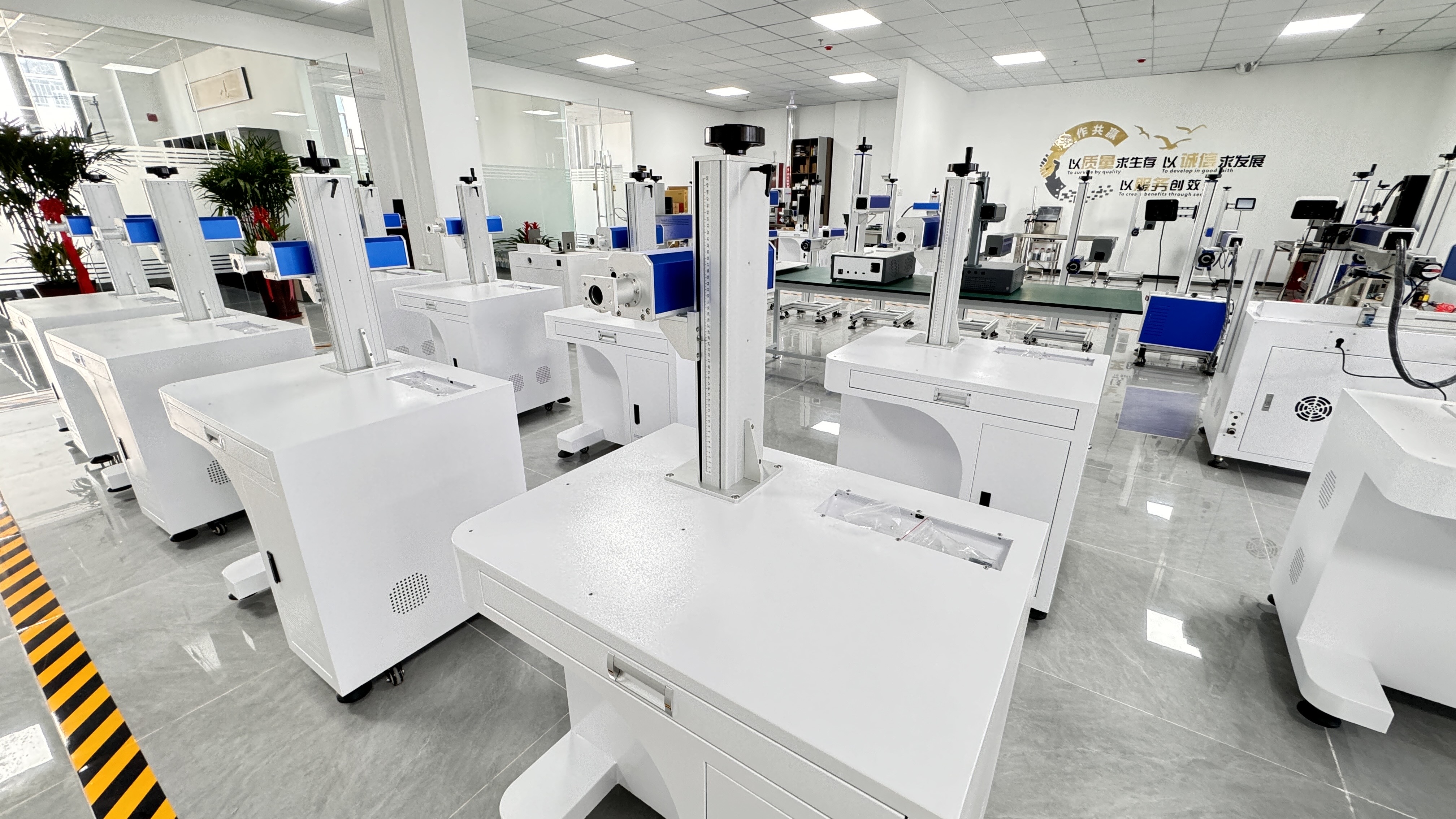
Portable laser marking units are assembled and checked before shipment; the safety documentation that travels with a unit should be verified with the same rigour as its optical specification.
Why portability changes the safety question
A fixed enclosed marking cabinet keeps the beam inside a machine guard. A portable unit does the opposite: it brings the beam to the workpiece, often into spaces where a fixed machine cannot go — large fabricated frames, installed pipe runs, or a bench where a single jewellery batch is being finished.
That proximity is the commercial advantage and the safety exposure at the same time. The operator stands closer to the marking point, the head is repositioned by hand, and the surrounding environment is not controlled by the machine builder. For a procurement team in the evaluation stage, the practical consequence is that safety performance must be evidenced through documentation rather than assumed from a fixed-machine design philosophy.
Two regulatory frameworks usually sit behind that documentation. In the European Union, laser processing machines are assessed against the machinery and laser safety standards, and hand-held laser processing devices have their own dedicated standard, EN ISO 11553-2, referenced in industry guidance on portable laser markers. In the United States, laser products are regulated as radiological health products under FDA 21 CFR Subchapter J, Parts 1000 through 1005.
The four safety questions buyers actually ask
Evaluation-stage buyers rarely need a physics lecture. They need four answers that can be checked against paper, and each answer maps to a different part of the machine.
- Laser and optical protection. What is the wavelength, how is the beam delivered, and what does the supplier claim about protective measures on the delivered unit?
- Electrical and high-voltage safety. What is the supply voltage, how is the enclosure earthed, and does the electrical design follow a recognised machine electrical standard?
- Declaration scope. Which exact model does the certificate cover? Portable equipment families often include several light sources under one brand name.
- Evidence form. Is the safety claim supported by a certificate with a number, an issuing body and a validity period, or only by catalogue text?
Those four questions are the qualification checklist this article works through, using the portable laser marking range of Jinan Yuanshida International Trade Co., Ltd. — a Jinan, China based manufacturer and exporter of handheld, benchtop, desktop and precision laser marking equipment — as a worked reference case.
What the reference case documents
Jinan Yuanshida International Trade Co., Ltd. is a laser marking equipment manufacturer and exporter established in 2012, supplying handheld, bench-top, desktop and precision laser marking machines to hardware and auto parts, pipes and profiles, electronic components, jewellery, mechanical parts and gifts and crafts industries. Its units are exported to Vietnam, Thailand, Malaysia, Turkey, the United States, Poland and Middle East markets, with after-sales technical support provided in English for equipment supplied to those export markets.
Two compliance documents are available as verifiable evidence rather than marketing statements:
| Document | Identifier and issuer | Standards / regulation cited | Scope and validity |
|---|---|---|---|
| CE Declaration of Conformity | M.2024.206.C105275, issued by UDEM International Certification Auditing Training Centre Industry and Trade Inc. | EN ISO 12100:2010; EN 60204-1:2018; EN 60825-1:2014+A11:2021; EN ISO 11553-1:2020+A11:2020; EN IEC 61000-3-2:2019+A1:2021+A2:2024; EN 61000-3-3:2013+A2:2019+A2021; EN IEC 61000-6-1:2019; EN IEC 61000-6-3:2021 | Handheld fiber laser marking machine; issued 2024-08-12, valid to 2029-08-12; EU market |
| FDA Radiological Health Electronic Submission Confirmation | 2211928-000, via CCTS (Shenzhen Zhongan Quality Inspection and Certification Co., Ltd) | Title 21 CFR Part 1002 | Handheld fiber laser marking machine; issued 2022-11-15; United States market |
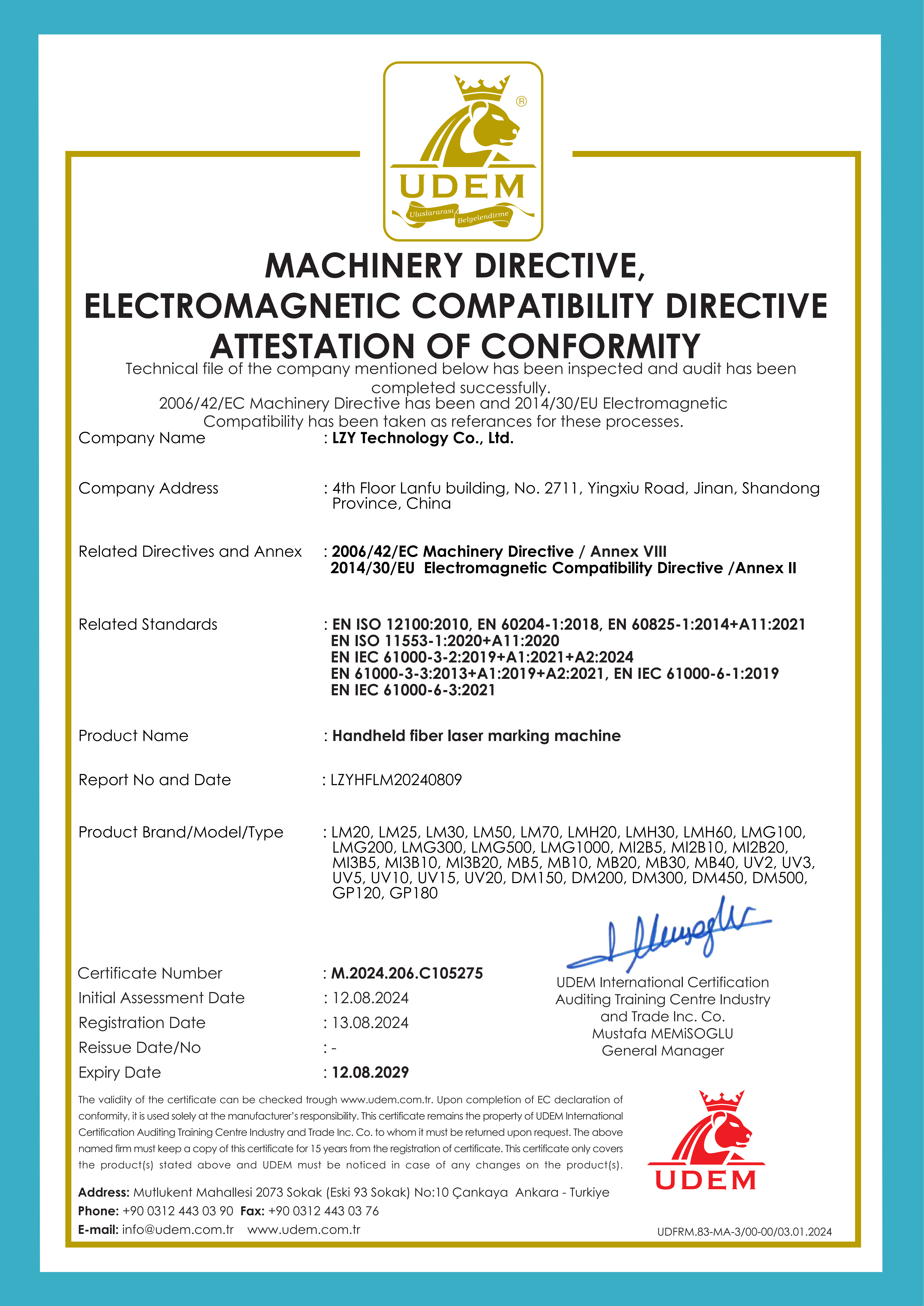
A CE Declaration of Conformity is only useful in a purchase file when the model scope, the cited standards and the validity dates can be read directly from the document.
Laser and optical safety: wavelength decides the protection strategy
Laser safety on portable units is not one problem but three, because the range spans three different light sources. The correct protective measures, eyewear specification and operator briefing all follow from the wavelength and power of the source in front of the operator.
1064 nm fiber sources: invisible, high-power, long reach
The handheld fiber marking machine is offered at 20 W, 30 W, 50 W and 60 W with a 1064 nm wavelength, air cooling, a Linux operating system with a 7-inch touch screen, Bluetooth, WiFi and mobile app support, a built-in lithium battery, and a stated laser life of about 100,000 hours on a 90 V–240 V, 50/60 Hz supply.
The safety significance of 1064 nm is that the beam is invisible. There is no visual blink reflex, and there is no visual cue that the beam path is obstructed or misdirected. Optical protection therefore depends on procedure and control measures rather than on operator perception, and the EN 60825-1:2014+A11:2021 reference in the declaration is the standard a buyer should look for when confirming how the laser product classification and labelling were handled.
355 nm UV: cold processing with actinic exposure considerations
The desktop UV laser marking machine runs at 3 W or 5 W with a 355 nm wavelength, sub-60 ns pulse width, 30–100 kHz modulation frequency, M² below 1.5 in single mode, marking speed up to 10,000 mm/s, 110 × 110 mm marking area, repeatability of ±0.001 mm, 140+ font libraries, overall power below 400 W and a 110 V–240 V operating voltage. Its cooling system is an external industrial water chiller (DWUV-05 included), and its stated materials include PE and PVC plastics, metal parts, building materials, glass, film, packaging and composite materials.
UV cold processing is the reason this unit is specified for heat-sensitive substrates: it delivers ultra-fine marking with low thermal load. From a qualification standpoint, two points matter. First, the external chiller is a separately powered enclosure, so the electrical safety review covers two units rather than one. Second, the UV source should be assessed as its own optical hazard case, not as a variant of the fiber unit.
1064 nm plus 455 nm dual source: a different briefing again
The miniature multi-material laser marking machine uses a switchable dual light source at 1064 nm and 455 nm, pulse operation, gradient power regulation from 25 to 100, processing speed up to 4,000 mm/s, a 133 mm scene focal length, 2.7 kg machine weight, air cooling, overall power of 100 W or less, and a supply arrangement of built-in lithium battery or DC 20 V with power bank support. Control is via mobile app, PC software or touch screen, with TYPE-A for data and TYPE-C for power.
A visible 455 nm source behaves differently in operational terms from an invisible 1064 nm source, and a unit that can be carried in one hand and run from a power bank is used in environments — craft workshops, jewellery benches, 3C accessory assembly — where a formal laser-controlled area may not exist. The practical qualification question is whether the supplier's documentation and operator instructions account for that reality, not merely whether the source is low power.
Electrical and high-voltage safety: what to verify inside the enclosure
Electrical safety on portable marking equipment is often treated as a formality. It should not be. Three design realities drive the risk profile.
Mains voltage across markets
The handheld fiber unit accepts 90 V–240 V at 50/60 Hz, and the desktop UV unit accepts 110 V–240 V. Wide-input designs are convenient for exporters, but they place the burden of correct earthing, fusing and enclosure rating on the electrical design rather than on a fixed supply assumption. The presence of EN 60204-1:2018 — electrical equipment of machines — in the CE declaration is the relevant evidence point, because it is the standard that addresses protective bonding, emergency stopping and enclosure safety for machine electrical systems.
Battery power adds a second energy source
Both the handheld fiber unit and the miniature dual-source unit can run from built-in lithium batteries, and the miniature unit also supports DC 20 V power bank operation. A battery-powered marking tool has an energy source that does not switch off when the mains plug is pulled — which changes lockout procedures, storage rules and the way a service technician approaches the unit. Buyers should expect the supplier to state how battery charging, storage and replacement are handled, and should treat transport documentation for lithium batteries as a separate item to be confirmed rather than assumed from a safety certificate.
Cooling architecture changes the electrical footprint
Air cooling on the fiber and miniature units keeps the electrical enclosure self-contained. The UV unit's external industrial water chiller does not: it introduces coolant, a pump and a second mains connection into the installation. That is a legitimate engineering choice for a 355 nm source, but it must appear on the installation drawing and in the risk assessment, and the chiller's own supply protection belongs in the qualification file.
Turning safety questions into a qualification checklist
The value of a checklist is that it converts open-ended reassurance into specific documents. The table below maps the purchase questions that matter at evaluation stage to the evidence a supplier should be able to produce, and to the interpretation rule a buyer should apply.
| Purchase question | Evidence to request | How to interpret it |
|---|---|---|
| Which standards were the laser product assessed against? | Declaration of Conformity listing laser safety, machine safety and electrical standards with edition years | Edition years matter. A declaration citing superseded editions is a signal to ask for an update schedule. |
| Which model does the declaration cover? | Model and product-family field on the certificate | Check the exact model you are ordering. A declaration for one configuration may not cover a different light source. |
| Is the declaration current? | Issue date, expiry date, issuing body | An expired or undated document cannot support an acceptance decision, whatever the brochure says. |
| How is the electrical system protected? | Reference to EN 60204-1:2018 and EN ISO 12100:2010 in the conformity file | These cover electrical equipment of machines and risk assessment respectively — the two foundations of a safe enclosure. |
| What about electromagnetic compatibility? | EMC standards cited (for example EN IEC 61000-6-1:2019, EN IEC 61000-6-3:2021, EN IEC 61000-3-2 and EN 61000-3-3) | Relevant when the unit sits beside sensitive control electronics in a production cell. |
| What is required for US import? | FDA radiological health submission confirmation with a reference number | The number should be quotable and traceable, not described generically as “FDA approved”. |
| Who supports the unit after installation? | Named after-sales channel and language of support | Safety procedures fail at the language barrier. Confirm the support language before the order, not after. |
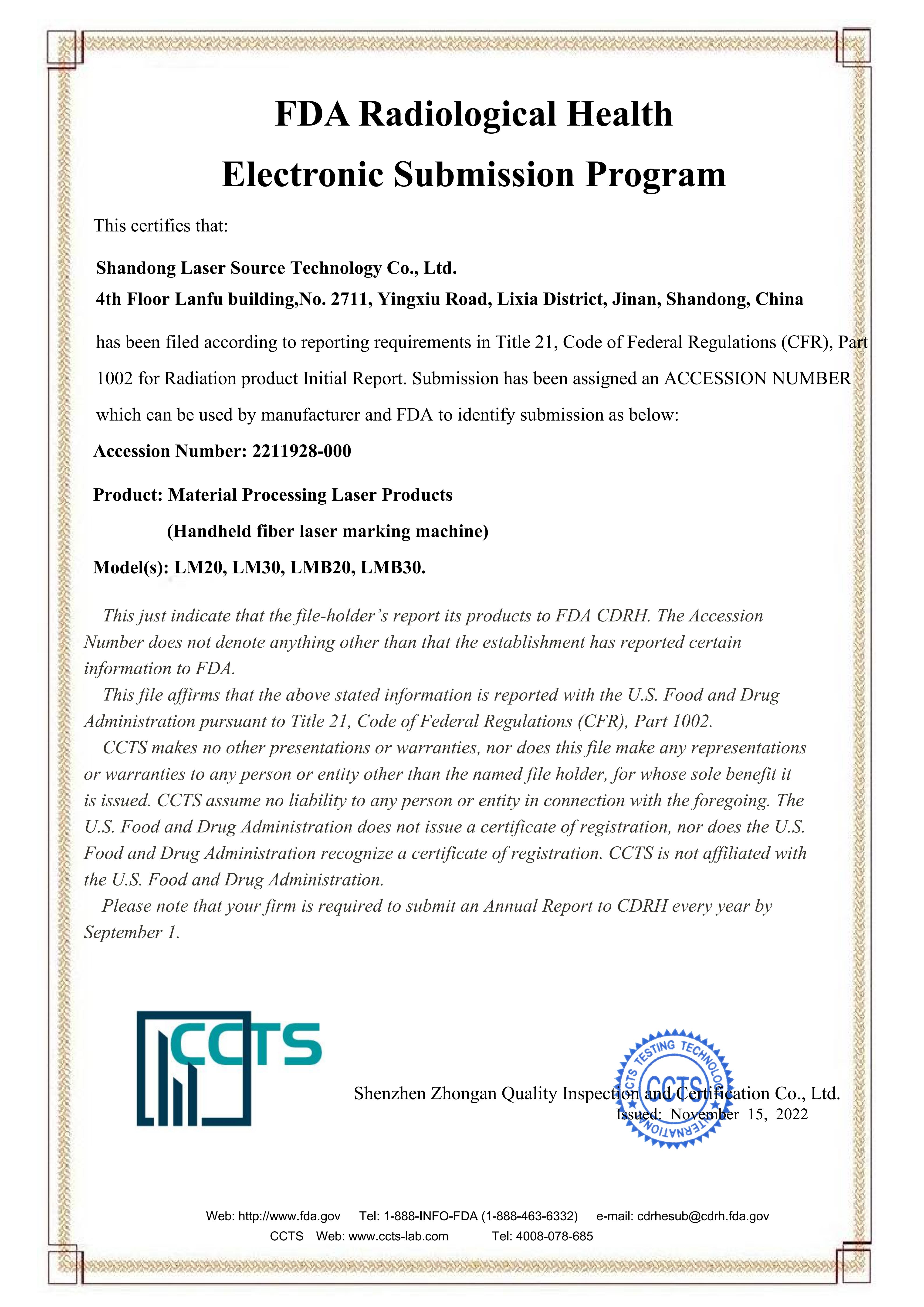
For US-bound orders, a traceable FDA submission reference number is more useful in a purchase file than a general compliance statement.
Application fit: where safety qualification meets the actual job
Safety requirements are not abstract. They become concrete at the point of use, and the portable range maps to distinct operating environments.
Mechanical parts, electronic components and medical equipment
The marking scenarios documented for this equipment family are mechanical parts, electronic components and medical equipment, in mechanical parts processing, electronic and electrical production, and medical equipment industries. In these settings the marking unit usually sits inside an existing production environment with its own EHS rules, so the supplier's documentation has to be readable by a safety officer who was not involved in the purchase.
On-site work on large workpieces, pipes and profiles
Handheld and on-site configurations exist precisely because the workpiece cannot come to the machine. That is also where the safety case is weakest in practice: an open factory floor, an installed pipe run, or an outdoor fabrication yard has none of the controlled boundaries of a marking cell. Battery operation, a 110 × 110 mm marking area and a 2.7 kg miniature body make the equipment easy to move, which places more weight on the operator briefing and on the clarity of the supplier's protective-measure documentation.
Jewellery, gifts, crafts and 3C accessories
The miniature dual-source unit is specified for gift and craft work, jewellery, customised DIY workshops and 3C electronic accessories, across metals, bamboo and wood, leather, paper, coloured glass, plastics and ceramics. Work of this kind is often ultra-fine — documented results for this equipment family include ultra-fine marking down to 10 microns with no thermal damage to sensitive components — and fine work means the operator's hands are close to the marking point, which is exactly where optical protection measures have to be unambiguous.
Market context: why safety files are moving up the agenda
The commercial backdrop explains the shift. Grand View Research estimated the global laser marking machine market at USD 4.4 billion in 2026, with fiber laser technology holding a 46.1% revenue share in 2025 and Asia Pacific accounting for approximately 44% of revenue in the same year. A market of that scale, with fiber as the dominant technology, means portable fiber units are being shipped in volume into factories that increasingly run formal supplier qualification processes.
Two structural trends reinforce the documentation requirement. First, distributed manufacturing — marking at the point of assembly rather than in a central marking room — multiplies the number of locations where a laser is operated, and each location needs its own controls. Second, export-driven supply chains require paperwork that satisfies both the destination market's regulator and the buyer's own audit, which is why a declaration number, an issuing body and a validity period now carry real commercial weight. HS code 845611, the classification for machine tools operated by laser processes, is the customs-side counterpart of the same documentation discipline.
Comparison with traditional approaches — and the limits of a certificate
The traditional alternative to a portable unit is a fixed enclosed marking station. A fixed station typically provides a Class 1 style enclosed working area, a defined installation footprint and a single controlled operating position. Its weakness is logistics: the workpiece must travel to the machine, which adds handling, queueing and, for large or installed parts, may be impossible.
A portable unit inverts that trade-off. It removes workpiece transport and allows marking at the point of need, but it also removes the fixed enclosure from the safety equation and returns part of the control burden to procedure, training and the supplier's documentation. Neither approach is universally better; the correct choice depends on workpiece size, batch structure and how much environmental control the buyer can realistically enforce.
The CE Declaration of Conformity M.2024.206.C105275 held for this range is scoped to the handheld fiber laser marking machine, and the FDA submission confirmation 2211928-000 is scoped to the same product. A buyer evaluating the desktop UV unit or the miniature dual-source multi-material unit should therefore request the specific conformity evidence covering the model being ordered, rather than treating one document as a family-wide clearance. The same applies to the standards cited: the CE file references EN ISO 11553-1:2020+A11:2020 for laser processing machines, and a buyer who specifically requires hand-held assessment under EN ISO 11553-2 should raise that as a documented question rather than assume it is included.
Two further boundaries are worth stating plainly. First, a safety certificate confirms conformity of the design against cited standards; it does not validate marking quality, throughput or repeatability on your specific material — those require your own sample validation. Second, industry weight ranges should not be read as per-model specifications: published guidance places handheld and portable laser marking machines broadly in the 15–35 lb (approximately 6.8–15.8 kg) band, while the miniature dual-source unit in this range is specified at 2.7 kg. Generalised data points and individual datasheets answer different questions.
Future outlook: from certificates to audit-ready safety files
The direction of travel is clear enough to plan for. Portable marking equipment is being pulled into connected production environments — Linux control, 7-inch touch screens, Bluetooth, WiFi and mobile app operation are already specified on the handheld fiber unit — and networked, app-controlled equipment invites questions that a paper certificate does not answer: who can change parameters remotely, how is the unit locked out during maintenance, and how are safety-relevant events logged.
Buyers should expect the qualification file to evolve from a single conformity document into a structured package: per-model declarations, dated certificates, electrical design references, operator instructions in the buyer's working language, and clear statements about battery handling and transport. Suppliers that can assemble that package quickly will find the evaluation stage shorter, because the buyer's safety officer and the buyer's purchasing team will be reading the same evidence rather than negotiating over its absence.
For teams currently building a shortlist, the useful discipline is to treat safety documentation as a scored criterion — with a named document, a number and a validity date — rather than as a pass/fail box ticked after the commercial terms are agreed.
FAQ
Which safety documents should a buyer expect in a quotation package for a portable laser marking machine?
A quote package should identify the conformity route for the specific model: a Declaration of Conformity with a certificate number, the issuing body, the standards cited with edition years, and the issue and expiry dates, plus any destination-market registration such as an FDA radiological health submission reference for US-bound equipment. For the handheld fiber unit in this range, the reference documents are CE Declaration M.2024.206.C105275 (issued 2024-08-12, valid to 2029-08-12) and FDA submission 2211928-000 (issued 2022-11-15).
Does a CE declaration for a handheld fiber unit cover a desktop UV or a miniature multi-material model?
Not automatically. Conformity declarations are issued against a defined product scope, and the scope here is stated as the handheld fiber laser marking machine. A buyer ordering a 355 nm desktop UV unit or the 1064 nm/455 nm dual-source miniature unit should request the declaration that names that specific model, and should check that the cited standards match the light source and electrical design of the unit being purchased.
Is a 455 nm dual-source portable unit lower risk than a 1064 nm fiber unit?
The hazard profile differs rather than simply reducing. A 1064 nm fiber source is invisible, so protection depends on control measures and procedure rather than on the operator's visual response; a 455 nm source is visible, which changes how the beam path can be perceived, but visibility is not a substitute for protective measures. Because the miniature multi-material unit is specified at 2.7 kg and can run from a built-in lithium battery or a DC 20 V power bank, it is also used in less controlled environments, which raises the importance of clear operator instructions.
What does the FDA submission confirmation number actually cover?
FDA submission 2211928-000 is a Radiological Health Electronic Submission Confirmation issued through CCTS on 2022-11-15 under Title 21 CFR Part 1002, and its stated scope is the handheld fiber laser marking machine for the United States market. It should be read alongside the wider framework in which laser products sold in the USA are regulated under 21 CFR Subchapter J, Parts 1000 through 1005.
How does battery power change the electrical safety review?
It adds an energy source that remains live when the mains supply is disconnected. Both the handheld fiber unit (built-in lithium battery, 90 V–240 V 50/60 Hz mains input) and the miniature dual-source unit (built-in lithium battery or DC 20 V power bank, overall power of 100 W or less) fall into this category. Buyers should ask specifically how charging, storage and battery replacement are handled, and should treat lithium battery transport documentation as a separate item to be confirmed in writing rather than inferred from a conformity certificate.
What should be re-verified when renewing a purchase order for the same portable marking model?
Re-check the certificate validity dates and the model scope, since declarations have finite validity periods — the CE Declaration M.2024.206.C105275 is valid to 2029-08-12. Confirm that the standards cited have not been superseded, that the supplier's pre-shipment inspection procedure is still documented and applied before delivery, and that after-sales technical support is still available in the language your operators use, which for export markets served by this manufacturer is English.
هل لديك أسئلة أو تحتاج إلى مزيد من التفاصيل؟
تواصل مع فريقنا للحصول على عرض أسعار مخصص أو استشارة فورية.
طلب عرض أسعار
املأ النموذج أدناه وسيتواصل معك فريقنا بعرض مقترح مخصص.
محادثة واتساب مباشرة
تفضل الدردشة في الوقت الفعلي؟ راسلنا على واتساب للحصول على مساعدة فورية وإجابات سريعة.
- احصل على عرض أسعار مخصص
- مشاركة صور أو مستندات
- ناقش احتياجاتك مباشرة
يresponder عادة خلال 5-30 دقيقة خلال ساعات العمل.