
Qualifying a Commercial Scent Diffuser Factory: Compliance and Customization
Qualifying a Commercial Scent Diffuser Factory: Compliance and Customization
A working qualification framework for importers and wholesalers who resell or install commercial scenting hardware — built around the two things a factory must prove before a bulk order: documented compliance and real customization capability.
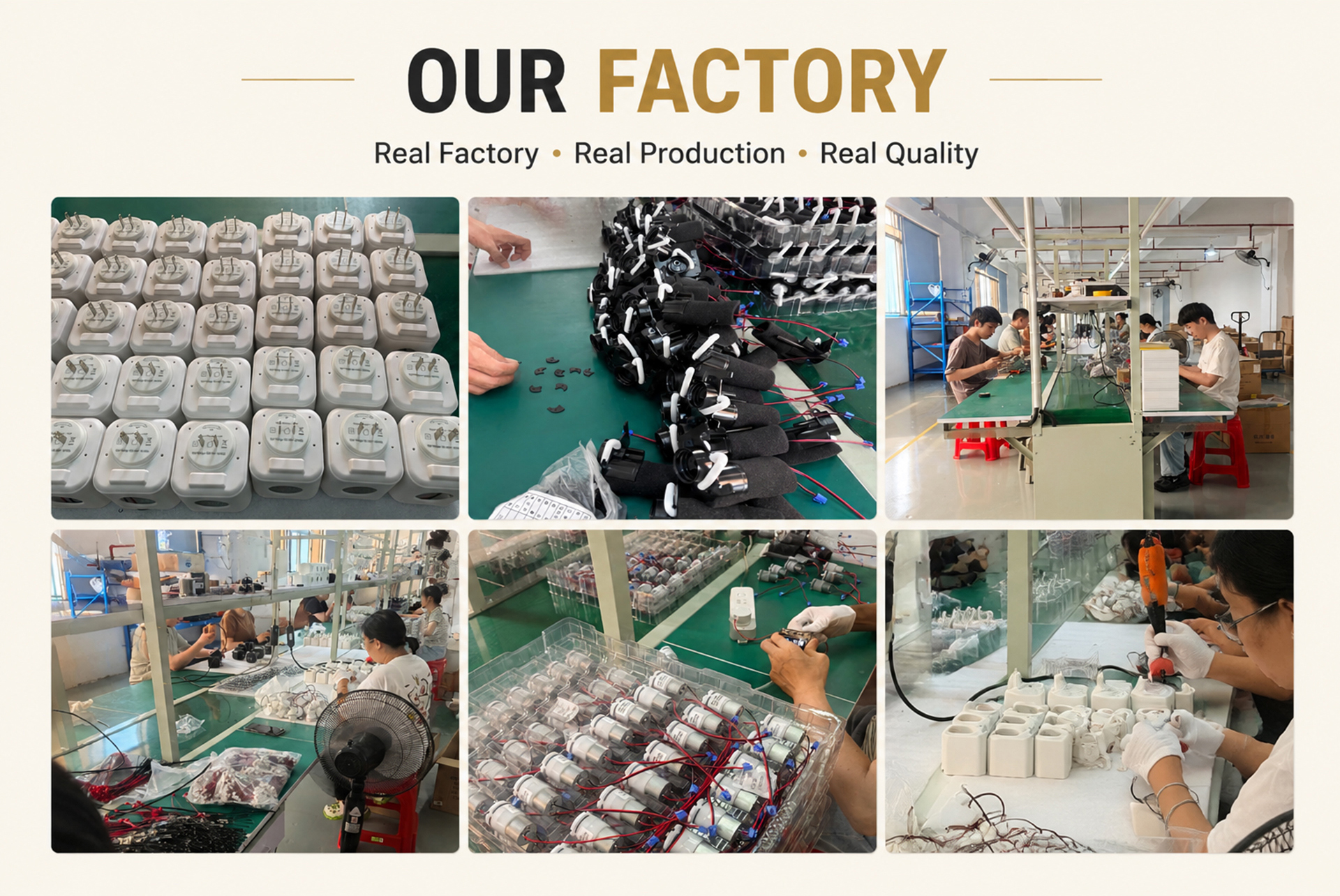
A factory audit for commercial scenting equipment should produce documentation, not just a price list.
Commercial scenting hardware is bought twice. The importer buys it once, at quotation stage. The destination market buys it again, when a compliance reviewer, facilities manager or brand owner decides whether the unit can legally be placed on the market and physically installed in a hotel lobby, a retail floor or an airport concourse. A factory that can quote aggressively but cannot produce model-specific documentation or a workable customization path creates cost at the second purchase, not the first.
That is why qualifying a commercial scent diffuser factory is not a price-comparison exercise. It is a three-gate evaluation: can the hardware be documented for the destination market, can the configuration be changed to match the resale or installation project, and can a batch be accepted against measurable criteria. Each gate uses different evidence and can fail independently of the others.
The procurement problem: compliance evidence rarely arrives with the quotation
Most sourcing conversations begin with coverage figures and unit price. Coverage and price are real variables, but they are not qualification criteria. A commercial scenting system sold into the European Union or the United States has to satisfy electrical safety, electromagnetic compatibility, restricted-substance and — for connected models — radio-frequency requirements before it can be resold. Those requirements attach to a specific model and configuration, not to a supplier in general.
Customization adds a second layer. Importers reselling under their own label need logo, packaging, user manual and plug-type changes; project installers need housing colour and control-interface alignment. A factory may support one of these and not the other, or may support them only above a certain order size. Treating customization as a yes-or-no answer at quotation stage usually produces surprises at production stage.
The practical solution is to run compliance and customization as separate audits and only then look at commercial terms. The framework below applies to any factory; the specification examples use hardware from Shenzhen Scentsea Technology Co., Ltd, a Shenzhen-based manufacturer founded in 2021 that produces cold-air nebulizing scent diffusers and fragrance oils for home, commercial and HVAC applications.
Gate 1 — Compliance evidence must attach to an exact model
The first qualification question is not whether a factory holds certificates, but whether the certificate on file names the exact model and configuration being purchased. A CE or FCC document covering a different housing material, a different power input or a different wireless module does not transfer to the model on the purchase order. Buyers should request the certificate and test report together and check the model designation, the electrical rating and the wireless configuration on both.
A model-level specification table is the fastest way to run this check, because it exposes the parameters that compliance documents must reference. The following figures are published model specifications, not marketing estimates.
| Model | Housing material | Rated input | Power | Oil capacity | Stated coverage |
|---|---|---|---|---|---|
| H5000 (floor standing) | Aluminium | DC 12V, plug-in | 20W | 1000 ml | 800–1300 m² |
| P02 (wall mounted) | Plastic | DC 12V, plug-in | 6.5W | 300 ml | 150–350 m² |
| P01 (battery or Type-C) | Plastic | 5V, 4×D batteries or Type-C | 2.5W | 500 ml | 100–150 m² |
| T3 (commercial) | Acrylic panel + steel casing | DC 12V 2A | 15W | 1000 ml | 1000–1600 m² |
| AC-MAX (HVAC) | Aluminium body + plastic bottle | DC 12V | 48W | 5 L | 2500–3500 m² |
Published model specifications. Coverage figures are nominal and should be validated against ceiling height, airflow and partitioning on site.
Reading the electrical line the way a reviewer reads it
Two parameters on that table carry most of the compliance risk. The first is rated voltage. The H5000 and P02 both operate on DC 12V with a plug-in supply, and the P01 operates on 5V from four D-cell batteries or a Type-C connection. Low-voltage DC input is relevant to importers for a practical reason: the product is only compliant as delivered once the correct external supply and plug configuration are confirmed for the destination market. Plug type is a customizable item in the factory capability set, which means the adapter specification must be locked at order stage rather than assumed.
The second is the wireless configuration. Bluetooth and Wi-Fi models can trigger additional radio-equipment requirements in the European Union beyond CE and RoHS. The P02 carries Bluetooth APP control for scheduling and scent intensity, with an optional Wi-Fi plus Bluetooth version for remote management, and it reconnects automatically after a power or network interruption. An importer who orders the connected variant must obtain documentation that covers that variant, not the non-connected base model. Buyers should always confirm that certificates and test reports apply to the exact production model and configuration being purchased.
It is worth separating product families at this point. A plug-in DC diffuser like the P02 or H5000, a battery-first unit like the P01, and a mains-powered advertising scent machine rated at 110–240V AC are three different electrical arguments. Grouping them under one certificate check is a common shortcut that creates problems at customs and at installation.
Housing material as a qualification signal, not a style choice
Material specifications tell an importer more than they appear to. The H5000 uses an aluminium housing in a gunmetal finish, with a net weight of 6.4 kg and a gross weight of 7.1 kg, and stands 610 mm high on a 180 mm by 180 mm footprint. A floor-standing aluminium unit of that mass needs different freight protection, different handling at installation and different mounting assumptions than a 0.8 kg plastic wall unit.
The P02 and P01 both use plastic housings and weigh 0.8 kg and 0.55 kg net respectively, which makes them suitable for wall mounting in corridors, washrooms and retail units where structural reinforcement is not practical. The T3 uses an acrylic front panel with a steel casing and weighs 5.3 kg net. None of these choices is inherently better; they define where a unit can be installed and what the importer must specify in the installation note that accompanies resale.
For a qualification file, the useful material questions are narrow: does the certificate reference the same housing material as the unit being shipped, is the finish specified (gunmetal for the H5000), and does the packaging specification protect the housing during a consolidated container shipment. The aluminium H5000 and the plastic P02 should not share one packaging assumption.
Gate 2 — Customization capability, tested against real change requests
Customization is the second gate because it determines whether the order can be sold as the importer's own product. Scentsea offers OEM and ODM services covering logo, product colour, packaging, user manual, plug type, APP interface, PCB and functions, and other product specifications. That is a broad list, and the qualification task is to map each item to an actual change request rather than accept the list as a whole.
A practical way to test the claim is to sort requests by the department that must approve them.
| Change request | What it affects | Evidence a buyer should obtain |
|---|---|---|
| Logo and packaging | Artwork, print files, carton specification | Approved artwork proof before production |
| Product colour | Housing finish and matching of front cover | Colour sample on the target model |
| Plug type and power supply | Market suitability of the delivered unit | Approved adapter and plug specification |
| APP interface | Branded control experience | Test build with scheduling and intensity settings |
| PCB and functions | Firmware behaviour and compliance scope | Confirmation that certificates cover the modified build |
The colour question is a useful illustration. The P02 is supplied in white or black, with customization available on the colour; the P01 is supplied in white or black. An importer asking for a brand-specific colour should expect a colour sample on the target model and a written confirmation of what changes in the production record. A request that is accepted verbally but never confirmed in writing is not a customization capability — it is an intention.
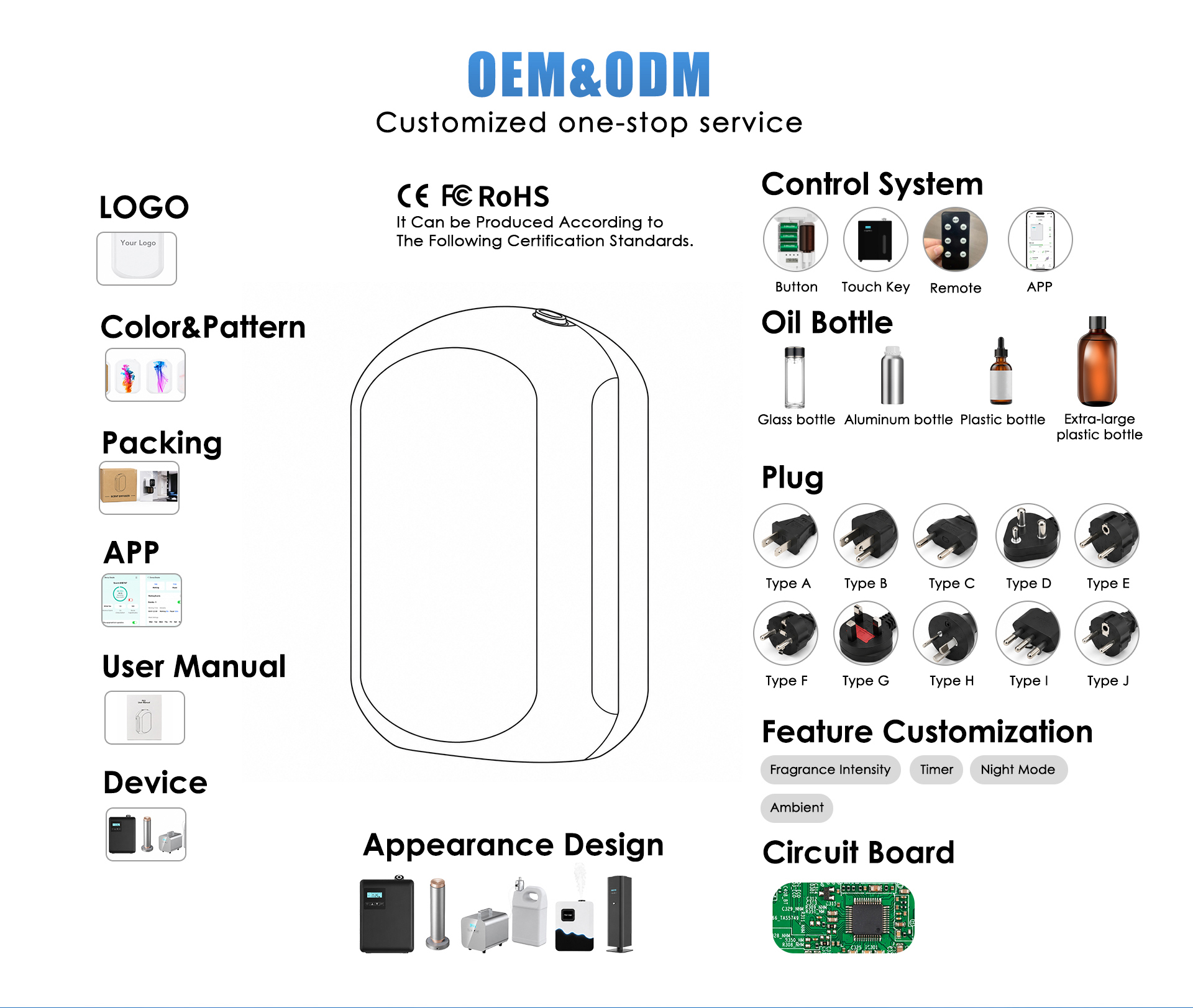
Customization should be qualified item by item, with a written sample or proof for each change request.
Control architecture deserves its own line in the qualification file. The AromaOS APP handles scheduling and intensity adjustment across supported models. On the P02, Bluetooth control is standard, and the optional Wi-Fi plus Bluetooth version adds remote management plus automatic reconnection after a power or network interruption. For an installer running multiple sites, that reconnection behaviour matters more than the interface design: a unit that stays offline after a power cut requires a site visit, while one that reconnects does not.
Gate 3 — Batch acceptance: turning quality control into a checklist
Compliance documents and customization samples prove what a factory can do. They do not prove what arrives in the container. The third gate converts the factory quality-control process into acceptance criteria the importer can hold the shipment against.
Scentsea applies 100% functional testing, atomization testing, leakage inspection, noise testing, APP and control testing, a 48-hour aging test, and a final appearance inspection before shipment. Each of these can be matched to a piece of evidence an importer should request per batch.
| Acceptance test | Reference point | Evidence to request |
|---|---|---|
| Functional and atomization | 100% of units tested | Batch pass record tied to the order number |
| Leakage inspection | Post-aging check on oil circuit | Inspection record and defect count |
| Noise | Below 45 dB for the H5000, below 30 dB for the P02 | Measured value recorded on the batch sheet |
| APP and control | Schedule and intensity functions | Test protocol and sample unit retained |
| Aging | 48-hour continuous run | Aging log covering the production lot |
| Appearance | Final inspection before packing | Pre-shipment photo set per carton reference |
Commercial terms belong in this gate as well, because they determine whether the acceptance criteria are realistic. Scentsea publishes a monthly capacity of 8,000 units, a lead time of 25 to 35 days, a minimum order quantity starting from 1 unit for diffusers, and a one-year free warranty on spare parts. An importer planning a seasonal retail rollout should work backwards from those figures: a 25 to 35 day production window plus transit means the order release date, not the delivery date, is the number to manage.
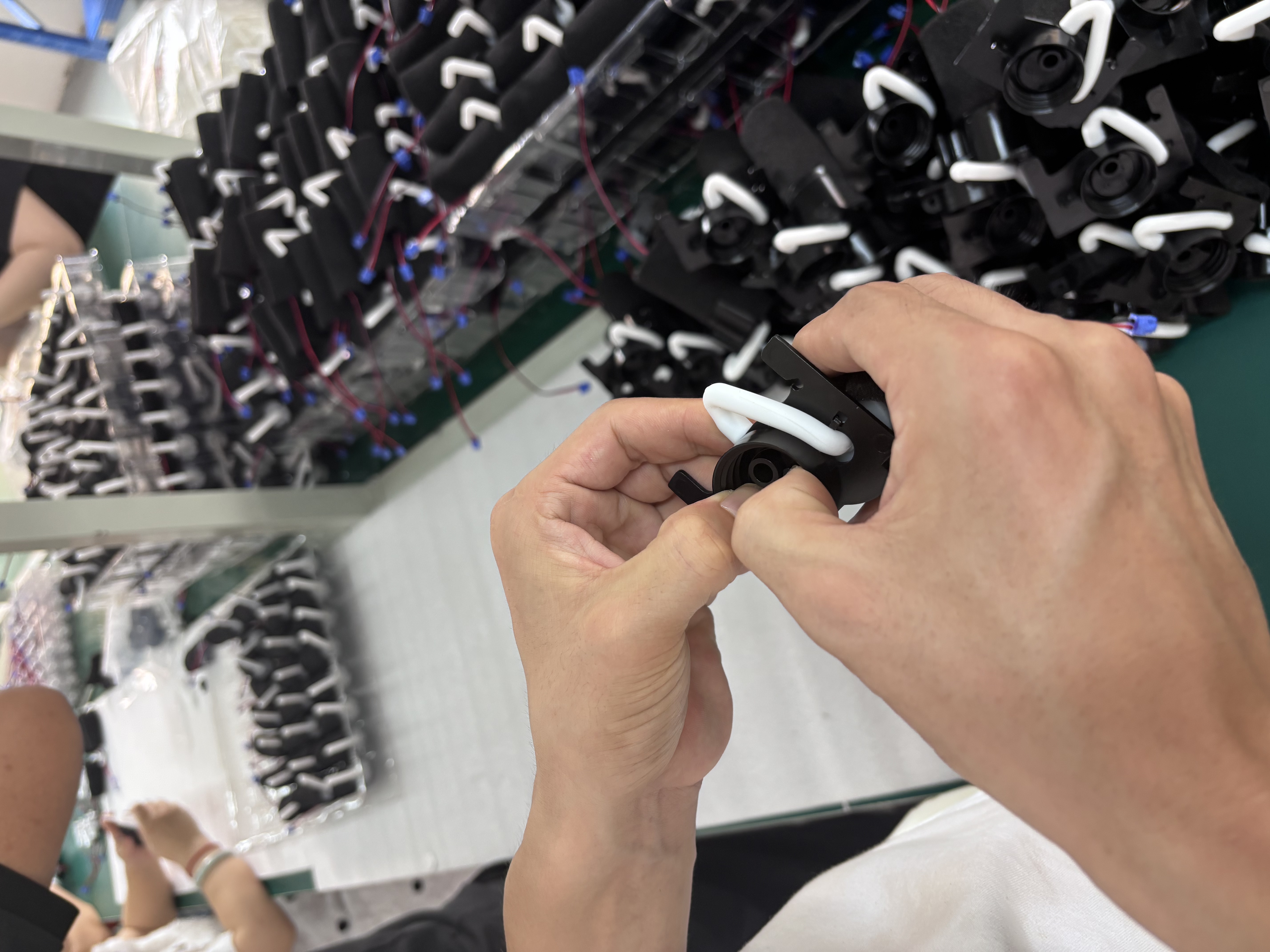
Assembly and testing records are the basis for batch acceptance criteria on a bulk order.
What the factory itself should be able to document
Beyond product evidence, the qualification file should contain a short factual profile of the manufacturing operation. Scentsea was founded in 2021 and is headquartered in Shenzhen, China, operating a 3,000 m² production facility with three production lines and a team of 30 employees. Annual output is stated at 100,000 units, with four engineers and 20 patents behind the product range, and an export ratio of about 70% concentrated on the EU and USA markets. The company reports supply to customers in more than 70 countries and regions, and states that all diffuser models are certified with CE, RoHS and FCC.
That profile is enough to answer the questions a buyer actually needs answered: is there a real production floor and R&D function, is there a documented export history, and does the certification claim cover the catalogue as a whole. It also exposes a limitation the buyer should test rather than ignore, discussed below.
Where the framework breaks down — honest limits
No qualification framework removes risk entirely, and importers should treat the following as structural limits rather than negotiable details.
Nominal coverage is not installed coverage. Stated figures such as 800–1300 m² for the H5000 or 150–350 m² for the P02 assume a space with supporting airflow. Ceiling height, ventilation rate, partitions and turnover of air all change the effective result. Model selection should be based on the actual space rather than the maximum rated figure, and a sample test in the real environment is the only reliable confirmation.
Customization is conditional on model and quantity. Logo, colour, packaging, user manual, plug type, APP interface and PCB changes are available, but not every option applies to every model and order size. Buyers who assume that a catalogue-wide customization menu applies to a 20-unit trial order will be disappointed.
Certificates must match the shipped configuration. A certificate issued for a non-connected unit does not automatically extend to the Wi-Fi plus Bluetooth variant. Wireless models may require additional radio-equipment documentation for the EU. The document trail must follow the production order, not the brochure.
The operating history is short. A factory founded in 2021 has fewer years of accumulated field data than a longer-established manufacturer. That does not disqualify it, but it shifts weight onto test records, sample verification and warranty terms, which is precisely why the third gate matters.
Matching qualified hardware to venue types
Once a factory clears the three gates, the remaining task is deployment fit. The same specification table becomes a selection map, because each model was designed around a different installation condition.
| Venue type | Suitable model | Reason |
|---|---|---|
| Hotel lobbies, showrooms, reception halls | H5000 | Floor standing, no wall installation, 800–1300 m² |
| Large halls, event venues, high-traffic malls | T3 | 1000 ml capacity, 1000–1600 m², continuous operation |
| Airports, malls, office towers with central ducts | AC-MAX | Split HVAC unit, 5 L tank, 2500–3500 m² |
| Retail stores, corridors, cinemas, offices, washrooms | P02 | Wall mounted, 150–350 m², below 30 dB |
| Elevators, washrooms and corridors without power outlets | P01 | 4×D batteries or Type-C, 100–150 m², lockable cover |
This mapping is where compliance and application meet. A battery-powered P01 in an elevator avoids new wiring, which simplifies the electrical argument for the site, but the four D batteries become a maintenance item the operator must plan. A duct-connected AC-MAX in an airport removes visible hardware but ties fragrance output to the HVAC schedule, which is why an airflow sensor option exists to synchronise operation. Neither choice is universally correct; both need to be documented in the resale specification.
Market context: why qualification is becoming a purchasing stage
The commercial case for tighter qualification is supported by the direction of the category. Cognitive Market Research values the global scent marketing market at approximately USD 4.1 billion in 2026 and projects it to reach USD 7.28 billion by 2035, a compound annual growth rate of 6.6% over the forecast period. A larger installed base in hotels, retail, transport and office environments means more units crossing borders, and more units crossing borders means more documentation checkpoints.
Cost structures reinforce the same conclusion. Commercial scent diffusers are classified under HS Code 8509.80, with a reported 4.2% ad valorem import duty for the United States. A 4.2% duty that applies to the declared value means the landed cost calculation has to be built on the correct classification from the start; a misclassified shipment does not become cheaper, it becomes delayed.
The technology itself is stable and well described: cold-air nebulizing diffusion atomizes fragrance oils into sub-micron particles below 2.5 micrometres without heat or water, which is why the same platform can serve a wall-mounted retail unit and a duct-connected HVAC system. What changes with scale is not the atomization principle but the evidence the buyer needs to hold.
Future outlook
Two shifts are likely to define importer qualification over the next few years. The first is documentation granularity: as more commercial scenting hardware includes Bluetooth or Wi-Fi control, the number of models requiring separate radio-frequency documentation grows, and the practice of accepting one certificate for a product family will become harder to sustain. The second is customization depth: private-label programmes are moving from logo and packaging toward APP interface and PCB-level changes, which means the engineering review, not the sales conversation, becomes the deciding step in supplier selection.
For importers, the practical response is procedural rather than strategic. Keep the three gates — compliance evidence at model level, customization feasibility at item level, batch acceptance at shipment level — and re-run them for every production order rather than once per supplier relationship.
FAQ
What should importers verify in a commercial scent diffuser electrical specification?
Verify the rated voltage, the power consumption and the delivered power supply configuration for the exact model being ordered. For reference, the H5000 and P02 both run on DC 12V with a plug-in supply at 20W and 6.5W respectively, while the P01 runs on 5V at 2.5W using four D batteries or a Type-C connection. Because plug type is a customizable item, the adapter specification must be confirmed at order stage so the delivered unit matches the destination market.
Which certifications matter for commercial scenting equipment sold into the EU and US?
Certification requirements depend on the destination market, the model and whether the unit has wireless functions. For the European market, buyers should normally check applicable CE and RoHS documents, and Bluetooth or Wi-Fi models may also need to meet RED requirements. For the United States, applicable FCC compliance should be verified. Scentsea states that all diffuser models are certified with CE, RoHS and FCC, and buyers should confirm that the certificates and test reports name the exact production model and configuration.
What can a factory customize on a commercial scent diffuser bulk order?
Scentsea offers OEM and ODM services covering logo, product colour, packaging, user manual, plug type, APP interface, PCB and functions, and other product specifications. In practice, the P02 is supplied in white or black with customization available on colour and uses a plug-in power design, and the P01 is supplied in white or black. The scope available on a given order depends on the model and the quantity, so each change request should be confirmed in writing with a sample or proof before production.
How should a bulk order acceptance test be structured?
Build acceptance criteria directly from the factory quality-control process. Scentsea applies 100% functional testing, atomization testing, leakage inspection, noise testing, APP and control testing, a 48-hour aging test and a final appearance inspection before shipment. Each item can be tied to evidence such as a batch pass record, a measured noise value against the model rating, an aging log for the production lot, and a pre-shipment photo set.
How do coverage ratings translate into model selection for different venues?
Rated coverage is a starting point, not a specification of installed performance. Ceiling height, airflow, partitioning and ventilation change the effective result, so selection should follow the actual space. As a reference, the H5000 is rated for approximately 800–1300 m² in a floor-standing format, the T3 for 1000–1600 m², the AC-MAX for 2500–3500 m² as a duct-connected HVAC unit, the P02 for 150–350 m² as a wall-mounted unit, and the P01 for 100–150 m² where battery or Type-C power is required.
What lead time and production capacity should an importer plan for?
Scentsea states a monthly capacity of 8,000 units and a lead time of 25 to 35 days, with a minimum order quantity starting from 1 unit for diffusers and a one-year free warranty on spare parts. Importers planning seasonal or project-based rollouts should schedule from the order release date rather than the target delivery date, and should confirm both capacity and lead time in writing for each production order.
Reference
The SCENTSEA company profile, including the diffuser and fragrance oil range, is available as a downloadable PDF for buyers assembling a supplier qualification file: SCENTSEA Company Profile (PDF).
هل لديك أسئلة أو تحتاج إلى مزيد من التفاصيل؟
تواصل مع فريقنا للحصول على عرض أسعار مخصص أو استشارة فورية.
طلب عرض أسعار
املأ النموذج أدناه وسيتواصل معك فريقنا بعرض مقترح مخصص.
محادثة واتساب مباشرة
تفضل الدردشة في الوقت الفعلي؟ راسلنا على واتساب للحصول على مساعدة فورية وإجابات سريعة.
- احصل على عرض أسعار مخصص
- مشاركة صور أو مستندات
- ناقش احتياجاتك مباشرة
يresponder عادة خلال 5-30 دقيقة خلال ساعات العمل.