
Qualifying a Lubrication Pump: Inlet, Oil and Relief Checks
Qualifying a Lubrication Pump: Inlet, Oil and Relief Checks
An industrial lubrication pump can pass every document check in a purchase order and still fail in its first month on site. The failures that matter during acceptance are rarely about displacement or speed; they come from air drawn in through the suction line, abrasive particles carried into the gear mesh, and a relief valve that was never verified against the circuit it protects. DEO's pump documentation treats these as mandatory conditions rather than recommendations, and that is the useful starting point for procurement: each condition can be converted into a witnessed check with a recorded result.
Why a datasheet check leaves three risks open
A lubrication pump purchase usually specifies displacement, speed, viscosity range, temperature limits and material. Those are necessary, and for the models discussed in this review they are documented: DEO lists the DK630 electric lubrication pump at 630 cc/rev with motor speeds of 950 and 1450 rpm and a QT500 body; the PSN100 trochoidal pump at 100 cc/rev with a maximum speed of 1800 rpm; and the PST180 bidirectional internal gear pump at 180 cc/rev with a maximum speed of 1800 rpm. What those numbers cannot do is control what happens between the pump inlet and the oil reservoir, or how the pump is treated during its first hours of commissioning.
The documentation separates the remaining constraints into three groups, and a procurement team can use the same split. Medium limits — viscosity, temperature, cleanliness — are the buyer's operating responsibility once the pump is handed over. Installation limits — an airtight inlet, adequate pipe diameter, coaxial alignment of bell housing and motor shaft on pump unit assemblies — belong to the installer and are usually outside the supplier's visibility. Protection limits — relief valve setting, the dry-running prohibition, rotation direction — are shared between the pump supplier and the system designer, which is precisely why they are the easiest to leave unverified. A purchase order that names only the first group leaves the other two sitting in a manual nobody is contractually required to follow.
Check one: the inlet line must be airtight, not merely connected
DEO's DK series documentation states the requirement directly: the pump inlet pipeline must be airtight without air leakage, otherwise insufficient suction flow and cavitation occur. The same condition appears in the DFLS self-circulating cooler documentation, where the oil suction pipeline of the built-in pump must be free of air leakage, otherwise circulation flow declines and cooling capacity drops sharply.
The reason is mechanical rather than administrative. A gear or trochoidal pump creates a low-pressure region at the inlet, and any joint that is tight against oil under positive pressure can still admit air under suction. A pinhole at a threaded union, a hardened gasket, a hose clamp tightened before the hose settled, or a flange face distorted in transit will all pass a visual inspection. Once air enters, volumetric efficiency falls, the flow reaching bearings and gear meshes drops, and collapsing bubbles erode the surfaces the oil film is supposed to protect. In a cooler circuit the effect compounds: less circulating flow means less heat removed, so oil temperature rises while the pump works harder to move less oil.
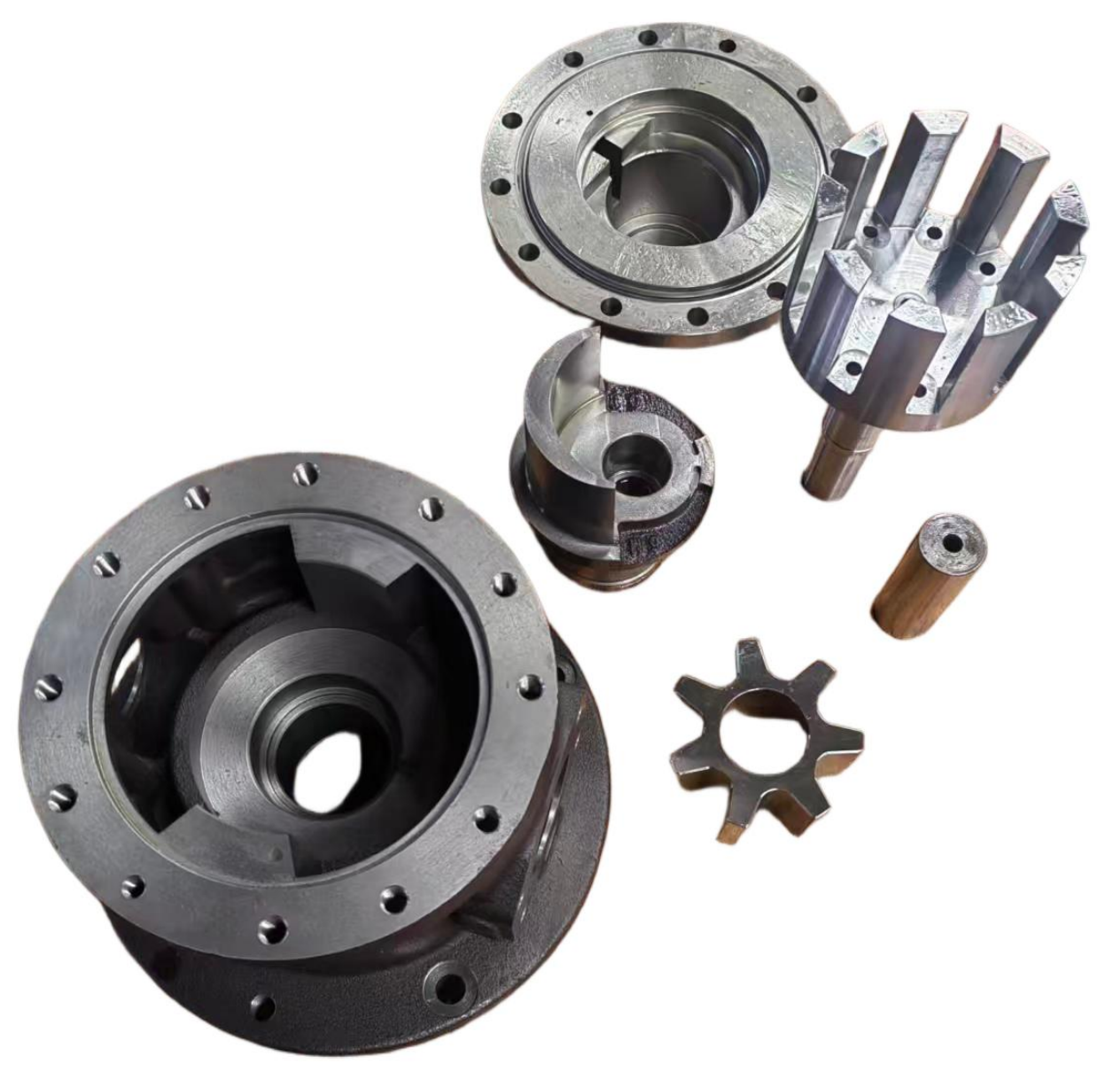
An acceptance check that can be signed off usually contains five items:
- Confirm the inlet pipe internal diameter is not smaller than the pump inlet port. DEO's documentation rules out a smaller inlet pipe because it restricts flow and adds pressure loss.
- Leak-test or pressure-decay test the suction line before first run where the circuit allows, and record the method, the test pressure and the hold time.
- Re-inspect and re-torque every joint after transport and again after flushing, since joints that were correct at the factory can loosen in transit.
- Prefer a flooded or short suction line, and remove unnecessary elbows and reducers that add resistance on the inlet side.
- Record the result in the commissioning file with the joint list and the name of the person who signed it off.
Boundary condition: DEO's supplied documentation specifies the airtightness requirement but does not publish a numeric leak-rate acceptance threshold or a named test standard for it. Where a project needs a number, the buyer should agree the test method in the purchase order rather than assume one exists in the supplier's documentation.
Check two: oil free of metal chips and sand
The second check is written as a medium condition. Oil must be free of metal chips, sand and other solid impurities, because particle impurities will scratch gear surfaces and wear bushings rapidly. For the DFLS self-circulating cooler range, DEO states that the oil medium must be clean and that a filter is mandatory for heavily polluted working conditions.
Particles in the clearance range do the most damage, and they do it in three ways. Between a gear flank and a bushing they act as a third body, accelerating wear and opening internal clearances; once clearances open, internal leakage rises and volumetric efficiency falls, so the pump has to run faster or hotter to deliver the same flow. A chip that lodges under a relief valve seat can hold the valve open and collapse system pressure, or jam it shut so that the surge protection never operates. Both outcomes appear as a pump fault even though the pump was not the source of the contamination.
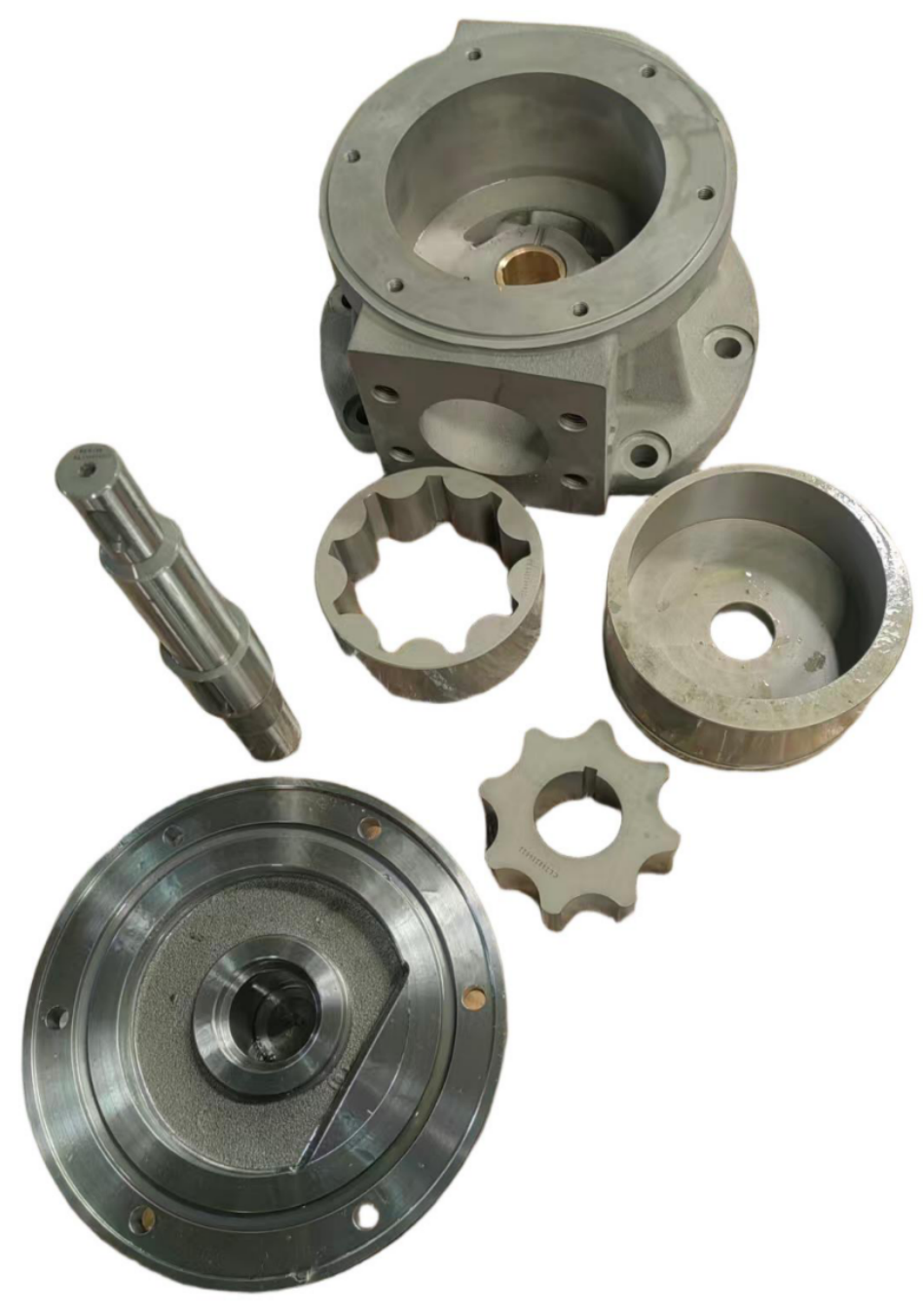
At acceptance, cleanliness is evidenced rather than asserted:
- Flush the reservoir and pipework before the pump is connected, or flush through a temporary filter element.
- Verify that filtration is installed and record the element condition before first run; for dirty site conditions, confirm who owns filter maintenance after handover.
- Draw an oil sample after flushing and again at commissioning, and keep both records with the pump serial number.
- Inspect for sand and casting debris, particularly where equipment is assembled on site, stored outdoors, or installed in steel, foundry, mining and construction environments.
- Confirm the oil grade against the documented range for the model ordered: for the DK series, kinematic viscosity from 12 to 20,000 cSt with fluid temperatures from −40 °C to +100 °C.
Boundary condition: DEO's documentation for these models states a qualitative cleanliness condition rather than a numbered cleanliness class. Buyers who need a numeric target — common in hydraulic systems — should agree the scale, the class and the verification method explicitly in the purchase order, and should not assume that a class has been claimed by the supplier.
Check three: the built-in relief valve
DK series pumps include a built-in relief valve assembly with a standard setting pressure of 5 to 25 bar. DEO describes its function narrowly and correctly: it provides overpressure protection for the pipeline and equipment against system pressure surges. It is not a flow controller, and the documentation warns that continuous overflow operation will lead to pump overheating and early wear.
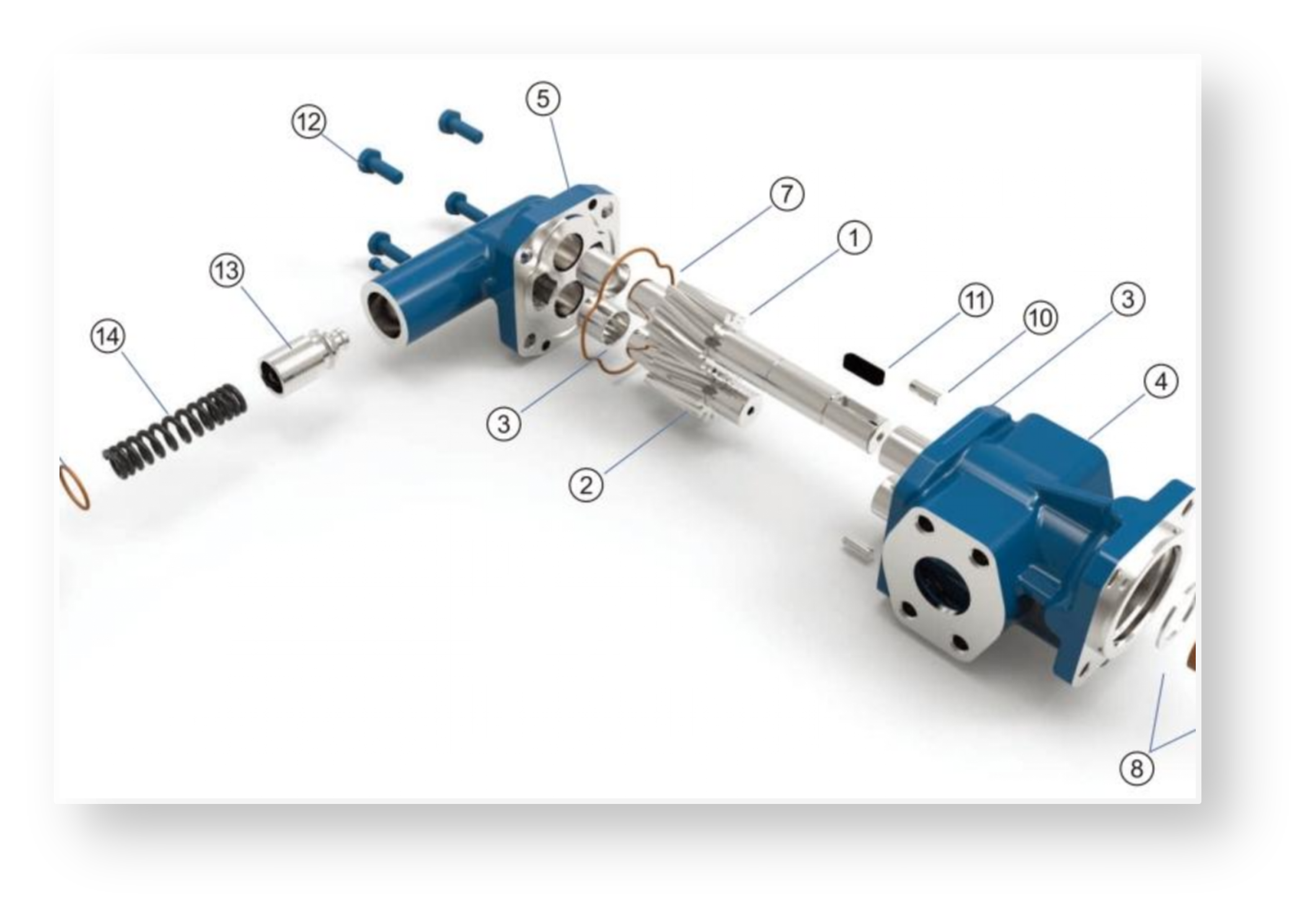
A spring-loaded relief valve has three states that matter. Set correctly, it stays closed in normal operation and opens only during a transient. Set too low, it opens during ordinary running flow, the pump recirculates oil internally, energy becomes heat, and the pump runs hot continuously — the exact failure the documentation warns about. Set too high, or left at a factory setting that does not match the circuit, it never opens, and the surge it was meant to absorb reaches the pipework or the downstream cooler instead. A valve contaminated by particles can sit in either state with no external sign at all.
The acceptance items follow from those states:
- Obtain the set pressure as a record rather than a verbal statement, and compare it with the maximum working pressure of the weakest downstream component.
- Confirm the adjusting screw is locked against the lock nut and that the setting is marked on the unit.
- Confirm the valve is not being used to regulate flow or to bypass a blocked filter continuously.
- Confirm that no downstream isolation valve can be closed while the pump runs, which would dead-head the circuit.
- Record the relief setting in the commissioning file beside the inlet test result.
Relief protection is an application-level requirement, and comparing set pressures across architectures is misleading. SKF's documentation for its CLP lubrication pump requires a pressure relief valve with a maximum 270 bar opening pressure on each pump element — a centralized system operating in a different pressure domain. That figure says nothing about a 5 to 25 bar gear pump circuit, and importing it in either direction would be a specification error. The qualification question is not which number another supplier publishes; it is what pressure this circuit can generate, and which component in it has the lowest rating.
Prohibitions that belong on the acceptance checklist
Two prohibitions are documented for the DK series and are frequently agreed in the purchase order and then forgotten at commissioning. The first is dry running: the pump must not run without oil medium, because dry friction burns shaft bushings and gears in a short time. The second is rotation direction: the marked direction on the pump nameplate must be followed, because reverse rotation invalidates the sealing and causes leakage failure.
Direction is model-specific and is worth checking per line item rather than per supplier. The PSN100 trochoidal pump and the PST180 internal gear pump are both described in DEO's product records as bidirectional; the DK series documentation carries the nameplate direction requirement. A buyer who applies one rule to all three will either add an unnecessary constraint or miss a real one.
A workable acceptance list is short: oil present at the suction before the first start; a bump test to confirm rotation before the pump is coupled to load; a drive arrangement that cannot run the pump dry when the reservoir is drained; and a commissioning note confirming all three. On pump unit assemblies, the same check should extend to bell housing and motor shaft coaxiality, which DEO's documentation lists as an installation requirement.
Mapping the checks to specific models
The checks apply to the product family, but the documented values differ by model, and the acceptance sheet should carry the values of the model actually delivered rather than a general statement.
| Model | Documented type and key values | Constraint to verify at acceptance |
|---|---|---|
| DK630 | Electric lubrication pump; 630 cc/rev; motor speed 950/1450 rpm; QT500 body | Inlet airtightness; relief valve setting within the DK series 5–25 bar range; priming and nameplate rotation direction |
| PSN100 | Trochoidal, bidirectional pump; 100 cc/rev; max 1800 rpm; −30 °C to +100 °C; QT500 | Clean oil before first run; suction line free of air; coupling and alignment check |
| PST180 | Bidirectional internal gear pump; 180 cc/rev; max 1800 rpm; −30 °C to +100 °C; GG250 or QT500 housing | Clean oil; suction line free of air; contamination check on the reservoir before connection |
| DFLSL-10 | Self-circulating cooler; 1.61/1.84 kW/°C; oil pump flow at VG46 of 100–125 L/min or 150–200 L/min; consumed power 5.5/7.5 kW | Suction line of the built-in pump airtight; clean oil; filter mandatory for heavily polluted conditions |
The DFLSL-10 is included because it contains a built-in circulating pump and is often installed in the same circuit as a lubrication pump. Because that circulating pump draws from the same reservoir, an air leak on its suction line produces a cooling failure that is easily misdiagnosed as a radiator or fan problem. The same logic applies in reverse: a buyer who has already qualified the suction line for the lubrication pump has done most of the work for the cooler circuit too.
What supplier evidence establishes, and what it does not
DEO — Deo Machinery Co., Ltd., founded in 2010 and based in Ningbo, China — manufactures hydraulic pumps, electric lubrication pumps, centralized lubrication system pumps and industrial oil coolers, and exports about 20% of output to Europe and America, Southeast Asia and Australia. The company holds ISO 9001 certification, certificate 16426Q00565R001, issued on 7 April 2026 by Huazhong International Certification and Inspection Group against GB/T 19001-2016/ISO 9001:2015, valid to 6 April 2029. The certified scope covers production of coolers and lubricating oil pumps for mines, ships and hydraulic machinery.
That is a quality management system certificate, and it should be read as exactly that. It supports the existence of a documented production and inspection process. It does not certify a product against a machinery directive, a marine standard or a regional electrical code, and this review does not assert any certification beyond ISO 9001. Where a project needs more, the evidence has to be requested item by item. It is instructive that SKF's documentation for its FK grease lubrication pump unit lists the directives and standards applied — Machinery Directive 2006/42/EC, RoHS II, the EMC Directive, and standards including EN ISO 12100, EN 809, EN 60204-1 and EN 60947-5-1 — because that list is what a compliance reviewer actually needs, and it is a different document from a quality certificate.
The production-side facts that matter to an acceptance programme are capacity and test discipline. DEO lists a monthly capacity of 2,500 units, a 35–45 day lead time, a minimum order quantity of one unit, OEM/ODM support and 100% testing. For a buyer, "100% test" is a claim worth converting into a specific question: which parameters are recorded per unit, and can the record for a given serial number be supplied with the pump? A relief valve setting that is tested but never recorded is a setting the buyer cannot qualify.
Why these checks are becoming more important
Automation changes the cost of a missed installation defect. A 2024 commercial research estimate places automatic lubrication at 67% of newly commissioned industrial machines, measured against a 2020 baseline in the same source. The figure is a market estimate rather than an official statistic and should be read as directional, but its procurement implication is concrete: a pump that runs unattended for long intervals cannot rely on an operator noticing a noisy suction line or a warm casing. Inlet airtightness, oil cleanliness and relief protection move from maintenance concerns to acceptance criteria, because commissioning is the first and sometimes only moment at which they are visible to the buyer.
Where these checks stop
Three boundaries are worth stating plainly. First, the checks qualify installation and operating conditions; they do not size the circuit. Pipe diameter calculations, relief sizing against system pressure, cooler duty and reservoir volume remain design tasks that a commissioning sheet cannot substitute for. Second, the documented relief range of 5 to 25 bar belongs to the DK series and to low-pressure lubrication duty; equipment operating in a different pressure domain needs its own protection review, and the SKF 270 bar example illustrates how far apart those domains can sit. Third, ultra-high-viscosity oil changes the inlet calculation: DEO's documentation advises reducing pump speed above 1000 cSt to avoid excessive suction resistance and cavitation, which means the suction check should be repeated if the oil grade changes after commissioning.
Conclusion
Qualification of an industrial lubrication pump is stronger when the purchase order carries three witnessed results rather than three statements of intent: an inlet line proven airtight, an oil charge proven free of metal chips and sand, and a relief valve setting recorded against the circuit it protects. None of these requires new supplier capability. They require the buyer to treat documented installation and protection conditions as acceptance items, and to keep each record attached to the pump serial number. For models such as the DK630, PSN100, PST180 and DFLSL-10, the documented constraints are specific enough to be tested; converting them into checks is the part procurement controls. General company and product information is available from Deo Machinery Co., Ltd., and the downloadable company brochure is published here: DEO Machinery brochure (PDF).
FAQ
What does an inlet pipeline check involve on an industrial lubrication pump?
It confirms that the suction line is airtight rather than merely assembled. DEO's DK series documentation requires the pump inlet pipeline to be airtight without air leakage, because leaks cause insufficient suction flow and cavitation, and it rules out an inlet pipe smaller than the pump inlet port. In practice the check covers joint inspection and re-torquing after transport, a leak or pressure-decay test where the circuit allows it, confirmation of inlet diameter, and a signed record of the method and result.
How clean must the oil be, and how is that proven at acceptance?
DEO's documentation requires oil free of metal chips, sand and other solid impurities, because particle impurities scratch gear surfaces and wear bushings rapidly; for the DFLS self-circulating cooler range it adds that the oil must be clean and that a filter is mandatory in heavily polluted conditions. Because the requirement is stated qualitatively rather than as a numbered cleanliness class, acceptance is proven by flushing the reservoir and lines, verifying filtration, and drawing oil samples after flushing and at commissioning. If a project needs a numeric class, that class and its verification method belong in the purchase order.
Is the built-in relief valve enough protection on its own?
It protects against transient pressure surges and does not replace circuit design. DK series pumps carry a built-in relief valve assembly with a standard setting of 5 to 25 bar, and DEO's documentation states that continuous overflow operation causes overheating and early wear, so the valve must not be used to regulate flow or to bypass a blockage. The setting should be recorded and compared with the lowest-rated downstream component. Systems in other pressure domains use different arrangements: SKF's CLP pump documentation, for example, calls for a relief valve with a maximum 270 bar opening pressure on each pump element in a centralized system.
What does the dry-running prohibition require during commissioning?
It requires oil at the pump inlet before the first start, and a drive arrangement that cannot run the pump dry if the reservoir is emptied. DEO's DK series documentation prohibits dry running because dry friction burns shaft bushings and gears in a short time, and it also requires the marked direction on the nameplate to be followed, since reverse rotation damages sealing and causes leakage. A bump test to confirm rotation plus a priming check before first run is enough to evidence both points. PSN100 and PST180 are described as bidirectional pumps, so the direction requirement should be checked per model rather than applied across the range.
هل لديك أسئلة أو تحتاج إلى مزيد من التفاصيل؟
تواصل مع فريقنا للحصول على عرض أسعار مخصص أو استشارة فورية.
طلب عرض أسعار
املأ النموذج أدناه وسيتواصل معك فريقنا بعرض مقترح مخصص.
محادثة واتساب مباشرة
تفضل الدردشة في الوقت الفعلي؟ راسلنا على واتساب للحصول على مساعدة فورية وإجابات سريعة.
- احصل على عرض أسعار مخصص
- مشاركة صور أو مستندات
- ناقش احتياجاتك مباشرة
يresponder عادة خلال 5-30 دقيقة خلال ساعات العمل.