
Qualifying a Sanitary Electromagnetic Flow Meter Supplier
Qualifying a Sanitary Electromagnetic Flow Meter Supplier
Why a datasheet is not yet a specification
Specification sheets for sanitary electromagnetic flow meters share a vocabulary but rarely a format. Two suppliers can both state “IP68”, “±0.5%” and “316L” while meaning different things by each term, because a datasheet field names the claim without necessarily stating the test condition, the model scope or the wetted boundary behind it. At research and evaluation stage, that gap is where most of the technical risk in a purchase sits: the meter gets bought against a document that looks comparable to three others and is not.
This article works through the three claims that carry the most procurement weight — enclosure protection, accuracy class and wetted materials — and sets out how each can be checked against documentation before a purchase order is raised. The worked example is the SMF sanitary electromagnetic flow meter from Shengda Water Meter Co., Ltd. (SDWM), a flow meter and water meter manufacturer established in 1995 and based in Kaifeng, China. One product family keeps the discussion concrete; the qualification logic applies to any sanitary electromagnetic flow meter supplier.
Why these three claims decide the purchase
Enclosure protection, accuracy class and wetted materials fail in three different ways, which is why one checklist line cannot qualify all three. The enclosure rating decides whether the installation survives its cleaning regime and its environment. The accuracy figure decides whether the meter is usable for the duty it was bought for — a batching step, a filling head, a utility balance. The wetted-material specification decides whether the meter may touch the product at all, and whether that product can be released into its destination market.
The supply side is broad enough that datasheet conventions vary widely. Flow Research reported the worldwide market for all types of flowmeter technologies at $8.4 billion in 2025, forecast to reach $10.4 billion by 2030, with Coriolis and magnetic flowmeters the revenue leaders. That is a market with many suppliers writing specifications in their own house style. The figure is context for the technology’s commercial weight; no electromagnetic-specific market size was available in the evidence behind this article, so it should not be read as a size estimate for sanitary meters.
The configuration being qualified
The SMF sanitary electromagnetic flow meter is an inline meter for hygienic duty with a stated nominal diameter range of DN10 to DN300 and a body in stainless steel 304 or 316L. Its measuring principle is the standard electromagnetic one: a conductive medium flowing through a magnetic field induces a voltage between electrodes proportional to mean flow velocity, which is why the specification sets a minimum medium conductivity of 5 µS/cm. Non-conductive fluids sit outside the principle, not merely outside the option list.
Table 1 maps each stated specification to the question it raises. The right-hand column is not a criticism of the datasheet; it is the difference between a printed value and a value a buyer can hold a supplier to.
| Stated field | SMF sanitary variant | Qualification question |
|---|---|---|
| Nominal diameter | DN10–DN300 | Does the certificate cover the size being bought? |
| Accuracy | ±0.5% / ±0.2% (optional) | Percent of reading or of span, over which range, at what conditions? |
| Conductivity | ≥5 µS/cm | What is the actual conductivity of the process fluid? |
| Liner | PTFE / PFA, food grade optional | Which liner, and what is its specific temperature limit? |
| Electrode | Stainless steel / Hastelloy C / titanium | Which electrode matches the fluid chemistry? |
| Body material | Stainless steel 304 / 316L | Is body material being confused with wetted material? |
| Temperature | −20 °C to +150 °C, depending on liner | Which liner gives which limit? |
| Protection class | IP65 / IP67 / IP68 (optional) | Which component is rated, under which test condition? |
| Output | 4-20 mA / pulse / frequency / RS485 / Modbus | Which set is fitted, and is a register map supplied? |
| Power and structure | 24 VDC / 220 VAC; integrated or remote | Does a remote transmitter keep the same enclosure rating? |
| Surface finish | Sanitary polished finish (optional) | What roughness value is specified, and how is it verified? |
The word doing heavy lifting in that table is “optional”. Every optional field is a configuration decision that has to be fixed in the order, because the delivered meter will match whichever option was agreed, not whichever option performed best in the brochure.
Reading the IP rating correctly
The sanitary SMF specification lists IP65, IP67 and IP68 as optional protection classes. The IP code itself is defined by IEC 60529, which classifies the degrees of protection provided by enclosures, and the second digit rises with the severity of water exposure — jets at 5, temporary immersion at 7, continuous immersion at 8. That structure is useful; what it does not do is tell a buyer what was tested.
Three things stay open in a one-line rating. First, which component carries it: the sensor, the transmitter, or the assembled unit with cable entries fitted. Second, the condition behind an IP68 claim, since continuous immersion depends on conditions set for the specific product and those conditions belong in the quotation. Third, whether a remote-type installation keeps the rating, because the SMF sanitary meter is available in integrated or remote structure and a separately mounted transmitter is a separate enclosure question. A hygienic line washed down between batches presents a different exposure from a meter in a flooded chamber. Buying IP68 for margin does not help if the cable gland or transmitter is rated lower than the sensor, because the assembly’s protection is set by its weakest interface — and no enclosure rating addresses cleaning chemistry or surface roughness.
Accuracy class: making ±0.5% and ±0.2% verifiable
The sanitary SMF specification states accuracy of ±0.5%, with ±0.2% available as an option. Both figures are ordinary in process instrumentation and both are uninformative until three references are attached: the basis of the percentage, the flow range over which it holds, and the conditions under which it was established.
A percentage of reading and a percentage of full scale are different claims. On a meter sized so that normal operation sits at a fraction of span, an error quoted against full scale is materially larger at the working point than the same number quoted against reading. The first question is therefore which basis applies, and whether the ±0.2% option uses the same basis as the ±0.5% figure. The second is range. The sanitary variant’s specification lists the conductivity threshold but no flow-velocity range, while the wider SMF family states 0.1–15 m/s; those are not interchangeable, because the diameter ranges differ. A DN10 line and a DN300 line do not share a usable flow window, and low-flow behaviour at the small end is exactly where a filling or dosing step operates. The buyer should ask for the flow range over which the quoted accuracy is claimed for the specific diameter, and whether ±0.2% extends across DN10–DN300 or only part of it. Installation conditions — straight runs, grounding, absence of entrained air — determine what the meter achieves in service and belong in the technical discussion, not only in the manual.
Two ISO documents give buyers neutral language for asking how a claim was established. ISO 9104:1991 specifies methods for evaluating the performance of electromagnetic flow-meters for liquids in closed conduits, and ISO 20456:2017 provides guidance for the use of electromagnetic flowmeters for conductive liquids. Water metering is a separate frame: ISO 4064-1:2014 and OIML R 49-1 (2013, with a 2024 edition of Part 1) set metrological and technical requirements for water meters for cold potable water and hot water, and EU Directive 2014/32/EU Annex MI-001 governs water meters placed on the EU market. A meter in a dairy or beverage line is a process instrument, so the buyer should confirm which regime, if any, the accuracy claim references rather than assume water-meter type approval transfers. Naming a standard is not evidence of compliance; it is the reference the supplier should be asked to cite.
Wetted materials: liner, electrode and body are three decisions
“Wetted materials” often collapses into one datasheet line. It is three decisions with three consequences: the liner sets chemical and temperature limits, the electrode sets compatibility with the fluid, and the body material is a structural and corrosion question frequently confused with product contact.
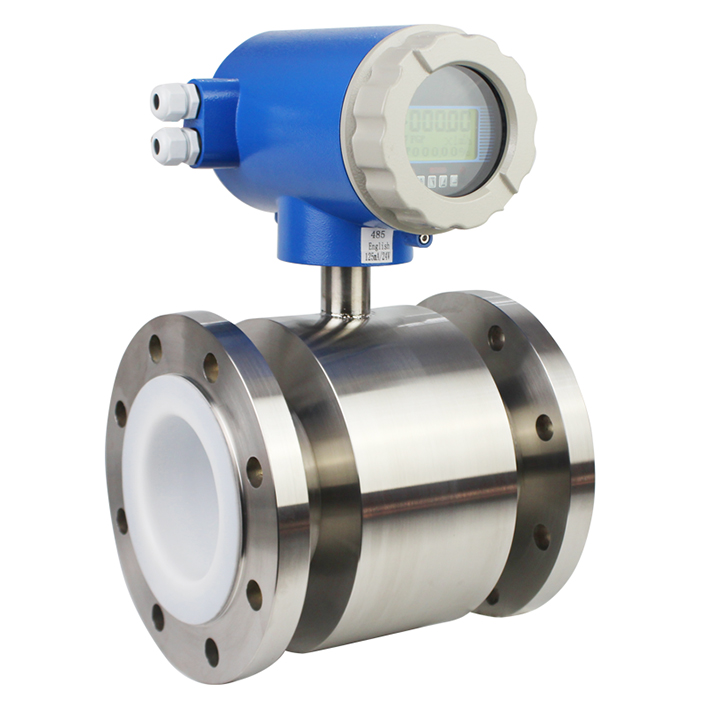
The sanitary variant offers PTFE or PFA liner, with a food-grade option, and states a working temperature of −20 °C to +150 °C depending on liner. The qualifier is the operative part: the liner sets the limit, and the specification does not break the limit down by liner material, so the liner-specific figure should be requested in writing rather than assumed. Care also applies to figures borrowed from other variants. Other SMF configurations state working temperature up to +180 °C depending on liner and offer rubber and FEP alongside PTFE and PFA; carrying that wider figure into a sanitary enquiry is a common route to a mismatch between the ordered meter and the process.
The electrode options are stainless steel, Hastelloy C and titanium. The documentation reviewed here lists the options but no chemical-compatibility table, so the choice cannot be made from the datasheet alone — the fluid chemistry, concentration, temperature, chlorides and cleaning agents are the input, and the recommendation should be requested in writing with the quotation. The body is listed as stainless steel 304 or 316L for the sanitary variant, and the documentation describes 316L stainless steel wetted parts. Carbon steel appears as a body option on other SMF variants; that is a body choice, not a wetted-material choice. A specification that answers “body material” while leaving liner and electrode open has not answered the wetted-material question.
Surface finish is listed as an optional sanitary polished finish. Where a hygiene plan requires a specific roughness, that requirement has to be written into the order, because the reviewed specification states no roughness value. The same logic applies to approvals: the documentation reviewed for this article does not list a recognised sanitary system approval (for example 3-A or EHEDG), an FDA food-contact listing, or an NSF/ANSI 61 listing, the US scheme covering health effects of drinking water system components. Where a customer, market or utility requires one, it should be requested at qualification stage — a “food grade optional” liner note is a material option, not a system approval.
Diameter, pressure and the edge of the certificate scope
The sanitary SMF range is DN10 to DN300 with working pressure PN10, PN16 or PN25. The wider SMF family extends to DN3000 and adds PN40, which is useful context for the platform but not a substitute for the sanitary rating. Pressure and temperature interact: a PN rating established at ambient temperature is not automatically the rating at +150 °C, so the enquiry should state design pressure at design temperature.
The most concrete qualification point sits at the small end of the range. The CE certificate included in the reviewed documentation covers electromagnetic flow meters of models SMF, LD and LDT at DN15–DN2000 against EN ISO 4064-2:2014 and EN ISO 20456:2019. The sanitary range starts at DN10. A buyer specifying DN10, or a size at the DN15 boundary, is relying on a document whose stated scope begins where the range begins. Requesting a certificate that names the size being purchased is specific, reasonable and easily answered — and a supplier who cannot produce one has told the buyer something useful.
Qualifying outputs and communication before the order
The sanitary SMF specification lists 4-20 mA, pulse, frequency, RS485 and Modbus as optional outputs, with a 24 VDC or 220 VAC supply and integrated or remote structure. Each term carries an integration question. “Optional” means the configuration is fixed at order, so the quotation should state which outputs are fitted, not which are available.
- 4-20 mA: active or passive, and what loop load can it drive?
- Pulse: what pulse weight, in what unit, and is it configurable on site?
- Frequency: over what output range, and how does it scale?
- RS485 / Modbus: is a register map supplied with baud rate, parity and default address, and is it version-controlled?
Two boundaries are worth stating explicitly. HART appears in the output list of other SMF variants but not in the sanitary variant’s list, so it should not be assumed. Battery-powered configurations exist in the SMF family, but the sanitary variant lists only 24 VDC and 220 VAC, so a site without mains power needs a specific answer rather than an inference from the platform. Where the meter feeds a PLC, SCADA system, data logger or cloud platform, the register map and scaling conventions are part of the delivered product, not documentation to be located afterwards.
The certificate layer: what each document proves
Certificates are the part of supplier qualification most often read as a single yes/no. They are better read as a register with three attributes each: what the document covers, who issued it, and whether it is currently valid.
| Document | Number and issuer | Scope | Validity |
|---|---|---|---|
| ISO 9001:2015 | 31624010128R3M; CEOC Testing & Certification Center (Beijing) Co., Ltd. | Quality management system | Issued 2021-04-09; valid to 2027-04-01 |
| ISO 14001:2015 | 31626E00146R301; CEOC | Environmental management system | Issued 2017-08-01; valid to 2029-05-07 |
| ISO 45001:2018 | 31626S00140R30; CEOC | Occupational health and safety system | Issued 2017-08-01; valid to 2029-05-07 |
| After-sales service, five-star (GB/T 27922-2011) | 31626FWO0009R300; CEOC | After-sales service capability | Issued 2020-05-11; valid to 2029-05-07 |
| CE certificate | 4Z210830.KSWTN31; ECM | Electromagnetic flow meter, models SMF, LD, LDT, DN15–DN2000; EN ISO 4064-2:2014, EN ISO 20456:2019 | Issued 2021-08-30; expiry 2026-08-29 |
| CE (EMC) | 8604093; LL-C | Electromagnetic flowmeter; EN IEC 61326-1:2021 | Issued 2024-05-13; valid to 2050-01-01 |
Each row answers a different question. The ISO 9001 certificate covers a management system, not a flow meter; its value is that it supports questions about process control, and SDWM’s stated quality sequence — incoming material inspection, in-process inspection, 100% functional testing, calibration testing and final inspection before shipment — is where those questions land. The ISO 14001, ISO 45001 and five-star after-sales certificates cover environmental, safety and service capabilities respectively. None of them speaks to accuracy, materials or enclosure protection.
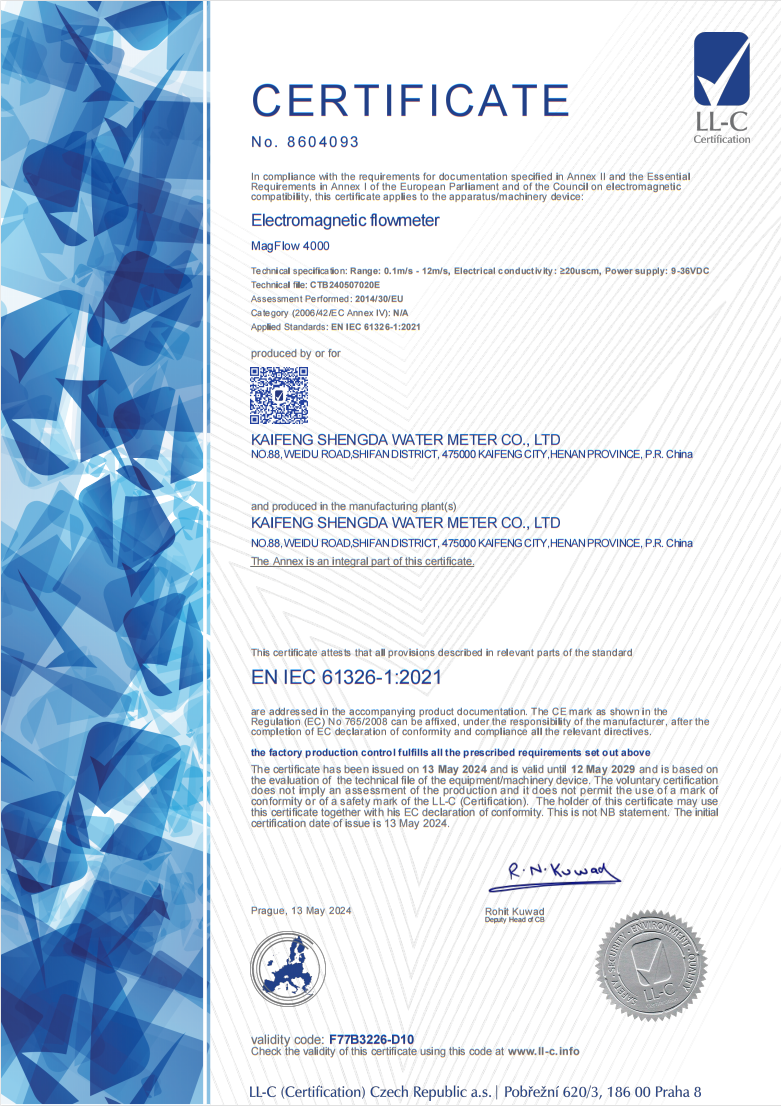
Validity dates are part of the specification. The CE certificate in the reviewed documentation carries an issue date of 30 August 2021 and an expiry date of 29 August 2026, which has passed relative to this article. That is the clearest illustration of why certificate review is a live exercise: a buyer ordering now should request the current certificate or renewal evidence and check that the replacement names the same models and standards. The EMC certificate in the same documentation, issued against EN IEC 61326-1:2021, remains valid to 2050 and covers electromagnetic flowmeters — useful for an EMC claim, irrelevant to accuracy.
Market access is a set of separate gates. EU water-meter placement depends on Directive 2014/32/EU Annex MI-001; equipment for potentially explosive atmospheres falls under Directive 2014/34/EU, and the sanitary SMF specification reviewed here lists no explosion-protection marking, so an Ex-rated requirement needs a documented answer rather than an assumption. In the United States, potable-water contact commonly requires an NSF/ANSI 61 listing in addition to, not instead of, metrological evidence. These are requirements to check, not claims that any supplier holds them.
A pre-purchase qualification checklist
The sequence below converts the discussion into an enquiry, assuming a shortlist exists and the task is to separate comparable quotations from incomparable ones.
- Fix the configuration in writing: diameter, liner, electrode, connection, pressure, temperature, power, structure and the exact output set.
- Request the liner-specific temperature limit rather than the family maximum.
- Ask which component carries the IP rating and what condition sits behind IP68; confirm cable entry and, for remote structure, the transmitter rating.
- Ask for the accuracy basis, the flow range for the quoted diameter, and whether ±0.2% is available at that size.
- Ask for the test-method reference behind the accuracy claim and whether a calibration certificate accompanies each unit.
- Request the electrode recommendation against the actual fluid chemistry.
- Confirm whether a specific surface finish is required and how it is specified and verified.
- Name the sanitary, food-contact or potable-water approvals your market requires, and request the certificates.
- Check every certificate for scope — models, sizes, standards, issuer — and for current validity.
- Request the register map and a configured datasheet for the protocol being integrated.
Where the meter fits, and where it needs confirmation
The sanitary variant’s listed applications are food and beverage, dairy, clean-fluid chemical processing, pure water and RO systems, beverage filling lines, brewing and cosmetics. These are applications where the wetted path and the cleaning regime, not the flow range alone, drive the selection.
Wash-down filling line. Enclosure rating, surface finish and the tri-clamp connection are one decision rather than three. If the line is washed down between batches, protection and finish have to be specified together, and IP68 bought for margin does not compensate for a lower-rated cable entry.
Low-flow dosing or batching. The small diameters in the DN10–DN300 range carry the accuracy question: the buyer needs the flow range over which ±0.5%, or the optional ±0.2%, is claimed at that diameter, because a headline figure attached to a range the line never reaches is not a usable specification.
RO and pure-water systems. These appear in the listed applications, but the meter requires a medium conductivity of at least 5 µS/cm. Where a stream is demineralised or otherwise low in conductivity, the actual value should be confirmed against that threshold rather than inferred from an application list. This is a fit boundary, not a defect: the measuring principle needs a conductive medium.
Sanitary electromagnetic and clamp-on ultrasonic: a fit comparison
Buyers often ask whether a clamp-on ultrasonic meter would do the same job. The two technologies answer different constraints, and the comparison is better made on documented characteristics than on general preference. Table 3 compares the SMF sanitary variant with SDWM’s own TUF clamp-on and portable ultrasonic range, so the comparison stays within one supplier’s published specifications rather than becoming a claim about other manufacturers.
| Attribute | SMF sanitary electromagnetic | TUF clamp-on / portable ultrasonic |
|---|---|---|
| Principle | Electromagnetic induction, inline | Transit-time ultrasonic, clamp-on transducers |
| Wetted contact | Liner and electrodes in contact with fluid | No contact; sensors mount outside the pipe |
| Stated accuracy | ±0.5%, ±0.2% optional | ±1.0%; ±0.5% optional on the wider ultrasonic range |
| Diameter range | DN10–DN300 (sanitary variant) | DN15–DN6000 |
| Fluid constraint | Conductive liquid, ≥5 µS/cm | Water, wastewater and industrial liquids; pipe material must suit the transducer |
| Pressure loss | No obstruction in the measuring tube | Non-invasive, no obstruction |
| Typical role | Continuous measurement in hygienic duty | Verification, commissioning and surveys where the pipe cannot be cut |
The clamp-on meter’s practical advantage is that it needs no pipe cut and adds no wetted material, which matters for checking an installed meter or running a temporary survey. The inline meter’s advantage is a fixed, cleanable measuring section suited to a hygienic process line. Neither characteristic establishes superiority in the other’s application, and the quoted accuracy figures are not directly comparable until the test references discussed earlier are attached.
What stricter qualification changes for buyers
Two shifts make the documentation layer more valuable than it was a decade ago. The first is commercial: a market of $8.4 billion in 2025 moving toward $10.4 billion in 2030, with magnetic flowmeters among the revenue leaders, is a market with enough suppliers that specification quality becomes a genuine differentiator. The second is technical: digital outputs such as RS485 and Modbus move part of the product’s behaviour into a register map — a document that has to be supplied and version-controlled, not a feature that can be inferred.
The outlook follows from those points rather than from a forecast about any specific product. As more meters connect to PLC, SCADA and cloud platforms, the qualification question shifts from “does the meter meet the accuracy class” to “can the supplier evidence the accuracy class, the enclosure rating, the wetted materials and the protocol in documents that survive an audit”. The forecast cited is an external projection, not a measured outcome; it explains why documentation discipline is worth the effort, and nothing more.
What the exercise produces
Qualifying a sanitary electromagnetic flow meter supplier is not a matter of finding the best datasheet. It is a matter of reducing three claims to evidence: which component is rated and under what condition, what the accuracy figure is referenced to and over which range, and which surfaces touch the product and under which approvals. On the SMF sanitary variant the documentation supports a clear starting position — DN10–DN300, ±0.5% with ±0.2% optional, PTFE or PFA liner with a food-grade option, stainless steel 304 or 316L body, IP65/IP67/IP68 options, −20 °C to +150 °C depending on liner, and 4-20 mA, pulse, frequency, RS485 and Modbus outputs. The same documentation leaves specific points open, and those are the points worth putting in the enquiry: liner-specific temperature limits, the test basis behind the accuracy figure, sanitary approvals where a market requires them, the current validity of the CE certificate, and certificate coverage at DN10.
SDWM’s company profile is available as a downloadable PDF for buyers who want the manufacturer-level context behind the product documentation.
FAQ
What does an IP68 rating confirm on a sanitary electromagnetic flow meter?
IP68 is an enclosure classification defined by IEC 60529, in which the second digit refers to continuous immersion. On the SMF sanitary electromagnetic flow meter, IP65, IP67 and IP68 are listed as optional protection classes. The rating confirms the protection of the tested enclosure, not of the whole installation, so the buyer should confirm which component was tested, the immersion condition behind the IP68 claim, and the rating of cable entries and any remote-mounted transmitter.
Can ±0.2% and ±0.5% accuracy claims be compared directly between suppliers?
Not as bare figures. A valid comparison needs the basis (percentage of reading or of full scale), the flow range over which the figure is claimed for the diameter being purchased, and the conditions of the test. ISO 9104:1991 sets out methods for evaluating the performance of electromagnetic flow-meters for liquids in closed conduits and ISO 20456:2017 gives guidance on their use, so a supplier can be asked to state a method reference. On the SMF sanitary variant, ±0.5% is stated with ±0.2% available as an option.
Which wetted material should be verified first on a food or beverage line?
The liner, because it sets the temperature limit as well as chemical compatibility. The SMF sanitary variant offers PTFE or PFA liner with a food-grade option and states a working temperature of −20 °C to +150 °C depending on liner, so the liner-specific limit should be confirmed in writing. The electrode — stainless steel, Hastelloy C or titanium — is then matched to the fluid chemistry, and the stainless steel 304 or 316L body is verified separately as a structural question rather than a product-contact one.
Does the CE certificate cover every SMF diameter?
The CE certificate in the reviewed documentation covers electromagnetic flow meters of models SMF, LD and LDT at DN15–DN2000 against EN ISO 4064-2:2014 and EN ISO 20456:2019, issued on 30 August 2021 with an expiry date of 29 August 2026. The sanitary SMF range is DN10–DN300, so both the DN10 size and the current validity of the certificate call for a specific answer from the supplier before purchase.
Which outputs must be confirmed before integration?
The sanitary SMF variant lists 4-20 mA, pulse, frequency, RS485 and Modbus as optional outputs, powered by 24 VDC or 220 VAC. Because they are options, the quotation should state exactly which are fitted. The buyer should also request the Modbus register map with baud rate, parity and default address, confirm the pulse weight and its unit, and check the 4-20 mA loop configuration. HART appears on other SMF variants but not in the sanitary output list, so it should not be assumed.
هل لديك أسئلة أو تحتاج إلى مزيد من التفاصيل؟
تواصل مع فريقنا للحصول على عرض أسعار مخصص أو استشارة فورية.
طلب عرض أسعار
املأ النموذج أدناه وسيتواصل معك فريقنا بعرض مقترح مخصص.
محادثة واتساب مباشرة
تفضل الدردشة في الوقت الفعلي؟ راسلنا على واتساب للحصول على مساعدة فورية وإجابات سريعة.
- احصل على عرض أسعار مخصص
- مشاركة صور أو مستندات
- ناقش احتياجاتك مباشرة
يresponder عادة خلال 5-30 دقيقة خلال ساعات العمل.