
Qualifying a Silicon Dioxide Grade for E551, FCC, USP or Food Contact Use
Qualifying a Silicon Dioxide Grade for E551, FCC, USP or Food Contact Use
A silicon dioxide lot can carry E551, an FCC grade number and a food contact statement on the same batch record and still fail a pharmaceutical excipient review, because those four labels answer four different questions. Qualifying one grade against a named standard means proving that grade against that standard's own evidence chain — not swapping one certificate for another.
The qualification rule in one line: a grade is qualified for a specific claim when the production site, the batch and the certificate all reference the same standard, and when the functional data needed for the intended application has also been verified by trial.
Why E551, FCC, USP and Food Contact Grade Are Not Interchangeable
Food Grade Silicon Dioxide, Food Additive Silicon Dioxide, Pharmaceutical Excipient Silica and Food Contact Grade Silica describe four different relationships between a material and a regulation. Treating them as one category is the most common cause of a failed supplier approval.
E551 is an additive identity. It sits inside the European Union framework: Commission Regulation (EU) No 231/2012 sets the purity criteria for silicon dioxide as a food additive, and Regulation (EC) No 1333/2008 sets the conditions under which it may be used in food. Qualifying for E551 therefore answers a narrow question — does this material meet the EU additive purity criteria, and is the intended food category authorised to contain it. The internationally comparable reference point is the JECFA specification for INS 551, which sets dry-basis SiO₂ at ≥94%, loss on drying at ≤8%, loss on ignition at ≤8.5%, total heavy metals at ≤10 mg/kg, Pb at ≤2 mg/kg and As at ≤3 mg/kg, with a pH range of 3.5–7.5 and an explicit requirement that the material be amorphous with no crystalline quartz present.
FCC grade is a compendium monograph claim. The Food Chemicals Codex monograph defines identity and quality for food-grade silicon dioxide. For precipitated and gel types it requires SiO₂ (ignited) at ≥94.0%, loss on drying at ≤7%, loss on ignition at ≤8.5%, As at ≤3 mg/kg, Pb at ≤2 mg/kg and Hg at ≤1 ppm, with X-ray diffraction confirming an amorphous structure and no crystalline quartz. It is a quality monograph, not a permission to use the material in any particular food at any particular level.
USP grade is an excipient monograph claim. Supplying silicon dioxide as a Pharmaceutical Excipient Silica means the material satisfies the relevant pharmacopoeial monograph — USP–NF, EP or JP as required by the customer's market — including identity testing, Pb limits in the ≤1–2 ppm range, total heavy metals at ≤10 ppm, and microbiological control performed under USP <61>/<62>. A food additive certificate does not carry those obligations, and an excipient certificate does not establish food additive status.
Food contact grade is a materials-safety claim, not a dietary one. It addresses whether a material may be used in contact with food — for example as an anti-blocking agent in packaging film — under a food contact materials framework such as GB 4806. The evidence is a food contact conformity statement tied to defined contact conditions, not a maximum intake or a maximum addition level in a recipe. A supplier can legitimately hold a food contact declaration for a grade that is not declared as an E551 additive, and the reverse is also true.
Because the underlying substance is the same — amorphous silicon dioxide, CAS 7631-86-9 — the analytical values across these frameworks often look similar. Similar numbers are not the same evidence. The qualification decision has to be made against the framework named in the purchase specification.
What Each Claim Actually Proves: A Qualification Matrix
The table below maps each claim to the framework that governs it, the items a buyer must see checked, and the document that closes the loop. A supplier response that does not name the framework in the first column is incomplete regardless of how many certificates are attached.
| Claim | Governing framework | Items that must be checked | Document the buyer should request |
|---|---|---|---|
| E551 | (EU) No 231/2012 for purity; (EC) No 1333/2008 for conditions of use | SiO₂ content, loss on drying, loss on ignition, total heavy metals as Pb, Pb, As, pH, amorphous confirmation | Batch-specific COA citing both regulations, plus the authorised maximum level for the target food category |
| FCC grade | Food Chemicals Codex silicon dioxide monograph | SiO₂ ignited ≥94.0%, loss on drying ≤7% (precipitated/gel), loss on ignition ≤8.5%, As ≤3 mg/kg, Pb ≤2 mg/kg, Hg ≤1 ppm, XRD amorphous | COA issued in FCC format for the shipped lot, with X-ray diffraction confirmation of amorphous structure |
| USP pharmaceutical excipient | USP–NF, EP or JP excipient monograph as required by the destination market | Monograph identity tests, Pb ≤1–2 ppm, total heavy metals ≤10 ppm, microbiological limits under USP <61>/<62> | COA in the required pharmacopoeial format, plus the microbiological results for that lot |
| Food contact grade | Food contact materials framework, e.g. GB 4806 | Material suitability for the stated contact application and contact conditions | Food contact conformity statement naming the standard and the intended contact use |
Two practical observations follow from this matrix. First, the same production lot may genuinely satisfy more than one column, but each column requires its own issued document. Second, a buyer who accepts a single certificate to cover two columns has effectively waived the missing one.
Reading a COA Against the Claimed Standard
A COA only supports a claim when its reported limits are the limits of the standard being claimed. The comparison below shows a supplier's published values for one food-grade grade, ZLSIL-22S, set against the JECFA INS 551 specification. It illustrates the format a buyer should expect — and the difference between a regulatory parameter and a functional one.
| Parameter | JECFA INS 551 specification | ZLSIL-22S published value |
|---|---|---|
| SiO₂ (dry basis) | ≥94% | 99.1% |
| Loss on drying, 105 °C / 2 h | ≤8% | 4.31% |
| Loss on ignition, 1000 °C / 2 h | ≤8.5% | 4.02% |
| Total heavy metals (as Pb) | ≤10 mg/kg | <10 mg/kg |
| Pb | ≤2 mg/kg | <1 mg/kg |
| As | ≤3 mg/kg | <1 mg/kg |
| pH | 3.5–7.5 | 6.8 |
| BET surface area | Not specified | 190 m²/g |
| Oil absorption (DBP) | Not specified | 270 ml/100 g |
| D50 | Not specified | 11.5 μm |
| Tapped density | Not specified | 0.09 g/cm³ |
Values for ZLSIL-22S are supplier-published figures for that grade and are not a representation about other grades in the range.
Three things need checking in any COA presented this way. The first is whether the reported limits belong to the standard named in the purchase order — a COA formatted to China's GB 25576-2020 is a valid document, but it is not an FCC-format report and cannot be filed as one without reissue. The second is whether the values are lot-specific. The third is whether the non-regulatory parameters — BET, oil absorption, D50, tapped density — were reported at all, because these are the numbers that predict how the grade will behave in the line, and no monograph requires them.
Where China's GB 25576-2020 sits in the picture
GB 25576-2020 ranks food additive silicon dioxide by ignited SiO₂ content into three classes: Class I at ≥99.3%, Class II at ≥99.0% and Class III at ≥96.0%, with Pb limited to ≤5 mg/kg, heavy metals as Pb to ≤30 mg/kg and As to ≤3 mg/kg. Those thresholds do not map one-to-one onto the E551, FCC or USP monograph values, so a grade that comfortably clears a GB class still has to be re-verified against the monograph the buyer actually needs.
There is also a naming trap worth closing at the enquiry stage. GB 29204 covers silicon dioxide gel, a wet-process material with a loss on ignition up to 70%, while GB 25576 covers precipitated silicon dioxide as a dry powder. Both are INS 551. A specification that asks for "silicon dioxide" without naming the standard can be answered with either one, and the two are not functional substitutes in a dry anti-caking or carrier application.
What the COA Does Not Tell You
Several variables that decide whether a grade works are outside the scope of every monograph above. They belong in the technical questionnaire, not the compliance file.
- Amorphous confirmation. FCC and USP monographs require an amorphous structure with no crystalline quartz. Ask for the X-ray diffraction result rather than assuming it from a passing chemistry panel.
- pH of the grade, not the grade family. Standard food grades sit at a near-neutral pH of 6.5–6.8, while an acidic grade in the same portfolio can measure around pH 2.6 for acidic systems. In formulations containing vitamins, enzymes or acid-sensitive actives, the pH of the specific grade is a formulation variable, not a footnote.
- Loss on drying as a performance parameter. Residual moisture in the silica itself reduces how much free water it can absorb from the powder it is meant to protect. A near-neutral grade with low loss on drying behaves differently in a humid warehouse from one at the upper limit of the monograph.
- Particle size distribution and surface area. D50 and BET determine dusting, dispersibility, mouthfeel and liquid-carrying capacity. A D50 that is too coarse reads as grit in a beverage; too fine reads as dusting and agglomeration on the line.
- Microbiological method basis. Limits quoted against USP <61>/<62> and limits quoted against a national food method are not automatically equivalent even when the numbers look comparable.
Buyer implication: the qualification questionnaire should ask for regulatory parameters and functional parameters in the same response. A supplier that can only supply the first set can support registration but not process validation.
Specification Compliance Is Not Finished-Product Performance
A COA that shows every parameter in specification confirms one thing: the material is chemically compliant. It does not confirm that the grade will perform in a specific formulation, because end performance is also governed by the formulation, the process and the equipment. Two grades with closely similar certificates can behave very differently in the same recipe.
This is the reason a pilot trial is not optional when a buyer switches from an imported grade or introduces a new one. A workable validation sequence looks like this:
- Fix the benchmark parameters in advance: D50, oil absorption, pH and loss on drying, taken from the incumbent grade.
- Run parallel tests at the same dosage as the existing formulation, so the comparison isolates the material rather than the recipe.
- Evaluate the outcomes that matter for the application — flowability, anti-caking performance, colour and solubility.
- Run accelerated stability at 40 °C / 75% RH for two to four weeks before committing to scale.
- Document the results and release for full production only if performance is acceptable.
Two controls keep the trial honest. Trial material must come from the same batch that will be scaled, and trial samples should be sealed and retained. Skipping the stage and moving straight to full production converts a manageable qualification cost into a full-batch failure risk.
The Document Set a Qualification File Should Contain
Whatever the target standard, a complete qualification file for one silicon dioxide grade should hold the following items, all traceable to the shipped lot.
- A lot-specific certificate of analysis issued in the format of the standard being claimed — E551, FCC, USP–NF/EP/JP or the applicable food contact framework.
- Confirmation that the material is amorphous, with no crystalline quartz detected by X-ray diffraction.
- The full elemental impurity panel — Pb, As, Hg and Cd or Cr — reported as measured values against stated limits, not as a pass mark alone.
- Microbiological results reported against a named method, with pathogen absence stated explicitly.
- A declaration of conformity that names the regulation or monograph, rather than a generic statement of food-grade status.
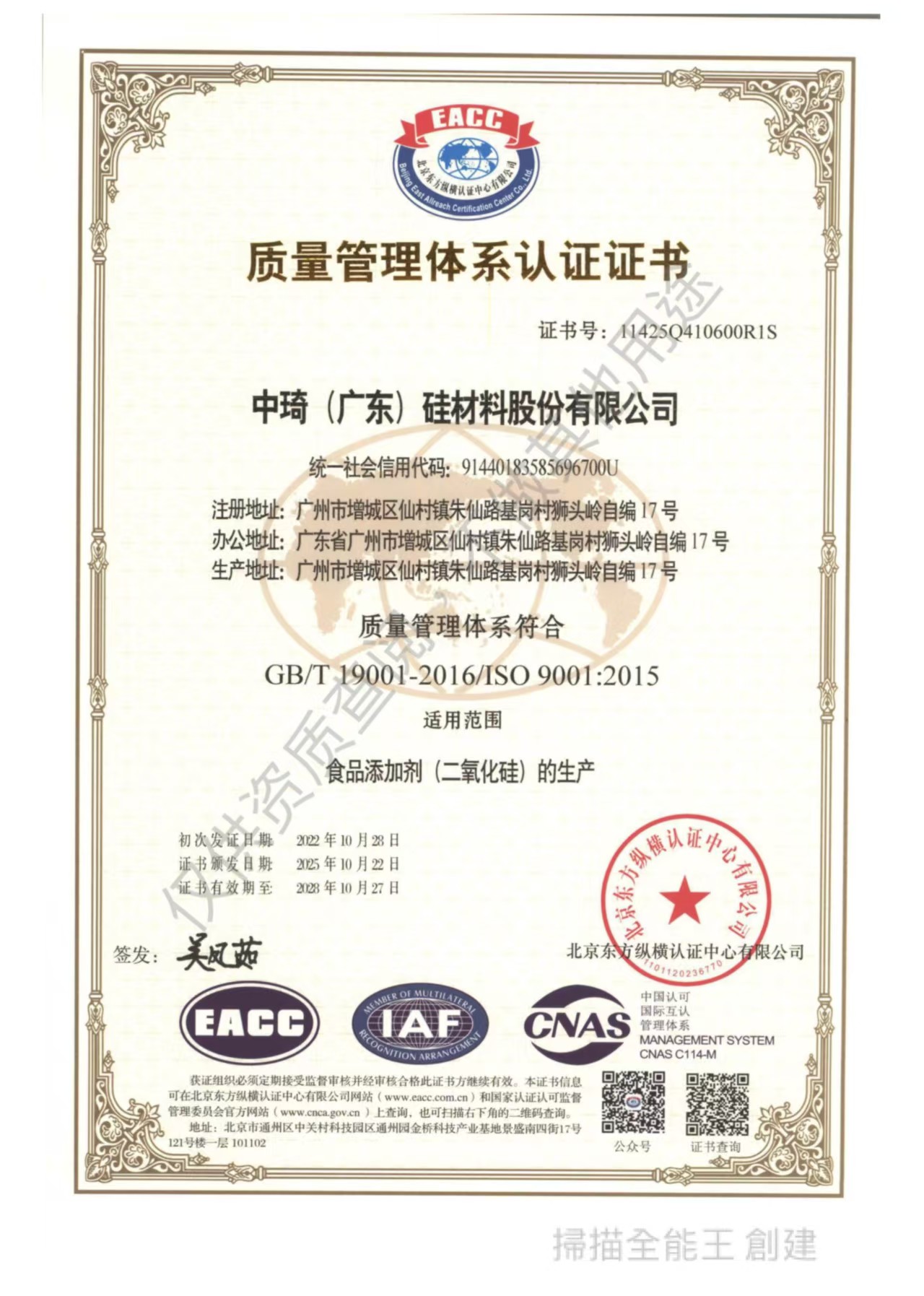
- Management system certificates with the certified scope and validity dates visible, so the buyer can confirm the site and product category are covered.
- Allergen, animal-origin and GMO statements, plus any market-specific declarations the destination requires.
- Packaging and moisture-barrier specification, together with storage conditions and shelf life.
- Retention sample and lot traceability confirmation, including how long samples are held.
What Supplier Certificates Prove — and What They Do Not
Site certificates are useful evidence of system control, and they belong in the file. They are not a substitute for product-level conformity. A management system certificate covers a certified scope at a certified site; unless a specific grade sits inside that scope, the certificate says nothing about it.
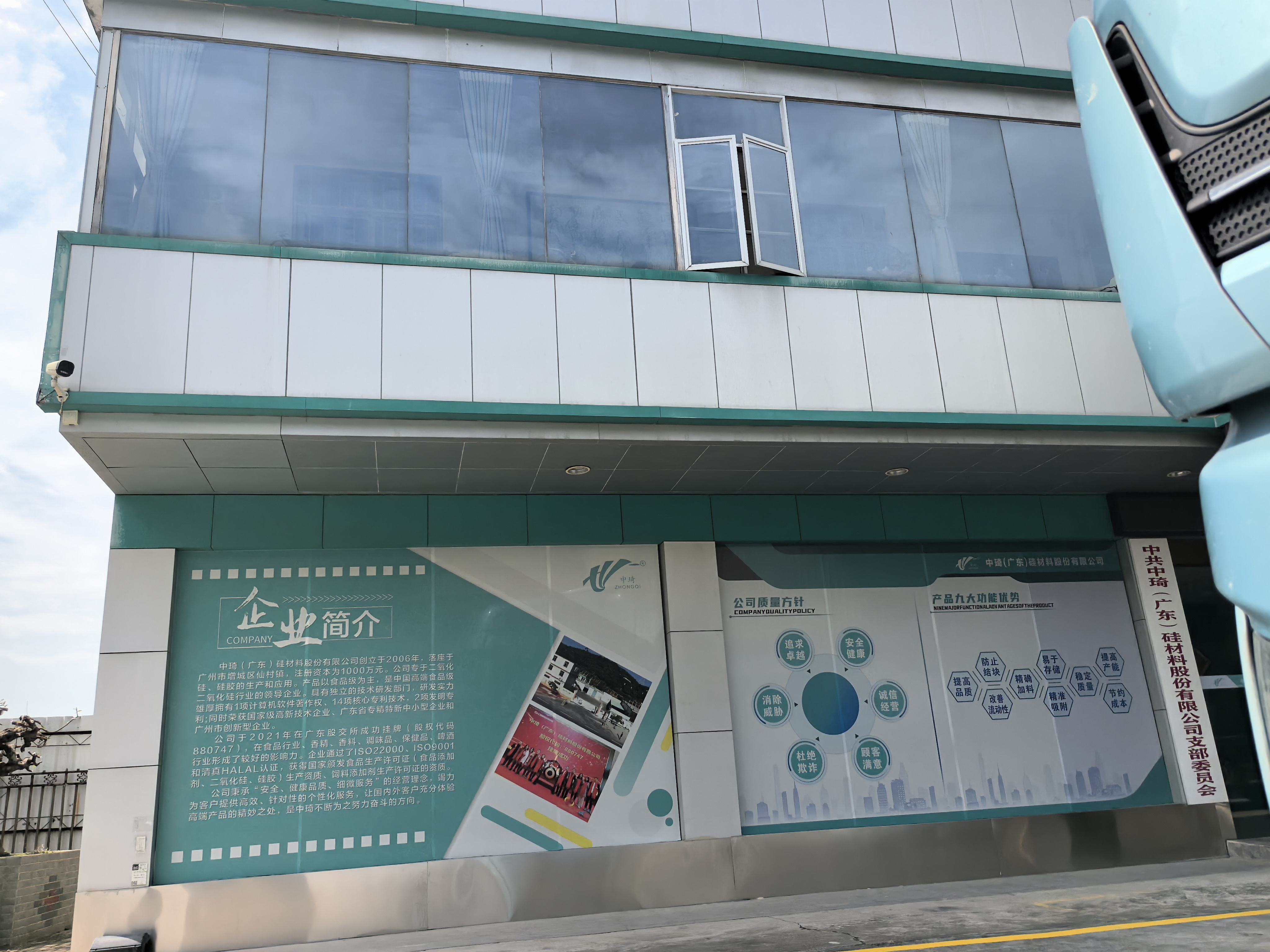
For reference, the certificate set published by Shandong Zhonglian Chemical, the overseas sales and brand operation arm of Zhongqi (Guangdong) Silicon Material Co., Ltd., includes the following. The production base is in Guangzhou.
| Certificate | Reference | Valid to |
|---|---|---|
| ISO 9001:2015 quality management system | 11425Q410600R1S (EACC) | 27 October 2028 |
| ISO 22000:2018 food safety management system | 116FSMS1300022 (HSL Certification Service) | 21 June 2027 |
| FSSC 22000 version 6.0 | CQC25FS1229R0S/4400 (CQC) | 30 October 2028 |
| FAMI-QS version 6.0, feed ingredients | 11625FAM0017 / FAM-2355 | 20 March 2028 |
| HALAL, including Indonesia BPJPH | 1198250000 | 22 May 2028 |
| OU Kosher | OUV2-JZVTP4 | 31 October 2026 |
| US FDA food facility registration | 14857861616 | Registration reference |
| SEDEX SMETA 4-Pillar social audit | ZAA600166938 (Intertek Shenzhen) | Audit report, dated 7 November 2025 |
Read the table for what it is. The food safety and quality certificates address site-level control across food additive and feed additive silica production. None of them states that a particular grade meets E551, FCC or USP. That determination still rests on the lot certificate, the amorphous confirmation and the elemental impurity panel described earlier. A buyer should also check the validity date against the intended delivery window, since a certificate expiring inside the supply period creates a documentation gap mid-contract.
Regulatory Signals Worth Tracking During Qualification
Two developments are relevant to buyers building a multi-year file on silicon dioxide, and they should not be confused with each other.
The first concerns oral safety. EFSA's re-evaluation concluded that E551 is safe for all population groups, including infants, at reported use levels, and JECFA has evaluated the substance with an acceptable daily intake recorded as "not specified" — the classification used when the available data do not justify a numerical limit. These conclusions address dietary exposure.
The second concerns occupational classification. In June 2024, ECHA proposed a harmonised classification of synthetic amorphous silica as STOT RE 1 (H372) on the basis of high-dose rat inhalation studies. That proposal addresses inhaled dust in workplace settings, not ingestion through food. The two lines of evidence answer different questions and are not in conflict. For a buyer, the practical consequence is that the qualification file should track both: the food additive authorisation that governs the application, and the classification status that governs handling documentation and safety data sheets for the buyer's own workforce.
Frequently Asked Questions
If a grade meets E551, does that mean it can be used as a pharmaceutical excipient?
No. E551 is a European food additive identity established by the purity criteria in (EU) No 231/2012 together with the conditions of use in (EC) No 1333/2008. Excipient use requires conformity with the relevant pharmacopoeial monograph — USP–NF, EP or JP — including monograph identity tests, Pb in the ≤1–2 ppm range, total heavy metals at ≤10 ppm and microbiological control performed under USP <61>/<62>. The numeric limits in the two frameworks can look similar, but they are issued under different authorities and prove different things.
What should an FCC-format report for silicon dioxide actually contain?
It should be a lot-specific certificate issued in FCC format, stating SiO₂ (ignited) at ≥94.0%, loss on drying at ≤7% for precipitated or gel types, loss on ignition at ≤8.5%, As at ≤3 mg/kg, Pb at ≤2 mg/kg and Hg at ≤1 ppm. It should also be supported by X-ray diffraction data confirming the material is amorphous with no crystalline quartz present. A report carrying the right numbers under a different standard's heading is not an FCC report.
Is food contact grade silica regulated in the same way as E551?
No, and the distinction matters at the enquiry stage. E551 governs the purity of a food additive and the food categories and levels at which it may be used. Food contact grade addresses the safety of a material intended to come into contact with food, typically under a framework such as GB 4806, and the supporting document is a food contact conformity statement naming the standard and the intended contact conditions. A supplier may hold a food contact declaration for a grade that is not declared as an E551 additive at all.
How much pilot data is enough before switching silicon dioxide suppliers?
Enough to show equivalence on both the regulatory and the functional side. Fix the benchmark parameters from the incumbent grade — D50, oil absorption, pH and loss on drying — then run parallel tests at the same dosage, assess flowability, anti-caking performance, colour and solubility, and complete accelerated stability at 40 °C / 75% RH for two to four weeks. Trial material should come from the same batch that will be scaled. If those results match, scale-up risk is controlled; if the comparison is skipped, the first production run becomes the test.
What does an ADI of "not specified" mean for buyers?
In JECFA terms it is the most favourable outcome — the available toxicological data do not justify setting a numerical acceptable daily intake. It does not override the additive rules of the destination market. Maximum permitted levels and authorised food categories are set by the applicable regulation, such as (EC) No 1333/2008 in the European Union or GB 2760 in China, and those limits apply regardless of the ADI classification.
Conclusion: One Grade, One Claim, One Evidence Chain
Qualification succeeds when the buyer stops asking "is this food grade?" and starts asking "which standard, proved by which document, for which batch?" E551, FCC grade, USP excipient and food contact grade each require their own framework reference, their own lot-level certificate and their own supporting declarations. The functional parameters that determine whether the grade works — pH, loss on drying, D50, BET and oil absorption — sit outside every monograph and must be requested and then verified by trial.
Applied in that order, the checklist produces a file that survives an audit and a production run. Applied in the reverse order, it produces a folder of certificates that satisfies nobody once the first batch reaches the line.
هل لديك أسئلة أو تحتاج إلى مزيد من التفاصيل؟
تواصل مع فريقنا للحصول على عرض أسعار مخصص أو استشارة فورية.
طلب عرض أسعار
املأ النموذج أدناه وسيتواصل معك فريقنا بعرض مقترح مخصص.
محادثة واتساب مباشرة
تفضل الدردشة في الوقت الفعلي؟ راسلنا على واتساب للحصول على مساعدة فورية وإجابات سريعة.
- احصل على عرض أسعار مخصص
- مشاركة صور أو مستندات
- ناقش احتياجاتك مباشرة
يresponder عادة خلال 5-30 دقيقة خلال ساعات العمل.