
Qualifying the BP6 MCB Pan Assembly Busbar for IEC 61439 and AS/NZS Projects
A component-level compliance statement is not the same thing as an assembly-level qualification. Here is what a buyer should actually verify before a 250A MCB pan assembly busbar becomes an acceptance criterion on a purchase order.
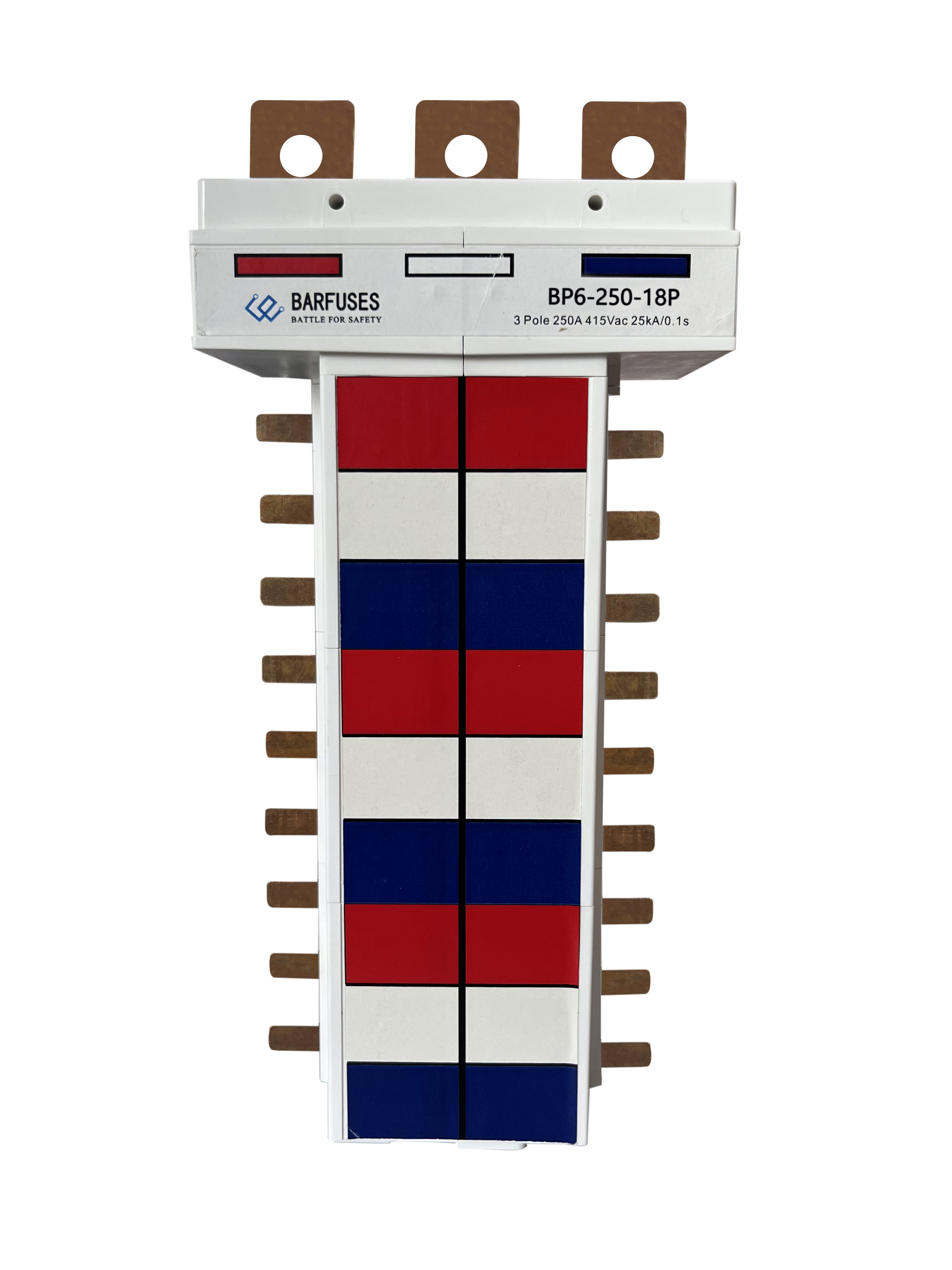
Low-voltage distribution boards in industrial plants and commercial buildings are specified, reviewed and handed over against IEC 61439 — and, in Australia and New Zealand, against the AS/NZS adoption of that series. For buyers sourcing modular busbar components, the practical question is not whether a product page says “compliant”. The practical question is which claims the project actually depends on, and which evidence should travel with the order.
The BP6 is an MCB pan assembly busbar manufactured by YUEQING BARFUSE ELECTRIC CO.,LTD, a Wenzhou-based manufacturer of low-voltage fuse switch disconnectors, busbar systems and high and low voltage distribution wiring management products, including MCB pan assemblies, MCCB pan assemblies and metal distribution boxes. The BP6 is stated at a rated current of 250A, with an outgoing terminal width of 6.5 × 12 mm, an incoming terminal width of 21 × 22 mm, copper conductive parts, polycarbonate (PC) insulating parts and a mounting plate that can be customized to the outgoing MCB configuration. Its product data states compliance with IEC 61439 and AS/NZS standards.
This article explains how to interpret that statement, and what to check before it hardens into a project requirement.
Why a compliant busbar is not the same as a compliant assembly
IEC 61439 is the international family of standards for low-voltage switchgear and controlgear assemblies. Part 6 of that family addresses busbar trunking systems; IEC 61439-6:2025 is listed by the IEC as active and updated, with an effective date of 1 December 2025. Buyers working on projects specified in 2026 should confirm which edition and which part of the series their project documentation actually references, because the answer changes what evidence is relevant.
The more important point for sourcing is structural: IEC 61439 verifies assemblies, not individual components inside them. A pan assembly busbar is a component that sits inside a distribution board. A manufacturer statement such as “compliant with IEC 61439 AS/NZS standards” is therefore a component-level claim about design, materials, dimensions and construction — it describes how the part is built and specified. The assembly-level verification of the finished board — design verification and routine verification — remains with the panel builder or switchboard manufacturer who assembles and tests the complete unit.
Understanding this division of responsibility early saves a great deal of rework later. It tells the buyer which questions belong to the busbar supplier and which belong to the board builder — and it prevents an inspector’s question from landing on the wrong party.
The BP6 specification as stated
Before discussing acceptance criteria, it helps to separate what is specified from what is assumed. The following is the BP6 data as published by the manufacturer.
| Parameter | Stated BP6 specification |
|---|---|
| Product category | MCB pan assembly busbar (MCB 3P chassis busbar) |
| Model designation | BP6 |
| Rated current | 250A |
| Outgoing terminal width | 6.5 × 12 mm |
| Incoming terminal width | 21 × 22 mm |
| Conductive material | Copper |
| Insulating material | Polycarbonate (PC) |
| Mounting plate | Customizable according to the outgoing MCB configuration |
| Stated standard compliance | IEC 61439 and AS/NZS |
| Intended application | Industrial application and commercial building electric management |
Two things stand out for a buyer at the research stage. First, the outgoing terminal dimension and the customizable mounting plate mean this part is configured around a specific MCB family — it is not a one-size-fits-all bar. Second, the compliance statement is attached to the product as a whole, not clause by clause. Turning that into an acceptance criterion is the buyer’s task.
The problem: qualification usually fails on evidence, not on the part
In low-voltage distribution projects, most procurement disputes about busbar components do not start with the physical part failing. They start with a documentation gap discovered late — during panel inspection, consultant review or handover — when someone asks which standard edition was applied, what the terminal torque value is, or which test report supports a statement on the datasheet.
The opportunity is straightforward: convert a broad compliance phrase into a short, closed checklist at purchase-order stage. Every item on that list is either answered before shipment or flagged as a project risk. This is especially relevant for a 250A modular pan assembly busbar, where the component interfaces with a specific MCB, a specific enclosure and a specific short-circuit coordination scheme.
Acceptance criteria to verify before ordering
For a part such as the BP6, these are the criteria worth closing out in writing.
| Acceptance criterion | What to confirm |
|---|---|
| Standard edition and part | Which edition of IEC 61439, and which AS/NZS adoption, the project references, and which part of the series applies to the assembly the busbar is installed in. |
| Rated current basis | The BP6 is stated at 250A. Confirm the ambient temperature and temperature-rise basis assumed for that rating against the actual installation conditions. |
| Terminal geometry | Outgoing terminal width 6.5 × 12 mm and incoming terminal width 21 × 22 mm, matched against the cable lug, busbar interface and tightening torque specified for the board. |
| Material and insulation | Copper conductive parts and PC insulating parts, and how those materials are addressed in the assembly-level material and flammability requirements. |
| Short-circuit coordination | The withstand figure that matters is the coordinated value for the assembly together with its upstream protective device, not a component figure read in isolation. |
| Mounting plate configuration | The mounting plate is customizable to the outgoing MCB. Freeze the plate drawing, MCB brand and pole configuration before tooling begins. |
| Documentation pack | Declaration of conformity, relevant test reports, certificate copies, product marking and batch traceability. |
| Commercial terms tied to acceptance | Sampling, inspection method, rework and replacement terms, and the point at which a drawing change restarts approval. |
Why the mounting plate deserves its own line item
The customizable mounting plate is often treated as a minor detail and then becomes the item that delays a shipment. Because the plate is configured to the outgoing MCB, any change in MCB brand, pole arrangement or way count after drawing approval affects the plate, not just the order quantity. Treating the plate drawing as a controlled document — approved once, versioned thereafter — is the simplest way to keep a modular pan assembly busbar project on schedule.
How the BP6 sits inside a verified board
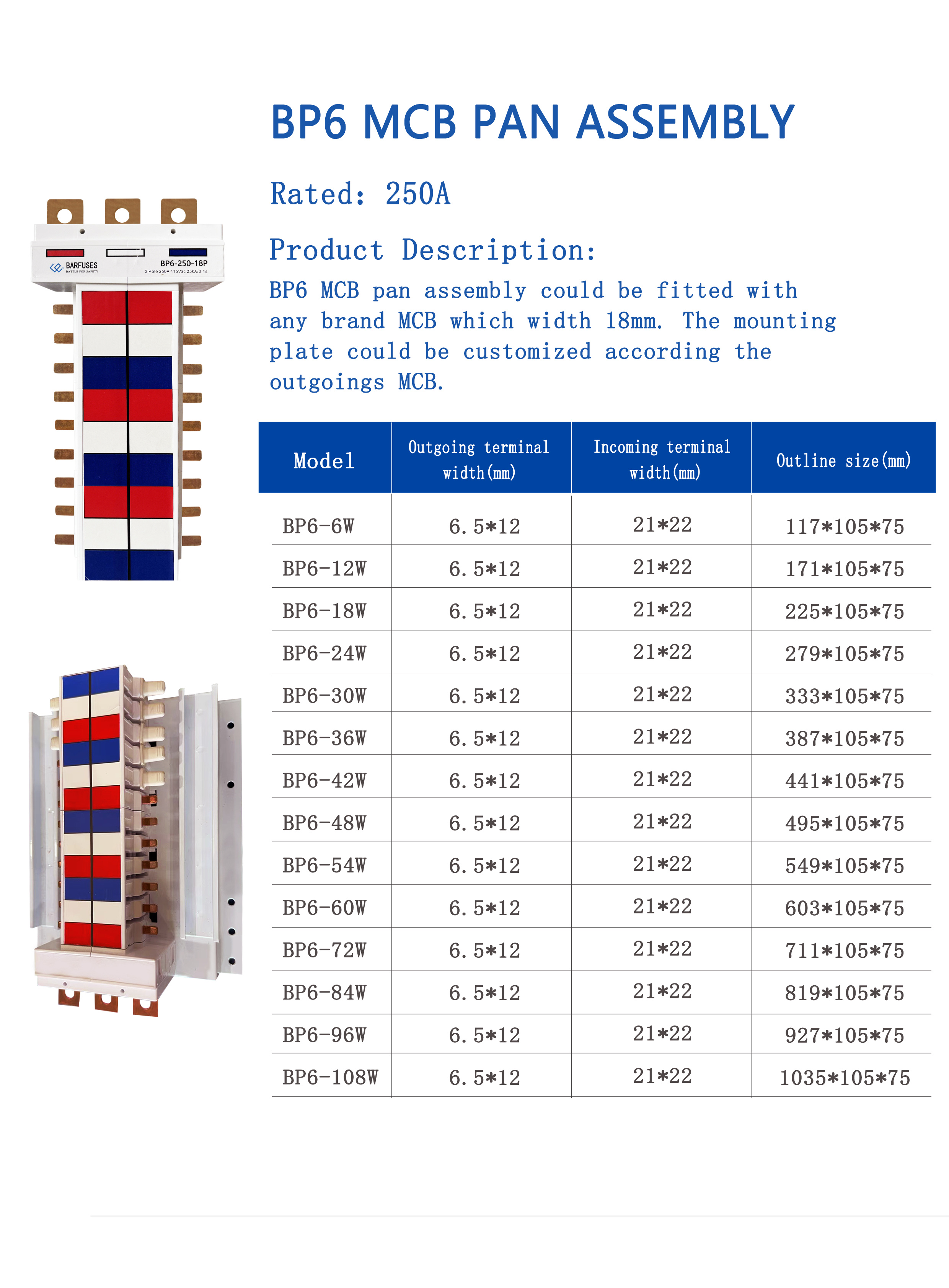
A pan assembly busbar is a pre-assembled distribution element. Instead of fabricating and drilling individual copper bars on site, the panel builder installs a module that already carries the phase conductors, the insulated carrier and the terminal positions for the outgoing protective devices. The BP6 follows that construction: a copper conductive path held in a PC insulating carrier, with a 21 × 22 mm incoming terminal and 6.5 × 12 mm outgoing terminals, and a mounting plate shaped to the outgoing MCB.
In practice, the design review of such a part focuses on three interfaces. The incoming interface determines how the feed connects to the module and what current the connection is rated for. The outgoing interface determines which MCB terminals can be landed and at what pitch. The mechanical interface — the mounting plate and carrier — determines whether the module fits the enclosure and whether the outgoing devices line up with the door cut-out.
The same manufacturer also produces related modular distribution components: the BP3 MCCB 3P pan assembly, rated for 250A, 400A, 630A and 800A incoming with 125A, 250A and 400A outgoing, in 2W to 14W configurations and compatible with MCCB pole distances of 25 mm, 30 mm, 35 mm and 45 mm; the BP5 MCCB 2P pan assembly busbar, with 125A, 250A and 400A incoming options and 63A or 125A outgoing ratings across 2W to 40W; and the BP1, BP2 and BP4 MCB pan assemblies for different pole and way configurations. Enclosure-side, the DB01 distribution box with MCB pan assembly busbar supports 2 to 32 ways with an MCCB 250A or 125A incomer or an MCB 63A incomer, while the DB02 distribution box with MCCB pan assembly busbar supports 2 to 16 ways with incomer ratings from 125A to 800A. Buyers specifying a board should confirm which module class matches the outgoing device type before comparing prices.
Application and use cases
The BP6 is intended for industrial application and commercial building electric management — the same segment the manufacturer serves across its busbar and distribution box range. In that setting the part operates indoors, in continuous 24/7 mode, with a role of power distribution and circuit protection, and with circuit breakers as the matched equipment.
Concretely, a 250A MCB pan assembly busbar typically appears where a sub-main feeds a group of single-phase or multi-phase MCB ways inside a distribution board, feed pillar or cabinet build-out. Australia is among the markets where this application pattern is common, alongside markets such as Indonesia, Kuwait, Nigeria, Oman, Russia, Saudi Arabia, Thailand, Vietnam, Pakistan, the Philippines, Malaysia, Romania, Turkey, South Africa, Egypt, Chile, Mexico, Peru, Colombia, Argentina and India, among others.
It is worth separating the roles that different busbar types play in the same enclosure. Phase conductors, neutral terminal busbars and earth terminal busbars carry different verification burdens, and a chassis busbar for MCB ways is a different component class from an MCCB pan assembly busbar or a comb busbar used purely for paralleling devices. When a project mixes copper busbar and aluminum busbar elements, the material difference should be reflected in both the current rating assumptions and the connection method.
Market context: why documentation expectations keep rising
Three verifiable signals are shaping how buyers qualify busbar components.
Standards are moving. IEC 61439-6:2025, the part of the IEC 61439 family covering busbar trunking systems, is listed as active/updated with an effective date of 1 December 2025. Projects specified or re-reviewed after that date are increasingly asked to demonstrate which edition was applied.
The category is large and still growing. Precedence Research puts the global busbar market valuation at USD 19.83 billion in 2025, with a forecast trajectory toward roughly USD 29.96 billion by 2035. Larger installed volume tends to mean more standardisation pressure on components — and more routine requests for clause-level documentation.
Material mix is shifting at the margin. Copper busbars held 62.8% of the market by material in 2025, so copper remains the dominant choice for conductive parts, including the BP6. At the same time, aluminum busbars are forecast to grow at a 6.9% CAGR over 2026–2035, driven largely by weight reduction and cost optimisation in large infrastructure. For buyers, the implication is not that one material replaces the other, but that cost-driven projects may present aluminum alternatives in the same comparison — and those alternatives should be compared on verification evidence, not on price alone.
Comparison with traditional site-fabricated busbars
The traditional alternative to a pre-assembled modular pan assembly busbar is a fabricated copper bar cut, drilled and mounted on site, with outgoing connections made by tapping or bolting individual devices.
| Dimension | Site-fabricated copper bar | Pre-assembled modular pan assembly busbar (BP6 class) |
|---|---|---|
| Repeatability | Depends on the fabricator’s process and the individual panel | Fixed terminal geometry defined by the product drawing |
| Terminal geometry | Drilled per panel, with pitch set during assembly | Outgoing 6.5 × 12 mm and incoming 21 × 22 mm as specified |
| Inspection | Inspection is largely assembly-specific | Component data, markings and drawings can be reviewed before delivery |
| Customisation | Fully free-form at the bench | Configurable only through the mounting plate and defined MCB configuration |
| Documentation | Depends on project documentation practice | Component-level documentation can be attached to the purchase order |
| Repair and extension | Reworked on site | Replaced as a module, subject to spare availability |
Limits and boundaries that buyers should accept
The modular approach has real boundaries, and stating them is more useful than implying the part fits everything.
Current class. The BP6 is rated at 250A. Where a project needs incoming ratings of 400A, 630A or 800A, the appropriate module class is the BP3 MCCB 3P pan assembly, which covers those incoming ratings with 125A, 250A and 400A outgoing options. The BP5 covers 2P MCCB branch arrangements with 125A, 250A and 400A incoming options. The BP6 is not a substitute for either.
Compliance scope. Component compliance does not transfer to the assembly. The panel builder remains responsible for the design verification and routine verification of the complete board.
Customisation cost. A customised mounting plate introduces a drawing approval step. Changes requested after approval are the most common source of schedule variance in modular busbar orders, and they sit outside the normal production sequence.
Material substitution. An aluminum pan assembly busbar is a different engineering proposition from a copper one, with different conductivity, weight and connection characteristics. It should not be treated as a drop-in swap on a copper specification.
Supplier evidence worth requesting
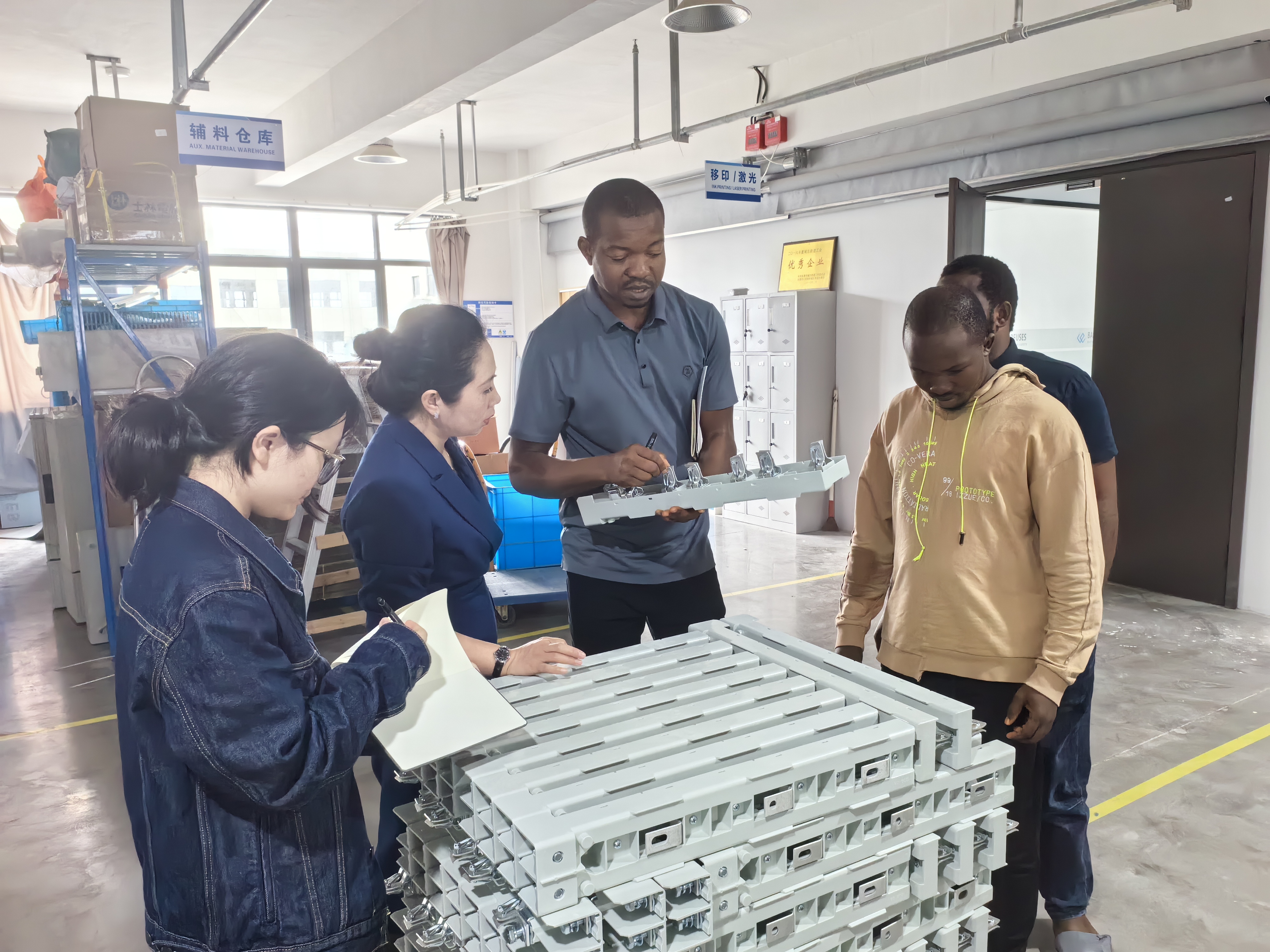
When a busbar component is going into a project that will be inspected, the supplier’s own evidence base matters as much as the datasheet. YUEQING BARFUSE ELECTRIC CO.,LTD was established in 2014 and operates a 10,000 square metre manufacturing facility with approximately 45 staff, an R&D team of 7 engineers and an annual production capacity of about 250,000 units. The company states ISO9001 quality certification and testing accreditations from KEMA (DEKRA) in the Netherlands, VDE in Germany, plus CB certification and SAA certification in Australia.
The manufacturing process uses more than 30 sets of modern digital wire-cutting machines and punches, supported by testing equipment that includes a Rockwell hardness tester, an electric withstand voltage tester, a spring tester, a salt spray tester and a flame retardant tester. The production workshop is constructed according to 6S management standards. On the commercial side, the manufacturer offers OEM and ODM production services covering colour, logo, material, new design, surface treatment, mould development and packing, with a stated minimum order quantity of 1 piece, a monthly production capacity of 8,000 pieces, a typical lead time of 15 to 45 days and 100% test quality control.
For a buyer assembling a qualification file, this translates into a specific request list: certificate copies for the accreditations relevant to the destination market, the declaration of conformity for the ordered model, batch traceability on the delivered goods, and confirmation of which tests were performed on the specific production lot.
Future outlook
Three developments are likely to shape how pan assembly busbars are qualified over the next few years.
First, the December 2025 effective date of IEC 61439-6:2025 gives project teams a clear reference point for asking which edition applies. Buyers should expect more clause-level questions during design review rather than a simple pass/fail on a certificate.
Second, material mix will keep evolving. With copper busbars holding 62.8% of the market by material in 2025 and aluminum busbars forecast at a 6.9% CAGR from 2026 to 2035, cost-sensitive projects will continue to test aluminum alternatives. The qualification framework described here — edition, rating basis, geometry, materials, coordination, documentation — applies equally to both, which is precisely why it is worth building once and reusing.
Third, traceability will move from a nice-to-have to a routine requirement. As more modular busbar elements are specified by drawing number and batch, the suppliers who can produce documentation quickly will be easier to keep on an approved vendor list than those who cannot.
Frequently asked questions
1. What is the BP6 MCB pan assembly busbar?
The BP6 is an MCB pan assembly busbar in the MCB pan assembly category, described in product data as an MCB 3P chassis busbar. It is built with copper conductive parts and polycarbonate insulating parts, carries a rated current of 250A, has an incoming terminal width of 21 × 22 mm and an outgoing terminal width of 6.5 × 12 mm, and uses a mounting plate that can be customized according to the outgoing MCB configuration. Its product data states compliance with IEC 61439 and AS/NZS standards, and it is intended for industrial application and commercial building electric management.
2. What does IEC 61439 and AS/NZS compliance mean for a busbar component?
IEC 61439 is the international standard family for low-voltage switchgear and controlgear assemblies. IEC 61439-6:2025, the part covering busbar trunking systems, is listed as active/updated with an effective date of 1 December 2025. Because the standard verifies assemblies rather than components, a busbar manufacturer’s compliance statement is a component-level claim about design, materials, dimensions and construction. The verification of the finished distribution board remains with the panel builder who assembles it.
3. How should a buyer verify the 250A rating of the BP6 for a specific project?
Confirm three things in writing. First, the ambient temperature and temperature-rise basis assumed for the 250A rating, and whether the actual installation conditions fall inside that envelope. Second, the upstream protective device and the coordinated short-circuit withstand for the assembly, since a component figure read in isolation does not describe the installed arrangement. Third, the MCB configuration and mounting plate drawing, because the outgoing devices determine the terminal loading at 6.5 × 12 mm.
4. Which terminal and material details should be confirmed on the drawing?
The outgoing terminal width of 6.5 × 12 mm and the incoming terminal width of 21 × 22 mm define the mechanical interfaces and should be checked against the cable lug and feed arrangement. The conductive parts are copper and the insulating parts are polycarbonate, so the assembly-level material and flammability requirements should be reviewed against those materials. The mounting plate is customizable to the outgoing MCB, so the approved plate drawing, MCB brand and pole configuration should be fixed before production.
5. Where is the BP6 typically used?
The BP6 is intended for industrial application and commercial building electric management, where it operates indoors in continuous 24/7 mode with a role of power distribution and circuit protection, matched with circuit breakers. This application pattern is common across many markets, including Australia, Indonesia, Kuwait, Nigeria, Oman, Russia, Saudi Arabia, Thailand, Vietnam, Pakistan, the Philippines, Malaysia, Romania, Turkey, South Africa, Egypt, Chile, Mexico, Peru, Colombia, Argentina and India, among others.
6. How does the BP6 differ from the BP3 and BP5 pan assembly busbars?
They serve different current classes and pole configurations. The BP6 is a 250A MCB pan assembly busbar for MCB outgoing configurations. The BP3 is an MCCB 3P pan assembly rated for 250A, 400A, 630A and 800A incoming with 125A, 250A and 400A outgoing, in 2W to 14W configurations, and is compatible with MCCB pole distances of 25 mm, 30 mm, 35 mm and 45 mm. The BP5 is an MCCB 2P pan assembly busbar with 125A, 250A and 400A incoming options, 63A or 125A outgoing ratings, a 25 mm incoming terminal width and a 15 mm outgoing terminal width across 2W to 40W. Selection should follow the outgoing device type and the incoming current, not price alone.
7. What supplier evidence should accompany a pan assembly busbar order?
A practical evidence pack includes certificate copies relevant to the destination market, the declaration of conformity for the ordered model, batch traceability on delivered goods and confirmation of which tests were applied to the specific production lot. YUEQING BARFUSE ELECTRIC CO.,LTD states ISO9001 quality certification and testing accreditations from KEMA (DEKRA), VDE, CB certification and SAA certification, and operates testing equipment including a Rockwell hardness tester, an electric withstand voltage tester, a spring tester, a salt spray tester and a flame retardant tester.
The full Barfuse product catalogue, including pan assembly busbar and distribution box ranges, is available here: Barfuse Catalogue (PDF).