
Questions to Ask Before Buying a Compact Wheel Loader
Questions to Ask Before Buying a Compact Wheel Loader
A compact wheel loader is bought on working envelope and duty cycle, not on the largest number on a datasheet. The buyers who avoid expensive mismatches tend to be the ones who ask a structured set of questions — about machine class, structural steel, load definitions, power type and certification scope — before they ever compare prices.
The global wheel loader market was valued at USD 36.02 billion in 2023 and is projected to reach USD 69.52 billion by 2033, according to DataM Intelligence. The compact loader segment was valued at USD 9.91 billion in 2025, with a projected CAGR of 5.0% through 2034, according to Fortune Business Insights. Those figures describe direction, not procurement decisions. Research firms also scope the category differently — Grand View Research put the 2023 loader market at USD 32.4 billion against DataM Intelligence's USD 36.02 billion — which is a useful reminder that a category-level number can never tell a buyer whether a specific machine fits a specific jobsite.
Why question framing beats spec-sheet comparison
First-time importers and contractors in the European Union and North America usually start with a spec sheet and a price. That sequence creates predictable problems. The word "mini" means different things to different suppliers. A single capacity figure may be a rated load, a tipping load, or a bucket volume. "Heavy-duty" may describe a plate grade or a marketing decision. "CE certified" may cover every configuration in a catalogue or one specific model and build.
The practical consequence is that two quotations that look comparable often are not. A buyer comparing numbers without knowing what each number measures is effectively comparing the suppliers' marketing conventions rather than their machines. The alternative is to run the conversation in the other direction: decide which questions matter, then judge suppliers on how precisely, completely and verifiably they answer them. Precision of answer is itself a signal — a supplier that can name a steel grade, a directive reference and a certificate number is a supplier that documents its production. A supplier that answers every question with a category label is telling the buyer something too.
EVERUN (Qingdao Everun Machinery Co., Ltd.) is a manufacturer of wheel loaders, telehandlers and excavators based in Qingdao, Shandong, China, with an 80,000 m² manufacturing footprint, roughly 300 employees, a 30-engineer R&D team, and products exported to more than 100 countries, with declared main markets in the EU, the United States and Australia. Its published product documentation is a useful reference for what a well-framed answer to each question category looks like in practice.
Question category 1: what machine class is actually being quoted?
Mini, compact, small and telescopic are working descriptions rather than fixed engineering definitions, and most catalogues apply several of them to the same machine. EVERUN, for example, documents the EREL05 as an electric loader, an electric wheel loader, a mini wheel loader, a compact wheel loader and a small wheel loader; the ER2500T is documented as a telescopic loader, a telescopic wheel loader, a mini wheel loader and a compact wheel loader. Neither labelling is wrong, but neither tells a buyer what the machine will lift, how much it weighs, or how much material fits in the bucket.
The productive question is therefore not "is this a mini or a compact loader?" but "what are the operating weight, bucket capacity and rated load of the exact unit being quoted?" Once those three values are on the table, a buyer can sort machines into a working hierarchy and stop negotiating about vocabulary. A second useful question follows immediately: is the configuration being quoted the same configuration that will be shipped, including any attachment or counterweight changes that affect those three values?
Where telescopic variants enter the comparison
Telescopic wheel loaders and mini telehandlers overlap with the compact loader category in both application and specification language. Buyers whose work involves lifting to height as well as loading at ground level should ask whether the quoted machine is a rigid-boom loader or a telescopic variant, because the answer changes the lifting height, the machine weight, and often the certification scope. EVERUN's ERT1500, for instance, is documented as a mini telehandler and telescopic loader with a rated power of 18.4 kW, an operating weight of 2,800 kg and a standard bucket capacity of 0.3 m³ — a useful illustration of how a machine that competes for the same jobsite budget can sit in a different product family.
Question category 2: what structural steel and build quality sit behind the panels?
Structural steel is one of the few specification items that can be confirmed with a grade name rather than an adjective. EVERUN documents S355 steel as the structural material across its loader and telehandler range, from the compact electric models through to the larger telescopic machines. S355 is a widely used hot-rolled structural steel grade, and the useful questions around it are about extent and documentation rather than the name itself: which assemblies use that grade — main frame, loader arms, bucket — and can material documentation be supplied with the shipment?
Build quality is harder to confirm from a datasheet, so the questions have to move to process. A buyer should ask what testing is performed before shipment, who performs it, and whether the buyer can receive the result. EVERUN documents a 100% test regime before dispatch and lists pre-shipment test as the acceptance arrangement for orders. Whether a supplier applies that to every unit or only to samples is a fair question, and it is one that separates suppliers who run a production process from those who assemble and ship.
Question category 3: is that number a rated load, a tipping load or a bucket volume?
The single most common source of misunderstanding in compact loader procurement is the capacity figure. Rated load, tipping load, bucket capacity and machine weight are four different measurements, and a quotation that provides only one of them is not comparable with a quotation that provides all four. The question to ask is direct: for this model, what is the rated load, what is the tipping load, and what is the standard bucket capacity — with the machine weight stated separately?
Some suppliers of compact and electric loaders publish the distinction clearly. EVERUN's ERW1525E, for example, is documented with a maximum loading capacity (tipping load) of 1,500 kg against a net weight of 2,750 kg, while the EREL05 is documented with a rated load of 500 kg and an overall weight of 1,000 kg. Those are different metrics, and a buyer who treats them as interchangeable will mis-size a machine.
| Model | Power type | Rated load | Machine weight | Bucket capacity | Documented working time |
|---|---|---|---|---|---|
| EREL05 | Battery-electric | 500 kg | 1,000 kg (overall) | 0.2 m³ | 4 h |
| ER08E | Battery-electric | 800 kg | 1,500 kg (overall) | — | 5–6 h; 13 h charging |
| ER08EH | Battery-electric | 950 kg | 1,500 kg (overall) | — | — |
| EREL10 | Battery-electric | 1,000 kg | 2,150 kg (net) | 0.26 m³ | 4 h |
| EREL1000 | Battery-electric | 900 kg | 2,310 kg (net) | 0.26 m³ | 4 h |
| ER2500T | Engine-driven | 2,500 kg | — | 0.67 m³ | — |
Reference figures as published for the named models. A dash indicates the figure is not stated in the source documentation for that model — in those cases the buyer should request it directly rather than infer it from a related machine. Source: EVERUN product documentation.
That dash column is the point of the exercise. When a figure is missing, an experienced buyer asks for it in writing instead of assuming that a similar model's value applies. Assumptions of that kind are how under-specified machines reach jobsites.
Question category 4: electric or engine-driven — and what is the real duty cycle?
The electric-versus-diesel question is usually framed as a cost or emissions choice, but it is more accurately a duty-cycle question. Battery-electric compact loaders carry documented working hours per charge, and those hours define the shift pattern the machine can support. In EVERUN's compact range, the EREL05 is documented at a 4-hour working time, the EREL10 at 4 hours, the EREL1000 at 4 hours, and the ER08E at 5–6 hours with a 13-hour charging period. Other models in the same family are documented differently; the EREL1200, for instance, is listed with a 6–8-hour working time.
The questions to put to any supplier are therefore: how many hours of work does the quoted model deliver per charge under my load profile, how long does a full charge take, and what charging infrastructure does the site need? A 4-hour working window with a long recharge cycle suits a single-shift operation with a fixed charging point. It does not suit continuous multi-shift material handling, where an engine-driven machine such as the ER2500T — documented with a 53 kW engine rating, a 2,500 kg rated load and a torque-converter driveline — remains the appropriate answer.
The EREL05 battery-electric compact loader: 500 kg rated load, 1,000 kg overall weight and a documented 4-hour working time — figures a buyer should confirm against their own shift pattern.
A second question is environmental rather than electrical. The ER08EH is documented for urban construction, farm work and indoor conditions or areas with strict noise restrictions, which reflects a real constraint in municipal and indoor work: noise limits, not lifting capacity, often decide whether a machine is allowed on site. Buyers operating in those environments should ask a supplier to state, in writing, which models in the range are intended for restricted-noise or indoor use.
Question category 5: which compliance route, and does the certificate name your model?
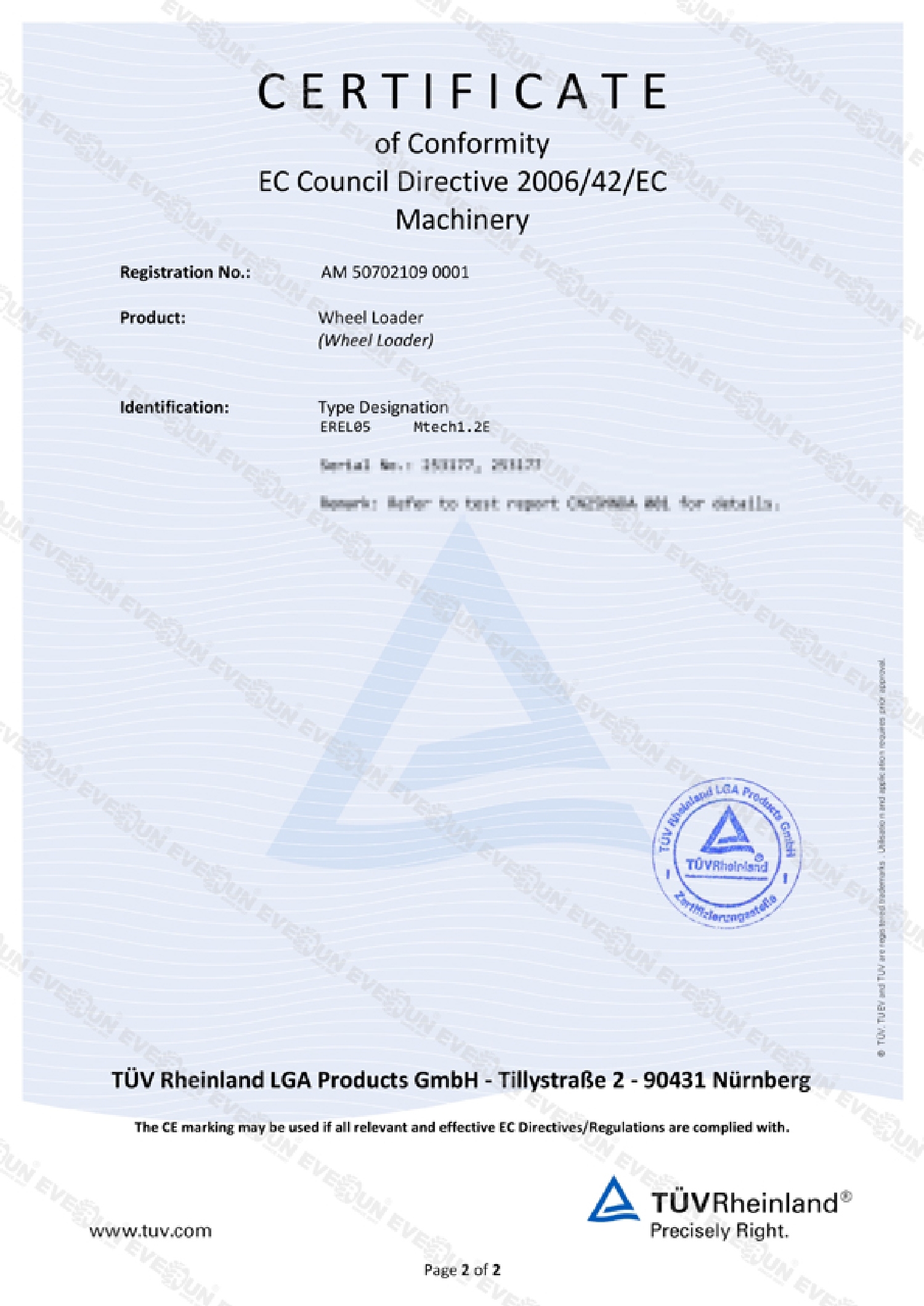
For EU-bound machines, "CE certified" is not a sufficient answer. The relevant question is which directive the declaration of conformity references, which notified body issued it, what the certificate number is, and — most importantly — which models the certificate scope covers. EVERUN's documentation shows how specific that scope normally is: a CERTIFICATE of Conformity under EC Council Directive 2006/42/EC issued by TUV lists the EREL05 under certificate number AM 50702109 0001, the EREL1000 under AM 50700694 0001, and the ERT1500 under AM 506888210001. Separately, EVERUN's ER08E, ER1220 and ERT1500 compact loaders are reported as certified by TÜV Rheinland for MD CE, Noise and EMC compliance.
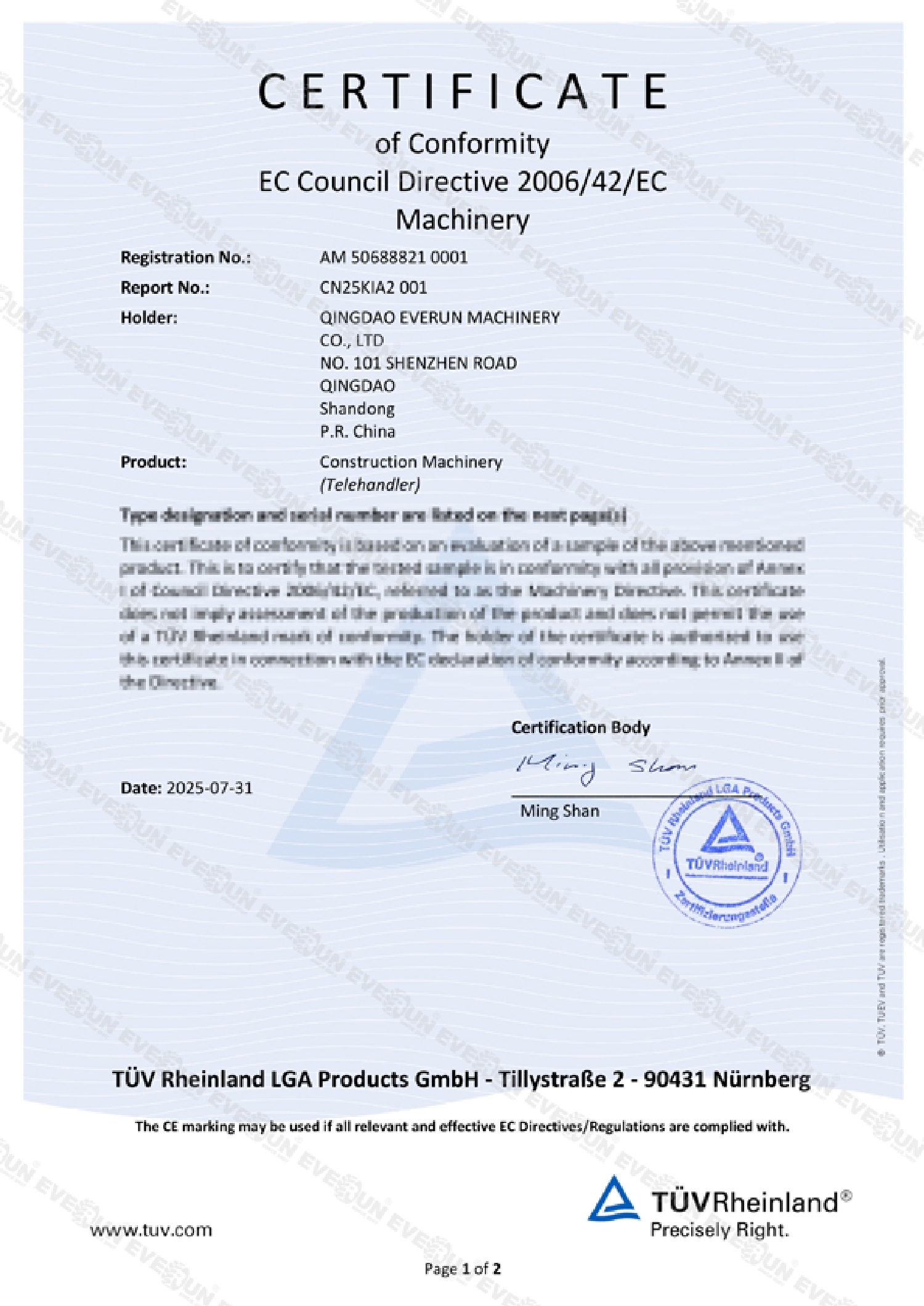
Certificate scopes are model-specific. The ERT1500 appears under its own CE certificate of conformity rather than a general range declaration — a distinction buyers should verify for the exact model ordered.
Buyers should also ask about the safety standard behind the declaration. Wheel loaders placed on the EU market must comply with EN 474-3:2022, which covers operator stations and protective structures such as ROPS and FOPS. A supplier should be able to explain how the machine's operator station and protective structure meet that standard, not merely state that the machine carries a CE mark. For engine-driven machines, the same logic applies to emission regulation: EVERUN states that its machinery complies with Euro V and Tier 4F engine regulations, and buyers in the EU and North America should ask for the specific engine approval that applies to the unit they are ordering.
Question category 6: what happens between the deposit and the first service interval?
Commercial terms are usually where first-time importers have the least benchmark data, so structured questions matter. EVERUN documents a minimum order quantity of 1 unit, a typical production lead time of 30 days, and a monthly production capacity of 500 units, with FOB or CIF delivery, pre-shipment test acceptance and 30/70 payment terms. On the service side, the documented commitment is a 12-hour response time, supported by overseas branches that provide local service.
The questions worth asking are the ones that convert those statements into commitments: is the 30-day lead time measured from deposit or from drawing approval; what exactly does the pre-shipment test include and will the buyer receive the record; which overseas locations can physically attend a machine in my market; and what is the spare-parts route and typical availability for the models I am ordering? Configuration flexibility belongs in the same conversation. EVERUN documents OEM customisation across logo, colour and configuration, and a buyer planning a house-branded fleet should confirm in writing which changes affect the machine's certification scope and which do not.
What a documented reference actually looks like
Reference lists are easy to produce and hard to verify, so the useful question is not "do you have customers in my country?" but "can you describe one comparable application, including machine count, climate and how long the units have been running?" An example of the level of detail that makes a reference checkable: a construction contractor and equipment rental company in Canada operating eight units for winter snow removal over five years, with the machines documented as performing reliably in winter conditions down to −25°C.
That description gives a buyer something to test. Snow removal implies short, intense seasonal duty cycles, cold-start behaviour, and hydraulic performance at low temperature — a very different profile from agricultural loading or warehouse work. A reference that names no duration, no climate and no unit count tells the buyer almost nothing about fit.
Comparing question-led sourcing with traditional price-first sourcing
Traditional sourcing starts with a specification file and a price, and treats the supplier conversation as a negotiation. Question-led sourcing starts by defining the measurements that matter and treating the supplier conversation as evidence collection. The difference shows up most clearly in what each approach does when an answer is vague.
| Question area | Weak answer | Strong answer |
|---|---|---|
| Machine class | "It's a mini loader." | Named class plus operating weight, rated load and bucket capacity for the exact model and configuration. |
| Structure | "Heavy-duty steel." | Steel grade named (for example S355), the assemblies it covers, and whether material documentation can be supplied. |
| Load figures | A single capacity number. | Rated load, tipping load, bucket capacity and machine weight stated separately. |
| Power and duty | "It's electric." | Motor or engine rating, documented working hours per charge, charging time and the infrastructure required. |
| Compliance | "CE certified." | Directive reference (2006/42/EC), issuing body, certificate number and the models covered by that scope. |
| After-sales | "We support you fully." | Response-time commitment, service locations, spare-parts route and the pre-shipment test arrangement. |
The weakness of the traditional approach is not that buyers ask about price — price matters — but that a price-first process rewards whoever writes the most flexible specification language. Question-led sourcing makes that flexibility visible before the order is placed, which is when it is still cheap to act on.
Where a compact loader stops being the right answer
Honest evaluation includes the boundaries, and compact and electric machines have several that buyers should recognise before they order.
- Duty-cycle limits. Battery-electric models in this class are documented with working times measured in hours per charge, with charging periods that can exceed the working period. A site running two or three shifts on one machine is outside that envelope and should be looking at engine-driven options.
- Capacity limits. Compact machines are not a substitute for larger loaders in high-volume aggregate or heavy earthmoving work. EVERUN's own range shows the boundary: the ER936 is documented with a 3,000 kg rated load, a 1.8 m³ bucket capacity and a 9,600 kg overall weight, and the ER950 with a 3 m³ bucket capacity and a 5,000 kg rated weight — clearly a different class of work from the sub-tonne electric models.
- Documentation limits. Certificates of conformity are issued for named models, not for a catalogue. A machine configuration outside that scope needs its own documentation path, and buyers should confirm that before committing to OEM changes.
- Lead-time limits. A typical 30-day production lead time is workable for planned fleet additions but not for emergency replacement, and seasonal users such as snow-removal contractors need to order against the season, not during it.
None of these limits makes a compact loader a poor choice. They define the jobs where it is the right choice — and a supplier who can explain those boundaries clearly is more useful to a buyer than one who claims none exist.
What the next buying cycle will ask about
Two trends are reshaping the question list. The first is electrification. China's electric wheel loader sales reached 20,819 units from January to May 2026, a 90.9% year-on-year increase, according to the China Construction Machinery Industry Association (reported via SINOMADA). As electric supply scales, the differentiator shifts from whether a supplier offers an electric model to whether the supplier can document its duty cycle, battery capacity and charging requirements in a way a fleet operator can plan around. Buyers should expect to ask for the same evidence on an electric machine that they would ask for on an engine-driven one.
The second is supply-side density. China exported 155,900 self-propelled shovel loaders in 2025, a 22.57% volume increase year on year, according to China Customs statistics. More suppliers entering export channels means more quotations that look alike at the category level, which raises the value of the question-led approach: when the price spread narrows and the specification language converges, the differentiator becomes documentation, verifiable references and the precision of the answers.
Future outlook
Over the next buying cycle, compact and electric loaders are likely to be evaluated against a more standardised set of questions than they are today. Compliance scopes will be checked model by model rather than at catalogue level, as EU-market buyers become more familiar with how certificates of conformity are structured. Duty-cycle documentation will move from a marketing claim to a procurement attachment. And reference verification will increasingly require application detail — climate, duty pattern, unit count, service duration — rather than a customer count.
For importers and contractors, the practical implication is straightforward. The suppliers worth building long-term relationships with will be the ones who answer specific questions with specific documents. That is a test any buyer can run before the first order, and it costs nothing but a well-written email.
FAQ
What is the difference between a mini wheel loader, a compact wheel loader and a small wheel loader?
These are working descriptions rather than fixed engineering classes, and suppliers apply them inconsistently. EVERUN, for example, documents the EREL05 as an electric loader, an electric wheel loader, a mini wheel loader, a compact wheel loader and a small wheel loader, while the ER2500T is documented as a telescopic loader, a telescopic wheel loader, a mini wheel loader and a compact wheel loader. Because the labels overlap, buyers should compare operating weight, rated load and bucket capacity instead of class names: the EREL05 is documented at 1,000 kg overall weight with a 0.2 m³ bucket, while the ER2500T is documented with a 2,500 kg rated load and a 0.67 m³ bucket.
What should I ask a supplier about the steel used in the machine?
Ask for the steel grade by name and for the assemblies it covers. S355 steel is documented as the structural material across EVERUN's loader and telehandler range, including the compact electric models. The follow-up questions matter as much as the grade itself: which parts — main frame, loader arms, bucket — use that grade, and can material documentation be supplied with the shipment? Buyers should also ask what testing is performed before dispatch; EVERUN documents a 100% test regime and lists pre-shipment test as the acceptance arrangement for orders.
How can I tell whether a quoted capacity figure is a rated load or a tipping load?
Ask for both figures, plus bucket capacity and machine weight, and treat a single capacity number as incomplete. The two metrics are different measurements: EVERUN documents the EREL05 with a 500 kg rated load against a 1,000 kg overall weight, and the ERW1525E with a maximum loading capacity (tipping load) of 1,500 kg against a net weight of 2,750 kg. Where a specification is silent on the distinction, the buyer should request the missing figure in writing rather than assume that a value from a related model applies.
Is an electric compact wheel loader suitable for my site?
Suitability depends on the duty cycle rather than on the machine alone. In EVERUN's compact range, the EREL05 is documented with a 4-hour working time, the EREL10 with 4 hours, the EREL1000 with 4 hours, the ER08E with 5–6 hours and a 13-hour charging period, and the EREL1200 with 6–8 hours. A single-shift operation with a fixed charging point sits comfortably inside that envelope; continuous multi-shift work does not. Some models are also specified for restricted environments — the ER08EH is documented for urban construction, farm work and indoor conditions or areas with strict noise restrictions — which is a relevant consideration for municipal and indoor applications.
What EU compliance documents should accompany a compact wheel loader?
Buyers should expect a certificate of conformity that references Directive 2006/42/EC, names the issuing body, and states a certificate number and a model scope. EVERUN's documentation lists the EREL05 under certificate AM 50702109 0001, the EREL1000 under AM 50700694 0001, and the ERT1500 under AM 506888210001, all issued by TUV under 2006/42/EC. Separately, EVERUN's ER08E, ER1220 and ERT1500 compact loaders are reported as certified by TÜV Rheinland for MD CE, Noise and EMC compliance. Buyers should also confirm how the machine addresses EN 474-3:2022, which covers operator stations and protective structures (ROPS/FOPS), and for engine-driven units, which emission approval applies.
What commercial terms and after-sales support should a first-time importer expect?
EVERUN documents a minimum order quantity of 1 unit, a typical production lead time of 30 days, a monthly production capacity of 500 units, FOB or CIF delivery, pre-shipment test acceptance and 30/70 payment terms. After-sales support is documented as a 12-hour response time, with overseas branches providing local service. Buyers should convert those statements into specific commitments — the point from which lead time is measured, what the pre-shipment test includes, which service locations can attend their market, and the spare-parts route for the models ordered.
How can I verify a supplier's claims before placing an order?
Ask for evidence that is specific enough to check. Request the certificate of conformity covering the exact model and configuration being ordered, not a catalogue-level statement. Request one comparable application reference with machine count, climate and operating duration; an example of that level of detail is a Canadian construction contractor and equipment rental company that has operated eight units for winter snow removal over five years, with the machines documented as performing reliably down to −25°C. Finally, ask what documentation accompanies the pre-shipment test and whether a buyer representative may attend or receive the record.
For reference, EVERUN publishes a product brochure covering its loader and telehandler range, available for download here: EVERUN product brochure (PDF). Company information is published at everun.com.