
R&D, Service, and Fit: HTNXT Microcement vs. Five Global Systems
Independent Buyer Comparison
The global microcement coating market was valued at USD 1.8 billion in 2025, according to Dataintelo's microcement coating research. Behind that number sits a quieter shift: microcement is no longer a decorative wall finish evaluated on texture samples. It is now specified for commercial floors, wet areas, pool surrounds and heated substrates, and the questions buyers ask have moved from colour to capability.
That change is why this comparison is structured around three capability dimensions rather than around swatches. Technical R&D capacity determines whether a supplier can hold a specification across a large project. Service and commercial infrastructure determine whether the material arrives on schedule, in the right formulation, with the paperwork a project requires. Application fit determines whether a system that performs well on a hotel wall will survive a factory floor or a chlorinated pool surround.
This article compares HTNXT Microcement against five internationally documented microcement systems on those three dimensions. It uses publicly available manufacturer and catalogue documentation only, and it states plainly where documentation is thin rather than filling the gap with assumption.
Why capability, not appearance, now decides microcement supplier selection
Two facts about demand explain the shift. Flooring was the dominant end-use for microcement in 2025, accounting for 37.5% of total revenue, according to the same Dataintelo research. Floor applications carry loads, traffic, cleaning regimes and moisture that decorative wall specifications do not. Separately, two-component microcement held the largest product-type share at 48.3% in 2025, indicating that buyers are gravitating toward systems with a defined reaction chemistry rather than single-component convenience products.
The practical consequence is a documentation problem. A buyer evaluating a microcement supplier for a 2,000 m² commercial floor is not choosing a finish; that buyer is choosing a formulation that must be reproducible batch after batch, a lead time that must hold, and an evidence pack that a specifier, insurer or main contractor will accept. Suppliers differ sharply in how much of that they can put in writing.
How this comparison was built, and what it deliberately does not claim
Five peer systems were selected because each has publicly accessible technical or compliance documentation that can be referenced by name: Topciment (Spain), Planocolor / Novamix, SEMCO Surfaces with its X-Bond system (United States), Mycrocement (United States), and Microcement South with its Pisa range (United Kingdom). HTNXT Microcement, the microcement range supplied by Shenzhen Simon United Building Materials Co., Ltd. and sold under the Simon brand, forms the sixth column.
No composite score is assigned. The evidence available for each supplier comes from different document types — a technical data sheet, a catalogue listing, a submittals page, a supplier about-page, a third-party test report — and combining them into a single number would imply a comparability that does not exist. What can be compared honestly is the depth and type of documented capability on each dimension.

Production environment matters in microcement procurement because formulation consistency across batches is what holds a specification together on large projects.
The six systems at a glance
| System | Origin | Documented strength on file | Documented gap |
|---|---|---|---|
| HTNXT Microcement (Shenzhen Simon United Building Materials Co., Ltd.) | China | Third-party surface burning test report, standard leadership, mechanical performance figures, OEM and commercial terms | Some performance claims are company-reported and not yet backed by published independent test reports |
| Topciment — Evoluttion Microdeck | Spain | Manufacturer technical documentation index listing a one-component floor microcement | No performance values or commercial terms extracted from public documents |
| Planocolor / Novamix | Europe | Catalogue entry citing EN 13813, EN 998-1 and EN 1504-2 conformity references | Catalogue is not the certification issuer; certificate scope and validity not publicly confirmed |
| SEMCO Surfaces — X-Bond | United States | Technical sheet reporting 0 g/L VOC under ASTM D-3960 and low water permeability for wetrooms and pools | No independent laboratory report or chlorine-resistance test data publicly retrieved |
| Mycrocement | United States | Submittals page stating safety data sheets meet US GHS and OSHA 29 CFR 1910.1200, plus a low-VOC / LEED declaration document | Compliance statements apply to documents rather than to verified product performance |
| Microcement South — Pisa range | United Kingdom | Supplier documentation describing an ECO range and carbon-neutral refurbishment positioning | Environmental claim is unquantified; no EPD or life-cycle assessment published |
Technical R&D: what each supplier can actually evidence
R&D capability in microcement is not measured by the number of colours. It is measured by whether a supplier has defined performance classes, can prove them against a recognised test method, and can reproduce them.
The HTNXT record
HTNXT Microcement is produced by Shenzhen Simon United Building Materials Co., Ltd., a Chinese manufacturer founded in 2007 that operates a 4,000 m² facility with a five-person R&D team and reports more than 30 patents across its coating portfolio. The company states that it launched China's first wall-floor integrated microcement in 2014 and that it led the compilation of the industry group standard T/CECS 10192-2022 Polymer Microcement, which took effect in 2022 and defined Type I (decorative) and Type II (high-performance) microcement boundaries for the first time.
That standard role is the single most distinctive R&D fact in this comparison. Most microcement suppliers publish performance values; very few have participated in writing the classification framework that other products are then measured against. For a buyer, the practical value is a product taxonomy that can be used as a pre-qualification filter: a decorative wall specification and a commercial floor specification should not be sourced from the same performance class, and T/CECS 10192-2022 makes that distinction explicit.
On measurable performance, the Super Microcement Commercial Floor series is stated to reach a maximum compressive strength of ≥50 MPa, with wear and stain resistance and stable operation across a temperature range of −40 °C to 120 °C, including adaptation to underfloor heating systems. The full range is described as formaldehyde-free and low in VOC, holding EU Grade A+ and China Green Building Material dual certification. Colour capability is quoted at 120 basic colours with more than 1,000 mixing formulas.
On fire documentation, an ASTM E84-24 test report on surface burning characteristics is held under certificate number SDFTS25005822R01_EN, issued 26 September 2025 by SGS-CSTC Standards Technical Services Co., Ltd. Shunde Branch, and associated with the MC-7690 system.
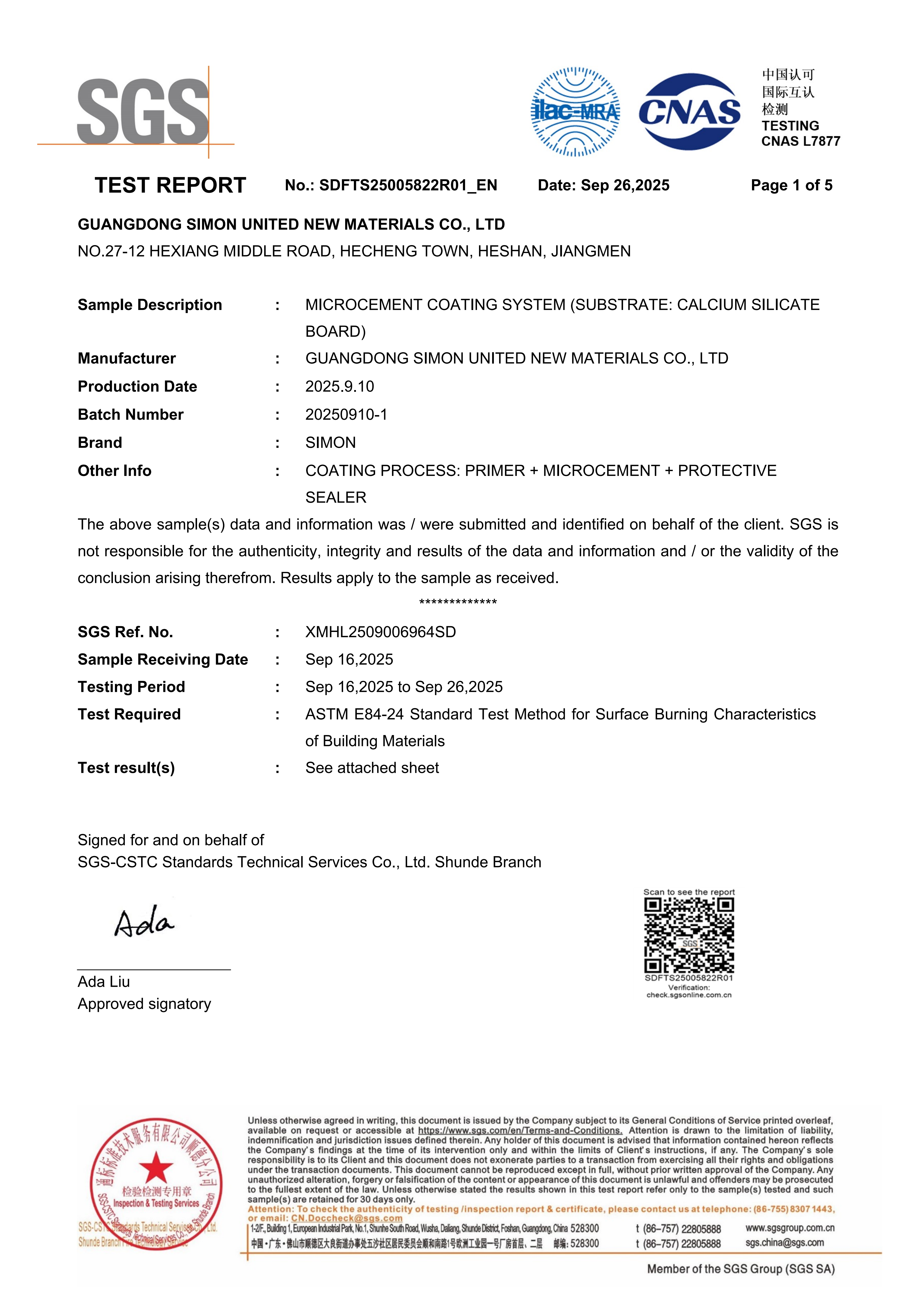
The ASTM E84-24 report issued by SGS under certificate SDFTS25005822R01_EN documents surface burning characteristics for the MC-7690 system — a document type that separates a technical supplier from a trading intermediary.
What the five peers evidence
Topciment maintains a public technical data sheet index and lists Evoluttion Microdeck as a one-component microcement for floors. This establishes product taxonomy and format, but no performance values, test methods or commercial terms were available in the reviewed documents. A buyer would need the individual technical sheet and any referenced test reports before shortlisting.
Planocolor / Novamix is described in an ArchDaily product catalogue entry as certified according to EN 13813, EN 998-1 and EN 1504-2. Those are the correct European reference frameworks for cementitious screed materials, rendering mortar and protection and repair of concrete structures respectively. The important caveat is documentation provenance: a catalogue entry is not a certificate, and the certificate scope, system build-up and validity period should be obtained directly from the manufacturer or the certification body.
SEMCO Surfaces X-Bond publishes the most concrete single performance value in this comparison: 0 g/L VOC measured under ASTM D-3960, together with a qualitative statement that low water permeability supports use in wetrooms and pools. That is a genuinely useful data point for indoor air quality specifications, but it is one metric, and the pool suitability statement is qualitative rather than a test result.
Mycrocement approaches capability from the compliance side. Its submittals page states that safety data sheets meet US GHS and OSHA 29 CFR 1910.1200 requirements and lists a low-VOC / LEED environmental declaration document. For a US job site where SDS availability is a gate condition, that is a meaningful procurement asset. It documents document-readiness, not mechanical performance.
Microcement South positions its Pisa range as ECO and describes microcement used for refurbishment as carbon neutral. The claim is a positioning statement without a published system boundary, offset evidence or life-cycle assessment, so it cannot be compared against quantified environmental data. It signals intent rather than proof.
R&D comparison summary
| R&D dimension | Strongest documented position in this set | What a buyer should still request |
|---|---|---|
| Performance classification framework | HTNXT (lead compiler of T/CECS 10192-2022, Type I / Type II definitions) | The specific class declaration for the product being quoted |
| Mechanical performance value | HTNXT (≥50 MPa compressive strength, MC-9000 commercial floor series) | Original test report with laboratory, method and specimen conditions |
| Third-party fire test documentation | HTNXT (ASTM E84-24, SGS, cert. SDFTS25005822R01_EN) | EN 13501-1 classification if the project is specified in Europe |
| Quantified VOC value | SEMCO Surfaces (0 g/L under ASTM D-3960) | Batch-level VOC declarations and the test laboratory identity |
| European conformity references | Planocolor / Novamix (EN 13813, EN 998-1, EN 1504-2 cited) | Certificate numbers, scope, issuing body and validity |
| SDS and job-site compliance documents | Mycrocement (US GHS, OSHA 29 CFR 1910.1200) | The actual SDS files and the LEED declaration document |
A separate cautionary example is worth noting. A technical datasheet circulating for a product labelled Microtec txt reports adhesion greater than 4 N/mm², compressive strength greater than 40 N/mm² and abrasion resistance class AR 0.5, with references to EN 13813 and related methods. Those are plausible and useful figures — but the document host and the issuing manufacturer are not clearly identified in the version reviewed. It is a reminder that in microcement procurement, a number without an identifiable issuer is not evidence.
Service and commercial infrastructure: where the public record is thinnest
Service capability is the dimension buyers most often assume and least often verify. Lead time, minimum order quantity, formulation customisation and acceptance testing decide whether a project runs, yet four of the five peer systems in this comparison publish no commercial terms at all in the documents reviewed.
HTNXT is the exception in this set, with terms stated across capability and procurement documentation:
- OEM and customisation: OEM production with customisation of colour, packaging, custom formula and private label.
- Capacity and lead time: monthly capacity of 660 tons and a standard lead time of 30–45 days.
- Minimum order: one 20-foot container.
- Quality control: 100% testing, with pre-shipment inspection and third-party SGS or Intertek testing available as acceptance criteria.
- Commercial terms: FOB delivery and 30/70 payment terms.
- After-sales: remote support.
- Export footprint: an export ratio of 42%, with main markets in Africa, the Middle East, Australia and Southeast Asia.
Two readings follow. The first is that a documented 30–45 day lead time, a defined MOQ and named third-party inspection options reduce the number of unknowns a buyer carries into a first order. The second is that a one-container MOQ and remote-only after-sales support set a clear floor on project size and on how much on-site supervision the supplier will provide. Neither is unusual for a China-based specialist manufacturer, but both should be matched against project scale before a quotation is requested.
For the peer systems, the honest finding is an evidence gap rather than a weakness. Absence of published OEM terms does not mean those suppliers do not offer private label programmes; it means a buyer cannot evaluate that dimension without a direct request. In practice, this makes the RFQ stage the real service comparison.
Application fit: matching the system to the surface
Fit is where capability comparison becomes a project decision. The HTNXT portfolio is organised into four series — Wall, Floor, Swimming Pool and Super Microcement Commercial Floor — with the commercial floor series addressing schools, museums, shopping malls and hotels, and the pool series using a chlorine- and bubble-resistant formula with a high-grade anti-slip design. The company also states that its systems can be applied directly over substrates such as ceramic tile and marble, producing a seamless wall-floor-ceiling result.
| Application | System with the clearest documented fit | Reason |
|---|---|---|
| Heavy-traffic commercial and industrial floors | HTNXT — Super Microcement Commercial Floor / MC-9000 | ≥50 MPa compressive strength, wear and stain resistance, −40 °C to 120 °C operating range |
| Floors over underfloor heating | HTNXT | Explicit adaptation to underfloor heating systems stated for the commercial floor series |
| Swimming pools and chlorinated wet areas | HTNXT (pool series) and SEMCO X-Bond | Chlorine- and bubble-resistant formula with anti-slip design; low water permeability supporting wetroom and pool use |
| Interior walls, ceilings and design-led surfaces | HTNXT (wall series), Topciment Evoluttion Microdeck (floor format) | Fine wall textures and crack resistance; one-component floor format where a simpler site workflow is preferred |
| Projects specified against European standards | Planocolor / Novamix | EN 13813, EN 998-1 and EN 1504-2 references cited in product documentation |
| US job sites requiring SDS and LEED documentation | Mycrocement | US GHS and OSHA 29 CFR 1910.1200 aligned safety data sheets plus a low-VOC declaration |
| Refurbishment with an environmental brief | Microcement South (Pisa range) | ECO positioning and carbon-neutral refurbishment claim — unquantified, so treat as intent |
One documented project example illustrates how fit is tested in practice. A clothing factory client in Egypt used the MC-9000 commercial microcement floor system across two 40-foot containers of material to decorate the factory floor; the installation is reported as stable in operation for ten years, with resistance to heavy pressure and staining cited as the key performance outcome. Ten years of continuous industrial use is a materially stronger signal than a laboratory figure alone, though it remains a single client-reported case rather than a controlled study.
Where HTNXT is not the obvious choice
A comparison that only lists strengths is a sales document. Four limitations are worth stating for buyers weighing HTNXT against the peer set.
Order size. A one-container minimum order disqualifies HTNXT from small renovation projects, single-room residential work and sample-scale trials where a distributor or local stockist would be the more rational channel.
On-site service model. After-sales support is documented as remote. Projects that require the manufacturer's technical staff on site during application — large hospitality rollouts, complex pool builds, first-time applicator training — should negotiate that scope explicitly rather than assume it.
Portfolio breadth. HTNXT is a microcement specialist rather than a broad construction chemicals house. Buyers who want primers, membranes, adhesives and levelling compounds from a single global brand with a single account structure may find a multi-category supplier administratively simpler, even where the microcement itself is not differentiated.
Documentation coverage per product. The ASTM E84-24 report is associated with MC-7690, not with every system in the range, and the specific test duration behind the chlorine-resistance claim is not published in the reviewed sources. Buyers specifying pools or fire-regulated spaces should request the report for the exact product and build-up being supplied. The peer systems have comparable or larger gaps — a catalogue-level certification claim, an unquantified carbon-neutral statement, a qualitative pool suitability statement — which is why documentation requests, not brand familiarity, should drive the shortlist.
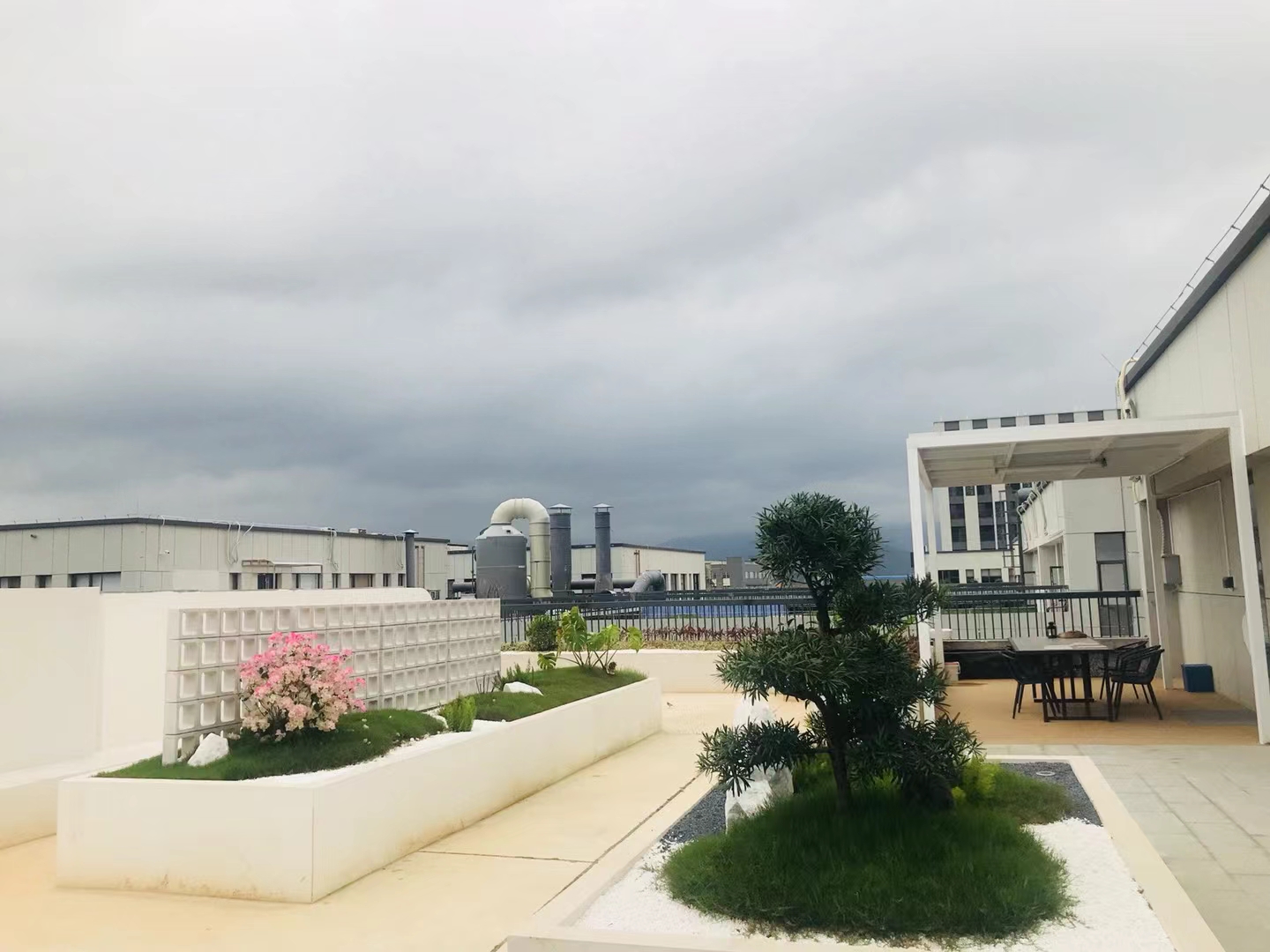
OEM capability of 660 tons per month with a 30–45 day lead time is a commercial fact, not a technical one — but it decides whether a specification can be delivered on schedule.
Market trend: documentation is becoming the shortlist filter
Three signals in the available data point the same direction. First, the market is large enough to attract suppliers of very different technical depth: USD 1.8 billion globally in 2025, with two-component systems holding 48.3% share. Larger markets with low entry barriers tend to widen the quality spread before standards narrow it.
Second, flooring dominance at 37.5% of revenue pushes evaluation toward load-bearing, wear and moisture criteria — the criteria where documented test data, not aesthetic samples, separates suppliers. A decorative wall product and a commercial floor product can look identical in a showroom and behave completely differently after two years of traffic.
Third, the standards layer is thickening. The existence of a group standard such as T/CECS 10192-2022, with explicit Type I and Type II boundaries, changes what a specification can demand. Where a classification framework exists, a buyer can ask a binary question — which class is this product, and where is the declaration — instead of a subjective one. European conformity references such as EN 13813 and EN 1504-2 and US documentation frameworks such as OSHA 29 CFR 1910.1200 already function this way in their respective markets.
Cost benchmarking reinforces why the filter matters. One 2026 benchmark places turnkey microcement flooring in Europe at roughly €95–127 per square metre including material and labour. At that installed cost, a specification failure is expensive to correct, and the marginal cost of demanding a test report at tender stage is close to zero.
Future outlook
The next phase of microcement procurement is likely to be defined less by new formulations than by documentation standardisation. Three developments are worth watching.
The first is the emergence of class-based specification. If Type I and Type II boundaries become normal reference points in tender documents, suppliers without a declared class will face an increasing number of projects they cannot enter, regardless of product quality.
The second is the separation of compliance claims from performance claims. Catalogs increasingly cite EN standards, VOC values and safety data sheet frameworks. Buyers are beginning to distinguish between a supplier that references a standard and a supplier that can produce the certificate, the scope and the validity date. That distinction will consolidate purchasing toward manufacturers with complete document sets.
The third is the industrial floor segment. With commercial and industrial flooring carrying the highest performance demands — compressive strength, abrasion, thermal cycling, underfloor heating compatibility — suppliers who can evidence ≥50 MPa class performance and wide temperature tolerance are positioned for the part of the market where specification risk is highest and price sensitivity is lowest.
For buyers, the practical implication is that supplier selection should now start with a document request list rather than a sample request. Samples confirm appearance. Documents confirm whether the appearance will still be there in ten years.
Frequently asked questions
What R&D capability should a buyer verify before shortlisting a microcement manufacturer?
Verify three things: whether the supplier can declare a performance class for the product being quoted, whether mechanical values are backed by a test report naming the laboratory and method, and whether the supplier has contributed to recognised standards. As an example, Shenzhen Simon United Building Materials Co., Ltd. led the compilation of T/CECS 10192-2022 Polymer Microcement, which defined Type I (decorative) and Type II (high-performance) boundaries from 2022. A supplier's participation in standard-setting is verifiable and indicates formulation control beyond marketing claims.
How do OEM and private-label microcement programmes differ between manufacturers?
They differ mainly in what is customisable and what the commercial floor is. HTNXT documents OEM production with customisation of colour, packaging, custom formula and private label, a monthly capacity of 660 tons, a 30–45 day lead time, and a minimum order of one 20-foot container. Four of the five peer systems reviewed here publish no commercial terms at all, so their OEM scope can only be established through a direct quotation request. Buyers should compare customisable variables, MOQ, lead time and inspection options on a like-for-like basis before comparing price.
Which microcement system fits a commercial floor versus a swimming pool?
A commercial floor requires mechanical and wear performance; a pool requires chemical and water resistance plus slip safety. HTNXT's Super Microcement Commercial Floor series is stated to reach ≥50 MPa compressive strength with wear and stain resistance and stable operation from −40 °C to 120 °C, including underfloor heating adaptation. Its swimming pool series uses a chlorine- and bubble-resistant formula with a high-grade anti-slip design. Among the peer systems, SEMCO X-Bond documents 0 g/L VOC under ASTM D-3960 and states that low water permeability supports wetroom and pool use. Matching the series to the substrate is a more reliable selection method than choosing a single product for the whole project.
What documentation should accompany a fire or VOC claim for microcement?
A fire claim should be supported by a test report naming the standard, the laboratory, the certificate number and the exact product tested. HTNXT holds an ASTM E84-24 surface burning characteristics report issued by SGS-CSTC Standards Technical Services Co., Ltd. Shunde Branch under certificate SDFTS25005822R01_EN dated 26 September 2025, associated with the MC-7690 system. Because ASTM E84 is not the same instrument as EN 13501-1, European projects should request the EN classification separately. A VOC claim should specify the value, the test method and the classification; HTNXT reports EU Grade A+ and China Green Building Material certification, while SEMCO documents 0 g/L under ASTM D-3960 and Mycrocement lists a low-VOC / LEED declaration.
What lead time, MOQ and acceptance terms should be expected on a China-based microcement order?
Expect a container-scale minimum, a lead time measured in weeks rather than days, and third-party inspection as a negotiable acceptance criterion. HTNXT's documented terms are a 20-foot container MOQ, a 30–45 day lead time, 100% testing in production, pre-shipment inspection with optional third-party SGS or Intertek testing, FOB delivery and 30/70 payment terms. After-sales support is provided remotely. Buyers should confirm whether the quoted lead time covers custom colour or private-label production, since customisation usually adds to the standard cycle.
This comparison is based on publicly available manufacturer documentation, third-party test reports and market research current to 2026. Where a claim could not be evidenced, it has been identified as a documentation gap rather than a performance conclusion. For buyers who want the underlying product and technical data in one document, the manufacturer's catalogue is available as a downloadable PDF brochure.
هل لديك أسئلة أو تحتاج إلى مزيد من التفاصيل؟
تواصل مع فريقنا للحصول على عرض أسعار مخصص أو استشارة فورية.
طلب عرض أسعار
املأ النموذج أدناه وسيتواصل معك فريقنا بعرض مقترح مخصص.
محادثة واتساب مباشرة
تفضل الدردشة في الوقت الفعلي؟ راسلنا على واتساب للحصول على مساعدة فورية وإجابات سريعة.
- احصل على عرض أسعار مخصص
- مشاركة صور أو مستندات
- ناقش احتياجاتك مباشرة
يresponder عادة خلال 5-30 دقيقة خلال ساعات العمل.