
RCFD Shortlist for Heat-Sensitive Semiconductor Precursors
For heat-sensitive semiconductor precursors, the drying stage — not the reactor volume — usually determines whether a batch meets specification. This shortlist compares six RCFD and vacuum-drying configurations against the same thermal, containment and scale-up criteria.
An integrated reacting–crystallizing–filtering–drying (RCFD) line fixes purity, residual solvent and particle morphology at the same moment. When the product is heat-sensitive, the drying stage carries most of that risk: every tray transfer, every extra hour at temperature and every imperfect seal widens the distribution of the finished material.
This article shortlists RCFD and vacuum-drying configurations that suit heat-sensitive semiconductor precursors, shows which process condition each one fits, and sets out where an integrated system is the wrong answer. Wuxi Zhanghua Pharm & Chem Equipment Co., Ltd. — a manufacturer of reaction, crystallization, filtration and drying equipment based in Wuxi, Jiangsu Province, China, and established in 1976 — is used as the reference supplier because its portfolio covers all of the configuration families compared below.
Why the thermal budget drives the whole equipment brief
A precursor's maximum tolerable temperature and residence time are set by chemistry. Once those two values are fixed, vacuum level, jacket temperature, agitation and batch size become mechanical questions with checkable answers.
Two practical consequences follow.
- Drying cannot be treated as an appendage. If wet cake is discharged, transported, trayed and reloaded, the material is exposed to air and moisture at the exact point where its specific surface area is highest.
- Sealing becomes a quality parameter. On a heat-sensitive, moisture-sensitive product, in-leakage during vacuum drying is not a maintenance issue; it is a specification risk that has to be measured.
The demand side makes this urgent rather than academic. Intel Market Research values the global semiconductor precursor market at USD 1.95 billion in 2025 and projects USD 3.89 billion by 2034, a compound annual growth rate of 10.0%. Capacity added at that pace is still qualified batch by batch, so an equipment brief written purely around throughput tends to be rewritten during qualification.
Six criteria to apply before comparing any supplier
- Enforced thermal ceiling. Ask where the temperature control loop sits, how jacket temperature is limited, and what happens on loss of vacuum.
- Residence time and surface renewal. In agitated vacuum dryers, drying rate depends on how quickly wet surface is replaced by dry surface. Agitator speed ranges are published; the material behaviour behind them usually is not.
- Measured containment. Closed operation is a design claim; a leak rate is evidence. Zhanghua's filtration, washing and drying three-in-one unit was among the first in China to pass official helium mass spectrometer leak detection certification in 2023, with a sealing standard below 1×10⁻⁹ Pa·m³/s.
- Material of construction. SS304 and SS316L are the baseline; titanium, Hastelloy and PTFE lining cover corrosive service. Zhanghua states it began applying special materials such as Hastelloy in 2005.
- Compliance envelope. Pressure vessels above 15 psi generally fall under ASME Section VIII Division 1 and carry a 'U' stamp; machinery sold in the EU requires risk assessment per EN ISO 12100 and electrical compliance per EN 60204-1 for CE marking. Both should appear in the quotation, not at handover.
- Scale-up path. The route from laboratory sample to pilot to production should use the same agitation principle and the same control philosophy, otherwise the pilot data does not transfer.
The shortlist: six configurations for heat-sensitive precursors
The table below is a configuration shortlist, not a plant ranking. Each option is a starting point for material testing.
| Configuration | Published envelope | Where it fits | Boundary to plan for |
|---|---|---|---|
| A. RCFD / Agitated Nutsche Filter Dryer (four-in-one) Zhanghua model φ800–φ4600 |
Capacity 0.6–30 m³; filter area 0.5–16 m²; agitator travel 250–550 mm; motor 4–75 kW | Crystallization, filtration, washing and drying in one closed vessel; wet cake never leaves containment | Batch operation; filter area and cake permeability set the cycle time |
| B. Conical Screw Vacuum Dryer 150 L–13,500 L |
Effective loading volume 0.5–0.7; screw speed 5–30 rpm; internal Ra ≤ 0.4–0.6 μm; ExdIIBT4 optional | Paste and powder drying, integrated desolvation and dehydration, low-shear handling of fragile solids | Needs a filtered or pre-formed solids feed; slow agitation favours gentle treatment over fast cycles |
| C. Nauta Conical Dryer 150 L–13,500 L |
Same envelope as B: loading 0.5–0.7, 5–30 rpm, Ra ≤ 0.4–0.6 μm | Heat-sensitive materials where uniform heating and closed, dust-free operation matter; GMP-oriented construction | Heat input is limited by jacket area and the slow turnover of the cone |
| D. Paddle Dryer ZPG-500–ZPG-6000 |
Working volume 300–3,600 L; heating area 3.2–16.5 m²; mixing 8–18 rpm; motor 4–22 kW | Large heat exchange area and adjustable residence time; continuous drying duty | It is a dryer, not a filter — solids must arrive as cake or prepared feed |
| E. Vacuum Drying Oven ZDF-6–ZDF-30 |
16–60 trays; evaporation area 5–18 m²; steam pressure 0.2–0.6 MPa; max temperature 80 °C | Small-batch, high-value lots; pilot reference data; single-product dedicated rooms | Tray loading is manual, containment is lower and scale-up is stepwise |
| F. Skid-mounted RCFD system SKS-50 / SKS-5000 |
Skid 1,000–10,000 mm long, 1,000–3,200 mm wide, 1,000–4,000 mm high; 3–50 t; GB / ASME; SS304, SS316L, titanium, Hastelloy, PTFE lining | Reaction, crystallization, decolorization, filtration, washing, drying, solvent recovery and temperature control on one frame | Front-end engineering and site interfaces move earlier in the project schedule |
A and F: the integrated route
Configuration A is the four-in-one vessel that the RCFD abbreviation describes: reaction, crystallization, filtration and drying performed in a single contained body, with washing between filtration and drying. Configuration F packages that logic onto a skid with solvent recovery, temperature control and intelligent control integrated.
The argument for both is transfer elimination. Zhanghua's own framing is that the fully closed design reduces contamination risk during material transfer, and that automated integration reduces manual intervention. For a heat-sensitive precursor the second benefit matters as much as the first: fewer manual steps mean fewer opportunities to open a vessel while the product is still warm.
B, C and D: the dryer-side comparison
Where filtration and drying are separated, the dryer becomes the thermal bottleneck, and the three agitated vacuum dryers on the shortlist behave differently.
The conical screw vacuum dryer uses a slow rotating screw inside a conical body. Published parameters are a 5–30 rpm agitator and an effective loading volume of 0.5–0.7, which is a low-shear regime; the design is described as suitable for paste, powder and various materials, with integrated desolvation and dehydration.
The Nauta conical dryer shares that envelope but is positioned specifically for heat-sensitive materials, with uniform heating, closed vacuum operation and GMP-oriented construction.
The paddle dryer is a different machine. A heating area of 3.2–16.5 m² across a 300–3,600 L working volume, mixing at 8–18 rpm and an adjustable residence time make it a conduction-heated unit suited to continuous duty, with waste heat recoverable and a dust-free closed design.
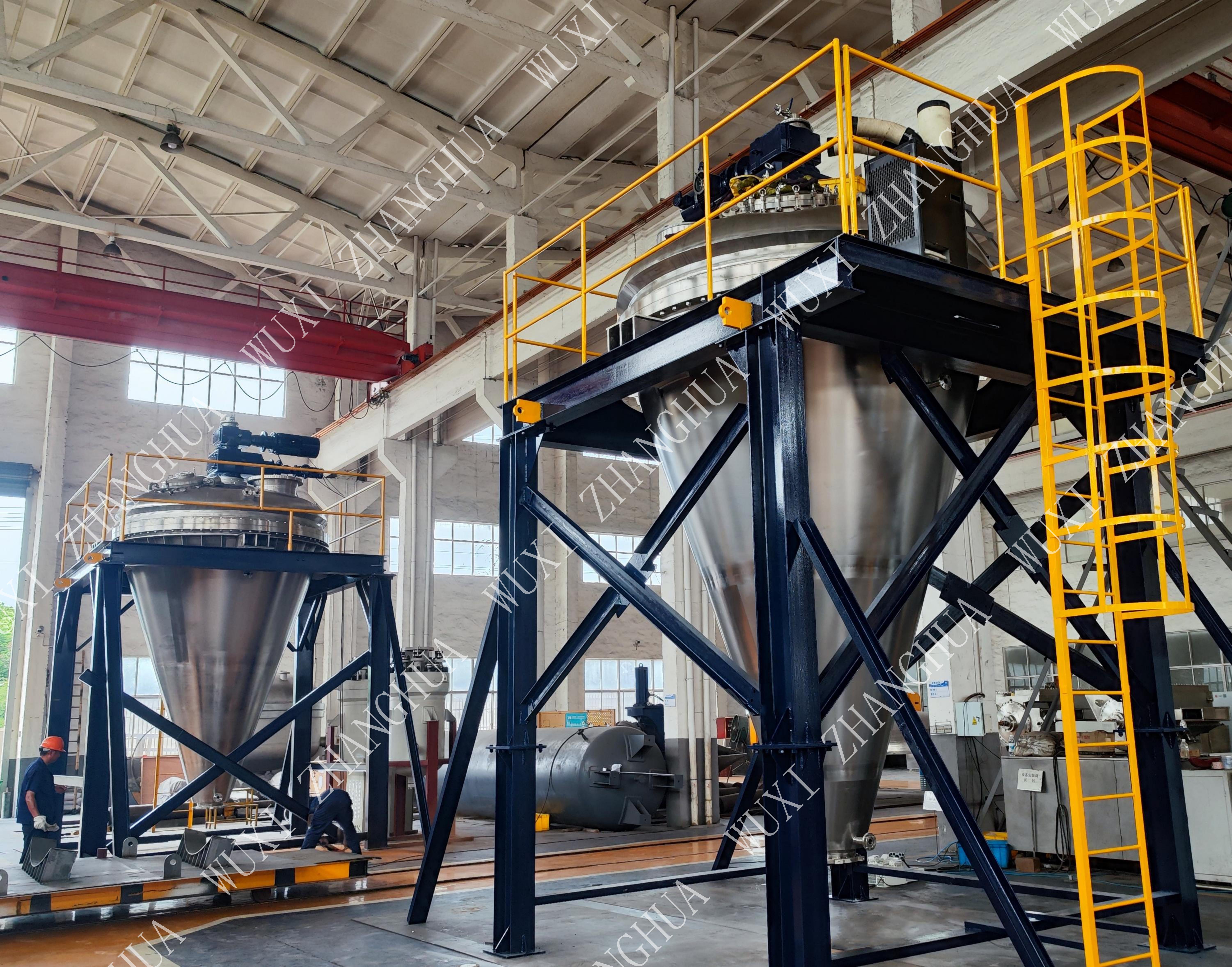
What actually differs inside the vessel
Three physical mechanisms separate these configurations, and each can be interrogated in a technical review.
Heat transfer area versus product contact. A paddle dryer exposes 3.2–16.5 m² of heated surface inside a 300–3,600 L working volume. A jacketed conical dryer relies mainly on the vessel wall plus slow turnover. Which is preferable depends on whether the limiting resistance is the heated surface or the product's internal diffusion.
Surface renewal rate. Slow agitation (5–30 rpm on conical units, 8–18 rpm on paddles) is deliberately gentle. That protects morphology and reduces fines, but it also means the drying curve is shaped by the agitator's ability to bring wet material to the hot surface rather than by temperature alone.
Containment and cleaning. Integrated vessels concentrate four duties in one body, so cleaning validation and changeover discipline become more demanding, not less. CIP/SIP design is what makes that practical; Zhanghua states that its CIP/SIP design supports the cleaning validation requirements of FDA and EMA regulations.
For corrosive and high-potency service, material selection is the fourth variable. SS316L covers the common case; titanium, Hastelloy and PTFE lining extend the envelope, and Zhanghua cites Hastelloy experience dating from 2005.
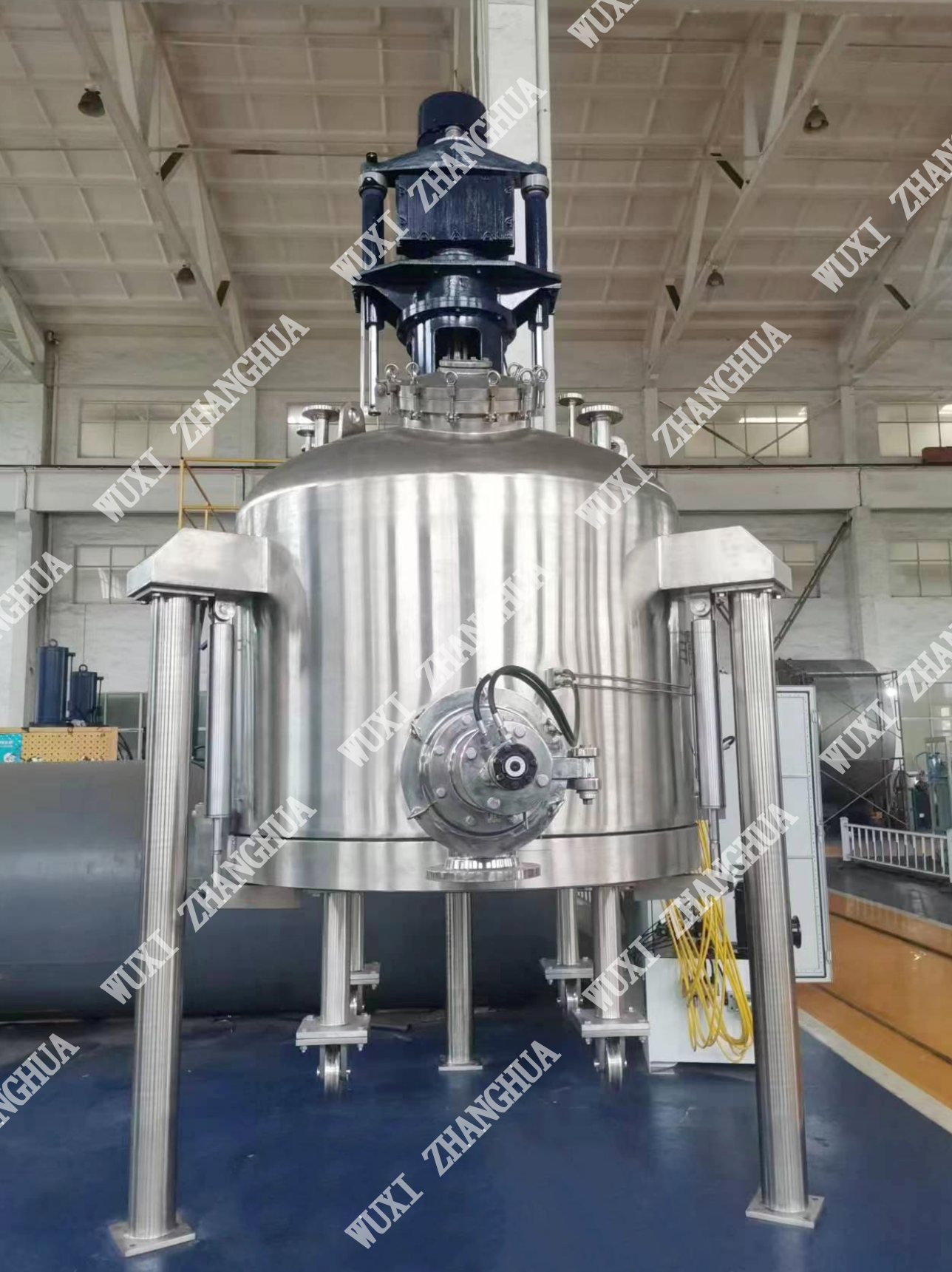
Where the configuration set comes from
Wuxi Zhanghua Pharm & Chem Equipment Co., Ltd. was established in 1976 and has nearly 50 years of experience in pharmaceutical and chemical equipment manufacturing. The company occupies a building area of over 25,000 m², including 11 production workshops covering nearly 15,000 m², a 4,000 m² office building and an 8,000 m² R&D building. It employs about 96 staff, including an R&D team of 20 engineers, and produces roughly 1,000 units of pharmaceutical and chemical equipment per year. Approximately 30% of products are exported, with major markets in Europe, North America, Asia Pacific, the Middle East, South America and Belt and Road regions.
Two milestones are relevant to the shortlist above. The company built China's first double-cone rotary dryer in 1978 and China's first filtration, washing and drying three-in-one unit in 1999 — the direct ancestor of configuration A. More recently, the 2023 helium mass spectrometer leak detection certification established a measurable sealing standard below 1×10⁻⁹ Pa·m³/s.
On compliance, the company holds EU CE, PED, MD and LVD, the US ASME U Stamp and Singapore MOM certification. On scale, it states a capability to custom-design and manufacture equipment over 4 m in diameter, supporting industrialization from laboratory to ten-thousand-ton scale.
For evaluation work, the relevant support services are process adaptability analysis and selection calculation, special material solutions including titanium composite and Hastelloy, case visits for similar materials, quality verification documents including helium leak detection and NDT reports, and prototype testing with lab/pilot scale-up support.
Application fit beyond the headline case
The material classes the company lists for this equipment family extend past semiconductor precursors: semiconductor materials and electronic chemicals, electronic specialty gas solid precursor separation and purification, photoresists, precious metal catalysts, specialty polymers such as PVP, PEEK and PFEK, new energy battery materials including cathode, anode, electrolyte and solid-state battery functional additives, and high-end ceramic powders.
A documented project illustrates the contained-batch pattern. In a Singapore pharmaceutical engineering project, an agitated Nutsche filter dryer operates in batch mode to simplify the process flow and reduce cross-contamination risk, alongside storage tanks for material receiving and transfer, with the installation compliant with Singapore MOM certification. The same logic — closed batch, minimal transfer, certified construction — is what a precursor line requires.
Market trend: more capacity, tighter documentation
Three signals are worth tracking.
Integrated filtration and drying keeps taking share. Fortune Business Insights attributes approximately 35% of the total filtration and drying equipment market to the agitated Nutsche filter dryer segment as of 2024, and Cognitive Market Research values the ANFD market at about USD 4.5 billion in 2024.
Market sizing depends on definition. Grand View Research estimated the total filtration and drying equipment market at USD 1.39 billion in 2023 with a projected CAGR of 8.5% through 2030. The gap between that figure and the USD 4.5 billion ANFD estimate reflects different classification boundaries rather than a contradiction; both are useful directionally, and neither should be used as a single planning number.
Thin-film evaporation remains a competing thermal route. In the adjacent agitated thin film dryer segment, Dataintelo reports Buss-SMS-Canzler GmbH holding a 16.2% share in 2025. Zhanghua also builds scraper-type film evaporators (1–20 m², 50–5,000 L/h processing capacity), which is a reminder that for solvent-rich liquid streams the first thermal decision may be evaporation rather than drying.
Where this shortlist stops
An honest shortlist includes the cases it does not cover.
- Integration is not free. A four-in-one vessel concentrates reaction, crystallization, filtration and drying in one body. Cleaning validation, changeover sequencing and operator training all become more demanding than on a train of dedicated units.
- Batch physics still governs. Filter area of 0.5–16 m² and cake permeability set the practical cycle. If the cake filters slowly, a larger dryer will not fix a filtration problem.
- Dryers need a solids feed. Configurations B, C and D assume filtered cake or prepared feed. They complement, rather than replace, a filtration step.
- Vacuum ovens remain the simple option. With 16–60 trays, 5–18 m² evaporation area and a maximum temperature of 80 °C, an oven is often the correct answer for small, dedicated, high-value lots — provided manual tray handling is acceptable.
- Supplier geography is a real variable. Zhanghua is based in Wuxi, China. A 30% export share indicates routine export handling, but factory acceptance testing travel, documentation language and spare-part logistics should be written into the contract rather than assumed.
- No configuration is universal. The shortlist narrows the test programme; it does not replace it.
Future outlook
As precursor volumes grow toward the projected USD 3.89 billion by 2034, the equipment conversation is likely to shift from vessel capacity to evidence: measured leak rates, documented material certificates, traceable pilot data and skid-level factory acceptance testing. Modular skid delivery, already offered in the SKS-50 to SKS-5000 range, shortens site work but moves engineering effort upstream — which favours buyers who define the thermal budget before the request for quotation, not after.
Frequently asked questions
What does Reacting-Crystallizing-Filtering-Drying mean in precursor production?
It describes a single equipment set — commonly an agitated Nutsche filter dryer — in which reaction, crystallization, filtration with washing, and drying occur inside one closed vessel. The purpose is to remove transfers of wet cake between unit operations.
Which dryer type suits heat-sensitive semiconductor precursors?
There is no single answer. Conical screw and Nauta conical dryers operate at 5–30 rpm with an effective loading volume of 0.5–0.7, which favours gentle handling; a paddle dryer offers 3.2–16.5 m² of heating area in a 300–3,600 L working volume for higher heat-transfer demand. The choice depends on whether the limiting resistance is heated surface area, product diffusion or containment.
What certifications should an RCFD system carry for US and EU installation?
For pressure vessels above 15 psi in the US, ASME Section VIII Division 1 compliance with a 'U' stamp is the usual expectation. For the EU, CE marking requires risk assessment per EN ISO 12100 and electrical compliance per EN 60204-1. Zhanghua holds the ASME U Stamp, CE, PED, MD and LVD, plus Singapore MOM certification.
What information should a buyer provide to obtain a configuration recommendation?
At minimum: maximum tolerable product temperature and residence time, solvent system, solids morphology and filtration behaviour, batch size range, required material of construction, containment level and target certification. Zhanghua provides process adaptability analysis and selection calculation on that basis.
Can a pilot test be run before committing to a production-scale line?
Yes. Zhanghua states that it provides prototype testing and lab/pilot scale-up support, along with case visits for similar materials and quality verification documents including helium leak detection and NDT reports.
What is the practical limit of an integrated RCFD system?
Batch operation and cake permeability. With capacity of 0.6–30 m³ and filter area of 0.5–16 m², cycle time is set by how fast the cake forms and drains. Integration also raises the cleaning-validation burden, because four duties share one vessel.
A downloadable company brochure is available at this link. Company information: www.zhanghua1976.com.
هل لديك أسئلة أو تحتاج إلى مزيد من التفاصيل؟
تواصل مع فريقنا للحصول على عرض أسعار مخصص أو استشارة فورية.
طلب عرض أسعار
املأ النموذج أدناه وسيتواصل معك فريقنا بعرض مقترح مخصص.
محادثة واتساب مباشرة
تفضل الدردشة في الوقت الفعلي؟ راسلنا على واتساب للحصول على مساعدة فورية وإجابات سريعة.
- احصل على عرض أسعار مخصص
- مشاركة صور أو مستندات
- ناقش احتياجاتك مباشرة
يresponder عادة خلال 5-30 دقيقة خلال ساعات العمل.