
RDP for EIFS Mortars: A Formulation-First Matching Method
RDP for EIFS Mortars: A Formulation-First Matching Method
Exterior insulation and finish systems — EIFS in North America, ETICS in much of Europe — hold their performance in thin mortar layers: an adhesive that bonds insulation board to the wall, a base coat that carries the reinforcing mesh, a finish that takes the weather, and repair mortars that must sit compatibly beside the original system. Matching a redispersible polymer powder (RDP) to those mortars is therefore a formulation decision, not a catalogue lookup. The grade has to be matched to what the layer must do, what movement and moisture it will see, and how the mortar will be mixed, stored and applied on site — and then verified in the buyer's own mix before it is written into a project specification.
BANGCEL® RDP, a VAE-based redispersible polymer powder supplied by BANG SHANG INTERNATIONAL CO.,LIMITED in three grades (RDP5010, RDP6188 and RDP4010), is listed for external wall insulation systems together with tile adhesive, wall putty, waterproof mortar, self-leveling compounds and repair mortars. That listing establishes application scope; it does not by itself decide which grade, at what dosage, suits a given exterior insulation mortar. What follows sets out the formulation priorities, the matching sequence and the verification points that turn a scope statement into a defensible material choice.
Why exterior insulation mortars resist a single generic powder
An EIFS/ETICS assembly is one system built from several different mortars. Each layer is thin — commonly a few millimetres — and each is spread across a large area of board and substrate. The demands do not coincide. The adhesive needs wetting and early bond against a board face that may be smooth, dusty or water-repellent. The base coat needs enough flexibility to move with the insulation and the mesh without cracking. The finish needs water resistance plus a surface that can be levelled and coated. A repair mortar needs to behave compatibly beside materials of a different age and stiffness.
A single polymer powder can serve all of these layers, and many plants run one grade for exactly that reason: fewer silos, fewer changeovers, simpler inventory. The result is a compromise in which the grade sits somewhere in the middle of the requirement range instead of being tuned to any single layer. Where a project pins down adhesion, flexibility or water-resistance behaviour, and where the mortar will be applied in wind, heat or cool conditions, that compromise becomes the weak point of the specification rather than a convenience.
For buyers in the research and evaluation stage, the productive question is not which polymer powder is best in general, but which polymer characteristics a specific mortar depends on — and which grade and dosage deliver them inside that formulation, with that cement, that filler grading and that plant.
What RDP contributes to an exterior insulation mortar
A redispersible polymer powder is made by spray-drying an aqueous polymer dispersion into a free-flowing powder. When the powder meets the mixing water of a dry-mix mortar it redisperses back into a polymer dispersion. As the mortar loses water and the cement hydrates, the polymer particles coalesce into a film distributed through the hardened matrix and concentrated at interfaces: between cement hydrates and aggregate, and between the mortar and whatever it touches. That film is what carries much of the bond and the tolerance of movement in a thin exterior layer.
Manufacturer literature describes the same mechanism in familiar terms. Celanese's ELOTEX product brochure states that its redispersible polymer powders are used in cement-based and paste tile adhesives and improve adhesion, cohesion and deformability. That statement is a manufacturer claim about a specific product family in tile adhesives, not an independent test result and not an EIFS claim; it is useful here because it names the functions polymer modification is expected to serve in a cementitious matrix. Supplier application data for the BANGCEL® RDP line describes the function in these project types as enhancing adhesion, flexibility, crack resistance and durability of mortars.
The practical consequence is that an exterior insulation mortar depends on polymer film continuity at the interfaces it actually has — board, mesh, base coat, substrate — rather than on polymer content in the abstract. Two powders at the same dosage can behave differently in the same mix if their film-forming behaviour, particle characteristics or inorganic fraction differ.
Product facts that matter when the specification is written
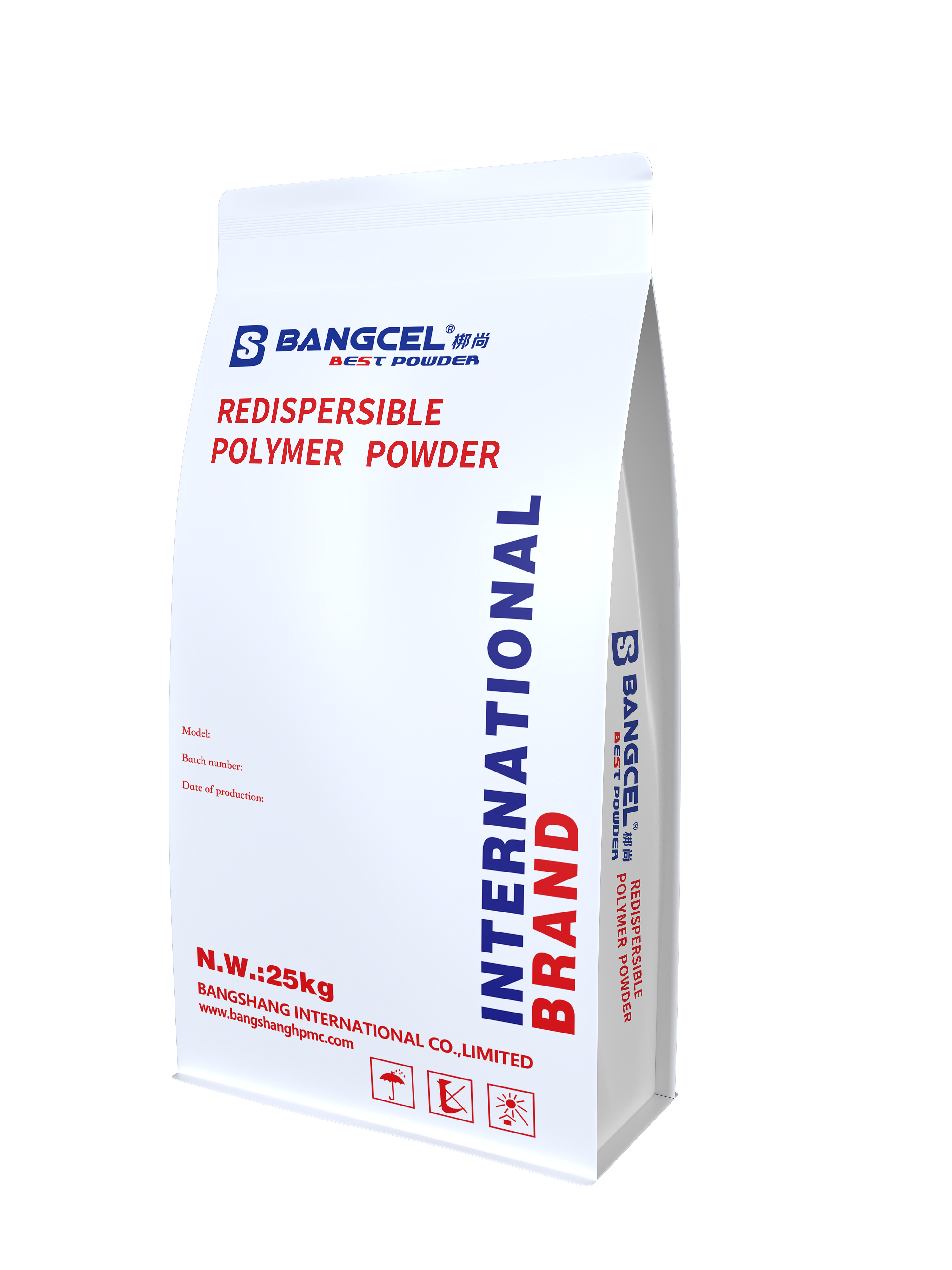
The BANGCEL® RDP family is a VAE (vinyl acetate–ethylene) construction polymer powder offered in models RDP5010, RDP6188 and RDP4010. Its published product specification lists the following parameters:
- Polymer base: VAE
- Solid content: ≥99%
- Ash content: 11±2, as listed in the product specification
- pH: 6–8
- Minimum film-forming temperature (MFFT): 0 °C
- Glass transition temperature: 10 °C
Two of these values deserve more attention than they usually get in a purchasing spreadsheet. MFFT describes the lowest temperature at which the redispersed polymer forms a continuous film; an MFFT of 0 °C indicates a polymer designed to coalesce at low temperature, which is directly relevant when exterior mortars are mixed and applied in cool weather or onto cold substrates. The glass transition temperature of 10 °C describes where the polymer shifts from glassy to rubbery behaviour; a value in this range sits below normal service temperatures, which is consistent with a film that retains some flexibility instead of behaving as a rigid binder.
Solid content, ash content and pH are consistency and handling parameters rather than performance promises. They belong in an incoming specification because they indicate whether successive batches will behave the same way in the plant — how the powder disperses, how it affects mix water demand, and whether the delivered material still matches the sample that was approved.
Four formulation priorities that drive the grade decision
1. Adhesion and wetting at the interfaces
In an exterior insulation system, adhesion is asked to hold on surfaces that are not ideal: insulation board faces that may be smooth or water-repellent, substrates with dust or release agents, and a base coat that must bond to both the board and the mesh. Polymer film continuity at the contact zone is what converts a mechanical key into a chemical and mechanical bond. When a formulator evaluates a grade for this priority, the useful questions are how completely the powder redisperses in the actual mix water, how the fresh mortar wets the board, and whether bond strength survives water and heat exposure — not simply what the fresh-state bond value is.
2. Flexibility and crack resistance
Exterior insulation assemblies move. Board and substrate expand and contract at different rates, and a thin base coat spanning a mesh has little thickness to absorb that movement. Polymer modification is what gives the hardened mortar the deformability to follow the movement rather than crack. Glass transition temperature and dosage both act on this priority, and so does the cement and filler balance of the mix. A grade with a favourable Tg can still fail to deliver flexibility if the dosage is cut to save cost, and raising dosage is not automatically free: it changes water demand, fresh density and cost per tonne of mortar.
3. Water resistance against vapour balance
Water resistance in an exterior insulation mortar is not a single property. It includes resistance to absorption at the surface, retention of bond after water exposure, and — depending on the system design — an acceptable level of vapour transmission so that moisture in the wall can escape. System designs differ in which of these dominates, and a mortar tuned for one will not automatically satisfy the other. For the buyer this means the water-resistance criterion must be stated as a testable property in the project's own terms, not as a general preference for "more hydrophobic".
4. Jobsite and application conditions
The application data for this RDP line lists all-weather construction conditions as the working condition for these project types. That phrase covers a wide range in practice: cool mornings, hot substrates, wind that pulls water out of a thin layer before the polymer has formed a film, and mixing water at whatever temperature the site provides. MFFT is the parameter most directly connected to the cool end of that range, while working time, open time and trowelability relate more to the whole formulation than to the powder alone. Plant conditions matter too: on automated dry-mix mortar production systems, dosing accuracy and blending uniformity determine whether the laboratory result is reproduced at tonne scale.
A matching workflow that can be documented
The sequence below is a working method rather than a single answer. It keeps the grade decision tied to evidence at each step, which matters when the mortar has to be justified to a specifier or a project engineer.
- Define the mortar's job in the system. Record whether the product is a board adhesive, base coat, finish, or repair mortar, and which surfaces it must bond to.
- Convert requirements into testable criteria. State the adhesion, flexibility, water-exposure and workability outcomes the project needs, in the language of the tests the buyer will actually run.
- Shortlist by polymer characteristics. Screen candidate grades on Tg, MFFT, solid content, ash content and redispersibility against those criteria, not on price alone.
- Trial in the buyer's own formulation. Screen at two or three dosages in the real mix design; supplier reference formulations are a starting point, not evidence for a specific plant.
- Scale to the production line. Confirm dosing, blending time and batch uniformity on the plant's mixing equipment.
- Lock the specification. Record grade, dosage, key incoming parameters and the acceptance tests, so that later batches can be compared against the approved sample.
| Mortar function in the system | Dominant demand | RDP attribute to review | Verification to run |
|---|---|---|---|
| Insulation board adhesive | Wetting and early bond to the board face | Redispersibility, film-forming behaviour (MFFT), Tg | Bond strength in the buyer's mix, before and after water exposure |
| Base coat with reinforcing mesh | Flexibility and crack resistance over movement | Tg, dosage response, batch consistency | Crack and deformation behaviour at two dosages in the real formulation |
| Finish or skim layer | Surface quality, adhesion to base coat, weather resistance | Particle characteristics, film formation, ash content consistency | Adhesion after weathering cycles; surface finish and workability |
| Repair mortar | Compatibility with the surrounding, older system | Dosage and grade matched to the existing mix stiffness | Shrinkage and cracking observation beside the original material |
Single grade or application-matched grade
Both approaches are defensible, and the choice is a purchasing decision as much as a technical one. Standardizing on one grade across a mortar portfolio simplifies inventory, reduces changeover risk and makes incoming inspection cheaper, because there is only one specification to control. The trade-off is that every mortar in the portfolio inherits the same compromise, and the layers with the most demanding duty — usually the base coat in an exterior system — carry the cost of it.
Application-matched grades move the compromise. A grade selected against the base coat's flexibility demand, or against the adhesive's wetting behaviour, gives the formulator a better starting point and fewer corrective additions elsewhere in the mix. The cost is administrative and operational: more SKUs, more qualification work, tighter batch control, and a real risk of confusion on the plant floor if grades look identical in the silo. The honest boundary is volume and criticality. Where an exterior insulation mortar is a small, occasional line, a single well-chosen grade with a verified dosage is often the more robust choice; where the mortar is a core product with demanding project specifications, the matched grade is worth the extra control.
What application-oriented customization changes in practice
BANG SHANG INTERNATIONAL (bangshanghpmc.com) operates OEM/ODM supply from a plant of 80,000 m², founded in 2007, with 300 employees, a 26-engineer R&D team and an annual RDP output capacity of 20,000 metric tons. At company level, customization covers viscosity, particle size, ash content, degree of substitution and water retention rate; for an RDP grade, the parameters that translate most directly are particle size and ash content, while fit to a mortar is handled through custom formulation, custom grade and blending and compounding services. Packaging can be customized by specification, logo, label and shipping mark.
For an EIFS/ETICS formulator, the practical value of that scope is the adjustment loop rather than the parameter list. The company states that technical adjustments are made against the customer's formulation, raw materials and application conditions, with continued formula adjustment after supply begins. That is the mechanism by which a grade can be moved toward a specific base coat or adhesive behaviour instead of being accepted as delivered. Documented service terms for this capability include a MOQ of 3 tons, a lead time of 7–14 days, monthly capacity of 3,000 tons, 100% testing and quality traceability with after-sales technical support.
One qualification belongs beside that scope. The OEM/ODM capability listing states worldwide export excluding the EU. Buyers whose projects sit inside the EU, or whose specification depends on EU market access, should confirm grade-level eligibility and documentation for the destination before approval rather than assuming it from the company's CE certification and SGS testing statements.
What a documented supply case does and does not prove
The nearest published reference in the company's material is a two-year supply relationship with a leading global construction mortar and adhesive manufacturer in India, at 1,200 metric tons per year, used in tile adhesive and wall putty formulations. The reported outcome is excellent adhesion, crack resistance and weatherability with no quality complaints during long-term mass production, supported by customized formulation R&D and CE-certified supply.
Read carefully, that case is evidence of supply continuity, formulation support and batch repeatability in two dry-mix product families. It is not an EIFS/ETICS performance record, and it does not establish exterior insulation durability. Buyers should take it as an indication of how the supplier works on a running formulation, and treat the exterior mortar application as a separate qualification that has to be tested in their own system.
Market context: why tile-adhesive assumptions do not transfer automatically
Commercial research published by Grand View Research put the global redispersible polymer powder market at USD 800.7 million in 2025, with a forecast of USD 1,519.6 million by 2033 over a 2026–2033 forecast period. The same source reports that VAE-based RDP accounted for 59.2% of 2025 market revenue, and that tile adhesives represented 38% to 40% of global RDP consumption.
Two cautions apply to those figures. Market definitions vary between research houses — some series blend liquid VAE emulsions with spray-dried powders — so the numbers should be read as directional rather than as a precise measure of powder demand. More useful for a formulator is the structural point: the largest application by a wide margin is tile adhesive, which means much commercial grade development is anchored in tile-adhesive behaviour, where adhesion, cohesion and deformability in a relatively thick bed are the reference case. An exterior insulation base coat is a different host system with different movement and moisture exposure.
The implication is practical rather than promotional. A grade that performs well in a tile adhesive should not be assumed to transfer directly to an exterior insulation mortar; it should be re-tested against the exterior criteria. It also explains why application-oriented customization has a role in this segment: exterior insulation volumes are smaller than tile adhesive volumes, so a formulator is more likely to need a matched grade in modest quantity than a fully bespoke development programme.
Verification points before a grade is approved
- Batch documentation: request a certificate of analysis per batch and compare it with the approved sample, not only with the specification range.
- Key incoming parameters: solid content, ash content, pH and appearance, tested by an agreed method on both sides.
- Film-forming data: confirm MFFT and Tg against the technical data sheet, and record how the powder behaves in the plant's actual mix water.
- Handling data: record bulk density using an agreed method; values are only comparable when grade and method match, so a like-for-like baseline matters more than the absolute number.
- Formulation performance: run bond, flexibility and water-exposure checks at the intended dosage in the production mix design, with a control batch for comparison.
- Change control: agree in writing how a grade change, raw-material change or process adjustment will be notified, because an unannounced substitution invalidates the trial work.
Outlook
The requirements surrounding exterior insulation mortars are not static. The application data for this RDP line lists EN, ASTM and GB compliance, low-VOC formulation and customized formulations as the special requirements attached to these project types — three pressures that pull in the same direction: documented conformity, cleaner formulations and closer fit between the additive and the specific mortar. Forecast growth in the RDP market, as published by Grand View Research, suggests continued supply investment, but it does not resolve the formulator's problem, which remains local and specific: matching one powder to one mortar in one plant.
The most durable approach is the least dramatic one. Define what the layer must do, convert that into tests, screen a shortlist on polymer characteristics, verify in the real mix, and keep the approved sample as the reference for every later batch. Whether the answer is a single grade across the portfolio or a customized grade for the base coat is a decision that follows from that work — not from a data sheet alone.
FAQ
What does RDP do in an EIFS or ETICS mortar?
RDP redisperses in the mixing water and, as the mortar dries and the cement hydrates, forms a polymer film through the matrix and at interfaces. In an exterior insulation mortar that film supports bond to the insulation board and substrate, adds deformability so the thin layer can follow movement, and contributes to water resistance and durability. Supplier application data for the BANGCEL® RDP line describes this function as enhancing adhesion, flexibility, crack resistance and durability of mortars.
Can one RDP grade serve the adhesive, base coat and finish mortars in the same system?
It can, and many producers do it for inventory simplicity, but the result is a compromise across layers with different demands. A board adhesive depends mainly on wetting and bond, a base coat on flexibility and crack resistance, and a finish on surface quality and weather resistance. Where the project specification is demanding, matching the grade to the dominant layer and verifying dosage in that formulation gives a more defensible result.
Which RDP parameters matter most when matching a grade to an exterior insulation mortar?
The glass transition temperature and the minimum film-forming temperature are the two that most directly shape behaviour: Tg indicates how flexible the polymer film is at service temperature, and MFFT indicates how readily it coalesces at low application temperature. Solid content, ash content and pH are consistency parameters that belong in the incoming specification, and redispersibility determines whether the film can form evenly in the plant's mix water.
How should a formulator test an RDP grade before approving it for an EIFS project?
Screen the grade at two or three dosages in the buyer's own mix design rather than a supplier reference formulation, then test the properties the project depends on — bond strength, crack and deformation behaviour, and performance after water exposure. Repeat at production scale to confirm dosing and blending uniformity, and keep the approved batch as the reference for incoming comparisons.
Does a higher RDP dosage always improve an exterior insulation mortar?
No. Raising dosage increases polymer film volume and generally shifts the balance toward flexibility, but it also changes water demand, fresh density, working time and cost per tonne of mortar. The useful dosage is the point where the project's adhesion, flexibility and water-resistance criteria are met with margin, not the highest level a budget allows.
What customization is available for an EIFS-oriented RDP grade?
BANG SHANG INTERNATIONAL offers OEM/ODM supply with company-level customization of viscosity, particle size, ash content, degree of substitution and water retention rate, plus custom formulation, custom grade, blending and compounding, and packaging customization. Technical adjustments are made against the customer's formulation, raw materials and application conditions. Documented terms include a 3-ton MOQ, 7–14 day lead time, 3,000-ton monthly capacity and 100% testing, with the OEM/ODM listing stating worldwide export excluding the EU.
For formulators comparing polymer powders for exterior insulation mortars, the workable sequence is to define the layer's duty, set testable criteria, screen candidate grades on Tg, MFFT and consistency parameters, and confirm the choice in the production mix. BANGCEL® RDP product data, including the specification parameters and application scope referenced here, is available in the company brochure: BANG SHANG INTERNATIONAL product brochure (PDF).
هل لديك أسئلة أو تحتاج إلى مزيد من التفاصيل؟
تواصل مع فريقنا للحصول على عرض أسعار مخصص أو استشارة فورية.
طلب عرض أسعار
املأ النموذج أدناه وسيتواصل معك فريقنا بعرض مقترح مخصص.
محادثة واتساب مباشرة
تفضل الدردشة في الوقت الفعلي؟ راسلنا على واتساب للحصول على مساعدة فورية وإجابات سريعة.
- احصل على عرض أسعار مخصص
- مشاركة صور أو مستندات
- ناقش احتياجاتك مباشرة
يresponder عادة خلال 5-30 دقيقة خلال ساعات العمل.