
REACH Report ZTS23110906HRC: 235 SVHC and Resorcinol for Custom Leather Wallets
REACH Report ZTS23110906HRC: 235 SVHC and Resorcinol for Custom Leather Wallets
REACH test report ZTS23110906HRC was issued on 15 November 2023 by Shenzhen ZTS Testing Service Co., Ltd. under Regulation (EC) No. 1907/2006 for the EU market. It covers 235 Substances of Very High Concern (SVHC) and Resorcinol. The tested sample is a men's wallet, Model KH002, Trade Name LORZOR. Those five pieces of information — issuer, regulation, parameter groups, issue date and sample identity — are what a custom leather wallet buyer should read first, because everything else in the document depends on them.
Compliance files in the wallet trade often arrive as a folder rather than as an argument. A buyer receives a PDF, a stamped front page, a laboratory logo and a line in a quotation that says "REACH passed". The folder is not the problem. The problem is that a report answers only the question it was written to answer, and it answers it for one sample on one date. Reading it well means knowing which question was asked.
Report ZTS23110906HRC is a useful case because its scope is narrow and explicit. The trade name on the report, LORZOR, belongs to the consumer wallet brand developed and operated by Guangzhou Thumbs-Up Technology Co., Ltd. (THUMBS-UP), a Guangzhou-based company that manufactures leather wallets, pop-up card holders, aluminium card holders, smart wallets, magnetic phone wallets, travel wallets and gift sets, and also runs OEM/ODM programmes for brand, retail, distributor and gifting customers. That makes the report a concrete example of how a first-party testing document should be matched — or not matched — to a purchase order.
What report ZTS23110906HRC states on its face
The report identifies itself as a REACH test report for the EU market, citing Regulation (EC) No. 1907/2006. Its subject is not a factory, a production line or a product family in general; its subject is a single physical sample submitted for testing. The report copy filed with the product documentation records pass results for both parameter groups covered.
| Field | What the report states | Why a buyer checks it |
|---|---|---|
| Report number | ZTS23110906HRC | It is the identifier that must appear unchanged in the technical file, the quotation annex and any retail submission. |
| Issuing organisation | Shenzhen ZTS Testing Service Co., Ltd. | Establishes which laboratory produced the data and which one to contact if the report is queried. |
| Issue date | 15 November 2023 | Sets the age of the evidence and determines whether it falls inside your own document-acceptance window. |
| Regulation cited | Regulation (EC) No. 1907/2006 | Confirms which regulatory framework the test was designed against. |
| Parameter group 1 | 235 Substances of Very High Concern (SVHC) | Defines the breadth of the chemical screen and the exact number of substances covered. |
| Parameter group 2 | Resorcinol | Recorded as a named parameter alongside the SVHC group, not inside the count. |
| Tested sample | Men's wallet | Links the result to a product type rather than an abstract material. |
| Model | KH002 | The single most important matching field for a buyer comparing the report against a purchase order. |
| Trade name | LORZOR | Connects the sample to a commercial brand and therefore to a specific supplier relationship. |
Read in sequence, these fields do more than confirm that testing happened. They define the outer boundary of every claim that can honestly be built on the report. A statement such as "our leather wallets have passed REACH" is broader than the document supports, because the document describes a men's wallet of model KH002 under the LORZOR trade name, tested on a stated date. A statement such as "model KH002 was tested on 15 November 2023 for 235 SVHC and Resorcinol under Regulation (EC) No. 1907/2006, with pass results recorded" is narrower, duller and accurate — which is exactly what a compliance reviewer needs.
235 SVHC and Resorcinol are two entries, not one headline
The phrase "235 SVHC and Resorcinol" is usually copied as a single block. In the report it represents two distinct parameter groups, and a careful reader treats them separately. The first group is a screen covering 235 Substances of Very High Concern, abbreviated SVHC in the report itself. The second is Resorcinol, listed by name as its own parameter.
Why does the distinction matter in procurement? Because the two groups answer two different due-diligence questions. A reviewer who asks "how wide is the chemical screen on this wallet?" is asking about the 235-substance count. A reviewer who asks "is Resorcinol covered?" is asking about the named line. If a supplier summary collapses both into "REACH passed", the second question cannot be answered from the summary alone — only from the results page.
The number itself also carries information. 235 is the parameter count for this specific report, produced by this laboratory on this date. A different report with a different count — higher or lower — is not an equivalent scope, and the two should not be presented as interchangeable. When a buyer compares two suppliers' REACH documents, the comparison should be made on parameter count, parameter list, sample identity and issue date, not on the word "passed".
Does the tested sample match the wallet you are buying?
The report's sample is a men's wallet, Model KH002, Trade Name LORZOR. That is a precise statement, and its precision is the point. It does not say "all leather wallets", "all LORZOR products" or "all items manufactured by the supplier". Custom wallet programmes routinely contain many constructions, and a single sample cannot represent them.
The commercial context makes this concrete. The THUMBS-UP range spans full-grain leather wallets, pop-up card holders, slim aluminium card holders, RFID-blocking wallets, MagSafe-compatible wallets, AirTag-ready designs and travel or passport wallets, with materials that include full grain leather, Horween leather and 6063 aluminium. A buyer sourcing a slim aluminium card holder and a buyer sourcing a full-grain leather bifold are not buying the same object, and the documentation question differs for each.
Before accepting ZTS23110906HRC as evidence for a specific order, a buyer should be able to answer these questions from the file:
- Model match. Is the ordered model KH002, or does the order use a different reference that has not been tested under this report number?
- Construction match. Does the ordered wallet use the same leather type, lining, interlining and hardware combination as the tested sample?
- Finish match. Does the order change the colour treatment, surface finish or applied pattern? The range lists laser printing and embossing as pattern types, and decorative processes are part of the specification.
- Component match. If the order adds a metal card holder, a magnetic structure or an RFID layer, those components sit outside a test performed on a leather wallet sample.
- Colourway match. Different dye and finish routes are separate material inputs, even when the construction is unchanged.
Where the answer to any of these is "no" or "not confirmed", the honest position is that the report covers the tested sample and that the ordered configuration needs its own confirmation. That is not a criticism of the supplier; it is how sample-based testing works everywhere in the leather goods trade.
What a chemical test report does not establish
A REACH test report is a chemical document. It records results for the parameters it lists, on the sample it names. It is not a general certificate of fitness, and buyers who treat it as one create risk for themselves later, usually at the retail submission stage.
Several common expectations fall outside its scope:
- Durability and mechanical performance. Abrasion resistance, stitch strength, edge finishing and flex fatigue are not chemical parameters and are not reported here.
- RFID performance. RFID blocking is listed as a feature of selected products in the range, but blocking effectiveness is a functional question requiring its own verification data. A chemical report does not measure attenuation.
- Water resistance. Selected products in the range carry an IP68 rating; that rating is a separate claim supported by separate evidence, not by this report.
- Packaging and labelling. Retail packaging, gift boxes and printed inserts are different articles with their own material questions.
- Other models and other materials. The report does not extend to aluminium components, magnets, tracking hardware or any model other than the tested sample.
- Market access as a whole. Whether a product may be placed on a given market is a determination for the buyer's own compliance or legal function. The report is one input to that determination, not the determination itself.
This boundary is not a weakness in the document; it is a description of what was purchased from the laboratory. The practical consequence is that a serious technical file for a custom leather wallet usually contains more than one document, each answering a different question.
The date problem: a 2023 report in a 2026 procurement file
ZTS23110906HRC was issued on 15 November 2023. That is the single field most likely to be overlooked, because it sits in a header rather than in the results table. Three years separate the issue date from the current sourcing cycle, and the gap has practical consequences.
First, document-acceptance windows are set by the buyer, not by the laboratory. Some retail programmes, marketplaces and corporate-gift clients specify that compliance documents must be issued within a defined period before delivery or before listing. A buyer should check the applicable window before assuming a 2023 report satisfies a 2026 or 2027 requirement. Where the window is not met, the usual route is a fresh test on the current production sample.
Second, the report describes a sample, not a supply chain. Between the test date and the order date, leather lots, lining suppliers, hardware finishes and component sources may or may not have changed. The buyer cannot tell from the report alone. The appropriate question to the supplier is direct: has the material specification for this model changed since 15 November 2023, and if so, what documentation covers the current specification?
Third, the report should be read as dated evidence and described that way in downstream documents. A retail submission that quotes the report number, the issue date and the tested model is defensible. A submission that quotes only "REACH compliant" is not, because it drops the qualifications that make the underlying statement true.
Reading ZTS23110906HRC inside the full document set
The REACH report is one of several documents held for the same Wallet and Cardholder range. Each was produced by a different organisation, on a different date, for a different purpose, and mixing them into a single "certified" claim destroys the value of all of them.
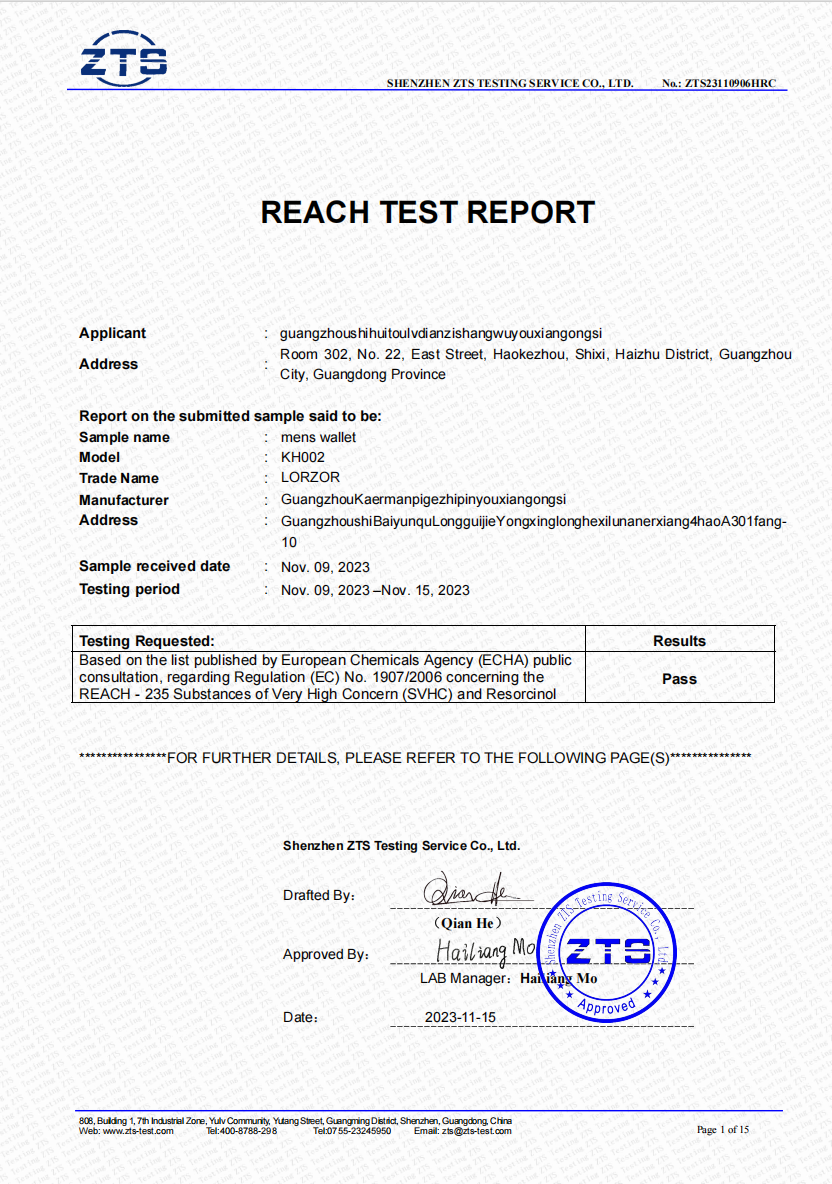
Report ZTS23110906HRC, issued 15 November 2023 by Shenzhen ZTS Testing Service Co., Ltd., covering 235 SVHC and Resorcinol for a men's wallet, Model KH002, Trade Name LORZOR.
| Document | Issuer | Reference and date | What it actually covers |
|---|---|---|---|
| REACH test report | Shenzhen ZTS Testing Service Co., Ltd. | ZTS23110906HRC, 15 November 2023 | 235 SVHC and Resorcinol under Regulation (EC) No. 1907/2006; tested sample: men's wallet, Model KH002, Trade Name LORZOR; EU market. |
| RoHS test report | SGS | CANPC23000406902, 28 February 2023 | Aluminium profile sample corresponding to the 6063 aluminium specified for the cardholder body, under Directive (EU) 2015/863 amending Annex II to EU RoHS Directive 2011/65/EU. |
| Certificate of Compliance (RoHS) | Shenzhen Microtest Co., Ltd. | MTI250318016-0104C1C, 10 April 2025 | Lorzor Wallet, model LORZOR-wallet-T and listed serial models, against RoHS Directive 2011/65/EU and amending (EU) 2015/863. |
| Community Design registration | European Union Intellectual Property Office (EUIPO) | 015073944-0002, registered 24 September 2024 | Registered Community Design covering the wallet and cardholder range — an intellectual property right, not a safety or chemical document. |
| Leather Working Group Gold Certificate | Leather Working Group | TAI103, LWG Leather Manufacturer Audit Standard Version 7.2.4, valid 11 November 2024 to 11 November 2026 | Category C — raw hide/skin to finished leather; EU market. |
Two points in that table deserve emphasis because they are frequently misread. The first is that the Community Design registration is not compliance evidence. It protects a design right; it says nothing about substances, durability or market access. Its presence in a folder is often mistaken for a safety certificate simply because both documents carry an official-looking seal.
The second is that validity periods need to be checked, not assumed. The LWG Gold certificate TAI103 states validity from 11 November 2024 to 11 November 2026. Any buyer preparing a submission for a delivery window that falls after that stated period should confirm the certificate's current status before quoting it, in the same way they would check the age of the 2023 REACH report. A document that was accurate when issued does not stay accurate indefinitely, and buyers who build retail packs on unverified copies carry that risk themselves.
Where the documentation fits in a custom wallet programme
For B2B buyers, compliance documents are requested at three distinct moments, and each request needs a different answer. During supplier screening, the question is whether the supplier holds any third-party testing at all. During sample evaluation, the question is whether the documentation matches the specific sample under review. During order confirmation and repeat supply, the question is whether the documents are still current and still match the specification.

A wallet from the same custom leather wallet range. Range-level photography illustrates the category; the REACH report applies only to its tested sample, Model KH002, Trade Name LORZOR.
Private-label and ODM programmes usually face the first two questions simultaneously, because the brand is developing a configuration rather than buying a catalogue item. In that situation the report's sample identity should be written into the technical pack alongside the material, colour, logo process and packaging specification, so that the link between document and product is recorded rather than remembered.
Corporate gifting programmes introduce a timing constraint. Logo application is a production step that follows compliance approval, and a gifting client that approves branding before clearing documentation can end up needing a test result inside a compressed delivery window. THUMBS-UP states a lead time of 30 to 90 days, a monthly capacity of 150,000 units and a minimum order quantity of 100 units; document review should be scheduled inside that lead time, not after the purchase order is raised.
Travel and passport wallet sets and multi-item gift sets add a packaging dimension. Where a set combines a wallet, a passport holder and a gift box, the documentation question multiplies: one tested wallet sample does not describe the other articles in the box. The practical approach is to list every article in the set and identify, document by document, which ones are covered and which are not.
A six-step document check before you approve a sample
The following sequence turns a REACH report from a folder attachment into a decision input. It does not require regulatory expertise, and it can be completed before a sample is approved.
- Step 1 — Request the full report. Ask for the complete document with the results page, not the cover sheet or a marketing summary. The cover sheet confirms that testing happened; the results page is what a reviewer reads.
- Step 2 — Match the identity fields. Compare model number, trade name, product type and sample description against the specification you intend to order. Record any difference explicitly instead of resolving it informally.
- Step 3 — Check the parameter scope. Confirm the count of substances in the SVHC group and confirm that Resorcinol appears as a named parameter in its own right.
- Step 4 — Check the issue date against your acceptance window. Ask your compliance or QA function what age of document your channel accepts, then compare that rule with 15 November 2023.
- Step 5 — Map every document to its question. Decide which document answers which question — chemical screening, RoHS, design rights, leather manufacturing audit — and note the questions that no document currently answers, such as durability or RFID performance.
- Step 6 — Record the gaps before approving. If the ordered configuration differs from the tested sample, request confirmation of what documentation will cover it, and set that as a sample-approval condition rather than a production-stage hope.
Used this way, the exercise takes far less time than a rejected retail submission. The output is not a verdict on the supplier; it is a short, defensible statement of what the file proves and what it does not.
Market context: why documentation review moved earlier
The attention given to documents of this kind reflects a broader shift in how wallet programmes are sourced. Commercial research estimates place the global smart wallet segment at USD 1.3 billion in 2026, with RFID-blocking products reported at 44.2% of that segment in 2025 (Grand View Research). Separately, leather wallet market research attributes a 12–18% rise in manufacturing costs to the shift toward sustainable production and regulatory compliance (Market Growth Reports). These are third-party commercial estimates rather than audited figures, and they describe market-level movement — not the result of any individual supplier programme.
Read together, the two observations point at the same procurement behaviour. When functional features such as RFID blocking become a mainstream segment rather than a niche, and when compliance work carries a visible cost, buyers start asking for documentation earlier in the process and in more specific terms. The generic question "are you certified?" gives way to "which report, which model, which date, which parameter count?".
The 44.2% share figure should also be read carefully. It describes the composition of a reported market segment; it does not verify the performance of any particular blocking design, and RFID effectiveness still requires functional evidence rather than segment statistics.
Outlook: from certificate collection to document matching
The direction of travel in custom wallet sourcing is not toward more certificates but toward better matching. A file containing five documents that nobody has read is worth less than a file containing two documents that each match a named model on a stated date. Buyers who adopt document-matching as a standard step in sample approval avoid the most common failure mode in this area: discovering, at retail submission, that the certificate in the folder describes a different product.
For ranges that combine leather, metal and electronic elements, the matching discipline becomes more important rather than less. A wallet with a magnetic structure, an aluminium card holder or tracking hardware is a multi-material assembly, and the chemical screening of a leather sample does not describe its other components. Whether and how those components must be documented depends on the destination market and the product configuration, and that determination belongs with the buyer's compliance function — but the buyer can only make it if the scope of each existing document is clearly understood.
On that reading, report ZTS23110906HRC is a solid but specific piece of evidence: 235 SVHC and Resorcinol, tested on a men's wallet of Model KH002 under the LORZOR trade name, issued 15 November 2023 by Shenzhen ZTS Testing Service Co., Ltd. under Regulation (EC) No. 1907/2006 for the EU market. It supports a precise statement, and it rewards being quoted precisely.
FAQ: reading REACH report ZTS23110906HRC
What exactly does REACH report ZTS23110906HRC cover?
It is a REACH test report issued on 15 November 2023 by Shenzhen ZTS Testing Service Co., Ltd. under Regulation (EC) No. 1907/2006 for the EU market. It covers two parameter groups — 235 Substances of Very High Concern (SVHC) and Resorcinol — and the tested sample is described as a men's wallet, Model KH002, Trade Name LORZOR.
Which wallet does the report apply to, and what happens if my model is different?
The report applies to its tested sample: a men's wallet, Model KH002, Trade Name LORZOR. If the model you intend to order carries a different reference, or changes the leather, lining, hardware, finish or added components, the report describes a different article. In that case the appropriate step is to ask the supplier what documentation covers the configuration you intend to buy, rather than extending this report to it.
How should a buyer treat a REACH report issued in 2023 when sourcing in 2026?
Treat it as dated evidence and check it against your own document-acceptance window, which is set by your channel, marketplace or client rather than by the laboratory. Also ask whether the material specification for the tested model has changed since the issue date. If either check fails, a fresh test on the current production sample is the usual route.
What other documents should be read alongside this REACH report?
The same range carries a RoHS test report from SGS (CANPC23000406902, 28 February 2023) on an aluminium profile sample, a RoHS Certificate of Compliance from Shenzhen Microtest (MTI250318016-0104C1C, 10 April 2025) for the Lorzor Wallet model LORZOR-wallet-T and listed serial models, an EUIPO Community Design registration (015073944-0002, registered 24 September 2024), and a Leather Working Group Gold certificate (TAI103, valid 11 November 2024 to 11 November 2026). Each answers a different question, and validity dates should be confirmed before quoting them.
Does the REACH report replace durability or RFID performance testing?
No. It is a chemical test report covering 235 SVHC and Resorcinol on one sample. Durability, abrasion, stitching performance, RFID blocking effectiveness and water resistance are functional questions that require separate evidence. Selected products in the range are listed with RFID blocking and an IP68 rating, but those are separate claims supported by separate documentation, not by report ZTS23110906HRC.
Documentation for review
Buyers evaluating the Wallet and Cardholder range can request the current compliance file, including report ZTS23110906HRC and the accompanying documents, together with the product specification for the model under consideration. The 2026 Product Catalog — Thumbs-Up Wallet lists the wallet, card holder and gift-set range, and the company profile and OEM/ODM capabilities are published at thumbsupwallet.com.
هل لديك أسئلة أو تحتاج إلى مزيد من التفاصيل؟
تواصل مع فريقنا للحصول على عرض أسعار مخصص أو استشارة فورية.
طلب عرض أسعار
املأ النموذج أدناه وسيتواصل معك فريقنا بعرض مقترح مخصص.
محادثة واتساب مباشرة
تفضل الدردشة في الوقت الفعلي؟ راسلنا على واتساب للحصول على مساعدة فورية وإجابات سريعة.
- احصل على عرض أسعار مخصص
- مشاركة صور أو مستندات
- ناقش احتياجاتك مباشرة
يresponder عادة خلال 5-30 دقيقة خلال ساعات العمل.