
REACH SVHC Screening for Wall Panel Films: HS71001 Report
REACH SVHC Screening for Wall Panel Films: HS71001 Report
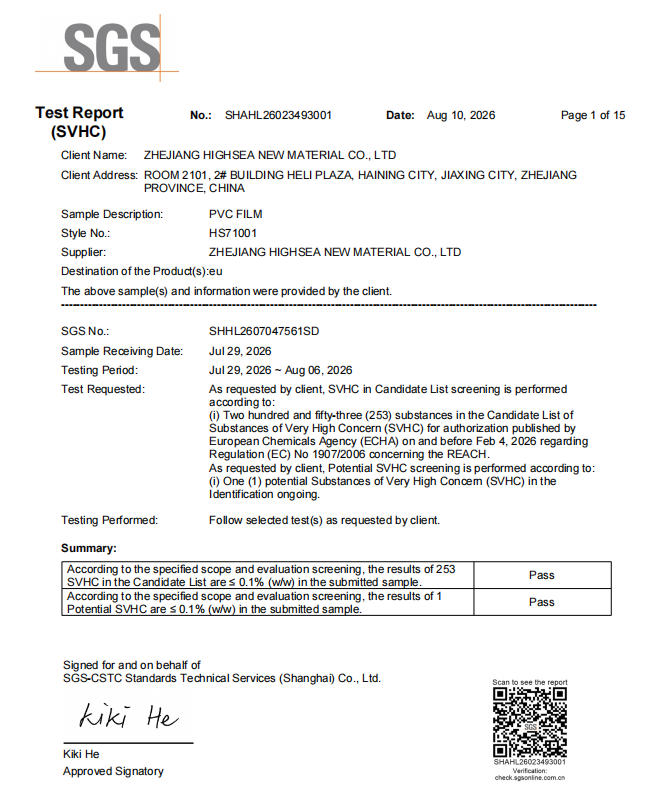
A REACH SVHC test report answers a chemical question, and a CE attestation of conformity answers a product question, which is why a wall panel technical file needs both rather than either one. The SGS report numbered SHAHL26023493001, issued on 10 August 2026 for PVC FILM Style No. HS71001, records screening of 253 substances in the Candidate List and 1 potential SVHC, with results of ≤ 0.1% (w/w) in the submitted sample. The same supplier's panel ranges are covered by two separate UDEM attestations citing EN 17104:2021. Importers who read one document as evidence for the other tend to discover the gap in a retailer's supplier questionnaire or at the customs broker's desk, not before.
Surfacing films sit at the front of that gap. A decorative film forms the visible face of a wall panel while the board behind it carries the structure, and the two arrive with different documentation. A buyer who asks only "is there a REACH certificate?" will usually receive a file, but not necessarily a file that names the film style being purchased.
The HS71001 record is a useful working example because it is narrow and specific. This article sets out what the document covers, how it differs from the EN 17104:2021 attestations held for PVC Panel and WPC Panel, where its evidence stops, and the checks an importer can run before filing it.
What the HS71001 SVHC report actually establishes
The report is a screening record for one film style, not a general statement about a product catalogue. Its identifying details are concrete and verifiable:
- Document type: Test Report (SVHC).
- Report number: SHAHL26023493001.
- Issuing laboratory: SGS.
- Issue date: 10 August 2026.
- Regulation cited: Regulation (EC) No 1907/2006 concerning REACH.
- Subject: PVC FILM, Style No. HS71001, supplied by ZHEJIANG HIGHSEA NEW MATERIAL CO., LTD.
- Screening scope: 253 substances in the Candidate List and 1 potential SVHC, screened in the submitted sample.
- Result: ≤ 0.1% (w/w) for the screened substances in that sample.
- Market: EU.
Two features in that list do most of the analytical work. The subject is a film identified by style number, and the result is expressed against a submitted sample. Both restrict the claim. A screening result describes the material the laboratory received; it does not automatically describe another colour, another film construction, or a finished panel assembled from the film plus a board and a coating.
The supplied record also carries no expiry date, unlike the CE attestations held for the same company's panels, which run to 9 August 2031. That asymmetry is normal for test reports and has a practical consequence: the issue date becomes the reference point. A buyer should treat the report as evidence of the sample tested on that date rather than as a certificate that renews itself.
SVHC screening and CE conformity: two documents, two jobs
The three documents on the table address different questions and belong in the file as parallel evidence rather than as stronger and weaker versions of the same thing. The comparison below uses only the details recorded for each document.
| Aspect | SVHC test report | CE attestation (PVC Panel) | CE attestation (WPC Panel) |
|---|---|---|---|
| Number | SHAHL26023493001 | M.2026.206.C145889 | M.2026.06.C1.45891 |
| Issuer | SGS | UDEM Uluslararasi Belgelendirme Denetim Egitim Merkezi San. ve Tic. A.S. | UDEM (same certification body) |
| Basis | Regulation (EC) No 1907/2006 (REACH) | EN 17104:2021 | EN 17104:2021 |
| Subject covered | PVC FILM, Style No. HS71001 | PVC Panel, listed models including 300×8×2900 mm and 1220×3000×3 mm | WPC Panel, listed models including 160×24 mm, 160×22 mm and 1220×3000×3 mm |
| What is recorded | Screening of 253 Candidate List substances plus 1 potential SVHC; ≤ 0.1% (w/w) in the submitted sample | Attestation of conformity to the named standard for the listed models | Attestation of conformity to the named standard for the listed models |
| Validity | Issued 10 August 2026; no expiry recorded | 10 August 2026 – 9 August 2031 | 7 August 2026 – 9 August 2031 |
Read across the table, the documents do not overlap. The SVHC report says nothing about conformity to EN 17104:2021, and the attestations, as described in the supplied records, do not present substance screening results for the film. A buyer holding only the two attestations has conformity evidence for the listed panel models and no film-level screening record; a buyer holding only the SVHC report has screening evidence for one film style and no panel conformity statement.
Filing rule: match each document to the item it names. Film evidence belongs with the film specification; panel attestations belong with the panel model and dimension on the order.
The style number is the part of the report buyers should check first
HS71001 is a style identifier, and it is the hinge on which the whole document turns. Because the scope line names a style rather than a material family, the report supports a purchase only when the ordered item carries the same style reference.
That matters more than it first appears in a catalogue-driven business. Zhejiang Highsea New Material Co., Ltd., whose decorative film and panel ranges are presented as Hisea-Decorative Film & Decorative Panels, offers OEM customization covering patterns, colours, sizes and packaging. Each customization changes the specification being bought. A bespoke colour or a custom pattern is not the same article as HS71001, and a sample-based screening result cannot reasonably be extended to a formulation the laboratory never received.
The check is therefore documentary rather than technical:
- Does the style reference on the report match the style reference on the purchase order, the specification sheet and the carton label?
- If the buyer uses a private-label code, has the supplier stated in writing how that code maps to HS71001?
- If the order specifies a different colour system, pattern or film build, has the supplier confirmed whether a separate screening record exists for that specification?
None of those questions needs a compliance specialist. They need the buyer to read the scope line and compare it with paperwork already in hand — and to accept that a negative answer is information, not an obstacle.
A six-point scope check for importers
The checks below run in sequence and take roughly as long as opening the file. They apply to any SVHC report, not only this one.
- Supplier legal entity. The HS71001 scope names ZHEJIANG HIGHSEA NEW MATERIAL CO., LTD. If the invoice, packing list or contract comes from a differently named company, obtain the relationship in writing before filing the report under that supplier's name.
- Product description and style. The subject should read PVC FILM with the style number being purchased, not a generic reference such as "PVC panel" or "decorative material".
- Regulation and screening basis. Confirm the report cites Regulation (EC) No 1907/2006 and describes screening against the Candidate List, so the basis matches the question your market is asking.
- Coverage and date. Record how many substances were screened, whether potential SVHCs were included, and the issue date. This record states 253 Candidate List substances plus 1 potential SVHC, dated 10 August 2026. Where a compliance team tracks the Candidate List, compare that coverage against the list status being worked to.
- Result expression. The threshold and the sample basis belong in the same sentence. "≤ 0.1% (w/w) in the submitted sample" is a precise statement; "REACH compliant" printed on a quotation is not.
- Report integrity. Check the report number on each page, the laboratory identity, and that a complete report has been supplied rather than a cropped photograph of one page.
Points four and five are the ones most often skipped, usually because a file has been assembled from screenshots forwarded between departments. A screenshot without a sample description answers no question well, and it will not satisfy an auditor who asks which substances were screened.
What a ≤ 0.1% (w/w) result does not cover
The result is meaningful and narrow at the same time. Its boundaries are worth stating plainly, because they determine what a buyer must ask for next.
- It covers the screened substances only. Screening against a defined list is not a full compositional analysis of everything a material might contain.
- It covers one sample. The submitted sample is the reference material. Sampling date, sampling location and chain of custody are worth requesting if the file will be audited.
- It does not extend across the panel build. A finished wall panel may combine a decorative face with a board and a coating. The PVC wall panel's non-porous surface that does not absorb water or hold odours, the WPC wall panel's moisture and rot resistance and the UV board's UV cured coating that forms a dense sealed film are properties of different material streams, and each stream can require its own documentation.
- It does not survive a formulation change. Batch-by-batch incoming material inspection supports consistency of formulation and process parameters, but inspection is not a re-test against the Candidate List. If the film formulation or colour system changes, the report's relevance has to be re-confirmed.
- It is not a market-access approval. Chemical screening does not replace fire classification, hygiene requirements, structural assessment or any other product rule applied by a destination market or project specification.
Stating those boundaries is not a criticism of the report; it is what makes the report usable. A buyer who knows the scope can request the missing document instead of assuming the file is complete, and a buyer who does not will eventually make a claim the paperwork cannot support.
Where a surfacing film sits in the finished wall panel
The film is the visible face; the panel behind it carries the structure and most of the functional performance. That division explains why evidence arrives in two streams and why asking for "the certificate" produces an incomplete answer.
Application context makes the split concrete. Wall panels are used for interior feature walls, TV backgrounds, hotel lobbies and corridors, offices and meeting rooms, restaurants, retail stores and showrooms, and ceilings, and in damp areas where a washable surface reduces cleaning effort. For humid and mixed indoor-outdoor projects, WPC wall panels are specified for moisture- and rot-resistant finishes, while UV boards carry a cured coating for surfaces that face frequent wiping. In each case the face material and the board are separate purchases with separate evidence.
For an importer buying finished panels rather than film, the instruction follows directly: request film-level screening for the exact face material and panel-level attestation for the exact model and dimension. A dossier with one but not the other is incomplete for most European retail and project buyers, and the missing half is usually the one nobody thought to ask about.
Documents the SVHC report cannot replace
Fire performance is the most frequent source of confusion. Commercial compliance guidance distinguishes EN 13501-1 for European markets, ASTM E84 for the USA and Canada, and GB 8624 for China, and notes that the applicable requirement depends on jurisdiction and project specification. Those systems rest on different test methods, so their results should not be converted into one another without a formal equivalence basis. An SVHC screening report is silent on all three.
Product standards form a second, separate track. CEN lists EN 13245-2:2008 for unplasticized PVC profiles used in interior and exterior wall and ceiling finishes, while the attestations discussed here cite EN 17104:2021. Which standard applies to a given declaration depends on the product and the market, and the buyer's check is identical in every case: read the standard number printed on the document and confirm it is the one the specification calls for.
Why the document set grows with the product range
Commercial research estimates place the global PVC panels market at USD 14.8 billion in 2025, with wall panels the largest product type at a 42.5% share (Dataintelo, March 2026). Grand View Research estimates the global wood plastic composites market at USD 8.9 billion in 2025, projected to reach USD 21.5 billion by 2033 at an 11.7% CAGR. Both are commercial research estimates rather than regulatory data, and the WPC figure is a forecast rather than a measured outcome.
For buyers, the relevant implication is documentary rather than commercial. A supplier covering WPC, PVC, UV board and bamboo charcoal board operates several material streams, each with its own standards, tests and certificate numbers. The realistic expectation is one matched evidence set per material and per model — the pattern visible in this supplier's file, where a single film style carries an SGS report number and each panel family carries its own UDEM attestation with its own model list and validity period.
Zhejiang Highsea New Material Co., Ltd. states its decorative film and panel scope on its own website, which is the appropriate starting point for confirming which ranges exist before requesting documents against them.
Frequently asked questions
Is a REACH SVHC test report the same as CE certification for a wall panel?
No. The SGS report SHAHL26023493001 screens 253 Candidate List substances and 1 potential SVHC in a PVC FILM sample under Regulation (EC) No 1907/2006, and records results of ≤ 0.1% (w/w). The CE Technical Inspection Attestations of Conformity held for this supplier's PVC Panel and WPC Panel cite EN 17104:2021 and cover listed models, with validity to 9 August 2031. One document addresses substance screening; the other addresses conformity to a product standard.
Does the SGS report SHAHL26023493001 cover finished PVC or WPC wall panels?
The supplied record scopes the report to PVC FILM, Style No. HS71001, supplied by ZHEJIANG HIGHSEA NEW MATERIAL CO., LTD., for the EU market, and it does not name finished panel models. Panel coverage is documented separately: PVC Panel under attestation M.2026.206.C145889 and WPC Panel under M.2026.06.C1.45891, both citing EN 17104:2021.
What does ≤ 0.1% (w/w) mean in the HS71001 report?
It is the result expression for the screened substances in the submitted sample: each of the 253 Candidate List substances and the 1 potential SVHC was found at or below 0.1% weight by weight in that sample. The figure describes the sample tested. It is not a statement that a finished panel, or a different film style, contains no substance of concern.
How can an importer confirm the report matches the film style being ordered?
Compare the style reference in the report scope with the purchase order, the specification sheet and the carton label, and ask the supplier to confirm in writing how any private-label code maps to HS71001. If the order specifies a different colour, pattern or film build, ask whether a screening record exists for that specification, because a sample-based result does not transfer automatically.
What happens if the film's colour or pattern changes after the report is issued?
The report remains a valid record of the sample tested on 10 August 2026, but its relevance to the new specification has to be re-established. Because patterns, colours, sizes and packaging are customizable, a changed specification is a changed article for documentation purposes. Buyers should request written confirmation of whether the existing screening applies to the new specification or whether a separate record is required.
Putting the report to work
The HS71001 report is useful precisely because it is specific: one laboratory, one report number, one film style, one issue date, one threshold and one submitted sample. Matching those elements to the purchase is the whole exercise. Where the match holds, the file supports a substance-screening statement for that film. Where it does not, the correct next step is a scoped request to the supplier rather than a broader claim in the buyer's own documentation.
For readers who need the wider product context, the company catalogue can be downloaded here: Hisea wall panel catalogue (PDF). Report and specification requests can be directed to Tommy at Tommy@zjhisea.com or +86 135-8645-8141.
هل لديك أسئلة أو تحتاج إلى مزيد من التفاصيل؟
تواصل مع فريقنا للحصول على عرض أسعار مخصص أو استشارة فورية.
طلب عرض أسعار
املأ النموذج أدناه وسيتواصل معك فريقنا بعرض مقترح مخصص.
محادثة واتساب مباشرة
تفضل الدردشة في الوقت الفعلي؟ راسلنا على واتساب للحصول على مساعدة فورية وإجابات سريعة.
- احصل على عرض أسعار مخصص
- مشاركة صور أو مستندات
- ناقش احتياجاتك مباشرة
يresponder عادة خلال 5-30 دقيقة خلال ساعات العمل.