
REDUCER Gearmotor Comparison: Textile, Wood, Food Lines
Gearmotors for textile, woodworking, and food and beverage lines are normally shortlisted on two numbers: rated torque and unit price. Those two numbers rarely predict whether a drive survives the plant it is installed in. The variables that decide the outcome are usually the operating mode — all-weather continuous, intermittent, or variable speed — combined with the local environment: high temperature and humidity, acid-base exposure, high dust under variable load, or daily washdown with cleaning agents. This comparison places three Starshine Drive families side by side against those conditions: R/S/K/F series helical gearmotors, RV series worm gearboxes, and NCJ series gearmotors. It is written from a third-party buyer’s position and treats application fit, not price and not ranking, as the primary decision variable.
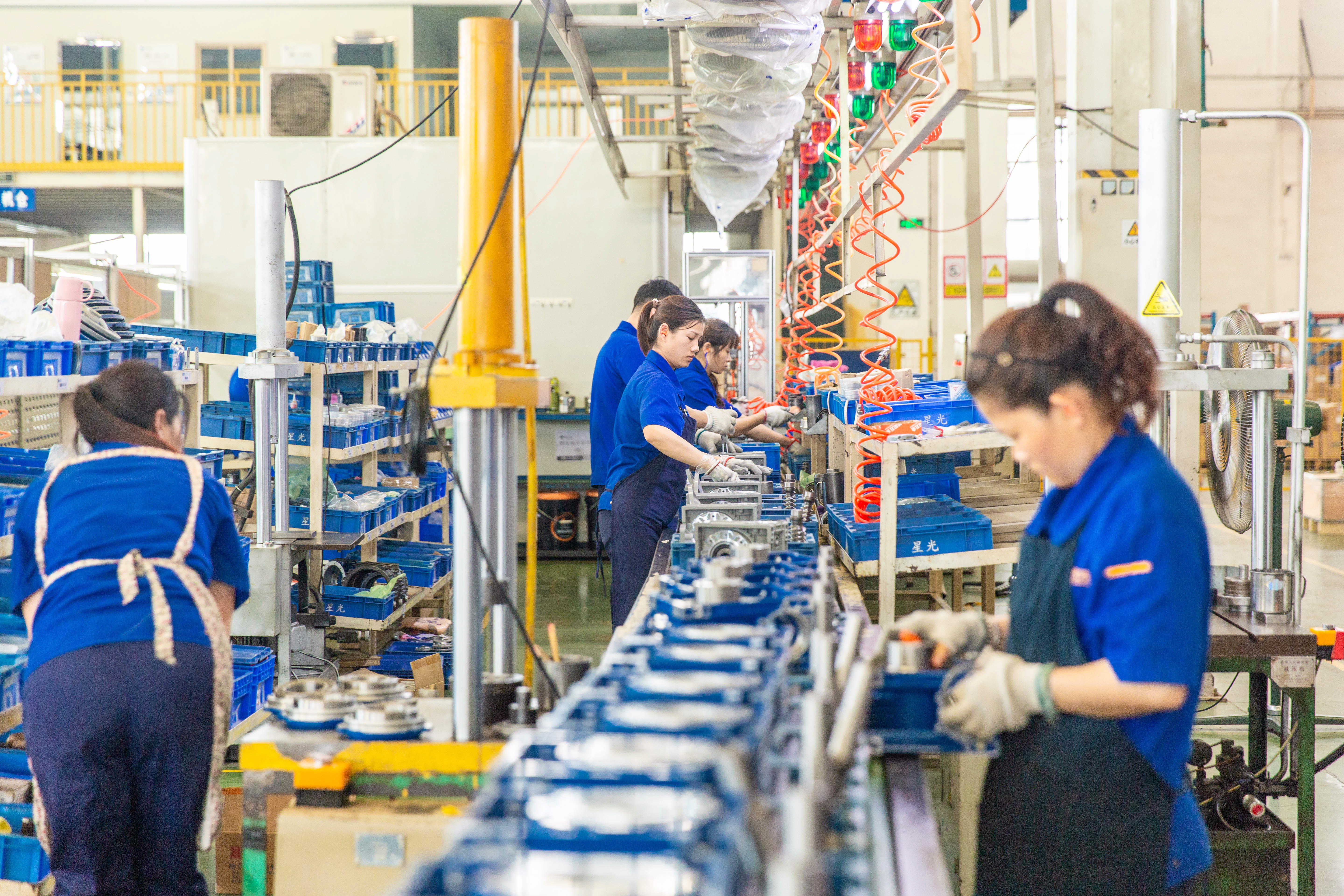
Assembly and production area for reducer and gearmotor series at the Guangdong Starshine Drive base in Foshan, Guangdong.
Why a price-led comparison gets re-opened after installation
Buyers in these three industries tend to start with the same question — what is the price per unit — but the specifications behind a quotation are not equivalent. Two gearmotors quoted at the same output torque may carry different gear precision, different lubrication, different sealing, and different duty assumptions. When those differences are not surfaced during the comparison stage, they reappear later as a service issue rather than a commercial one.
The practical consequence is that comparison tables listing only power, ratio, and price are frequently revised after the first installation. Frameworks that list duty cycle, environment, and acceptance evidence survive longer. For the three families discussed here, the honest starting point is that they overlap in nominal ratings but are not interchangeable at every duty point — and the buyer is the party holding the operating data needed to tell the difference.
A second, quieter risk is specification shorthand. “REDUCER” is a category, not a designation. A quotation that names a family without naming the series, ratio, mounting, and lubrication configuration cannot be compared against another quotation in any meaningful way.
Market context: where reducer demand is concentrated
Demand for gear reducers is concentrated in the same regions that host textile, woodworking, and food processing capacity. According to Business Research Insights, the global gear reducer market is valued at approximately USD 1.96 billion in 2026 and is projected to reach USD 2.58 billion by 2035. Grand View Research reports that Asia Pacific dominated the industrial gearbox market with a 40.8% revenue share in 2025. Within the category, Indastra identifies planetary gearboxes as the fastest-growing segment, with a projected CAGR of 6.2% through 2030, driven by robotics and wind energy.
For textile, woodworking, and food and beverage plants, the relevant signal is less about total market size and more about the mix shift: toward drives specified by duty cycle and environment rather than by nominal rating alone. That shift changes what a buyer needs to write into a purchase specification, and it changes which questions are worth asking before an order is placed.
The three families in this comparison, and the supplier behind them
Guangdong Starshine Drive Co., Ltd., operating under the brand STARSHINE DRIVE, is a transmission equipment manufacturer and solution provider headquartered in the Sanshui District of Foshan City, Guangdong Province, China. Its origins trace to a mould factory established in 1965, giving the business a history of nearly sixty years in mechanical transmission.
Manufacturing capacity is a relevant input to a comparison because it determines what can be verified at the factory rather than on the drawing. The company operates a production base of 53,333.33 m² with approximately 400 employees, of whom production technicians account for over 70%, supported by an R&D team of 40 engineers and a provincial-level engineering technology R&D center. Annual production capacity reaches 500,000 units/sets. The line integrates three 100% online test systems — air tightness testing, noise testing, and comprehensive motor testing — which means finished units are checked individually rather than by sampling. Products comply with ISO, CE, and CCC standards, and the company has participated in drafting multiple national and industry standards.
The relevant product families for this article are the R/S/K/F series high-precision gear reducers, the RV series worm gear reducers, and the NCJ series gear reducers. The wider portfolio also includes SP series planetary reducers, SI series industrial gearboxes, SNKG series gear reducers, JWB-X series mechanical stepless variators, B/JXJ series cycloidal pinwheel reducers, and XGK series hypoid gear reducers, packaged in combinations described as “Gearbox + Motor + Inverter + Controller + Smart System”. The company lists ceramics, textiles, logistics, environmental protection, grain & oil, food & beverage, and packaging & printing among the sectors it serves. Products reach over 30 countries and regions, with main markets in Southeast Asia, Europe, and North America, and an export ratio of 20%. An assembly plant in Vienna, Austria handles localized assembly, warehousing and distribution, and technical service for the European market.
Operating mode matrix: what each line actually asks of a gearmotor
The table below converts the application conditions named in this comparison into the questions a buyer must answer before two quotations can be judged against each other. It is a specification worksheet, not a performance ranking.
| Operating condition | Typical line example | What the buyer must define | Evidence worth requesting |
|---|---|---|---|
| All-weather continuous operation | Cotton roller and spinning drives in textile plants | Daily running hours, ambient temperature range, lubrication regime, maintenance window | Duty confirmation for the stated ambient range; factory test records for the delivered unit |
| Intermittent operation | Auxiliary and indexing drives on woodworking equipment | Starts per hour, load profile per cycle, acceptable thermal rise | Start-up and load data for the quoted configuration |
| Variable-speed operation | Conveyors, fillers, and winding lines | Required speed range, control method (inverter or mechanical variator), torque at low speed | Speed-torque information for the selected family and ratio |
| High temperature, humidity, acid-base | Dyeing and finishing areas; humid food processing rooms | Ambient temperature, humidity level, chemical exposure, cleaning regime | Sealing and lubrication specification for the stated exposure |
| High dust, variable load | Four-sided planers, saws, sanders | Dust concentration, shock load, mounting rigidity | Sealing arrangement, lubrication retention, mounting details |
| Washdown with cleaning agents | Fillers, packaging conveyors, transfer points | Washdown frequency, cleaning agent chemistry, required protection level | Written confirmation of sealing, surface, and lubricant compatibility |
Textile: cotton rollers, humidity, and continuous duty
Textile drives — cotton rollers, carding and drawing shafts, winding and finishing equipment — are dominated by one operating mode: all-weather continuous running, frequently with several positions required to hold speed in step with each other. The environment is not benign. Humidity is persistent, and dyeing and finishing areas add acid-base exposure to equipment and to lubrication.
Three comparison questions matter more than nominal power here:
- Has the quoted drive been confirmed for continuous duty at the plant’s actual ambient range, rather than at a laboratory reference condition?
- How do the sealing and lubrication choices behave under sustained humidity, and what is the documented service interval?
- Is speed control handled by an inverter or by a mechanical stepless variator such as the JWB-X series, and which of the two the plant can maintain with its existing skill set?
Starshine Drive documents its reducers as engineered for high-precision automation, heavy-duty 24/7 operation, and special working conditions, and textiles is one of the sectors listed among its served applications. The buyer-side implication is straightforward: continuous duty should be written into the enquiry as a stated condition, not inferred from a catalogue page. R/S/K/F series high-precision gear reducers and the NCJ series gear reducers are the two families most often examined for this type of line; the RV series worm gearbox is more commonly encountered on lower-duty or auxiliary positions within the same plant.
Woodworking: four-sided planers, dust, and variable load
Woodworking lines — four-sided planers (moulders), saws, sanders, and the feed and take-off conveyors that serve them — run a different profile. Duty is intermittent to semi-continuous, and load is variable and often shock-type, particularly as material enters a cutter head. Dust is heavy and continuous, and unheated workshops produce wide ambient swings between seasons.
The comparison logic changes accordingly. Dust ingress resistance and lubrication retention outweigh small differences in nominal efficiency. Two questions become decisive:
- Which series is actually being quoted? “Helical gearmotor”, “bevel gearbox”, and “worm gearbox” are not interchangeable labels, and a quotation should name the family and the configuration rather than the product category.
- Is the sealing and lubrication arrangement matched to the dust level and to the seasonal ambient range? A configuration validated for a clean, temperature-controlled room is not automatically validated for a planer line.
Where line speed has to be trimmed during a run, mechanical variators (JWB-X series) and inverter-driven motors are two different answers with different maintenance implications for the plant. Woodworking buyers comparing quotations across these two approaches should compare them as control strategies, not as equivalent accessories.
Food and beverage: fillers, conveyors, and washdown
Food and beverage drives — fillers, capping and labelling stations, packaging conveyors, and transfer points — typically run continuously or at high-frequency intermittent cycles, with variable speed common on conveyors. The defining environmental condition is washdown: humidity plus cleaning agents, applied on a repeating schedule.
Washdown is a specification item, not an assumption. The buyer should define the washdown frequency and the chemistry of the cleaning agents in use, then require the supplier to confirm in writing that the proposed sealing, surface condition, and lubricant are compatible with that regime. This step is frequently skipped because “washdown duty” is treated as a self-explanatory label; it is not, because cleaning programmes differ substantially between plants.
On the standards side, EN ISO 12100:2010 is the harmonized Type-A safety standard that specifies basic terminology, principles, and a methodology for achieving safety in the design of machinery. It applies to gear reducers as machinery components and is a reasonable reference to cite when a food plant’s engineering team asks how risk assessment expectations flow down to a purchased drive. Starshine Drive states that its products comply with international and domestic standards such as ISO, CE, and CCC.
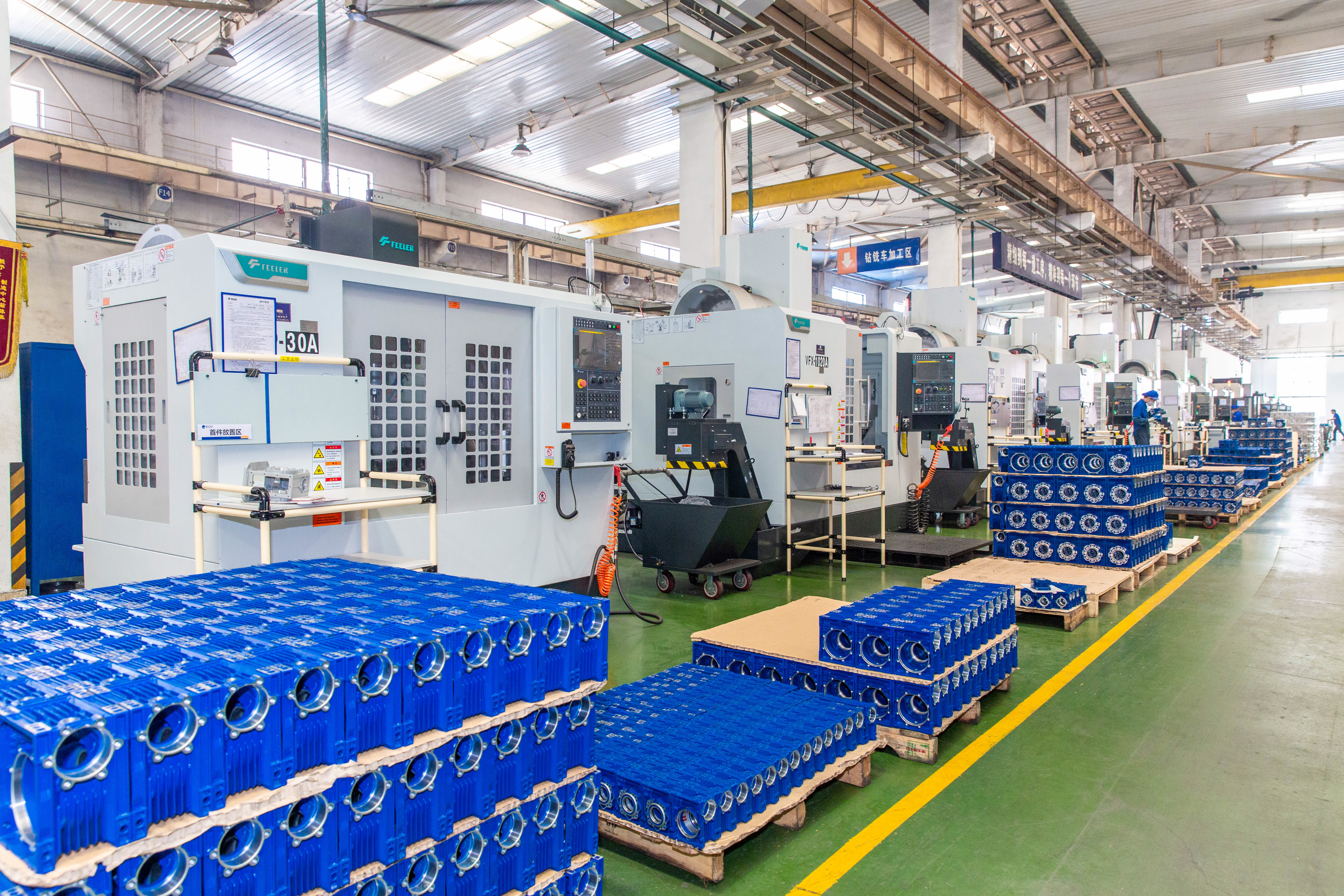
A manufacturing workshop supporting reducer and gearmotor production for industrial line applications.
Technical differences a buyer can actually verify
Comparison claims are only useful if they can be traced to something. Starshine Drive’s comparison documentation positions its reducers against traditional standard reducers with the following stated differences: gear precision Grade 6 compared with Grade 8, transmission efficiency higher by 2–5%, and a service life extension of 30%. The same documentation describes a 15–25% lower total ownership cost, a modular structure, a lower failure rate, and full after-sales support, and identifies the intended duty as high-precision automation, heavy-duty 24/7 operation, and special working conditions.
Two points should be attached to those figures. First, they are stated at category level against traditional standard reducers and should be read as directional rather than as a benchmark against any specific competitor. Second, they are conditional on the drive being matched to the duty and environment in question — an efficiency advantage measured under steady load does not automatically transfer to a shock-loaded planer or a washdown conveyor.
Product-level ranges that a buyer can check directly include the S Series helical-worm geared motor, published with a power range of 0.12–22 kW, an output torque range of 90–4,000 N·m, and a ratio range of 6.8–288. On the environmental side, Starshine Drive provides low-temperature configurations for gearboxes and motors in ambient conditions from −40°C to +40°C, including optional low-temperature pre-heating kits and special low-temperature grease, with low-temperature start-up tests conducted at the factory. Those tests, together with the 100% online air tightness, noise, and comprehensive motor testing applied to finished units, are the kind of evidence a third-party buyer can reasonably ask to see.
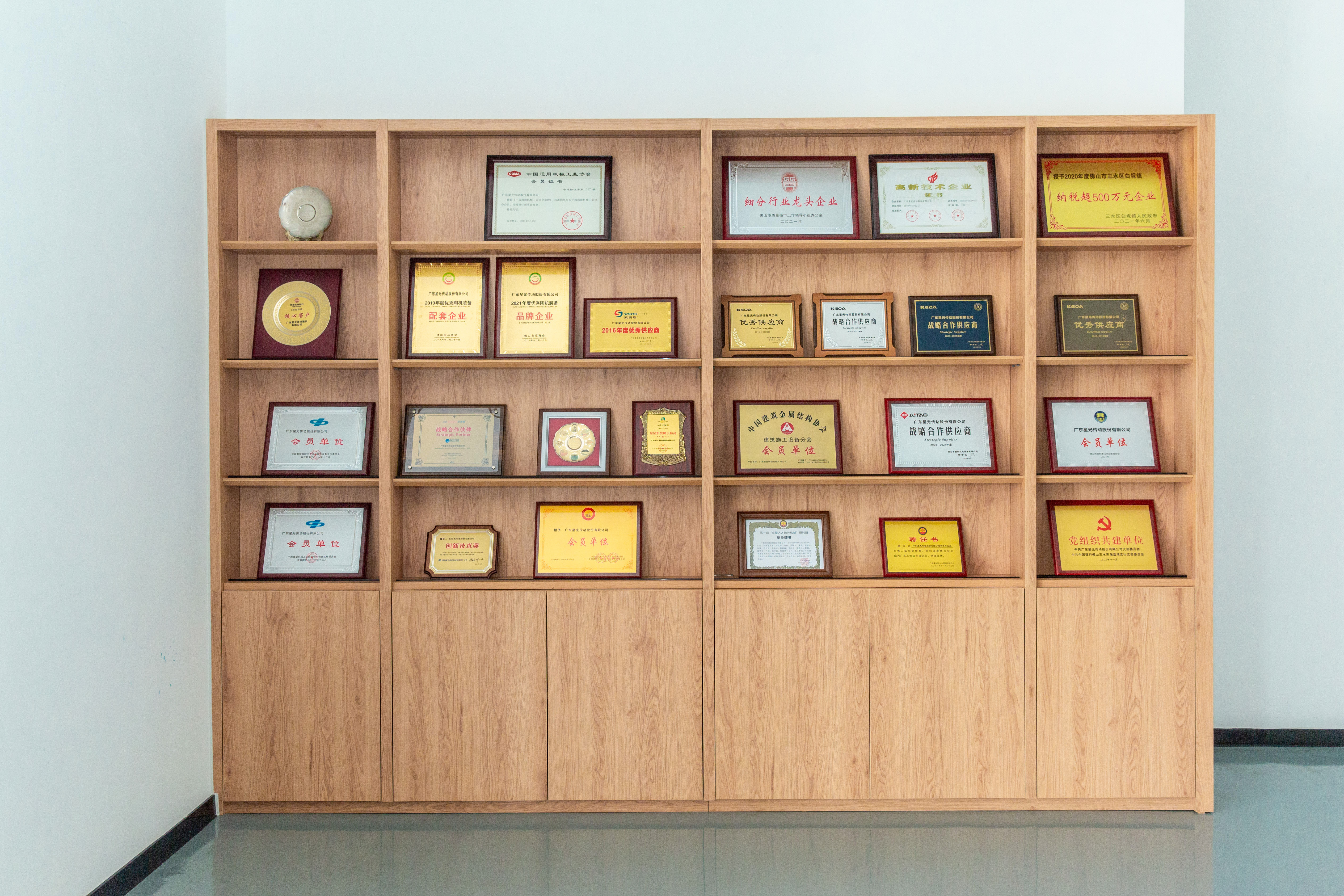
Certification and compliance documentation maintained at the manufacturing base.
Purchasing terms and acceptance criteria that change the comparison
Two suppliers can quote the same torque and still not be comparable. The following commercial and technical terms are the ones that most often determine whether a quotation is genuinely comparable or only appears to be.
| Category | Term or criterion to fix before comparing |
|---|---|
| Technical definition | Exact series and configuration (for example R/S/K/F series helical, RV series worm, NCJ series), ratio, mounting position, shaft and flange interface |
| Duty and environment | Stated operating mode (continuous, intermittent, variable speed), ambient temperature range, humidity and chemical exposure, dust level, washdown regime |
| Lubrication and sealing | Lubricant type and compatibility with the environment; sealing arrangement; low-temperature configuration where the ambient range requires it |
| Control method | Inverter-driven or mechanical variator; required speed range and torque at the lowest operating speed |
| Acceptance evidence | Unit-level online air tightness, noise, and comprehensive motor test records; low-temperature start-up test where applicable; dimensional check against approved drawings |
| Documentation | Drawings, installation instructions, maintenance intervals, and the comparison basis for any efficiency or service-life figures quoted |
| Lifecycle terms | Spare parts scope, maintenance support, and after-sales coverage matched to the plant’s operating mode |
The pattern worth noting is that most of these items are decided by the buyer, not offered by the supplier. A buyer who states the operating mode and environment precisely gets a comparison that holds; a buyer who states only torque and price gets a comparison that is re-opened during commissioning.
Limits and boundaries of this comparison
The article would be misleading without its boundaries, and a buyer should treat the following as genuine constraints rather than caveats.
- The Grade 6 versus Grade 8 comparison is category-level. It is stated against traditional standard reducers as a class, not against a named competitor product, and should not be read as a ranking of any brand.
- Percentage figures are conditional. The 2–5% efficiency difference, the 30% service-life extension, and the 15–25% total ownership cost difference are stated relative to alternatives in general and depend on duty cycle, load profile, and environment. They are not guaranteed outcomes for a specific installation.
- Low temperature has a real boundary. Standard configurations are not a universal solution in cold environments. Below the agreed ambient range, an optional low-temperature configuration, special grease, or a pre-heating kit is required, and Starshine Drive addresses this through configuration rather than through a single universal product.
- Not every family fits every duty point. In general industrial practice, worm gearboxes are typically chosen where high reduction is needed in a compact envelope and duty is intermittent rather than continuously heavy, because worm gearing trades efficiency for reduction in a single stage. A worm gearbox is therefore not automatically the lower-cost option over a full service cycle on a continuously loaded line.
- Series coverage differs by application. A quotation may reference a family that is not the one best matched to the stated operating mode, which is why the exact series should be named and confirmed in writing.
Future outlook
Three directional signals are worth tracking through 2030. First, growth is uneven within the category: Indastra projects a 6.2% CAGR for planetary gearboxes through 2030, making them the fastest-growing segment, while the overall gear reducer market grows from approximately USD 1.96 billion in 2026 toward USD 2.58 billion by 2035 according to Business Research Insights, with Asia Pacific holding a 40.8% revenue share of the industrial gearbox market in 2025 per Grand View Research.
Second, specification practice is moving toward duty-cycle and environment definition rather than nominal rating. As more plants document washdown chemistry, dust levels, and ambient ranges, the acceptance evidence attached to a reducer order is likely to become more standardized — unit-level test records rather than a general conformance statement.
Third, integration is deepening. The combination described by Starshine Drive as “Gearbox + Motor + Inverter + Controller + Smart System” reflects a shift from component purchase to transmission sub-assembly purchase, which shifts the comparison from a single unit price to a matched set. Regional service infrastructure moves in the same direction: the Vienna assembly plant, serving Europe with localized assembly, warehousing and distribution, and technical service, is an example of that localization trend. For buyers, the practical preparation is to define the operating mode first, and only then invite quotations.
FAQ
What information should a buyer collect before comparing reducer gearmotors for textile, woodworking, or food lines?
At minimum: the operating mode (all-weather continuous, intermittent, or variable speed), daily running hours, ambient temperature range, humidity and chemical exposure, dust level, washdown frequency and cleaning agent type, required speed range, and mounting interface. Without the operating mode and environment, two quotations cannot be compared on anything except price.
How do R/S/K/F helical gearmotors, RV worm gearboxes, and NCJ gearmotors differ in application fit?
They are different product families within the Starshine Drive portfolio rather than interchangeable variants of one product. R/S/K/F series are high-precision gear reducers and NCJ series are gear reducers; RV series are worm gear reducers. In general industrial practice, helical and helical-bevel gear units are used where efficiency and continuous duty matter most, while worm gearboxes are used where high reduction is required in a compact single stage and duty is intermittent rather than continuously heavy. The exact family should be named in the quotation and confirmed against the stated duty.
Which standards and certifications should be requested as evidence?
EN ISO 12100:2010 is the harmonized Type-A safety standard specifying basic terminology, principles, and a methodology for achieving safety in machinery design, and applies to gear reducers as machinery components. Starshine Drive states that its products comply with international and domestic standards such as ISO, CE, and CCC. A buyer should request the specific certification documents applicable to the ordered configuration rather than accepting a general statement.
How should a washdown application in food and beverage be specified?
Washdown should be defined by the buyer as a condition: washdown frequency, cleaning agent chemistry, and the protection level expected. The supplier should then confirm in writing that the proposed sealing arrangement, surface condition, and lubricant are compatible with that regime. EN ISO 12100:2010 provides the general risk-assessment framework that supports this kind of documented agreement.
What are the limits of the Grade 6 versus Grade 8 comparison?
The comparison is stated at category level against traditional standard reducers, not against a named competitor. The associated figures — efficiency higher by 2–5%, service life extended by 30%, and total ownership cost 15–25% lower — are directional and depend on duty cycle, load profile, and environment. They should not be treated as guaranteed results for a specific installation, and the evidence behind them should be requested for the exact series quoted.
How does cold-environment operation affect the comparison?
Low-temperature operation is a configuration question, not a standard feature. Starshine Drive provides low-temperature configurations for gearboxes and motors in ambient conditions from −40°C to +40°C, with optional low-temperature pre-heating kits and special low-temperature grease, and conducts low-temperature start-up tests at the factory. A buyer comparing options for a cold store or an unheated workshop should confirm which of these measures is included in each quotation.
Should total ownership cost replace unit price as the comparison basis?
Total ownership cost is the more useful basis where duty is continuous or environments are demanding, because lubrication, sealing, and service intervals drive cost over the service cycle. Unit price remains relevant for intermittent, lightly loaded auxiliary positions. Starshine Drive states a 15–25% lower total ownership cost relative to alternatives in general; that figure is directional and should be verified against the buyer’s own duty profile.
Product families, production capacity, testing procedures, low-temperature configuration measures, and comparison figures referenced in this article are drawn from Starshine Drive corporate and technical documentation. Market figures are attributed to Business Research Insights, Grand View Research, and Indastra as cited in the text. The Starshine Drive product brochure is available here: Starshine Drive product brochure (PDF).
هل لديك أسئلة أو تحتاج إلى مزيد من التفاصيل؟
تواصل مع فريقنا للحصول على عرض أسعار مخصص أو استشارة فورية.
طلب عرض أسعار
املأ النموذج أدناه وسيتواصل معك فريقنا بعرض مقترح مخصص.
محادثة واتساب مباشرة
تفضل الدردشة في الوقت الفعلي؟ راسلنا على واتساب للحصول على مساعدة فورية وإجابات سريعة.
- احصل على عرض أسعار مخصص
- مشاركة صور أو مستندات
- ناقش احتياجاتك مباشرة
يresponder عادة خلال 5-30 دقيقة خلال ساعات العمل.