
RS485 Water Meter Fit in Industrial BMS and SCADA
RS485 Water Meter Fit in Industrial BMS and SCADA
An RS485 water meter fits a site when the system that will read it already speaks a wired protocol — a PLC programme, a SCADA node, or a building management system with a fieldbus segment — and when a cable route can be installed and maintained for the life of the meter. It fits badly when the meter must sit somewhere with no route, no power and nobody available to commission a register map. Most disappointing RS485 deployments are not metrology failures; they are integration failures that surface months after the meters are already in the ground.
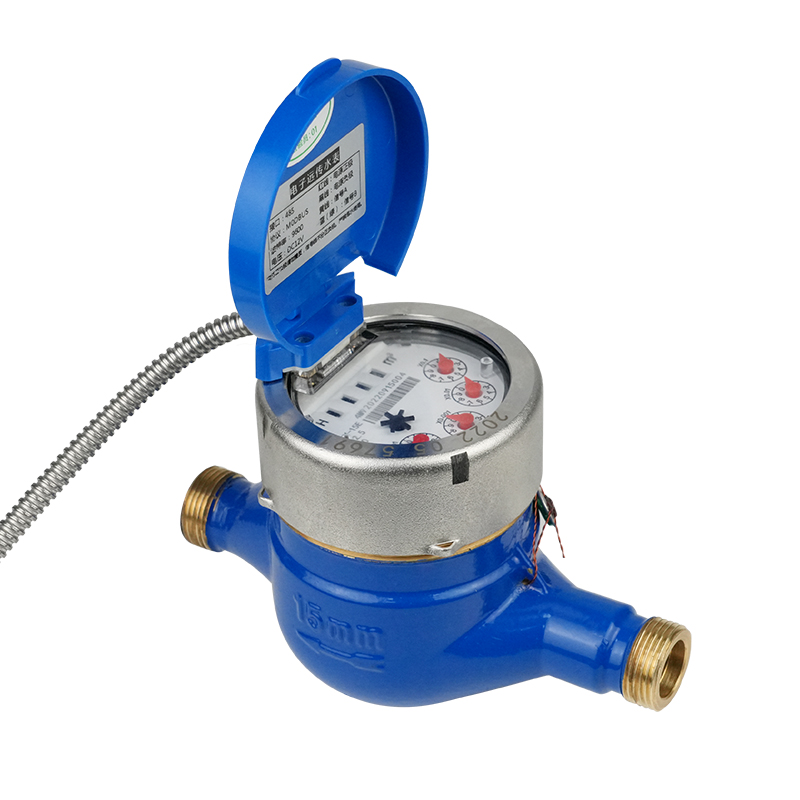
This article works through that fit question at scenario level rather than at catalogue level: plant process and utility metering read by SCADA, commercial building sub-metering read by a BMS, utility AMR/AMI backbones that use a wired segment to a concentrator, and pit or valve-chamber installations where power and moisture decide the configuration. The reference product throughout is the LXSY wired remote water meter from Shengda Water Meter Co., Ltd. (SDWM), a Chinese water-meter and flow-meter manufacturer established in 1995, whose published configuration for this model covers DN15–DN600, RS485 with Modbus RTU or M-Bus EN 13757, and a stated communication distance of up to 1000–1200 m depending on cable type and installation conditions.
The fit test starts with the reading system, not the meter
A wired water meter is a sensor with a serial port. The value it delivers depends entirely on what sits at the other end of the cable. Before any specification is compared, three site questions decide whether RS485 is the right architecture at all.
The first question is whether a controller already exists. If a facility already runs a PLC rack or a SCADA server with Modbus-capable channels, adding a meter to an existing poll cycle is an incremental engineering task. If no controller exists and one would have to be bought, housed, powered and maintained purely to read water meters, the wired approach carries a cost that wireless options do not.
The second question is whether the cable route is physical and permanent. RS485 needs a twisted pair between the meter and the controller, protected from mechanical damage and separated from power cabling where possible. In a plant with cable trays this is routine. In a finished apartment block with sealed risers, it can be the deciding obstacle.
The third question is who owns the protocol. RS485 defines electrical characteristics, not a data language. The standard behind the port, ANSI/TIA-485-A, describes the balanced digital multipoint interface that the meter's transceiver implements; it does not tell an integrator which register holds the volume total. That information comes from the meter supplier's protocol document, and its quality is as important to the project as the meter's accuracy class.
Why wired segments remain the backbone of industrial control
Wireless metering has expanded quickly, but it has not displaced wired segments inside plants and buildings, because the two solve different problems. A radio meter solves the problem of a location that cannot be cabled. A wired meter solves the problem of a location that must report on a fixed schedule to a control system that already exists.
Three characteristics keep RS485 relevant in industrial environments. Reading is deterministic: the controller asks, the meter answers, and the value appears in the same scan cycle as pressure, level and flow signals from other instruments. There is no dependence on gateway coverage, SIM subscription or radio duty-cycle policy. And the segment continues to work when the site has no mobile network at all, which is common in basements, culverts and rural treatment works.
The trade-off is equally concrete. Every meter added to a wired network requires an address, a cable pair, a termination decision and a place in the polling plan. The engineering effort concentrates at commissioning rather than at purchase, which is why the specification conversation should include the controls engineer and not only the procurement team. Fortune Business Insights valued the global smart water meter market at USD 5.38 billion in 2025 in a report published in October 2024; the size of that market says nothing about which interface a given site should use, but it does explain why the same meter platform is now offered in wired and wireless variants rather than as a single fixed design.
The documented reference: SDWM's LXSY wired remote water meter
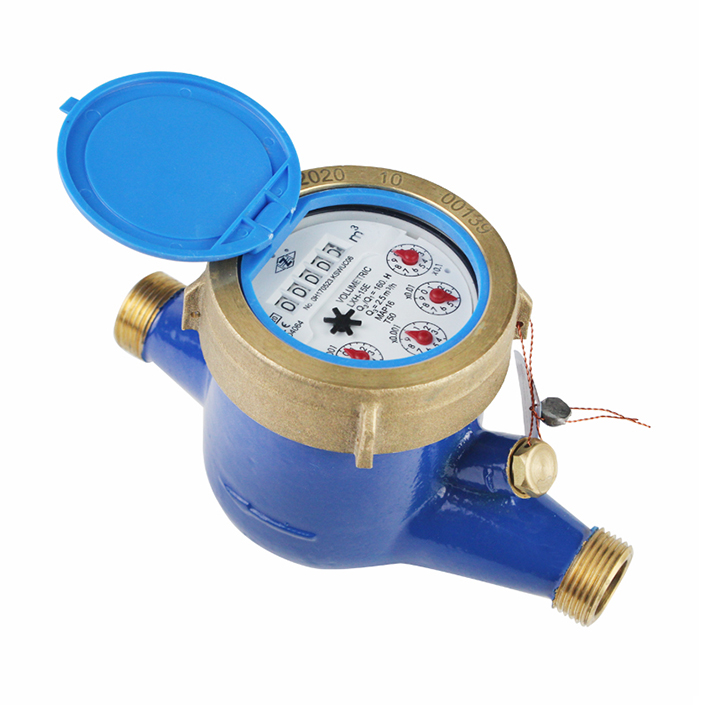
Shengda Water Meter Co., Ltd. publishes the LXSY as a wired remote water meter that can be configured with mechanical or ultrasonic measurement, and with RS485, M-Bus or pulse output as the communication interface. The published specification matters for scenario planning because it defines the envelope inside which a site can be matched without custom engineering.
- Diameter range: DN15–DN600, which allows one product family to serve tenant sub-metering and plant mains metering in the same project.
- Metrological ratio: R100, R160, R250 or R400 depending on configuration.
- Interface and protocol: RS485, M-Bus or pulse output, with Modbus RTU or M-Bus EN 13757 as the application protocol option.
- Communication distance: up to 1000–1200 m, depending on cable type and installation conditions.
- Power: battery powered or external power supply, depending on configuration, with a stated battery life of up to 6–10 years.
- Enclosure and pressure: IP68 protection, PN10 or PN16 pressure rating.
- Temperature: working range −20 °C to +60 °C; water temperature 0 °C to +50 °C.
- Body material: brass, stainless steel or composite material as options.
- Installation: horizontal or vertical.
- Data and diagnostics: AMR/AMI data reading, optional historical consumption storage, optional remote shut-off valve, and alarms for leakage, low battery, reverse flow, tampering and abnormal consumption.
- Certification: MID listed for this model.
Behind the product sits a manufacturer profile that matters when a project needs configuration rather than a stock item. SDWM operates a 66,000 m² facility with a stated annual output of 3 million units and a 12-engineer R&D team, holds ISO 9001, ISO 14001 and ISO 45001 certification, and states CE, MID and ISO 4064 certification across its product range. Its OEM/ODM scope covers logo, colour, housing design, communication module, software platform, protocol, packaging and product specifications. Samples are quoted from 3 units, customized OEM projects from 500 pcs, with standard lead times of 15–20 days and customized lead times of 30–40 days depending on project requirements. Quality control runs through incoming material inspection, in-process inspection, 100% functional testing, calibration testing and final inspection before shipment.
Modbus RTU over RS485: what the 1200 m figure does and does not mean
The published distance of up to 1000–1200 m is a planning envelope, not a guarantee. The qualifier attached to it — depending on cable type and installation conditions — carries most of the engineering weight, and a commissioning plan that ignores it will produce intermittent readings that are hard to diagnose later.
Distance on a Modbus RTU segment is consumed by several factors at once. Conductor cross-section sets the resistive loss along the run. Shielding and cable capacitance affect signal integrity at higher baud rates. The number of devices sharing the pair increases the load on the driver. Electrical noise from pumps, variable-frequency drives and welding equipment raises the error rate. Junction boxes, terminal blocks and long unshielded stubs all subtract from the usable length. A 1200 m run through clean conduit at low baud rate is a different proposition from a 1200 m run through a pump hall.
Bus topology is the second constraint. RS485 is a multipoint interface designed for a daisy-chain arrangement, with termination at the physical ends of the segment and the shield grounded at one point rather than both. Star wiring, long spurs and mixed cable types are common causes of failure on retrofit projects. Where the site layout forces a star, the practical answer is usually a repeater or a second controller channel rather than a longer cable.
Addressing and polling form the third constraint. Each meter on the segment needs a unique address, and the controller must be configured with the correct baud rate, parity, stop bits and response timeout. Battery-powered meters deepen this constraint, because a device that sleeps between readings cannot be polled at will. The supplier's protocol document should state how register values are scaled, which byte order applies to multi-register values, and how the meter behaves when it misses a poll — all of which affect how the SCADA tag is built and how a communications alarm is interpreted.
Power choice redefines the deployment scenario
The choice between battery power and an external supply is not a minor electrical detail — it changes which scenarios the meter can serve at all. A battery-powered meter with a stated life of up to 6–10 years, depending on configuration, is suited to locations where no mains supply exists and readings are needed at intervals. An externally powered meter is suited to locations where continuous polling, frequent data requests or remote valve operation are part of the operating model.
In practice this means the same meter model can appear in two very different projects. A district metering point in a roadside chamber will normally run on battery, reporting on a schedule. A plant room where the meter shares a SCADA scan cycle with process instruments will normally run on external power, because a controller polling every few seconds would exhaust a battery quickly. Buyers should state the intended polling regime in the enquiry, since it determines the power configuration, the expected service interval and whether remote valve control is realistic.
Deployment scenario matrix
The matrix below maps five common deployment scenarios against the factors that actually decide whether a wired meter belongs there. It is a planning aid for a site conversation, not a ranking of scenarios.
| Scenario | Reading system | Power consideration | Main fit risk |
|---|---|---|---|
| Plant process and utility water metering | PLC or SCADA node over Modbus RTU | External supply where continuous polling is required | Noise from drives and pumps; cable separation and shielding |
| Commercial building sub-metering | BMS, often via a Modbus RTU to Modbus TCP gateway | Mains supply in plant rooms; battery in remote pits | Address planning across many tenants and mixed meter types |
| Utility AMR/AMI backbone | Wired segment to a data concentrator feeding the AMR/AMI platform | Battery, with scheduled rather than continuous reads | Segment length and concentrator channel count |
| Valve chamber and pump station | RTU or SCADA, with optional remote valve control | Battery in unpowered chambers; external supply where available | Ingress protection and surge exposure on long outdoor runs |
| Campus or multi-building retrofit | Existing Modbus network, expanded | Usually existing local supply | Mixed meter generations, register inconsistency across vintages |
Scenario one: plant-level SCADA and process water
In an industrial plant, water metering rarely stands alone. A SCADA system already polls flow, pressure, level and temperature, and the water meter becomes one more tag in that scan. This is the scenario where RS485 has the clearest advantage, because the integration path already exists and the marginal cost of adding a device is a channel and a cable.
The practical requirement here is tag discipline. The project team should obtain the register map before ordering, agree the polling interval and timeout, and decide how a communications failure will be presented to the operator — as a bad-quality tag, an alarm, or both. Where the meter sits downstream of a variable-frequency drive or near a large motor, shielded twisted pair routed away from power cables is the minimum precaution. On large plants with mains sizes beyond the meter's range, the DN15–DN600 envelope also determines whether the same product can serve both the incoming main and the sub-loops, or whether a separate bulk meter is required.
Scenario two: commercial building BMS and tenant sub-metering
In a commercial building, the meter serves two masters: the BMS that monitors plant performance, and the billing process that allocates consumption to tenants. Wired sub-metering fits this scenario well when the risers are accessible and the building already runs a BMS with fieldbus segments, because the same cable infrastructure can carry dozens of meters back to a plant-room controller.
The common architecture is a set of RS485 meters on a segment, terminated at the plant room, connected to a Modbus RTU channel on a controller or gateway. Above that gateway, the data usually becomes Modbus TCP or a BMS-native protocol. The meter's job ends at the register; everything above it is building IT. That split is worth making explicit in the specification, because responsibility for the gateway, the database and the billing calculation normally sits with different parties than responsibility for the meter.
Two product details matter more in buildings than in plants. IP68 protection supports installation in plant rooms, basements and pits where leakage and humidity are realistic. Remote valve control, available as an option on this model, supports the arrears-management workflows that many commercial landlords expect — but it only makes sense where the meter has an external supply or a battery configuration rated for the additional actuation duty.
Scenario three: utility AMR/AMI backbones with a wired last segment
Utilities rarely choose one technology for an entire territory. A common pattern is a wireless or cellular concentrator serving an area, with a wired segment collecting meters inside a single building or block before the concentrator takes the data onward. In that architecture the RS485 meter functions as an AMR water meter at the edge of an AMI platform, and the wired segment is the cheapest way to aggregate meters that are physically close together.
This is where scheduled rather than continuous reading becomes normal. A battery-powered meter reporting on a fixed schedule fits the utility's billing cycle and keeps the service interval within the stated 6–10 years, depending on configuration. The technical questions the utility should resolve before tender are the size of each segment, the concentrator's channel count, the addressing convention used across meter vintages, and how historical consumption storage is retrieved when a reading is missed.
Scenario four: pits, valve chambers and pump stations
Chamber and pit installations are the hardest environment in this list, and the one where enclosure and power decisions dominate. Standing water, condensation and seasonal flooding make IP68 protection a starting requirement rather than a premium feature. PN10 or PN16 pressure ratings cover most distribution and plant duties, but the installer should confirm the actual system pressure against the rating rather than assuming it.
Power is the usual constraint. Where no mains supply reaches the chamber, a battery configuration with scheduled reporting is the practical choice, and the alarm set — low battery, tamper, reverse flow, leakage, abnormal consumption — becomes part of the maintenance workflow rather than a software feature. Where a supply is available, external power allows continuous polling and makes the optional remote shut-off valve usable for emergency isolation. Long outdoor cable runs also raise surge and earthing questions that belong in the electrical design, not in the meter datasheet.
Where RS485 stops fitting: the boundary against LoRaWAN and NB-IoT
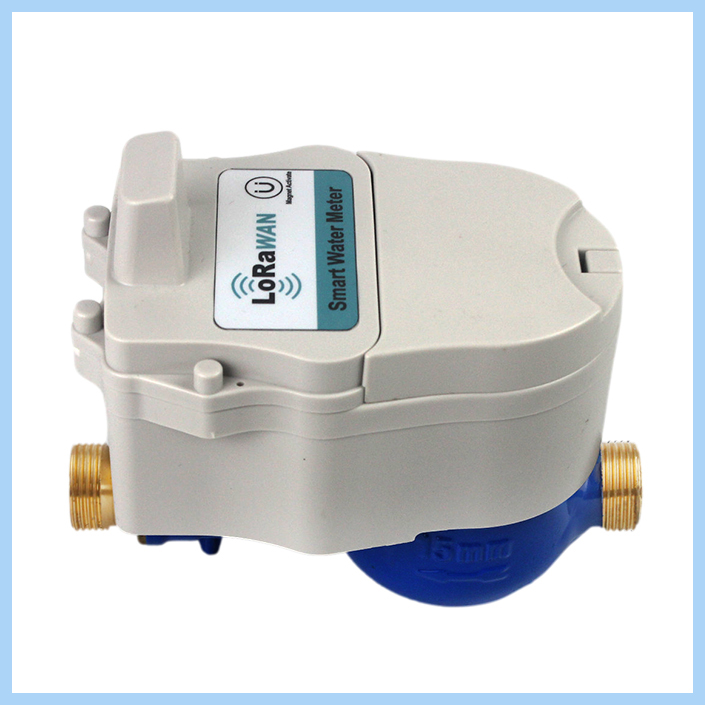
RS485 is the wrong choice when the cable cannot exist, when meters are scattered across a wide area, or when the operator has no controls engineering capacity to maintain a fieldbus. Those are the conditions under which LPWA technologies become attractive, and SDWM offers LoRaWAN, NB-IoT and 4G variants of its smart meter range for exactly those cases. LoRaWAN is an open low-power wide-area specification maintained by the LoRa Alliance and operates in unlicensed ISM bands under regional parameters; NB-IoT was specified within 3GPP Release 13, functionally frozen in 2016, and runs in licensed spectrum. Those differences in spectrum regime and network ownership explain why a utility roll-out and a factory retrofit can reasonably choose different interfaces for the same measurement task.
A fair comparison stops there. Available documentation does not provide a common field test comparing RS485, LoRaWAN and NB-IoT meters on the same site, so no claim of superior reliability, lower lifetime cost or better accuracy should be inferred in either direction. What can be said is narrower and more useful: a wired segment delivers deterministic polling and no dependency on radio coverage; a wireless meter removes the cable and the segment engineering but introduces dependence on gateway placement, network availability and, for cellular options, subscription management. Choose the constraint the site can actually carry.
Evaluation checklist before the meters are ordered
The following checks convert the scenario discussion into something a buyer can send to a supplier. They are written for wired metering projects and assume the site has already decided that RS485 belongs there.
- Protocol document: request the Modbus RTU register map, including data types, scaling, byte order and the supported baud and parity settings.
- Bus plan: confirm segment topology, termination points, cable specification and the expected device count per segment against the supplier's unit-load information.
- Distance budget: measure the real cable route, then apply margin for noise, junctions and baud rate rather than planning to the stated 1000–1200 m limit.
- Power decision: state whether continuous polling or scheduled reading applies, and confirm the resulting battery or external-supply configuration and expected service interval.
- Environmental fit: verify IP68 and PN10/PN16 against the actual installation point, and check water temperature against the 0 °C to +50 °C range for the intended duty.
- Body material: confirm brass, stainless steel or composite selection against water quality, and check any local material requirements for drinking-water contact.
- Certification match: ask for the MID certificate and confirm that the certificate references the exact model, diameter and communication configuration being purchased.
- Alarm mapping: agree which alarms — leakage, low battery, reverse flow, tamper, abnormal consumption — will be exposed to the BMS or SCADA and how they will be interpreted.
- Valve scope: if remote shut-off is required, confirm it as an option with the correct power configuration and define the actuation policy.
- Customization scope: for OEM/ODM projects, confirm which elements — logo, colour, housing, communication module, software platform, protocol, packaging, specifications — fall inside the agreed scope and lead time.
What these scenarios add up to
The pattern across all four scenarios is consistent. RS485 water meters win where a controller, a cable route and a protocol owner already exist, and where deterministic reading matters more than installation flexibility. They lose where any of those three is missing. The meter specification determines whether a given site can be served — diameter, ratio, pressure rating, enclosure, temperature, protocol, power. The site determines whether it should be served by a wire at all.
For buyers at the research and evaluation stage, the practical conclusion is to specify the integration before the hardware. A metering tender that names the protocol, the register mapping requirement, the polling regime and the segment design will produce comparable offers. One that names only the diameter and the communication type will produce meters that look identical on paper and behave very differently once they are connected.
SDWM's wired remote water meter family, with its published DN15–DN600 range, RS485 Modbus RTU and M-Bus EN 13757 options, IP68 protection and battery or external power configurations, sits inside the scenarios described here rather than across all of them. Matching it to a specific building or plant means checking the site against the specification in this article — and checking the specification against the certificate before the purchase order. Further detail on the manufacturer and its product range is available at Shengda Water Meter Co., Ltd.
Frequently asked questions
What does an RS485 water meter need before a SCADA system can read it?
It needs three things beyond the meter itself: a controller channel configured for the meter's electrical interface, the supplier's Modbus RTU or M-Bus register map so the correct values and scaling can be mapped to tags, and a cable route with correct termination and shielding. RS485 standardises the electrical layer only, so the register documentation is what turns a connected meter into a readable data point.
How far can an RS485 water meter be installed from the controller?
The LXSY wired remote water meter is published with a communication distance of up to 1000–1200 m, depending on cable type and installation conditions. That figure is an upper planning envelope. Conductor size, shielding, baud rate, the number of devices on the segment, junction boxes and electrical noise from pumps or drives all reduce the usable distance, so a commissioning plan should include margin rather than design to the limit.
Should an RS485 water meter be battery powered or externally powered?
It depends on the reading regime. A battery-powered configuration, with a stated life of up to 6–10 years depending on configuration, suits chambers and remote points where readings are scheduled rather than continuous. An external power supply suits plant rooms and BMS segments where the meter is polled frequently or where remote valve control is part of the operating model, because continuous polling and valve actuation place additional demand on any power source.
Can an RS485 water meter be added to an existing Modbus network?
Usually yes, provided the existing controller has a free address, sufficient channel capacity and a compatible baud and parity setting. The practical constraint is consistency: meters from different vintages may use different register layouts, so the integrator must document each device type separately. Where an existing segment is already close to its electrical limits, adding meters may require a repeater or an additional controller channel rather than a simple address assignment.
When is a wireless meter a better fit than an RS485 meter?
A wireless meter is the better fit when no cable route exists or can be maintained, when meters are spread across a wide area, or when the operator has no capacity to engineer and maintain a fieldbus. LoRaWAN and NB-IoT variants remove the cable and the segment engineering but introduce dependence on gateway coverage, network availability and, for cellular options, subscription management. The decision is about which constraint the site can carry, not about which interface is intrinsically better.
For configuration details, certificates and the full product range, the company brochure can be downloaded here: Shengda Water Meter profile (PDF).
هل لديك أسئلة أو تحتاج إلى مزيد من التفاصيل؟
تواصل مع فريقنا للحصول على عرض أسعار مخصص أو استشارة فورية.
طلب عرض أسعار
املأ النموذج أدناه وسيتواصل معك فريقنا بعرض مقترح مخصص.
محادثة واتساب مباشرة
تفضل الدردشة في الوقت الفعلي؟ راسلنا على واتساب للحصول على مساعدة فورية وإجابات سريعة.
- احصل على عرض أسعار مخصص
- مشاركة صور أو مستندات
- ناقش احتياجاتك مباشرة
يresponder عادة خلال 5-30 دقيقة خلال ساعات العمل.