
RTP Reinforcement Compared: Polyester, Aramid, Glass, Steel
Reinforced thermoplastic pipe (RTP) is defined by its reinforcement layer, not by its outside diameter. Four reinforcement families dominate oilfield and mining specifications — polyester fiber, aramid fiber, glass fiber and steel wire — and each one moves the same project in a different direction on pressure capability, corrosion behaviour, handling weight and installed cost. What follows is a decision framework for buyers who are comparing quotations at final selection, not a product catalogue.
Why the Reinforcement Layer Carries the Decision
An RTP construction stacks three functional layers: a thermoplastic liner that contains the fluid, a reinforcement layer that carries hoop load, and an outer jacket that protects the structure in service. The liner decides chemical compatibility; the reinforcement decides how much internal pressure the pipe can hold and how much mechanical load it can absorb.
That distinction has commercial consequences. Two pipes can share the same outside diameter, the same liner material and the same end fittings, yet behave very differently once design pressure, abrasive solids or impact exposure enter the picture. The reinforcement is usually the variable that separates a pipe which fits the duty from one that does not. Compare quotations on price per meter alone and that variable disappears from the discussion entirely.
API Specification 15S (2nd Edition, 2016) is the industry-standard reference for the manufacture and qualification of spoolable reinforced plastic line pipe for oilfield applications, and it covers pipe diameters up to 6 inches. Because the standard is written around the whole construction — liner, reinforcement and jacket together — qualification evidence, rather than material naming alone, is what a buyer can actually verify.
Corrosion is the risk that sits underneath most of this discussion. A documented control approach is to select a corrosion-resistant material for the wetted surface and to validate that selection through simulation testing before field deployment, rather than relying on the general reputation of a material category.
The Four Reinforcement Families at a Glance
The table below summarises how the four families are generally characterised in oilfield and mining service. Pressure ratings remain project-specific: liner material, bore size, wall construction and end connection all participate in the final qualified rating, so this is a screening tool rather than a specification.
| Reinforcement | Where it tends to win | Main trade-off | Constraint it usually answers |
|---|---|---|---|
| Glass fiber | Balanced strength and material cost; broad availability across product ranges | Lower specific strength than aramid, so the most demanding pressure classes generally require more reinforcement material | Cost-controlled gathering, water and gas lines, general oilfield duty |
| Aramid fiber | High strength-to-weight ratio; pressure-critical lines where installed weight matters | Higher material cost, normally justified only when pressure or weight is the binding constraint | High pressure combined with limited handling or transport capacity |
| Polyester fiber | Cost efficiency and flexibility in lower-pressure, moderate-duty service | Generally the lowest pressure capability of the four, leaving tighter design margins | Lower-pressure transfer where flexibility and handling dominate |
| Steel wire | High hoop strength and tolerance to impact and abrasion | Added weight increases coil handling and transport cost; the metallic element makes liner and jacket integrity a corrosion-control priority | Abrasive slurry, mechanically exposed routes, demanding duty cycles |
Reinforcement families compared by dominant decision constraint. Construction details and pressure classes are confirmed per project by the manufacturer.
Glass fiber: the volume default
Glass fiber reinforced thermoplastic pipe represents the majority of the product market, accounting for an estimated 64.7% of total RTP market share (Fact.MR, 2025). That position reflects economics more than superiority: glass fiber offers a workable balance of stiffness, pressure capacity and material cost across a very wide range of applications, which is why it appears so often in general gathering, water transfer and utility scopes.
The boundary to note is specific strength. Where a pressure class moves toward the upper end of a spoolable envelope, glass reinforcement has to be heavier relative to higher-performance fibers, which increases pipe weight and can erode the handling advantage that made RTP attractive in the first place.
Aramid fiber: pressure without the weight
Aramid reinforcement is generally selected when the dominant constraint is pressure or installed weight rather than material cost. Its strength-to-weight ratio allows a construction to reach demanding pressure classes without the wall weight that heavier reinforcement options impose, which matters on offshore platforms, in restricted right-of-way corridors, and on sites where every coil is moved by hand or with light equipment.
The trade-off is straightforward. Aramid costs more per unit of reinforcement, so it earns its place when pressure, payload or installation logistics are the binding constraints — not on a low-pressure transfer duty that glass or polyester can serve adequately at lower cost.
Polyester fiber: flexibility and cost discipline
Polyester reinforcement sits at the cost-driven end of the spectrum. It is generally used in lower-pressure, moderate-duty service where the design margin is comfortable and the priority is a flexible, easily handled pipe at a controlled price. Applications tend toward transfer lines, utility water and service duties where the corrosion resistance of the thermoplastic liner is the primary reason RTP was selected at all.
Polyester reinforcement is best treated as a scope-matching decision rather than a downgrade. The failure mode to avoid is specifying it into a pressure class it was never intended to carry.
Steel wire: strength with a maintenance obligation
Steel wire reinforcement generally delivers the highest hoop strength and the best tolerance to impact and abrasion among the four families, which is why it appears in mining slurry transfer, rough terrain routes and duties where mechanical damage exposure is high. That capability carries two costs: weight, which shows up in coil handling, transport and installation logistics, and the need to keep liner and jacket intact so the metallic reinforcement is not exposed to the environment surrounding the pipe.
The practical rule is that steel wire reinforcement shifts part of the reliability burden from material selection to field protection and inspection discipline.
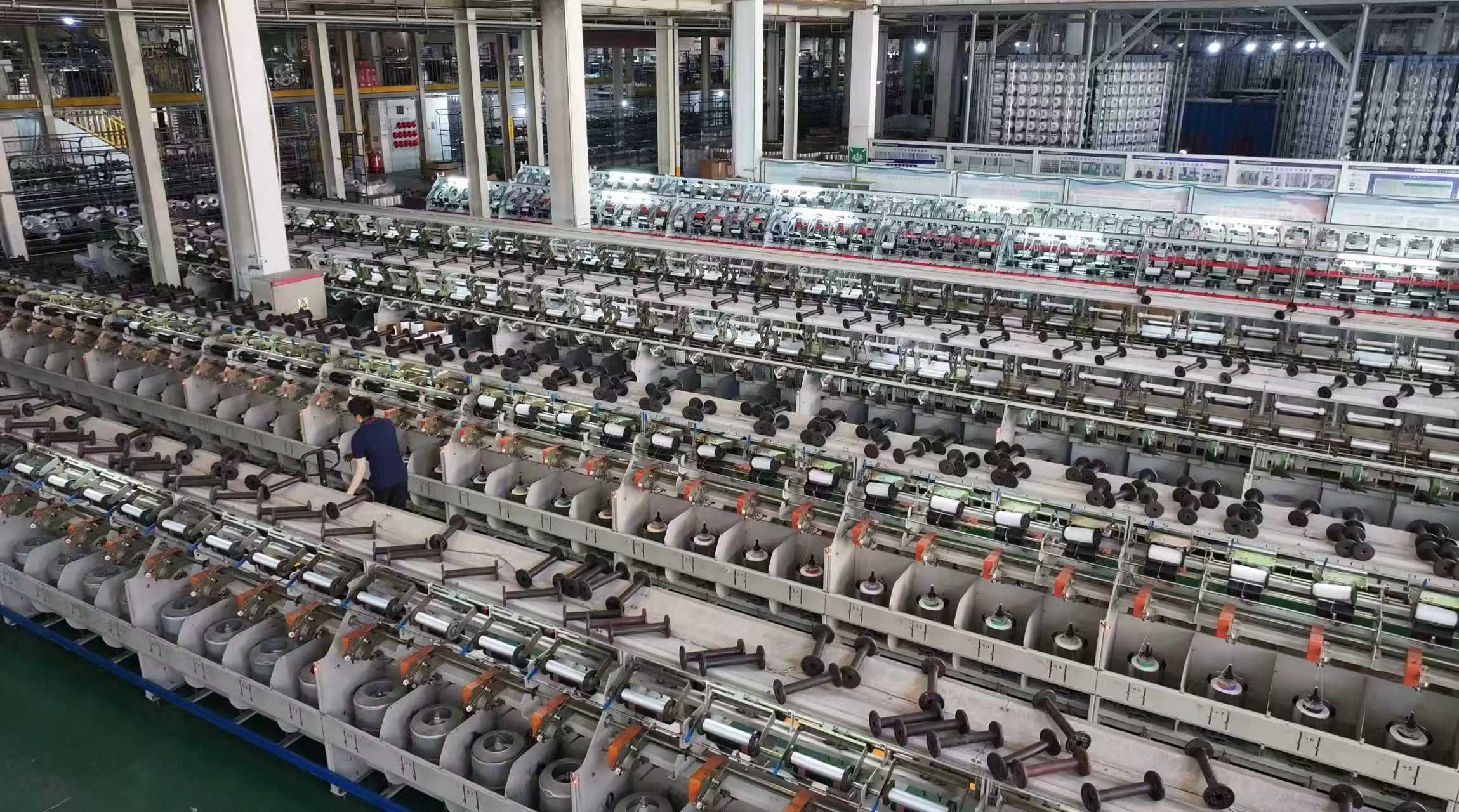
Fiber reinforcement processing: the reinforcement family chosen for a project changes both the pipe construction and the production route behind it.
A Buyer's Decision Framework: Match Reinforcement to the Dominant Constraint
Reinforcement selection becomes manageable when a project is reduced to a sequence of constraints instead of a list of material preferences. The framework below orders the decision the way it usually resolves in practice.
1. Fix the design envelope first
Start with design pressure, bore size and the operating environment, then check whether the duty falls inside the spoolable RTP envelope at all. API Spec 15S covers diameters up to 6 inches, so large-bore transmission remains a steel pipe conversation. Only once the duty sits inside the envelope does reinforcement choice become the deciding variable.
2. Define the chemical environment before the reinforcement
The liner handles corrosion; the reinforcement handles load. Liner materials such as PE100 RC and PA12 are selected against the produced fluid, temperature and pressure profile, and where hydrocarbon service requires charge dissipation, a static dissipative or conductive liner grade enters the specification. Corrosion risk is controlled by material selection validated through simulation testing, so the reinforcement family should be chosen after that barrier is settled, not before it.
3. Price the installation route, not just the pipe
Reinforcement choice changes coil weight, transport cost and how quickly the line goes in. RTP installation runs at 10 km per day against less than 2 km per day for steel pipe, a 5x difference — and that is precisely the advantage heavy reinforcement can erode. On projects with restricted access or manual handling, aramid reinforcement often earns its premium; on open routes with standard equipment, glass fiber frequently does the same job at lower material cost.
4. Assess abrasion, impact and third-party damage exposure
Mining slurry transfer and busy industrial corridors are where steel wire reinforcement is most often justified, because impact and abrasion tolerance is a structural requirement rather than a pressure requirement. The same exposure creates a maintenance obligation: where RTP requires intervention, the practical trigger is force damage, so routing, bedding and protection measures belong in the same decision as the reinforcement choice.
5. Compare installed cost, then qualify the evidence
RTP holds roughly a 20% lower cost position than steel pipe in comparable duty, with a maintenance profile limited to force damage scenarios, while steel pipe requires corrosion maintenance several times a year. That advantage survives only when the reinforcement genuinely matches the duty. An underspecified pipe that fails early, or an overspecified pipe that adds weight without adding service life, both erase the commercial case. The final step is documentary: the supplier's qualification evidence for the exact construction being offered.
RTP Versus Steel Pipe at Final Selection
The comparison that most often decides a final award is not reinforcement versus reinforcement, but composite versus carbon steel. Three measurable differences frame it. Installation efficiency runs at 10 km per day for RTP versus less than 2 km per day for steel, a 5x increase that compresses schedule and site labour. Cost sits around 20% lower for RTP in comparable service. Maintenance diverges further: RTP needs intervention only in case of force damage, while steel pipe requires corrosion maintenance several times a year. Handling also favours the composite, since lighter coils reduce site transport cost and equipment requirements.
Steel pipe nonetheless retains real advantages, and an honest selection process should say so. Three boundaries matter.
- Bore size: API Spec 15S is written for spoolable reinforced plastic line pipe up to 6 inches in diameter, so large-diameter transmission remains steel territory.
- Damage dependence: the corrosion advantage of RTP rests on the thermoplastic liner and jacket staying intact. In traffic corridors, rock backfill or heavy third-party activity, protection measures and post-installation inspection are not optional.
- Extreme service: where very high pressure, elevated temperature or severe mechanical abuse combine, steel's isotropic strength and tolerance to rough handling are difficult to match with a spoolable composite construction.
Within the composite category, the same honesty applies to reinforcement choice. Aramid is more expensive per unit of reinforcement than polyester or glass. Steel wire adds weight that can partially offset the handling benefit of RTP. Polyester carries the lowest pressure capability of the four. None of these are defects; they are scope boundaries that determine whether a construction belongs on a project at all.
Where ZYfire Fits in the Reinforcement Decision
ZYfire Hose Corporation, founded in 2000, is a Beijing Stock Exchange-listed manufacturer of fire hose and composite pipelines made from polymer materials such as polyurethane and rubber-plastic alloy, with products used in oil and gas exploitation, emergency rescue, mineral development, slurry transportation, agricultural water conservancy and marine engineering. The company exports to more than 70 countries and regions, with a stated export ratio of 80% and principal markets in the United States, the Middle East, the EU and Southeast Asia.
Three capability facts are directly relevant to a reinforcement decision rather than being background colour.
- Engineering depth. A research and development team of 50 engineers works on the liner, reinforcement and jacket as a single construction, which is what allows reinforcement choice to be treated as a project variable instead of a fixed catalogue item.
- Test evidence. The ZYfire laboratory has passed the professional accreditation of the China National Accreditation Service for Conformity Assessment (CNAS) and holds nationally and internationally recognised testing capabilities, described by the company as the first nationally recognised lab in the subdivision industry. Corrosion and material risks are addressed through simulation testing rather than bare material claims.
- Industrial base. Manufacturing is supported by a 150,000 m² facility and 600 employees, with global production bases, research and development centres and logistics warehouses located in the United States, Saudi Arabia, the United Arab Emirates, Malaysia and China, including Nanjing Jiangsu, Taizhou Jiangsu and Chuzhou Anhui.
Product-side, ZYfire's RTP is certified under API 15S and the company specialises in custom bore sizes and high-pressure applications for oilfields and mining. That combination — accredited in-house testing, custom bore capability and a reinforcement and liner programme developed together — matters at final selection because reinforcement families cannot be compared in isolation from the liner and the qualified pressure class of the finished pipe.
Two verification steps remain the buyer's responsibility regardless of supplier. First, confirm in writing which reinforcement families are qualified for the required pressure class, liner material and bore size. Second, request the test documentation for that specific construction rather than for the product family as a whole.
Where the Market Is Moving
The global RTP market was estimated at USD 7.2 billion in 2024 and is projected to reach USD 10.2 billion by 2030, a compound annual growth rate of 5.9% (Strategic Market Research). Oil and gas is the dominant end-user segment, accounting for approximately 71.2% of total RTP demand in 2025, as operators seek corrosion-free alternatives to steel (Fact.MR). Asia Pacific is identified as both the largest and fastest-growing regional market for thermoplastic pipes in 2024/2025, driven by infrastructure investment and water management programmes (Mordor Intelligence / Market Research Future).
On the product side, glass fiber reinforced thermoplastic pipe accounts for an estimated 64.7% of total RTP market share (Fact.MR), which is consistent with the screening logic above: the volume of the market sits in duties where balanced strength and cost, not maximum pressure, are the deciding factors. Aramid and steel wire reinforcement address the narrower, more demanding portion of demand.
One caution belongs with these figures. Published market size estimates vary widely depending on scope — whether a study covers all thermoplastic pipes or specifically spoolable RTP. Market Research Future, for example, places the spoolable RTP market at USD 3.698 billion for 2024, and Dataintelo sizes the RTP liner segment at USD 2.8 billion in 2025. Buyers reading market growth as a procurement signal should attach the scope definition to the number before drawing conclusions. The competitive landscape itself is established, with suppliers such as NOV, Baker Hughes, Shawcor (Flexpipe) and Soluforce (Pipelife) operating alongside specialised manufacturers including ZYfire.
Future Outlook
Two shifts are likely to shape reinforcement selection over the next few procurement cycles. The first is documentation. As RTP penetrates higher-value oilfield and mining scopes, buyers are moving from material-name comparisons toward qualified construction comparisons — the specific liner, reinforcement, bore and pressure class combination that carries test evidence. Suppliers with accredited in-house laboratories and traceable test records are positioned better for that shift than suppliers competing only on unit price.
The second is application-led specification. Mining slurry transfer, offshore service and high-pressure onshore gathering each impose a different dominant constraint, and the reinforcement family that fits one rarely fits all three. Procurement teams that define the dominant constraint before issuing a request for quotation tend to receive comparable offers, fewer technical clarifications and a shorter evaluation cycle. That is the practical value of treating reinforcement as a decision variable rather than a line item.
Frequently Asked Questions
Which RTP reinforcement is best for high-pressure oilfield service?
There is no universal answer, because pressure rating is a property of the finished construction rather than of the reinforcement material alone. In practice, aramid fiber or steel wire reinforcement is generally selected when pressure is the dominant constraint, while glass fiber serves the broad middle of the market and polyester covers lower-pressure service. The reliable comparison is the qualified pressure class of a specific liner, reinforcement, bore size and end connection combination, which the manufacturer confirms for the project.
Does the reinforcement type affect corrosion resistance?
The reinforcement is not the corrosion barrier; the thermoplastic liner is. Corrosion risk is normally controlled by selecting a corrosion-resistant liner material appropriate to the produced fluid and validating it through simulation testing. Reinforcement choice nevertheless influences corrosion outcomes indirectly, because it determines the pipe's response to mechanical damage — and in steel wire reinforced constructions, liner and jacket integrity is what keeps the metallic reinforcement isolated from the surrounding environment.
How does RTP compare with steel pipe on installation and maintenance?
RTP installs at roughly 10 km per day compared with less than 2 km per day for steel pipe, a 5x difference, and its cost position is around 20% lower in comparable duty. Maintenance requirements for RTP are minimal, with intervention needed only if force damage occurs, whereas steel pipe requires corrosion maintenance several times a year. These figures describe typical comparison conditions; actual results depend on route, soil, fluid and handling practice.
Is glass fiber the default choice because it holds the largest market share?
Not necessarily. Glass fiber reinforced thermoplastic pipe accounts for an estimated 64.7% of total RTP market share, but that figure reflects aggregate volume across many applications where balanced strength and cost are the deciding factors. Where pressure, installed weight or impact exposure becomes the dominant constraint, aramid fiber or steel wire reinforcement can be the more appropriate construction even though it holds a smaller share of the market.
What should buyers verify about a supplier's reinforcement capability before award?
Four items are worth confirming in writing: the reinforcement families the supplier can actually qualify for the required pressure class and bore size; the certification and scope of the RTP product, for example API 15S; the accreditation status and test scope of the supplier's laboratory, such as CNAS accreditation; and the traceability of test documentation for the specific construction being purchased rather than for the product family as a whole.
Reference: ZYfire Hose Corporation is an API 15S certified RTP manufacturer listed on the Beijing Stock Exchange, with an accredited in-house laboratory and custom bore and high-pressure capability for oilfield and mining service. Product brochure (PDF): https://cdn.socialarks.com/sbsp/24607/0/2026/0429/69f1dd58398ca.pdf · Company website: www.zyfire.com