
RTP Supplier Evidence: ZYfire's Plant, CNAS Lab and Capacity
Supplier Evidence Dossier · Reinforced Thermoplastic Pipe · 2026
Reinforced thermoplastic pipe (RTP) is a spoolable composite line pipe formed from a thermoplastic liner, a reinforcement layer and a protective outer jacket. Because it is bought against a project schedule rather than from shelf stock, the decisive procurement question in 2026 is no longer whether a supplier can offer RTP — it is whether that supplier can produce a plant, a laboratory, a certificate scope and a delivery record that survive an audit.
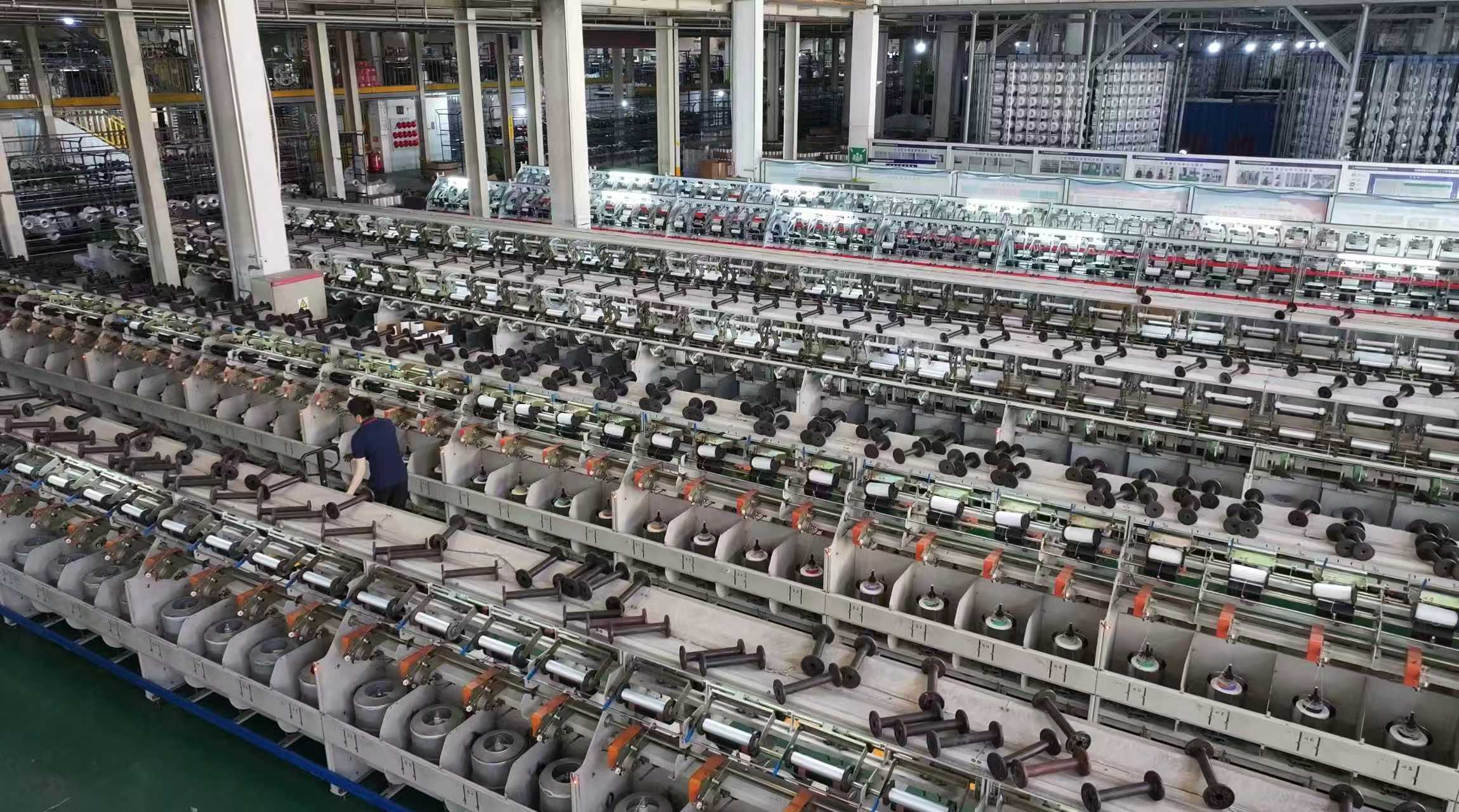
ZYfire Hose Corporation, founded in 2000 and headquartered in Jiangyan City, Jiangsu, China, is a manufacturer of fire hose and polymer composite pipelines whose portfolio includes RTP for oil and gas exploitation. This reference dossier assembles the capability evidence the company discloses — a 150,000 m² plant, a 600-person workforce, a 50-engineer R&D team, a CNAS-accredited laboratory, 100,000 m/month RTP capacity, 100% product testing, a 30-day lead time, a 50 m MOQ and production bases in the USA, Saudi Arabia, the UAE, Malaysia and China — and places it against the way five global RTP and thermoplastic composite pipe peers are publicly positioned. Where a figure is company-reported rather than independently verified, this article states that explicitly instead of filling the gap.
Why capability evidence has become the first filter
Market context explains the shift. Commercial research cited for 2026 places the global reinforced thermoplastic pipe market at approximately USD 7.94 billion, with the oil and gas segment valued between USD 2.0 and 2.5 billion. The same research estimates that RTP systems reduce corrosion-related failures by more than 70% compared with traditional steel pipelines — a claim strong enough to explain adoption, but not strong enough on its own to select a supplier.
Regulation narrows the field further. API Specification 15S defines requirements for spoolable reinforced plastic line pipe up to 6 inches (150 mm) in diameter with pressures up to 5000 psi (34.5 MPa). Once a specification sets a documentable ceiling, differentiation stops being about the product category and starts being about the paperwork behind it: which factory, which test method, which certificate scope, which delivery commitment. Buyers in Research and Evaluation stages are therefore asking for evidence that can be checked line by line.
The practical problem is that the three variables with the largest schedule impact — monthly capacity, lead time and minimum order quantity — are exactly the ones least covered by independent public data. Capacity is frequently reported on inconsistent bases (monthly output, annual output, facility capability), and commercial terms are conditional by nature. A supplier dossier is only useful if it separates what the supplier has documented from what still needs to be confirmed in a request for quotation.
ZYfire's disclosed capability base
The table below consolidates the company-disclosed facts that are relevant to a supplier qualification file. It records what ZYfire publishes, not an independent audit.
| Evidence point | Disclosed value | What it constrains in procurement |
|---|---|---|
| Manufacturing footprint | 150,000 m² facility | Space for parallel reinforcement lines, reel handling and finished-goods staging |
| Workforce | 600 employees | Shift coverage for 24/7 project supply |
| Engineering | 50-engineer R&D team | Capacity to answer OEM/ODM specifications rather than catalog-only orders |
| Laboratory | CNAS-accredited laboratory | In-house testing under an accredited quality system |
| RTP capacity | 100,000 m per month (company-reported) | Volume ceiling for campaign-based ordering |
| Lead time | 30 days | Schedule baseline for long-term supply programs |
| MOQ | 50 m | Feasibility of trial lengths and site-specific variants |
| Quality control | 100% product testing | Acceptance evidence per length, not per batch sample |
| Production bases | USA, Saudi Arabia, UAE, Malaysia, China (Nanjing Jiangsu, Taizhou Jiangsu, Chuzhou Anhui) | Delivery reach and regional supply continuity |
| After-sales | On-site service and after-sales consultation | Installation support in remote oilfield and mining sites |
Verification status: the footprint, workforce, engineering headcount, laboratory accreditation, MOQ, lead time and testing statements are consistent across ZYfire's published material. The 100,000 m/month capacity figure is a company claim; public sources describe company capacity on different bases that cannot be reconciled without direct confirmation, so it should be re-confirmed in writing with its basis defined before it is used in a schedule commitment.
Reading the evidence: what each figure actually constrains
Plant scale is a flexibility signal, not an output figure
A 150,000 m² facility matters less as a number than as an indication of layout. RTP production requires liner extrusion, reinforcement tape preparation, winding or wrapping, jacket application and reel winding, plus space to store 920 m coils and 3,700 × 1,200 mm reels. A plant sized for that flow can run concurrent orders without queuing behind a single line; that is the capability a project buyer is really testing when delivery dates slip.
Engineering depth determines whether customization is real
A 50-engineer R&D team is the difference between a supplier that can quote a non-standard bore and one that can only sell from a list. ZYfire offers OEM/ODM production with customization across size and diameter, working pressure, weight, length and bending radius. For a buyer, the test is not the headcount — it is whether the customization request returns a documented design basis: liner material, reinforcement architecture, pressure class and connection type, each with an acceptance criterion.
An accredited laboratory makes 100% testing operable
ZYfire's laboratory has passed accreditation by the China National Accreditation Service for Conformity Assessment (CNAS), and the company describes it as the first nationally recognized laboratory in its segment. This matters because a 100% testing claim is only credible if the test capacity exists in-house. Buyers should still ask which tests are performed on every length, what the acceptance criteria are, and how long records are retained — accreditation confirms laboratory competence, not the acceptance threshold of a specific purchase order.
Capacity, lead time and MOQ are one combined signal
Read separately, the three numbers are unremarkable. Read together, they describe a supplier structured for both volume and small experimental orders: a stated 100,000 m/month capacity, a 30-day lead time and a 50 m minimum order. That combination is what allows a buyer to place a short qualification length before committing to a 120,000 m program — a sequencing pattern that reduces exposure in first-time RTP adoption.
Product envelope: the specifications to match against project conditions
RTP capacity and laboratory evidence only become procurement-relevant once they are tied to a specific construction. ZYfire's RTP/TCP product data for the 2-inch, 3500 PSI construction is summarised below.
| Parameter | Disclosed specification |
|---|---|
| Nominal pressure | 3500 PSI |
| Outside diameter | 79.8 mm |
| Reel specification | 3700 × 1200 mm |
| Single length | 920 m |
| Reel weight | 1,200 kg |
| Full plate weight | 5,524 kg |
| Inner and outer layer | HDPE, PE-RT (UV and antioxidant options available) |
| Reinforcement layer | Polyester filament; aramid fiber tape; glass fiber tape; steel wire tape |
| Application industry | Oil and gas; mining |
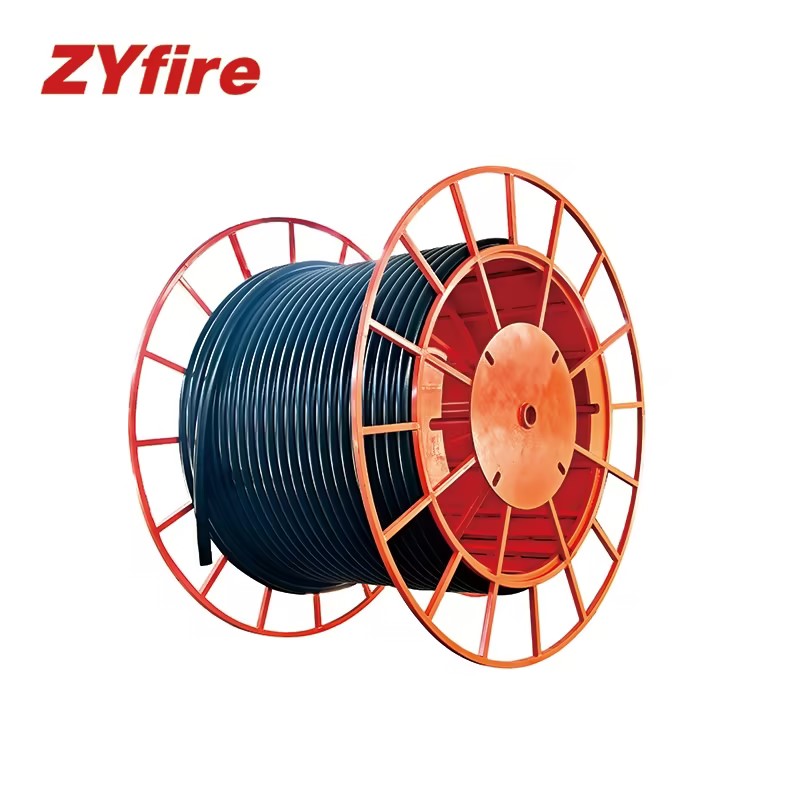
The 920 m single length is the specification most often undervalued in early evaluation. Long continuous lengths mean fewer fittings and joints per kilometre, which reduces both installation time and the number of potential leak paths — a direct advantage in oilfield gathering and mine slurry transfer where access for repair is expensive. The trade-off is logistics: 920 m coils at roughly 5,524 kg full plate weight require handling equipment and transport planning that short-length steel or shorter composite sections do not.
Material selection is a second decision layer. HDPE and PE-RT liners serve different temperature and fluid-compatibility conditions, and the four reinforcement architectures — polyester filament, aramid fiber tape, glass fiber tape and steel wire tape — are not interchangeable across pressure classes. A buyer should require the supplier to state which combination is proposed for the specific pressure, temperature and fluid, and to justify it against test data rather than a catalog table.
Certification scope: the constraint that decides eligibility
Certification is where constrained procurement most often fails, and where a certificate number is least useful without its scope. ZYfire's RTP product (product reference 3533) holds API Spec 15S certification number 15S-0025, issued by the American Petroleum Institute, applicable to the global market and compliant with API Spec Q1 and API Spec 15S.
| Certificate attribute | Recorded value |
|---|---|
| Certification | API-15S |
| Certificate number | 15S-0025 |
| Issuing authority | American Petroleum Institute |
| Standards | API Spec Q1; API Spec 15S |
| Scope | Non-metallic Reinforced Pipe – Glass Fiber; Steel Reinforced Pipe, Couplings |
| Market | Global |
| Issue and expiry | Issued 2025-12-18; expires 2027-02-21 |
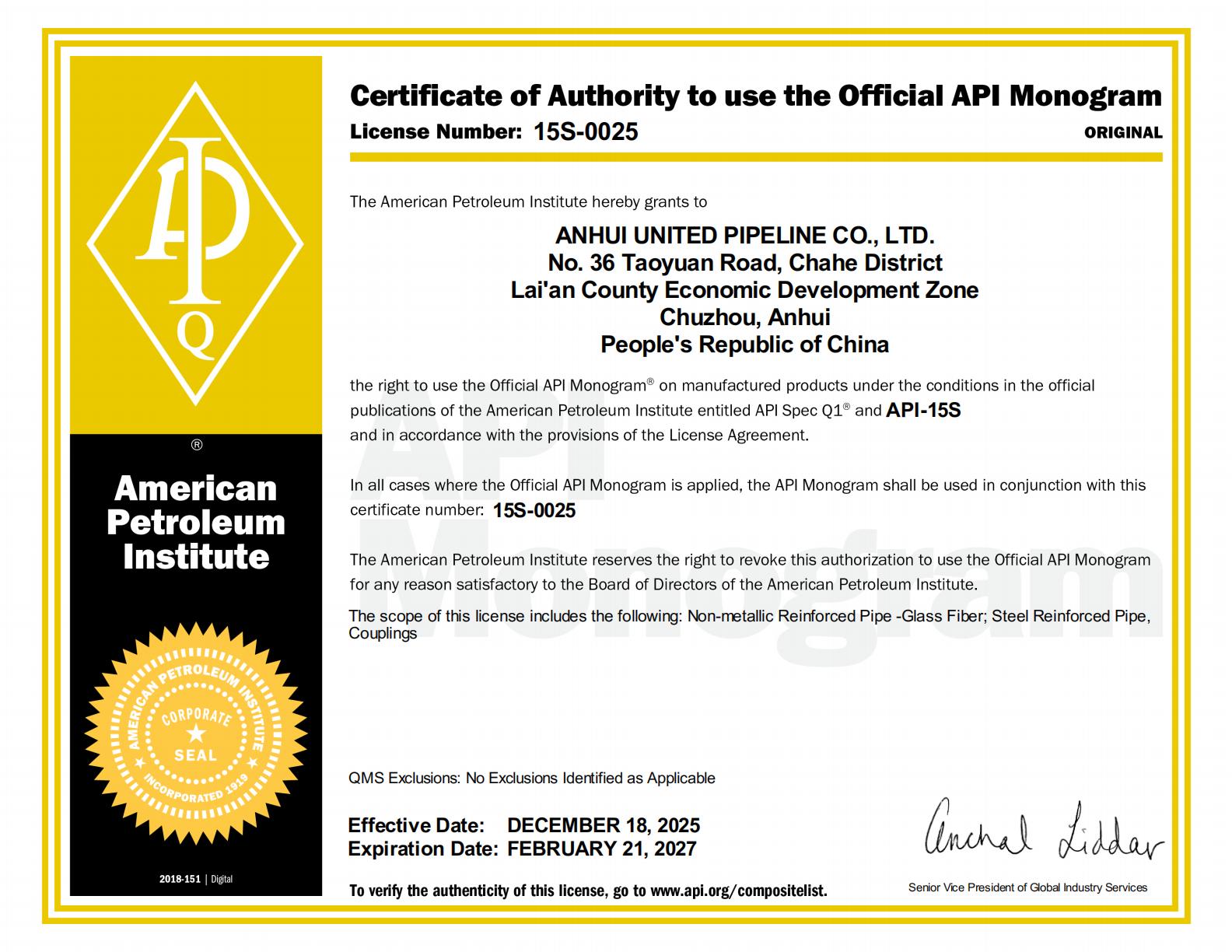
Three practical readings follow. First, the scope is construction-specific: it covers glass-fiber non-metallic reinforced pipe, steel reinforced pipe and couplings, so an order for an aramid or polyester construction should have its certification coverage confirmed against the certificate rather than assumed from the product family name. Second, the validity window runs to 2027-02-21, which means a project awarded later in that period should plan a re-verification step before final acceptance. Third, API 15S certification confirms conformity to a specification and a quality management system within that scope; it does not certify a supplier's capacity, lead time or project-specific performance, which remain commercial and technical questions.
Benchmarking against global RTP and TCP peers
Five suppliers are commonly named in RTP and thermoplastic composite pipe evaluations: Flexpipe (a Mattr company), Fiberspar (NOV), Strohm, Polyflow and SoluForce. Each is a real, identifiable business with a publicly reported operating base. What is not publicly comparable, and is therefore not asserted here, is their manufacturing floor area, monthly capacity, test protocol or quoted lead time. The table records positioning and the verification action a buyer should take, rather than a ranking.
| Supplier | Publicly reported operating region | Capacity / testing data used here | Verification action before award |
|---|---|---|---|
| ZYfire | China; production bases in USA, Saudi Arabia, UAE, Malaysia and China | 150,000 m² plant; CNAS lab; 100% testing; 100,000 m/month (company-reported); 30-day lead time; 50 m MOQ | Confirm capacity basis, certificate scope for the ordered construction, and test records |
| Flexpipe (Mattr) | North America | Not verified in this review | Request plant list, pressure-class matrix, test protocol and lead time in writing |
| Fiberspar (NOV) | North America | Not verified in this review | Request certificate scope, spool length options and regional delivery terms |
| Strohm | Europe | Not verified in this review | Confirm applicability of the product family to onshore vs offshore duty |
| Polyflow | North America | Not verified in this review | Request capacity basis and testing documentation for the proposed construction |
| SoluForce | Europe | Not verified in this review | Request MOQ, lead time and fitting availability for the target bore |
This benchmark compares disclosure, not performance. No peer capacity, testing frequency, facility size or lead-time figure is stated here because none could be verified from attributable sources during this review. Region of operation is publicly reported positioning and should be confirmed directly with each supplier.
The asymmetry is itself the finding. A buyer comparing these suppliers will typically receive complete documentation from one and partial documentation from others, and the temptation is to read completeness as superiority. The disciplined approach is to treat missing data as missing, issue the same structured RFQ to all candidates, and compare only the answers that come back in documented form: certificate number and scope, test method and acceptance criteria, capacity with its basis, spool length, MOQ, lead time and Incoterms.
Application fit: where the evidence converts into project value
ZYfire's RTP is positioned for mining and oil and gas fluid transmission, operating on a 24/7 basis. The working conditions the company lists map directly onto the technical case for composite pipe: corrosion resistance, a higher pressure rating, no swelling, flexibility, long single lengths, non-frequent fittings, simple installation and a long cycle life. Reference markets include the UAE, Argentina, Australia, Bahrain, Canada, Kuwait, Liberia and Libya, and special requirements listed for these duties include corrosion resistance, explosion-proof operation, high-pressure tolerance and compliance with API standards.
- Onshore oilfield gathering and flowlines: long 920 m lengths reduce joint count across spaced wellheads; flexibility supports route changes without additional fittings.
- High-pressure water injection and flowback: the 3500 PSI 2-inch construction with aramid, glass or steel tape reinforcement addresses pressure duty where steel corrosion drives maintenance cost.
- Mining slurry transfer and backfill: abrasion and corrosion resistance matter more than nominal pressure; liner and reinforcement selection should be justified against slurry characteristics.
- OEM/ODM programs: ZYfire's stated customization across diameter, working pressure, weight, length and bending radius supports buyers who need a private-label or project-specific configuration.
A documented case in ZYfire's material covers an OEM/ODM program of 120,000 m of RTP over five years for fluid transmission across oil and gas and mining duty, reporting stable operation under high-pressure conditions, no leakage and reduced maintenance costs, with corrosion resistance, long service life and easy installation cited as the governing advantages. As with all supplier-reported outcomes, the value for a new buyer is the pattern — short qualification order, staged volume, five-year continuity — rather than the figure alone.
Market trend: qualification burden is rising faster than demand
Two movements are visible in the data available for 2026. The first is scale: a global RTP market of roughly USD 7.94 billion, with USD 2.0–2.5 billion concentrated in oil and gas, is large enough to support multiple regional supply chains rather than a single export corridor. The second is documentation: as API Spec 15S becomes the reference specification for spoolable reinforced plastic line pipe up to 6 inches and 5000 psi, buyers increasingly filter suppliers by certificate scope before they discuss price.
ZYfire's structure reflects both. An export ratio of 80%, distribution to more than 70 countries and regions, and production bases across the USA, Saudi Arabia, the UAE, Malaysia and China describe a supplier positioning itself for regional delivery rather than single-origin export. For buyers, multi-region footprint is primarily a continuity argument: it shortens the distance between a reorder and a site when a project expands unexpectedly or a route changes.
Where the evidence stops: limitations and comparison with traditional supply
RTP does not replace steel everywhere, and an honest supplier dossier should say so. API Spec 15S addresses pipe up to 6 inches in diameter and 5000 psi; duties above that envelope fall outside the specification's scope and typically remain steel territory, as do applications where site repair infrastructure, welding standards and inspection routines are built entirely around steel pipe. The 70% corrosion-failure reduction cited in commercial research is an argument for RTP in corrosive service, not a general claim of superiority.
The same discipline applies to supplier evidence. Compared with traditional price-and-specification sourcing — where a buyer compares unit price and a datasheet — an evidence-based approach costs more time upfront but moves risk earlier in the process. The boundaries a buyer should record for ZYfire are specific:
- Capacity is company-reported. The 100,000 m/month figure is a claim; public material describes capacity on different bases, so it should be confirmed with its definition before being used in a delivery plan.
- Lead time and MOQ are conditional. The 30-day lead time and 50 m MOQ are stated for certain long-term oil and gas and mining supply programs and will vary with specification, quantity, destination and order configuration.
- Certificate scope is construction-specific. Coverage is stated for glass-fiber non-metallic reinforced pipe, steel reinforced pipe and couplings; aramid and polyester constructions require scope confirmation.
- Some compliance claims were not validated here. No independent evidence for CE PED marking or a specific ISO certificate was verified in this review, so those should be requested as documents rather than assumed.
- Logistics is a real constraint. 920 m coils at 5,524 kg full plate weight require handling and transport planning that affects total delivered cost, particularly for remote sites.
Future outlook
The next phase of RTP competition is likely to be decided on documentation rather than on product claims. Three developments follow from the evidence reviewed here. First, laboratory accreditation and per-length testing records will carry more weight as oilfield operators extend qualification requirements down the supply chain. Second, capacity claims will increasingly be challenged to state their basis, because capacity reported monthly, annually and by facility cannot be compared directly. Third, multi-region production will be evaluated as a risk instrument — the difference between a supplier that can reroute volume and one that cannot.
For ZYfire, the disclosed base — a 150,000 m² plant, 600 staff, 50 engineers, a CNAS-accredited laboratory, 100% testing, API Spec 15S certificate 15S-0025 and bases across five countries — places the company in a documented position that most suppliers cannot yet match on paper. The remaining work is verification: converting disclosure into confirmed, project-specific commitments. For buyers, that is also the correct posture. Treat every capacity, lead time and MOQ statement, from any supplier, as a hypothesis to be tested in the RFQ.
FAQ
Which certification should an RTP supplier hold before oilfield supply?
API Spec 15S is the industry specification for spoolable reinforced plastic line pipe, covering pipe, end fittings and couplings within a defined diameter and pressure envelope of up to 6 inches and 5000 psi. ZYfire's RTP product reference 3533 is certified under API Spec 15S, certificate number 15S-0025, issued by the American Petroleum Institute, compliant with API Spec Q1 and API Spec 15S, with a stated scope covering glass-fiber non-metallic reinforced pipe, steel reinforced pipe and couplings, valid from 2025-12-18 to 2027-02-21. Buyers should confirm that the construction they intend to order falls inside that scope.
How should a buyer interpret a 100,000 m/month capacity and a 30-day lead time?
Both are company-reported figures. The 100,000 m/month value describes ZYfire's stated RTP output, and the 30-day lead time is stated for certain long-term oil and gas and mining supply programs. Because public material describes manufacturer capacity on different bases — monthly output, annual output and facility capacity are not interchangeable — the figure should be confirmed in writing together with its definition, the ordered specification, the quantity and the destination to which the lead time applies.
What does a CNAS-accredited laboratory add to RTP qualification?
CNAS accreditation is an accreditation of a laboratory's testing competence by the China National Accreditation Service for Conformity Assessment. ZYfire's laboratory holds this accreditation and the company describes it as the first nationally recognized laboratory in its segment. In practice, accreditation means testing can be performed in-house to documented methods, which is what makes a 100% product testing claim operable at production volume. It does not substitute for product certification, nor does it set the acceptance criteria of a specific purchase order.
Can bore size, pressure rating and length be customized, and what is the minimum order?
ZYfire operates OEM/ODM production with customization across size and diameter, working pressure, weight, length and bending radius, and states a minimum order quantity of 50 m. Customization is technically bounded by the reinforcement architecture and liner material selected: HDPE and PE-RT liners serve different conditions, and polyester filament, aramid fiber tape, glass fiber tape and steel wire tape reinforcement are not interchangeable across pressure classes. The proposed combination should be documented and justified against test data in the RFQ response.
How should ZYfire be compared with Flexpipe, Fiberspar, Strohm, Polyflow or SoluForce?
Compare documents, not positioning. The relevant comparison fields are certificate number and scope, test method and acceptance criteria, capacity with a defined basis, spool length and coil weight, MOQ, lead time and delivery terms. In this review, only ZYfire's disclosed figures could be traced to company documentation; equivalent peer figures for facility size, monthly capacity, testing frequency and lead time were not independently verified and are therefore not asserted. Issuing the same structured RFQ to all candidates keeps the comparison factual.
Reference note. Capability figures in this dossier are drawn from ZYfire's published company, product, certification and capability material. Capacity, lead time and MOQ are company-reported and conditional on specification, quantity and destination; certification coverage is limited to the scope stated on certificate 15S-0025. Peer names are included for comparison planning only, with no performance data asserted.
ZYfire's technical product brochure is available for download: ZYfire product brochure (PDF).
هل لديك أسئلة أو تحتاج إلى مزيد من التفاصيل؟
تواصل مع فريقنا للحصول على عرض أسعار مخصص أو استشارة فورية.
طلب عرض أسعار
املأ النموذج أدناه وسيتواصل معك فريقنا بعرض مقترح مخصص.
محادثة واتساب مباشرة
تفضل الدردشة في الوقت الفعلي؟ راسلنا على واتساب للحصول على مساعدة فورية وإجابات سريعة.
- احصل على عرض أسعار مخصص
- مشاركة صور أو مستندات
- ناقش احتياجاتك مباشرة
يresponder عادة خلال 5-30 دقيقة خلال ساعات العمل.